fan FORD FOCUS 2013 3.G Owners Manual
[x] Cancel search | Manufacturer: FORD, Model Year: 2013, Model line: FOCUS, Model: FORD FOCUS 2013 3.GPages: 475, PDF Size: 5.55 MB
Page 10 of 475
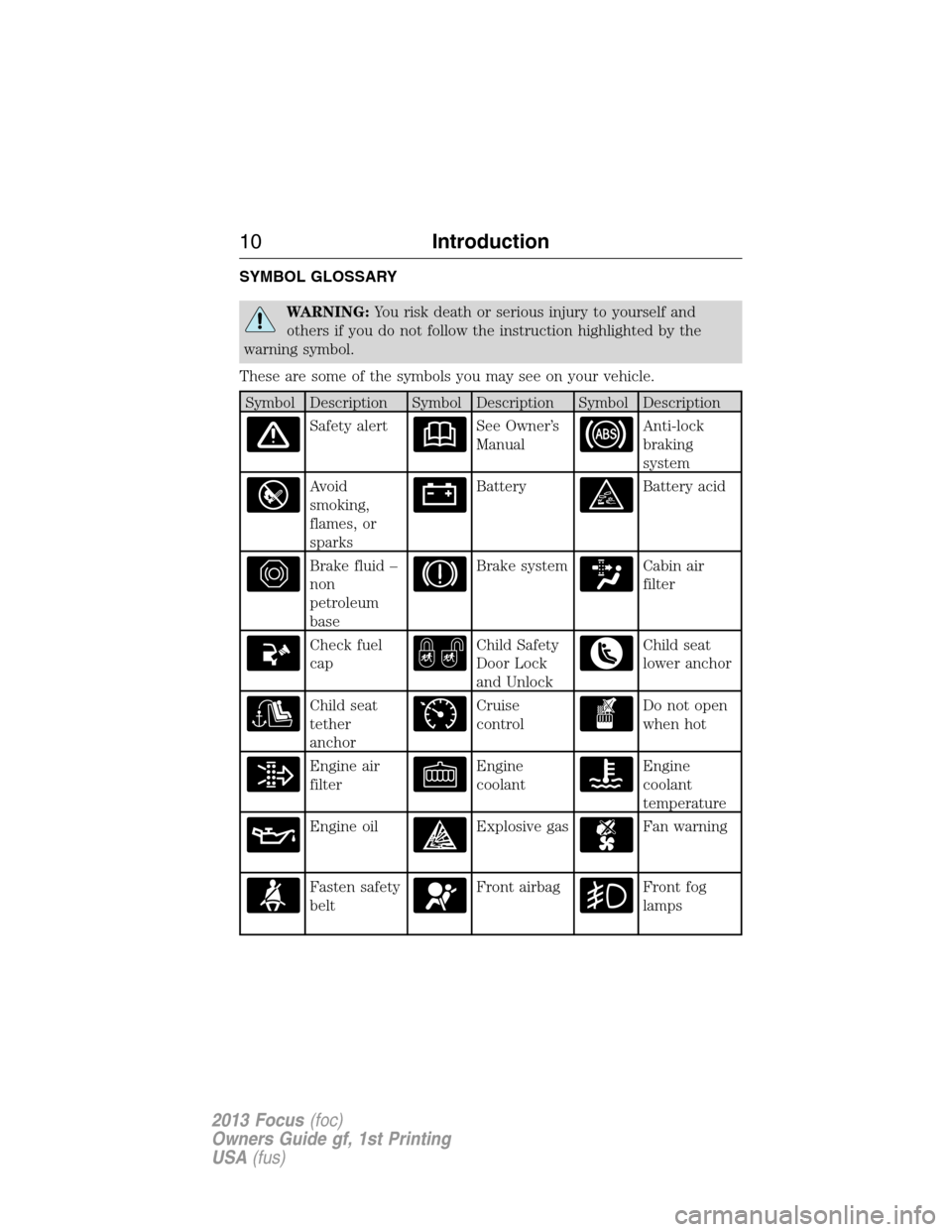
SYMBOL GLOSSARY
WARNING:You risk death or serious injury to yourself and
others if you do not follow the instruction highlighted by the
warning symbol.
These are some of the symbols you may see on your vehicle.
Symbol Description Symbol Description Symbol Description
Safety alertSee Owner’s
ManualAnti-lock
braking
system
Avoid
smoking,
flames, or
sparksBatteryBattery acid
Brake fluid –
non
petroleum
baseBrake systemCabin air
filter
Check fuel
capChild Safety
Door Lock
and UnlockChild seat
lower anchor
Child seat
tether
anchorCruise
controlDo not open
when hot
Engine air
filterEngine
coolantEngine
coolant
temperature
Engine oilExplosive gasFan warning
Fasten safety
beltFront airbagFront fog
lamps
10Introduction
2013 Focus(foc)
Owners Guide gf, 1st Printing
USA(fus)
Page 15 of 475
Collision Repairs
We hope that you never experience a collision but, accidents do happen.
Genuine Ford replacement collision parts meet our stringent
requirements for fit, finish, structural integrity, corrosion protection and
dent resistance. During vehicle development we validate these parts
deliver the intended level of protection as a whole system. A great way
to know for sure you are getting this level of protection is to use genuine
Ford replacement collision parts.
Warranty on Replacement Parts
Genuine Ford and Motorcraft replacement parts are the only
replacement parts that benefit from a Ford Warranty. Damage caused to
your vehicle as a result of the failure of non-Ford parts may not be
covered by the Ford Warranty. For additional information, refer to the
terms and conditions of the Ford Warranty.
SPECIAL NOTICES
New Vehicle Limited Warranty
For a detailed description of what is covered and what is not covered by
your vehicle’s New Vehicle Limited Warranty, refer to the warranty
information that is provided to you along with your Owner’s Manual.
Special Instructions
For your added safety, your vehicle is fitted with sophisticated electronic
controls.
WARNING:Please read theSupplementary Restraints System
chapter. Failure to follow the specific warnings and instructions
could result in personal injury.
WARNING:Front seat mounted rear-facing child or infant seats
shouldNEVERbe placed in front of an active passenger airbag.
Using your vehicle with a snowplow
Do not use this vehicle for snowplowing.
Your vehicle is not equipped with a snowplowing package.
Using your vehicle as an ambulance
Do not use this vehicle as an ambulance.
Your vehicle is not equipped with the Ford Ambulance Preparation Package.
Introduction15
2013 Focus(foc)
Owners Guide gf, 1st Printing
USA(fus)
Page 18 of 475
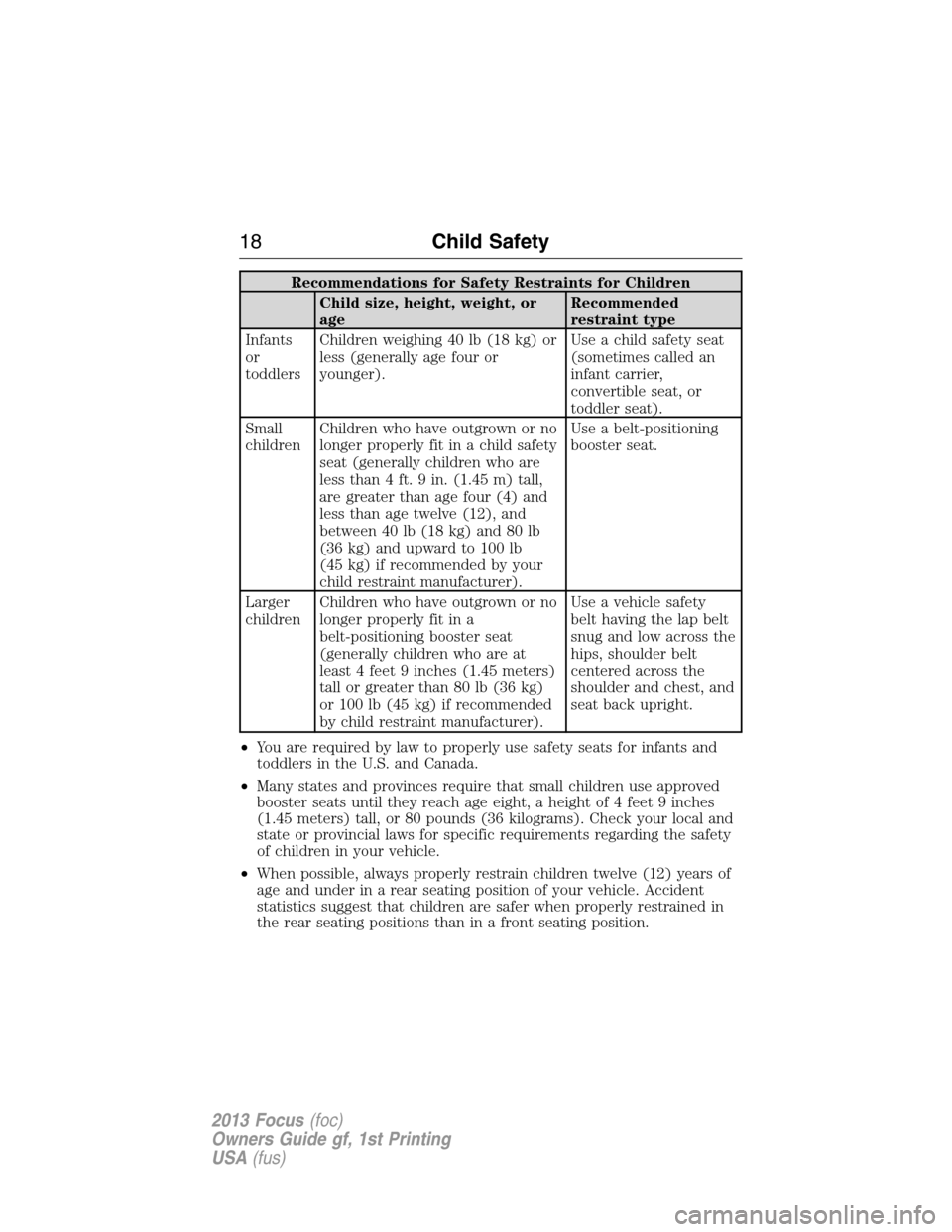
Recommendations for Safety Restraints for Children
Child size, height, weight, or
ageRecommended
restraint type
Infants
or
toddlersChildren weighing 40 lb (18 kg) or
less (generally age four or
younger).Use a child safety seat
(sometimes called an
infant carrier,
convertible seat, or
toddler seat).
Small
childrenChildren who have outgrown or no
longer properly fit in a child safety
seat (generally children who are
less than 4 ft. 9 in. (1.45 m) tall,
are greater than age four (4) and
less than age twelve (12), and
between 40 lb (18 kg) and 80 lb
(36 kg) and upward to 100 lb
(45 kg) if recommended by your
child restraint manufacturer).Use a belt-positioning
booster seat.
Larger
childrenChildren who have outgrown or no
longer properly fit in a
belt-positioning booster seat
(generally children who are at
least 4 feet 9 inches (1.45 meters)
tall or greater than 80 lb (36 kg)
or 100 lb (45 kg) if recommended
by child restraint manufacturer).Use a vehicle safety
belt having the lap belt
snug and low across the
hips, shoulder belt
centered across the
shoulder and chest, and
seat back upright.
•You are required by law to properly use safety seats for infants and
toddlers in the U.S. and Canada.
•Many states and provinces require that small children use approved
booster seats until they reach age eight, a height of 4 feet 9 inches
(1.45 meters) tall, or 80 pounds (36 kilograms). Check your local and
state or provincial laws for specific requirements regarding the safety
of children in your vehicle.
•When possible, always properly restrain children twelve (12) years of
age and under in a rear seating position of your vehicle. Accident
statistics suggest that children are safer when properly restrained in
the rear seating positions than in a front seating position.
18Child Safety
2013 Focus(foc)
Owners Guide gf, 1st Printing
USA(fus)
Page 19 of 475
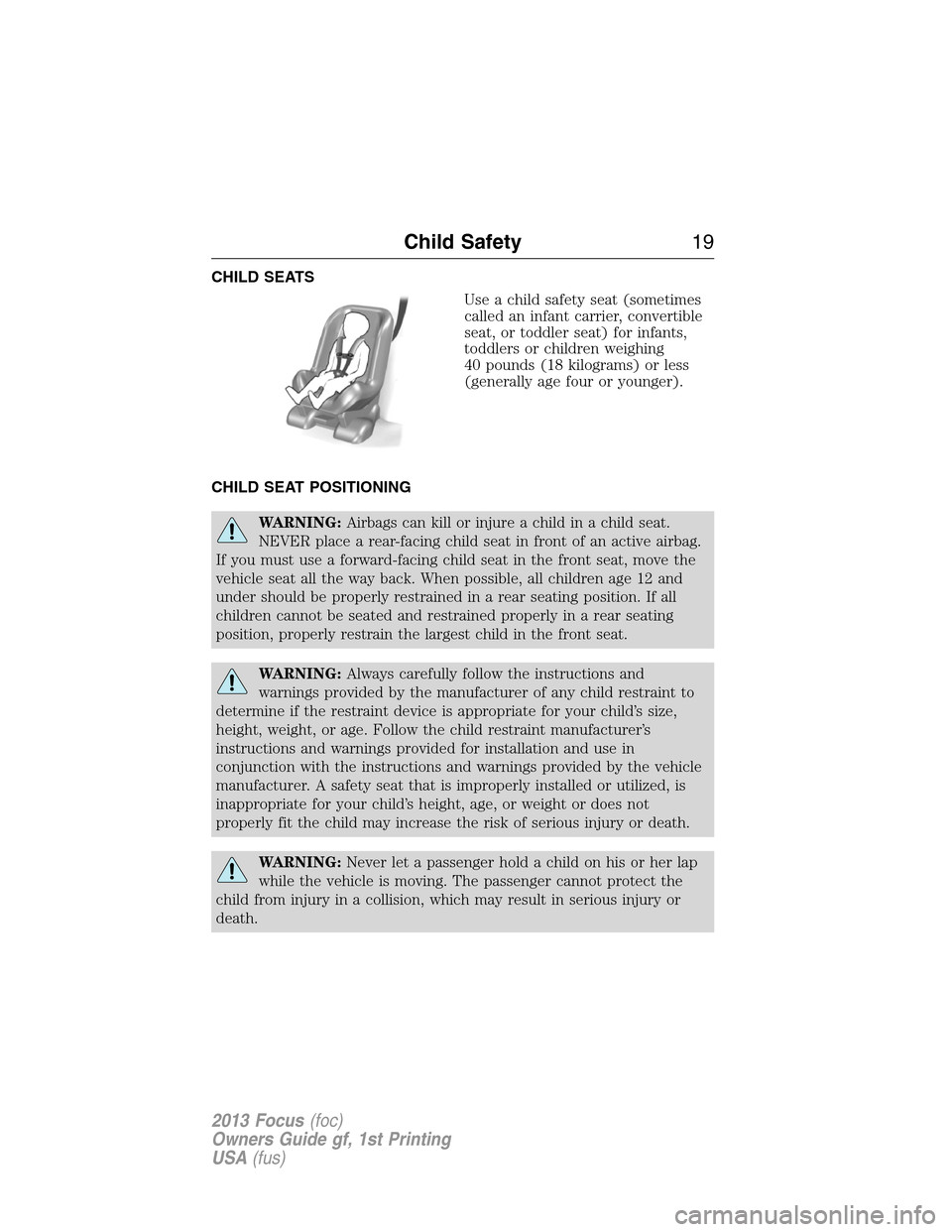
CHILD SEATS
Use a child safety seat (sometimes
called an infant carrier, convertible
seat, or toddler seat) for infants,
toddlers or children weighing
40 pounds (18 kilograms) or less
(generally age four or younger).
CHILD SEAT POSITIONING
WARNING:Airbags can kill or injure a child in a child seat.
NEVER place a rear-facing child seat in front of an active airbag.
If you must use a forward-facing child seat in the front seat, move the
vehicle seat all the way back. When possible, all children age 12 and
under should be properly restrained in a rear seating position. If all
children cannot be seated and restrained properly in a rear seating
position, properly restrain the largest child in the front seat.
WARNING:Always carefully follow the instructions and
warnings provided by the manufacturer of any child restraint to
determine if the restraint device is appropriate for your child’s size,
height, weight, or age. Follow the child restraint manufacturer’s
instructions and warnings provided for installation and use in
conjunction with the instructions and warnings provided by the vehicle
manufacturer. A safety seat that is improperly installed or utilized, is
inappropriate for your child’s height, age, or weight or does not
properly fit the child may increase the risk of serious injury or death.
WARNING:Never let a passenger hold a child on his or her lap
while the vehicle is moving. The passenger cannot protect the
child from injury in a collision, which may result in serious injury or
death.
Child Safety19
2013 Focus(foc)
Owners Guide gf, 1st Printing
USA(fus)
Page 49 of 475
The indicator lamp is located under the climate controls. The indicator
lamp will illuminate for a short period of time when the ignition is turned
to the on position to confirm it is functional.
Note:When the passenger airbag off light is illuminated, the passenger
(seat mounted) side airbag may be disabled to avoid the risk of airbag
deployment injuries.
The front passenger sensing system is designed to disable (will not
inflate) the front passenger’s frontal airbag when the front passenger
seat is unoccupied, or a rear facing infant seat, a forward-facing child
restraint, or a booster seat is detected.
•When the front passenger sensing system disables (will not inflate)
the front passenger frontal airbag, the passenger airbag status
indicator will illuminate the OFF lamp and stay lit to remind you that
the front passenger frontal airbag is disabled.
•If the child restraint has been installed and the indicator lamp is not
lit, then turn the vehicle off, remove the child restraint from the
vehicle and reinstall the restraint following the child restraint
manufacturer’s instructions.
The front passenger sensing system is designed to enable (may inflate)
the front passenger’s frontal airbag anytime the system senses that a
person of adult size is sitting properly in the front passenger seat.
•When the front passenger sensing system enables the front passenger
frontal airbag (may inflate), the indicator will be unlit and stay unlit.
If a person of adult size is sitting in the front passenger’s seat, but the
pass airbag off indicator lamp is lit, it is possible that the person isn’t
sitting properly in the seat. If this happens:
•Turn the vehicle off and ask the person to place the seatback in the
full upright position.
•Have the person sit upright in the seat, centered on the seat cushion,
with the person’s legs comfortably extended.
•Restart the vehicle and have the person remain in this position for
about two minutes. This will allow the system to detect that person
and enable the passenger’s frontal airbag.
•If the indicator lamp remains lit even after this, the person should be
advised to ride in the rear seat.
Supplementary Restraints System49
2013 Focus(foc)
Owners Guide gf, 1st Printing
USA(fus)
Page 64 of 475
Remote Starting the Vehicle
Note:Each button press must be done within three seconds of each
other. The vehicle will not remote start if this sequence is not followed
and the horn will not chirp.
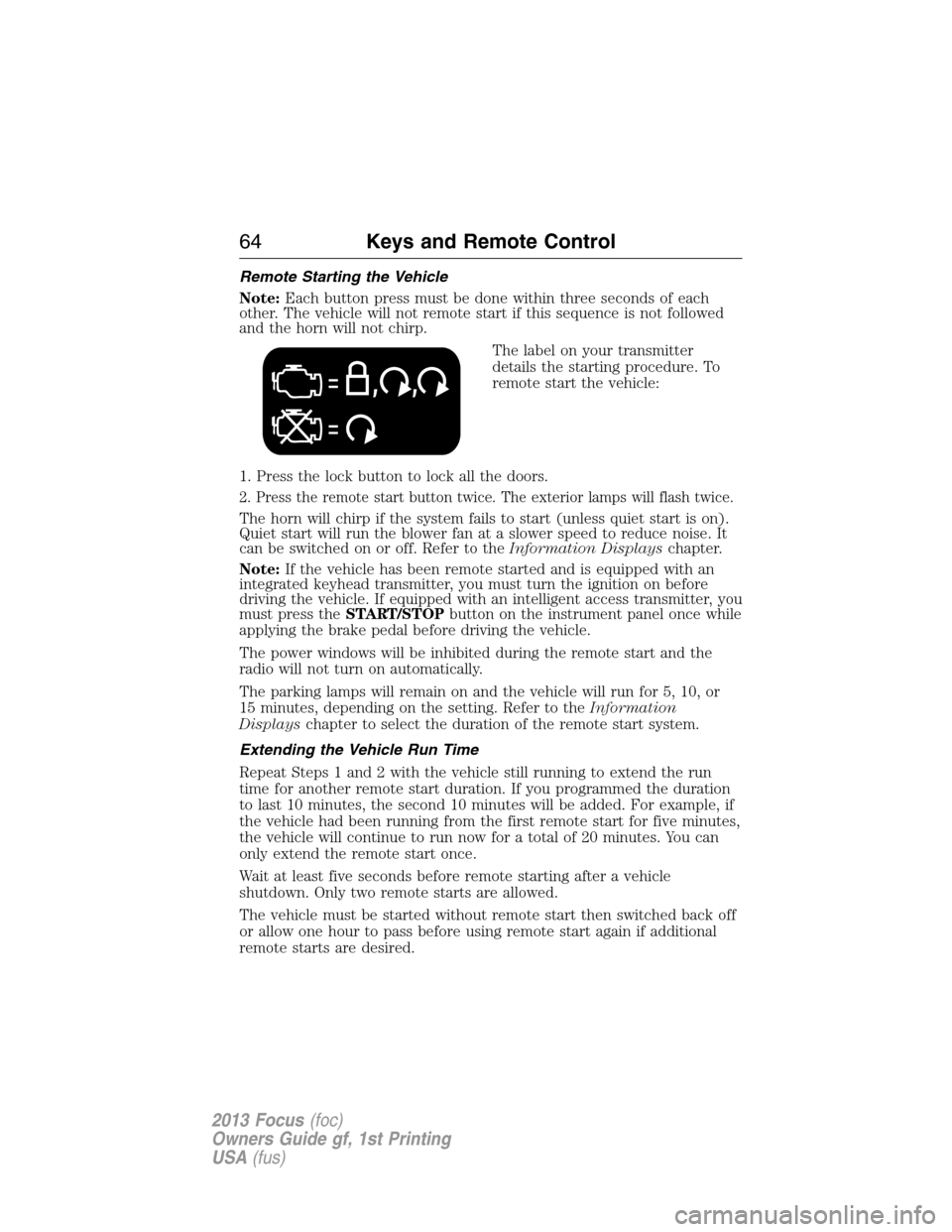
The label on your transmitter
details the starting procedure. To
remote start the vehicle:
1. Press the lock button to lock all the doors.
2. Press the remote start button twice. The exterior lamps will flash twice.
The horn will chirp if the system fails to start (unless quiet start is on).
Quiet start will run the blower fan at a slower speed to reduce noise. It
can be switched on or off. Refer to theInformation Displayschapter.
Note:If the vehicle has been remote started and is equipped with an
integrated keyhead transmitter, you must turn the ignition on before
driving the vehicle. If equipped with an intelligent access transmitter, you
must press theSTART/STOPbutton on the instrument panel once while
applying the brake pedal before driving the vehicle.
The power windows will be inhibited during the remote start and the
radio will not turn on automatically.
The parking lamps will remain on and the vehicle will run for 5, 10, or
15 minutes, depending on the setting. Refer to theInformation
Displayschapter to select the duration of the remote start system.
Extending the Vehicle Run Time
Repeat Steps 1 and 2 with the vehicle still running to extend the run
time for another remote start duration. If you programmed the duration
to last 10 minutes, the second 10 minutes will be added. For example, if
the vehicle had been running from the first remote start for five minutes,
the vehicle will continue to run now for a total of 20 minutes. You can
only extend the remote start once.
Wait at least five seconds before remote starting after a vehicle
shutdown. Only two remote starts are allowed.
The vehicle must be started without remote start then switched back off
or allow one hour to pass before using remote start again if additional
remote starts are desired.
64Keys and Remote Control
2013 Focus(foc)
Owners Guide gf, 1st Printing
USA(fus)
Page 141 of 475
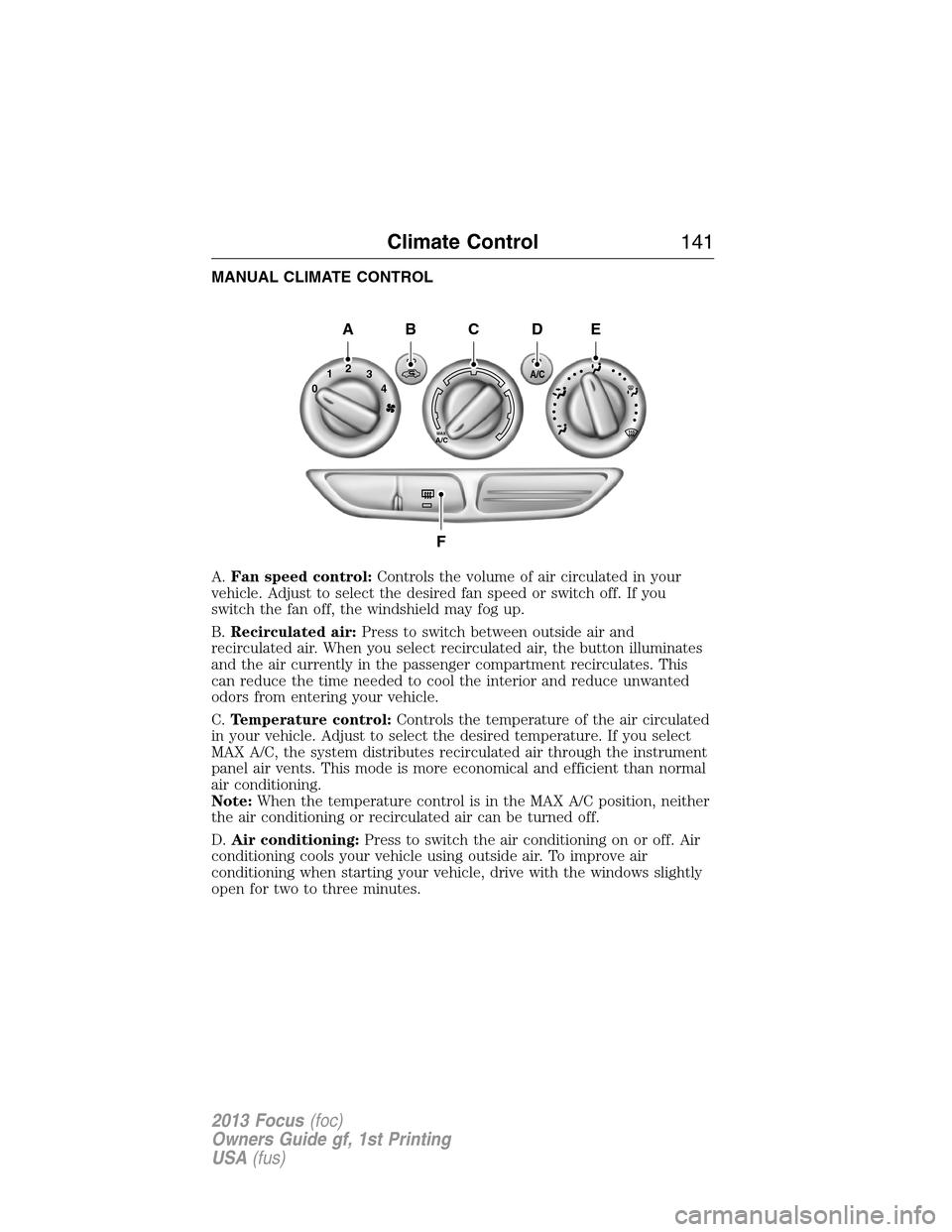
MANUAL CLIMATE CONTROL
A.Fan speed control:Controls the volume of air circulated in your
vehicle. Adjust to select the desired fan speed or switch off. If you
switch the fan off, the windshield may fog up.
B.Recirculated air:Press to switch between outside air and
recirculated air. When you select recirculated air, the button illuminates
and the air currently in the passenger compartment recirculates. This
can reduce the time needed to cool the interior and reduce unwanted
odors from entering your vehicle.
C.Temperature control:Controls the temperature of the air circulated
in your vehicle. Adjust to select the desired temperature. If you select
MAX A/C, the system distributes recirculated air through the instrument
panel air vents. This mode is more economical and efficient than normal
air conditioning.
Note:When the temperature control is in the MAX A/C position, neither
the air conditioning or recirculated air can be turned off.
D.Air conditioning:Press to switch the air conditioning on or off. Air
conditioning cools your vehicle using outside air. To improve air
conditioning when starting your vehicle, drive with the windows slightly
open for two to three minutes.
012
3
4
MAXA/C
A/C
AB
F
CDE
Climate Control141
2013 Focus(foc)
Owners Guide gf, 1st Printing
USA(fus)
Page 142 of 475
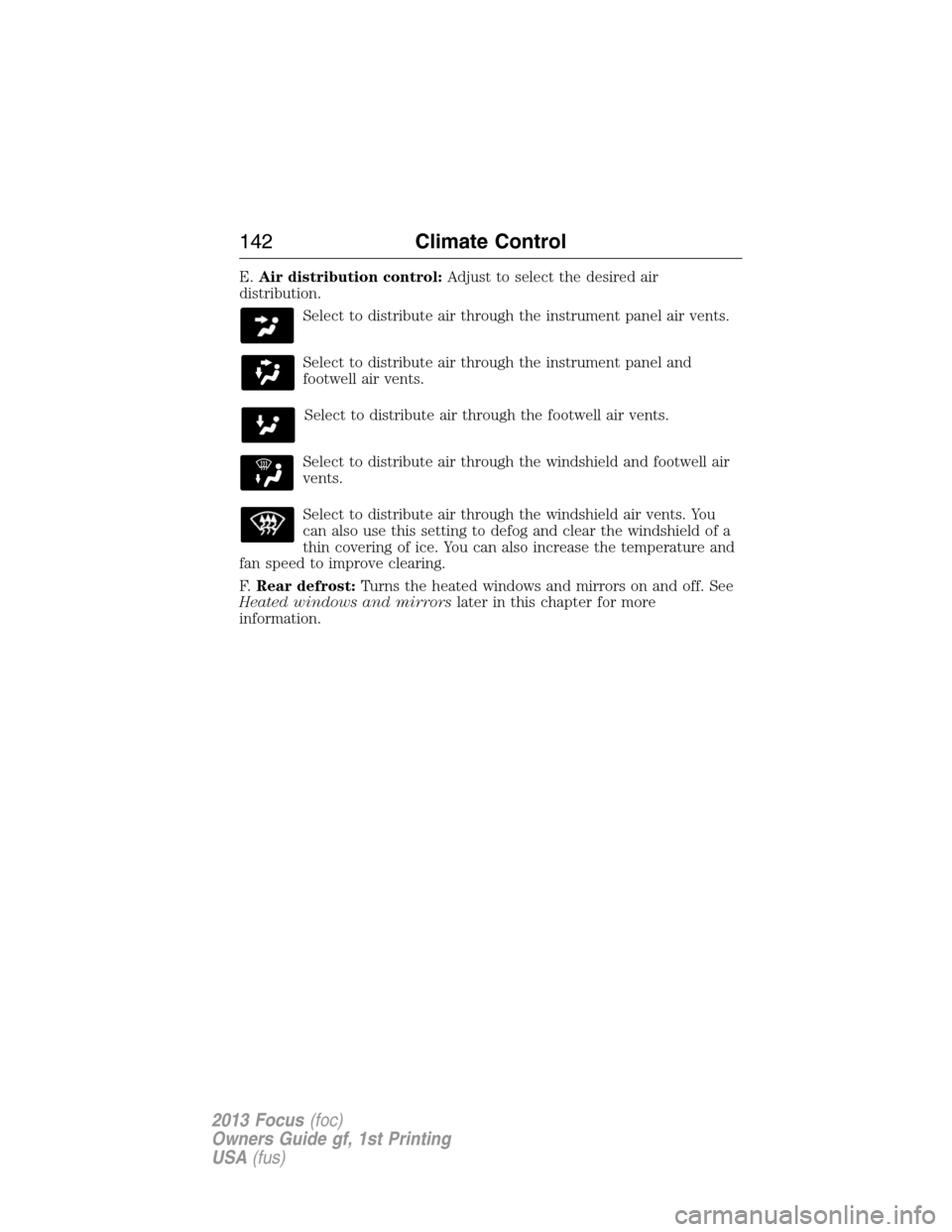
E.Air distribution control:Adjust to select the desired air
distribution.
Select to distribute air through the instrument panel air vents.
Select to distribute air through the instrument panel and
footwell air vents.
Select to distribute air through the footwell air vents.
Select to distribute air through the windshield and footwell air
vents.
Select to distribute air through the windshield air vents. You
can also use this setting to defog and clear the windshield of a
thin covering of ice. You can also increase the temperature and
fan speed to improve clearing.
F.Rear defrost:Turns the heated windows and mirrors on and off. See
Heated windows and mirrorslater in this chapter for more
information.
142Climate Control
2013 Focus(foc)
Owners Guide gf, 1st Printing
USA(fus)
Page 143 of 475
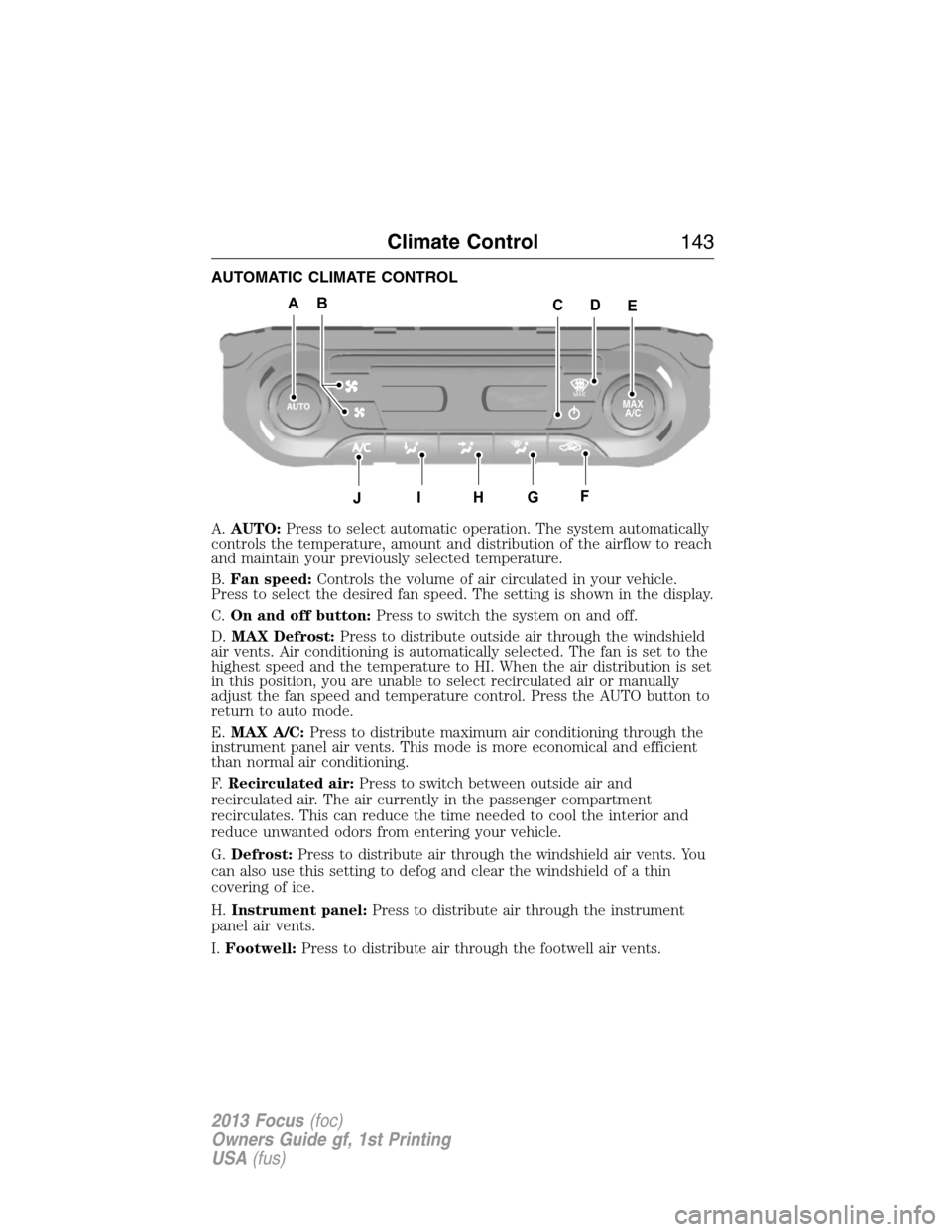
AUTOMATIC CLIMATE CONTROL
A.AUTO:Press to select automatic operation. The system automatically
controls the temperature, amount and distribution of the airflow to reach
and maintain your previously selected temperature.
B.Fan speed:Controls the volume of air circulated in your vehicle.
Press to select the desired fan speed. The setting is shown in the display.
C.On and off button:Press to switch the system on and off.
D.MAX Defrost:Press to distribute outside air through the windshield
air vents. Air conditioning is automatically selected. The fan is set to the
highest speed and the temperature to HI. When the air distribution is set
in this position, you are unable to select recirculated air or manually
adjust the fan speed and temperature control. Press the AUTO button to
return to auto mode.
E.MAX A/C:Press to distribute maximum air conditioning through the
instrument panel air vents. This mode is more economical and efficient
than normal air conditioning.
F.Recirculated air:Press to switch between outside air and
recirculated air. The air currently in the passenger compartment
recirculates. This can reduce the time needed to cool the interior and
reduce unwanted odors from entering your vehicle.
G.Defrost:Press to distribute air through the windshield air vents. You
can also use this setting to defog and clear the windshield of a thin
covering of ice.
H.Instrument panel:Press to distribute air through the instrument
panel air vents.
I.Footwell:Press to distribute air through the footwell air vents.
ABAAEAAC
J
D
AHAGAFAI
MAX
A/C
Climate Control143
2013 Focus(foc)
Owners Guide gf, 1st Printing
USA(fus)
Page 145 of 475
HINTS ON CONTROLLING THE INTERIOR CLIMATE
General Hints
Note:Prolonged use of recirculated air may cause the windows to fog
up.
Note:A small amount of air may be felt from the footwell air vents
regardless of the air distribution setting.
Note:To reduce humidity build-up inside your vehicle, do not drive with
the system switched off or with recirculated air always switched on.
Note:Do not place objects under the front seats as this may interfere
with the airflow to the rear seats.
Note:Remove any snow, ice or leaves from the air intake area at the
base of the windshield.
Manual Climate Control
Note:To reduce fogging of the windshield during humid weather, adjust
the air distribution control to the windshield air vents position. Increase
the temperature and fan speed to improve clearing if required.
Automatic Climate Control
Note:Do not adjust the settings when your vehicle interior is extremely
hot or cold. The system automatically adjusts to the previously stored
settings. For the system to function efficiently, the instrument panel and
side air vents should be fully open.
Note:At low ambient temperatures with AUTO selected, the air stream
is directed toward the windshield and side windows for as long as the
engine remains cold.
Note:When the system is switched off, outside air is prevented from
entering your vehicle.
Note:When the system is in AUTO mode, and the interior and exterior
temperatures are high, the system automatically selects recirculated air
to maximize cooling of the interior. When the selected air temperature is
reached, the system automatically selects outside air.
Note:When you select windshield defrosting and defogging, the
instrument panel and footwell level functions automatically switch off
and air conditioning switches on. Outside air flows into your vehicle.
Climate Control145
2013 Focus(foc)
Owners Guide gf, 1st Printing
USA(fus)