warning FORD FOCUS 2018 User Guide
[x] Cancel search | Manufacturer: FORD, Model Year: 2018, Model line: FOCUS, Model: FORD FOCUS 2018Pages: 473, PDF Size: 39.91 MB
Page 23 of 473
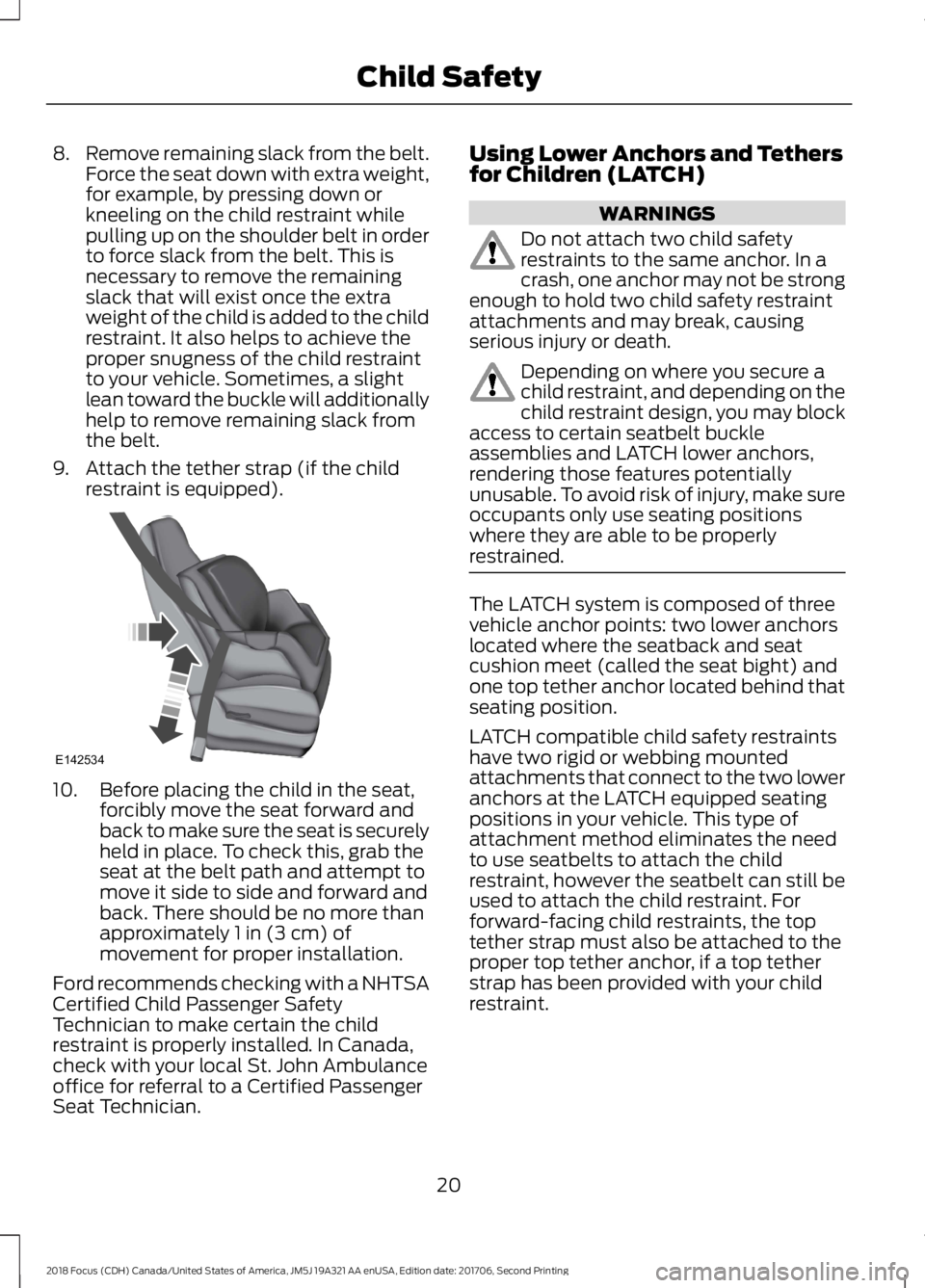
8.Remove remaining slack from the belt.Force the seat down with extra weight,for example, by pressing down orkneeling on the child restraint whilepulling up on the shoulder belt in orderto force slack from the belt. This isnecessary to remove the remainingslack that will exist once the extraweight of the child is added to the childrestraint. It also helps to achieve theproper snugness of the child restraintto your vehicle. Sometimes, a slightlean toward the buckle will additionallyhelp to remove remaining slack fromthe belt.
9.Attach the tether strap (if the childrestraint is equipped).
10.Before placing the child in the seat,forcibly move the seat forward andback to make sure the seat is securelyheld in place. To check this, grab theseat at the belt path and attempt tomove it side to side and forward andback. There should be no more thanapproximately 1 in (3 cm) ofmovement for proper installation.
Ford recommends checking with a NHTSACertified Child Passenger SafetyTechnician to make certain the childrestraint is properly installed. In Canada,check with your local St. John Ambulanceoffice for referral to a Certified PassengerSeat Technician.
Using Lower Anchors and Tethersfor Children (LATCH)
WARNINGS
Do not attach two child safetyrestraints to the same anchor. In acrash, one anchor may not be strongenough to hold two child safety restraintattachments and may break, causingserious injury or death.
Depending on where you secure achild restraint, and depending on thechild restraint design, you may blockaccess to certain seatbelt buckleassemblies and LATCH lower anchors,rendering those features potentiallyunusable. To avoid risk of injury, make sureoccupants only use seating positionswhere they are able to be properlyrestrained.
The LATCH system is composed of threevehicle anchor points: two lower anchorslocated where the seatback and seatcushion meet (called the seat bight) andone top tether anchor located behind thatseating position.
LATCH compatible child safety restraintshave two rigid or webbing mountedattachments that connect to the two loweranchors at the LATCH equipped seatingpositions in your vehicle. This type ofattachment method eliminates the needto use seatbelts to attach the childrestraint, however the seatbelt can still beused to attach the child restraint. Forforward-facing child restraints, the toptether strap must also be attached to theproper top tether anchor, if a top tetherstrap has been provided with your childrestraint.
202018 Focus (CDH) Canada/United States of America, JM5J 19A321 AA enUSA, Edition date: 201706, Second PrintingChild SafetyE142534
Page 24 of 473
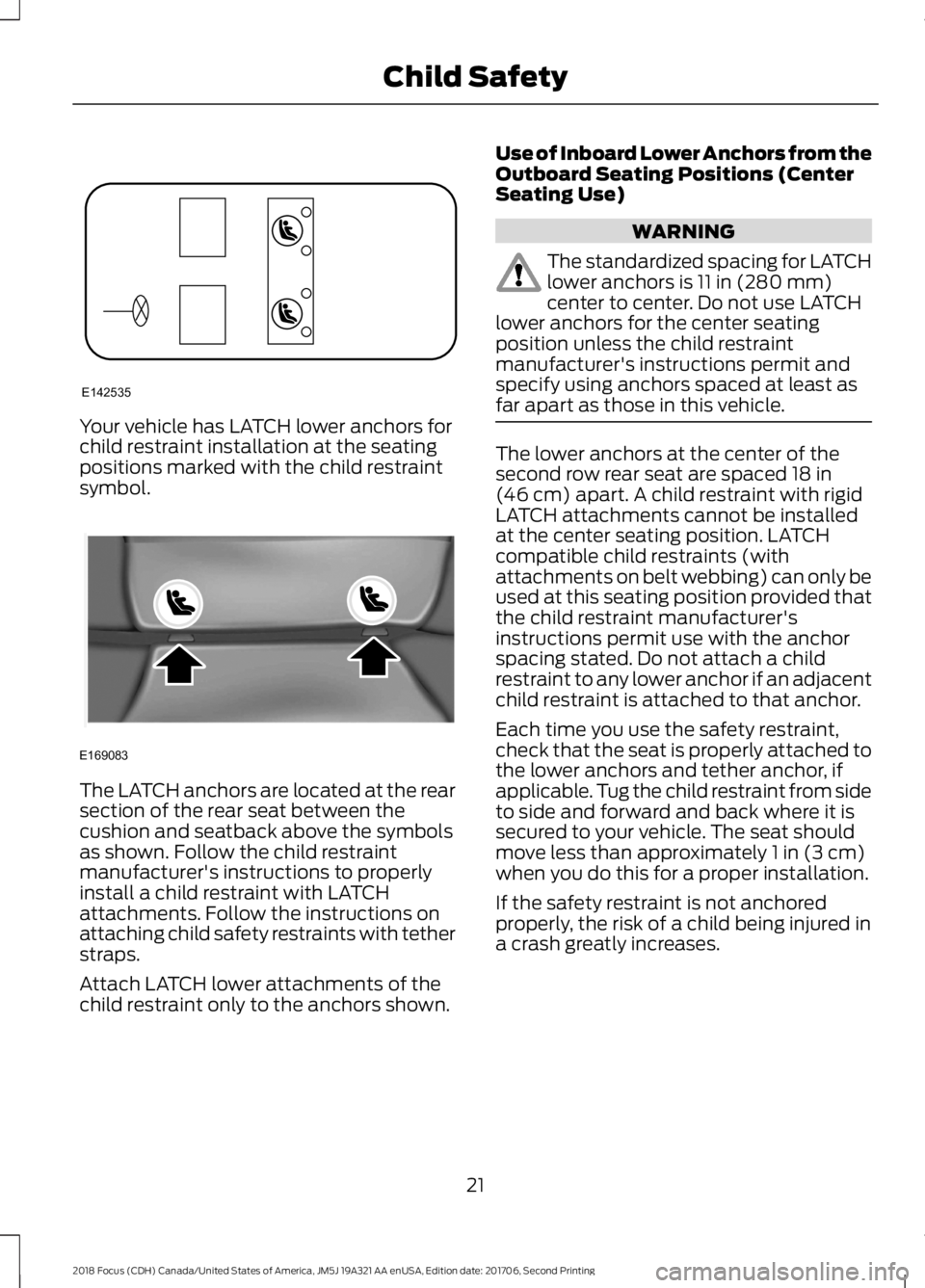
Your vehicle has LATCH lower anchors forchild restraint installation at the seatingpositions marked with the child restraintsymbol.
The LATCH anchors are located at the rearsection of the rear seat between thecushion and seatback above the symbolsas shown. Follow the child restraintmanufacturer's instructions to properlyinstall a child restraint with LATCHattachments. Follow the instructions onattaching child safety restraints with tetherstraps.
Attach LATCH lower attachments of thechild restraint only to the anchors shown.
Use of Inboard Lower Anchors from theOutboard Seating Positions (CenterSeating Use)
WARNING
The standardized spacing for LATCHlower anchors is 11 in (280 mm)center to center. Do not use LATCHlower anchors for the center seatingposition unless the child restraintmanufacturer's instructions permit andspecify using anchors spaced at least asfar apart as those in this vehicle.
The lower anchors at the center of thesecond row rear seat are spaced 18 in(46 cm) apart. A child restraint with rigidLATCH attachments cannot be installedat the center seating position. LATCHcompatible child restraints (withattachments on belt webbing) can only beused at this seating position provided thatthe child restraint manufacturer'sinstructions permit use with the anchorspacing stated. Do not attach a childrestraint to any lower anchor if an adjacentchild restraint is attached to that anchor.
Each time you use the safety restraint,check that the seat is properly attached tothe lower anchors and tether anchor, ifapplicable. Tug the child restraint from sideto side and forward and back where it issecured to your vehicle. The seat shouldmove less than approximately 1 in (3 cm)when you do this for a proper installation.
If the safety restraint is not anchoredproperly, the risk of a child being injured ina crash greatly increases.
212018 Focus (CDH) Canada/United States of America, JM5J 19A321 AA enUSA, Edition date: 201706, Second PrintingChild SafetyE142535 E169083
Page 27 of 473
BOOSTER SEATS
WARNING
Do not put the shoulder section ofthe seatbelt or allow the child to putthe shoulder section of the seatbeltunder their arm or behind their back. Failureto follow this instruction could reduce theeffectiveness of the seatbelt and increasethe risk of injury or death in a crash.
Use a belt-positioning booster seat forchildren who have outgrown or no longerproperly fit in a child safety restraint(generally children who are less than 57 in(1.45 m) tall, are greater than age 4 andless than age 12, and between 40 lb (18 kg)and 80 lb (36 kg) and upward to 100 lb(45 kg) if recommended by your childrestraint manufacturer). Many state andprovincial laws require that children useapproved booster seats until they reachage eight, a height of 57 in (1.45 m) tall, or80 lb (36 kg).
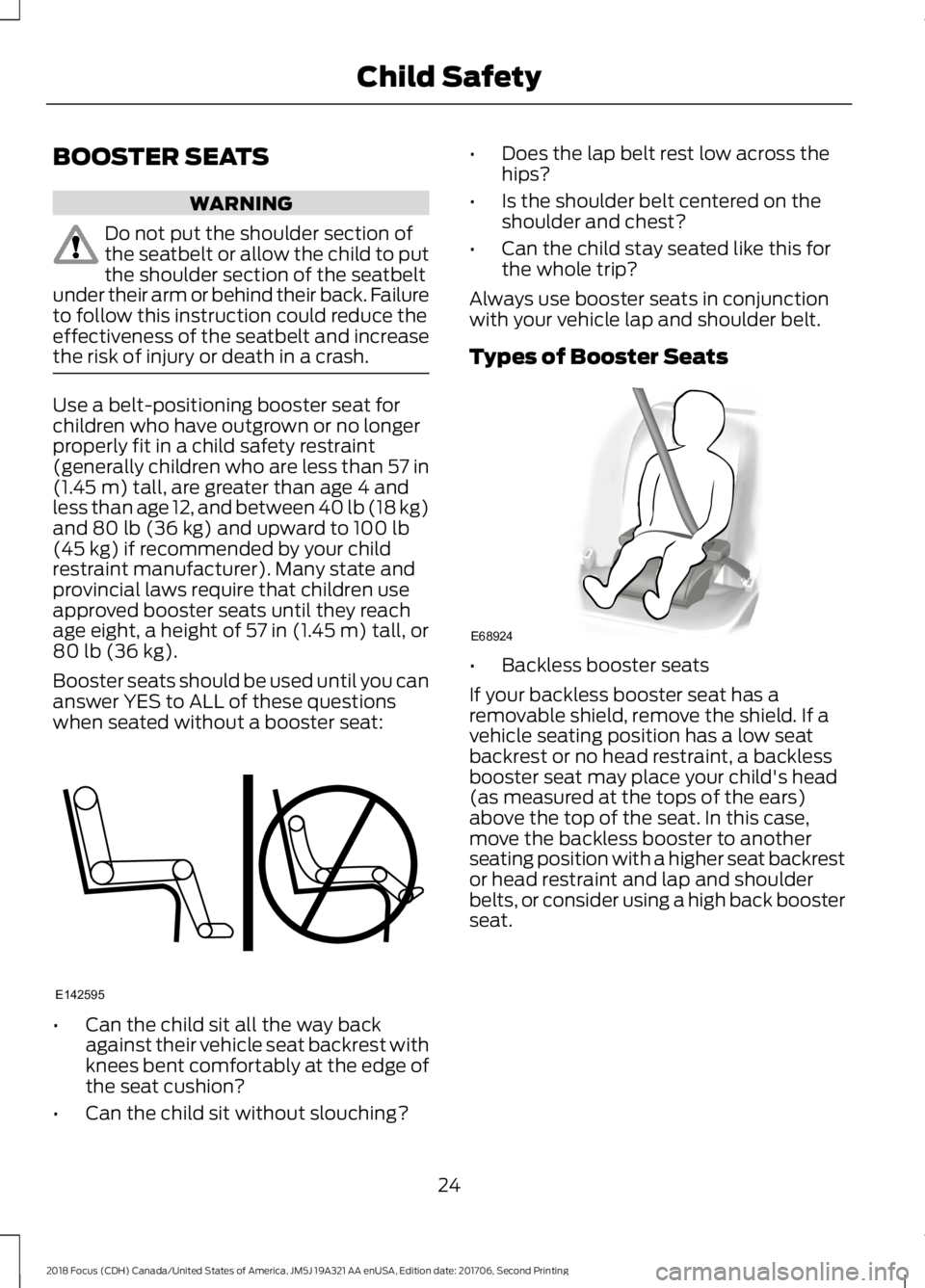
Booster seats should be used until you cananswer YES to ALL of these questionswhen seated without a booster seat:
•Can the child sit all the way backagainst their vehicle seat backrest withknees bent comfortably at the edge ofthe seat cushion?
•Can the child sit without slouching?
•Does the lap belt rest low across thehips?
•Is the shoulder belt centered on theshoulder and chest?
•Can the child stay seated like this forthe whole trip?
Always use booster seats in conjunctionwith your vehicle lap and shoulder belt.
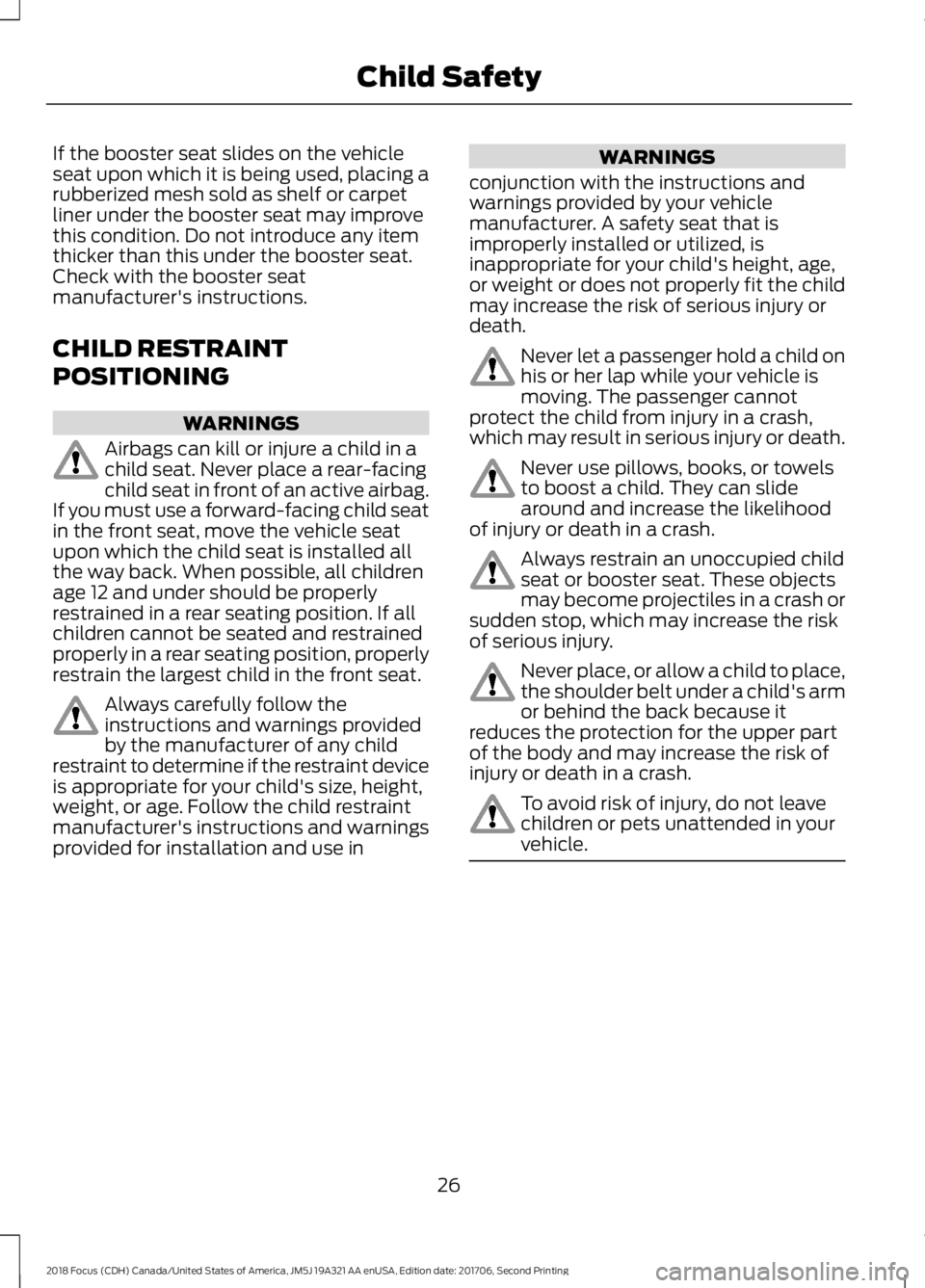
Types of Booster Seats
•Backless booster seats
If your backless booster seat has aremovable shield, remove the shield. If avehicle seating position has a low seatbackrest or no head restraint, a backlessbooster seat may place your child's head(as measured at the tops of the ears)above the top of the seat. In this case,move the backless booster to anotherseating position with a higher seat backrestor head restraint and lap and shoulderbelts, or consider using a high back boosterseat.
242018 Focus (CDH) Canada/United States of America, JM5J 19A321 AA enUSA, Edition date: 201706, Second PrintingChild SafetyE142595 E68924
Page 29 of 473
If the booster seat slides on the vehicleseat upon which it is being used, placing arubberized mesh sold as shelf or carpetliner under the booster seat may improvethis condition. Do not introduce any itemthicker than this under the booster seat.Check with the booster seatmanufacturer's instructions.
CHILD RESTRAINT
POSITIONING
WARNINGS
Airbags can kill or injure a child in achild seat. Never place a rear-facingchild seat in front of an active airbag.If you must use a forward-facing child seatin the front seat, move the vehicle seatupon which the child seat is installed allthe way back. When possible, all childrenage 12 and under should be properlyrestrained in a rear seating position. If allchildren cannot be seated and restrainedproperly in a rear seating position, properlyrestrain the largest child in the front seat.
Always carefully follow theinstructions and warnings providedby the manufacturer of any childrestraint to determine if the restraint deviceis appropriate for your child's size, height,weight, or age. Follow the child restraintmanufacturer's instructions and warningsprovided for installation and use in
WARNINGS
conjunction with the instructions andwarnings provided by your vehiclemanufacturer. A safety seat that isimproperly installed or utilized, isinappropriate for your child's height, age,or weight or does not properly fit the childmay increase the risk of serious injury ordeath.
Never let a passenger hold a child onhis or her lap while your vehicle ismoving. The passenger cannotprotect the child from injury in a crash,which may result in serious injury or death.
Never use pillows, books, or towelsto boost a child. They can slidearound and increase the likelihoodof injury or death in a crash.
Always restrain an unoccupied childseat or booster seat. These objectsmay become projectiles in a crash orsudden stop, which may increase the riskof serious injury.
Never place, or allow a child to place,the shoulder belt under a child's armor behind the back because itreduces the protection for the upper partof the body and may increase the risk ofinjury or death in a crash.
To avoid risk of injury, do not leavechildren or pets unattended in yourvehicle.
262018 Focus (CDH) Canada/United States of America, JM5J 19A321 AA enUSA, Edition date: 201706, Second PrintingChild Safety
Page 32 of 473
PRINCIPLE OF OPERATION
WARNINGS
Always drive and ride with yourseatback upright and the lap beltsnug and low across the hips.
To reduce the risk of injury, makesure children sit where they can beproperly restrained.
Never let a passenger hold a child onhis or her lap while your vehicle ismoving. The passenger cannotprotect the child from injury in a crash.
All occupants of your vehicle,including the driver, should alwaysproperly wear their seatbelts, evenwhen an airbag supplemental restraintsystem is provided. Failure to properly wearyour seatbelts could seriously increase therisk of injury or death.
It is extremely dangerous to ride in acargo area, inside or outside of avehicle. In a crash, people riding inthese areas are more likely to be seriouslyinjured or killed. Do not allow people to ridein any area of your vehicle that is notequipped with seats and seatbelts. Be sureeveryone in your vehicle is in a seat andusing a seatbelt properly.
In a rollover crash, an unbeltedperson is significantly more likely todie than a person wearing a seatbelt.
Each seating position in your vehiclehas a specific seatbelt assemblywhich is made up of one buckle andone tongue that are designed to be usedas a pair. 1) Use the shoulder belt on theoutside shoulder only. Never wear theshoulder belt under the arm. 2) Neverswing the seatbelt around your neck overthe inside shoulder. 3) Never use a singlebelt for more than one person.
WARNINGS
When possible, all children 12 yearsold and under should be properlyrestrained in a rear seating position.Failure to follow this could seriouslyincrease the risk of injury or death.
Seatbelts and seats can become hotin a vehicle that has been closed upin sunny weather; they could burn asmall child. Check seat covers and bucklesbefore you place a child anywhere nearthem.
Front and rear seat occupants,including pregnant women, shouldwear seatbelts for optimumprotection in an accident.
All seating positions in your vehicle havelap and shoulder seatbelts. All occupantsof the vehicle should always properly weartheir seatbelts, even when an airbagsupplemental restraint system is provided.
The seatbelt system consists of:
•Lap and shoulder seatbelts.
•Shoulder seatbelt with automaticlocking mode, (except driver seatbelt).
•Height adjuster at the front outboardseating positions.
•Seatbelt pretensioner at the frontoutboard seating positions.
•Belt tension sensor at the frontoutboard passenger seating position.
· Seatbelt warning light andchime.
· Crash sensors and monitoringsystem with readiness indicator.
292018 Focus (CDH) Canada/United States of America, JM5J 19A321 AA enUSA, Edition date: 201706, Second PrintingSeatbeltsE71880 E67017
Page 33 of 473
The seatbelt pretensioners at the frontseating positions are designed to tightenthe seatbelts when activated. In frontaland near-frontal crashes, the seatbeltpretensioners may be activated alone or,if the crash is of sufficient severity, togetherwith the front airbags. The pretensionerswill activate when the Safety Canopy isdeployed.
FASTENING THE SEATBELTS
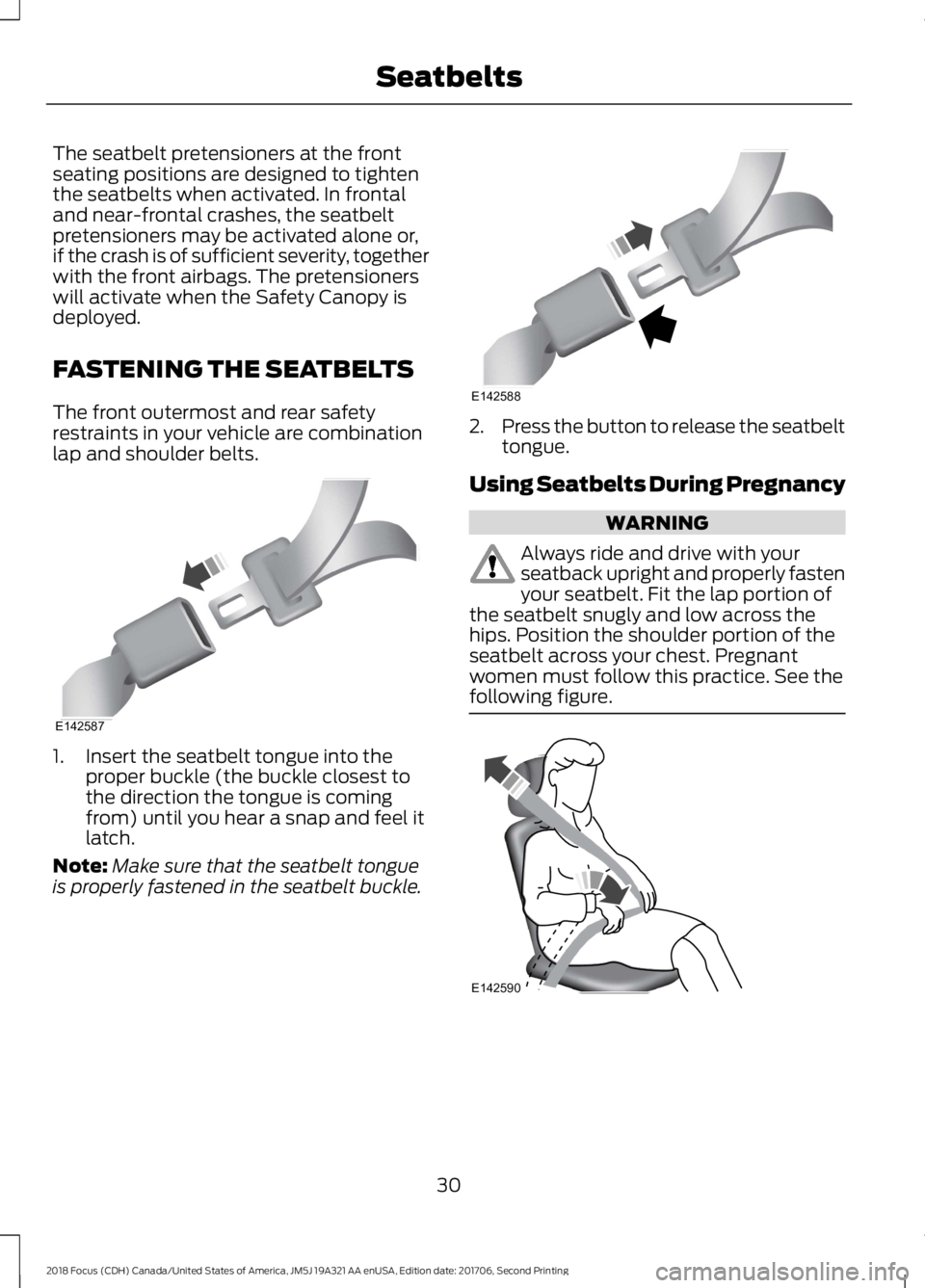
The front outermost and rear safetyrestraints in your vehicle are combinationlap and shoulder belts.
1.Insert the seatbelt tongue into theproper buckle (the buckle closest tothe direction the tongue is comingfrom) until you hear a snap and feel itlatch.
Note:Make sure that the seatbelt tongueis properly fastened in the seatbelt buckle.
2.Press the button to release the seatbelttongue.
Using Seatbelts During Pregnancy
WARNING
Always ride and drive with yourseatback upright and properly fastenyour seatbelt. Fit the lap portion ofthe seatbelt snugly and low across thehips. Position the shoulder portion of theseatbelt across your chest. Pregnantwomen must follow this practice. See thefollowing figure.
302018 Focus (CDH) Canada/United States of America, JM5J 19A321 AA enUSA, Edition date: 201706, Second PrintingSeatbeltsE142587 E142588 E142590
Page 34 of 473
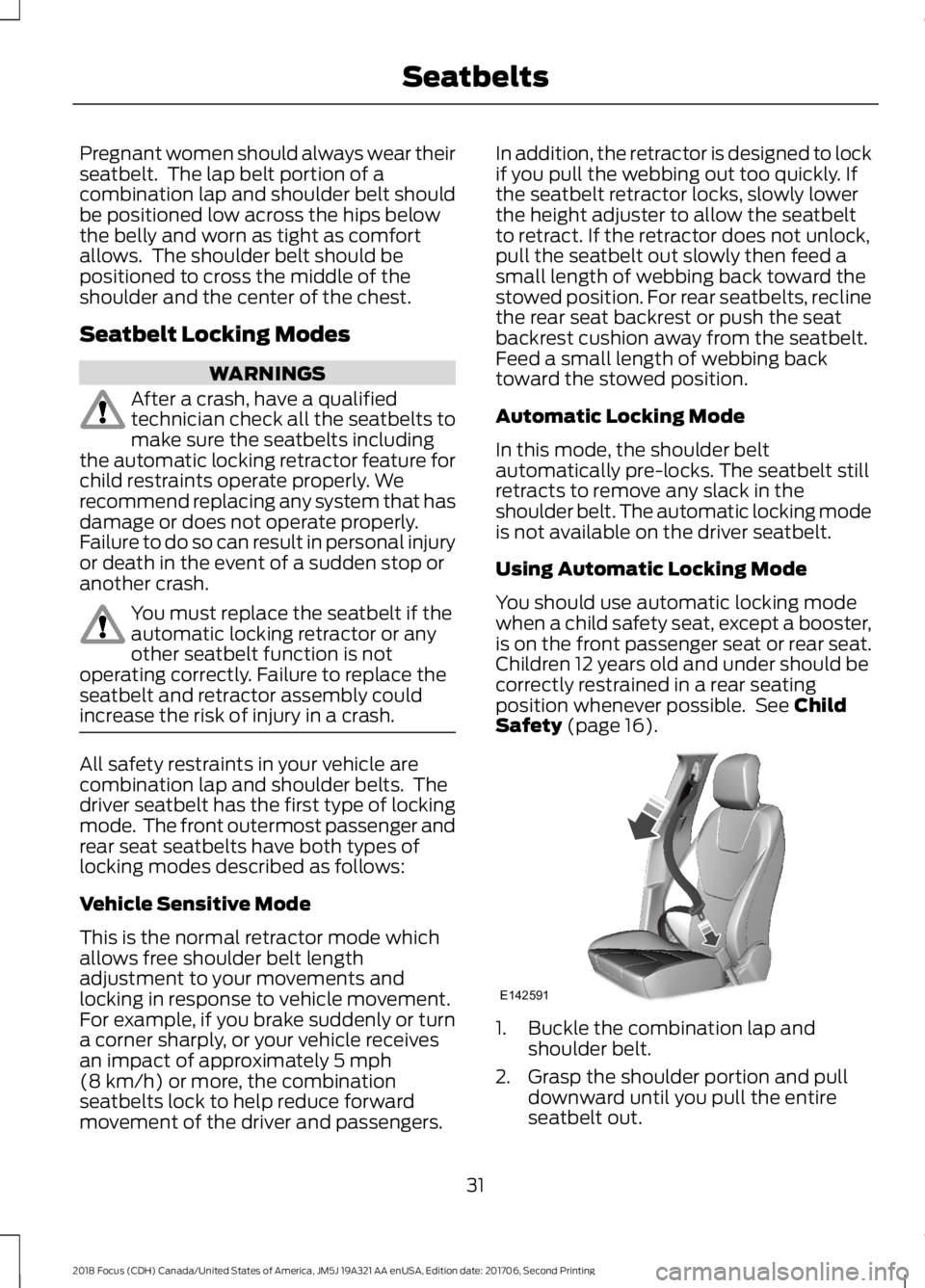
Pregnant women should always wear theirseatbelt. The lap belt portion of acombination lap and shoulder belt shouldbe positioned low across the hips belowthe belly and worn as tight as comfortallows. The shoulder belt should bepositioned to cross the middle of theshoulder and the center of the chest.
Seatbelt Locking Modes
WARNINGS
After a crash, have a qualifiedtechnician check all the seatbelts tomake sure the seatbelts includingthe automatic locking retractor feature forchild restraints operate properly. Werecommend replacing any system that hasdamage or does not operate properly.Failure to do so can result in personal injuryor death in the event of a sudden stop oranother crash.
You must replace the seatbelt if theautomatic locking retractor or anyother seatbelt function is notoperating correctly. Failure to replace theseatbelt and retractor assembly couldincrease the risk of injury in a crash.
All safety restraints in your vehicle arecombination lap and shoulder belts. Thedriver seatbelt has the first type of lockingmode. The front outermost passenger andrear seat seatbelts have both types oflocking modes described as follows:
Vehicle Sensitive Mode
This is the normal retractor mode whichallows free shoulder belt lengthadjustment to your movements andlocking in response to vehicle movement.For example, if you brake suddenly or turna corner sharply, or your vehicle receivesan impact of approximately 5 mph(8 km/h) or more, the combinationseatbelts lock to help reduce forwardmovement of the driver and passengers.
In addition, the retractor is designed to lockif you pull the webbing out too quickly. Ifthe seatbelt retractor locks, slowly lowerthe height adjuster to allow the seatbeltto retract. If the retractor does not unlock,pull the seatbelt out slowly then feed asmall length of webbing back toward thestowed position. For rear seatbelts, reclinethe rear seat backrest or push the seatbackrest cushion away from the seatbelt.Feed a small length of webbing backtoward the stowed position.
Automatic Locking Mode
In this mode, the shoulder beltautomatically pre-locks. The seatbelt stillretracts to remove any slack in theshoulder belt. The automatic locking modeis not available on the driver seatbelt.
Using Automatic Locking Mode
You should use automatic locking modewhen a child safety seat, except a booster,is on the front passenger seat or rear seat.Children 12 years old and under should becorrectly restrained in a rear seatingposition whenever possible. See ChildSafety (page 16).
1.Buckle the combination lap andshoulder belt.
2.Grasp the shoulder portion and pulldownward until you pull the entireseatbelt out.
312018 Focus (CDH) Canada/United States of America, JM5J 19A321 AA enUSA, Edition date: 201706, Second PrintingSeatbeltsE142591
Page 35 of 473
3.Let the seatbelt retract.
Note:As the seatbelt retracts, you will heara clicking sound. This indicates the seatbeltis now in the automatic locking mode.
Disengaging Automatic Locking Mode
Unbuckle the combination lap andshoulder belt and allow it to retractcompletely to disengage the automaticlocking mode and return the seatbelt tothe vehicle sensitive mode.
SEATBELT HEIGHT
ADJUSTMENT
WARNING
Position the seatbelt height adjusterso that the seatbelt rests across themiddle of your shoulder. Failure toadjust the seatbelt correctly could reduceits effectiveness and increase the risk ofinjury in a crash.
Adjust the height of the shoulder belt sothe belt rests across the middle of yourshoulder.
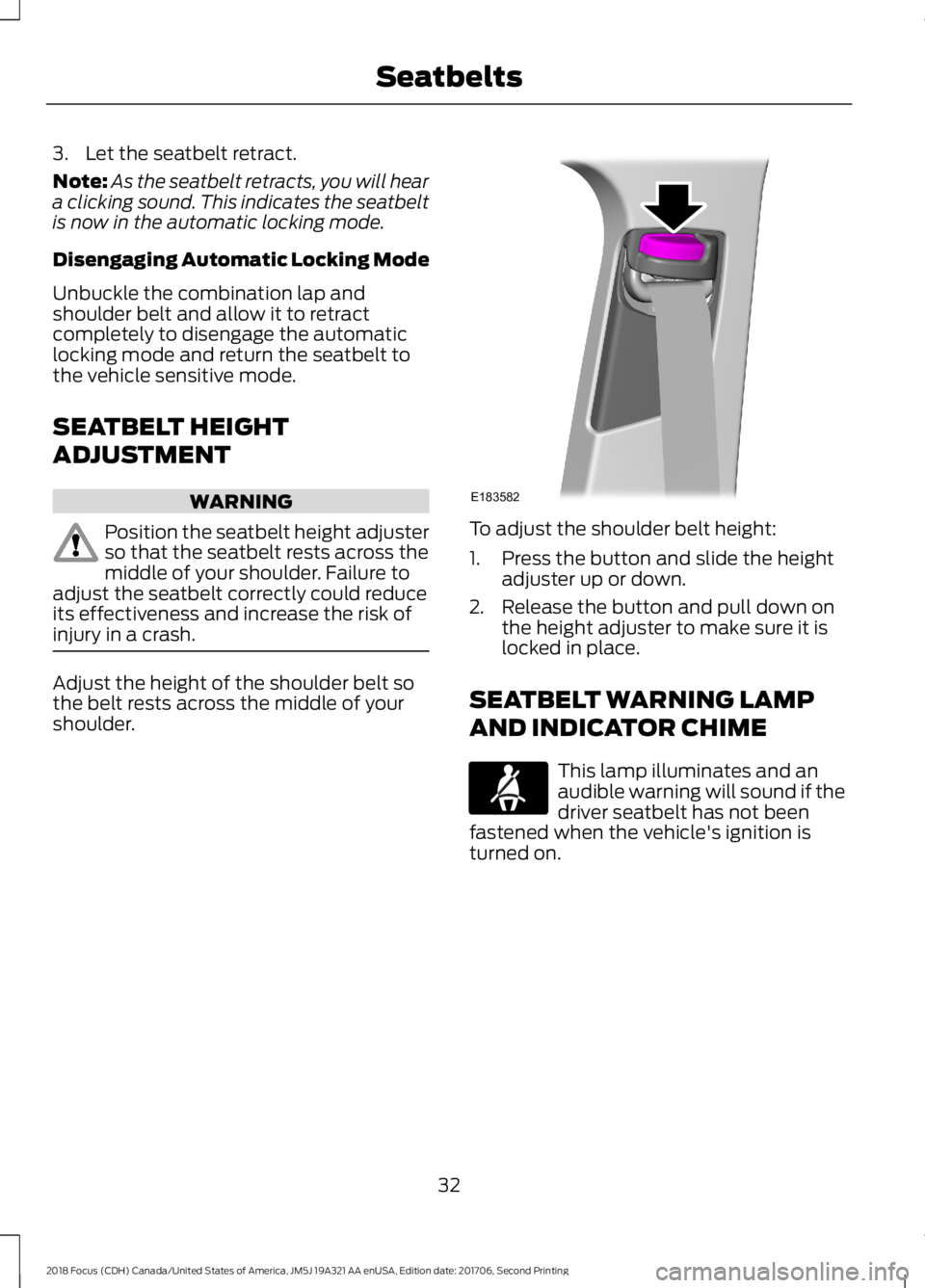
To adjust the shoulder belt height:
1.Press the button and slide the heightadjuster up or down.
2.Release the button and pull down onthe height adjuster to make sure it islocked in place.
SEATBELT WARNING LAMP
AND INDICATOR CHIME
This lamp illuminates and anaudible warning will sound if thedriver seatbelt has not beenfastened when the vehicle's ignition isturned on.
322018 Focus (CDH) Canada/United States of America, JM5J 19A321 AA enUSA, Edition date: 201706, Second PrintingSeatbeltsE183582 E71880
Page 36 of 473
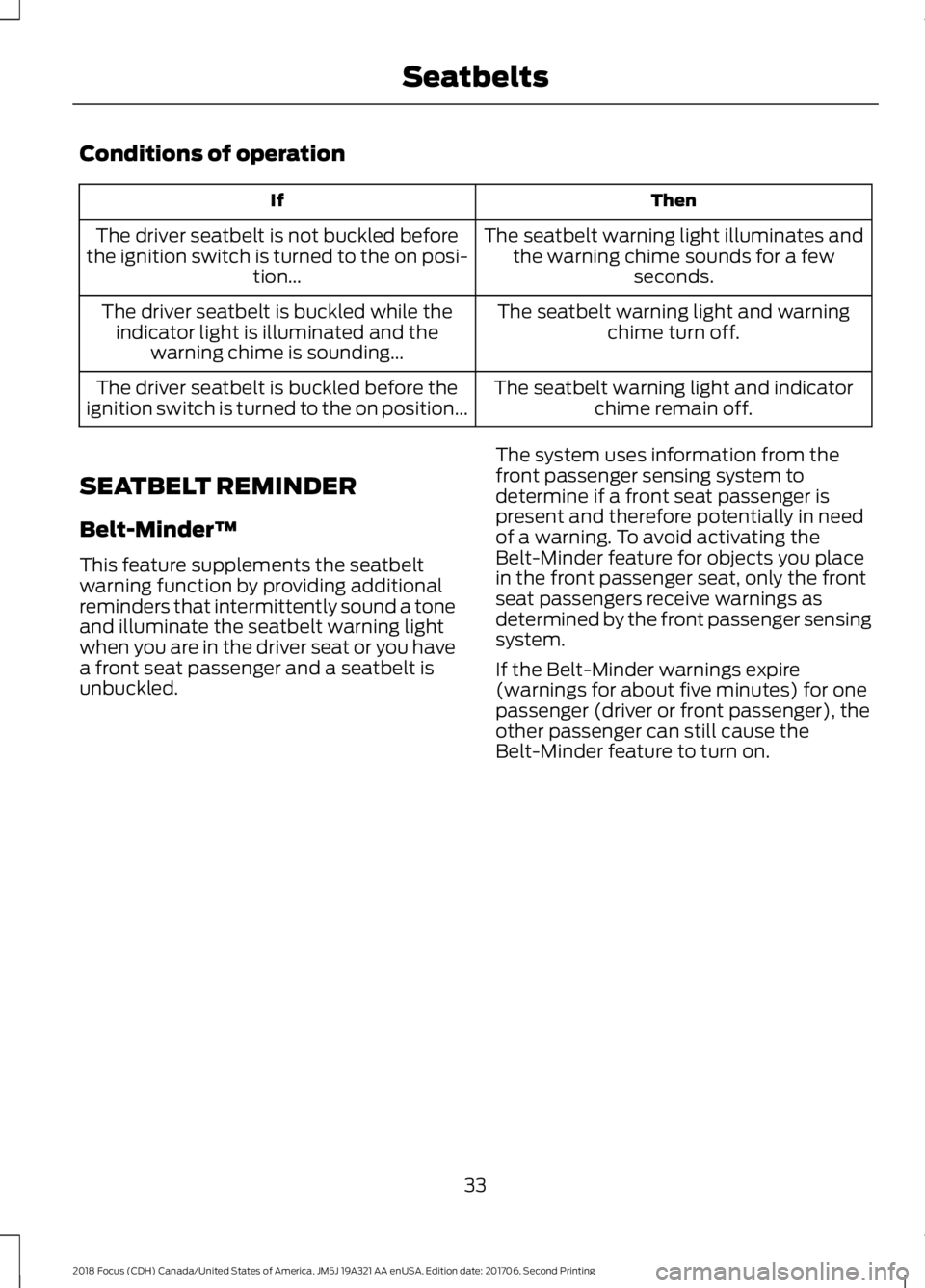
Conditions of operation
ThenIf
The seatbelt warning light illuminates andthe warning chime sounds for a fewseconds.
The driver seatbelt is not buckled beforethe ignition switch is turned to the on posi-tion...
The seatbelt warning light and warningchime turn off.The driver seatbelt is buckled while theindicator light is illuminated and thewarning chime is sounding...
The seatbelt warning light and indicatorchime remain off.The driver seatbelt is buckled before theignition switch is turned to the on position...
SEATBELT REMINDER
Belt-Minder™
This feature supplements the seatbeltwarning function by providing additionalreminders that intermittently sound a toneand illuminate the seatbelt warning lightwhen you are in the driver seat or you havea front seat passenger and a seatbelt isunbuckled.
The system uses information from thefront passenger sensing system todetermine if a front seat passenger ispresent and therefore potentially in needof a warning. To avoid activating theBelt-Minder feature for objects you placein the front passenger seat, only the frontseat passengers receive warnings asdetermined by the front passenger sensingsystem.
If the Belt-Minder warnings expire(warnings for about five minutes) for onepassenger (driver or front passenger), theother passenger can still cause theBelt-Minder feature to turn on.
332018 Focus (CDH) Canada/United States of America, JM5J 19A321 AA enUSA, Edition date: 201706, Second PrintingSeatbelts
Page 37 of 473
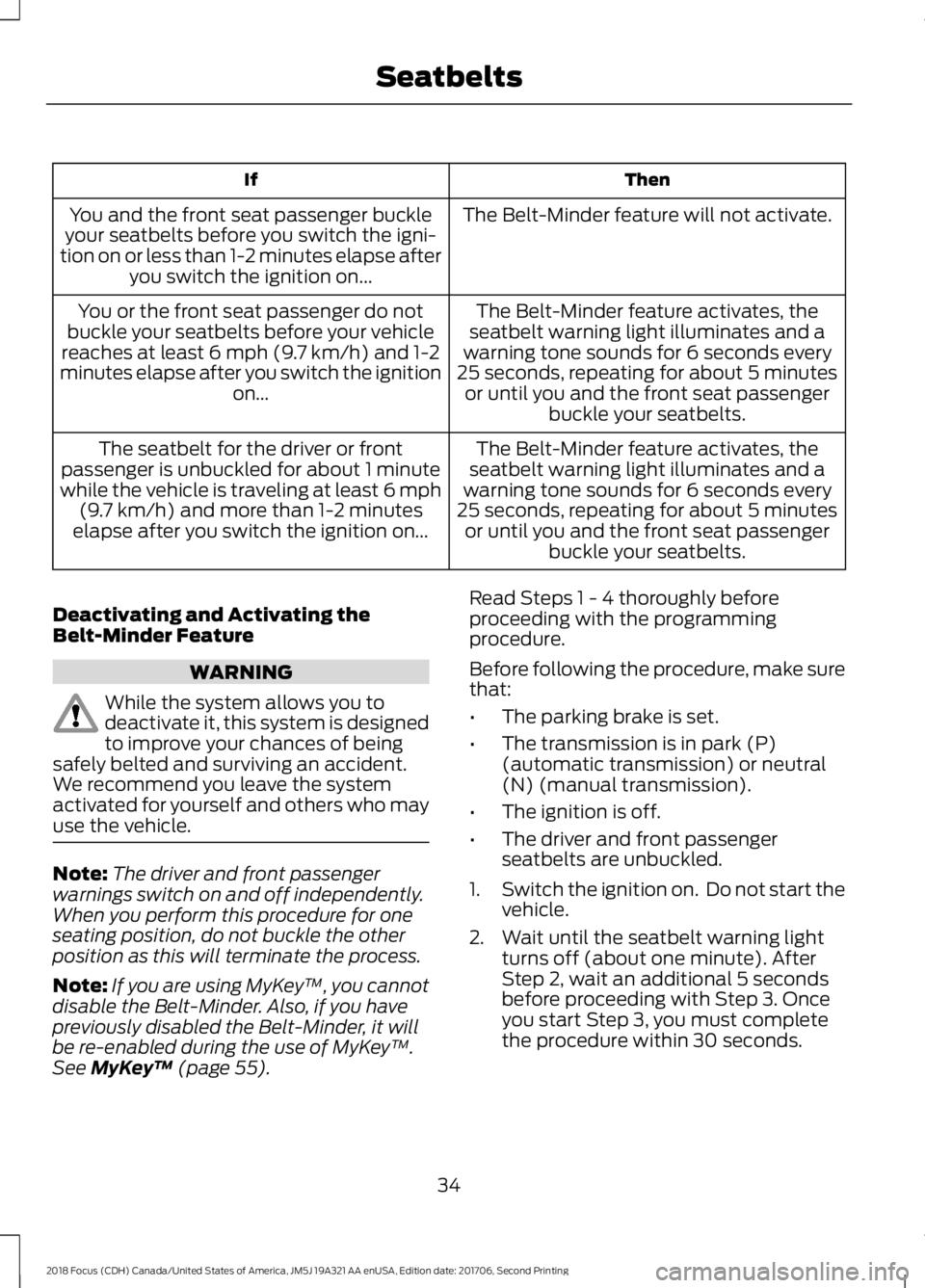
ThenIf
The Belt-Minder feature will not activate.You and the front seat passenger buckleyour seatbelts before you switch the igni-tion on or less than 1-2 minutes elapse afteryou switch the ignition on...
The Belt-Minder feature activates, theseatbelt warning light illuminates and awarning tone sounds for 6 seconds every25 seconds, repeating for about 5 minutesor until you and the front seat passengerbuckle your seatbelts.
You or the front seat passenger do notbuckle your seatbelts before your vehiclereaches at least 6 mph (9.7 km/h) and 1-2minutes elapse after you switch the ignitionon...
The Belt-Minder feature activates, theseatbelt warning light illuminates and awarning tone sounds for 6 seconds every25 seconds, repeating for about 5 minutesor until you and the front seat passengerbuckle your seatbelts.
The seatbelt for the driver or frontpassenger is unbuckled for about 1 minutewhile the vehicle is traveling at least 6 mph(9.7 km/h) and more than 1-2 minuteselapse after you switch the ignition on...
Deactivating and Activating theBelt-Minder Feature
WARNING
While the system allows you todeactivate it, this system is designedto improve your chances of beingsafely belted and surviving an accident.We recommend you leave the systemactivated for yourself and others who mayuse the vehicle.
Note:The driver and front passengerwarnings switch on and off independently.When you perform this procedure for oneseating position, do not buckle the otherposition as this will terminate the process.
Note:If you are using MyKey™, you cannotdisable the Belt-Minder. Also, if you havepreviously disabled the Belt-Minder, it willbe re-enabled during the use of MyKey™.See MyKey™ (page 55).
Read Steps 1 - 4 thoroughly beforeproceeding with the programmingprocedure.
Before following the procedure, make surethat:
•The parking brake is set.
•The transmission is in park (P)(automatic transmission) or neutral(N) (manual transmission).
•The ignition is off.
•The driver and front passengerseatbelts are unbuckled.
1.Switch the ignition on. Do not start thevehicle.
2.Wait until the seatbelt warning lightturns off (about one minute). AfterStep 2, wait an additional 5 secondsbefore proceeding with Step 3. Onceyou start Step 3, you must completethe procedure within 30 seconds.
342018 Focus (CDH) Canada/United States of America, JM5J 19A321 AA enUSA, Edition date: 201706, Second PrintingSeatbelts