traction control FORD FUSION 2019 Owner's Manual
[x] Cancel search | Manufacturer: FORD, Model Year: 2019, Model line: FUSION, Model: FORD FUSION 2019Pages: 550, PDF Size: 8.5 MB
Page 292 of 550
Tire Quality Grades apply to new
pneumatic passenger car tires.
They do not apply to deep tread,
winter-type snow tires,
space-saver or temporary use
spare tires, light truck or LT type
tires, tires with nominal rim
diameters of 10 to 12 inches or
limited production tires as defined
in Title 49 Code of Federal
Regulations Part 575.104 ©)(2).
U.S. Department of
Transportation Tire quality
grades: The U.S. Department of
Transportation requires Ford
Motor Company to give you the
following information about tire
grades exactly as the government
has written it.
Treadwear
The treadwear grade is a
comparative rating based on the
wear rate of the tire when tested
under controlled conditions on a
specified government test course.
For example, a tire graded 150
would wear 1 ½ times as well on
the government course as a tire
graded 100. The relative
performance of tires depends
upon the actual conditions of their
use, however, and may depart
significantly from the norm due to
variations in driving habits, service
practices, and differences in road
characteristics and climate. Traction AA A B C WARNING:
The traction
grade assigned to this tire is
based on straight-ahead braking
traction tests, and does not
include acceleration, cornering,
hydroplaning or peak traction
characteristics.
The traction grades, from highest
to lowest are AA, A, B, and C. The
grades represent the tire ’s ability
to stop on wet pavement as
measured under controlled
conditions on specified
government test surfaces of
asphalt and concrete. A tire
marked C may have poor traction
performance.
Temperature A B C WARNING:
The
temperature grade for this tire is
established for a tire that is
properly inflated and not
overloaded. Excessive speed,
underinflation, or excessive
loading, either separately or in
combination, can cause heat
buildup and possible tire failure.
The temperature grades are A
(the highest), B and C,
representing the tire ’s resistance
to the generation of heat and its
ability to dissipate heat when
tested under controlled conditions
on a specified indoor laboratory
289
Fusion (CC7) Canada/United States of America, enUSA, Edition date: 201805, Second-Printing Wheels and Tires
Page 296 of 550
the tire size code and the last four
numbers represent the week and
year the tire was built. For
example, the numbers 317 mean
the 31st week of 1997. After 2000
the numbers go to four digits. For
example, 2501 means the 25th
week of 2001. The numbers in
between are identification codes
used for traceability. This
information is used to contact
customers if a tire defect requires
a recall.
I.
M+S or M/S: Mud and Snow, or
AT:
All Terrain, or
AS:
All Season.
J. Tire Ply Composition and
Material Used:
Indicates the
number of plies or the number of
layers of rubber-coated fabric in
the tire tread and sidewall. Tire
manufacturers also must indicate
the ply materials in the tire and the
sidewall, which include steel,
nylon, polyester, and others.
K. Maximum Load: Indicates the
maximum load in kilograms and
pounds that can be carried by the
tire. Refer to the Safety
Compliance Certification Label
(affixed to either the door hinge
pillar, door-latch post, or the door
edge that meets the door-latch
post, next to the driver's seating
position), for the correct tire
pressure for your vehicle.
L. Treadwear, Traction and
Temperature Grades: *
Treadwear: The treadwear
grade is a comparative rating
based on the wear rate of the tire
when tested under controlled
conditions on a specified
government test course. For
example, a tire graded 150 would
wear one and one-half times as
well on the government course as
a tire graded 100.
*
Traction: The traction grades,
from highest to lowest are AA, A,
B, and C. The grades represent the
tire's ability to stop on wet
pavement as measured under
controlled conditions on specified
government test surfaces of
asphalt and concrete. A tire
marked C may have poor traction
performance.
*
Temperature: The temperature
grades are A (the highest), B and
C, representing the tire's
resistance to the generation of
heat and its ability to dissipate
heat when tested under controlled
conditions on a specified indoor
laboratory test wheel.
M. Maximum Inflation
Pressure:
Indicates the tire
manufacturers' maximum
permissible pressure or the
pressure at which the maximum
load can be carried by the tire. This
pressure is normally higher than
the vehicle manufacturer's
recommended cold inflation
pressure which can be found on
the Safety Compliance
Certification Label (affixed to
either the door hinge pillar,
293
Fusion (CC7) Canada/United States of America, enUSA, Edition date: 201805, Second-Printing Wheels and Tires
Page 306 of 550
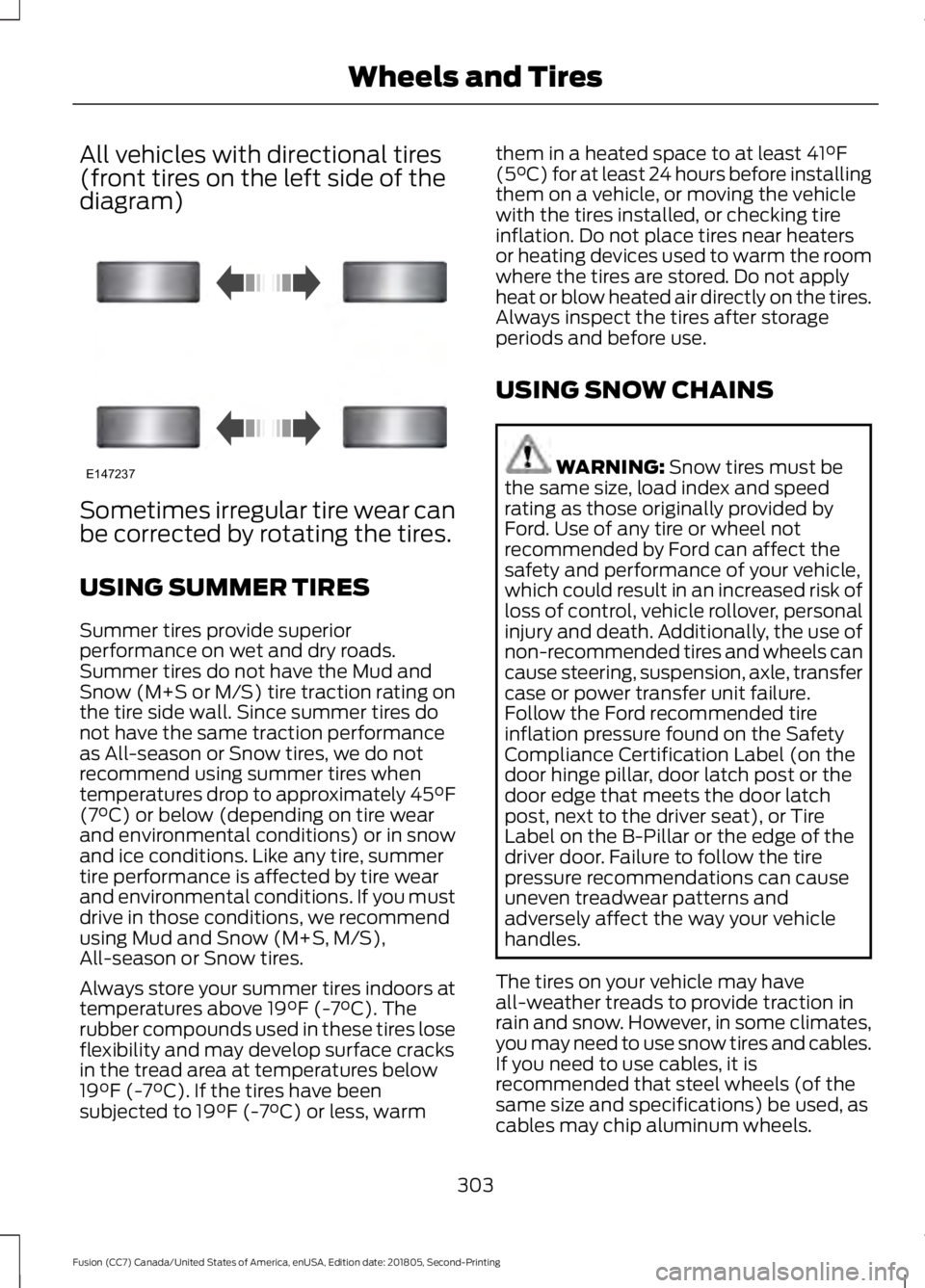
All vehicles with directional tires
(front tires on the left side of the
diagram)
Sometimes irregular tire wear can
be corrected by rotating the tires.
USING SUMMER TIRES
Summer tires provide superior
performance on wet and dry roads.
Summer tires do not have the Mud and
Snow (M+S or M/S) tire traction rating on
the tire side wall. Since summer tires do
not have the same traction performance
as All-season or Snow tires, we do not
recommend using summer tires when
temperatures drop to approximately 45°F
(7°C) or below (depending on tire wear
and environmental conditions) or in snow
and ice conditions. Like any tire, summer
tire performance is affected by tire wear
and environmental conditions. If you must
drive in those conditions, we recommend
using Mud and Snow (M+S, M/S),
All-season or Snow tires.
Always store your summer tires indoors at
temperatures above
19°F (-7°C). The
rubber compounds used in these tires lose
flexibility and may develop surface cracks
in the tread area at temperatures below
19°F (-7°C)
. If the tires have been
subjected to 19°F (-7°C) or less, warm them in a heated space to at least
41°F
(5°C) for at least 24 hours before installing
them on a vehicle, or moving the vehicle
with the tires installed, or checking tire
inflation. Do not place tires near heaters
or heating devices used to warm the room
where the tires are stored. Do not apply
heat or blow heated air directly on the tires.
Always inspect the tires after storage
periods and before use.
USING SNOW CHAINS WARNING:
Snow tires must be
the same size, load index and speed
rating as those originally provided by
Ford. Use of any tire or wheel not
recommended by Ford can affect the
safety and performance of your vehicle,
which could result in an increased risk of
loss of control, vehicle rollover, personal
injury and death. Additionally, the use of
non-recommended tires and wheels can
cause steering, suspension, axle, transfer
case or power transfer unit failure.
Follow the Ford recommended tire
inflation pressure found on the Safety
Compliance Certification Label (on the
door hinge pillar, door latch post or the
door edge that meets the door latch
post, next to the driver seat), or Tire
Label on the B-Pillar or the edge of the
driver door. Failure to follow the tire
pressure recommendations can cause
uneven treadwear patterns and
adversely affect the way your vehicle
handles.
The tires on your vehicle may have
all-weather treads to provide traction in
rain and snow. However, in some climates,
you may need to use snow tires and cables.
If you need to use cables, it is
recommended that steel wheels (of the
same size and specifications) be used, as
cables may chip aluminum wheels.
303
Fusion (CC7) Canada/United States of America, enUSA, Edition date: 201805, Second-Printing Wheels and TiresE147237
Page 307 of 550
Follow these guidelines when using snow
tires and traction devices
•
If possible, avoid fully loading your
vehicle
• Purchase chains or cables from a
manufacturer that clearly labels body
to tire dimension restrictions.
• Use no larger than 0.59 in (15 mm)
cables or chains ONLY on front axle
with 215/60R16 tires. Do not use chains
or cables on any other size tires.
• The snow chains or cables must be
mounted in pairs on the front axle.
• When driving with tire cables do not
exceed
30 mph (48 km/h) or the
maximum speed recommended by the
chain manufacturer, whichever is less.
• Drive cautiously. If you hear the cables
rub or bang against the vehicle, stop
and retighten them. If this does not
work, remove the cables to prevent
vehicle damage.
• Remove the cables when they are no
longer needed. Do not use cables on
dry roads.
If you have any questions regarding snow
chains or cables, please contact your
authorized dealer.
TIRE PRESSURE MONITORING
SYSTEM WARNING:
The tire pressure
monitoring system is not a substitute for
manually checking tire pressures. You
should periodically check tire pressures
using a pressure gauge. Failure to
correctly maintain tire pressures could
increase the risk of tire failure, loss of
control, vehicle rollover and personal
injury. Note:
You should only use tire sealants in
roadside emergencies as they could cause
damage to the tire pressure monitoring
system sensor.
Note: If the tire pressure monitoring system
sensor becomes damaged, it will not
function. Each tire, including the spare (if
provided), should be checked
monthly when cold and inflated
to the inflation pressure recommended by
the vehicle manufacturer on the vehicle
placard or tire inflation pressure label. (If
your vehicle has tires of a different size
than the size indicated on the vehicle
placard or tire inflation pressure label, you
should determine the proper tire inflation
pressure for those tires).
As an added safety feature, your vehicle
has been equipped with a Tire Pressure
Monitoring System (TPMS) that
illuminates a low tire pressure telltale
when one or more of your tires is
significantly under-inflated. Accordingly,
when the low tire pressure telltale
illuminates, you should stop and check
your tires as soon as possible, and inflate
them to the proper pressure. Driving on a
significantly under-inflated tire causes the
tire to overheat and can lead to tire failure.
Under-inflation also reduces fuel efficiency
and tire tread life, and could affect the
vehicle ’s handling and stopping ability.
Please note that the TPMS is not a
substitute for proper tire maintenance, and
it is the driver ’s responsibility to maintain
correct tire pressure, even if under-inflation
has not reached the level to trigger
illumination of the TPMS low tire pressure
telltale.
304
Fusion (CC7) Canada/United States of America, enUSA, Edition date: 201805, Second-Printing Wheels and Tires
Page 446 of 550
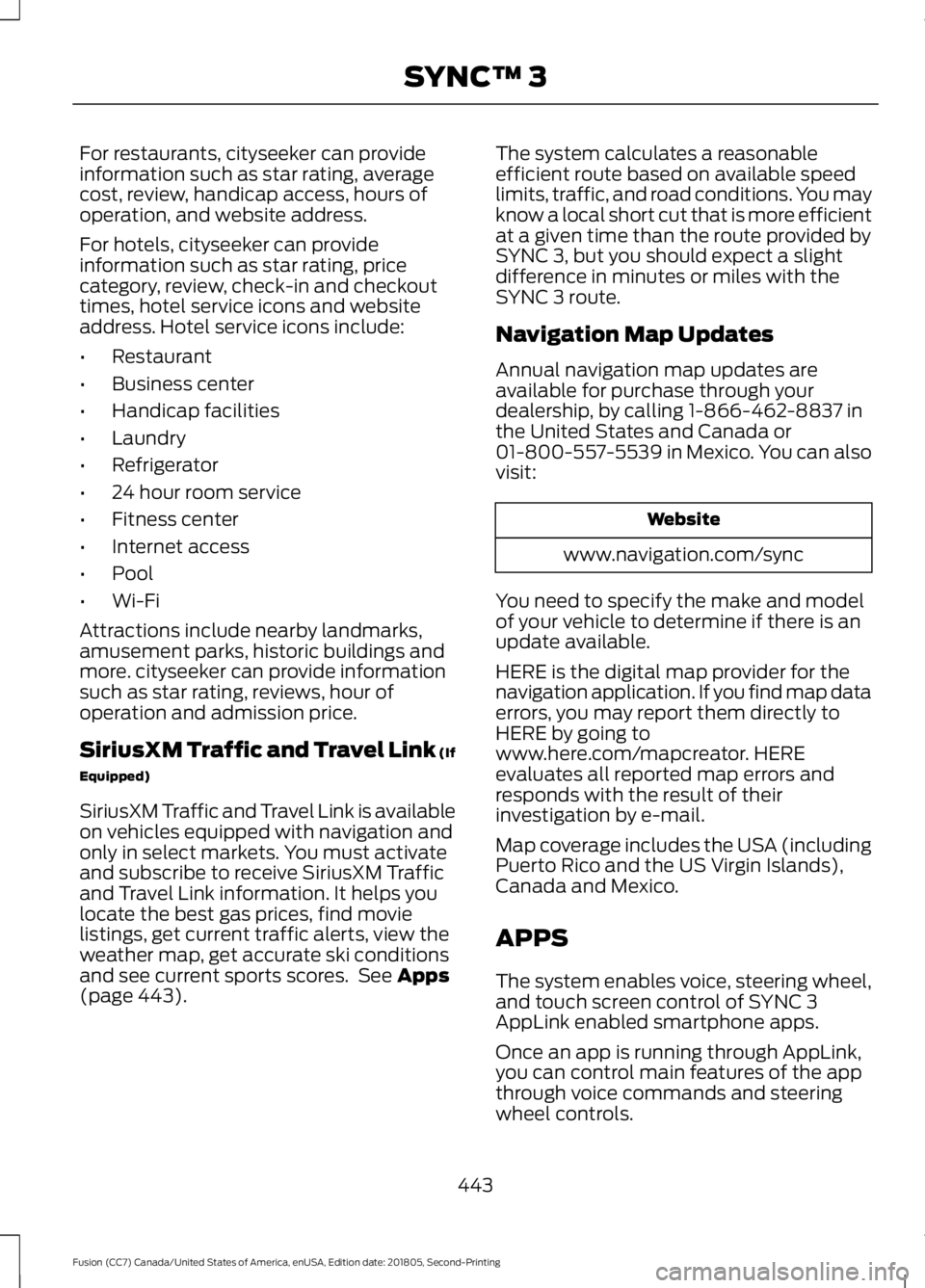
For restaurants, cityseeker can provide
information such as star rating, average
cost, review, handicap access, hours of
operation, and website address.
For hotels, cityseeker can provide
information such as star rating, price
category, review, check-in and checkout
times, hotel service icons and website
address. Hotel service icons include:
•
Restaurant
• Business center
• Handicap facilities
• Laundry
• Refrigerator
• 24 hour room service
• Fitness center
• Internet access
• Pool
• Wi-Fi
Attractions include nearby landmarks,
amusement parks, historic buildings and
more. cityseeker can provide information
such as star rating, reviews, hour of
operation and admission price.
SiriusXM Traffic and Travel Link (If
Equipped)
SiriusXM Traffic and Travel Link is available
on vehicles equipped with navigation and
only in select markets. You must activate
and subscribe to receive SiriusXM Traffic
and Travel Link information. It helps you
locate the best gas prices, find movie
listings, get current traffic alerts, view the
weather map, get accurate ski conditions
and see current sports scores. See Apps
(page 443). The system calculates a reasonable
efficient route based on available speed
limits, traffic, and road conditions. You may
know a local short cut that is more efficient
at a given time than the route provided by
SYNC 3, but you should expect a slight
difference in minutes or miles with the
SYNC 3 route.
Navigation Map Updates
Annual navigation map updates are
available for purchase through your
dealership, by calling 1-866-462-8837 in
the United States and Canada or
01-800-557-5539 in Mexico. You can also
visit:
Website
www.navigation.com/sync
You need to specify the make and model
of your vehicle to determine if there is an
update available.
HERE is the digital map provider for the
navigation application. If you find map data
errors, you may report them directly to
HERE by going to
www.here.com/mapcreator. HERE
evaluates all reported map errors and
responds with the result of their
investigation by e-mail.
Map coverage includes the USA (including
Puerto Rico and the US Virgin Islands),
Canada and Mexico.
APPS
The system enables voice, steering wheel,
and touch screen control of SYNC 3
AppLink enabled smartphone apps.
Once an app is running through AppLink,
you can control main features of the app
through voice commands and steering
wheel controls.
443
Fusion (CC7) Canada/United States of America, enUSA, Edition date: 201805, Second-Printing SYNC™ 3
Page 503 of 550
SYNC® Automotive Important Safety
Information Read and follow
instructions:
•
Before using your SYNC® system, read
and follow all instructions and safety
information provided in this end user
manual ("Owner Guide".) Not
following precautions found in the
Owner Guide can lead to an accident
or other serious injuries.
General Operation
• Voice Command Control: Certain
functions within the SYNC® system
may be accomplished using voice
commands. Using voice commands
while driving helps you to operate the
system without removing your hands
from the wheel or eyes from the road.
• Prolonged Views of Screen:
Do not
access any function requiring a
prolonged view of the screen while you
are driving. Pull over in a safe and legal
manner before attempting to access a
function of the system requiring
prolonged attention.
• Volume Setting:
Do not raise the
volume excessively. Keep the volume
at a level where you can still hear
outside traffic and emergency signals
while driving. Driving while unable to
hear these sounds could cause an
accident.
• Navigation Features:
Any navigation
features included in the system are
intended to provide turn by turn
instructions to get you to a desired
destination. Please make certain all
persons using this system carefully
read and follow instructions and safety
information fully. •
Distraction Hazard:
Any navigation
features may require manual
(non-verbal) setup. Attempting to
perform such set-up or insert data
while driving can distract your attention
and could cause an accident or other
serious injury. Stop the vehicle in a safe
and legal manner before attempting
these operations.
• Let Your Judgment Prevail:
Any
navigation features are provided only
as an aid. Make your driving decisions
based on your observations of local
conditions and existing traffic
regulations. Any such feature is not a
substitute for your personal judgment.
Any route suggestions made by this
system should never replace any local
traffic regulations or your personal
judgment or knowledge of safe driving
practices.
• Route Safety: Do not follow the route
suggestions if doing so would result in
an unsafe or illegal maneuver, if you
would be placed in an unsafe situation,
or if you would be directed into an area
that you consider unsafe. The driver is
ultimately responsible for the safe
operation of the vehicle and therefore,
must evaluate whether it is safe to
follow the suggested directions.
• Potential Map Inaccuracy:
Maps
used by this system may be inaccurate
because of changes in roads, traffic
controls or driving conditions. Always
use good judgment and common sense
when following the suggested routes.
• Emergency Services:
Do not rely on
any navigation features included in the
system to route you to emergency
services. Ask local authorities or an
emergency services operator for these
locations. Not all emergency services
such as police, fire stations, hospitals
and clinics are likely to be contained in
the map database for such navigation
features.
500
Fusion (CC7) Canada/United States of America, enUSA, Edition date: 201805, Second-Printing Appendices
Page 544 of 550
Head Restraints..............................................131
Adjusting the Head Restraint......................... 132
Tilting Head Restraints .................................... 133
Heated Exterior Mirrors...............................129
Heated Rear Window..................................129
Heated Seats.................................................138
Heated Steering Wheel................................75
Heating See: Climate Control........................................... 121
Hill Start Assist
..............................................178
Switching the System On and Off................179
Using Hill Start Assist........................................ 179
Hints on Controlling the Interior Climate...........................................................127
Defogging the Side Windows in Cold Weather............................................................. 129
General Hints........................................................ 127
Quickly Cooling the Interior............................ 128
Quickly Heating the Interior............................ 128
Recommended Settings for Cooling...........129
Recommended Settings for Heating..........128
Hints on Driving With Anti-Lock Brakes.............................................................176
Home Screen
................................................409
Hood Lock See: Opening and Closing the Hood..........256
I
In California (U.S. Only)
............................239
Information Display Control.......................75
Information Displays.....................................97 General Information............................................ 97
Information Messages...............................106 Active Park............................................................ 106
Adaptive Cruise Control................................... 107
AdvanceTrac®..................................................... 107
Airbag..................................................................... 108
Alarm...................................................................... 108
All-Wheel Drive.................................................... 110
Automatic Engine Shutdown......................... 110
Auto Start-Stop.................................................. 108
Battery and Charging System.......................... 111
Blind Spot Information and Cross Traffic Alert System...................................................... 111
Doors and Locks................................................... 112
Driver Alert.............................................................. 112
Fuel........................................................................\
.... 112Hill Start Assist.....................................................
112
Keys and Intelligent Access............................. 113
Lane Keeping System........................................ 114
Maintenance.......................................................... 114
MyKey....................................................................... 115
Park Aid................................................................... 116
Park Brake.............................................................. 116
Power Steering...................................................... 117
Pre-Collision Assist............................................. 117
Remote Start......................................................... 117
Seats........................................................................\
118
Starting System .................................................. 118
Tire Pressure Monitoring System................... 118
Traction Control................................................... 119
Transmission......................................................... 119
Installing Child Restraints...........................22 Child Seats.............................................................. 22
Using Lap and Shoulder Belts......................... 22
Using Lower Anchors and Tethers for CHildren (LATCH)............................................ 27
Using Tether Straps............................................. 28
Instrument Cluster
........................................90
Instrument Lighting Dimmer......................79 Vehicles With Front Fog Lamps..................... 80
Vehicles Without Front Fog Lamps..............80
Instrument Panel
............................................18
Interior Lamps.................................................82 Front Interior Lamp............................................. 83
Rear Interior Lamps............................................. 83
Interior Luggage Compartment Release...........................................................69
Interior Mirror...................................................88 Auto-Dimming Mirror......................................... 88
Manual Dimming Mirror.................................... 88
Introduction.........................................................7
J
Jump Starting the Vehicle........................234 Connecting the Jumper Cables.................... 234
Jump Starting...................................................... 235
Preparing Your Vehicle..................................... 234
Removing the Jumper Cables....................... 235
541
Fusion (CC7) Canada/United States of America, enUSA, Edition date: 201805, Second-Printing Index
Page 548 of 550
Starting Your Vehicle.........................................
149
Stopping the Engine When Your Vehicle is Moving................................................................. 151
Stopping the Engine When Your Vehicle is Stationary......................................................... 150
Starting and Stopping the Engine.........148
General Information.......................................... 148
Steering............................................................215 Electric Power Steering.................................... 215
Steering Wheel................................................73
Storage Compartments
.............................147
Sunroof See: Moonroof...................................................... 88
Sun Visors.........................................................88 Illuminated Vanity Mirror................................... 88
Supplementary Restraints System.........44 Principle of Operation........................................ 44
Symbols Glossary
.............................................7
SYNC™ 3........................................................397
General Information.......................................... 397
SYNC™ 3 Troubleshooting.....................460
SYNC™ Applications and Services.......375 911 Assist............................................................... 375
SYNC Mobile Apps............................................. 377
SYNC™
...........................................................359
General Information......................................... 359
SYNC™ Troubleshooting.........................389
T
Technical Specifications See: Capacities and Specifications.............319
The Better Business Bureau (BBB) Auto Line Program (U.S. Only)
......................240
Tire Care..........................................................288
Glossary of Tire Terminology........................ 290
Information About Uniform Tire Quality Grading............................................................. 288
Information Contained on the Tire Sidewall............................................................. 291
Temperature A B C............................................ 289
Traction AA A B C.............................................. 289
Treadwear............................................................ 289
Tire Pressure Monitoring System..........304 Changing Tires With a Tire Pressure
Monitoring System....................................... 305
Understanding Your Tire Pressure Monitoring System ...................................... 305Tires
See: Wheels and Tires..................................... 288
Towing a Trailer
.............................................224
Load Placement................................................. 224
Towing Points................................................237 Installing the Recovery Hook......................... 237
Recovery Hook Location.................................. 237
Towing the Vehicle on Four Wheels..........................................................228
Emergency Towing............................................ 228
Recreational Towing......................................... 228
Vehicles Equipped with 1.5L, 2.0L, and 2.5L Engines............................................................. 228
Vehicles Equipped with a 2.7L Engine............................................................... 228
Towing..............................................................224
Traction Control............................................180 Principle of Operation...................................... 180
Transmission Code Designation.............327
Transmission..................................................166
Transporting the Vehicle...........................236
Type Approvals.............................................522 China....................................................................... 532
Radio Frequency Certification for Keys and Remote Controls........................................... 532
Radio Frequency Certifications for Blind Spot Information System.......................... 530
Radio Frequency Certifications for Body Control Module.............................................. 532
Radio Frequency Certifications for Cruise Control Module.............................................. 532
Radio Frequency Certifications for Mid Range Radar................................................... 524
Radio Frequency Certifications for Passive Anti-Theft System........................................ 525
Radio Frequency Certifications for Radio Transceiver Module...................................... 528
Radio Frequency Certifications for SYNC 3........................................................................\
... 532
Radio Frequency Certifications for Tire Pressure Monitoring Sensor(s)................522
Radio Frequency Certifications for Wireless Charging............................................................ 531
Radio Frequency Statement for Audio Unit..................................................................... 533
545
Fusion (CC7) Canada/United States of America, enUSA, Edition date: 201805, Second-Printing Index
Page 549 of 550
U
Under Hood Overview - 1.5L
EcoBoost™..................................................257
Under Hood Overview - 2.0L EcoBoost™.................................................258
Under Hood Overview - 2.5L...................259
Under Hood Overview - 2.7L EcoBoost™................................................260
Unique Driving Characteristics................153
Universal Garage Door Opener...............140
HomeLink Wireless Control System...........140
USB Port
.........................................................358
Using Adaptive Cruise Control................198 Automatic Cancellation.................................. 202
Blocked Sensor.................................................. 203
Canceling the Set Speed................................. 201
Changing the Set Speed.................................. 201
Detection Issues................................................. 202
Following a Vehicle.......................................... 200
Following a Vehicle to a Complete Stop................................................................... 200
Hilly Condition Usage....................................... 202
Overriding the Set Speed................................ 201
Park Brake Application.................................... 202
Resuming the Set Speed................................. 201
Setting the Adaptive Cruise Speed.............199
Setting the Adaptive Cruise Speed When Your Vehicle is Stationary........................... 199
Setting the Gap Distance............................... 200
Switching Adaptive Cruise Control Off...................................................................... 202
Switching Adaptive Cruise Control On........................................................................\
199
Switching to Normal Cruise Control..........204
System Not Available...................................... 203
Using All-Wheel Drive..................................171 Driving In Special Conditions With
All-Wheel Drive (AWD)................................. 171
Using Cruise Control
....................................197
Canceling the Set Speed................................. 198
Changing the Set Speed.................................. 197
Resuming the Set Speed................................. 198
Setting the Cruise Speed................................. 197
Switching Cruise Control Off......................... 198
Switching Cruise Control On........................... 197
Using MyKey With Remote Start Systems..........................................................62 Using Snow Chains
.....................................303
Using Stability Control................................182
Using Summer Tires...................................303
Using SYNC™ With Your Media Player
............................................................380
Accessing Your USB Song Library...............384
Bluetooth Devices and System
Settings............................................................ 386
Connecting Your Digital Media Player to the USB Port.......................................................... 380
Media Menu Features...................................... 383
Media Voice Commands................................. 381
USB 2..................................................................... 386
Voice Commands for Audio Sources.........387
Using SYNC™ With Your Phone............363 Accessing Features through the Phone
Menu................................................................. 368
Accessing Your Phone Settings..................... 371
Bluetooth Devices.............................................. 372
Making Calls......................................................... 367
Pairing a Phone for the First Time..............364
Pairing Subsequent Phones.......................... 365
Phone Options during an Active Call.........367
Phone Voice Commands................................ 365
Receiving Calls.................................................... 367
System Settings................................................. 373
Text Messaging.................................................. 369
Using Traction Control...............................180 Switching the System Off............................... 180
System Indicator Lights and Messages......................................................... 180
Using a Switch.................................................... 180
Using the Information Display Controls............................................................ 180
Using Voice Recognition............................361 Audio Voice Commands................................... 411
Climate Voice Commands.............................. 412
Initiating a Voice Session................................. 361
Mobile App Voice Commands....................... 415
Navigation Voice Commands........................ 414
Phone Voice Commands................................. 412
SiriusXM Traffic and Travel Link Voice Commands...................................................... 415
System Interaction and Feedback..............362
Voice Settings Commands............................. 416
Utilizing the Mediation/Arbitration Program (Canada Only)
.........................241
546
Fusion (CC7) Canada/United States of America, enUSA, Edition date: 201805, Second-Printing Index