light FORD GRANADA 1985 Service Owner's Guide
[x] Cancel search | Manufacturer: FORD, Model Year: 1985, Model line: GRANADA, Model: FORD GRANADA 1985Pages: 255, PDF Size: 14.98 MB
Page 86 of 255
See Chapter 1, Section 46.
See Chapter 1, Section 46.
See Chapter 1, Section 46.
1Drain the radiator. There is no need to drain
the cylinder block. On DOHC engines the
electric cooling fan assembly must be removed
to gain the clearance to remove the radiator.
2Disconnect the top and bottom hoses from
the radiator by slackening the hose clips and
pulling off the hoses with a twisting motion
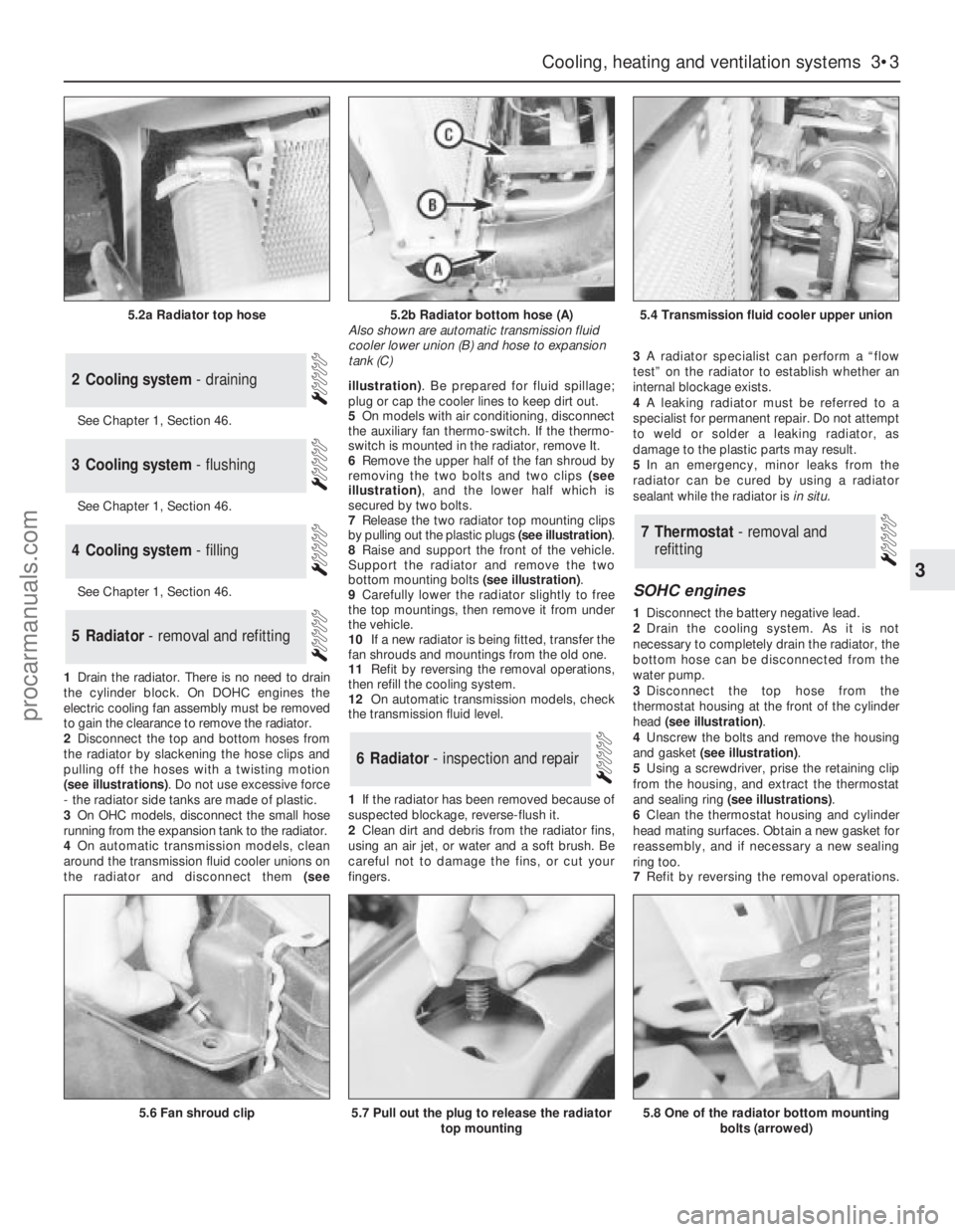
(see illustrations). Do not use excessive force
- the radiator side tanks are made of plastic.
3On OHCmodels, disconnect the small hose
running from the expansion tank to the radiator.
4On automatic transmission models, clean
around the transmission fluid cooler unions on
the radiator and disconnect them (seeillustration). Be prepared for fluid spillage;
plug or cap the cooler lines to keep dirt out.
5On models with air conditioning, disconnect
the auxiliary fan thermo-switch. If the thermo-
switch is mounted in the radiator, remove It.
6Remove the upper half of the fan shroud by
removing the two bolts and two clips (see
illustration), and the lower half which is
secured by two bolts.
7Release the two radiator top mounting clips
by pulling out the plastic plugs (see illustration).
8Raise and support the front of the vehicle.
Support the radiator and remove the two
bottom mounting bolts (see illustration).
9Carefully lower the radiator slightly to free
the top mountings, then remove it from under
the vehicle.
10If a new radiator is being fitted, transfer the
fan shrouds and mountings from the old one.
11Refit by reversing the removal operations,
then refill the cooling system.
12On automatic transmission models, check
the transmission fluid level.
1If the radiator has been removed because of
suspected blockage, reverse-flush it.
2Clean dirt and debris from the radiator fins,
using an air jet, or water and a soft brush. Be
careful not to damage the fins, or cut your
fingers. 3A radiator specialist can perform a “flow
test” on the radiator to establish whether an
internal blockage exists.
4A leaking radiator must be referred to a
specialist for permanent repair. Do not attempt
to weld or solder a leaking radiator, as
damage to the plastic parts may result.
5In an emergency, minor leaks from the
radiator can be cured by using a radiator
sealant while the radiator is in situ.
SOHC engines
1Disconnect the battery negative lead.
2Drain the cooling system. As it is not
necessary to completely drain the radiator, the
bottom hose can be disconnected from the
water pump.
3Disconnect the top hose from the
thermostat housing at the front of the cylinder
head (see illustration).
4Unscrew the bolts and remove the housing
and gasket (see illustration).
5Using a screwdriver, prise the retaining clip
from the housing, and extract the thermostat
and sealing ring (see illustrations).
6Clean the thermostat housing and cylinder
head mating surfaces. Obtain a new gasket for
reassembly, and if necessary a new sealing
ring too.
7Refit by reversing the removal operations.
7Thermostat - removal and
refitting
6Radiator - inspection and repair
5Radiator - removal and refitting
4Cooling system - filling
3Cooling system - flushing
2Cooling system - draining
Cooling, heating and ventilation systems 3•3
3
5.2a Radiator top hose5.2b Radiator bottom hose (A)
Also shown are automatic transmission fluid
cooler lower union (B) and hose to expansion
tank (C)5.4 Transmission fluid cooler upper union
5.6 Fan shroud clip5.7 Pull out the plug to release the radiator
top mounting5.8 One of the radiator bottom mounting
bolts (arrowed)
procarmanuals.com
Page 108 of 255
20Checking and adjustment should be
completed within 30 seconds of the meter
readings stabilising. If this has not been
possible, run the engine at 3000 rpm for 15
seconds, then allow the engine to idle. Re-
check the CO content and carry out further
adjustments if necessary.
21On completion of adjustment, stop the
engine and disconnect the tachometer and the
exhaust gas analyser. Refit the cover to the
adjustment screw.
2.4 & 2.9 litre V6 engines
22As with the 2.8 V6, idle speed is
electronically controlled. Basic idle speed
adjustment can only be carried out by a Ford
dealer using special equipment.
23On models not equipped with a catalytic
converter, mixture adjustment can be carried
out as described above.
24On models equipped with a catalytic
converter, the mixture is controlled by the EEC IV
module and no manual adjustment is possible.
SOHC and V6 engines
1Disconnect the battery negative lead.
2Free the throttle position sensor multi-plug
from its clip. On the OHCmodels this is below
the idle speed control valve, on the underside
of the inlet manifold; on V6 engines it is
located below the throttle valve housing.
3Relieve the locktabs and unbolt the throttle
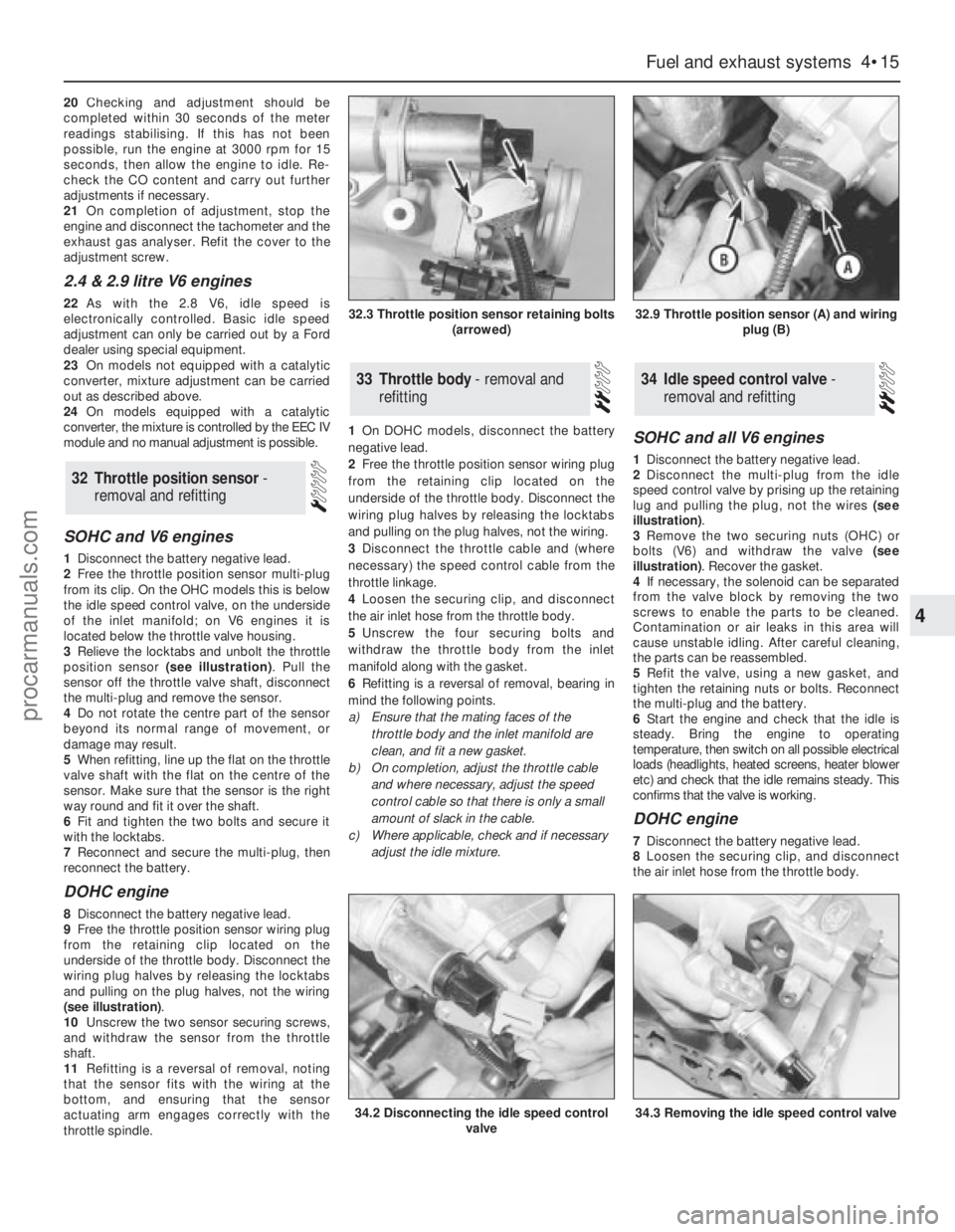
position sensor (see illustration). Pull the
sensor off the throttle valve shaft, disconnect
the multi-plug and remove the sensor.
4Do not rotate the centre part of the sensor
beyond its normal range of movement, or
damage may result.
5When refitting, line up the flat on the throttle
valve shaft with the flat on the centre of the
sensor. Make sure that the sensor is the right
way round and fit it over the shaft.
6Fit and tighten the two bolts and secure it
with the locktabs.
7Reconnect and secure the multi-plug, then
reconnect the battery.
DOHC engine
8Disconnect the battery negative lead.
9Free the throttle position sensor wiring plug
from the retaining clip located on the
underside of the throttle body. Disconnect the
wiring plug halves by releasing the locktabs
and pulling on the plug halves, not the wiring
(see illustration).
10Unscrew the two sensor securing screws,
and withdraw the sensor from the throttle
shaft.
11Refitting is a reversal of removal, noting
that the sensor fits with the wiring at the
bottom, and ensuring that the sensor
actuating arm engages correctly with the
throttle spindle.1On DOHC models, disconnect the battery
negative lead.
2Free the throttle position sensor wiring plug
from the retaining clip located on the
underside of the throttle body. Disconnect the
wiring plug halves by releasing the locktabs
and pulling on the plug halves, not the wiring.
3Disconnect the throttle cable and (where
necessary) the speed control cable from the
throttle linkage.
4Loosen the securing clip, and disconnect
the air inlet hose from the throttle body.
5Unscrew the four securing bolts and
withdraw the throttle body from the inlet
manifold along with the gasket.
6Refitting is a reversal of removal, bearing in
mind the following points.
a)Ensure that the mating faces of the
throttle body and the inlet manifold are
clean, and fit a new gasket.
b)On completion, adjust the throttle cable
and where necessary, adjust the speed
control cable so that there is only a small
amount of slack in the cable.
c)Where applicable, check and if necessary
adjust the idle mixture.
SOHC and all V6 engines
1Disconnect the battery negative lead.
2Disconnect the multi-plug from the idle
speed control valve by prising up the retaining
lug and pulling the plug, not the wires (see
illustration).
3Remove the two securing nuts (OHC) or
bolts (V6) and withdraw the valve (see
illustration). Recover the gasket.
4If necessary, the solenoid can be separated
from the valve block by removing the two
screws to enable the parts to be cleaned.
Contamination or air leaks in this area will
cause unstable idling. After careful cleaning,
the parts can be reassembled.
5Refit the valve, using a new gasket, and
tighten the retaining nuts or bolts. Reconnect
the multi-plug and the battery.
6Start the engine and check that the idle is
steady. Bring the engine to operating
temperature, then switch on all possible electrical
loads (headlights, heated screens, heater blower
etc) and check that the idle remains steady. This
confirms that the valve is working.
DOHC engine
7Disconnect the battery negative lead.
8Loosen the securing clip, and disconnect
the air inlet hose from the throttle body.
34Idle speed control valve -
removal and refitting33Throttle body - removal and
refitting
32Throttle position sensor -
removal and refitting
Fuel and exhaust systems 4•15
4
32.3 Throttle position sensor retaining bolts
(arrowed)32.9 Throttle position sensor (A) and wiring
plug (B)
34.2 Disconnecting the idle speed control
valve34.3 Removing the idle speed control valve
procarmanuals.com
Page 111 of 255
connector is supplied with a captive “tell-tale”
ring, the purpose being to hold the connector
teeth retracted. When the two halves of the
connector are pressed together, the ring is
ejected to show that the connection has been
successfully made. Fit the fuel pipe connector
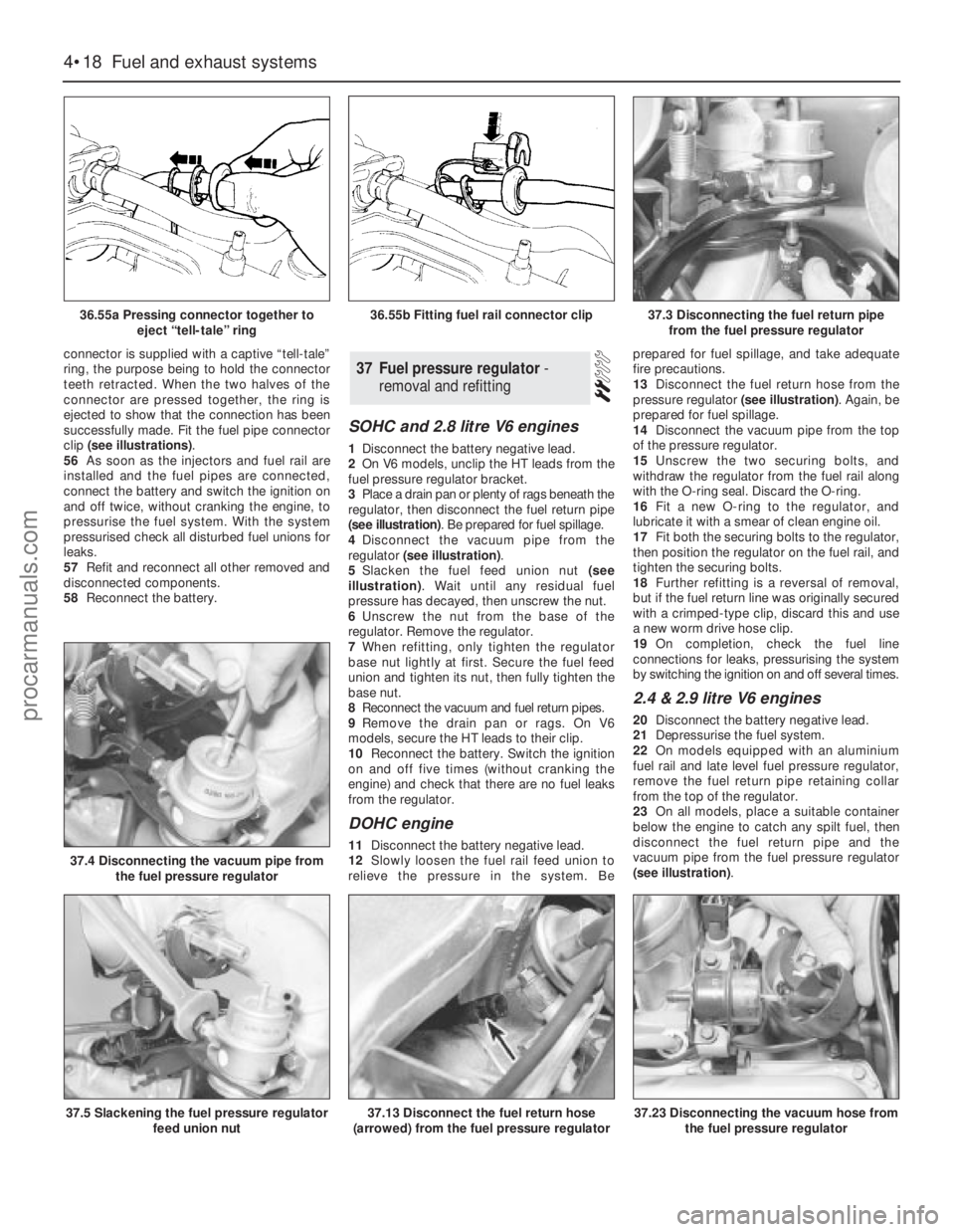
clip (see illustrations).
56As soon as the injectors and fuel rail are
installed and the fuel pipes are connected,
connect the battery and switch the ignition on
and off twice, without cranking the engine, to
pressurise the fuel system. With the system
pressurised check all disturbed fuel unions for
leaks.
57Refit and reconnect all other removed and
disconnected components.
58Reconnect the battery.
SOHC and 2.8 litre V6 engines
1Disconnect the battery negative lead.
2On V6 models, unclip the HT leads from the
fuel pressure regulator bracket.
3Place a drain pan or plenty of rags beneath the
regulator, then disconnect the fuel return pipe
(see illustration). Be prepared for fuel spillage.
4Disconnect the vacuum pipe from the
regulator (see illustration).
5Slacken the fuel feed union nut (see
illustration). Wait until any residual fuel
pressure has decayed, then unscrew the nut.
6Unscrew the nut from the base of the
regulator. Remove the regulator.
7When refitting, only tighten the regulator
base nut lightly at first. Secure the fuel feed
union and tighten its nut, then fully tighten the
base nut.
8Reconnect the vacuum and fuel return pipes.
9Remove the drain pan or rags. On V6
models, secure the HT leads to their clip.
10Reconnect the battery. Switch the ignition
on and off five times (without cranking the
engine) and check that there are no fuel leaks
from the regulator.
DOHC engine
11Disconnect the battery negative lead.
12Slowly loosen the fuel rail feed union to
relieve the pressure in the system. Beprepared for fuel spillage, and take adequate
fire precautions.
13Disconnect the fuel return hose from the
pressure regulator (see illustration). Again, be
prepared for fuel spillage.
14Disconnect the vacuum pipe from the top
of the pressure regulator.
15Unscrew the two securing bolts, and
withdraw the regulator from the fuel rail along
with the O-ring seal. Discard the O-ring.
16Fit a new O-ring to the regulator, and
lubricate it with a smear of clean engine oil.
17Fit both the securing bolts to the regulator,
then position the regulator on the fuel rail, and
tighten the securing bolts.
18Further refitting is a reversal of removal,
but if the fuel return line was originally secured
with a crimped-type clip, discard this and use
a new worm drive hose clip.
19On completion, check the fuel line
connections for leaks, pressurising the system
by switching the ignition on and off several times.
2.4 & 2.9 litre V6 engines
20Disconnect the battery negative lead.
21Depressurise the fuel system.
22On models equipped with an aluminium
fuel rail and late level fuel pressure regulator,
remove the fuel return pipe retaining collar
from the top of the regulator.
23On all models, place a suitable container
below the engine to catch any spilt fuel, then
disconnect the fuel return pipe and the
vacuum pipe from the fuel pressure regulator
(see illustration).
37Fuel pressure regulator -
removal and refitting
4•18Fuel and exhaust systems
36.55a Pressing connector together to
eject “tell-tale” ring
37.4 Disconnecting the vacuum pipe from
the fuel pressure regulator
37.5 Slackening the fuel pressure regulator
feed union nut37.13 Disconnect the fuel return hose
(arrowed) from the fuel pressure regulator37.23 Disconnecting the vacuum hose from
the fuel pressure regulator
36.55b Fitting fuel rail connector clip37.3 Disconnecting the fuel return pipe
from the fuel pressure regulator
procarmanuals.com
Page 112 of 255
24Unbolt and remove the regulator from the
fuel rail. Remove the sealing O-ring and
discard it; a new one must be used on
refitting.
25Refitting is a reverse of the removal
procedure applying a smear of clean engine oil
to the new regulator O-ring. On models
equipped with a late level regulator, ensure
that the return pipe is securely held in position
by the retaining collar.
26On completion, switch the ignition on and
off five times without cranking the engine to
pressurise the fuel system.
27With the system pressurised check all
disturbed fuel unions for signs of leakage.
1The potentiometer is located on the right-
hand side of the engine compartment, behind
the MAP sensor.
2Disconnect the battery negative lead.
3Remove the securing screw, then withdraw
the potentiometer and disconnect the wiring
plug.
4Refitting is a reversal of removal. On
completion adjust the idle mixture.1On 2.4 & 2.9 litre V6 engines, disconnect the
battery.
2Disconnect the switch wiring connector.
3Slacken and remove the switch from the
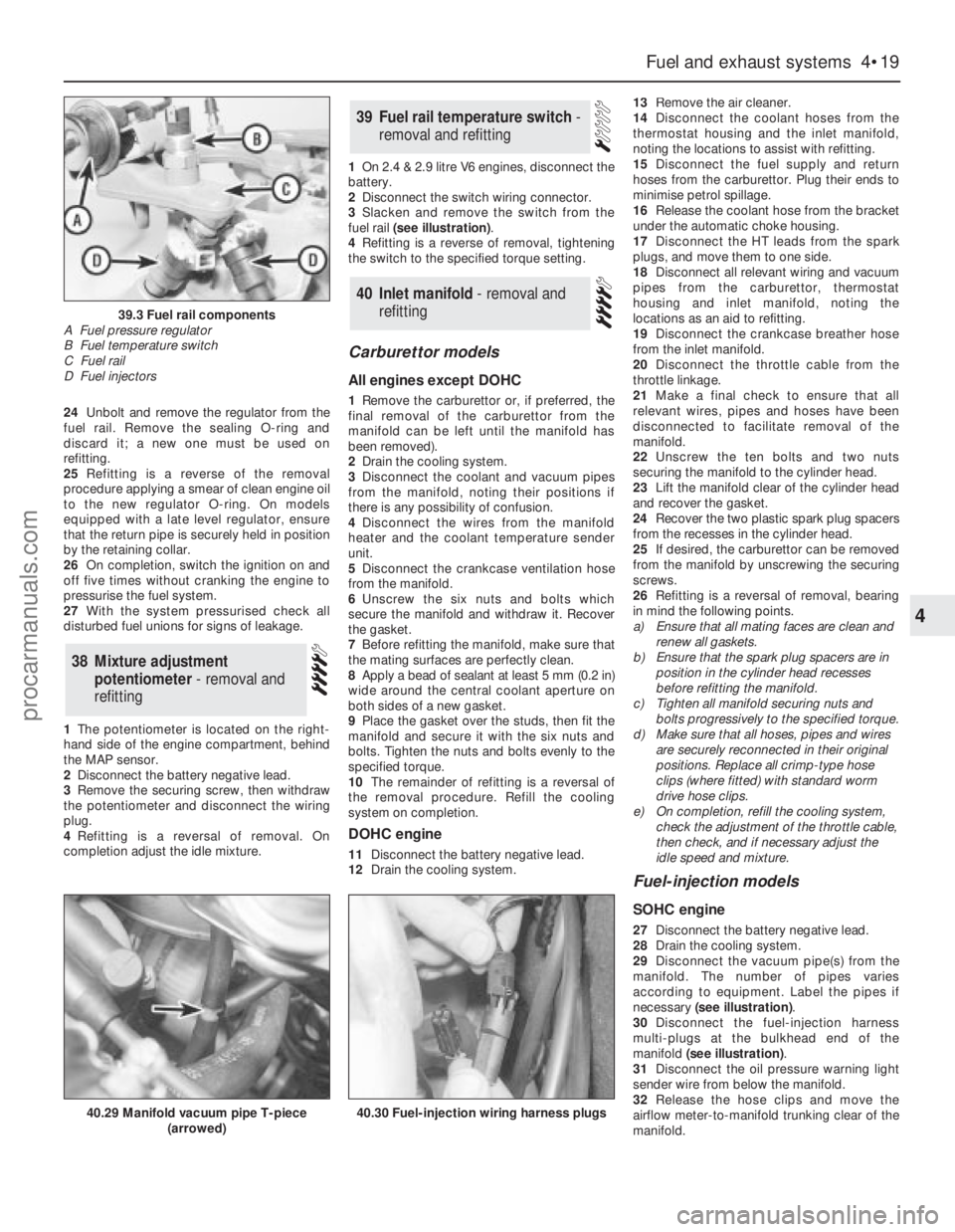
fuel rail (see illustration).
4Refitting is a reverse of removal, tightening
the switch to the specified torque setting.
Carburettor models
All engines except DOHC
1Remove the carburettor or, if preferred, the
final removal of the carburettor from the
manifold can be left until the manifold has
been removed).
2Drain the cooling system.
3Disconnect the coolant and vacuum pipes
from the manifold, noting their positions if
there is any possibility of confusion.
4Disconnect the wires from the manifold
heater and the coolant temperature sender
unit.
5Disconnect the crankcase ventilation hose
from the manifold.
6Unscrew the six nuts and bolts which
secure the manifold and withdraw it. Recover
the gasket.
7Before refitting the manifold, make sure that
the mating surfaces are perfectly clean.
8Apply a bead of sealant at least 5 mm (0.2 in)
wide around the central coolant aperture on
both sides of a new gasket.
9Place the gasket over the studs, then fit the
manifold and secure it with the six nuts and
bolts. Tighten the nuts and bolts evenly to the
specified torque.
10The remainder of refitting is a reversal of
the removal procedure. Refill the cooling
system on completion.
DOHC engine
11Disconnect the battery negative lead.
12Drain the cooling system.13Remove the air cleaner.
14Disconnect the coolant hoses from the
thermostat housing and the inlet manifold,
noting the locations to assist with refitting.
15Disconnect the fuel supply and return
hoses from the carburettor. Plug their ends to
minimise petrol spillage.
16Release the coolant hose from the bracket
under the automatic choke housing.
17Disconnect the HT leads from the spark
plugs, and move them to one side.
18Disconnect all relevant wiring and vacuum
pipes from the carburettor, thermostat
housing and inlet manifold, noting the
locations as an aid to refitting.
19Disconnect the crankcase breather hose
from the inlet manifold.
20Disconnect the throttle cable from the
throttle linkage.
21Make a final check to ensure that all
relevant wires, pipes and hoses have been
disconnected to facilitate removal of the
manifold.
22Unscrew the ten bolts and two nuts
securing the manifold to the cylinder head.
23Lift the manifold clear of the cylinder head
and recover the gasket.
24Recover the two plastic spark plug spacers
from the recesses in the cylinder head.
25If desired, the carburettor can be removed
from the manifold by unscrewing the securing
screws.
26Refitting is a reversal of removal, bearing
in mind the following points.
a)Ensure that all mating faces are clean and
renew all gaskets.
b)Ensure that the spark plug spacers are in
position in the cylinder head recesses
before refitting the manifold.
c)Tighten all manifold securing nuts and
bolts progressively to the specified torque.
d)Make sure that all hoses, pipes and wires
are securely reconnected in their original
positions. Replace all crimp-type hose
clips (where fitted) with standard worm
drive hose clips.
e)On completion, refill the cooling system,
check the adjustment of the throttle cable,
then check, and if necessary adjust the
idle speed and mixture.
Fuel-injection models
SOHC engine
27Disconnect the battery negative lead.
28Drain the cooling system.
29Disconnect the vacuum pipe(s) from the
manifold. The number of pipes varies
according to equipment. Label the pipes if
necessary (see illustration).
30Disconnect the fuel-injection harness
multi-plugs at the bulkhead end of the
manifold (see illustration).
31Disconnect the oil pressure warning light
sender wire from below the manifold.
32Release the hose clips and move the
airflow meter-to-manifold trunking clear of the
manifold.
40Inlet manifold - removal and
refitting
39Fuel rail temperature switch -
removal and refitting
38Mixture adjustment
potentiometer - removal and
refitting
Fuel and exhaust systems 4•19
4
39.3 Fuel rail components
A Fuel pressure regulator
B Fuel temperature switch
C Fuel rail
D Fuel injectors
40.29 Manifold vacuum pipe T-piece
(arrowed)40.30 Fuel-injection wiring harness plugs
procarmanuals.com
Page 121 of 255
1Disconnect the battery negative (earth) lead.
2Disconnect the battery positive leads. These
may be protected by a plastic cover. Do not
allow the spanner to bridge the positive and
negative terminals.
3Release the battery hold-down clamp. Lift
out the battery. Keep it upright and be careful
not to drop it - it is heavy.
4Commence by placing the battery in its tray,
making sure it is the right way round. Secure it
with the hold-down clamp.
5Clean the battery terminals if necessary
then reconnect them. Connect the positive
lead first, then the negative lead.
1Should it appear that the alternator is not
charging the battery, check first that the
drivebelt is intact and in good condition and
that its tension is correct. Also check the
condition and security of the alternator
electrical connections and the battery leads.
2Accurate assessment of alternator output
requires special equipment and a degree of
skill. A rough idea of whether output is
adequate can be gained by using a voltmeter
(range 0 to 15 or 0 to 20 volts) as follows.
3Connect the voltmeter across the battery
terminals. Switch on the headlights and note
the voltage reading: it should be between 12
and 13 volts.
4Start the engine and run it at a fast idle
(approx 1500 rpm). Read the voltmeter: it
should indicate 13 to 14 volts.
5With the engine still running at a fast idle,
switch on as many electrical consumers as
possible (heated rear window, heater blower
etc). The voltage at the battery should be
maintained at 13 to 14 volts. Increase the
engine speed slightly if necessary to keep the
voltage up.
6If alternator output is low or zero, check the
brushes. If the brushes are OK, seek expert
advice.7Occasionally the condition may arise where
the alternator output is excessive. Clues to this
condition are constantly blowing bulbs;
brightness of lights vary considerably with
engine speed; overheating of alternator and
battery, possible with steam or fumes coming
from the battery. This condition is almost
certainly due to a defective voltage regulator,
but expert advice should be sought.
8Note that the alternator voltage regulator
can be renewed without removing the
alternator from the vehicle. The procedure is
part of brush renewal.
1Disconnect the battery negative lead.
2Disconnect the multi-plug from the rear of
the alternator. It may be secured by a wire clip.
3Slacken the alternator adjusting and pivot
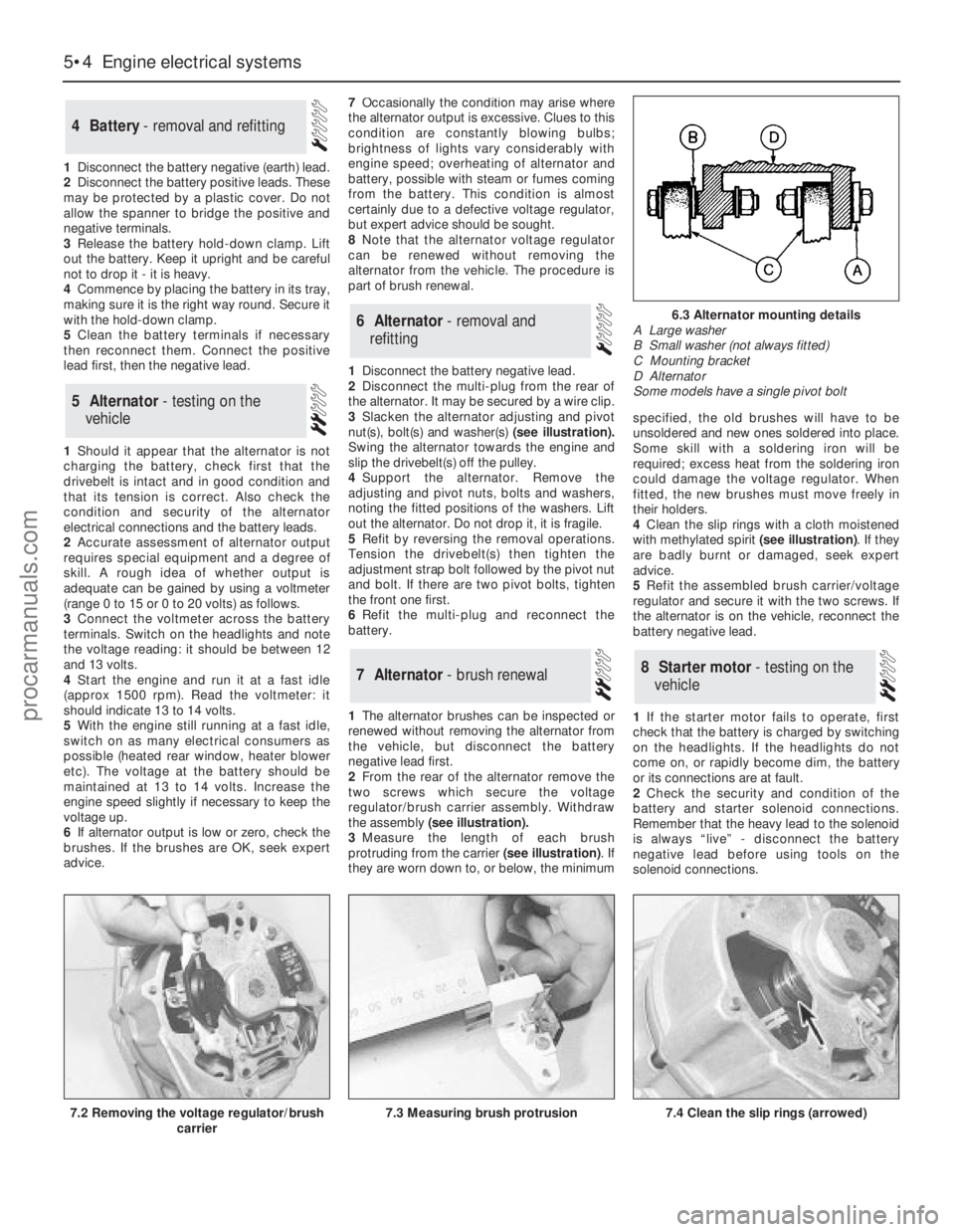
nut(s), bolt(s)and washer(s)(see illustration).
Swing the alternator towards the engine and
slip the drivebelt(s) off the pulley.
4Support the alternator. Remove the
adjusting and pivot nuts, bolts and washers,
noting the fitted positions of the washers. Lift
out the alternator. Do not drop it, it is fragile.
5Refit by reversing the removal operations.
Tension the drivebelt(s) then tighten the
adjustment strap bolt followed by the pivot nut
and bolt. If there are two pivot bolts, tighten
the front one first.
6Refit the multi-plug and reconnect the
battery.
1The alternator brushes can be inspected or
renewed without removing the alternator from
the vehicle, but disconnect the battery
negative lead first.
2From the rear of the alternator remove the
two screws which secure the voltage
regulator/brush carrier assembly. Withdraw
the assembly (see illustration).
3Measure the length of each brush
protruding from the carrier (see illustration). If
they are worn down to, or below, the minimumspecified, the old brushes will have to be
unsoldered and new ones soldered into place.
Some skill with a soldering iron will be
required; excess heat from the soldering iron
could damage the voltage regulator. When
fitted, the new brushes must move freely in
their holders.
4Clean the slip rings with a cloth moistened
with methylated spirit (see illustration). If they
are badly burnt or damaged, seek expert
advice.
5Refit the assembled brush carrier/voltage
regulator and secure it with the two screws. If
the alternator is on the vehicle, reconnect the
battery negative lead.
1If the starter motor fails to operate, first
check that the battery is charged by switching
on the headlights. If the headlights do not
come on, or rapidly become dim, the battery
or its connections are at fault.
2Check the security and condition of the
battery and starter solenoid connections.
Remember that the heavy lead to the solenoid
is always “live” - disconnect the battery
negative lead before using tools on the
solenoid connections.
8Starter motor - testing on the
vehicle7Alternator - brush renewal
6Alternator - removal and
refitting
5Alternator - testing on the
vehicle
4Battery - removal and refitting
5•4Engine electrical systems
7.3 Measuring brush protrusion7.4 Clean the slip rings (arrowed)
6.3 Alternator mounting details
A Large washer
B Small washer (not always fitted)
C Mounting bracket
D Alternator
Some models have a single pivot bolt
7.2 Removing the voltage regulator/brush
carrier
procarmanuals.com
Page 122 of 255
Solenoid check
3Disconnect the battery negative lead, and all
leads from the solenoid.
4Connect a battery and a 3 watt test lamp
between the solenoid body and the solenoid
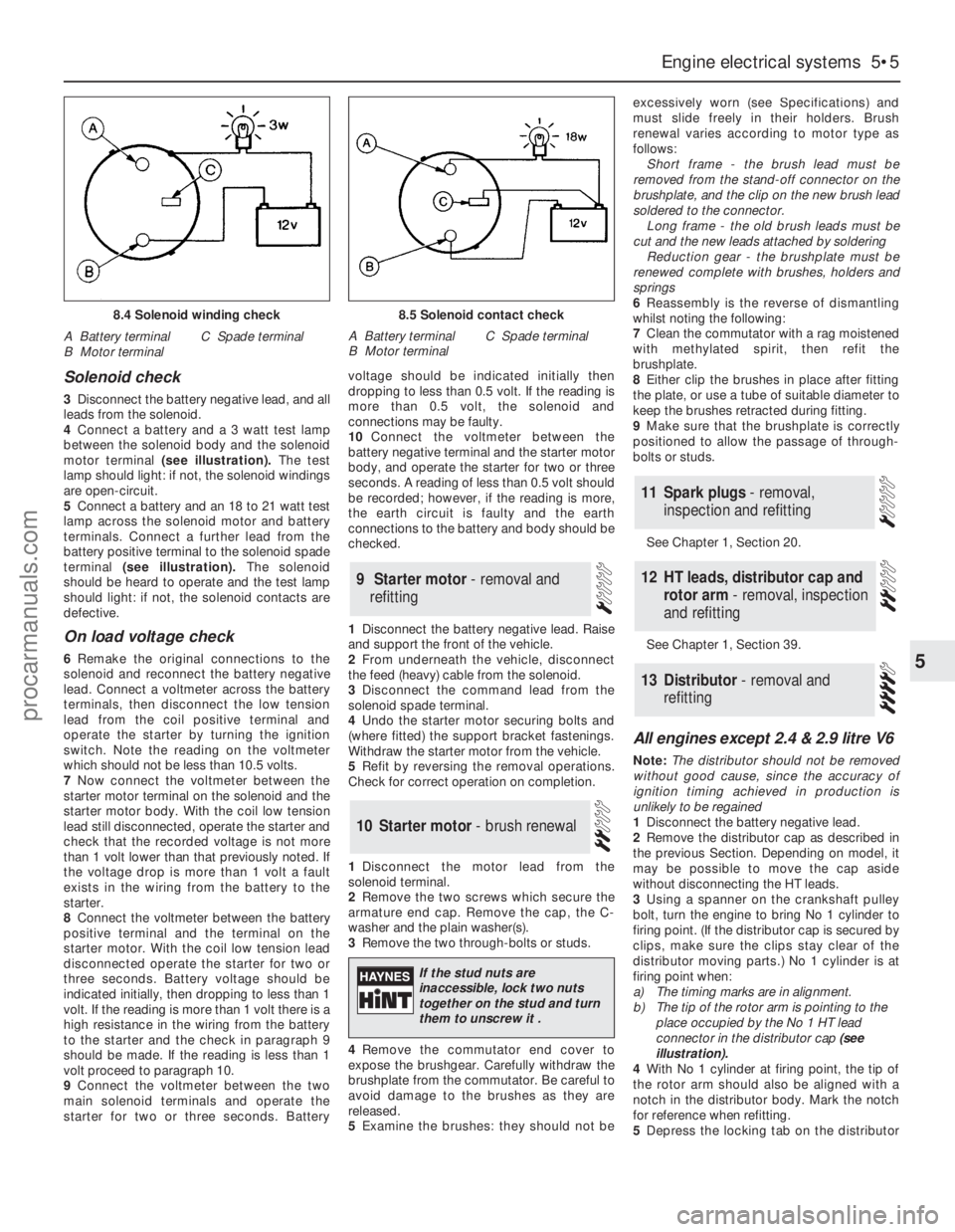
motor terminal (see illustration).The test
lamp should light: if not, the solenoid windings
are open-circuit.
5Connect a battery and an 18 to 21 watt test
lamp across the solenoid motor and battery
terminals. Connect a further lead from the
battery positive terminal to the solenoid spade
terminal(see illustration).The solenoid
should be heard to operate and the test lamp
should light: if not, the solenoid contacts are
defective.
On load voltage check
6Remake the original connections to the
solenoid and reconnect the battery negative
lead. Connect a voltmeter across the battery
terminals, then disconnect the low tension
lead from the coil positive terminal and
operate the starter by turning the ignition
switch. Note the reading on the voltmeter
which should not be less than 10.5 volts.
7Now connect the voltmeter between the
starter motor terminal on the solenoid and the
starter motor body. With the coil low tension
lead still disconnected, operate the starter and
check that the recorded voltage is not more
than 1 volt lower than thatpreviously noted. If
the voltage drop is more than 1 volt a fault
exists in the wiring from the battery to the
starter.
8Connect the voltmeter between the battery
positive terminal and the terminal on the
starter motor. With the coil low tension lead
disconnected operate the starter for two or
three seconds. Battery voltage should be
indicated initially, then dropping to less than 1
volt. If the reading is more than 1 volt there is a
high resistance in the wiring from the battery
to the starter and the check in paragraph 9
should be made. If the reading is less than 1
volt proceed to paragraph 10.
9Connect the voltmeter between the two
main solenoid terminals and operate the
starter for two or three seconds. Batteryvoltage should be indicated initially then
dropping to less than 0.5 volt. If the reading is
more than 0.5 volt, the solenoid and
connections may be faulty.
10Connect the voltmeter between the
battery negative terminal and the starter motor
body, and operate the starter for two or three
seconds. A reading of less than 0.5 volt should
be recorded; however, if the reading is more,
the earth circuit is faulty and the earth
connections to the battery and body should be
checked.
1Disconnect the battery negative lead. Raise
and support the front of the vehicle.
2From underneath the vehicle, disconnect
the feed (heavy) cable from the solenoid.
3Disconnect the command lead from the
solenoid spade terminal.
4Undo the starter motor securing bolts and
(where fitted) the support bracket fastenings.
Withdraw the starter motor from the vehicle.
5Refit by reversing the removal operations.
Check for correct operation on completion.
1Disconnect the motor lead from the
solenoid terminal.
2Remove the two screws which secure the
armature end cap. Remove the cap, the C-
washer and the plain washer(s).
3Remove the two through-bolts or studs.
4Remove the commutator end cover to
expose the brushgear. Carefully withdraw the
brushplate from the commutator. Be careful to
avoid damage to the brushes as they are
released.
5Examine the brushes: they should not beexcessively worn (see Specifications) and
must slide freely in their holders. Brush
renewal varies according to motor type as
follows:
Short frame - the brush lead must be
removed from the stand-off connector on the
brushplate, and the clip on the new brush lead
soldered to the connector.
Long frame - the old brush leads must be
cut and the new leads attached by soldering
Reduction gear - the brushplate must be
renewed complete with brushes, holders and
springs
6Reassembly is the reverse of dismantling
whilst noting the following:
7Clean the commutator with a rag moistened
with methylated spirit, then refit the
brushplate.
8Either clip the brushes in place after fitting
the plate, or use a tube of suitable diameter to
keep the brushes retracted during fitting.
9Make sure that the brushplate is correctly
positioned to allow the passage of through-
bolts or studs.
See Chapter 1, Section 20.
See Chapter 1, Section 39.
All engines except 2.4 & 2.9 litre V6
Note: The distributor should not be removed
without good cause, since the accuracy of
ignition timing achieved in production is
unlikely to be regained
1Disconnect the battery negative lead.
2Remove the distributor cap as described in
the previous Section. Depending on model, it
may be possible to move the cap aside
without disconnecting the HT leads.
3Using a spanner on the crankshaft pulley
bolt, turn the engine to bring No 1 cylinder to
firing point. (If the distributor cap is secured by
clips, make sure the clips stay clear of the
distributor moving parts.) No 1 cylinder is at
firing point when:
a)The timing marks are in alignment.
b)The tip of the rotor arm is pointing to the
place occupied by the No 1 HT lead
connector in the distributor cap (see
illustration).
4With No 1 cylinder at firing point, the tip of
the rotor arm should also be aligned with a
notch in the distributor body. Mark the notch
for reference when refitting.
5Depress the locking tab on the distributor
13Distributor - removal and
refitting
12HT leads, distributor cap and
rotor arm - removal, inspection
and refitting
11Spark plugs - removal,
inspection and refitting
10Starter motor - brush renewal
9Starter motor - removal and
refitting
Engine electrical systems 5•5
5
8.4 Solenoid winding check
A Battery terminal
B Motor terminalC Spade terminal
8.5 Solenoid contact check
A Battery terminal
B Motor terminalC Spade terminal
If the stud nuts are
inaccessible, lock two nuts
together on the stud and turn
them to unscrew it .
procarmanuals.com
Page 124 of 255
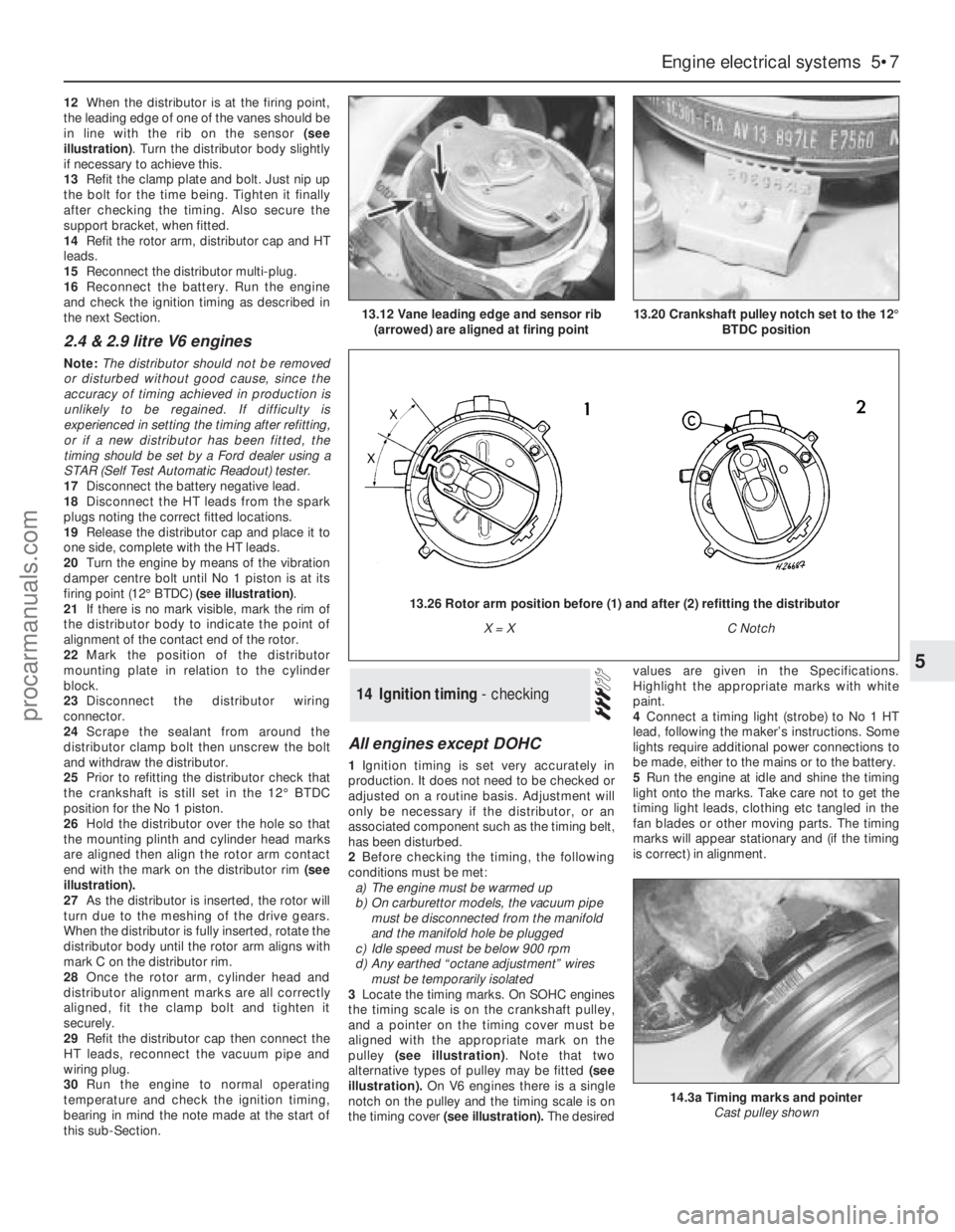
12When the distributor is at the firing point,
the leading edge of one of the vanes should be
in line with the rib on the sensor (see
illustration). Turn the distributor body slightly
if necessary to achieve this.
13Refit the clamp plate and bolt. Just nip up
the bolt for the time being. Tighten it finally
after checking the timing. Also secure the
support bracket, when fitted.
14Refit the rotor arm, distributor cap and HT
leads.
15Reconnect the distributor multi-plug.
16Reconnect the battery. Run the engine
and check the ignition timing as described in
the next Section.
2.4 & 2.9 litre V6 engines
Note: The distributor should not be removed
or disturbed without good cause, since the
accuracy of timing achieved in production is
unlikely to be regained. If difficulty is
experienced in setting the timing after refitting,
or if a new distributor has been fitted, the
timing should be set by a Ford dealer using a
STAR (Self Test Automatic Readout) tester.
17Disconnect the battery negative lead.
18Disconnect the HT leads from the spark
plugs noting the correct fitted locations.
19Release the distributor cap and place it to
one side, complete with the HT leads.
20Turn the engine by means of the vibration
damper centre bolt until No 1 piston is at its
firing point (12°BTDC) (see illustration).
21If there is no mark visible, mark the rim of
the distributor body to indicate the point of
alignment of the contact end of the rotor.
22Mark the position of the distributor
mounting plate in relation to the cylinder
block.
23Disconnect the distributor wiring
connector.
24Scrape the sealant from around the
distributor clamp bolt then unscrew the bolt
and withdraw the distributor.
25Prior to refitting the distributor check that
the crankshaft is still set in the 12°BTDC
position for the No 1 piston.
26Hold the distributor over the hole so that
the mounting plinth and cylinder head marks
are aligned then align the rotor arm contact
end with the mark on the distributor rim (see
illustration).
27As the distributor is inserted, the rotor will
turn due to the meshing of the drive gears.
When the distributor is fully inserted, rotate the
distributor body until the rotor arm aligns with
mark C on the distributor rim.
28Once the rotor arm, cylinder head and
distributor alignment marks are all correctly
aligned, fit the clamp bolt and tighten it
securely.
29Refit the distributor cap then connect the
HT leads, reconnect the vacuum pipe and
wiring plug.
30Run the engine to normal operating
temperature and check the ignition timing,
bearing in mind the note made at the start of
this sub-Section.
All engines except DOHC
1Ignition timing is set very accurately in
production. It does not need to be checked or
adjusted on a routine basis. Adjustment will
only be necessary if the distributor, or an
associated component such as the timing belt,
has been disturbed.
2Before checking the timing, the following
conditions must be met:
a)The engine must be warmed up
b)On carburettor models, the vacuum pipe
must be disconnected from the manifold
and the manifold hole be plugged
c)Idle speed must be below 900 rpm
d)Any earthed “octane adjustment” wires
must be temporarily isolated
3Locate the timing marks. On SOHC engines
the timing scale is on the crankshaft pulley,
and a pointer on the timing cover must be
aligned with the appropriate mark on the
pulley (see illustration). Note that two
alternative types of pulley may be fitted (see
illustration).On V6 engines there is a single
notch on the pulley and the timing scale is on
the timing cover (see illustration).The desiredvalues are given in the Specifications.
Highlight the appropriate marks with white
paint.
4Connect a timing light (strobe) to No 1 HT
lead, following the maker’s instructions. Some
lights require additional power connections to
be made, either to the mains or to the battery.
5Run the engine at idle and shine the timing
light onto the marks. Take care not to get the
timing light leads, clothing etc tangled in the
fan blades or other moving parts. The timing
marks will appear stationary and (if the timing
is correct) in alignment.
14Ignition timing - checking
Engine electrical systems 5•7
5
13.12 Vane leading edge and sensor rib
(arrowed) are aligned at firing point13.20 Crankshaft pulley notch set to the 12°
BTDC position
14.3a Timing marks and pointer
Cast pulley shown
13.26 Rotor arm position before (1) and after (2) refitting the distributor
X = XC Notch
procarmanuals.com
Page 125 of 255
6If adjustment is necessary, stop the engine.
Slacken the distributor clamp bolt and turn the
distributor body slightly. To retard the ignition
(move the mark nearer TDC) turn the
distributor body clockwise, and vice versato
advance the ignition. Tighten the clamp bolt
and re-check the timing.
7When adjustment is correct, stop the engine
and disconnect the timing light. Reconnect the
vacuum pipe, when applicable, and reconnect
any “octane adjustment” wires.
DOHC engine
8The ignition timing for this engine is
controlled by the ESC II or EEC IV module and
no adjustment is possible.
SOHC and 2.8 litre V6 engines
1Disconnect the battery negative lead.
2Disconnect the distributor multi-plug.
3On V6 models only, make alignment marks
between the distributor body and the engine.
Slacken the distributor clamp bolt and swivel
the distributor to make the module securing
screws accessible.
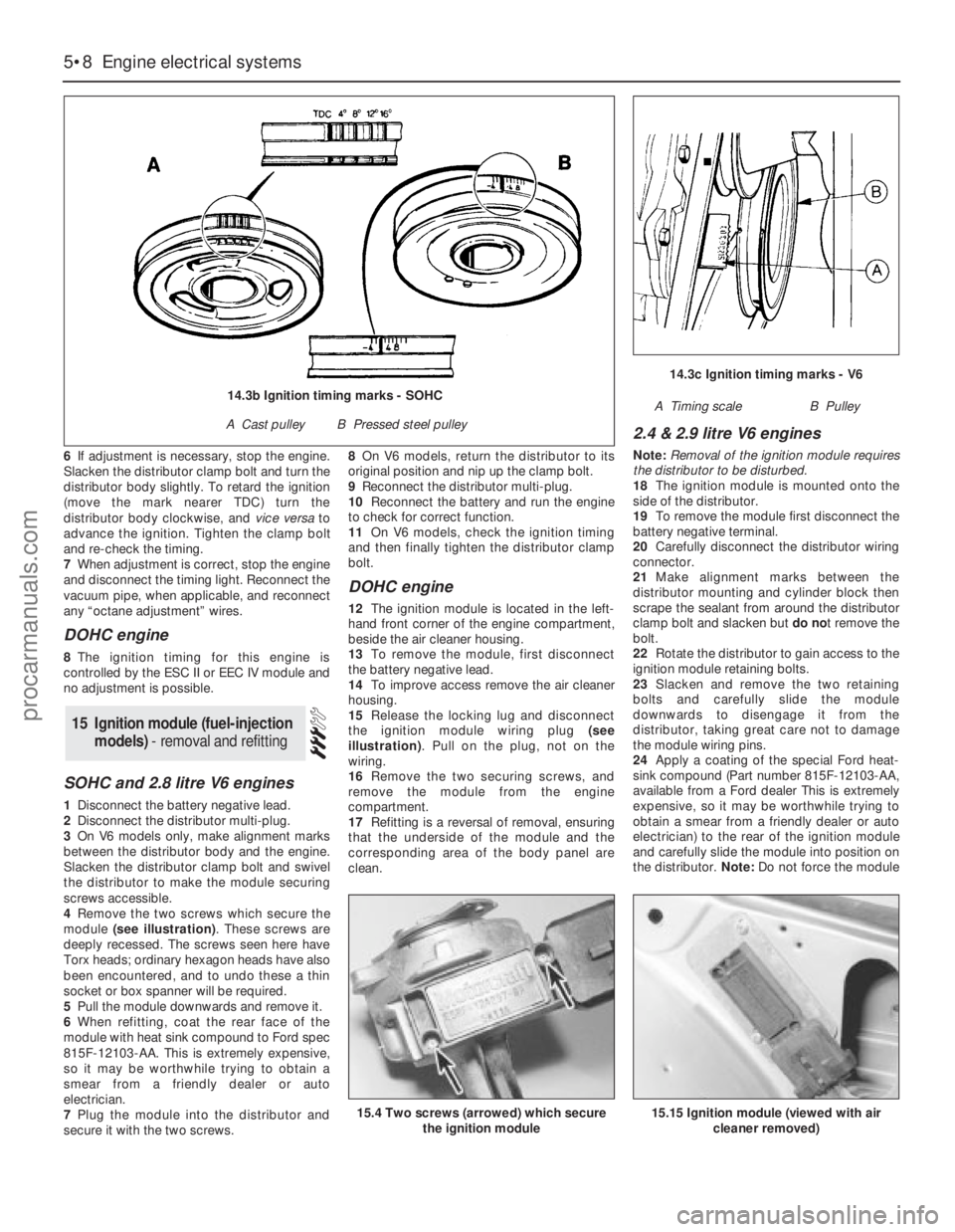
4Remove the two screws which secure the
module (see illustration). These screws are
deeply recessed. The screws seen here have
Torx heads; ordinary hexagon heads have also
been encountered, and to undo these a thin
socket or box spanner will be required.
5Pull the module downwards and remove it.
6When refitting, coat the rear face of the
module with heat sink compound to Ford spec
815F-12103-AA. This is extremely expensive,
so it may be worthwhile trying to obtain a
smear from a friendly dealer or auto
electrician.
7Plug the module into the distributor and
secure it with the two screws.8On V6 models, return the distributor to its
original position and nip up the clamp bolt.
9Reconnect the distributor multi-plug.
10Reconnect the battery and run the engine
to check for correct function.
11On V6 models, check the ignition timing
and then finally tighten the distributor clamp
bolt.
DOHC engine
12The ignition module is located in the left-
hand front corner of the engine compartment,
beside the air cleaner housing.
13To remove the module, first disconnect
the battery negative lead.
14To improve access remove the air cleaner
housing.
15Release the locking lug and disconnect
the ignition module wiring plug (see
illustration). Pull on the plug, not on the
wiring.
16Remove the two securing screws, and
remove the module from the engine
compartment.
17Refitting is a reversal of removal, ensuring
that the underside of the module and the
corresponding area of the body panel are
clean.
2.4 & 2.9 litre V6 engines
Note: Removal of the ignition module requires
the distributor to be disturbed.
18The ignition module is mounted onto the
side of the distributor.
19To remove the module first disconnect the
battery negative terminal.
20Carefully disconnect the distributor wiring
connector.
21Make alignment marks between the
distributor mounting and cylinder block then
scrape the sealant from around the distributor
clamp bolt and slacken but do not remove the
bolt.
22Rotate the distributor to gain access to the
ignition module retaining bolts.
23Slacken and remove the two retaining
bolts and carefully slide the module
downwards to disengage it from the
distributor, taking great care not to damage
the module wiring pins.
24Apply a coating of the special Ford heat-
sink compound (Part number 815F-12103-AA,
available from a Ford dealer This is extremely
expensive, so it may be worthwhile trying to
obtain a smear from a friendly dealer or auto
electrician) to the rear of the ignition module
and carefully slide the module into position on
the distributor. Note: Do not force the module
15Ignition module (fuel-injection
models) - removal and refitting
5•8Engine electrical systems
15.4 Two screws (arrowed) which secure
the ignition module15.15 Ignition module (viewed with air
cleaner removed)
14.3c Ignition timing marks - V6
A Timing scaleB Pulley14.3b Ignition timing marks - SOHC
A Cast pulleyB Pressed steel pulley
procarmanuals.com
Page 127 of 255
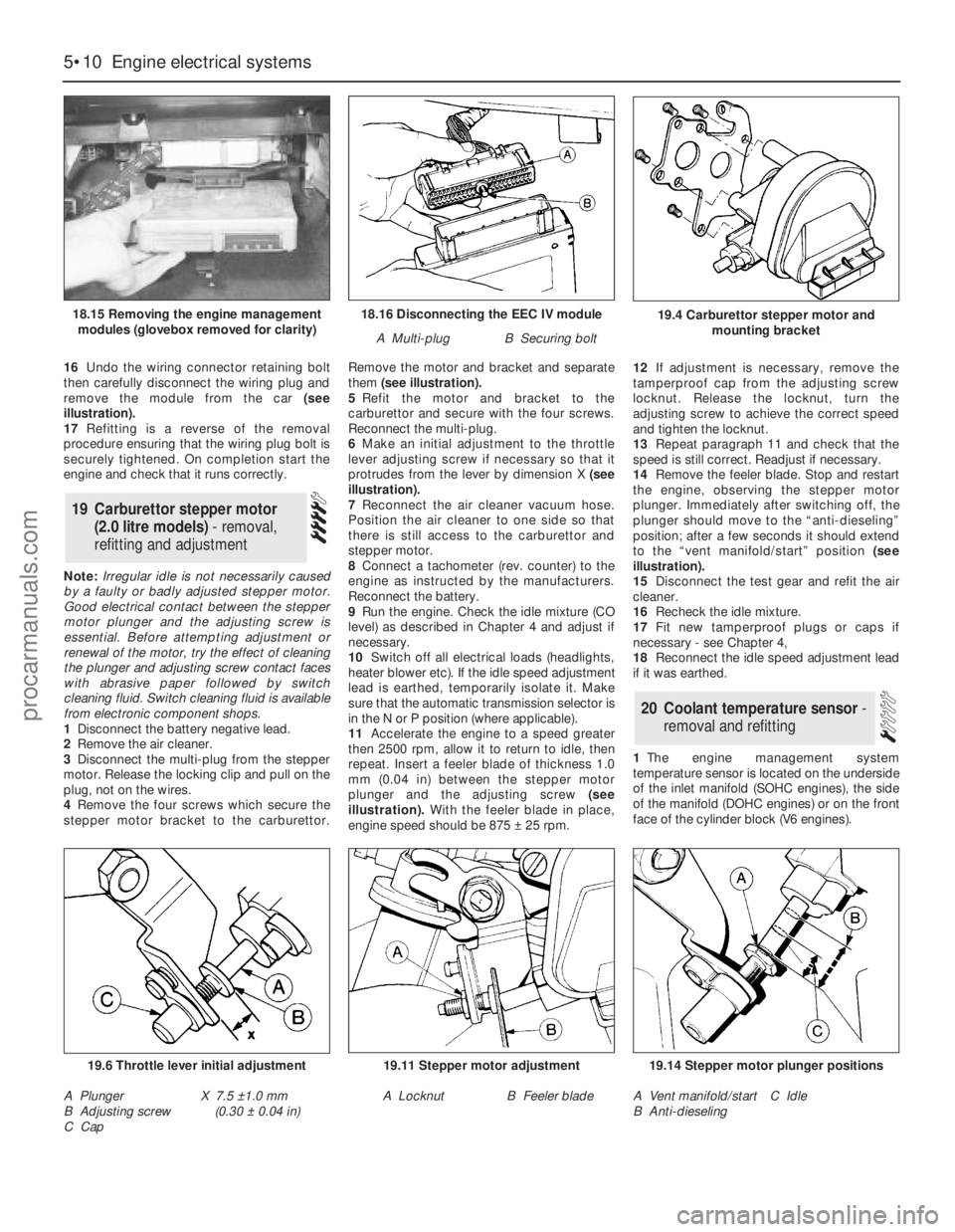
16Undo the wiring connector retaining bolt
then carefully disconnect the wiring plug and
remove the module from the car (see
illustration).
17Refitting is a reverse of the removal
procedure ensuring that the wiring plug bolt is
securely tightened. On completion start the
engine and check that it runs correctly.
Note: Irregular idle is not necessarily caused
by a faulty or badly adjusted stepper motor.
Good electrical contact between the stepper
motor plunger and the adjusting screw is
essential. Before attempting adjustment or
renewal of the motor, try the effect of cleaning
the plunger and adjusting screw contact faces
with abrasive paper followed by switch
cleaning fluid. Switch cleaning fluid is available
from electronic component shops.
1Disconnect the battery negative lead.
2Remove the air cleaner.
3Disconnect the multi-plug from the stepper
motor. Release the locking clip and pull on the
plug, not on the wires.
4Remove the four screws which secure the
stepper motor bracket to the carburettor.Remove the motor and bracket and separate
them (see illustration).
5Refit the motor and bracket to the
carburettor and secure with the four screws.
Reconnect the multi-plug.
6Make an initial adjustment to the throttle
lever adjusting screw if necessary so that it
protrudes from the lever by dimension X (see
illustration).
7Reconnect the air cleaner vacuum hose.
Position the air cleaner to one side so that
there is still access to the carburettor and
stepper motor.
8Connect a tachometer (rev. counter) to the
engine as instructed by the manufacturers.
Reconnect the battery.
9Run the engine. Check the idle mixture (CO
level) as described in Chapter 4 and adjust if
necessary.
10Switch off all electrical loads (headlights,
heater blower etc). If the idle speed adjustment
lead is earthed, temporarily isolate it. Make
sure that the automatic transmission selector is
in the N or P position (where applicable).
11Accelerate the engine to a speed greater
then 2500 rpm, allow it to return to idle, then
repeat. Insert a feeler blade of thickness 1.0
mm (0.04 in) between the stepper motor
plunger and the adjusting screw(see
illustration).With the feeler blade in place,
engine speed should be 875 ±25 rpm. 12If adjustment is necessary, remove the
tamperproof cap from the adjusting screw
locknut. Release the locknut, turn the
adjusting screw to achieve the correct speed
and tighten the locknut.
13Repeat paragraph 11 and check that the
speed is still correct. Readjust if necessary.
14Remove the feeler blade. Stop and restart
the engine, observing the stepper motor
plunger. Immediately after switching off, the
plunger should move to the “anti-dieseling”
position; after a few seconds it should extend
to the “vent manifold/start” position (see
illustration).
15Disconnect the test gear and refit the air
cleaner.
16Recheck the idle mixture.
17Fit new tamperproof plugs or caps if
necessary - see Chapter 4,
18Reconnect the idle speed adjustment lead
if it was earthed.
1The engine management system
temperature sensor is located on the underside
of the inlet manifold (SOHC engines), the side
of the manifold (DOHC engines) or on the front
face of the cylinder block (V6 engines).
20Coolant temperature sensor -
removal and refitting
19Carburettor stepper motor
(2.0 litre models) - removal,
refitting and adjustment
5•10Engine electrical systems
18.16 Disconnecting the EEC IV module
A Multi-plugB Securing bolt
19.6 Throttle lever initial adjustment
A Plunger
B Adjusting screw
C CapX 7.5 ±1.0 mm
(0.30 ±0.04 in)
19.11 Stepper motor adjustment
A LocknutB Feeler blade
19.14 Stepper motor plunger positions
A Vent manifold/start
B Anti-dieselingC Idle
19.4 Carburettor stepper motor and
mounting bracket18.15 Removing the engine management
modules (glovebox removed for clarity)
procarmanuals.com
Page 131 of 255
Models covered in this Manual have disc
brakes fitted all round. The footbrake operates
hydraulically on all four wheels, and the
handbrake operates mechanically on the rear
wheels. Both footbrake and handbrake are
self-adjusting in use.
Ford’s anti-lock braking system (ABS) is
fitted to all models. The system monitors the
rotational speed of each roadwheel. When a
wheel begins to lock under heavy braking, the
ABS reduces the hydraulic pressure to that
wheel, so preventing it from locking. When this
happens a pulsating effect will be noticed at
the brake pedal. On some road surfaces the
tyres may squeal when braking hard even
though the wheels are not locked.
The main components of the system are the
hydraulic unit, the calipers, pads and discs,
the wheel sensors and the “brain” or control
module. The hydraulic unit contains the
elements of a traditional master cylinder, plus
an electric motor and pump, a pressure
accumulator and control valves. The pump is
the source of pressure for the system and
does away with the need for a vacuum servo.
The hydraulic circuit is split front and rear,
as is normal practice with rear-wheel drive
vehicles. In the event that the hydraulic pump
fails, unassisted braking effort is still available
on the front calipers only.
Warning lights inform the driver of low brake
fluid level, ABS failure and (on some models)
brake pad wear. The low fluid level light
doubles as a “handbrake on” light; if it
illuminates at the same time as the ABS
warning light, it warns of low hydraulic
pressure.
ABS cannot overturn the laws of physics:
stopping distances will inevitably be greater on
loose or slippery surfaces. However, the system
should allow even inexperienced drivers to
retain directional control under panic braking.
From August 1986 the following
modifications were made to the braking
system.
a)The relays differ from earlier versions.b)The hydraulic pump is constructed of iron
rather than alloy.
c)A new pressure warning switch is used.
d)The earlier high pressure rubber hose is
replaced by a steel pipe.
To overcome the problem of excessive rear
brake pad wear, Ford introduced a differential
valve which is screwed into the ABS valve
block.The valve limits the pressure applied to
the rear brake calipers and so reduces brake
pad wear. From 1988 onwards, the valve has
been fitted during production. The differential
valve can also be fitted to earlier models. Refer
to your Ford dealer for further information.
From April 1992 onwards, the models
covered in this Manual were equipped with a
new Teves MK IV anti-lock braking system
instead of the Teves MK II system fitted to the
earlier models.
The Teves MK IV system differs from the
earlier MK II system in the following ways.
a)The source of hydraulic pressure for the
system is a conventional master cylinder
and vacuum servo assembly.
b)A valve block and pump assembly is used
instead of the hydraulic control unit. The
block contains the inlet and outlet
solenoid valves that control the hydraulic
system. There are three pairs of valves,
one for each brake circuit (paragraph c).
c)The hydraulic braking system consists of
three separate circuits; one for each front
brake (which are totally independent of
each other), and a joint circuit which
operates both rear brakes.
d)A G (gravity) switch is incorporated in the
system. This is an inertia type switch and
informs the control module when the
vehicle is decelerating rapidly.
e)A Pedal Travel Sensor (PTS) is fitted to the
vacuum servo unit. The PTS informs the
control module of the position of the brake
pedal when the anti-lock sequence starts
and ensures that a constant pedal height
is maintained during the sequence.
The MK IV system operates as follows.
During normal operation the system
functions in the same way as a non-ABS
system would. During this time the three inlet
valves in the valve block are open and theoutlet valves are closed, allowing full hydraulic
pressure present in the master cylinder to act
on the main braking circuit. If the control
module receives a signal from one of the
wheel sensors and senses that a wheel is
about to lock, it closes the relevant inlet valve
in the valve block which then isolates the
brake caliper on the wheel which is about to
lock from the master cylinder, effectively
sealing in the hydraulic pressure. If the speed
of rotation of the wheel continues to decrease
at an abnormal rate, the control module will
then open the relevant outlet valve in the valve
block; this allows the fluid from the relevant
hydraulic circuit to return to the master
cylinder reservoir, releasing pressure on the
brake caliper so that the brake is released. The
pump in the valve block also operates to assist
in the quick release of pressure. Once the
speed of rotation of the wheel returns to an
acceptable rate the pump stops, the outlet
valve closes and the inlet valve is opened,
allowing the hydraulic master cylinder
pressure to return to the caliper which then
reapplies the brake. This cycle can be carried
many times a second. The solenoid valves
connected to the front calipers operate
independently, but the valve connected to the
rear calipers operates both calipers
simultaneously.
The operation of the ABS system is entirely
dependent on electrical signals. To prevent
the system responding to any inaccurate
signals, a built-in safety circuit monitors all
signals received by the control module. If an
inaccurate signal or low battery voltage is
detected, the ABS system is automatically
shut down and the warning lamp on the
instrument cluster is illuminated to inform the
driver that the ABS system is not operational.
Whilst in this state the system functions in the
same way as a non-ABS system would. If a
fault does develop in the ABS system, the car
must be taken to a Ford dealer for fault
diagnosis and repair. The system is equipped
with a diagnostic plug into which a special
diagnostic (STAR) tester can be plugged. This
allows faults to be easily traced.
1General information
10•2Braking system
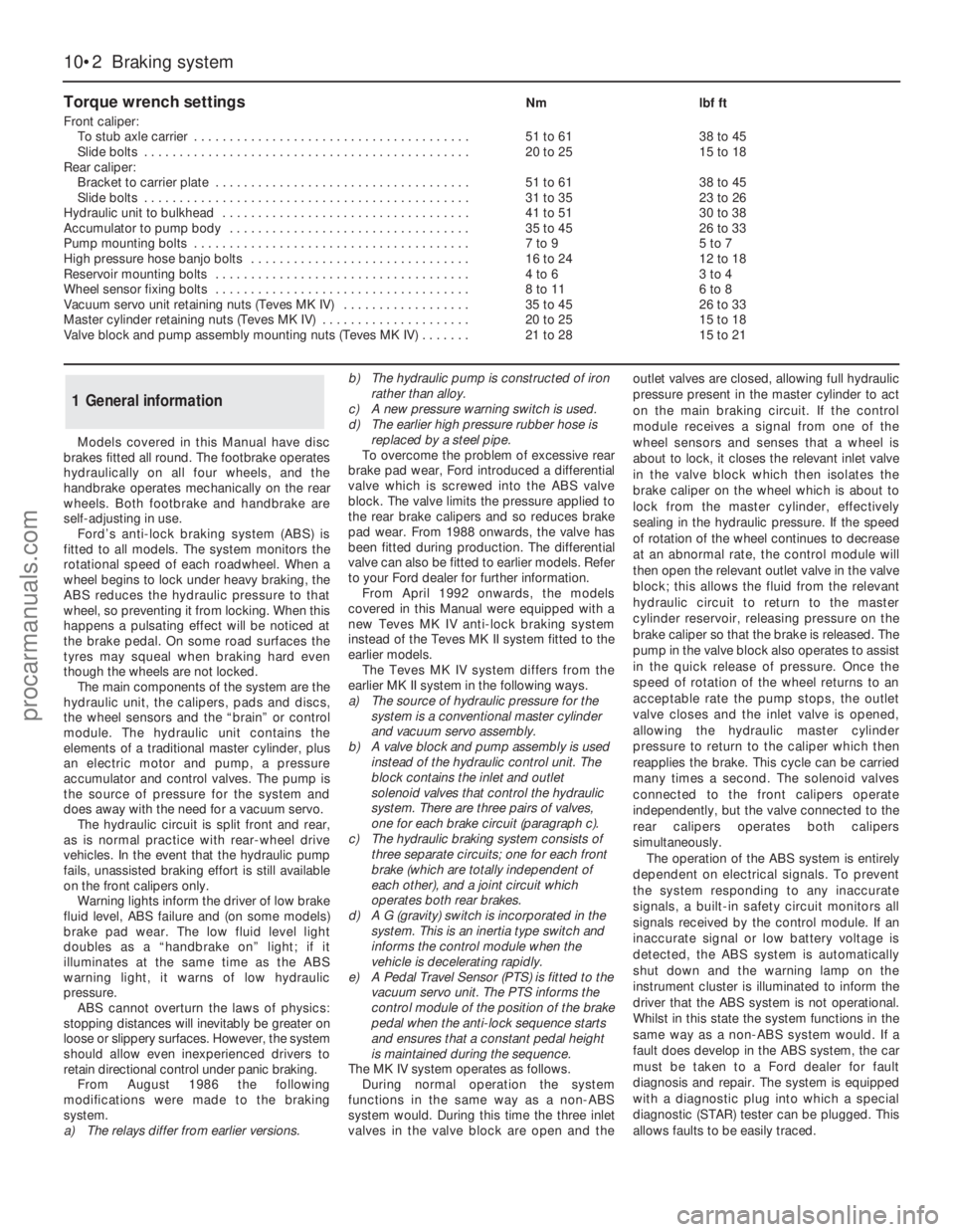
Torque wrench settingsNmlbf ft
Front caliper:
To stub axle carrier . . . . . . . . . . . . . . . . . . . . . . . . . . . . . . . . . . . . . . .51 to 6138 to 45
Slide bolts . . . . . . . . . . . . . . . . . . . . . . . . . . . . . . . . . . . . . . . . . . . . . .20 to 2515 to 18
Rear caliper:
Bracket to carrier plate . . . . . . . . . . . . . . . . . . . . . . . . . . . . . . . . . . . .51 to 6138 to 45
Slide bolts . . . . . . . . . . . . . . . . . . . . . . . . . . . . . . . . . . . . . . . . . . . . . .31 to 3523 to 26
Hydraulic unit to bulkhead . . . . . . . . . . . . . . . . . . . . . . . . . . . . . . . . . . .41 to 5130 to 38
Accumulator to pump body . . . . . . . . . . . . . . . . . . . . . . . . . . . . . . . . . .35 to 4526 to 33
Pump mounting bolts . . . . . . . . . . . . . . . . . . . . . . . . . . . . . . . . . . . . . . .7 to 95 to 7
High pressure hose banjo bolts . . . . . . . . . . . . . . . . . . . . . . . . . . . . . . .16 to 2412 to 18
Reservoir mounting bolts . . . . . . . . . . . . . . . . . . . . . . . . . . . . . . . . . . . .4 to 63 to 4
Wheel sensor fixing bolts . . . . . . . . . . . . . . . . . . . . . . . . . . . . . . . . . . . .8 to 116 to 8
Vacuum servo unit retaining nuts (Teves MK IV) . . . . . . . . . . . . . . . . . .35 to 4526 to 33
Master cylinder retaining nuts (Teves MK IV) . . . . . . . . . . . . . . . . . . . . .20 to 2515 to 18
Valve block and pump assembly mounting nuts (Teves MK IV) . . . . . . .21 to 2815 to 21
procarmanuals.com