battery FORD GT 2005 1.G User Guide
[x] Cancel search | Manufacturer: FORD, Model Year: 2005, Model line: GT, Model: FORD GT 2005 1.GPages: 200, PDF Size: 17.38 MB
Page 77 of 200
Second stage: Checking tire pressure
1. Stop driving after approximately two miles. Refer to theTips for use
of the tire inflation kit for safe operation of the tire inflation kit. Then
check the air pressure of the damaged tire as follows:
• Ensure the compressor is turned off by pressing the “O ” side of the
orange button.
• Remove the hose and the cable with the electrical plug from the kit ’s
storage compartment.
• Remove the valve cap from the sealed tire, then screw the hose firmly
onto the tire ’s air valve.
• Start the engine (only if the vehicle is outdoors or in a
well-ventilated area) to prevent the vehicle’s battery from draining.
• Insert the electrical plug into the vehicle ’s power point.
• Read the air pressure gauge on the inflation kit.
2. If the air pressure reads 19 psi or higher, switch the air compressor on
by pressing the “I” side of the orange button and adjust the air pressure
to the recommended pressure. This pressure can be found on a label
affixed to the B-Pillar. If the air pressure is higher than the label states,
reduce the excess pressure by pressing down on the pressure release
valve (8).
2005 GT(gto)
Owners Guide (post-2002-fmt)
USA_English (fus)
Tires, Wheels and Loading
77
Page 79 of 200
Note:If you experience any unusual vibration, ride disturbance or noise
while driving, reduce your speed until you can safely pull off to the side
of the road to call for roadside assistance.
You can check the tire pressure any time within the 120 miles by
performing the following:
1. Ensure the compressor is turned off by pressing the “O ” side of the
orange button.
2. Remove the hose and the cable with the electrical plug from the kit ’s
storage compartment.
3. Remove the valve cap from the sealed tire, then screw the hose firmly
onto the tire ’s air valve.
4. Insert the electrical plug into the vehicle ’s power point.
5. Start the engine (only if the vehicle is outdoors or in a
well-ventilated area) to prevent the vehicle’s battery from draining.
6. Read the air pressure gauge on the inflation kit.
If the tire pressure needs to be increased, operate the air compressor
and inflate the tire to the recommended pressure as indicated on the
label on the B-Pillar.
WHEEL LUG NUT TORQUE SPECIFICATIONS
Retighten the lug nuts to the specified torque at 500 miles (800 km)
after any wheel disturbance (tire rotation, changing a flat tire, wheel
removal, etc.).
Bolt size Wheel lug nut torque* lb.ft. N•m
1⁄2x 20 100 135
* Torque specifications are for nut and bolt threads free of dirt and
rust. Use only Ford recommended replacement fasteners.
When a wheel is installed, always remove any corrosion, dirt or
foreign materials present on the mounting surfaces of the wheel
or the surface of the front disc brake hub and rotor that contacts the
wheel. Installing wheels without correct metal-to-metal contact at
the wheel mounting surfaces can cause the wheel nuts to loosen
and the wheel to come off while the vehicle is in motion, resulting in
loss of control.
2005 GT(gto)
Owners Guide (post-2002-fmt)
USA_English (fus)
Tires, Wheels and Loading
79
Page 97 of 200
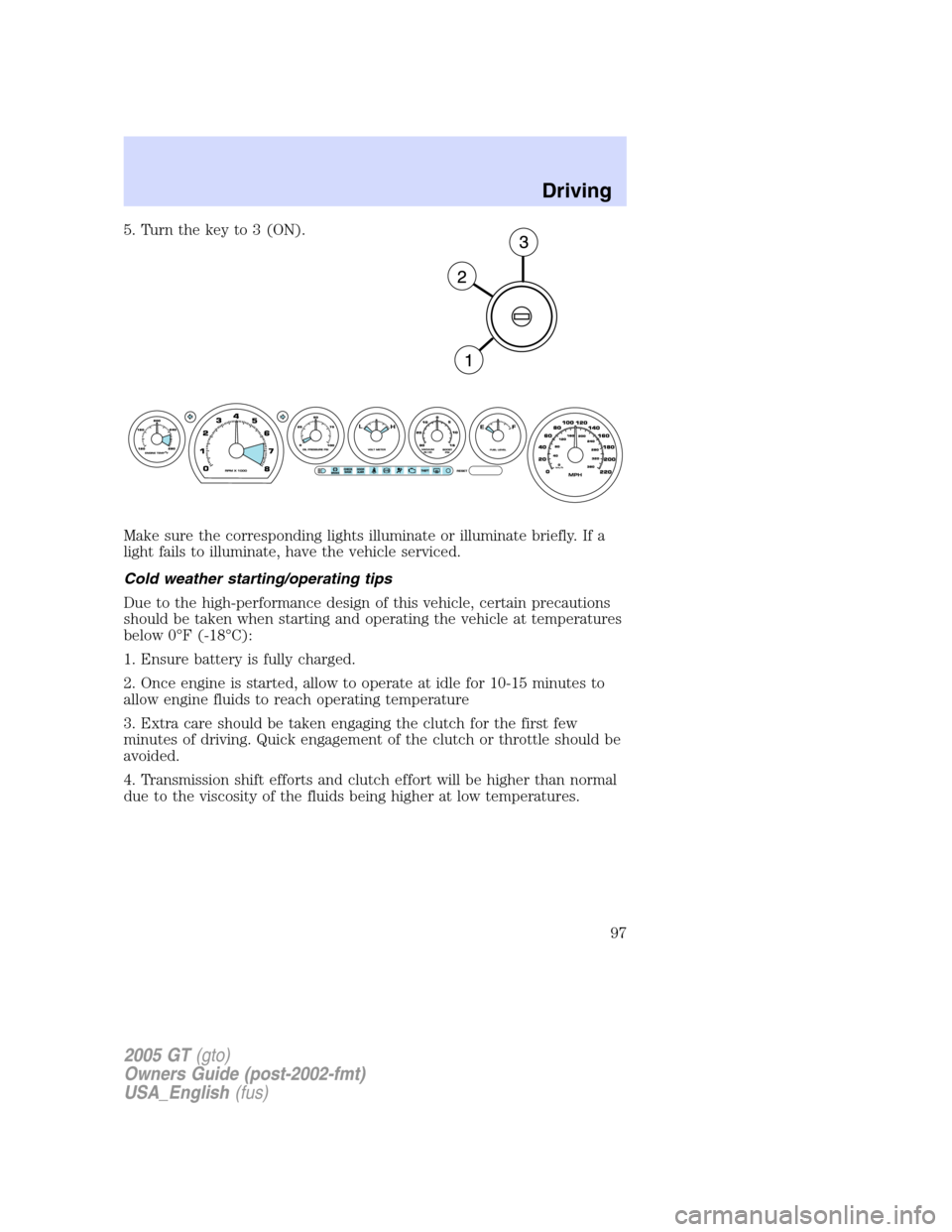
5. Turn the key to 3 (ON).
Make sure the corresponding lights illuminate or illuminate briefly. If a
light fails to illuminate, have the vehicle serviced.
Cold weather starting/operating tips
Due to the high-performance design of this vehicle, certain precautions
should be taken when starting and operating the vehicle at temperatures
below 0°F (-18 °C):
1. Ensure battery is fully charged.
2. Once engine is started, allow to operate at idle for 10-15 minutes to
allow engine fluids to reach operating temperature
3. Extra care should be taken engaging the clutch for the first few
minutes of driving. Quick engagement of the clutch or throttle should be
avoided.
4. Transmission shift efforts and clutch effort will be higher than normal
due to the viscosity of the fluids being higher at low temperatures.
2005 GT(gto)
Owners Guide (post-2002-fmt)
USA_English (fus)
Driving
97
Page 105 of 200
GETTING ROADSIDE ASSISTANCE
To fully assist you should you have a vehicle concern, Ford Motor
Company offers a complimentary roadside assistance program. This
program is separate from the New Vehicle Limited Warranty. The service
is available:
•24–hours, seven days a week
• for the New Vehicle Limited Warranty period of three years or 36,000
miles (60,000 km), whichever occurs first on Ford and Mercury
vehicles, and four years or 50,000 miles (80,000 km) on Lincoln
vehicles.
Roadside assistance will cover:
• a flat tire change with a good spare (except Ford GT which has a tire
inflation kit)
• battery jump start
• lock-out assistance (key replacement cost is the customer ’s
responsibility)
• fuel delivery (2.0 gallons [7.5L], maximum two occurrences within 12
month period)
• towing of your disabled vehicle to the nearest Ford Motor Company
dealership, or your selling dealer if within 35 miles (56.3 km) of the
nearest Ford Motor Company dealership (one tow per disablement).
Even non-warranty related tows, like accidents, are covered (some
exclusions apply, such as impound towing or repossession).
Canadian customers refer to your Owner Information Guide for
information on:
• coverage period
• exact fuel amounts
• towing of your disabled vehicle
• emergency travel expense reimbursement
• travel planning benefits
USING ROADSIDE ASSISTANCE
Complete the roadside assistance identification card and place it in your
wallet for quick reference. In the United States, this card is found in the
Owner Guide portfolio in the glove compartment. In Canada, the card is
found in the Owner Information Guide in the glove compartment.
U.S. Ford or Mercury vehicle customers who require roadside assistance,
call 1 –800 –241 –3673; Lincoln vehicle customers call 1 –800 –521 –4140.
2005 GT(gto)
Owners Guide (post-2002-fmt)
USA_English (fus)
Roadside Emergencies
Roadside Emergencies
105
Page 106 of 200
Canadian customers who require roadside assistance, call
1–800 –665 –2006.
If you need to arrange roadside assistance for yourself, Ford Motor
Company will reimburse a reasonable amount. To obtain reimbursement
information, U.S. Ford or Mercury vehicles customers call
1-800-241-3673; Lincoln vehicle customers call 1 –800 –521 –4140.
Canadian customers who need to obtain reimbursement information, call
1 –800 –665 –2006.
ROADSIDE COVERAGE BEYOND BASIC WARRANTY
In the United States, you may purchase additional roadside assistance
coverage beyond this period through the Ford Auto Club by contacting
your Ford or Lincoln/Mercury dealer.
Similarly in Canada, for uninterrupted Roadside Assistance coverage, you
may purchase extended coverage prior to your Basic Warranty ’s Roadside
Assistance expiring. For more information and enrollment, contact
1 –877 –294 –2582 or visit our website at www.ford.ca.
HAZARD FLASHER
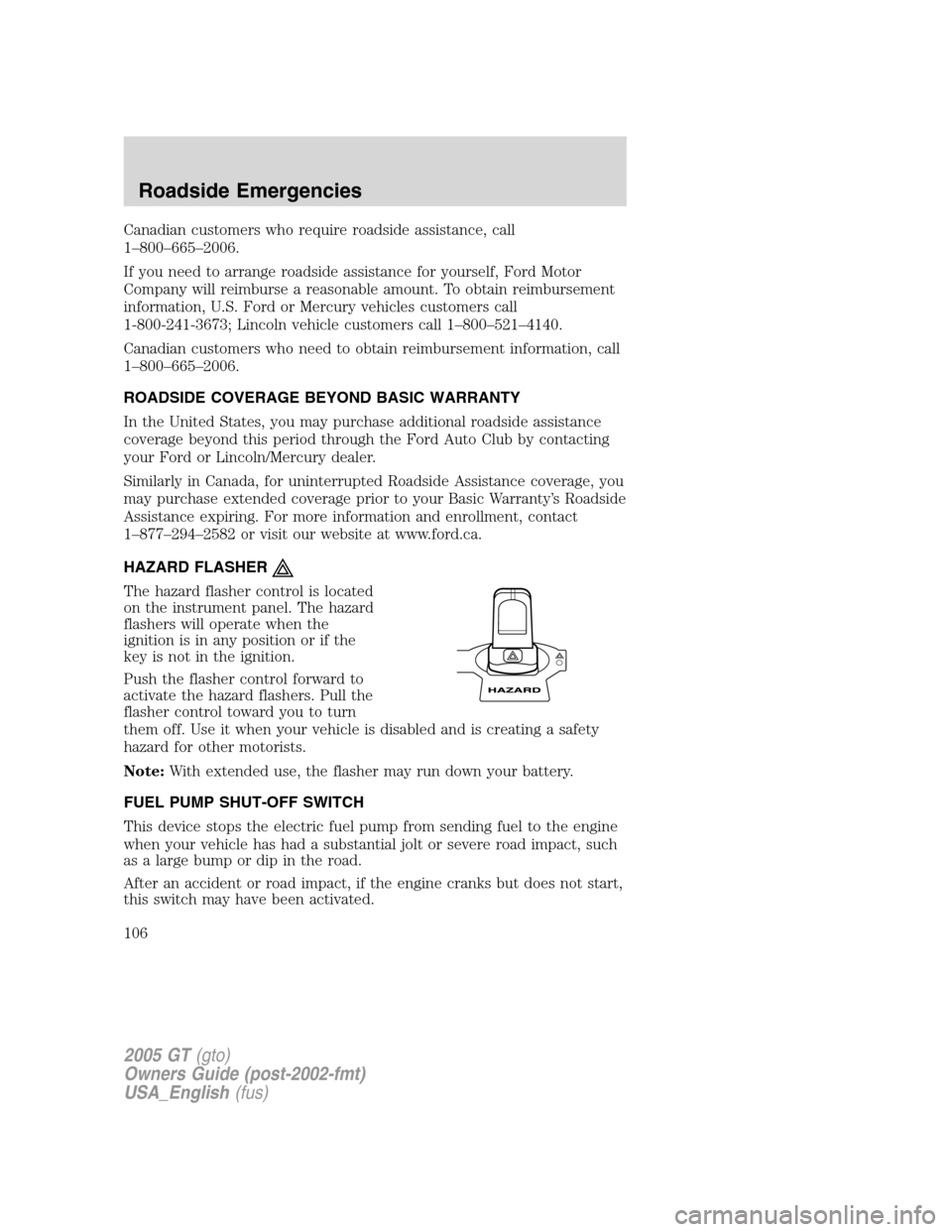
The hazard flasher control is located
on the instrument panel. The hazard
flashers will operate when the
ignition is in any position or if the
key is not in the ignition.
Push the flasher control forward to
activate the hazard flashers. Pull the
flasher control toward you to turn
them off. Use it when your vehicle is disabled and is creating a safety
hazard for other motorists.
Note: With extended use, the flasher may run down your battery.
FUEL PUMP SHUT-OFF SWITCH
This device stops the electric fuel pump from sending fuel to the engine
when your vehicle has had a substantial jolt or severe road impact, such
as a large bump or dip in the road.
After an accident or road impact, if the engine cranks but does not start,
this switch may have been activated.
2005 GT(gto)
Owners Guide (post-2002-fmt)
USA_English (fus)
Roadside Emergencies
106
Page 111 of 200
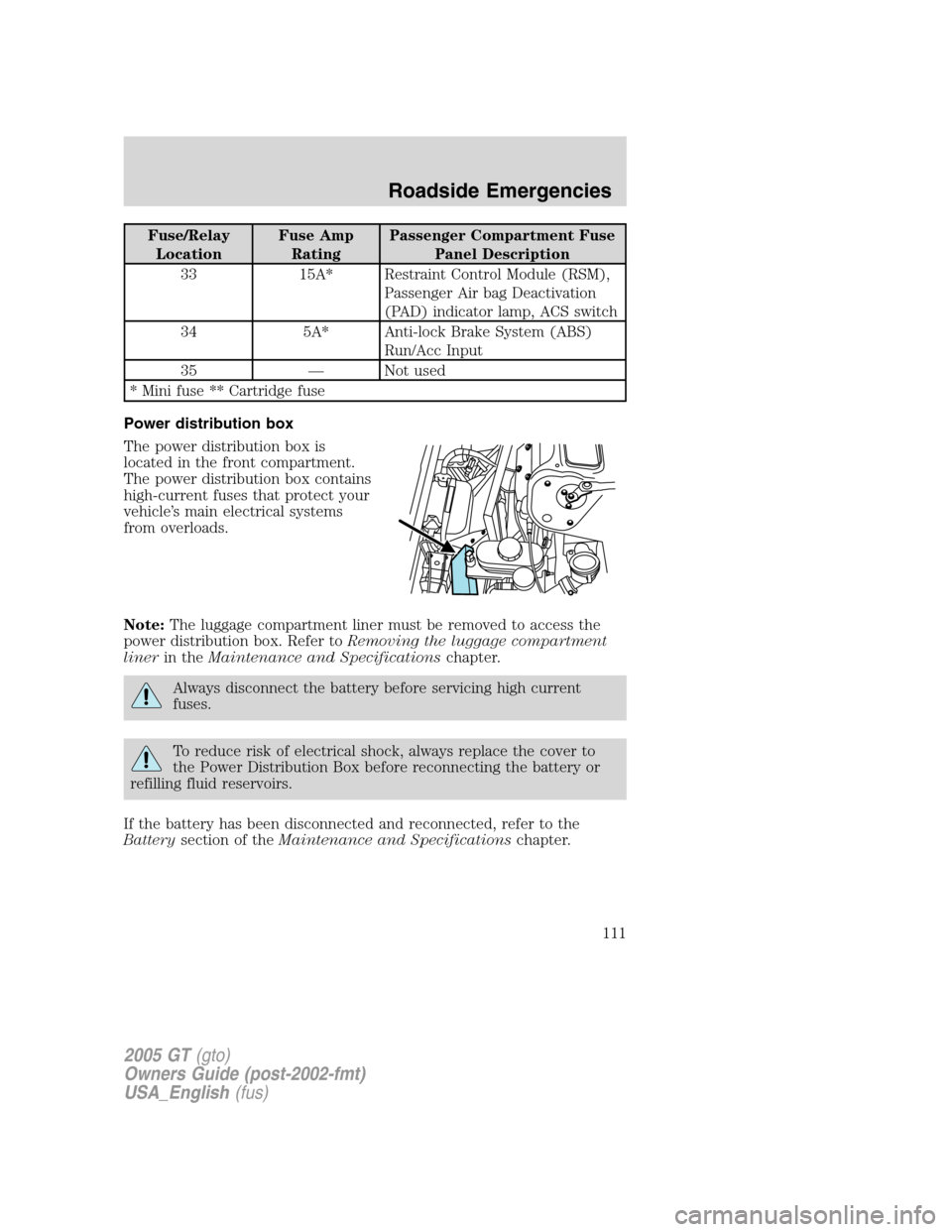
Fuse/RelayLocation Fuse Amp
Rating Passenger Compartment Fuse
Panel Description
33 15A* Restraint Control Module (RSM), Passenger Air bag Deactivation
(PAD) indicator lamp, ACS switch
34 5A* Anti-lock Brake System (ABS) Run/Acc Input
35 —Not used
* Mini fuse ** Cartridge fuse
Power distribution box
The power distribution box is
located in the front compartment.
The power distribution box contains
high-current fuses that protect your
vehicle ’s main electrical systems
from overloads.
Note: The luggage compartment liner must be removed to access the
power distribution box. Refer to Removing the luggage compartment
liner in the Maintenance and Specifications chapter.
Always disconnect the battery before servicing high current
fuses.
To reduce risk of electrical shock, always replace the cover to
the Power Distribution Box before reconnecting the battery or
refilling fluid reservoirs.
If the battery has been disconnected and reconnected, refer to the
Battery section of the Maintenance and Specifications chapter.
2005 GT(gto)
Owners Guide (post-2002-fmt)
USA_English(fus)
Roadside Emergencies
111
Page 115 of 200
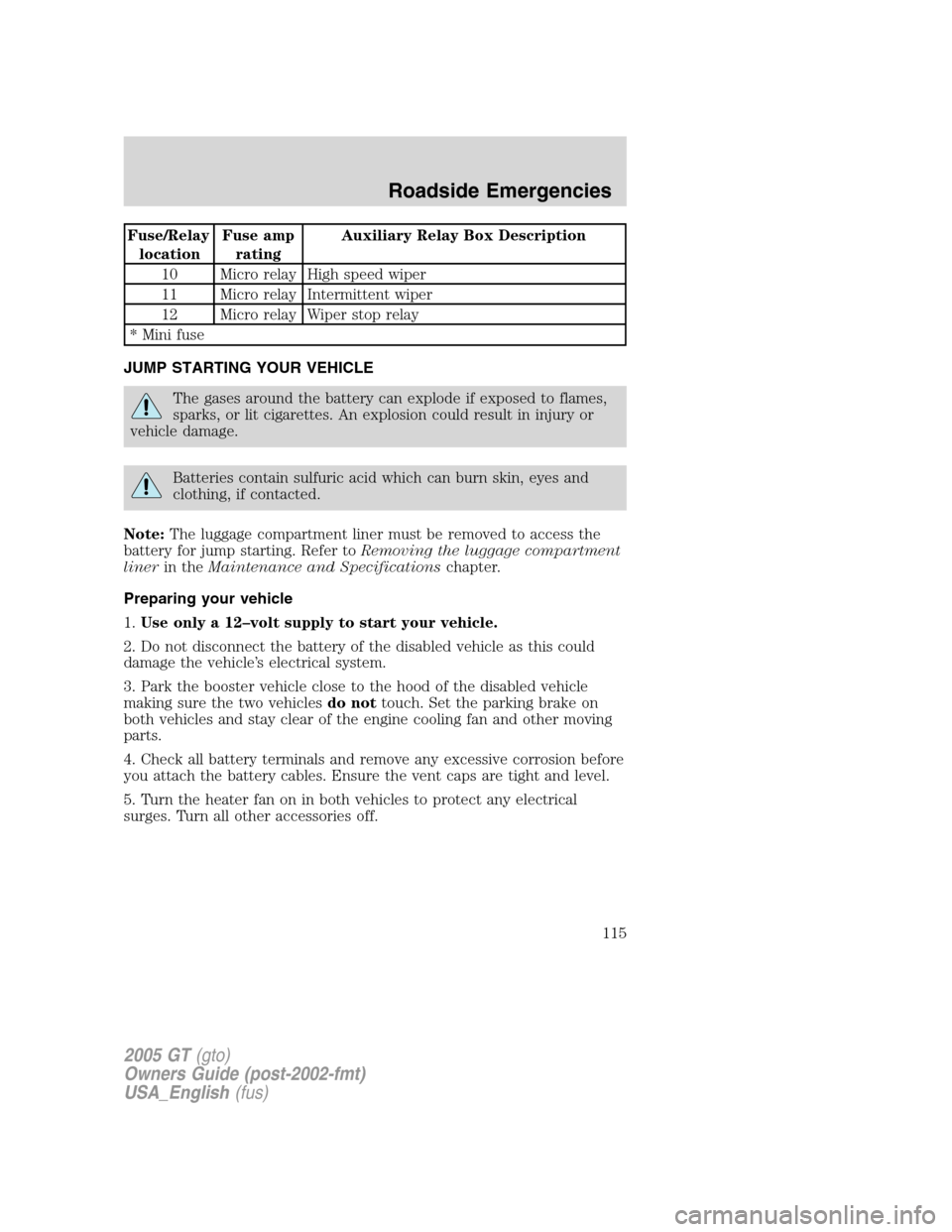
Fuse/Relaylocation Fuse amp
rating Auxiliary Relay Box Description
10 Micro relay High speed wiper
11 Micro relay Intermittent wiper
12 Micro relay Wiper stop relay
* Mini fuse
JUMP STARTING YOUR VEHICLE
The gases around the battery can explode if exposed to flames,
sparks, or lit cigarettes. An explosion could result in injury or
vehicle damage.
Batteries contain sulfuric acid which can burn skin, eyes and
clothing, if contacted.
Note: The luggage compartment liner must be removed to access the
battery for jump starting. Refer to Removing the luggage compartment
liner in the Maintenance and Specifications chapter.
Preparing your vehicle
1. Use only a 12 –volt supply to start your vehicle.
2. Do not disconnect the battery of the disabled vehicle as this could
damage the vehicle ’s electrical system.
3. Park the booster vehicle close to the hood of the disabled vehicle
making sure the two vehicles do nottouch. Set the parking brake on
both vehicles and stay clear of the engine cooling fan and other moving
parts.
4. Check all battery terminals and remove any excessive corrosion before
you attach the battery cables. Ensure the vent caps are tight and level.
5. Turn the heater fan on in both vehicles to protect any electrical
surges. Turn all other accessories off.
2005 GT(gto)
Owners Guide (post-2002-fmt)
USA_English (fus)
Roadside Emergencies
115
Page 116 of 200
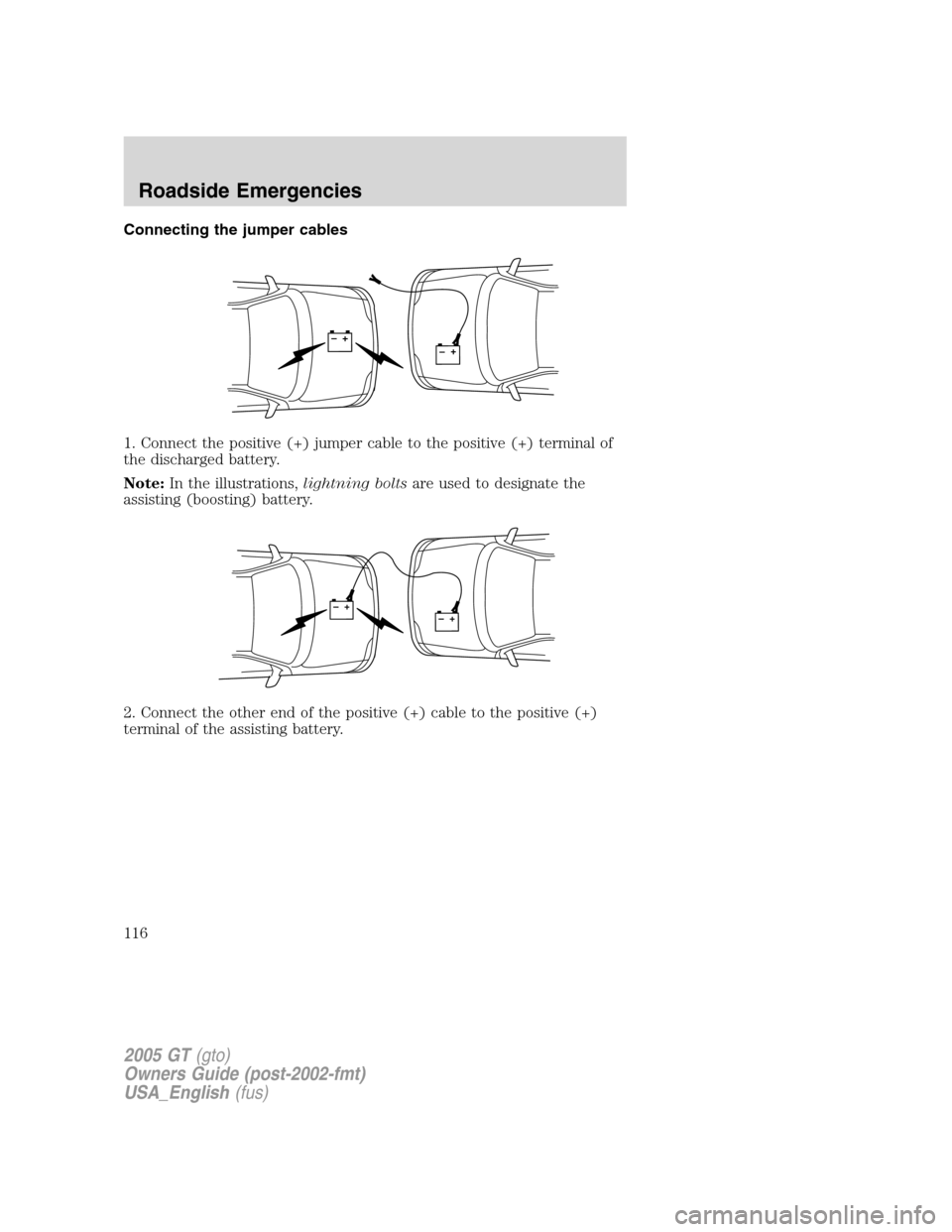
Connecting the jumper cables
1. Connect the positive (+) jumper cable to the positive (+) terminal of
the discharged battery.
Note:In the illustrations, lightning boltsare used to designate the
assisting (boosting) battery.
2. Connect the other end of the positive (+) cable to the positive (+)
terminal of the assisting battery.
+–+–
+–+–
2005 GT(gto)
Owners Guide (post-2002-fmt)
USA_English (fus)
Roadside Emergencies
116
Page 117 of 200
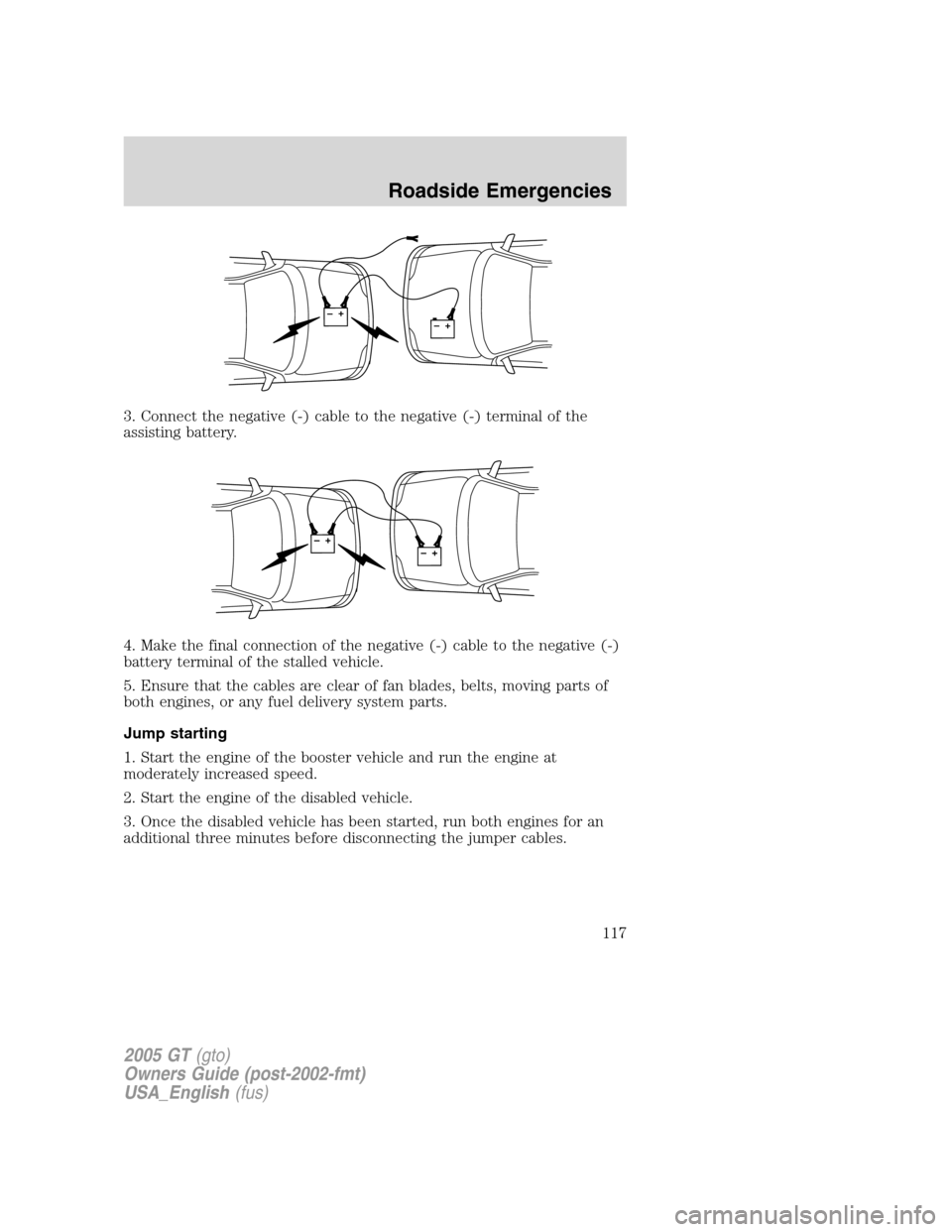
3. Connect the negative (-) cable to the negative (-) terminal of the
assisting battery.
4. Make the final connection of the negative (-) cable to the negative (-)
battery terminal of the stalled vehicle.
5. Ensure that the cables are clear of fan blades, belts, moving parts of
both engines, or any fuel delivery system parts.
Jump starting
1. Start the engine of the booster vehicle and run the engine at
moderately increased speed.
2. Start the engine of the disabled vehicle.
3. Once the disabled vehicle has been started, run both engines for an
additional three minutes before disconnecting the jumper cables.
+–+–
2005 GT(gto)
Owners Guide (post-2002-fmt)
USA_English(fus)
Roadside Emergencies
117
Page 118 of 200
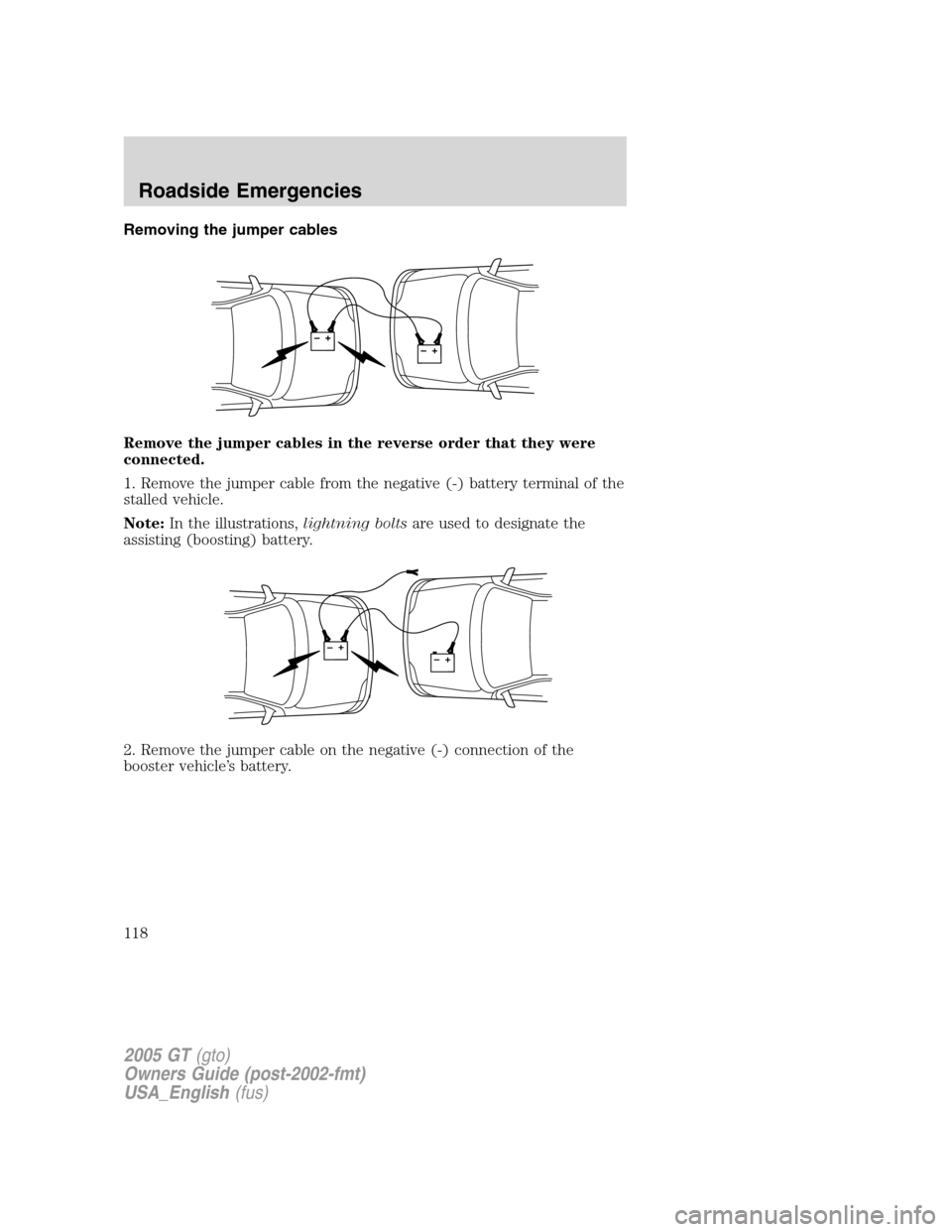
Removing the jumper cables
Remove the jumper cables in the reverse order that they were
connected.
1. Remove the jumper cable from the negative (-) battery terminal of the
stalled vehicle.
Note:In the illustrations, lightning boltsare used to designate the
assisting (boosting) battery.
2. Remove the jumper cable on the negative (-) connection of the
booster vehicle ’s battery.
+–+–
2005 GT(gto)
Owners Guide (post-2002-fmt)
USA_English (fus)
Roadside Emergencies
118