brake FORD GT 2006 1.G User Guide
[x] Cancel search | Manufacturer: FORD, Model Year: 2006, Model line: GT, Model: FORD GT 2006 1.GPages: 200, PDF Size: 1.86 MB
Page 73 of 200
•Drive carefully and avoid abrupt steering maneuvers.
• Periodically monitor tire inflation pressure in the affected tire; if the
tire is losing pressure, have the vehicle towed.
• Read the information in the Tips for use of the tire inflation kit
section to ensure safe operation of the tire inflation kit and your
vehicle.
Tips for use of the tire inflation kit
Read the following list of tips to ensure safe operation of the tire
inflation kit:
• Before operating the inflation kit, make sure your vehicle is safely off
the road and away from moving traffic.
• Always set the parking brake to ensure the vehicle doesn’t move
unexpectedly.
• Do not remove any foreign objects, such as nails or screws, from the
tire.
• When using the inflation kit, leave the engine running (only if the
vehicle is outdoors or in a well-ventilated area) so the
compressor doesn’t drain the vehicle’s battery.
• Do not allow the compressor to operate continuously for more than 10
minutes; this will help prevent the compressor from overheating.
• Never leave the inflation kit unattended when it is operating.
• Keep the inflation kit away from children.
• Only use the inflation kit when the ambient temperature is above
–20°F.
• Only use the inflation kit for sealing/inflating the tires on your vehicle.
Do not use the kit for inflating tires on motorcycles, bicycles or any
other type of tire.
• Only use the sealing compound before the expiration date. The
expiration date is labeled on the unit.
• Do not store the inflation kit inside the passenger compartment of the
vehicle as it may cause injury during a sudden stop or collision. Store
the kit in its proper location.
2006GT (gto)
Owners Guide (post-2002-fmt)
USA_English (fus)
Tires, Wheels and Loading
73
Page 79 of 200
Note:If you experience any unusual vibration, ride disturbance or noise
while driving, reduce your speed until you can safely pull off to the side
of the road to call for roadside assistance.
You can check the tire pressure any time within the 120 miles by
performing the following:
1. Ensure the compressor is turned off by pressing the “O” side of the
orange button.
2. Remove the hose and the cable with the electrical plug from the kit’s
storage compartment.
3. Remove the valve cap from the sealed tire, then screw the hose firmly
onto the tire’s air valve.
4. Insert the electrical plug into the vehicle’s power point.
5. Start the engine (only if the vehicle is outdoors or in a
well-ventilated area) to prevent the vehicle’s battery from draining.
6. Read the air pressure gauge on the inflation kit.
If the tire pressure needs to be increased, operate the air compressor
and inflate the tire to the recommended pressure as indicated on the
label on the B-Pillar.
WHEEL LUG NUT TORQUE SPECIFICATIONS
Retighten the lug nuts to the specified torque at 500 miles (800 km)
after any wheel disturbance (tire rotation, changing a flat tire, wheel
removal, etc.).
Bolt size Wheel lug nut torque* lb.ft. N•m
12x 20 100 135
* Torque specifications are for nut and bolt threads free of dirt and
rust. Use only Ford recommended replacement fasteners.
When a wheel is installed, always remove any corrosion, dirt or
foreign materials present on the mounting surfaces of the wheel
or the surface of the front disc brake hub and rotor that contacts the
wheel. Installing wheels without correct metal-to-metal contact at
the wheel mounting surfaces can cause the wheel nuts to loosen
and the wheel to come off while the vehicle is in motion, resulting in
loss of control.
2006 GT (gto)
Owners Guide (post-2002-fmt)
USA_English (fus)
Tires, Wheels and Loading
79
Page 96 of 200
If you smell exhaust fumes inside your vehicle, have your dealer
inspect your vehicle immediately. Do not drive if you smell
exhaust fumes.
Important safety precautions
When the engine starts, the idle RPM runs faster to warm the engine. If
the engine idle speed does not slow down automatically, have the vehicle
checked.
Before starting the vehicle:
1. Make sure all occupants buckle their safety belts. For more
information on safety belts and their proper usage, refer to the Seating
and Safety Restraints chapter.
2. Make sure the headlamps and electrical accessories are off.
3. Make sure the parking brake is
set.
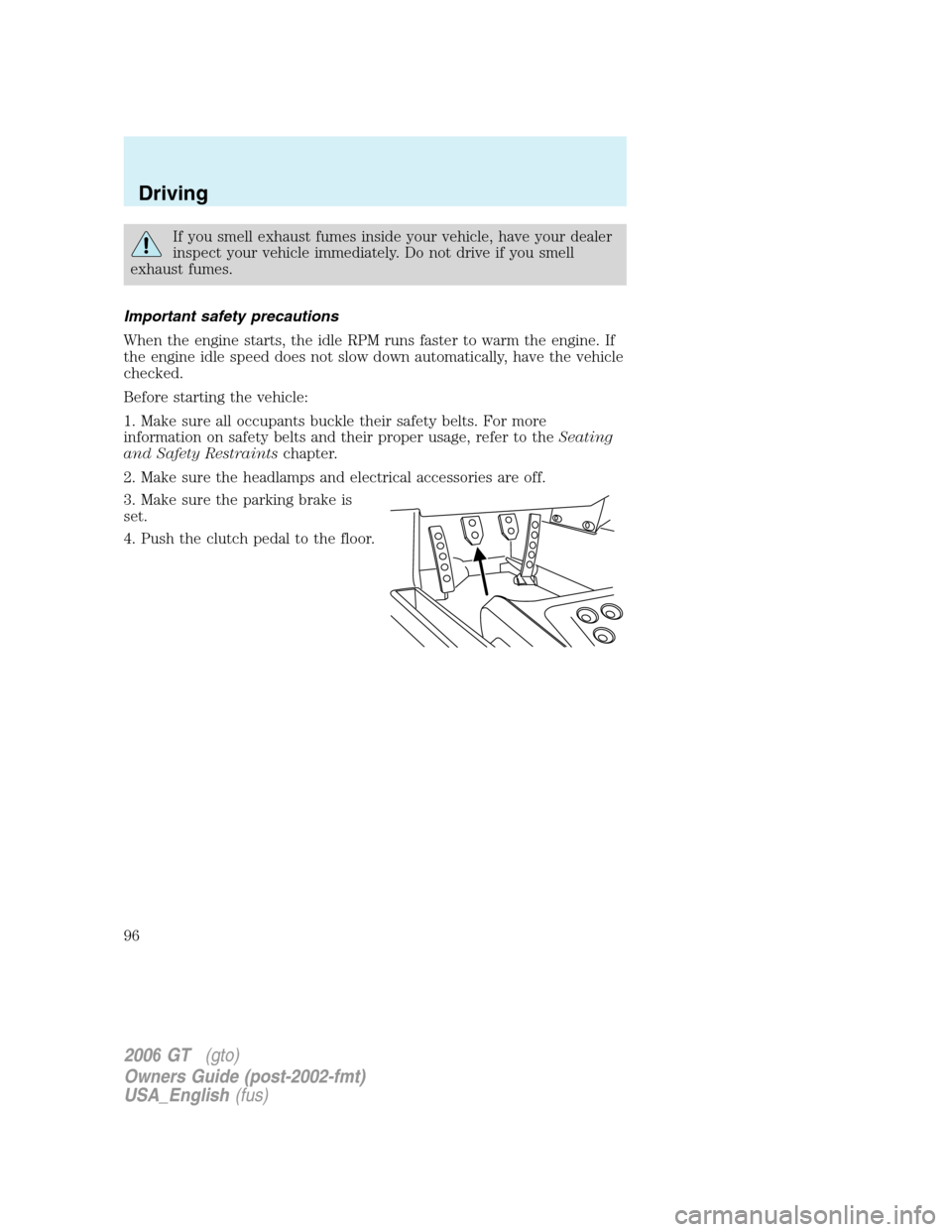
4. Push the clutch pedal to the floor.
2006 GT (gto)
Owners Guide (post-2002-fmt)
USA_English (fus)
Driving
96
Page 99 of 200
BRAKES
Occasional brake noise is normal. If a metal-to-metal, continuous grinding
or continuous squeal sound is present, the brake linings may be worn-out
and should be inspected by a qualified service technician. If the vehicle
has continuous vibration or shudder in the steering wheel while braking,
the vehicle should be inspected by a qualified service technician.
Refer toBrake system warning
light in the Instrument Cluster
chapter for information on the brake
system warning light.
Four-wheel anti-lock brake system (ABS)
Your vehicle is equipped with an Anti-lock Braking System (ABS). This
system helps you maintain steering control during emergency stops by
keeping the brakes from locking. Noise from the ABS pump motor and
brake pedal pulsation may be observed during ABS braking and the
brake pedal may suddenly travel a little farther as soon as ABS braking is
done and normal brake operation resumes. These are normal
characteristics of the ABS and should be no reason for concern.
ABS warning lamp
The ABS lamp in the instrument
cluster momentarily illuminates
when the ignition is turned on. If
the light does not illuminate during
start up, remains on or flashes, the
ABS may be disabled and may need to be serviced.
Even when the ABS is disabled,
normal braking is still effective. (If
your BRAKE warning lamp
illuminates with the parking brake
released, have your brake system serviced immediately.)
Using ABS
When hard braking is required, apply continuous force on the brake
pedal; do not pump the brake pedal since this will reduce the
effectiveness of the ABS and will increase your vehicle’s stopping
distance. The ABS will be activated immediately, allowing you to retain
full steering control during hard braking and on slippery surfaces.
However, the ABS does not decrease stopping distance.
!
BRAKE
ABS
!
BRAKE
2006 GT (gto)
Owners Guide (post-2002-fmt)
USA_English (fus)
Driving
99
Page 100 of 200
Parking brake
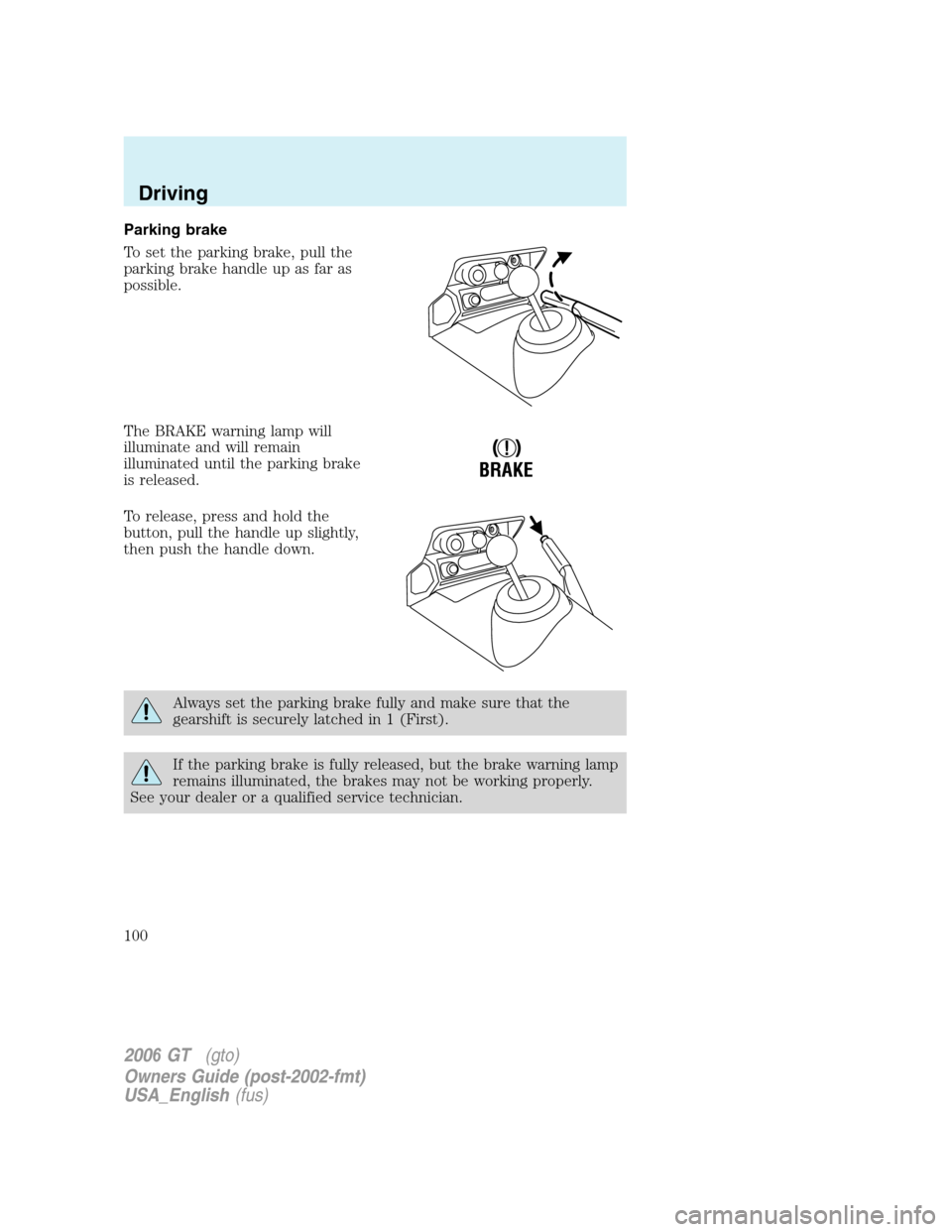
To set the parking brake, pull the
parking brake handle up as far as
possible.
The BRAKE warning lamp will
illuminate and will remain
illuminated until the parking brake
is released.
To release, press and hold the
button, pull the handle up slightly,
then push the handle down.
Always set the parking brake fully and make sure that the
gearshift is securely latched in 1 (First).
If the parking brake is fully released, but the brake warning lamp
remains illuminated, the brakes may not be working properly.
See your dealer or a qualified service technician.
!
BRAKE
2006 GT (gto)
Owners Guide (post-2002-fmt)
USA_English (fus)
Driving
100
Page 102 of 200
MANUAL TRANSMISSION OPERATION
Using the clutch
The manual transmission has a starter interlock that prevents cranking
the engine unless the clutch pedal is fully depressed.
To start the vehicle:
1. Make sure the parking brake is fully set.
2. Press the clutch pedal to the floor, then put the gearshift lever in the
neutral position.
3. Start the engine, then press the brake pedal and release the parking
brake.
4. Move the gearshift lever to 1st gear, then slowly release the clutch
pedal while slowly pressing on the accelerator.
During each shift, the clutch pedal must be fully depressed to the floor.
Failure to fully depress the clutch pedal to the floor may cause increased
shift efforts, prematurely wear transmission components or damage the
transmission. Make sure the floor mat is properly positioned so it doesn’t
interfere with the full extension of the clutch pedal.
Do not drive with your foot resting on the clutch pedal or use the clutch
pedal to hold your vehicle at a standstill while waiting on a hill. These
actions will reduce the life of the clutch.
Recommended shift speeds
Do not downshift into 1 (First) when your vehicle is moving
faster than 30 mph (48 km/h). This may damage the clutch and/or
transmission.
2006GT (gto)
Owners Guide (post-2002-fmt)
USA_English (fus)
Driving
102
Page 103 of 200
Upshift according to the following chart:
Upshifts when accelerating (recommended for best fueleconomy)
Shift from:
1 - 2 15 mph (24 km/h)
2 - 3 25 mph (40 km/h)
3 - 4 40 mph (64 km/h)
4 - 5 45 mph (72 km/h)
5 - 6 50 mph (80 km/h)
Reverse
1. Make sure that your vehicle is at a complete stop before you shift into
R (Reverse). Failure to do so may damage the transmission.
2. Move the gearshift lever into the neutral position and wait at least
three seconds before shifting into R (Reverse).
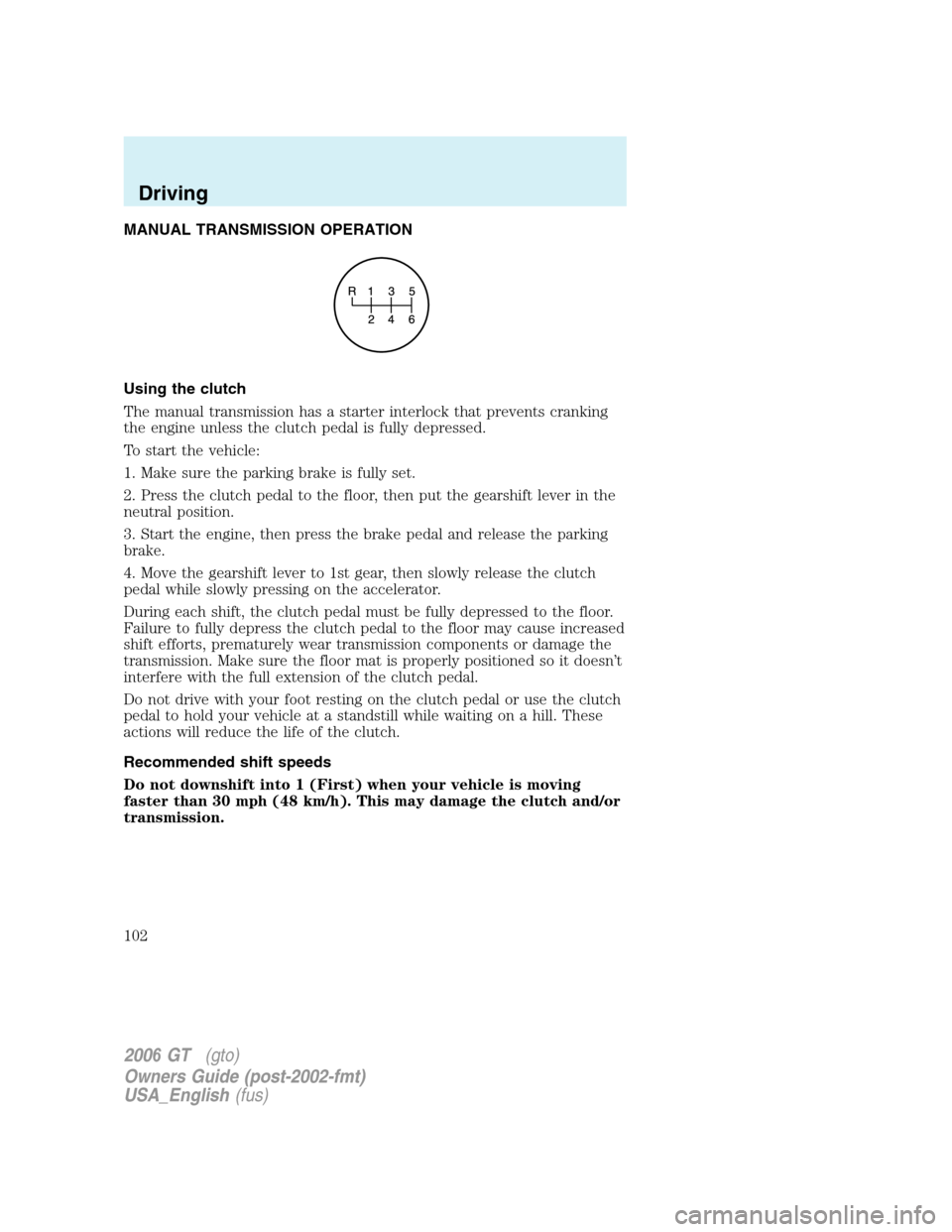
3. Shift into R (Reverse) by pulling the gearshift lever fully to the left
through the detent, then forward. The detent force is high to prevent
inadvertently shifting into R (Reverse).
Parking your vehicle
1. Apply the brake and shift into the neutral position.
2. Fully apply the parking brake, then shift into 1 (First).
3. Turn the ignition off.
Do not park your vehicle in Neutral, it may move unexpectedly
and injure someone. Use 1 (First) gear and set the parking brake
fully.
DRIVING THROUGH WATER
Do not drive quickly through standing water, especially if the depth is
unknown. Traction or brake capability may be limited and if the ignition
system gets wet, your engine may stall. Water may also enter your
engine’s air intake and severely damage your engine.
If driving through deep or standing water is unavoidable, proceed very
slowly. Never drive through water that is higher than the bottom of the
hubs (for trucks) or the bottom of the wheel rims (for cars).
2006 GT (gto)
Owners Guide (post-2002-fmt)
USA_English (fus)
Driving
103
Page 104 of 200
Once through the water, always try the brakes. Wet brakes do not stop
the vehicle as effectively as dry brakes. Drying can be improved by
moving your vehicle slowly while applying light pressure on the brake
pedal.
GROUND CLEARANCE
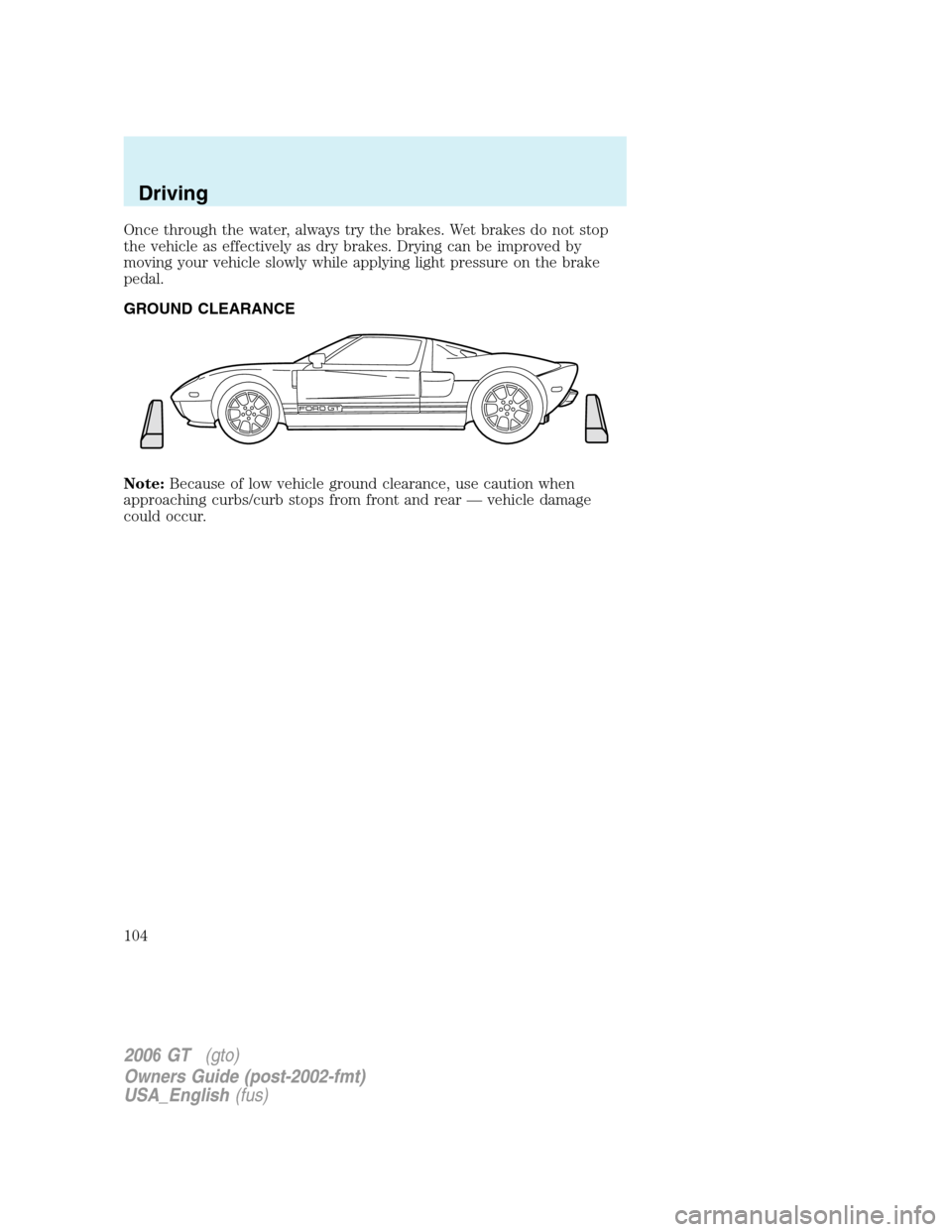
Note:Because of low vehicle ground clearance, use caution when
approaching curbs/curb stops from front and rear — vehicle damage
could occur.
2006 GT (gto)
Owners Guide (post-2002-fmt)
USA_English (fus)
Driving
104
Page 111 of 200
Fuse/RelayLocation Fuse Amp
Rating Passenger Compartment Fuse
Panel Description
33 15A* Restraint Control Module (RSM), Passenger Air bag Deactivation
(PAD) indicator lamp, ACS switch
34 5A* Anti-lock Brake System (ABS) Run/Acc Input
35 — Not used
* Mini fuse ** Cartridge fuse
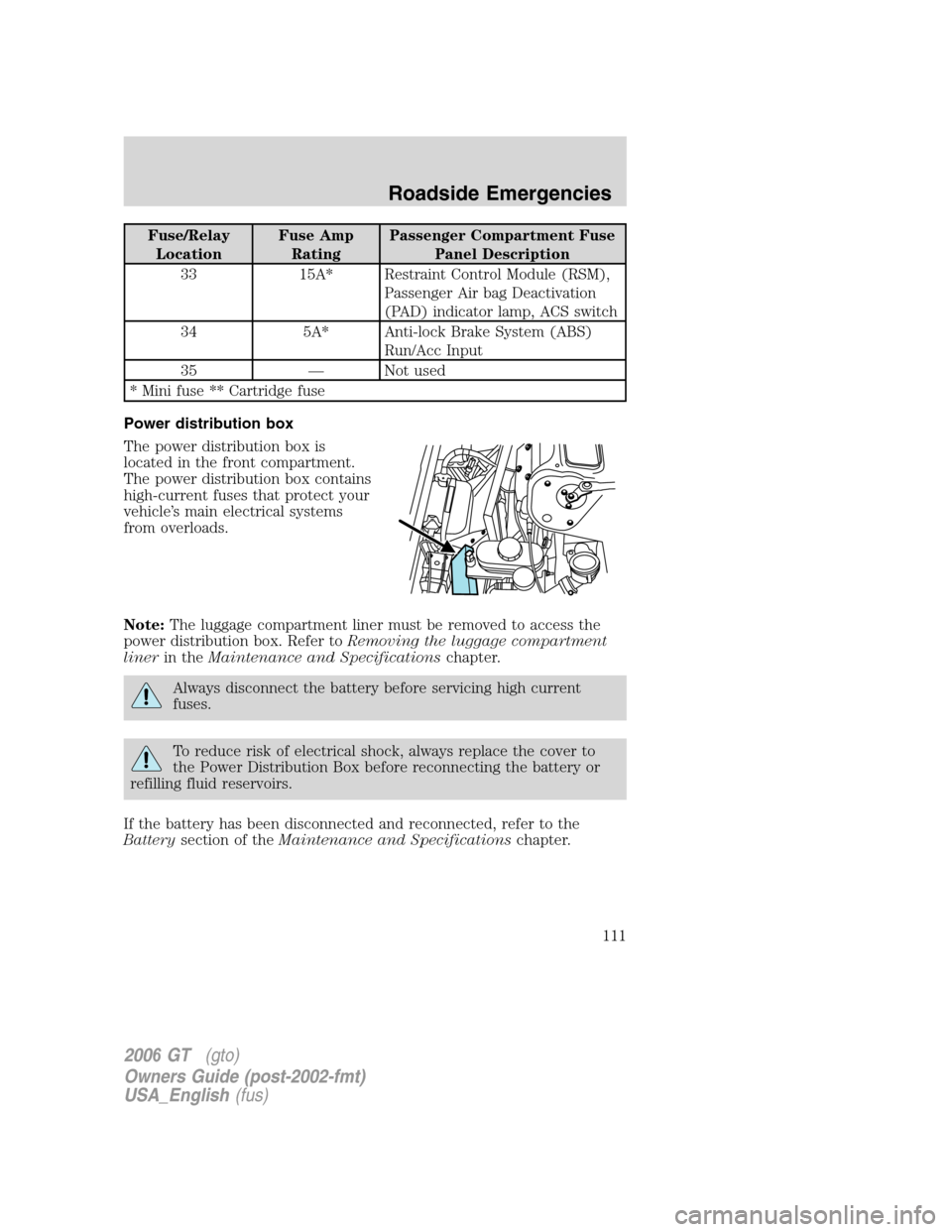
Power distribution box
The power distribution box is
located in the front compartment.
The power distribution box contains
high-current fuses that protect your
vehicle’s main electrical systems
from overloads.
Note: The luggage compartment liner must be removed to access the
power distribution box. Refer to Removing the luggage compartment
liner in the Maintenance and Specifications chapter.
Always disconnect the battery before servicing high current
fuses.
To reduce risk of electrical shock, always replace the cover to
the Power Distribution Box before reconnecting the battery or
refilling fluid reservoirs.
If the battery has been disconnected and reconnected, refer to the
Battery section of the Maintenance and Specifications chapter.
2006GT (gto)
Owners Guide (post-2002-fmt)
USA_English (fus)
Roadside Emergencies
111
Page 112 of 200
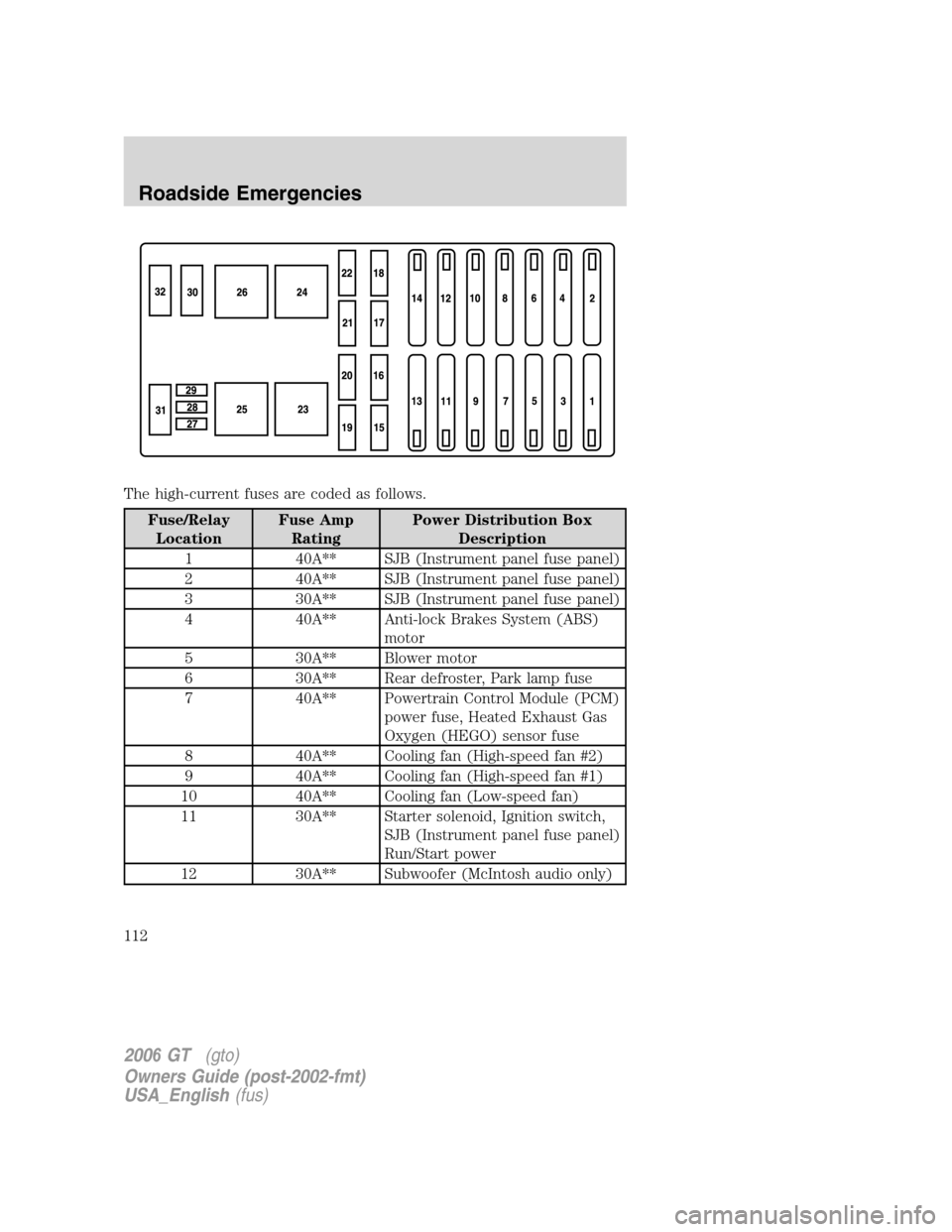
The high-current fuses are coded as follows.
Fuse/RelayLocation Fuse Amp
Rating Power Distribution Box
Description
1 40A** SJB (Instrument panel fuse panel)
2 40A** SJB (Instrument panel fuse panel)
3 30A** SJB (Instrument panel fuse panel)
4 40A** Anti-lock Brakes System (ABS) motor
5 30A** Blower motor
6 30A** Rear defroster, Park lamp fuse
7 40A** Powertrain Control Module (PCM) power fuse, Heated Exhaust Gas
Oxygen (HEGO) sensor fuse
8 40A** Cooling fan (High-speed fan #2)
9 40A** Cooling fan (High-speed fan #1)
10 40A** Cooling fan (Low-speed fan)
11 30A** Starter solenoid, Ignition switch, SJB (Instrument panel fuse panel)
Run/Start power
12 30A** Subwoofer (McIntosh audio only)
2006 GT (gto)
Owners Guide (post-2002-fmt)
USA_English (fus)
Roadside Emergencies
112