brake FORD GT 2006 1.G Owner's Manual
[x] Cancel search | Manufacturer: FORD, Model Year: 2006, Model line: GT, Model: FORD GT 2006 1.GPages: 200, PDF Size: 1.86 MB
Page 113 of 200
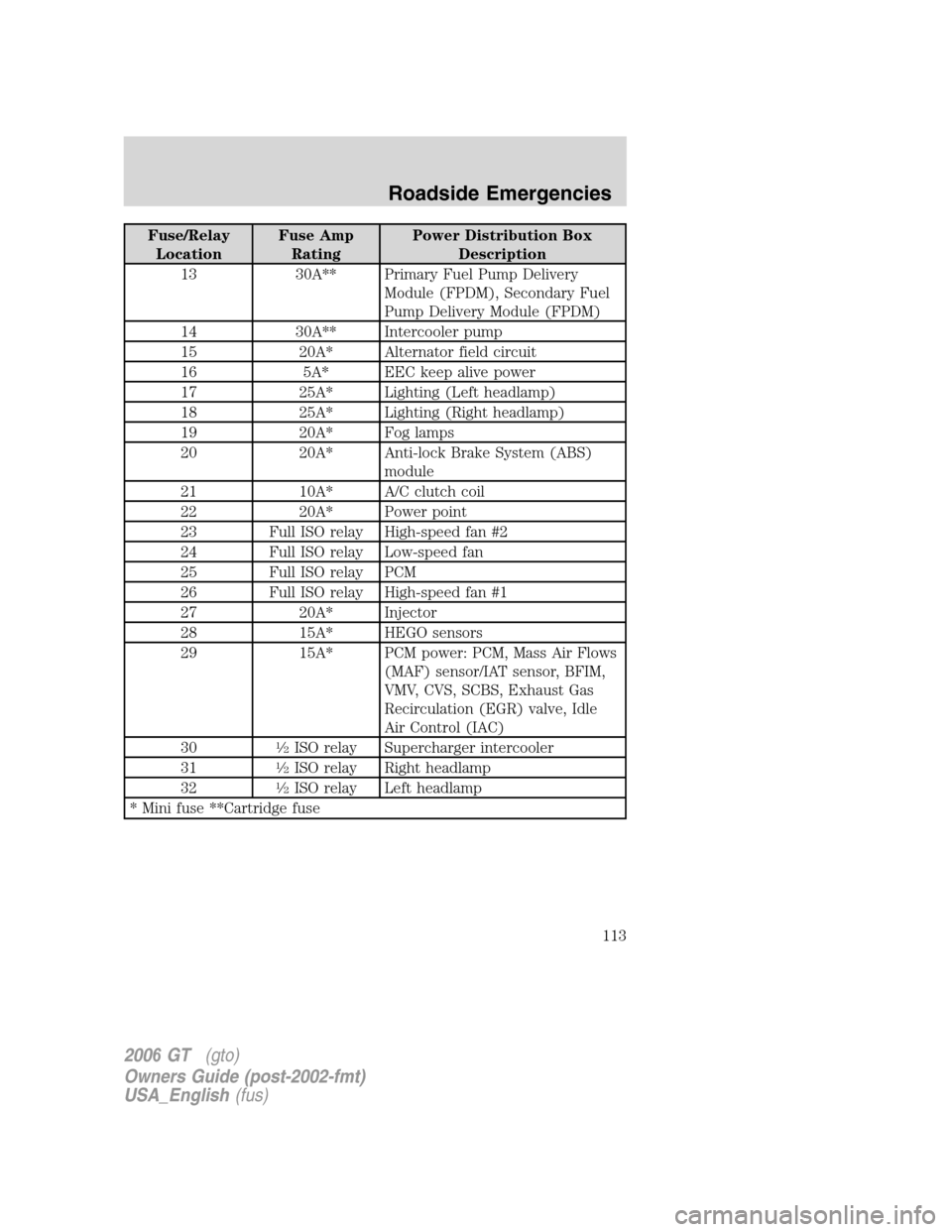
Fuse/RelayLocation Fuse Amp
Rating Power Distribution Box
Description
13 30A** Primary Fuel Pump Delivery Module (FPDM), Secondary Fuel
Pump Delivery Module (FPDM)
14 30A** Intercooler pump
15 20A* Alternator field circuit
16 5A* EEC keep alive power
17 25A* Lighting (Left headlamp)
18 25A* Lighting (Right headlamp)
19 20A* Fog lamps
20 20A* Anti-lock Brake System (ABS) module
21 10A* A/C clutch coil
22 20A* Power point
23 Full ISO relay High-speed fan #2
24 Full ISO relay Low-speed fan
25 Full ISO relay PCM
26 Full ISO relay High-speed fan #1
27 20A* Injector
28 15A* HEGO sensors
29 15A* PCM power: PCM, Mass Air Flows (MAF) sensor/IAT sensor, BFIM,
VMV, CVS, SCBS, Exhaust Gas
Recirculation (EGR) valve, Idle
Air Control (IAC)
30
12ISO relay Supercharger intercooler
31
12ISO relay Right headlamp
32
12ISO relay Left headlamp
* Mini fuse **Cartridge fuse
2006 GT (gto)
Owners Guide (post-2002-fmt)
USA_English (fus)
Roadside Emergencies
113
Page 114 of 200
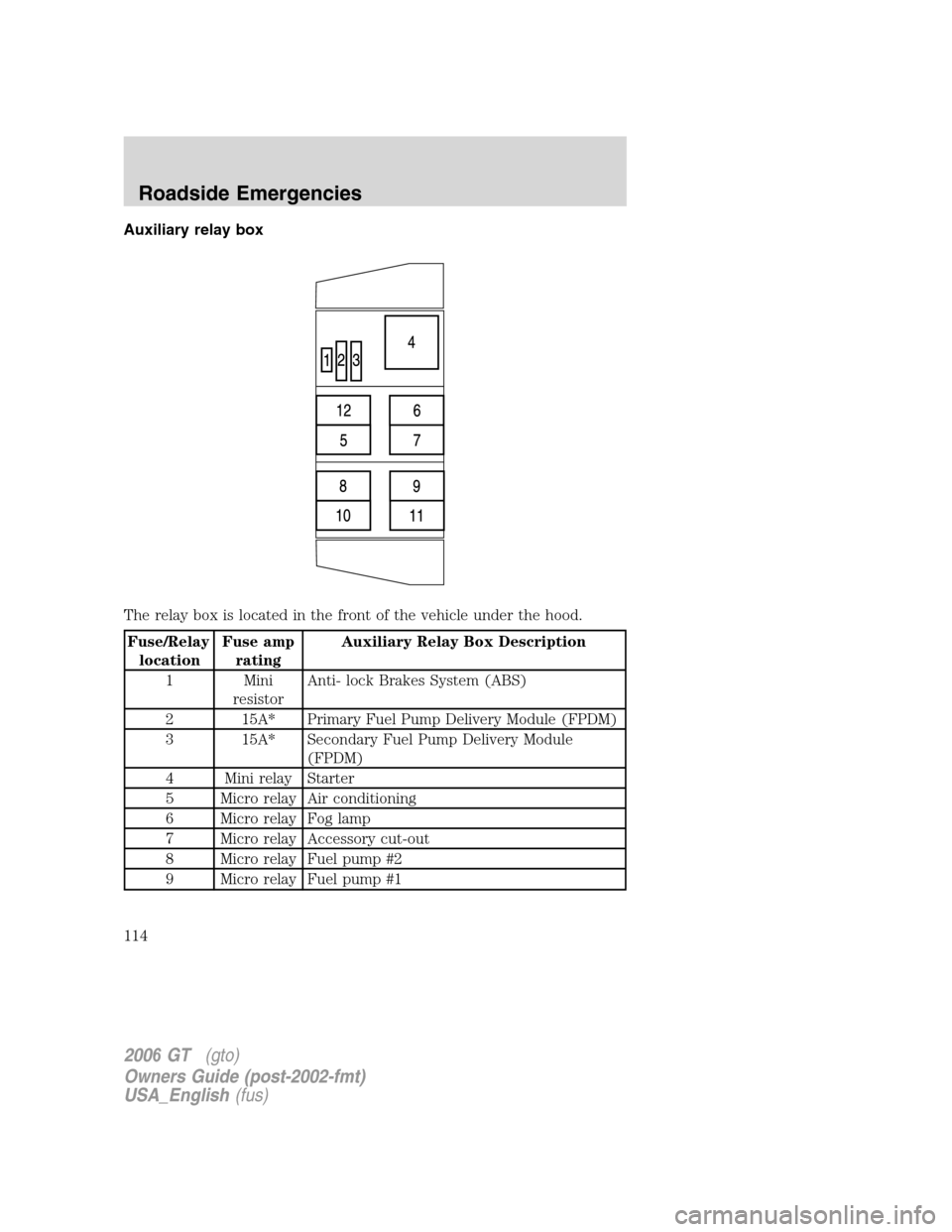
Auxiliary relay box
The relay box is located in the front of the vehicle under the hood.
Fuse/Relaylocation Fuse amp
rating Auxiliary Relay Box Description
1 Mini resistor Anti- lock Brakes System (ABS)
2 15A* Primary Fuel Pump Delivery Module (FPDM)
3 15A* Secondary Fuel Pump Delivery Module (FPDM)
4 Mini relay Starter
5 Micro relay Air conditioning
6 Micro relay Fog lamp
7 Micro relay Accessory cut-out
8 Micro relay Fuel pump #2
9 Micro relay Fuel pump #1
2006 GT (gto)
Owners Guide (post-2002-fmt)
USA_English (fus)
Roadside Emergencies
114
Page 115 of 200
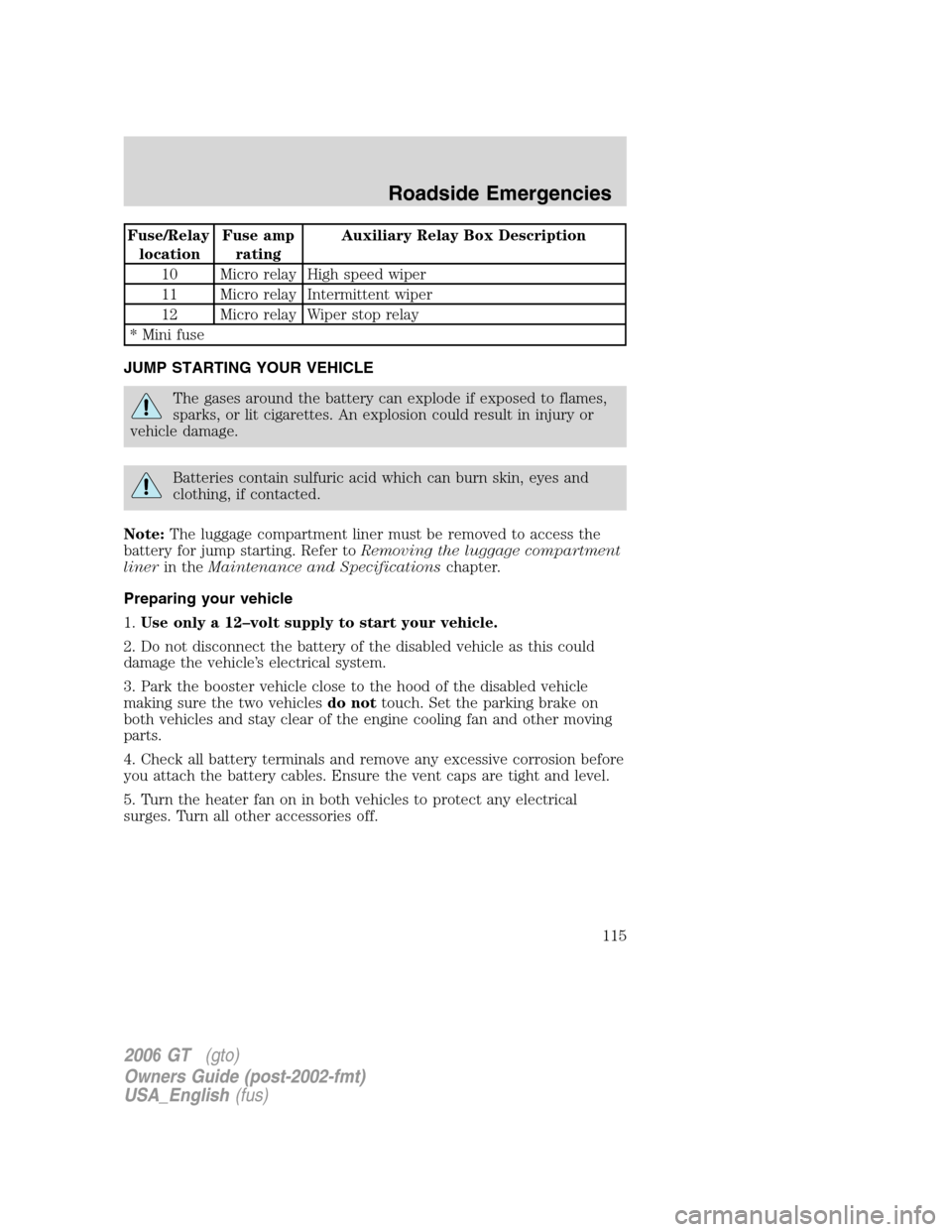
Fuse/Relaylocation Fuse amp
rating Auxiliary Relay Box Description
10 Micro relay High speed wiper
11 Micro relay Intermittent wiper
12 Micro relay Wiper stop relay
* Mini fuse
JUMP STARTING YOUR VEHICLE
The gases around the battery can explode if exposed to flames,
sparks, or lit cigarettes. An explosion could result in injury or
vehicle damage.
Batteries contain sulfuric acid which can burn skin, eyes and
clothing, if contacted.
Note: The luggage compartment liner must be removed to access the
battery for jump starting. Refer to Removing the luggage compartment
liner in the Maintenance and Specifications chapter.
Preparing your vehicle
1. Use only a 12–volt supply to start your vehicle.
2. Do not disconnect the battery of the disabled vehicle as this could
damage the vehicle’s electrical system.
3. Park the booster vehicle close to the hood of the disabled vehicle
making sure the two vehicles do nottouch. Set the parking brake on
both vehicles and stay clear of the engine cooling fan and other moving
parts.
4. Check all battery terminals and remove any excessive corrosion before
you attach the battery cables. Ensure the vent caps are tight and level.
5. Turn the heater fan on in both vehicles to protect any electrical
surges. Turn all other accessories off.
2006 GT (gto)
Owners Guide (post-2002-fmt)
USA_English (fus)
Roadside Emergencies
115
Page 122 of 200
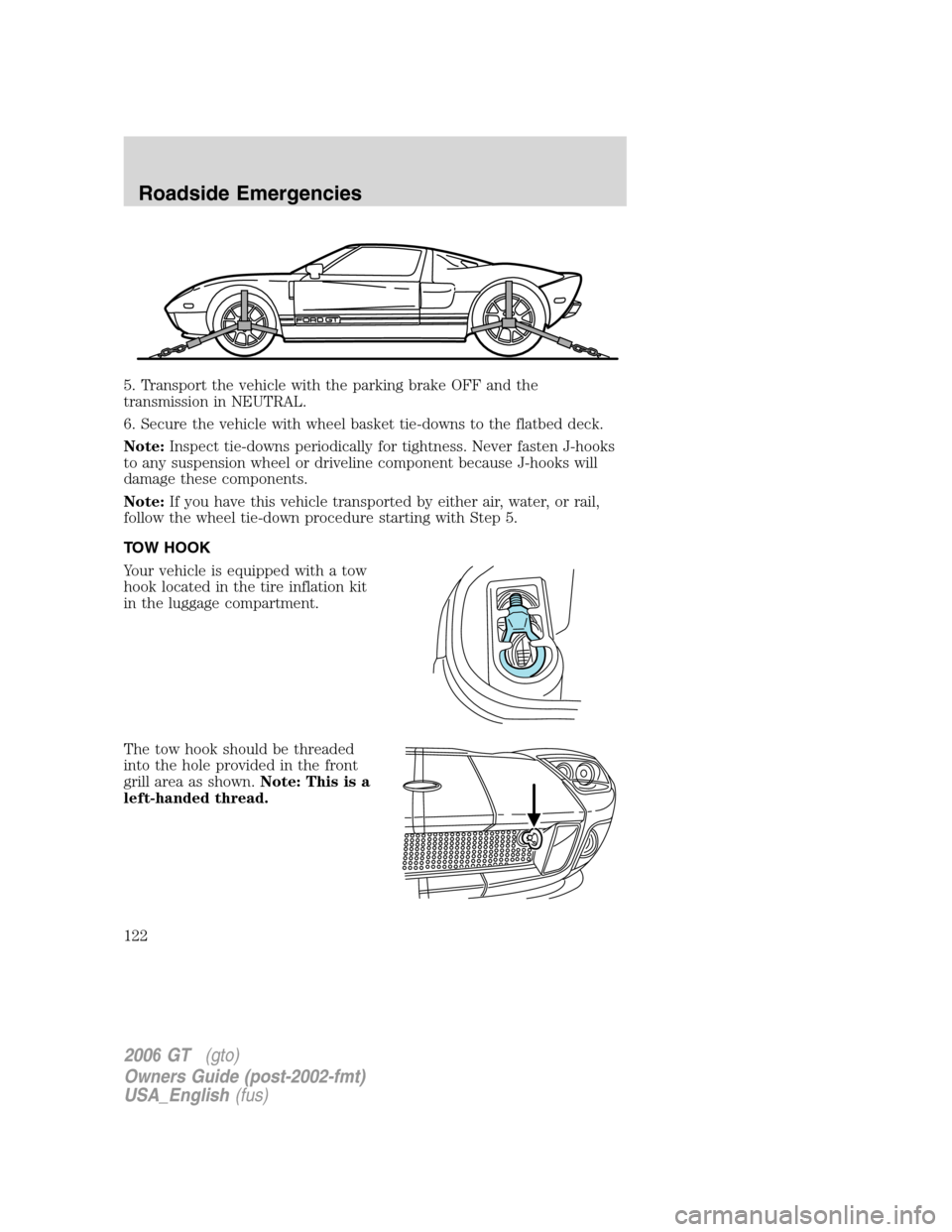
5. Transport the vehicle with the parking brake OFF and the
transmission in NEUTRAL.
6. Secure the vehicle with wheel basket tie-downs to the flatbed deck.
Note:Inspect tie-downs periodically for tightness. Never fasten J-hooks
to any suspension wheel or driveline component because J-hooks will
damage these components.
Note: If you have this vehicle transported by either air, water, or rail,
follow the wheel tie-down procedure starting with Step 5.
TOW HOOK
Your vehicle is equipped with a tow
hook located in the tire inflation kit
in the luggage compartment.
The tow hook should be threaded
into the hole provided in the front
grill area as shown. Note: This is a
left-handed thread.
2006 GT (gto)
Owners Guide (post-2002-fmt)
USA_English (fus)
Roadside Emergencies
122
Page 134 of 200
ALUMINUM WHEELS AND WHEEL COVERS
Aluminum wheels and wheel covers are coated with a clearcoat paint
finish. In order to maintain their shine:
•Clean weekly with Motorcraft Wheel and Tire Cleaner (ZC-37–A),
which is available from your dealer. Heavy dirt and brake dust
accumulation may require agitation with a sponge. Rinse thoroughly
with a strong stream of water.
• Never apply any cleaning chemical to hot or warm wheel rims or
covers.
• Some automatic car washes may cause damage to the finish on your
wheel rims or covers. Chemical-strength cleaners, or cleaning
chemicals, in combination with brush agitation to remove brake dust
and dirt, could wear away the clearcoat finish over time.
• Do not use hydrofluoric acid-based or high caustic-based wheel
cleaners, steel wool, fuels or strong household detergent.
• To remove tar and grease, use Motorcraft Bug and Tar Remover
(ZC-42), available from your dealer.
ENGINE
Engines are more efficient when they are clean because grease and dirt
buildup keep the engine warmer than normal. When washing:
• Take care when using a power washer to clean the engine. The high
pressure fluid could penetrate the sealed parts and cause damage.
• Do not spray a hot engine with cold water to avoid cracking the
engine block or other engine components.
• Spray Motorcraft Engine Shampoo and Degreaser (ZC-20) on all parts
that require cleaning and pressure rinse clean.
• Cover the highlighted area to prevent water damage when cleaning
the engine. Note:Use caution when cleaning the engine, ensuring that
water does not enter the air intakes.
2006 GT (gto)
Owners Guide (post-2002-fmt)
USA_English (fus)
Cleaning
134
Page 139 of 200
SERVICE RECOMMENDATIONS
To help you service your vehicle:
•We highlight do-it-yourself items in the engine compartment for easy
location.
• We provide a scheduled maintenance guide which makes tracking
routine service easy.
If your vehicle requires professional service, your dealership can provide
the necessary parts and service. Check your Warranty Guide/Owner
Information Guide to find out which parts and services are covered.
Use only recommended fuels, lubricants, fluids and service parts
conforming to specifications. Motorcraft parts are designed and built to
provide the best performance in your vehicle.
PRECAUTIONS WHEN SERVICING YOUR VEHICLE
• Do not work on a hot engine.
• Make sure that nothing gets caught in moving parts.
• Do not work on a vehicle with the engine running in an enclosed
space, unless you are sure you have enough ventilation.
• Keep all open flames and other burning (cigarettes) material away
from the battery and all fuel related parts.
Working with the engine off
1. Set the parking brake, depress the clutch and place the gearshift in 1
(First).
2. Turn off the engine and remove the key.
3. Block the wheels.
Working with the engine on
1. Set the parking brake, depress the clutch and place the gearshift in N
(Neutral).
2. Block the wheels.
Note: Do not start your engine with the air cleaner removed and do not
remove it while the engine is running.
2006 GT (gto)
Owners Guide (post-2002-fmt)
USA_English (fus)
Maintenance and Specifications
Maintenance and Specifications
139
Page 146 of 200
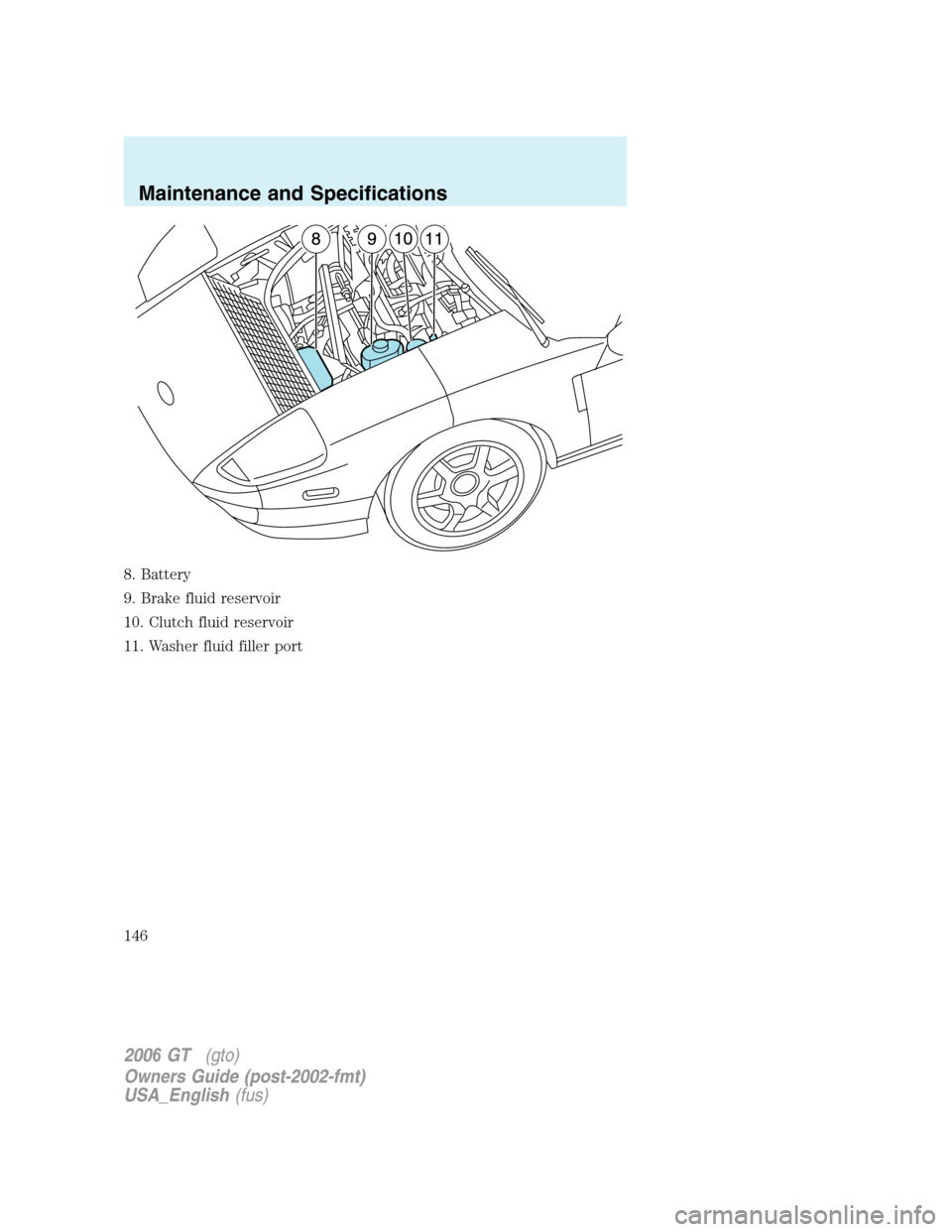
8. Battery
9. Brake fluid reservoir
10. Clutch fluid reservoir
11. Washer fluid filler port
2006GT (gto)
Owners Guide (post-2002-fmt)
USA_English (fus)
Maintenance and Specifications
146
Page 147 of 200
WINDSHIELD WASHER FLUID
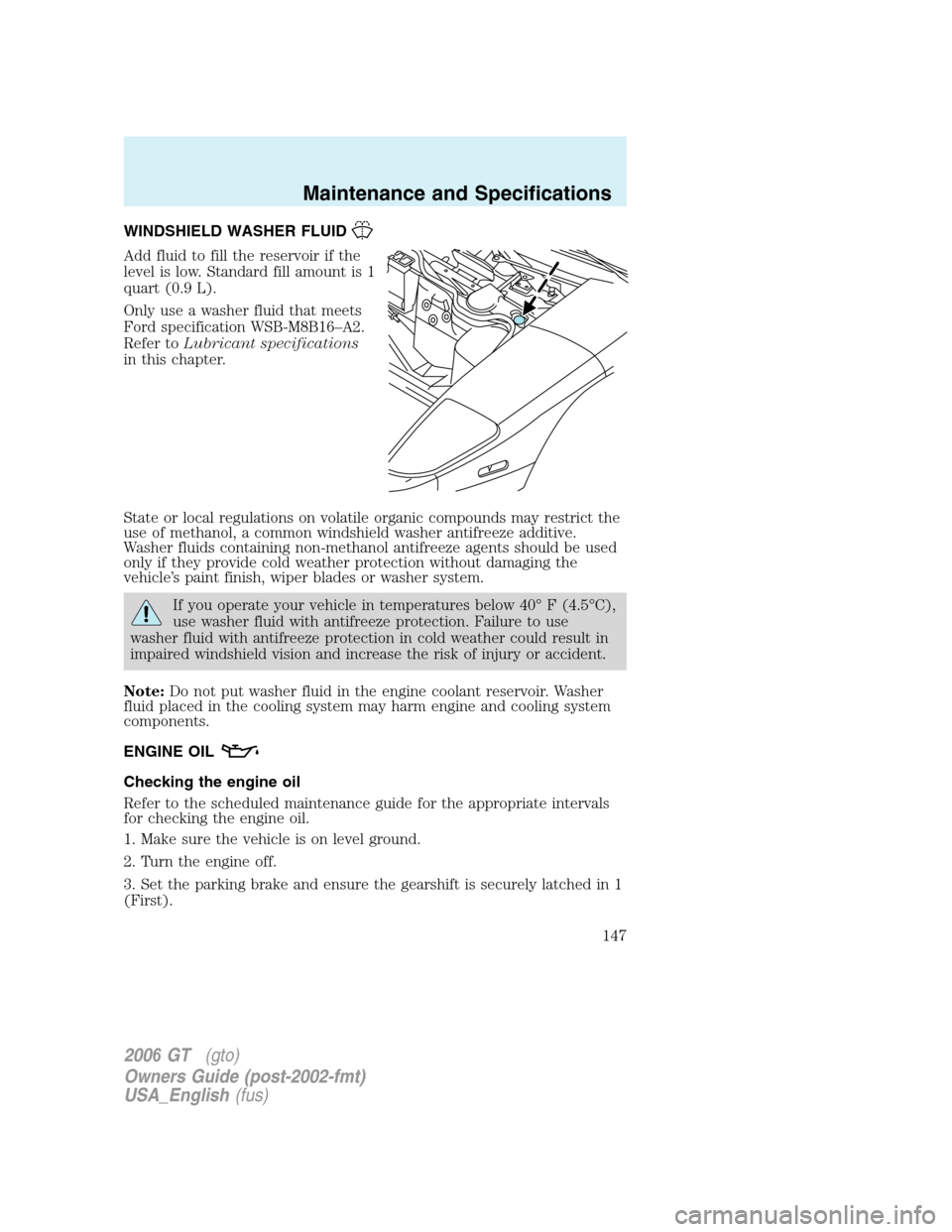
Add fluid to fill the reservoir if the
level is low. Standard fill amount is 1
quart (0.9 L).
Only use a washer fluid that meets
Ford specification WSB-M8B16–A2.
Refer toLubricant specifications
in this chapter.
State or local regulations on volatile organic compounds may restrict the
use of methanol, a common windshield washer antifreeze additive.
Washer fluids containing non-methanol antifreeze agents should be used
only if they provide cold weather protection without damaging the
vehicle’s paint finish, wiper blades or washer system.
If you operate your vehicle in temperatures below 40° F (4.5°C),
use washer fluid with antifreeze protection. Failure to use
washer fluid with antifreeze protection in cold weather could result in
impaired windshield vision and increase the risk of injury or accident.
Note: Do not put washer fluid in the engine coolant reservoir. Washer
fluid placed in the cooling system may harm engine and cooling system
components.
ENGINE OIL
Checking the engine oil
Refer to the scheduled maintenance guide for the appropriate intervals
for checking the engine oil.
1. Make sure the vehicle is on level ground.
2. Turn the engine off.
3. Set the parking brake and ensure the gearshift is securely latched in 1
(First).
2006 GT (gto)
Owners Guide (post-2002-fmt)
USA_English (fus)
Maintenance and Specifications
147
Page 151 of 200
Battery posts, terminals and related accessories contain lead and
lead compounds.Wash hands after handling.
Because your vehicle’s engine is electronically controlled by a computer,
some control conditions are maintained by power from the battery. When
the battery is disconnected or a new battery is installed, the engine must
relearn its idle and fuel trim strategy for optimum driveability and
performance. To begin this process:
1. With the vehicle at a complete stop, set the parking brake.
2. Put the gearshift in the neutral position (manual transmission), turn
off all accessories and start the engine.
3. Run the engine until it reaches normal operating temperature.
4. Allow the engine to idle for at least one minute.
5. Turn the A/C on and allow the engine to idle for at least one minute.
6. Drive the vehicle to complete the relearning process.
• The vehicle may need to be driven 10 miles (16 km) or more to
relearn the idle and fuel trim strategy.
• If you do not allow the engine to relearn its idle trim, the idle
quality of your vehicle may be adversely affected until the idle
trim is eventually relearned.
If the battery has been disconnected or a new battery has been installed,
the clock and the preset radio stations must be reset once the battery is
reconnected.
• Always dispose of automotive
batteries in a responsible manner.
Follow your local authorized
standards for disposal. Call your
local authorized recycling center
to find out more about recycling
automotive batteries.
LEAD
RETURN
RECYCLE
2006GT (gto)
Owners Guide (post-2002-fmt)
USA_English (fus)
Maintenance and Specifications
151
Page 162 of 200
Keep a record for at least one month and record the type of driving (city
or highway). This will provide an accurate estimate of the vehicle’s fuel
economy under current driving conditions. Additionally, keeping records
during summer and winter will show how temperature impacts fuel
economy. In general, lower temperatures give lower fuel economy.
Driving style — good driving and fuel economy habits
Give consideration to the lists that follow and you may be able to change
a number of variables and improve your fuel economy.
Habits
•Smooth, moderate operation can yield up to 10% savings in fuel.
• Steady speeds without stopping will usually give the best fuel
economy.
• Idling for long periods of time (greater than one minute) may waste
fuel.
• Anticipate stopping; slowing down may eliminate the need to stop.
• Sudden or hard accelerations may reduce fuel economy.
• Slow down gradually.
• Driving at reasonable speeds (traveling at 55 mph [88 km/h] uses 15%
less fuel than traveling at 65 mph [105 km/h]).
• Revving the engine before turning it off may reduce fuel economy.
• Using the air conditioner or defroster may reduce fuel economy.
• Resting your foot on the brake pedal while driving may reduce fuel
economy.
• Combine errands and minimize stop-and-go driving.
Maintenance
• Keep tires properly inflated and use only recommended size.
• Operating a vehicle with the wheels out of alignment will reduce fuel
economy.
• Use recommended engine oil. Refer to Lubricant specificationsin
this chapter.
• Perform all regularly scheduled maintenance items. Follow the
recommended maintenance schedule and owner maintenance checks
found in the scheduled maintenance guide chapter.
2006GT (gto)
Owners Guide (post-2002-fmt)
USA_English (fus)
Maintenance and Specifications
162