brake FORD GT 2017 2.G Workshop Manual
[x] Cancel search | Manufacturer: FORD, Model Year: 2017, Model line: GT, Model: FORD GT 2017 2.GPages: 313, PDF Size: 6.41 MB
Page 174 of 313
General Information
WARNING
Failure to follow these guidelines
could result in an increased risk of
loss of vehicle control, injury or death.
Note:
Do not use the kit if you have severely
damaged a tire. Only seal punctures located
within the tire tread with the kit.
Do not attempt to repair punctures larger
than ¼ inch (6 millimeters) or damage to
the tire's sidewall. The tire may not
completely seal.
Loss of air pressure may adversely affect
tire performance. For this reason:
Note: Do not drive the vehicle above
50 mph (80 km/h).
Note: Do not drive further than
120 mi
(200 km). Drive only to the closest
authorized Ford dealer or tire repair shop to
have your tire inspected.
• Drive carefully and avoid abrupt
steering maneuvers.
• Periodically monitor tire inflation
pressure in the affected tire; if the tire
is losing pressure, have the vehicle
towed on a flat bed.
• Read the information in the Tips for
Use of the Kit section to make sure safe
operation of the kit and your vehicle.
Tips for Use of the Kit
To ensure safe operation of the kit:
• Read all instructions and cautions fully.
• Before operating the kit, make sure
your vehicle is safely off the road and
away from moving traffic. Switch on
the hazard lights.
• Always set the parking brake to ensure
the vehicle does not move
unexpectedly. •
Do not remove any foreign objects,
such as nails or screws, from the tire.
• When using the kit, leave the engine
running (only if the vehicle is outdoors
or in a well-ventilated area) so the
compressor does not drain the
vehicle's battery.
• Do not allow the compressor to
operate continuously for more than 15
minutes. This will help prevent the
compressor from overheating.
• Never leave the kit unattended during
operation.
• Sealant compound contains latex.
Those with latex sensitivities should
use appropriate precautions to avoid
an allergic reaction.
• Keep the kit away from children.
• Only use the kit when the ambient
temperature is between -22°F (-30°C)
and 158°F (70°C).
• Only use the sealing compound before
the use-by date. The use-by date is on
a label on the sealant canister, which
you can see through the rectangular
viewing window on the bottom of the
compressor. Check the use-by date
regularly and replace the canister after
four years of non-use.
• Do not store the kit unsecured inside
the passenger compartment of the
vehicle as it may cause injury during a
sudden stop or crash. Always store the
kit in its original location.
• After sealant use, an authorized Ford
dealer must replace the tire pressure
monitoring system sensor and valve
stem on the wheel.
• Operating the kit could cause an
electrical disturbance in radio
operation.
171
Ford GT (CGX) Canada/United States of America, enUSA, First Printing Wheels and Tires
Page 175 of 313
* When inflation only is required
for a tire or other objects, the
selector must be in the Air
position.
What to do When a Tire Is
Punctured
You can repair a tire puncture within the
tire's tread area in two stages with the kit.
• In the first stage, inflate the tire with a
sealing compound and air. After you
inflate the tire, you will need to drive
the vehicle a short distance (about 4 mi
(6 km) to distribute the sealant in the
tire.
• In the second stage, check the tire
pressure and adjust, if necessary, to the
vehicle's specified tire inflation
pressure.
First Stage: Inflating the Tire with
Sealing Compound and Air WARNINGS
Do not stand directly over the kit
while inflating the tire. If you notice
any unusual bulges or deformations
in the tire's sidewall during inflation, stop
and call roadside assistance. If the tire does not inflate to the
recommended tire pressure within
15 minutes, stop and call roadside
assistance. Do not run the engine when
operating the air compressor unless
the vehicle is outdoors or in a
well-ventilated area. Preparation: Park the vehicle in a safe, level
and secure area, away from moving traffic.
Switch the hazard lights on. Apply the
parking brake and switch the engine off.
Inspect the flat tire for visible damage. Sealant compound contains latex. Use
appropriate precautions to avoid any
allergic reactions.
Do not remove any foreign object that has
pierced the tire. If a puncture is located in
the tire sidewall, stop and call roadside
assistance.
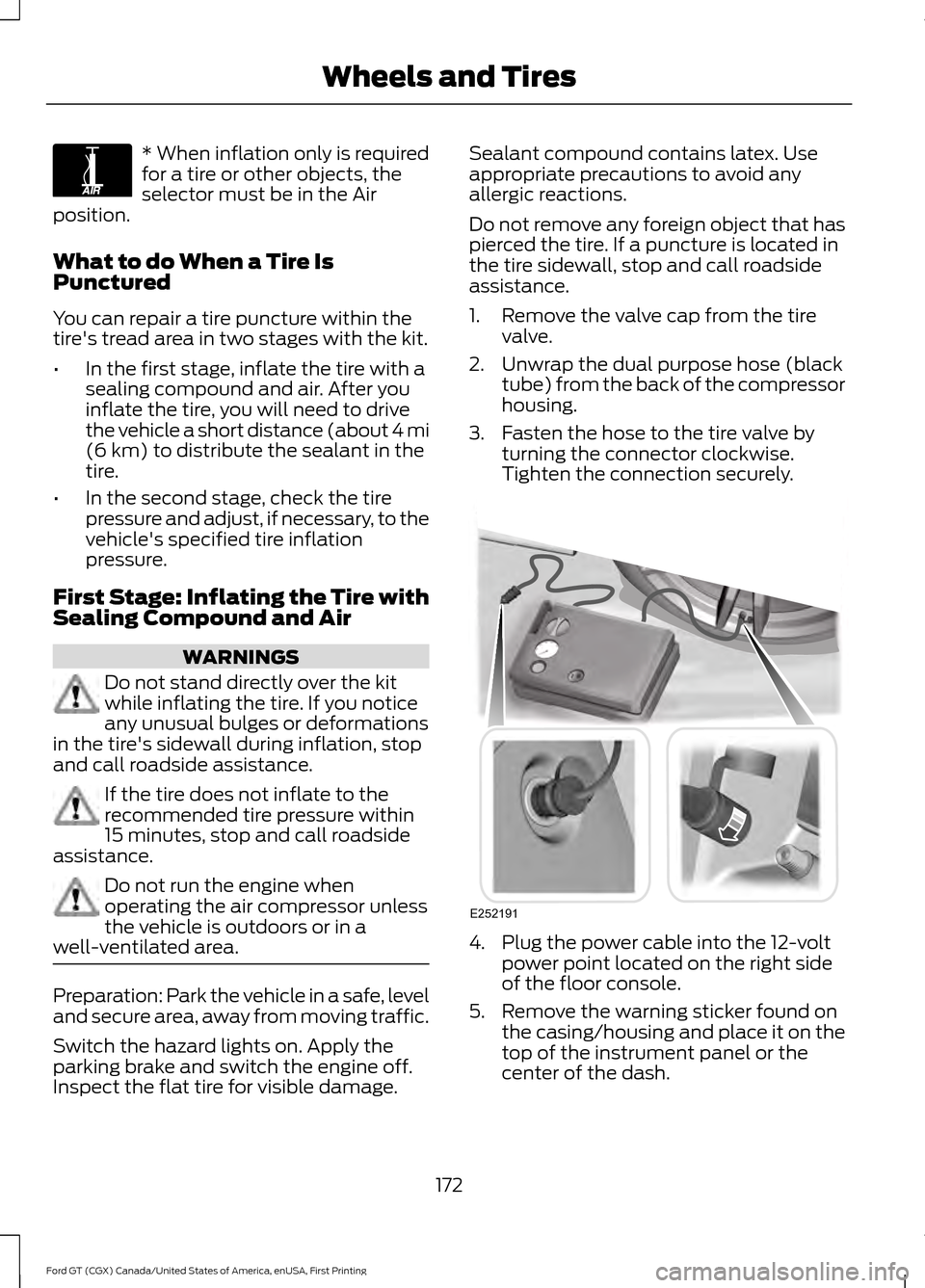
1. Remove the valve cap from the tire
valve.
2. Unwrap the dual purpose hose (black tube) from the back of the compressor
housing.
3. Fasten the hose to the tire valve by turning the connector clockwise.
Tighten the connection securely. 4. Plug the power cable into the 12-volt
power point located on the right side
of the floor console.
5. Remove the warning sticker found on the casing/housing and place it on the
top of the instrument panel or the
center of the dash.
172
Ford GT (CGX) Canada/United States of America, enUSA, First Printing Wheels and TiresE175978 E252191
Page 196 of 313
Note:
If you are not sure about the proper
tire inflation pressures, contact an
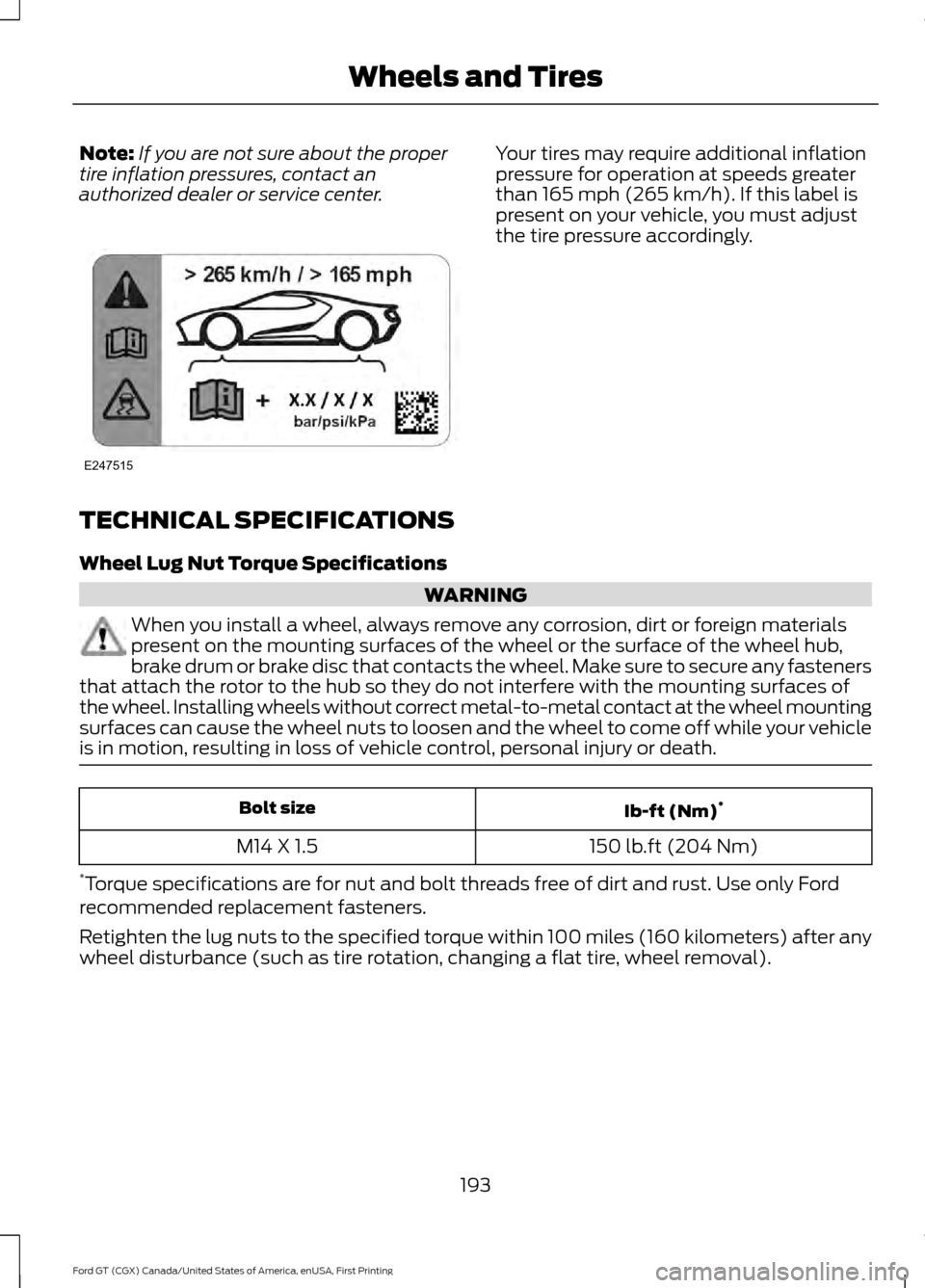
authorized dealer or service center. Your tires may require additional inflation
pressure for operation at speeds greater
than 165 mph (265 km/h). If this label is
present on your vehicle, you must adjust
the tire pressure accordingly.
TECHNICAL SPECIFICATIONS
Wheel Lug Nut Torque Specifications WARNING
When you install a wheel, always remove any corrosion, dirt or foreign materials
present on the mounting surfaces of the wheel or the surface of the wheel hub,
brake drum or brake disc that contacts the wheel. Make sure to secure any fasteners
that attach the rotor to the hub so they do not interfere with the mounting surfaces of
the wheel. Installing wheels without correct metal-to-metal contact at the wheel mounting
surfaces can cause the wheel nuts to loosen and the wheel to come off while your vehicle
is in motion, resulting in loss of vehicle control, personal injury or death. Ib-ft (Nm)
*
Bolt size
150 lb.ft (204 Nm)
M14 X 1.5
* Torque specifications are for nut and bolt threads free of dirt and rust. Use only Ford
recommended replacement fasteners.
Retighten the lug nuts to the specified torque within 100 miles (160 kilometers) after any
wheel disturbance (such as tire rotation, changing a flat tire, wheel removal).
193
Ford GT (CGX) Canada/United States of America, enUSA, First Printing Wheels and TiresE247515
Page 200 of 313
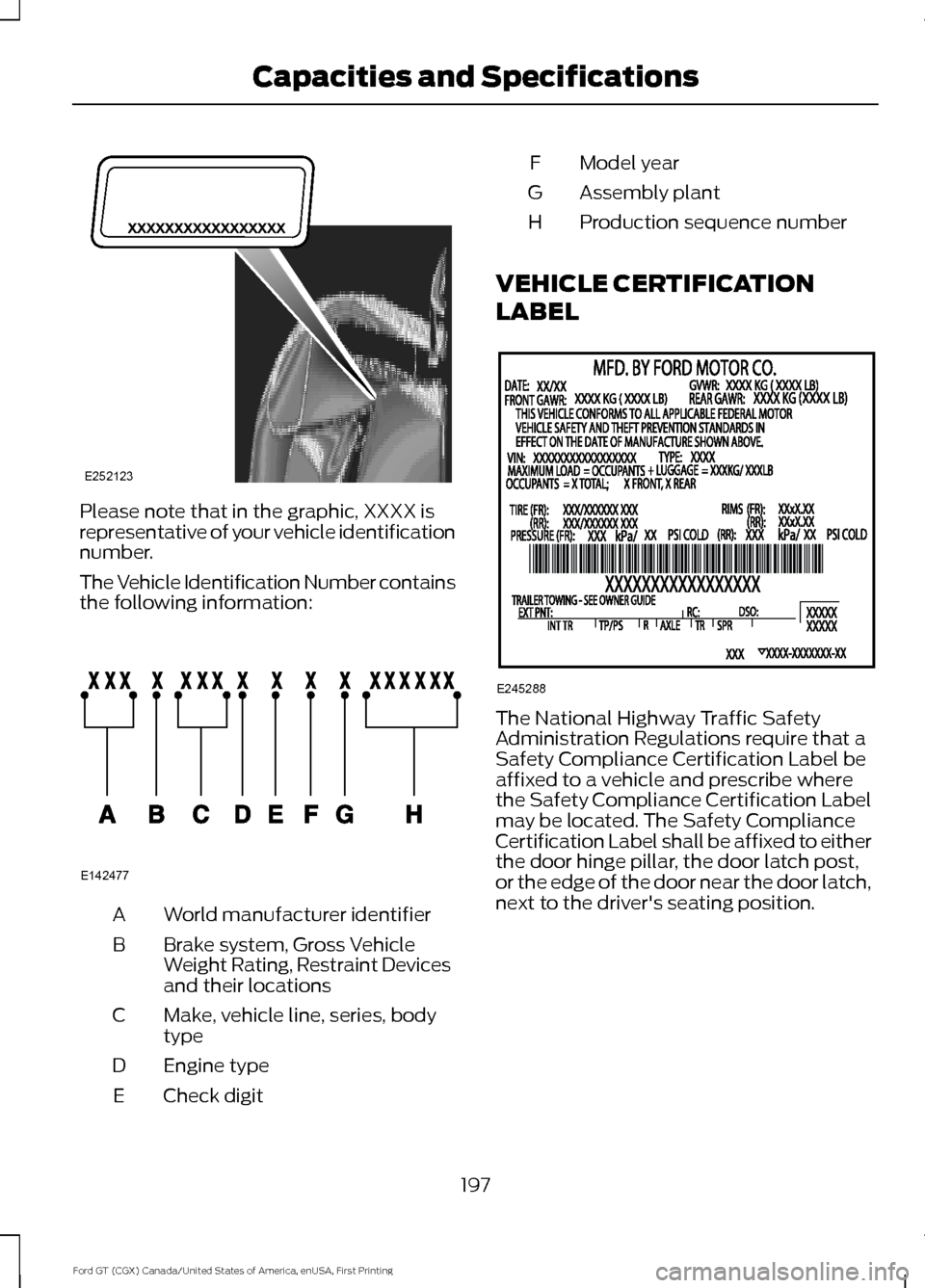
Please note that in the graphic, XXXX is
representative of your vehicle identification
number.
The Vehicle Identification Number contains
the following information:
World manufacturer identifier
A
Brake system, Gross Vehicle
Weight Rating, Restraint Devices
and their locations
B
Make, vehicle line, series, body
type
C
Engine type
D
Check digit
E Model year
F
Assembly plant
G
Production sequence number
H
VEHICLE CERTIFICATION
LABEL The National Highway Traffic Safety
Administration Regulations require that a
Safety Compliance Certification Label be
affixed to a vehicle and prescribe where
the Safety Compliance Certification Label
may be located. The Safety Compliance
Certification Label shall be affixed to either
the door hinge pillar, the door latch post,
or the edge of the door near the door latch,
next to the driver's seating position.
197
Ford GT (CGX) Canada/United States of America, enUSA, First Printing Capacities and SpecificationsE252123 E142477 E245288
Page 202 of 313
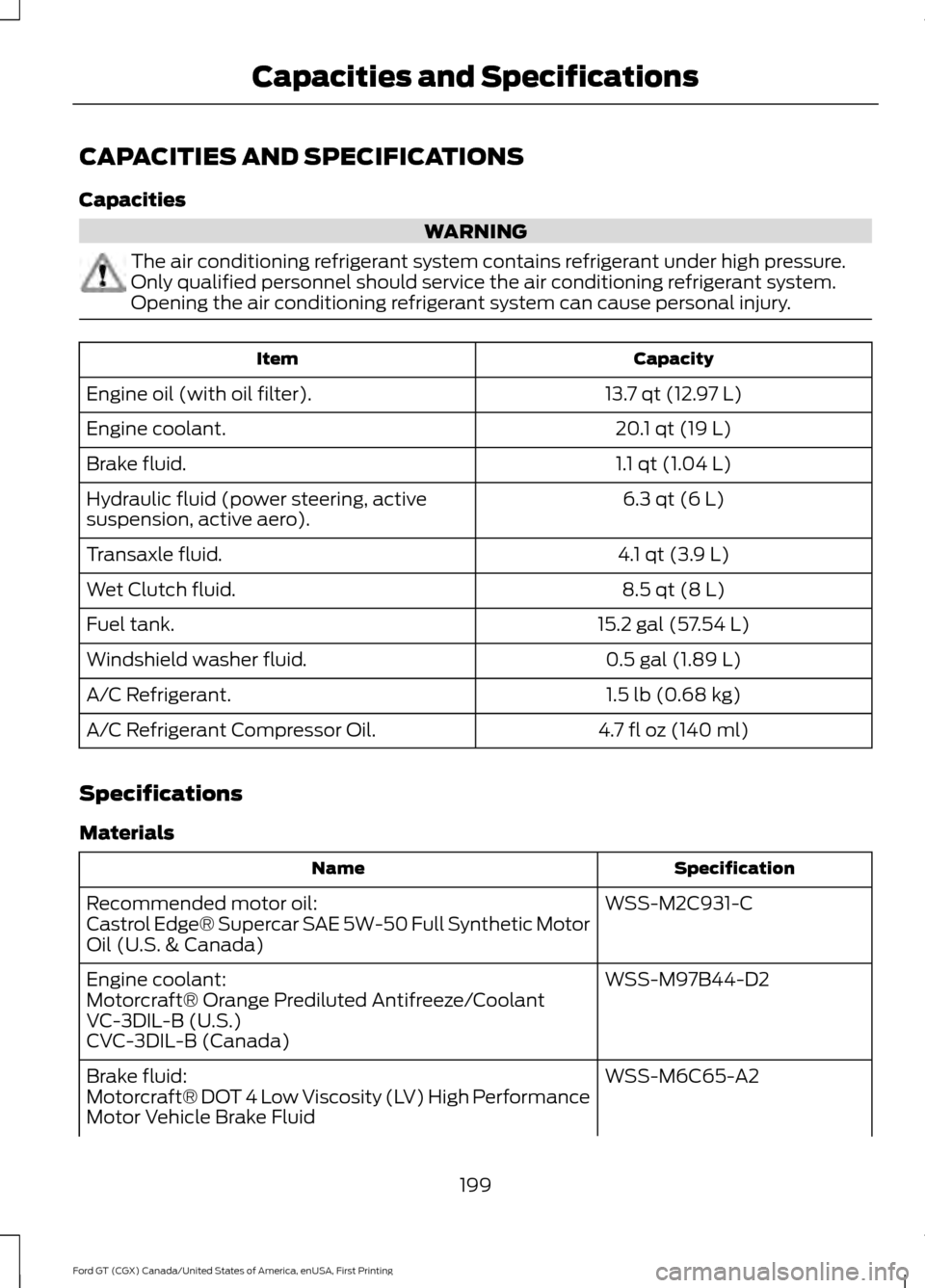
CAPACITIES AND SPECIFICATIONS
Capacities
WARNING
The air conditioning refrigerant system contains refrigerant under high pressure.
Only qualified personnel should service the air conditioning refrigerant system.
Opening the air conditioning refrigerant system can cause personal injury.
Capacity
Item
13.7 qt (12.97 L)
Engine oil (with oil filter).
20.1 qt (19 L)
Engine coolant.
1.1 qt (1.04 L)
Brake fluid.
6.3 qt (6 L)
Hydraulic fluid (power steering, active
suspension, active aero).
4.1 qt (3.9 L)
Transaxle fluid.
8.5 qt (8 L)
Wet Clutch fluid.
15.2 gal (57.54 L)
Fuel tank.
0.5 gal (1.89 L)
Windshield washer fluid.
1.5 lb (0.68 kg)
A/C Refrigerant.
4.7 fl oz (140 ml)
A/C Refrigerant Compressor Oil.
Specifications
Materials Specification
Name
WSS-M2C931-C
Recommended motor oil:
Castrol Edge® Supercar SAE 5W-50 Full Synthetic Motor
Oil (U.S. & Canada)
WSS-M97B44-D2
Engine coolant:
Motorcraft® Orange Prediluted Antifreeze/Coolant
VC-3DIL-B (U.S.)
CVC-3DIL-B (Canada)
WSS-M6C65-A2
Brake fluid:
Motorcraft® DOT 4 Low Viscosity (LV) High Performance
Motor Vehicle Brake Fluid
199
Ford GT (CGX) Canada/United States of America, enUSA, First Printing Capacities and Specifications
Page 203 of 313
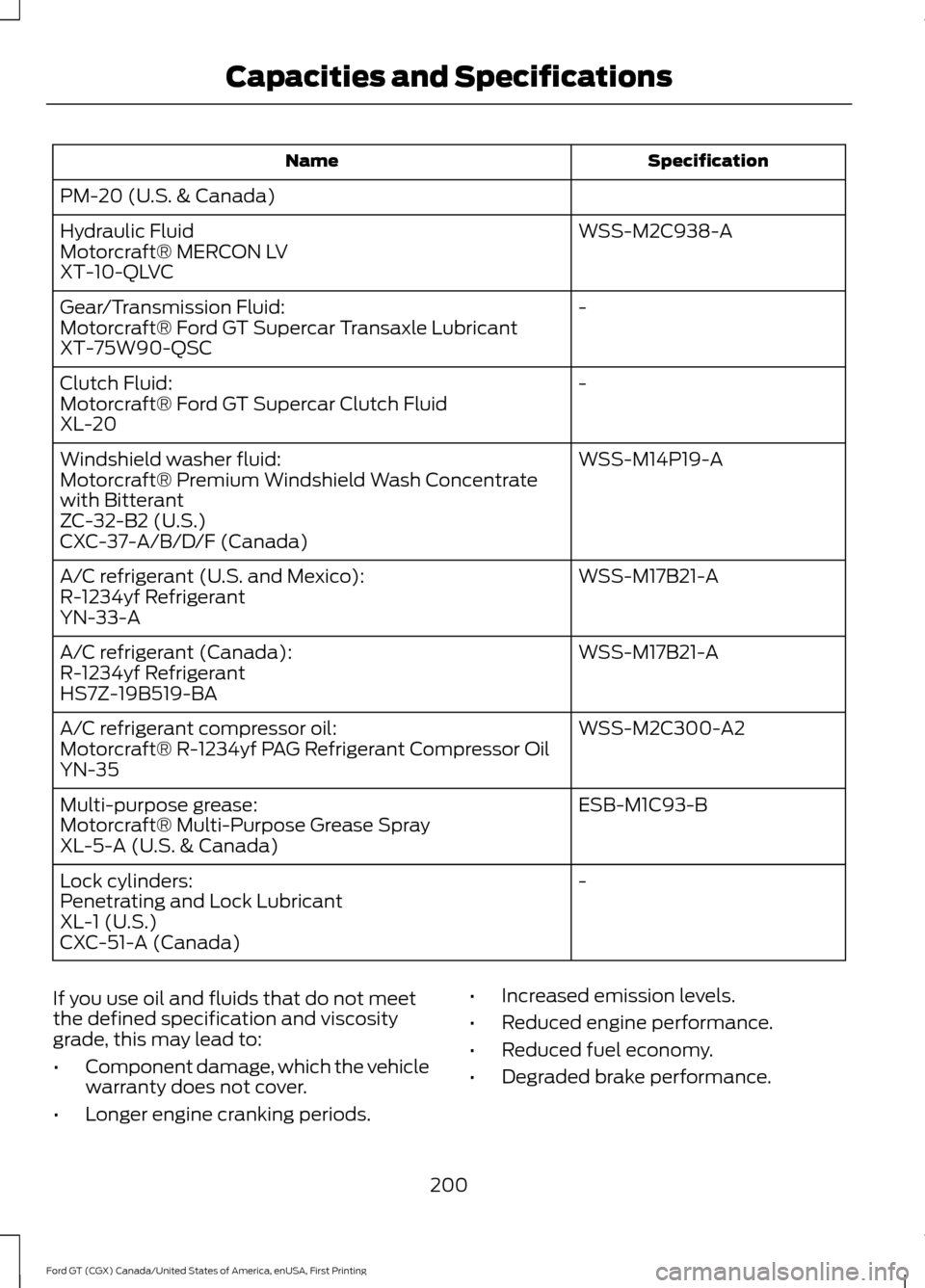
Specification
Name
PM-20 (U.S. & Canada) WSS-M2C938-A
Hydraulic Fluid
Motorcraft® MERCON LV
XT-10-QLVC
-
Gear/Transmission Fluid:
Motorcraft® Ford GT Supercar Transaxle Lubricant
XT-75W90-QSC
-
Clutch Fluid:
Motorcraft® Ford GT Supercar Clutch Fluid
XL-20
WSS-M14P19-A
Windshield washer fluid:
Motorcraft® Premium Windshield Wash Concentrate
with Bitterant
ZC-32-B2 (U.S.)
CXC-37-A/B/D/F (Canada)
WSS-M17B21-A
A/C refrigerant (U.S. and Mexico):
R-1234yf Refrigerant
YN-33-A
WSS-M17B21-A
A/C refrigerant (Canada):
R-1234yf Refrigerant
HS7Z-19B519-BA
WSS-M2C300-A2
A/C refrigerant compressor oil:
Motorcraft® R-1234yf PAG Refrigerant Compressor Oil
YN-35
ESB-M1C93-B
Multi-purpose grease:
Motorcraft® Multi-Purpose Grease Spray
XL-5-A (U.S. & Canada)
-
Lock cylinders:
Penetrating and Lock Lubricant
XL-1 (U.S.)
CXC-51-A (Canada)
If you use oil and fluids that do not meet
the defined specification and viscosity
grade, this may lead to:
• Component damage, which the vehicle
warranty does not cover.
• Longer engine cranking periods. •
Increased emission levels.
• Reduced engine performance.
• Reduced fuel economy.
• Degraded brake performance.
200
Ford GT (CGX) Canada/United States of America, enUSA, First Printing Capacities and Specifications
Page 204 of 313
Only use fluid that meets Ford
specifications.
We recommend Castrol Edge Supercar
5W-50 motor oil for your Ford GT. If this
oil is not available, use motor oils of the
recommended viscosity grade that meet
the Ford specification of WSS-M2C931-C
such as Motorcraft® 5W-50.
Do not use oil labeled with API SN service
category unless the label also displays the
API certification mark.
Do not use supplemental engine oil
additives because they are unnecessary
and could lead to engine damage that may
not be covered by your vehicle warranty.
Note:
Ford recommends using DOT 4 Low
Viscosity (LV) High Performance Brake Fluid
or equivalent meeting WSS-M6C65-A2. Use
of any fluid other than the recommended
fluid may cause degraded brake
performance and not meet the Ford
performance standards. Keep brake fluid
clean and dry. Contamination with dirt,
water, petroleum products or other
materials may result in brake system
damage and possible failure.
201
Ford GT (CGX) Canada/United States of America, enUSA, First Printing Capacities and SpecificationsE115472
Page 267 of 313
Oils and Fluids
In many cases, fluid discoloration is a
normal operating characteristic and, by
itself, does not necessarily indicate a
concern or that the fluid needs to be
changed. However, a qualified expert, such
as the factory-trained technicians at your
dealership, should inspect discolored fluids
that also show signs of overheating or
foreign material contamination
immediately.
Make sure to change your vehicle
’s oils and
fluids at the specified intervals or in
conjunction with a repair.
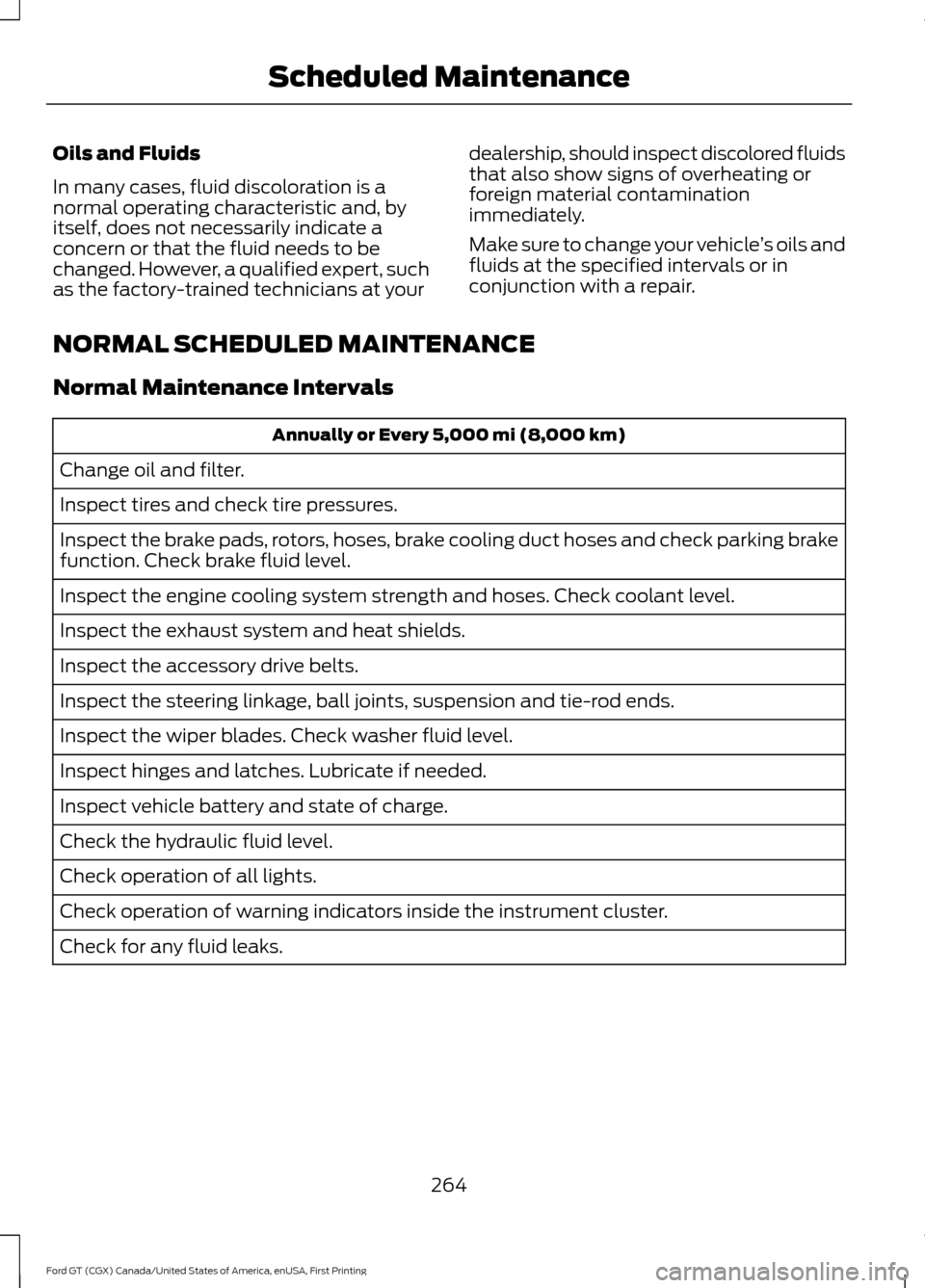
NORMAL SCHEDULED MAINTENANCE
Normal Maintenance Intervals Annually or Every 5,000 mi (8,000 km)
Change oil and filter.
Inspect tires and check tire pressures.
Inspect the brake pads, rotors, hoses, brake cooling duct hoses and check parking brake
function. Check brake fluid level.
Inspect the engine cooling system strength and hoses. Check coolant level.
Inspect the exhaust system and heat shields.
Inspect the accessory drive belts.
Inspect the steering linkage, ball joints, suspension and tie-rod ends.
Inspect the wiper blades. Check washer fluid level.
Inspect hinges and latches. Lubricate if needed.
Inspect vehicle battery and state of charge.
Check the hydraulic fluid level.
Check operation of all lights.
Check operation of warning indicators inside the instrument cluster.
Check for any fluid leaks.
264
Ford GT (CGX) Canada/United States of America, enUSA, First Printing Scheduled Maintenance
Page 268 of 313
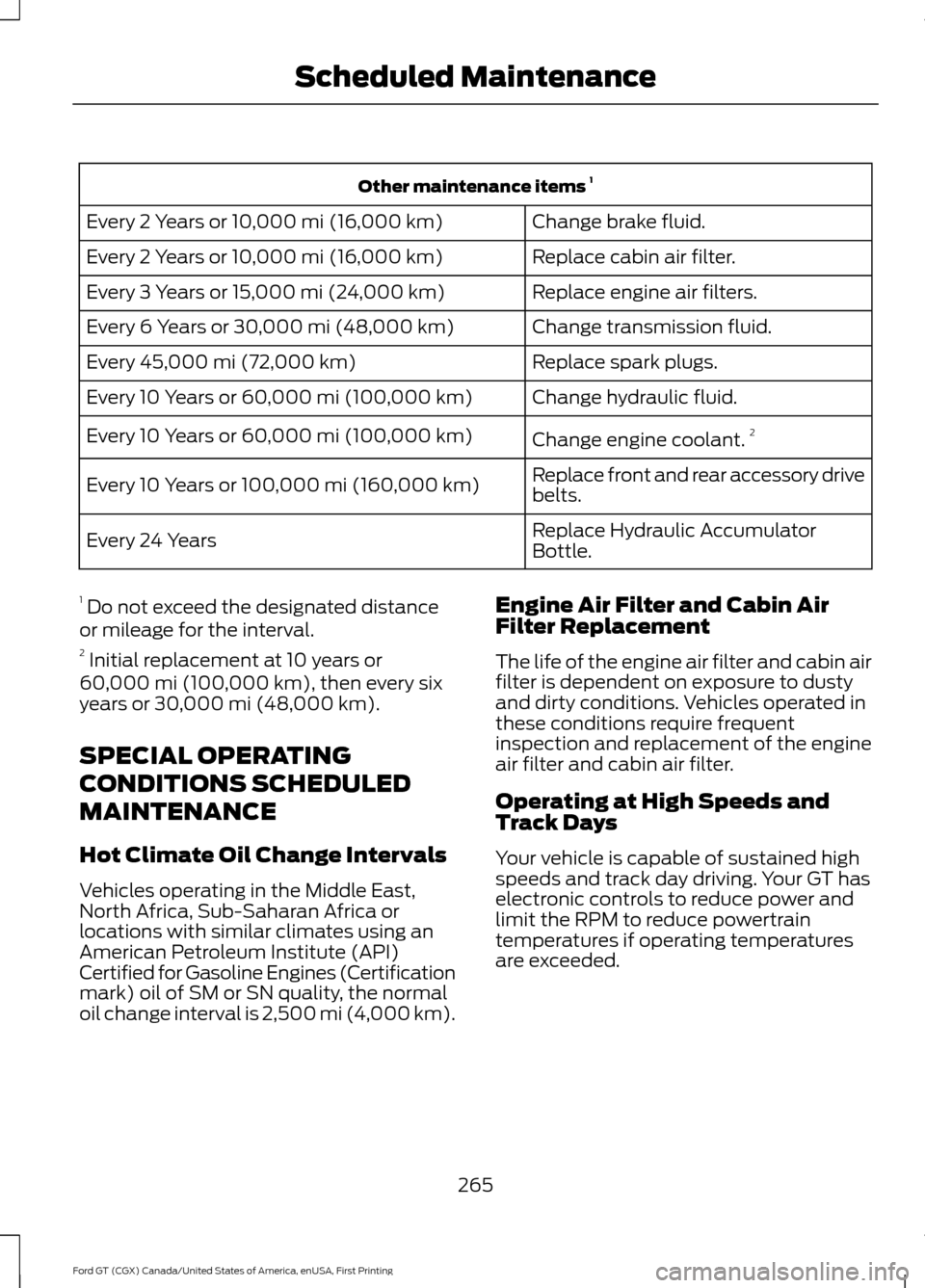
Other maintenance items
1
Change brake fluid.
Every 2 Years or 10,000 mi (16,000 km)
Replace cabin air filter.
Every 2 Years or
10,000 mi (16,000 km)
Replace engine air filters.
Every 3 Years or
15,000 mi (24,000 km)
Change transmission fluid.
Every 6 Years or
30,000 mi (48,000 km)
Replace spark plugs.
Every
45,000 mi (72,000 km)
Change hydraulic fluid.
Every 10 Years or
60,000 mi (100,000 km)
Change engine coolant.2
Every 10 Years or
60,000 mi (100,000 km)
Replace front and rear accessory drive
belts.
Every 10 Years or
100,000 mi (160,000 km)
Replace Hydraulic Accumulator
Bottle.
Every 24 Years
1 Do not exceed the designated distance
or mileage for the interval.
2 Initial replacement at 10 years or
60,000 mi (100,000 km)
, then every six
years or 30,000 mi (48,000 km).
SPECIAL OPERATING
CONDITIONS SCHEDULED
MAINTENANCE
Hot Climate Oil Change Intervals
Vehicles operating in the Middle East,
North Africa, Sub-Saharan Africa or
locations with similar climates using an
American Petroleum Institute (API)
Certified for Gasoline Engines (Certification
mark) oil of SM or SN quality, the normal
oil change interval is 2,500 mi (4,000 km). Engine Air Filter and Cabin Air
Filter Replacement
The life of the engine air filter and cabin air
filter is dependent on exposure to dusty
and dirty conditions. Vehicles operated in
these conditions require frequent
inspection and replacement of the engine
air filter and cabin air filter.
Operating at High Speeds and
Track Days
Your vehicle is capable of sustained high
speeds and track day driving. Your GT has
electronic controls to reduce power and
limit the RPM to reduce powertrain
temperatures if operating temperatures
are exceeded.
265
Ford GT (CGX) Canada/United States of America, enUSA, First Printing Scheduled Maintenance
Page 269 of 313
Before Operating Your Vehicle at High
Speeds:
•
Verify your tires have the correct
pressures See Technical
Specifications (page 193).
• Inspect wheels and tires for wear and
damage. Replace any damaged wheels
and tires.
• Check and set lug nut torque. See
Technical Specifications (page 193).
• Verify fluid levels for oil, coolant, brake,
and hydraulic fluid. See Maintenance
(page
147).
• Change the oil and filter prior to use on
the track. After Operating Your vehicle at High
Speeds and Track Day Driving, Do the
Following:
•
Set tire pressures to specification.
• Check and set lug nut torque. See
Technical Specifications (page 193).
• Check all fluid levels.
• If you drive your car for an extended
period of time at high speed or on the
track for an extended time, change the
oil and filter.
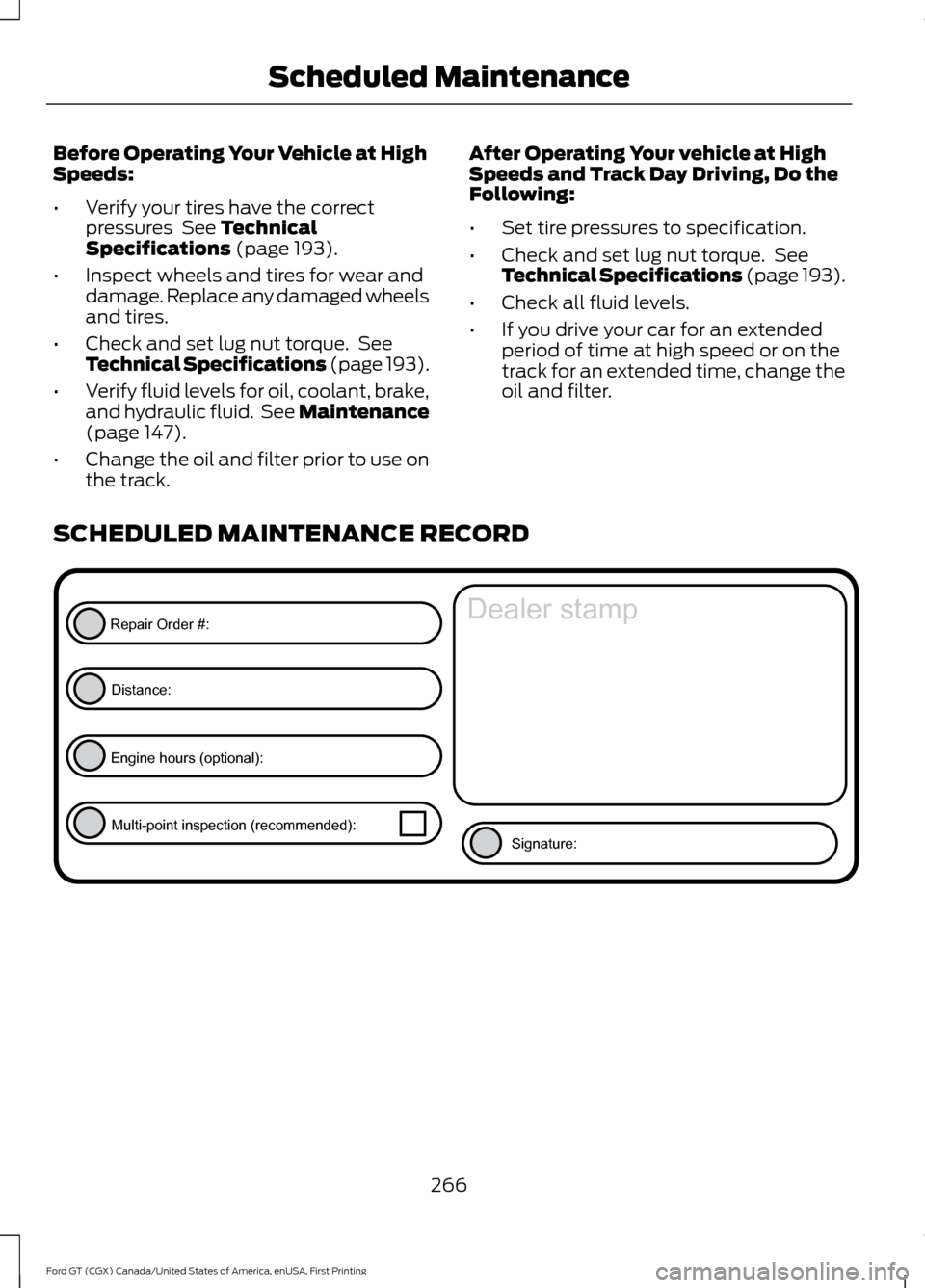
SCHEDULED MAINTENANCE RECORD 266
Ford GT (CGX) Canada/United States of America, enUSA, First Printing Scheduled MaintenanceE146852
Repair Order #:Distance:
Engine hours (optional): Multi-point inspection (recommended): Signature:
Dealer stamp