brake FORD KUGA 2010 1.G Owner's Manual
[x] Cancel search | Manufacturer: FORD, Model Year: 2010, Model line: KUGA, Model: FORD KUGA 2010 1.GPages: 226, PDF Size: 8.07 MB
Page 142 of 226
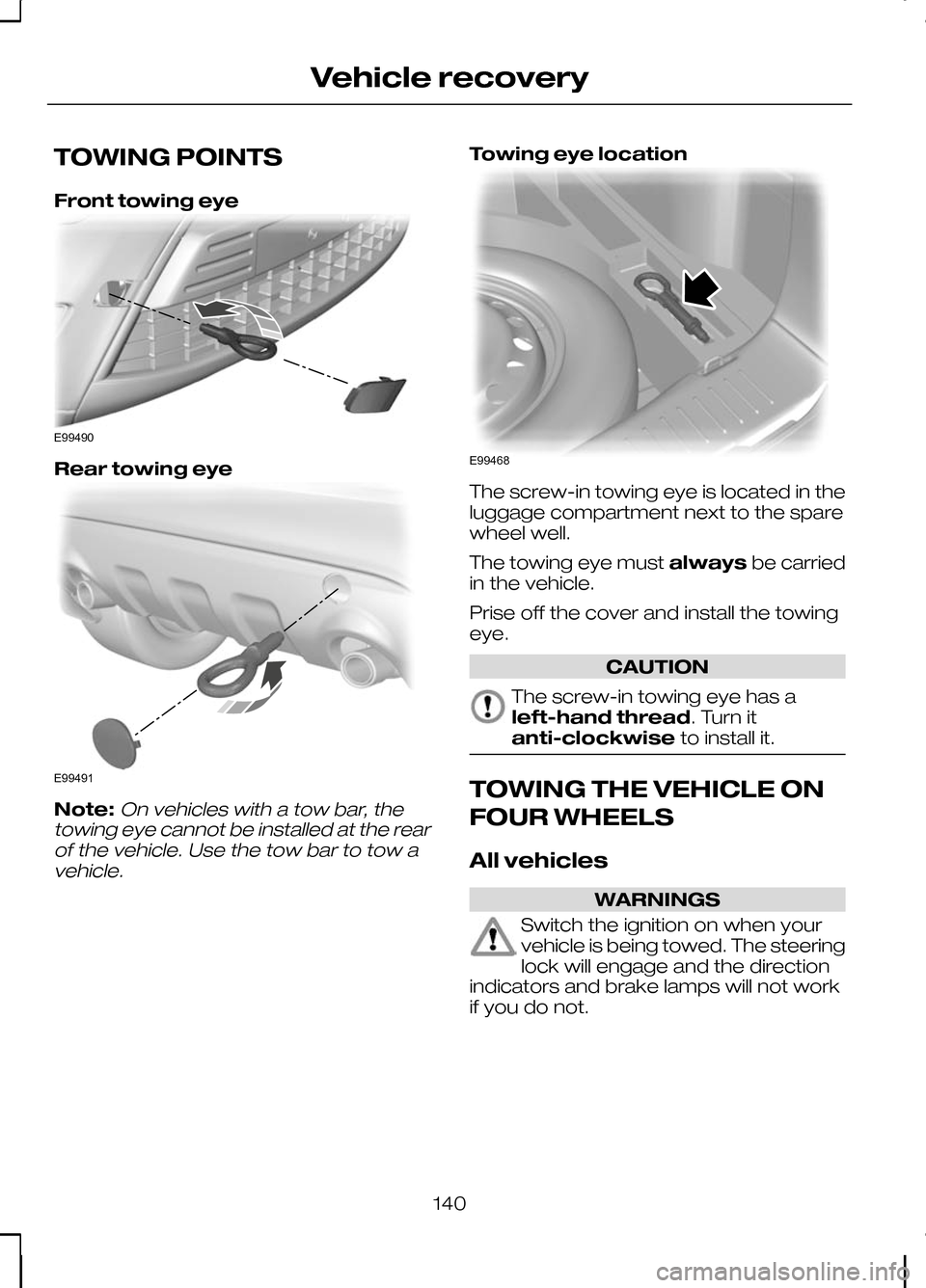
TOWING POINTS
Front towing eye
Rear towing eye
Note:On vehicles with a tow bar, the
towing eye cannot be installed at the rear of the vehicle. Use the tow bar to tow avehicle.
Towing eye location The screw-in towing eye is located in the
luggage compartment next to the spare
wheel well.
The towing eye must
alwaysbe carried
in the vehicle.
Prise off the cover and install the towing
eye. CAUTION
The screw-in towing eye has a
left-hand thread. Turn it
anti-clockwise
to install it. TOWING THE VEHICLE ON
FOUR WHEELS
All vehicles
WARNINGS
Switch the ignition on when your
vehicle is being towed. The steering
lock will engage and the direction
indicators and brake lamps will not work
if you do not.
140
Vehicle recoveryE99490 E99491 E99468
Page 143 of 226
WARNINGS
The brake servo and the power
steering pump do not operate
unless the engine is running. Press
the brake pedal harder and allow for
increased stopping distances and heavier
steering. CAUTIONS
Too much tension in the tow rope
could cause damage to your vehicle
or the vehicle that is towing.
Do not use a rigid tow bar on the
front towing eye.
Select neutral when your vehicle is
being towed.
For vehicles with AWD, in the event
of a breakdown or mechanical failure
of the transmission your vehicle must
be recovered with either ALLwheels on
the ground or transported with ALL
wheels off the ground. Drive off slowly and smoothly without
jerking the vehicle that is towing.
Vehicles with automatic
transmission
CAUTIONS
If a speed of 20 km/h (12 mph) and
a distance of 20 kilometres (12 miles)
is to be exceeded the drive wheels
must be lifted clear of the ground. It is recommended not to tow with
the drive wheels on the ground.
However, if it is required to move the
vehicle from a dangerous location, do not
tow your vehicle faster than 20 km/h (12
mph) or further than 20 kilometres (12
miles). Do not tow your vehicle backwards. CAUTIONS
In the event of a mechanical failure
of the transmission the drive wheels
must be lifted clear of the ground.
Do not tow your vehicle if the
ambient temperature is below 0ºC
(32ºF).
141
Vehicle recovery
Page 144 of 226
GENERAL INFORMATION
Have your vehicle serviced regularly to
help maintain its roadworthiness and
resale value. There is a large network of
Ford Authorised Repairers that are there
to help you with their professional
servicing expertise. We believe that their
specially trained technicians are best
qualified to service your vehicle properly
and expertly. They are supported by a
wide range of highly specialised tools
developed specifically for servicing your
vehicle.
In addition to regular servicing, we
recommend that you carry out the
following additional checks.
WARNINGS
Switch the ignition off before
touching or attempting adjustment
of any kind.
Do not touch the electronic ignition
system parts after you have
switched the ignition on or when the
engine is running. The system operates
at high voltage. Keep your hands and clothing clear
of the engine cooling fan. Under
certain conditions, the fan may
continue to run for several minutes after
you have switched the engine off. CAUTION
When carrying out maintenance
checks, make sure that filler caps are
fitted securely.
Daily checks
•
Exterior lamps.
• Interior lamps.
• Warning lamps and indicators. Check when refuelling
•
Engine oil level. See
Engine oil
check (page 147).
• Brake fluid level. See
Brake and
clutch fluid check (page 149).
• Washer fluid level. See
Washer fluid
check (page 149).
• Tyre pressures (when cold). See
Technical specifications
(page
168).
• Tyre condition. See
Tyre care(page
166).
Monthly checks
• Engine coolant level (engine cold).
See
Engine coolant check (page
148).
• Pipes, hoses and reservoirs for leaks.
• Power steering fluid level. See
Power steering fluid check
(page
149).
• Air conditioning operation.
• Parking brake operation.
• Horn operation.
• Tightness of wheel nuts. See
Technical specifications
(page
168).
OPENING AND CLOSING
THE BONNET
Opening the bonnet WARNING
To prevent damage to, or loss of the
key, remove the key immediately
after opening and swivel the Ford
badge back. Note:On vehicles with keyless entry, use
the spare key. See Keyless entry(page
31).
142
Maintenance
Page 146 of 226
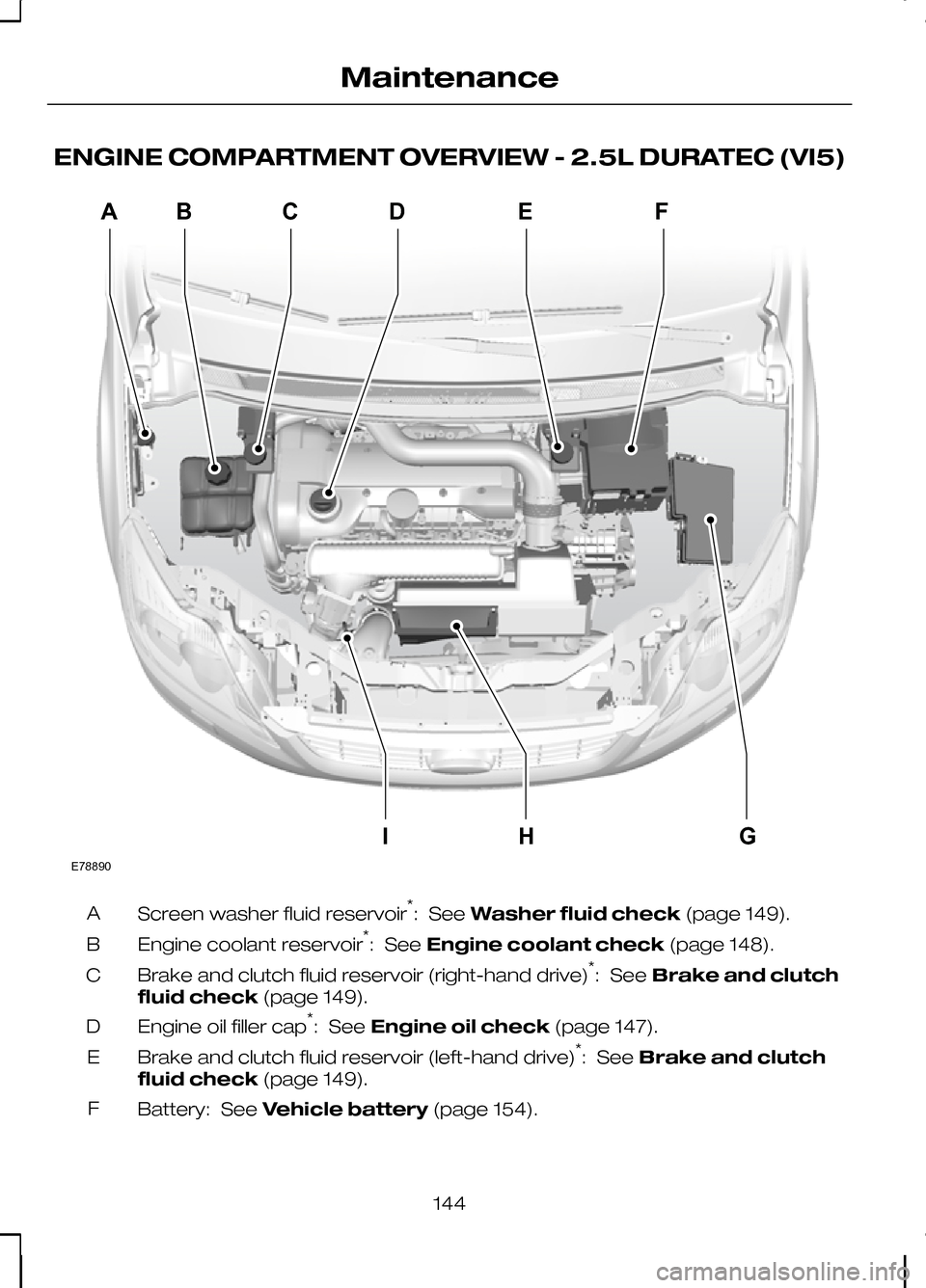
ENGINE COMPARTMENT OVERVIEW - 2.5L DURATEC (VI5)
Screen washer fluid reservoir
*
: See Washer fluid check (page 149).
A
Engine coolant reservoir *
: See Engine coolant check (page 148).
B
Brake and clutch fluid reservoir (right-hand drive) *
: See Brake and clutch
fluid check (page 149).
C
Engine oil filler cap *
: See Engine oil check (page 147).
D
Brake and clutch fluid reservoir (left-hand drive) *
: See Brake and clutch
fluid check (page 149).
E
Battery: See Vehicle battery (page 154).
F
144
MaintenanceE78890IFEDCBAHG
Page 148 of 226
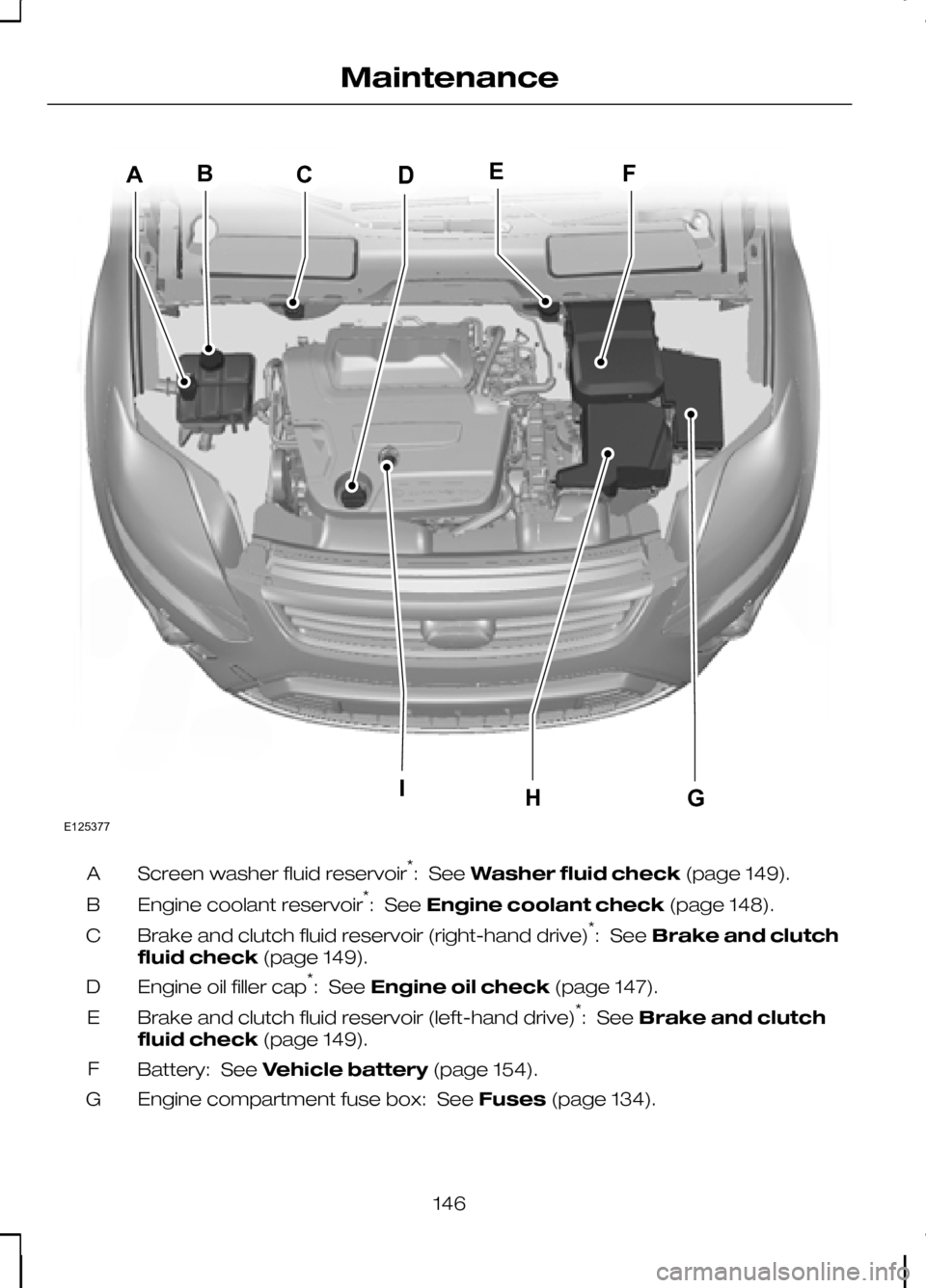
Screen washer fluid reservoir
*
: See Washer fluid check (page 149).
A
Engine coolant reservoir *
: See Engine coolant check (page 148).
B
Brake and clutch fluid reservoir (right-hand drive) *
: See Brake and clutch
fluid check (page 149).
C
Engine oil filler cap *
: See Engine oil check (page 147).
D
Brake and clutch fluid reservoir (left-hand drive) *
: See Brake and clutch
fluid check (page 149).
E
Battery: See Vehicle battery (page 154).
F
Engine compartment fuse box: See Fuses(page 134).
G
146
MaintenanceIFEDCBAHGE125377
Page 151 of 226
BRAKE AND CLUTCH FLUID
CHECK
WARNINGS
Do not allow the fluid to touch your
skin or eyes. If this happens, rinse
the affected areas immediately with
plenty of water and contact your doctor. If the level is at the
MINmark, have
the system checked by a properly
trained technician as soon as
possible. Note:The brake and the clutch systems
are supplied from the same reservoir.
Top up with fluid that meets the Ford
specification. See Technical
specifications (page 150).
POWER STEERING FLUID
CHECK WARNING
Do not allow the fluid to touch your
skin or eyes. If this happens, rinse
the affected areas immediately with
plenty of water and contact your doctor. CAUTION
Make sure that the level is between
the
MIN and the MAXmarks. If the level is at the
MINmark, top up
immediately.
Topping up
Remove the filler cap. CAUTION
Do not top up further than the
MAX
mark. Top up with fluid that meets the Ford
specification. See
Technical
specifications (page 150).
WASHER FLUID CHECK
The front and rear washer systems are
supplied from the same reservoir.
149
Maintenance
Page 152 of 226
TECHNICAL SPECIFICATIONS
Vehicle fluids
Specification
Recommended fluid
Item
WSS-M2C913-C
Castrol Engine Oil *
Engine oil
WSS-M2C204-A2
Ford or Motorcraft Power
Steering Fluid
Power steering fluid
WSS-M97B44-D
Motorcraft SuperPlus Anti-
freeze
Coolant
ESD-M6C57-A
Ford or Motorcraft Super
DOT 4 Brake Fluid
Brake fluid
* Providing it meets the specification defined by WSS-M2C913-C, you can also use
Ford Engine Oil or an alternative engine oil.
Note:If you operate your vehicle in temperatures below -20°C (-4°F), you must not
use SAE 10W-40 engine oil.
Topping up the oil: If you are unable to find an oil that meets the specification defined
by WSS-M2C913-C, you must use SAE 5W-30(preferred),SAE 5W-40 (except
vehicles with E85 fuel) or SAE 10W-40that meets the specification defined by either
ACEA A1/B1 (preferred) orACEA A3/B3. Using these oils can result in longer engine
cranking periods, reduced engine performance, reduced fuel economy and increased
emission levels.
Castrol engine oil recommended. Capacities
Capacity in litres (gallons)
Item
Variant
MAX mark
Power assisted steering
fluid
All
approx. 8.6 (1.9)
Engine cooling system
All
4.0 (0.9)
Windscreen washer system
All
65 (14.3)
Fuel tank
2.0L Duratorq-TDCi
66 (14.5)
Fuel tank
2.5L Duratec
150
MaintenanceE115472
Page 161 of 226
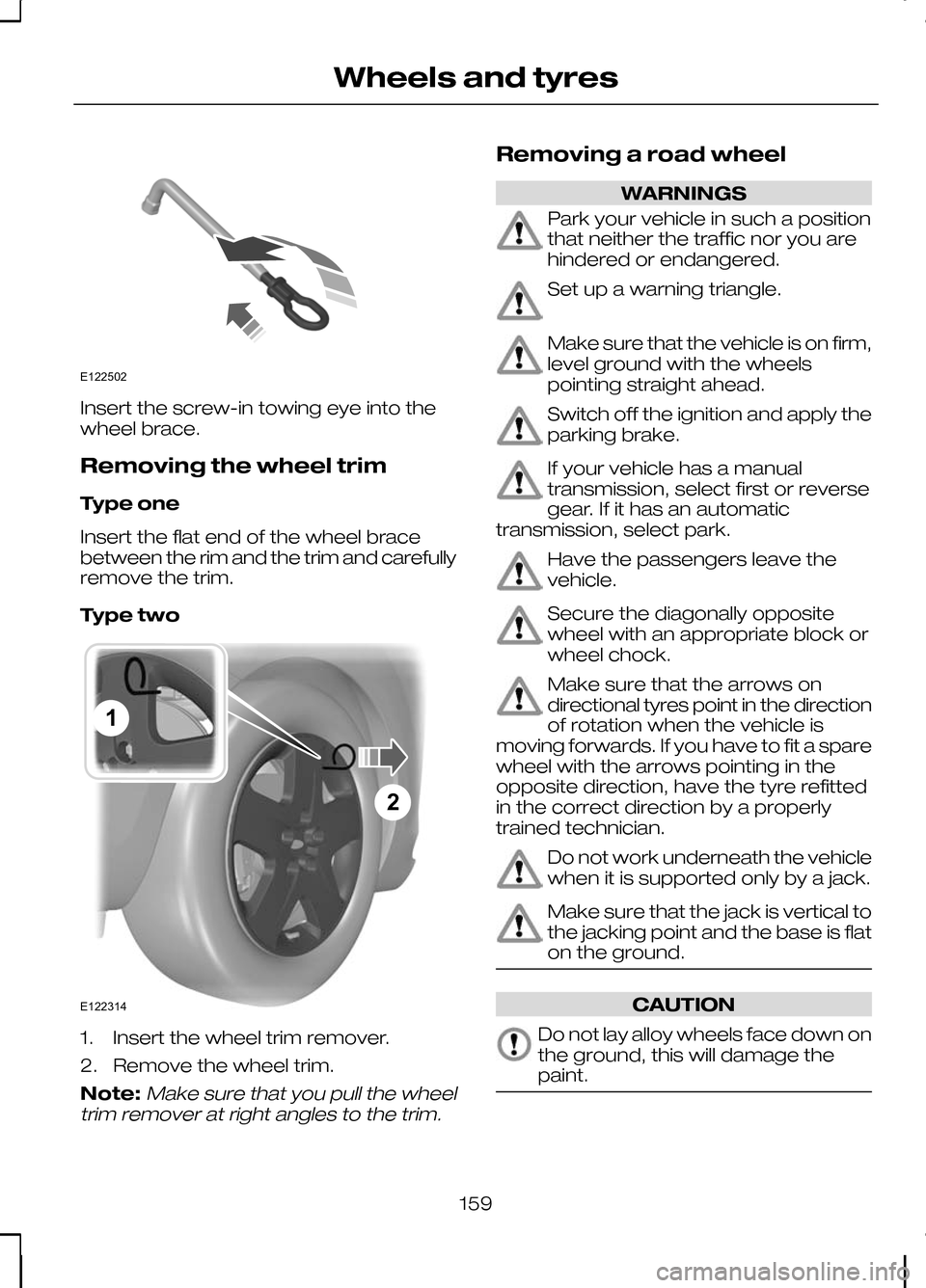
Insert the screw-in towing eye into the
wheel brace.
Removing the wheel trim
Type one
Insert the flat end of the wheel brace
between the rim and the trim and carefully
remove the trim.
Type two
1. Insert the wheel trim remover.
2. Remove the wheel trim.
Note:Make sure that you pull the wheel
trim remover at right angles to the trim.
Removing a road wheel WARNINGS
Park your vehicle in such a position
that neither the traffic nor you are
hindered or endangered.
Set up a warning triangle.
Make sure that the vehicle is on firm,
level ground with the wheels
pointing straight ahead.
Switch off the ignition and apply the
parking brake.
If your vehicle has a manual
transmission, select first or reverse
gear. If it has an automatic
transmission, select park. Have the passengers leave the
vehicle.
Secure the diagonally opposite
wheel with an appropriate block or
wheel chock.
Make sure that the arrows on
directional tyres point in the direction
of rotation when the vehicle is
moving forwards. If you have to fit a spare
wheel with the arrows pointing in the
opposite direction, have the tyre refitted
in the correct direction by a properly
trained technician. Do not work underneath the vehicle
when it is supported only by a jack.
Make sure that the jack is vertical to
the jacking point and the base is flat
on the ground.
CAUTION
Do not lay alloy wheels face down on
the ground, this will damage the
paint.
159
Wheels and tyresE122502 E12231421
Page 164 of 226
•
Park your vehicle at the roadside so
that you do not obstruct the flow of
traffic and so that you are able to use
the kit without being in danger.
• Apply the parking brake, even if you
have parked on a level road, to make
sure that the vehicle will not move.
• Do not attempt to remove foreign
objects like nails or screws penetrating
the tyre.
• Leave the engine running while the kit
is in use, but not if the vehicle is in an
enclosed or poorly ventilated area (for
example, inside a building). In these
circumstances, switch the
compressor on with the engine turned
off.
• Replace the sealant bottle with a new
one before the expiry date (see top
of bottle) is reached.
• Inform all other users of the vehicle
that the tyre has been temporarily
sealed with the tyre repair kit and
make them aware of the special
driving conditions to be observed.
Inflating the tyre WARNINGS
Check the sidewall of the tyre prior
to inflation. If there are any cracks,
bumps or similar damage, do not
attempt to inflate the tyre. Do not stand directly beside the tyre
while the compressor is pumping.
Watch the sidewall of the tyre. If any
cracks, bumps or similar damage
appear, turn off the compressor and
let the air out by means of the pressure
relief valve B. Do not continue driving with
this tyre. WARNINGS
The sealant contains natural rubber
latex. Avoid contact with skin and
clothing. If this happens, rinse the
affected areas immediately with plenty of
water and contact your doctor. If the tyre inflation pressure does not
reach 1.8 bar (26 psi) within seven
minutes, the tyre may have suffered
excessive damage, making a temporary
repair impossible. In this case, do not
continue driving with this tyre. CAUTION
Screwing the bottle onto the bottle
holder will pierce the seal of the
bottle. Do not unscrew the bottle
from the holder as the sealant will escape. 162
Wheels and tyres
Page 214 of 226
ELECTROMAGNETIC
COMPATIBILITY
WARNINGS
Your vehicle has been tested and
certified to European legislations
relating to electromagnetic
compatibility (2004/104/EC). It is your
responsibility to ensure that any
equipment you have fitted complies with
applicable local legislations. Have any
equipment fitted by properly trained
technicians. WARNINGS
Radio frequency (RF) transmitter
equipment (e.g. cellular telephones,
amateur radio transmitters etc.) may
only be fitted to your vehicle if they comply
with the parameters shown in the table
below. There are no special provisions or
conditions for installations or use. Do not mount any transceiver,
microphones, speakers, or any
other item in the deployment path
of the airbag system. Do not fasten antenna cables to
original vehicle wiring, fuel pipes and
brake pipes.
212
AppendicesE114220