Low level FORD KUGA 2010 1.G Owners Manual
[x] Cancel search | Manufacturer: FORD, Model Year: 2010, Model line: KUGA, Model: FORD KUGA 2010 1.GPages: 226, PDF Size: 8.07 MB
Page 67 of 226
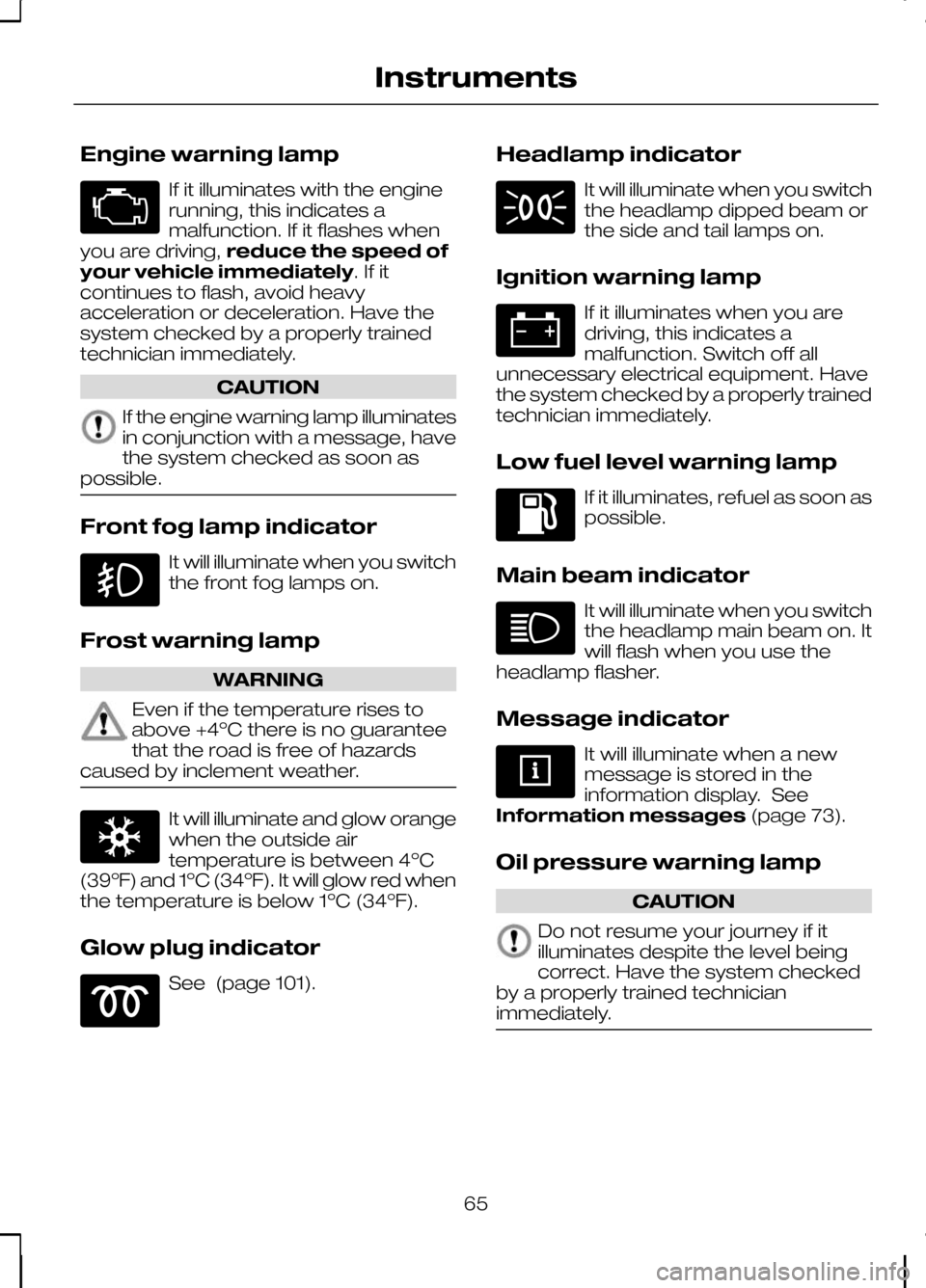
Engine warning lamp
If it illuminates with the engine
running, this indicates a
malfunction. If it flashes when
you are driving, reduce the speed of
your vehicle immediately. If it
continues to flash, avoid heavy
acceleration or deceleration. Have the
system checked by a properly trained
technician immediately. CAUTION
If the engine warning lamp illuminates
in conjunction with a message, have
the system checked as soon as
possible. Front fog lamp indicator
It will illuminate when you switch
the front fog lamps on.
Frost warning lamp WARNING
Even if the temperature rises to
above +4ºC there is no guarantee
that the road is free of hazards
caused by inclement weather. It will illuminate and glow orange
when the outside air
temperature is between 4ºC
(39ºF) and 1ºC (34ºF). It will glow red when
the temperature is below 1ºC (34ºF).
Glow plug indicator See (page 101). Headlamp indicator It will illuminate when you switch
the headlamp dipped beam or
the side and tail lamps on.
Ignition warning lamp If it illuminates when you are
driving, this indicates a
malfunction. Switch off all
unnecessary electrical equipment. Have
the system checked by a properly trained
technician immediately.
Low fuel level warning lamp If it illuminates, refuel as soon as
possible.
Main beam indicator It will illuminate when you switch
the headlamp main beam on. It
will flash when you use the
headlamp flasher.
Message indicator It will illuminate when a new
message is stored in the
information display. See
Information messages (page 73).
Oil pressure warning lamp CAUTION
Do not resume your journey if it
illuminates despite the level being
correct. Have the system checked
by a properly trained technician
immediately. 65
Instruments
Page 68 of 226
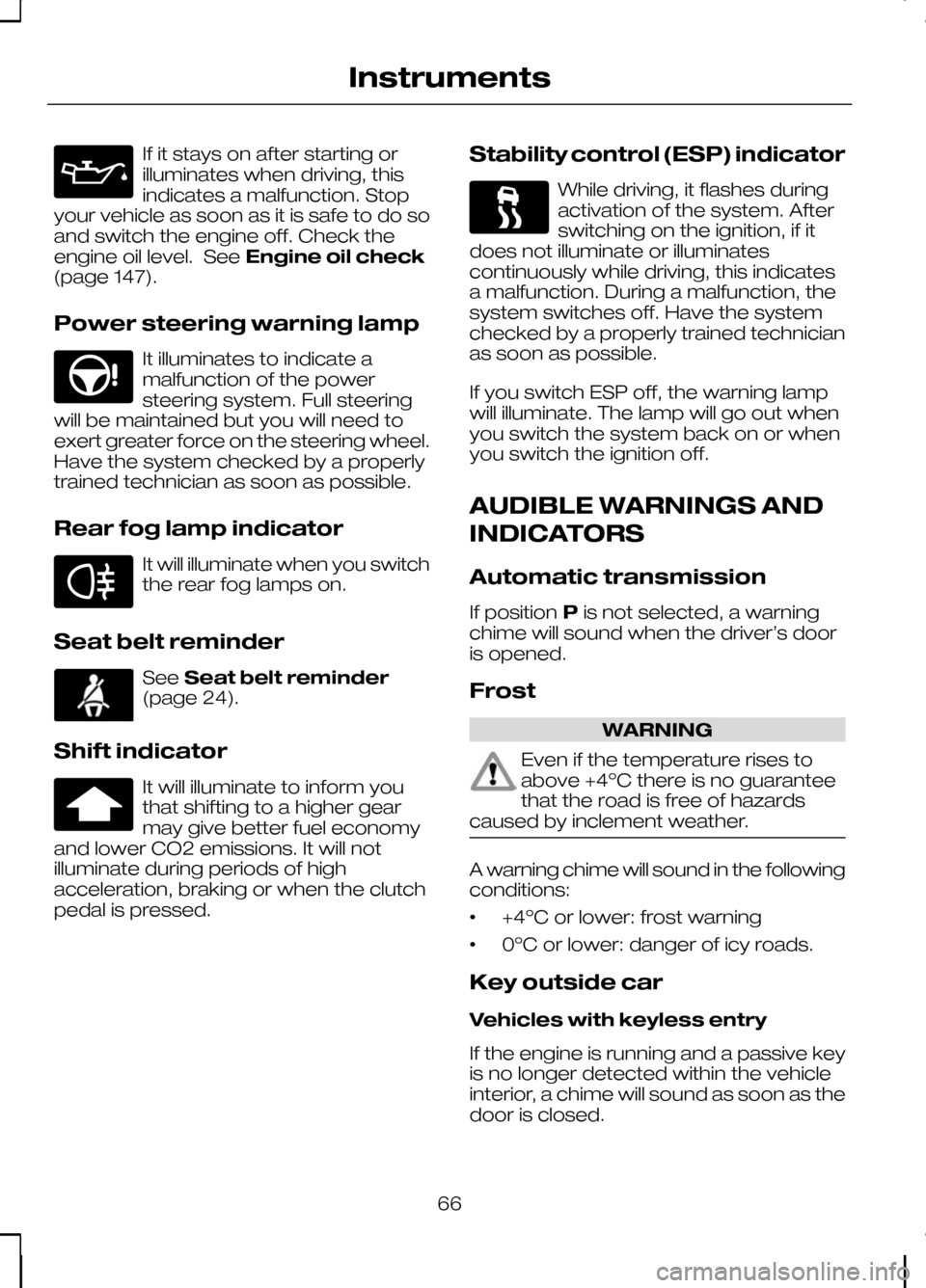
If it stays on after starting or
illuminates when driving, this
indicates a malfunction. Stop
your vehicle as soon as it is safe to do so
and switch the engine off. Check the
engine oil level. See Engine oil check
(page 147).
Power steering warning lamp It illuminates to indicate a
malfunction of the power
steering system. Full steering
will be maintained but you will need to
exert greater force on the steering wheel.
Have the system checked by a properly
trained technician as soon as possible.
Rear fog lamp indicator It will illuminate when you switch
the rear fog lamps on.
Seat belt reminder See
Seat belt reminder
(page 24).
Shift indicator It will illuminate to inform you
that shifting to a higher gear
may give better fuel economy
and lower CO2 emissions. It will not
illuminate during periods of high
acceleration, braking or when the clutch
pedal is pressed. Stability control (ESP) indicator While driving, it flashes during
activation of the system. After
switching on the ignition, if it
does not illuminate or illuminates
continuously while driving, this indicates
a malfunction. During a malfunction, the
system switches off. Have the system
checked by a properly trained technician
as soon as possible.
If you switch ESP off, the warning lamp
will illuminate. The lamp will go out when
you switch the system back on or when
you switch the ignition off.
AUDIBLE WARNINGS AND
INDICATORS
Automatic transmission
If position Pis not selected, a warning
chime will sound when the driver’s door
is opened.
Frost WARNING
Even if the temperature rises to
above +4ºC there is no guarantee
that the road is free of hazards
caused by inclement weather. A warning chime will sound in the following
conditions:
•
+4ºC or lower: frost warning
• 0ºC or lower: danger of icy roads.
Key outside car
Vehicles with keyless entry
If the engine is running and a passive key
is no longer detected within the vehicle
interior, a chime will sound as soon as the
door is closed.
66
Instruments
Page 78 of 226
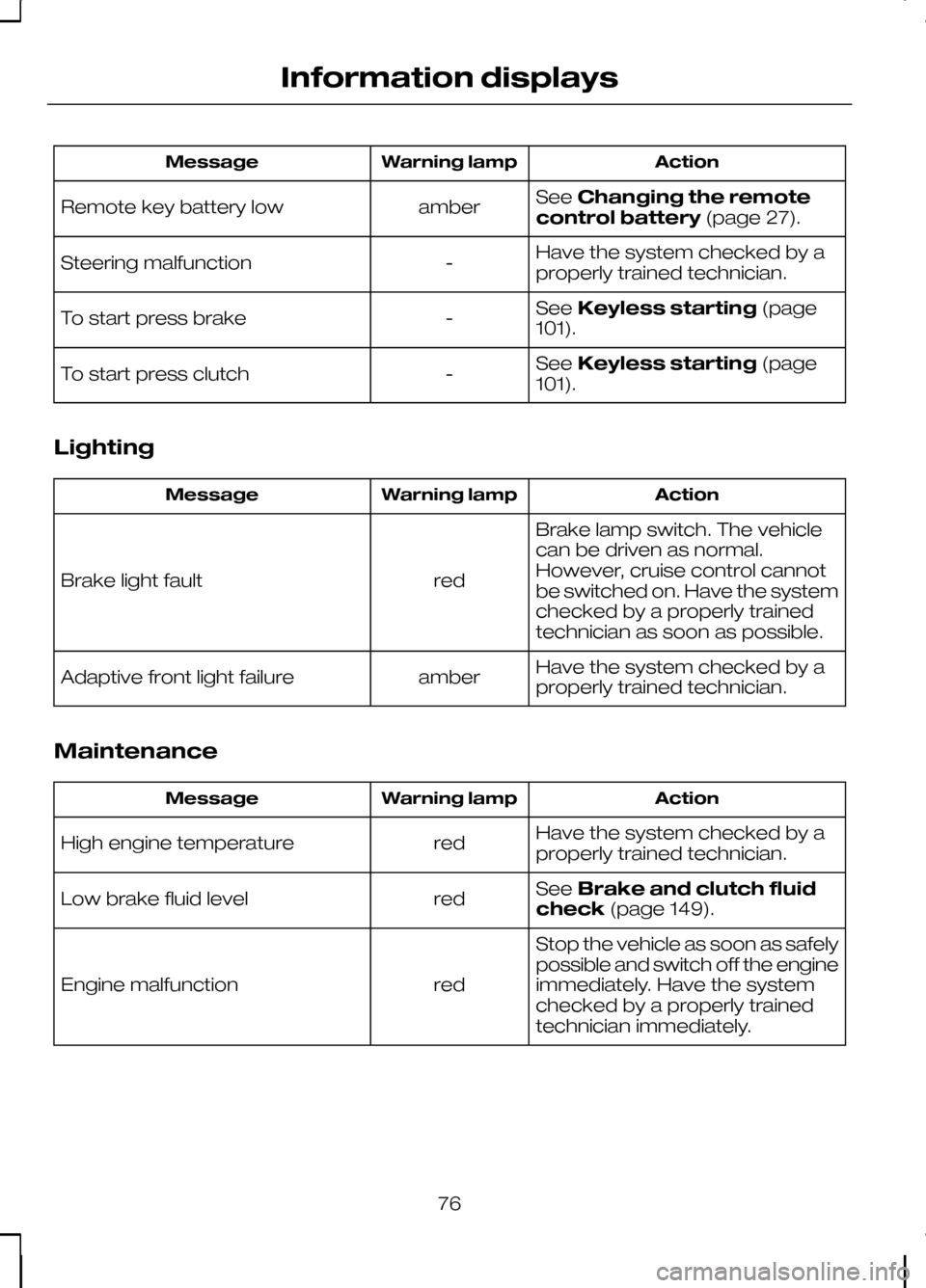
Action
Warning lamp
Message
SeeChanging the remote
control battery (page 27).
amber
Remote key battery low
Have the system checked by a
properly trained technician.
-
Steering malfunction
SeeKeyless starting (page
101).
-
To start press brake
SeeKeyless starting (page
101).
-
To start press clutch
Lighting Action
Warning lamp
Message
Brake lamp switch. The vehicle
can be driven as normal.
However, cruise control cannot
be switched on. Have the system
checked by a properly trained
technician as soon as possible.
red
Brake light fault
Have the system checked by a
properly trained technician.
amber
Adaptive front light failure
Maintenance Action
Warning lamp
Message
Have the system checked by a
properly trained technician.
red
High engine temperature
SeeBrake and clutch fluid
check (page 149).
red
Low brake fluid level
Stop the vehicle as soon as safely
possible and switch off the engine
immediately. Have the system
checked by a properly trained
technician immediately.
red
Engine malfunction
76
Information displays
Page 79 of 226
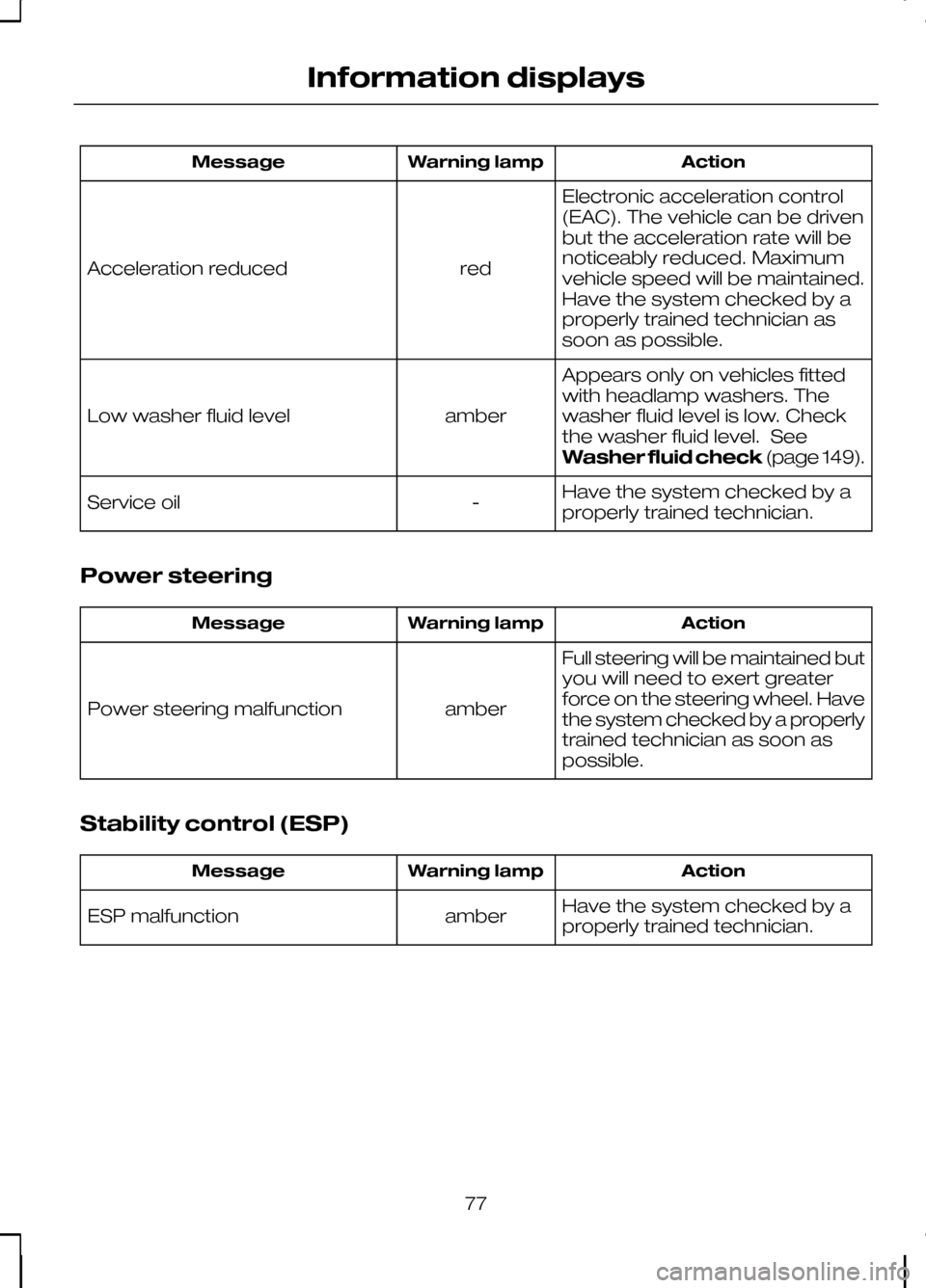
Action
Warning lamp
Message
Electronic acceleration control
(EAC). The vehicle can be driven
but the acceleration rate will be
noticeably reduced. Maximum
vehicle speed will be maintained.
Have the system checked by a
properly trained technician as
soon as possible.
red
Acceleration reduced
Appears only on vehicles fitted
with headlamp washers. The
washer fluid level is low. Check
the washer fluid level. See
Washer fluid check(page 149).
amber
Low washer fluid level
Have the system checked by a
properly trained technician.
-
Service oil
Power steering Action
Warning lamp
Message
Full steering will be maintained but
you will need to exert greater
force on the steering wheel. Have
the system checked by a properly
trained technician as soon as
possible.
amber
Power steering malfunction
Stability control (ESP) Action
Warning lamp
Message
Have the system checked by a
properly trained technician.
amber
ESP malfunction
77
Information displays
Page 83 of 226
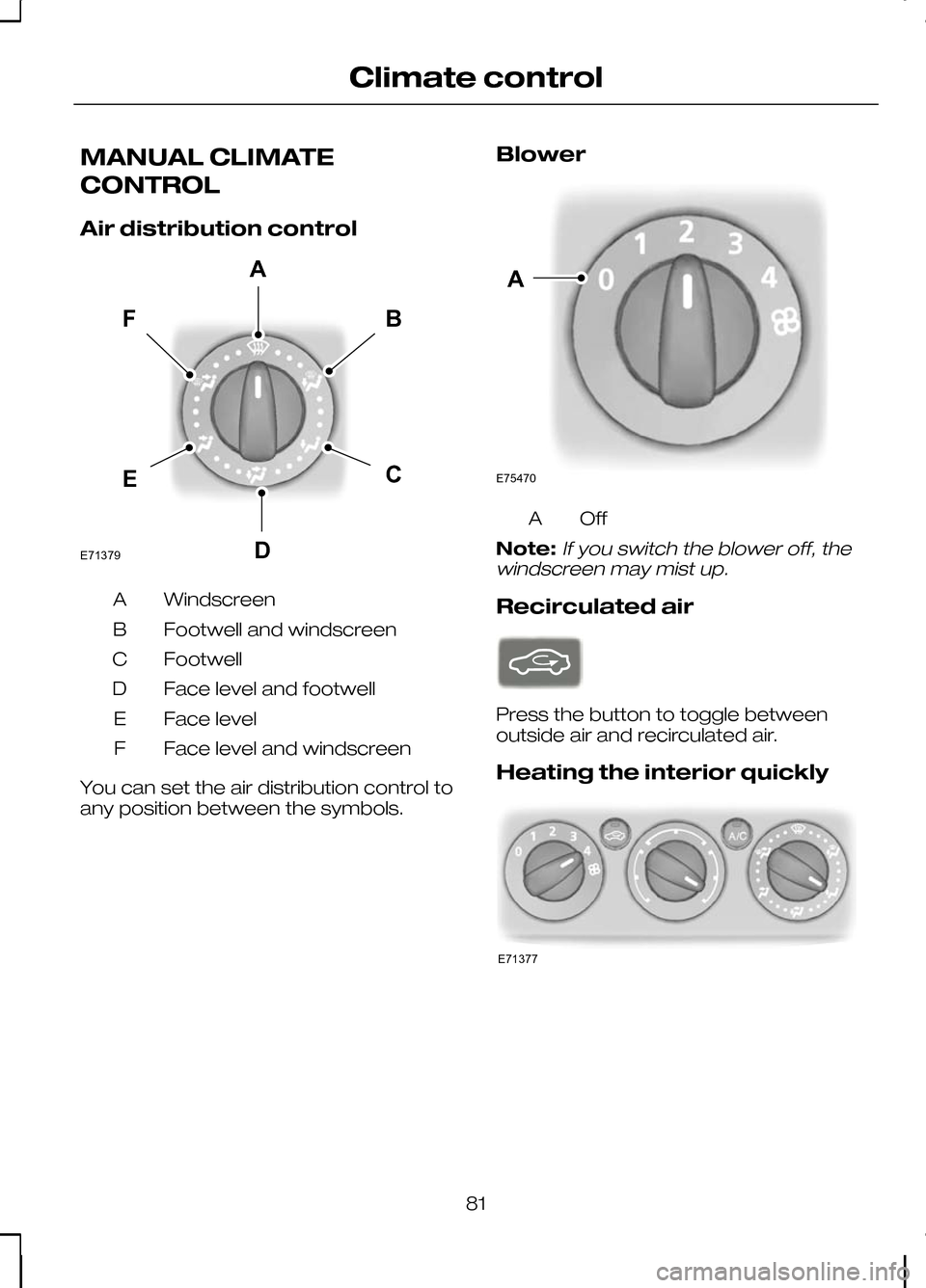
MANUAL CLIMATE
CONTROL
Air distribution control
Windscreen
A
Footwell and windscreen
B
Footwell
C
Face level and footwell
D
Face level
E
Face level and windscreen
F
You can set the air distribution control to
any position between the symbols. Blower OffA
Note:If you switch the blower off, the
windscreen may mist up.
Recirculated air Press the button to toggle between
outside air and recirculated air.
Heating the interior quickly
81
Climate controlAFBCDEE71379 E75470A E71377
Page 87 of 226
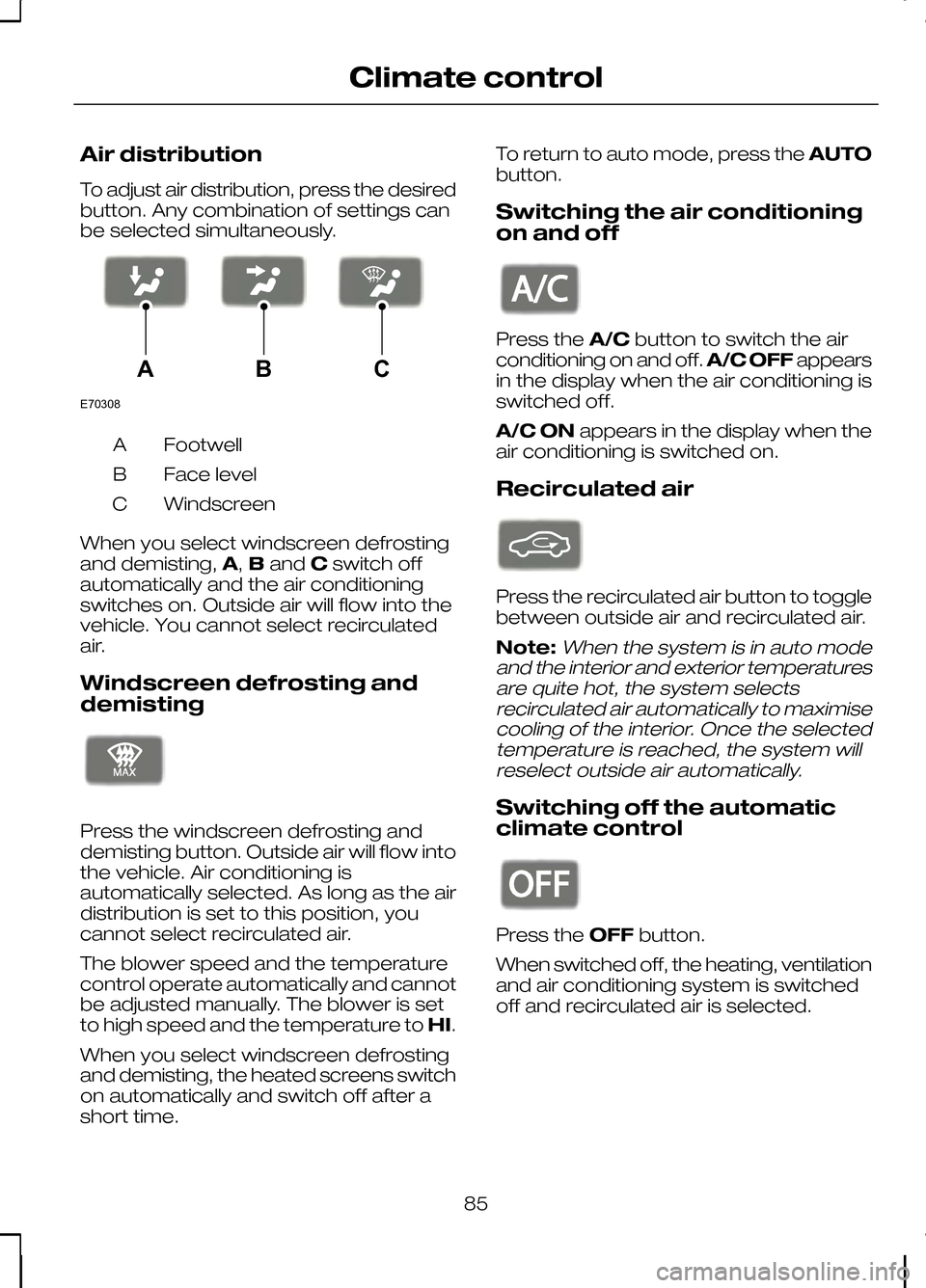
Air distribution
To adjust air distribution, press the desired
button. Any combination of settings can
be selected simultaneously.
Footwell
A
Face level
B
Windscreen
C
When you select windscreen defrosting
and demisting, A,Band Cswitch off
automatically and the air conditioning
switches on. Outside air will flow into the
vehicle. You cannot select recirculated
air.
Windscreen defrosting and
demisting Press the windscreen defrosting and
demisting button. Outside air will flow into
the vehicle. Air conditioning is
automatically selected. As long as the air
distribution is set to this position, you
cannot select recirculated air.
The blower speed and the temperature
control operate automatically and cannot
be adjusted manually. The blower is set
to high speed and the temperature to
HI.
When you select windscreen defrosting
and demisting, the heated screens switch
on automatically and switch off after a
short time. To return to auto mode, press the
AUTO
button.
Switching the air conditioning
on and off Press the
A/Cbutton to switch the air
conditioning on and off. A/C OFFappears
in the display when the air conditioning is
switched off.
A/C ON appears in the display when the
air conditioning is switched on.
Recirculated air Press the recirculated air button to toggle
between outside air and recirculated air.
Note:When the system is in auto mode
and the interior and exterior temperatures are quite hot, the system selectsrecirculated air automatically to maximisecooling of the interior. Once the selectedtemperature is reached, the system willreselect outside air automatically.
Switching off the automatic
climate control Press the
OFFbutton.
When switched off, the heating, ventilation
and air conditioning system is switched
off and recirculated air is selected.
85
Climate controlE70308ABC E91392 E91393 E91394
Page 92 of 226
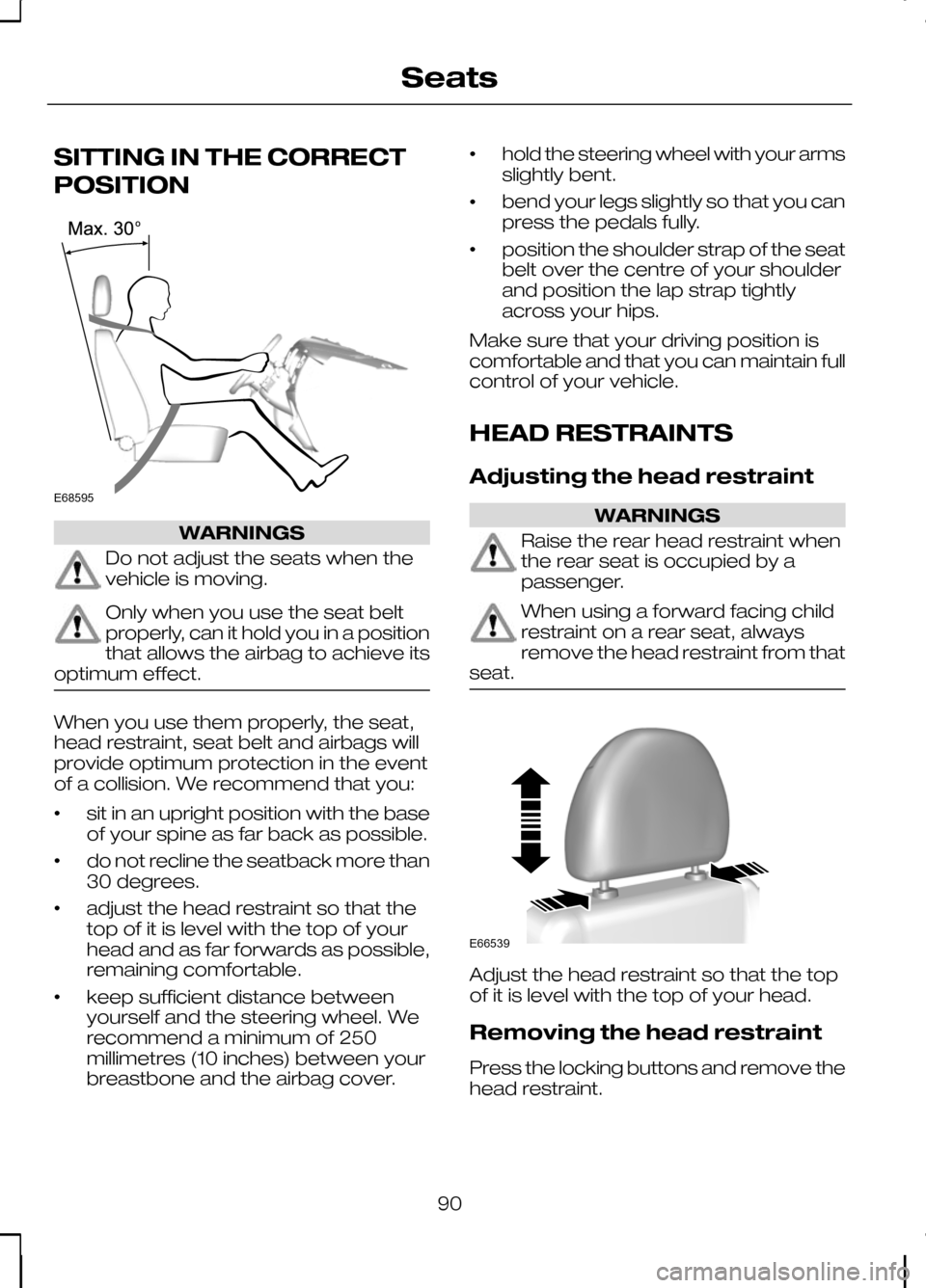
SITTING IN THE CORRECT
POSITION
WARNINGS
Do not adjust the seats when the
vehicle is moving.
Only when you use the seat belt
properly, can it hold you in a position
that allows the airbag to achieve its
optimum effect. When you use them properly, the seat,
head restraint, seat belt and airbags will
provide optimum protection in the event
of a collision. We recommend that you:
•
sit in an upright position with the base
of your spine as far back as possible.
• do not recline the seatback more than
30 degrees.
• adjust the head restraint so that the
top of it is level with the top of your
head and as far forwards as possible,
remaining comfortable.
• keep sufficient distance between
yourself and the steering wheel. We
recommend a minimum of 250
millimetres (10 inches) between your
breastbone and the airbag cover. •
hold the steering wheel with your arms
slightly bent.
• bend your legs slightly so that you can
press the pedals fully.
• position the shoulder strap of the seat
belt over the centre of your shoulder
and position the lap strap tightly
across your hips.
Make sure that your driving position is
comfortable and that you can maintain full
control of your vehicle.
HEAD RESTRAINTS
Adjusting the head restraint WARNINGS
Raise the rear head restraint when
the rear seat is occupied by a
passenger.
When using a forward facing child
restraint on a rear seat, always
remove the head restraint from that
seat. Adjust the head restraint so that the top
of it is level with the top of your head.
Removing the head restraint
Press the locking buttons and remove the
head restraint.
90
SeatsE68595 E66539
Page 96 of 226
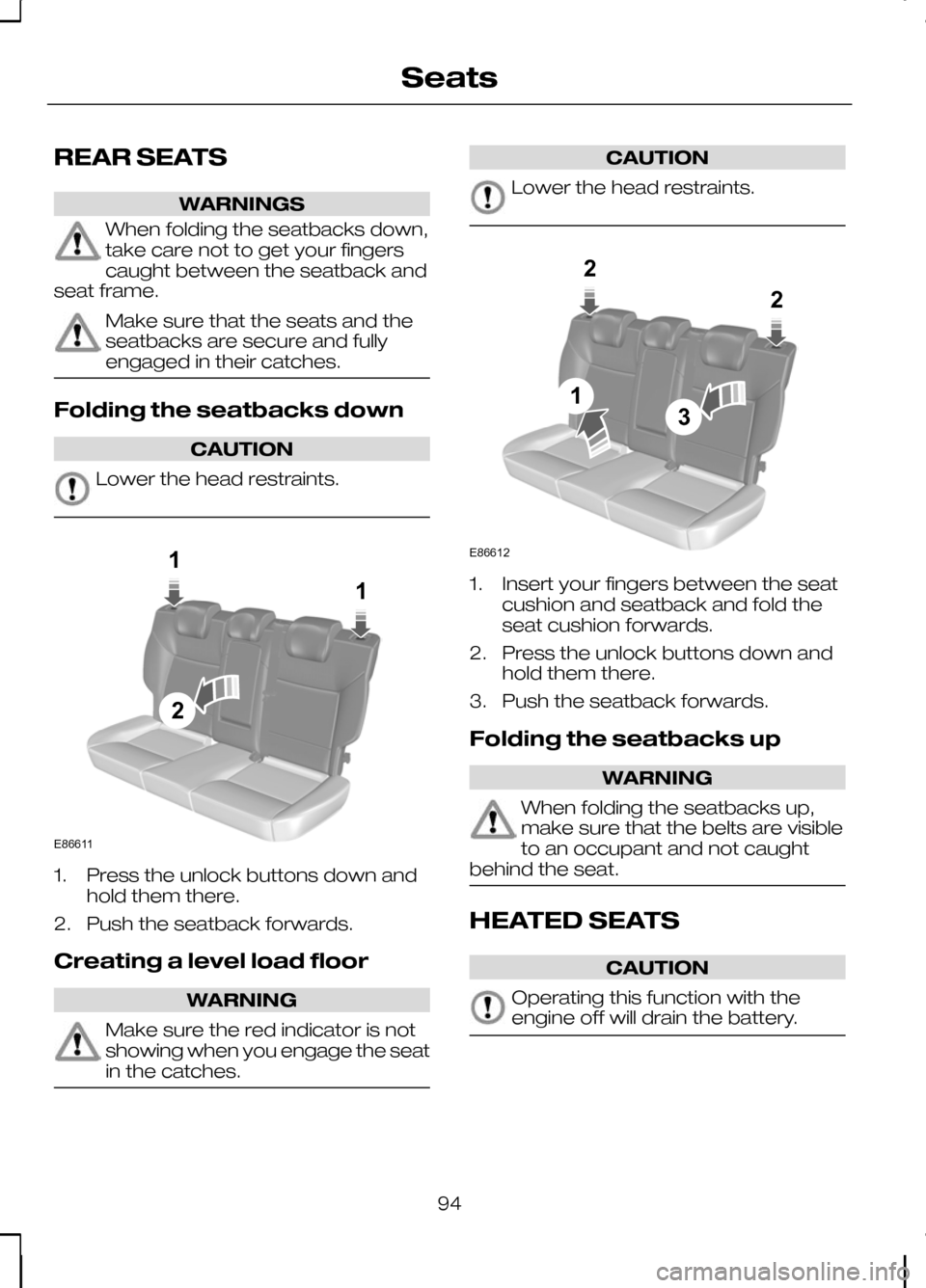
REAR SEATS
WARNINGS
When folding the seatbacks down,
take care not to get your fingers
caught between the seatback and
seat frame. Make sure that the seats and the
seatbacks are secure and fully
engaged in their catches.
Folding the seatbacks down
CAUTION
Lower the head restraints.
1. Press the unlock buttons down and
hold them there.
2. Push the seatback forwards.
Creating a level load floor WARNING
Make sure the red indicator is not
showing when you engage the seat
in the catches. CAUTION
Lower the head restraints.
1. Insert your fingers between the seat
cushion and seatback and fold the
seat cushion forwards.
2. Press the unlock buttons down and hold them there.
3. Push the seatback forwards.
Folding the seatbacks up WARNING
When folding the seatbacks up,
make sure that the belts are visible
to an occupant and not caught
behind the seat. HEATED SEATS
CAUTION
Operating this function with the
engine off will drain the battery.
94
Seats121E86611 2132E86612
Page 144 of 226
GENERAL INFORMATION
Have your vehicle serviced regularly to
help maintain its roadworthiness and
resale value. There is a large network of
Ford Authorised Repairers that are there
to help you with their professional
servicing expertise. We believe that their
specially trained technicians are best
qualified to service your vehicle properly
and expertly. They are supported by a
wide range of highly specialised tools
developed specifically for servicing your
vehicle.
In addition to regular servicing, we
recommend that you carry out the
following additional checks.
WARNINGS
Switch the ignition off before
touching or attempting adjustment
of any kind.
Do not touch the electronic ignition
system parts after you have
switched the ignition on or when the
engine is running. The system operates
at high voltage. Keep your hands and clothing clear
of the engine cooling fan. Under
certain conditions, the fan may
continue to run for several minutes after
you have switched the engine off. CAUTION
When carrying out maintenance
checks, make sure that filler caps are
fitted securely.
Daily checks
•
Exterior lamps.
• Interior lamps.
• Warning lamps and indicators. Check when refuelling
•
Engine oil level. See
Engine oil
check (page 147).
• Brake fluid level. See
Brake and
clutch fluid check (page 149).
• Washer fluid level. See
Washer fluid
check (page 149).
• Tyre pressures (when cold). See
Technical specifications
(page
168).
• Tyre condition. See
Tyre care(page
166).
Monthly checks
• Engine coolant level (engine cold).
See
Engine coolant check (page
148).
• Pipes, hoses and reservoirs for leaks.
• Power steering fluid level. See
Power steering fluid check
(page
149).
• Air conditioning operation.
• Parking brake operation.
• Horn operation.
• Tightness of wheel nuts. See
Technical specifications
(page
168).
OPENING AND CLOSING
THE BONNET
Opening the bonnet WARNING
To prevent damage to, or loss of the
key, remove the key immediately
after opening and swivel the Ford
badge back. Note:On vehicles with keyless entry, use
the spare key. See Keyless entry(page
31).
142
Maintenance
Page 150 of 226
Topping up
WARNINGS
Only top up when the engine is cold.
If the engine is hot, wait 10 minutes
for the engine to cool down.
Do not remove the filler cap when
the engine is running.
Remove the filler cap.
CAUTION
Do not top up further than the
MAX
mark. Top up with fluid that meets the Ford
specification. See
Technical
specifications (page 150).
ENGINE COOLANT CHECK
Checking the coolant level WARNING
Do not allow the fluid to touch your
skin or eyes. If this happens, rinse
the affected areas immediately with
plenty of water and contact your doctor. CAUTION
Make sure that the level is between
the
MIN and the MAXmarks.Note:Coolant expands when it is hot.
The level may therefore extend beyond
the MAX mark.
If the level is at the MINmark, top up
immediately. Topping up WARNINGS
Only top up when the engine is cold.
If the engine is hot, wait 10 minutes
for the engine to cool down.
Do not remove the filler cap when
the engine is running.
Do not remove the filler cap when
the engine is hot. Wait for the engine
to cool down.
Undiluted coolant is flammable and
may ignite if spilt on a hot exhaust.
CAUTIONS
In an emergency, you can add just
water to the cooling system to reach
a vehicle service station. The system
must then be drained and refilled with a
50/50 mixture of coolant and water. Have
the system checked by a properly trained
technician as soon as possible. Increased dilution of the coolant can
cause engine damage from
corrosion, overheating or freezing.
Unscrew the cap
slowly. Any pressure
will escape slowly as you unscrew the
cap. CAUTION
Do not top up further than the
MAX
mark. Top up with a 50/50 mixture of coolant
and water using fluid that meets the Ford
specification. See
Technical
specifications (page 150).
148
Maintenance