Scr FORD KUGA 2011 1.G Workshop Manual
[x] Cancel search | Manufacturer: FORD, Model Year: 2011, Model line: KUGA, Model: FORD KUGA 2011 1.GPages: 2057
Page 384 of 2057
must use the same language. This language is
called a protocol.
At present, Ford uses three different data bus
systems. Depending upon model and equipment
level, all three data bus systems are used. Each
of these data bus systems has its own protocol.
Data bus systems
ISO 9141 bus
The International Organisation for Standardisation
ISO 9141 bus. This consists of a single wire and
is used exclusively for communication between the
modules and the Ford diagnostic unit. The fault
memories of the various modules are read out via
the ISO 9141 bus.
Local Interconnect Network (LIN) bus
The LIN bus is a standard specifically designed for
cost-effective communication between intelligent
sensors and actuators in vehicles. The LIN control
unit subnet is used in every situation where the
bandwidth and versatility of CAN is not needed.
The LIN specification comprises the LIN protocol,
a standard format for describing a complete LIN
and the interface between an LIN and the
application. An LIN comprises a LIN master and
one or more LIN slaves. The LIN utilizes the
master/slave principle for the purpose of bus
access control. This has the significant advantage
that few resources (CPU performance, ROM, RAM)
are required for bus management in the slave
module. The master is implemented in a control
module or a gateway which has the necessary
resources. All communication is initiated by the
master. Consequently, a message always consists
of a header, which is generated by the master, and
a response from the slave. The data transfer rate
is in the region of up to 20 Kbit/s. The LIN master
knows the time sequence of all data which are to
be transmitted. These data are transmitted by the
corresponding LIN slaves (e.g. ultrasonic sensors)
if they are requested to do so by the LIN master.
LIN is a single-wire bus, i.e. the data are
transmitted in the cable via one wire. Usually the
same cable is also used to provide the supply
voltage. The ground connection of the supply
voltage also acts as the ground connection of the
data transmission. An LIN does not use a
terminating resistor.
Controller Area Network (CAN) bus
This consists of two twisted wires and operates
serially (data is transmitted sequentially). It is used
for communication between the modules
themselves and between the modules and the Ford
diagnostic unit. The modules are connected to the
data bus in parallel. New modules can be
incorporated easily, without modifying the other
wiring or modules. The transmitted data is received
by every module connected to the control unit
network (CAN). As each data packet has an
identifier (label), in which the priority of the
message is determined as well as the content
identification, each module can detect whether or
not the data is relevant for its own information
processing. This enables several modules to be
addressed with a particular data packet and
supplied with data simultaneously. For this
purpose, it is ensured that important data (for
example from the ABS) is transmitted first. The
other modules are only able to submit their data to
the data bus after the high-priority messages have
been received.
The advantages of the CAN bus are:
• Minimization of wiring requirements
•
High degree of error protection (fault / fail-proof)
• Robustness
• Good extendibility
• Prioritization of messages
• Inexpensive
• Automatic repetition of faulty messages
• Independent system monitoring and the ability to disconnect faulty modules from the data bus
automatically
Due to the increased number of modules and the
resulting continued increase in data transfer, two
different CAN bus systems are used. Essentially,
they only differ in terms of their data transmission
rates and application areas.
To be able to distinguish between the individual
CAN bus systems, the CAN bus system with the
high transfer speed is called the high speed CAN
bus (HS-CAN). The data are transmitted at a baud
rate of 500 kB/s.
The CAN bus system with the medium transfer
speed is called the medium speed CAN bus
(MS-CAN) and is mainly used for communication
in the comfort electronics or the multimedia system.
The data are transmitted at a baud rate of 125 kB/s.
An interface (gateway) is used to exchange data
between the HS-CAN and the MS-CAN. This
provides the connection between the three CAN
databus systems and is installed in the GEM and
in the electronic instrument cluster. The number of
modules which are connected to the three databus G1030779en
2008.50 Kuga 8/2011 418-00-7
Module Communications Network
418-00-7
DESCRIPTION AND OPERATIONTO MODEL INDEX
BACK TO CHAPTER INDEX
FORD KUGA 2011.0MY WORKSHOP REPAIR MANUAL
Page 385 of 2057
systems depends on the equipment level of the
vehicle.
In order to guarantee a high degree of error
protection, two 120 Ohm terminating resistors are
installed in the CAN. These are integrated in the
first module connected to the CAN and in the last
module connected to the CAN respectively and
are used for suppression as well as the elimination
of voltage peaks. In order to ensure correct
functioning of the data bus system, the modules
must always be connected with an integral
terminating resistor. In order to enable
communication between the modules on the
HS-CAN and the modules on the MS-CAN, one
module is connected to both data bus systems.
The connection of both data bus systems is
designated as a gateway. In this gateway, the
received data is converted to the transmission rate
required for the relevant data bus and is
transmitted. This ensures an optimal distribution
of information between both data bus systems.
Component Description
ABS
The GEM is integrated in the CJB (central junction
box) and cannot be replaced as a separate unit.
G1030779en
2008.50 Kuga 8/2011 418-00-8
Module Communications Network
418-00-8
DESCRIPTION AND OPERATIONTO MODEL INDEX
BACK TO CHAPTER INDEX
FORD KUGA 2011.0MY WORKSHOP REPAIR MANUAL
Page 389 of 2057
Programmable Module Installation
Activation
5.
Install the most up-to-date software version in
IDS.
6. If, before replacing a module, it was not possible
to read out the vehicle-specific data using the
integrated diagnostic system (IDS) (the module
to be replaced does not respond) then, during
programming of the new module, the
vehicle-specific data must be entered manually
via a selection list in IDS or via a code which
can be obtained from the Technical Hotline.
7. In order to program, select the "Install
programmable module" submenu in the "Module
programming" menu tool box and then follow
the instructions.
8. The following modules must be programmed
after replacement:
•
• Anti-lock braking system module (ABS)
• Audio system module (ACM)
• CD player (CDP)
• Driver's door control unit (D-DCU)
• Passenger's door control unit (P-DCU)
• Rear left door control unit (RL-DCU)
• Rear right door control unit (RR-DCU)
• Electrical power steering (EPS)
• Generic Display Module (GDM) (vehicles
with DVD navigation system with
touchscreen)
• Generic electronic module (GEM)
• Headlamp control module (HCM) (vehicles with gas discharge headlamps)
• Instrument cluster (IC)
• Navigation system (NAV) (vehicles with navigation system)
• Parking aid module(PAM)
• Powertrain control module (PCM)
• Restraint control module (RCM)
• Rear entertainment system module (RETM) (vehicles with rear seat entertainment
system)
9. In order to configure the PCM, select the
"Programmable parameters" submenu in the
"Module programming" menu tool box and then
follow the instructions.
10. For vehicles with anti-lock braking system and
electronic stability program, these must also be configured using IDS following replacement of
the lateral acceleration sensor, yaw rate sensor
or pressure sensor. Configuration is performed
in the "Programmable parameters" menu tool
box.
G1158258en
2008.50 Kuga 8/2011 418-01-3
Module Configuration
418-01-3
GENERAL PROCEDURESTO MODEL INDEX
BACK TO CHAPTER INDEX
FORD KUGA 2011.0MY WORKSHOP REPAIR MANUAL
Page 433 of 2057
SECTION 419-01A Anti-Theft - Active
VEHICLE APPLICATION:
2008.50 Kuga
PAGE
CONTENTS
DESCRIPTION AND OPERATION
419-01A-2
Anti-Theft - Active (Component Location)..........................................................................
419-01A-4
Anti-Theft - Active (Overview).............................................................................................
419-01A-4
Function check - Intrusion sensors.....................................................................................
419-01A-5
Anti-Theft - Active (System Operation and Component Description).................................
419-01A-5
System Diagram.................................................................................................................
419-01A-6
System Operation...............................................................................................................
419-01A-6
Anti-theft warning system...............................................................................................
419-01A-7
Component Description......................................................................................................
419-01A-7
Interior scanning sensors................................................................................................
419-01A-7
Anti-theft alarm horn with integral battery.......................................................................
DIAGNOSIS AND TESTING 419-01A-8
Anti-Theft - Active...............................................................................................................
419-01A-8
Inspection and Verification..................................................................................................
REMOVAL AND INSTALLATION 419-01A-9
Anti-Theft Alarm Horn.........................................................................................................
419-01A-11
Anti-Theft Alarm Horn with Integral Battery........................................................................ 419-01A-1
Anti-Theft - Active
419-01A-1
.TO MODEL INDEX
BACK TO CHAPTER INDEX
FORD KUGA 2011.0MY WORKSHOP REPAIR MANUAL
Page 435 of 2057
Description
Item
Anti-theft alarm system horn with
integrated battery (right-hand drive
vehicles)
12 Description
Item
13 Switch for deactivation of interior scanning
sensors (right-hand drive vehicles) G1066074en
2008.50 Kuga 8/2011 419-01A-3
Anti-Theft - Active
419-01A-3
DESCRIPTION AND OPERATIONTO MODEL INDEX
BACK TO CHAPTER INDEX
FORD KUGA 2011.0MY WORKSHOP REPAIR MANUAL
Page 436 of 2057
Anti-Theft - Active – Overview
The function of the anti-theft alarm system
components can be checked using the GEM's
service mode.
If an exact diagnosis is not possible using the
service mode, a system diagnosis must be carried
out with the Ford diagnostic unit. The last four
trigger signals from the anti-theft alarm signal can
also be read out during this process.
Function check - Intrusion sensors
Activate the anti-theft alarm system is check the
function of the intrusion sensors. After a waiting
time of approx. 30 seconds, perform movements
on both sides of the vehicle interior through the
open side windows. Each movement that is
detected is acknowledged through triggering of the
anti-theft alarm system.
G1065778en
2008.50 Kuga 8/2011 419-01A-4
Anti-Theft - Active
419-01A-4
DESCRIPTION AND OPERATIONTO MODEL INDEX
BACK TO CHAPTER INDEX
FORD KUGA 2011.0MY WORKSHOP REPAIR MANUAL
Page 438 of 2057
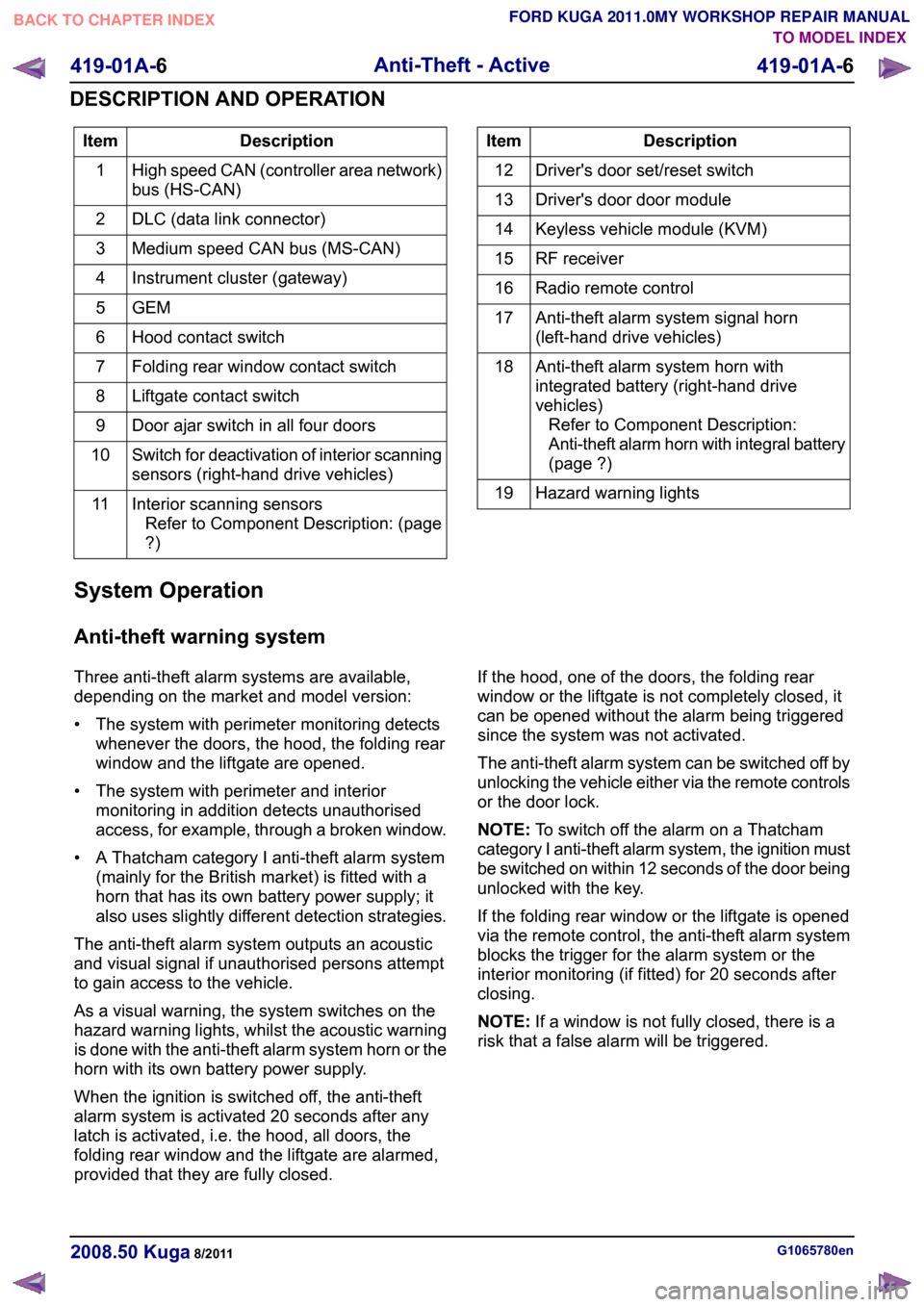
Description
Item
High speed CAN (controller area network)
bus (HS-CAN)
1
DLC (data link connector)
2
Medium speed CAN bus (MS-CAN)
3
Instrument cluster (gateway)
4
GEM5
Hood contact switch
6
Folding rear window contact switch
7
Liftgate contact switch
8
Door ajar switch in all four doors
9
Switch for deactivation of interior scanning
sensors (right-hand drive vehicles)
10
Interior scanning sensorsRefer to Component Description: (page
?)
11 Description
Item
Driver's door set/reset switch
12
Driver's door door module
13
Keyless vehicle module (KVM)
14
RF receiver
15
Radio remote control
16
Anti-theft alarm system signal horn
(left-hand drive vehicles)
17
Anti-theft alarm system horn with
integrated battery (right-hand drive
vehicles)Refer to Component Description:
Anti-theft alarm horn with integral battery
(page ?)
18
Hazard warning lights
19
System Operation
Anti-theft warning system
Three anti-theft alarm systems are available,
depending on the market and model version:
• The system with perimeter monitoring detects whenever the doors, the hood, the folding rear
window and the liftgate are opened.
• The system with perimeter and interior monitoring in addition detects unauthorised
access, for example, through a broken window.
• A Thatcham category I anti-theft alarm system (mainly for the British market) is fitted with a
horn that has its own battery power supply; it
also uses slightly different detection strategies.
The anti-theft alarm system outputs an acoustic
and visual signal if unauthorised persons attempt
to gain access to the vehicle.
As a visual warning, the system switches on the
hazard warning lights, whilst the acoustic warning
is done with the anti-theft alarm system horn or the
horn with its own battery power supply.
When the ignition is switched off, the anti-theft
alarm system is activated 20 seconds after any
latch is activated, i.e. the hood, all doors, the
folding rear window and the liftgate are alarmed,
provided that they are fully closed. If the hood, one of the doors, the folding rear
window or the liftgate is not completely closed, it
can be opened without the alarm being triggered
since the system was not activated.
The anti-theft alarm system can be switched off by
unlocking the vehicle either via the remote controls
or the door lock.
NOTE:
To switch off the alarm on a Thatcham
category I anti-theft alarm system, the ignition must
be switched on within 12 seconds of the door being
unlocked with the key.
If the folding rear window or the liftgate is opened
via the remote control, the anti-theft alarm system
blocks the trigger for the alarm system or the
interior monitoring (if fitted) for 20 seconds after
closing.
NOTE: If a window is not fully closed, there is a
risk that a false alarm will be triggered. G1065780en
2008.50 Kuga 8/2011 419-01A-6
Anti-Theft - Active
419-01A-6
DESCRIPTION AND OPERATIONTO MODEL INDEX
BACK TO CHAPTER INDEX
FORD KUGA 2011.0MY WORKSHOP REPAIR MANUAL
Page 439 of 2057
Component Description
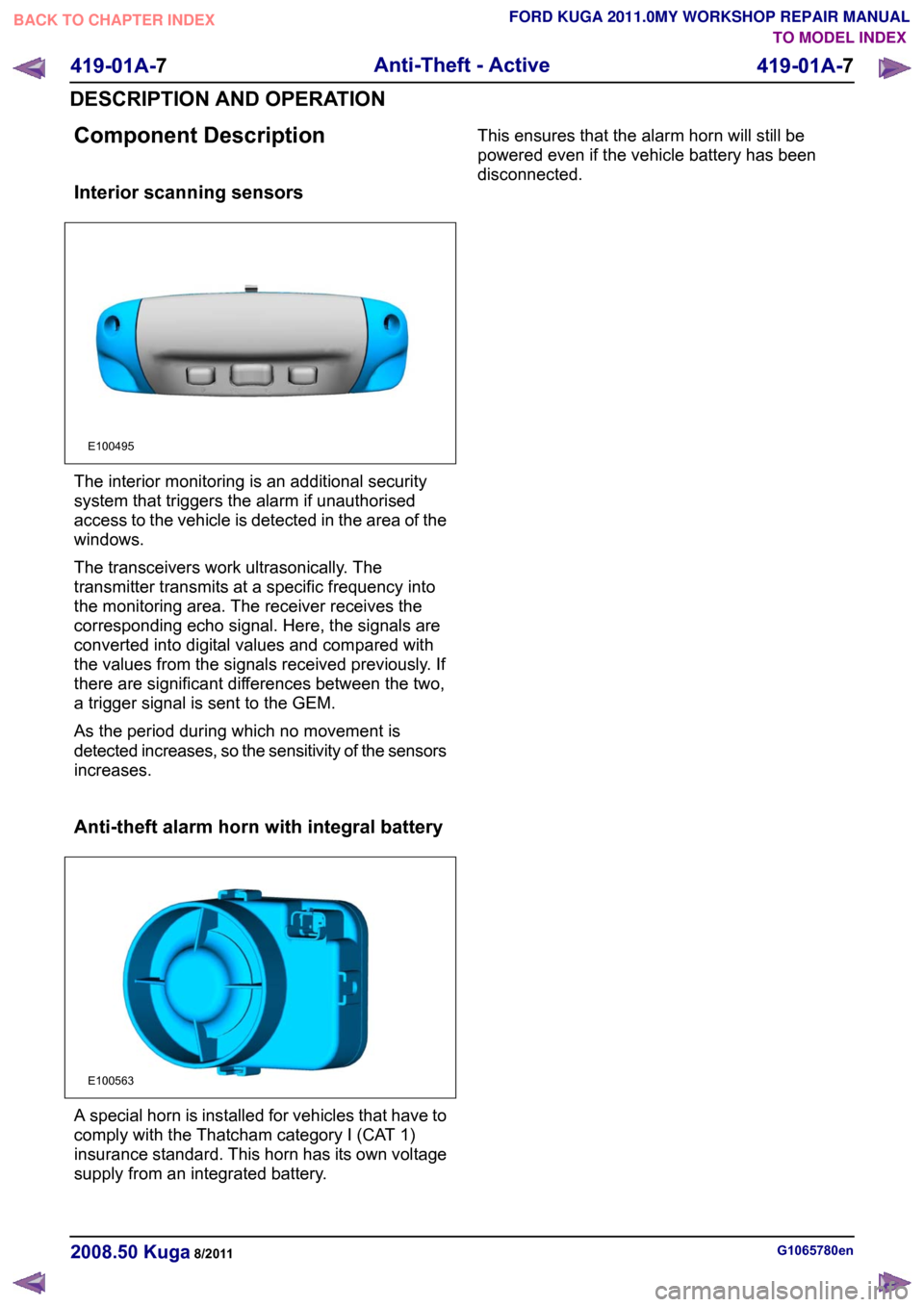
Interior scanning sensors
The interior monitoring is an additional security
system that triggers the alarm if unauthorised
access to the vehicle is detected in the area of the
windows.
The transceivers work ultrasonically. The
transmitter transmits at a specific frequency into
the monitoring area. The receiver receives the
corresponding echo signal. Here, the signals are
converted into digital values and compared with
the values from the signals received previously. If
there are significant differences between the two,
a trigger signal is sent to the GEM.
As the period during which no movement is
detected increases, so the sensitivity of the sensors
increases.
Anti-theft alarm horn with integral battery
A special horn is installed for vehicles that have to
comply with the Thatcham category I (CAT 1)
insurance standard. This horn has its own voltage
supply from an integrated battery. This ensures that the alarm horn will still be
powered even if the vehicle battery has been
disconnected.
G1065780en
2008.50 Kuga 8/2011 419-01A-7
Anti-Theft - Active
419-01A-7
DESCRIPTION AND OPERATIONTO MODEL INDEX
BACK TO CHAPTER INDEX
FORD KUGA 2011.0MY WORKSHOP REPAIR MANUALE100495 E100563
Page 444 of 2057
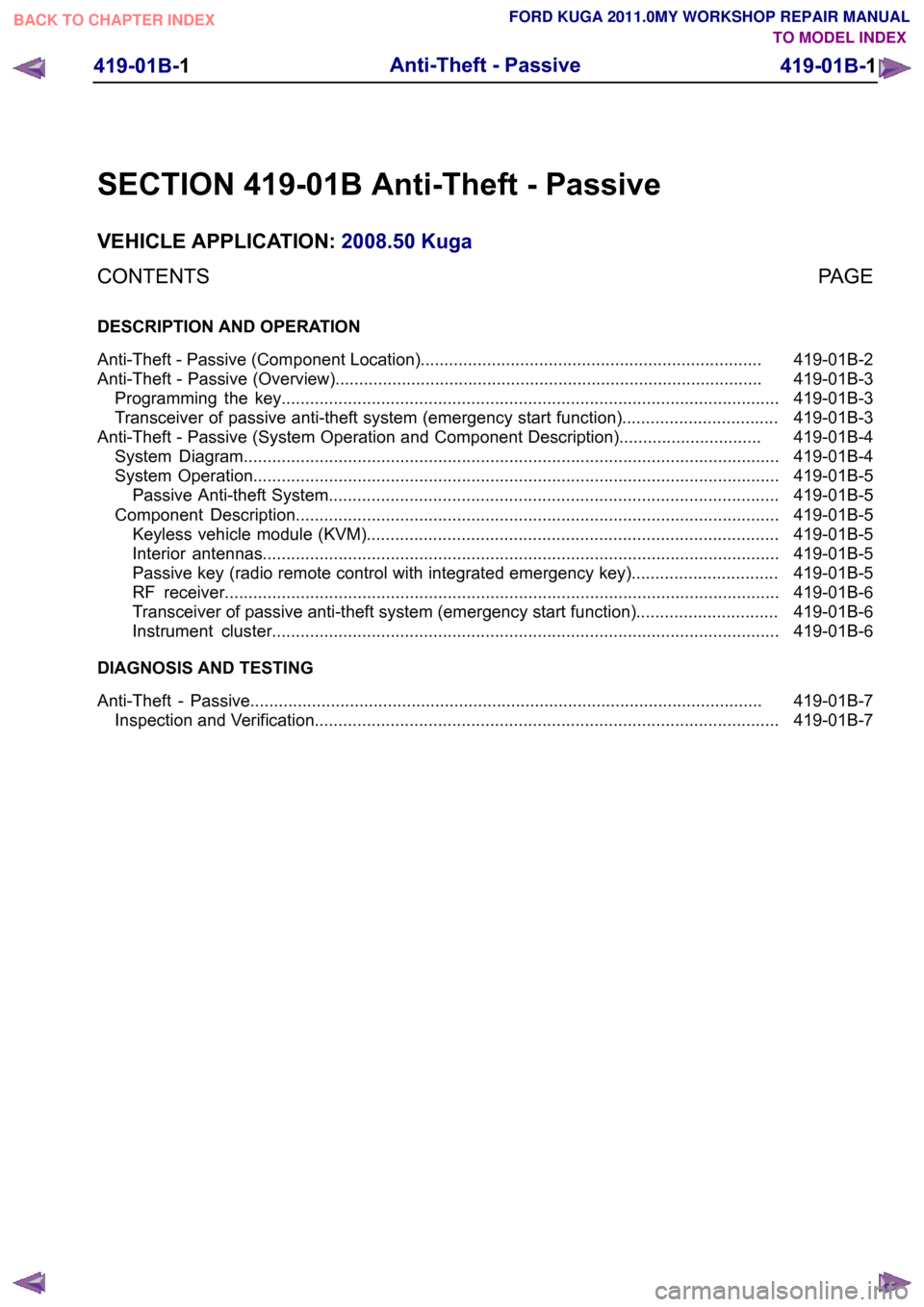
SECTION 419-01B Anti-Theft - Passive
VEHICLE APPLICATION:
2008.50 Kuga
PAGE
CONTENTS
DESCRIPTION AND OPERATION
419-01B-2
Anti-Theft - Passive (Component Location)........................................................................
419-01B-3
Anti-Theft - Passive (Overview)..........................................................................................
419-01B-3
Programming the key.........................................................................................................
419-01B-3
Transceiver of passive anti-theft system (emergency start function).................................
419-01B-4
Anti-Theft - Passive (System Operation and Component Description)..............................
419-01B-4
System Diagram.................................................................................................................
419-01B-5
System Operation...............................................................................................................
419-01B-5
Passive Anti-theft System...............................................................................................
419-01B-5
Component Description......................................................................................................
419-01B-5
Keyless vehicle module (KVM).......................................................................................
419-01B-5
Interior antennas.............................................................................................................
419-01B-5
Passive key (radio remote control with integrated emergency key)...............................
419-01B-6
RF receiver.....................................................................................................................
419-01B-6
Transceiver of passive anti-theft system (emergency start function)..............................
419-01B-6
Instrument cluster...........................................................................................................
DIAGNOSIS AND TESTING 419-01B-7
Anti-Theft - Passive............................................................................................................
419-01B-7
Inspection and Verification.................................................................................................. 419-01B-1
Anti-Theft - Passive
419-01B-1
.TO MODEL INDEX
BACK TO CHAPTER INDEX
FORD KUGA 2011.0MY WORKSHOP REPAIR MANUAL
Page 446 of 2057
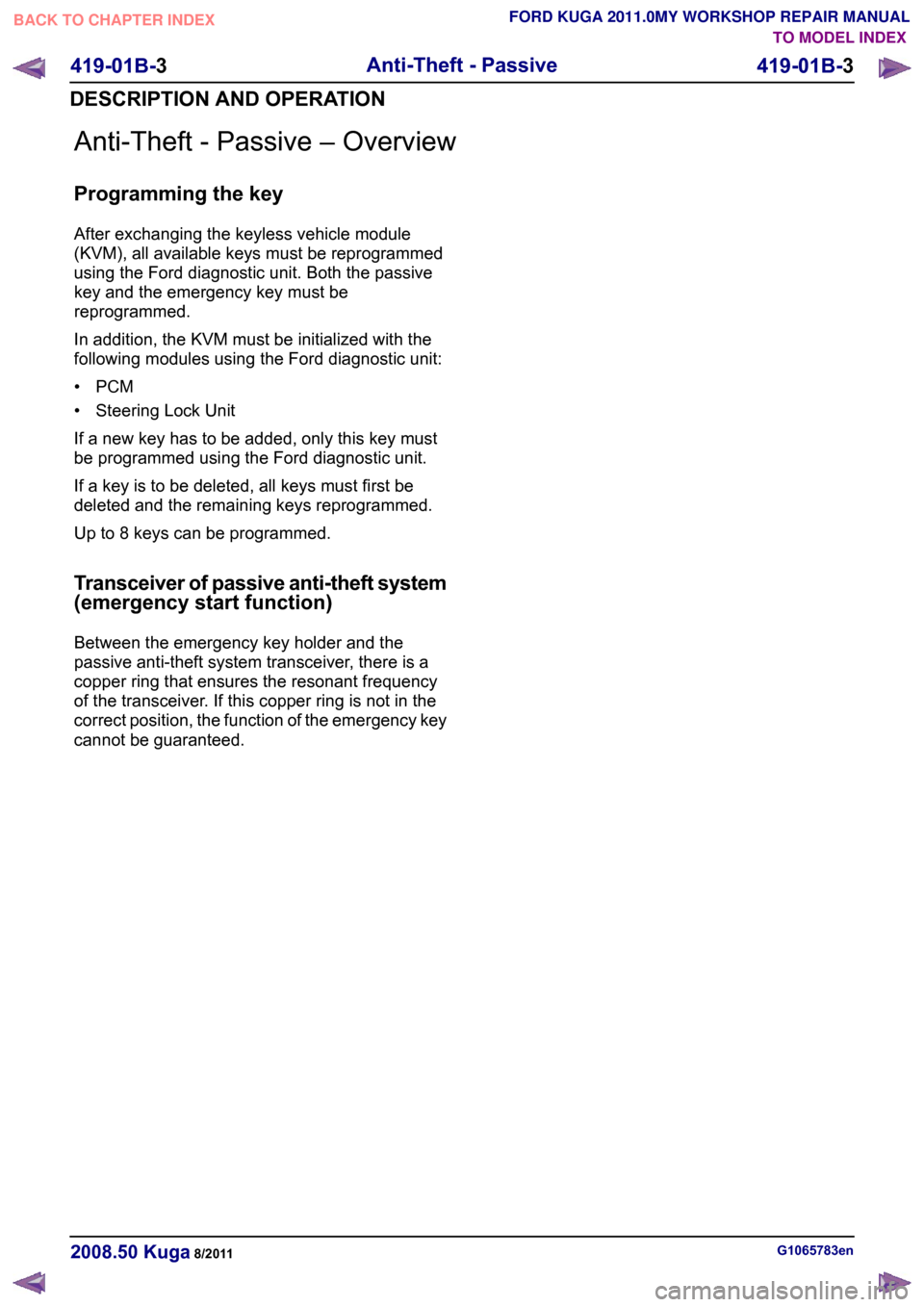
Anti-Theft - Passive – Overview
Programming the key
After exchanging the keyless vehicle module
(KVM), all available keys must be reprogrammed
using the Ford diagnostic unit. Both the passive
key and the emergency key must be
reprogrammed.
In addition, the KVM must be initialized with the
following modules using the Ford diagnostic unit:
• PCM
• Steering Lock Unit
If a new key has to be added, only this key must
be programmed using the Ford diagnostic unit.
If a key is to be deleted, all keys must first be
deleted and the remaining keys reprogrammed.
Up to 8 keys can be programmed.
Transceiver of passive anti-theft system
(emergency start function)
Between the emergency key holder and the
passive anti-theft system transceiver, there is a
copper ring that ensures the resonant frequency
of the transceiver. If this copper ring is not in the
correct position, the function of the emergency key
cannot be guaranteed.
G1065783en
2008.50 Kuga 8/2011 419-01B-3
Anti-Theft - Passive
419-01B-3
DESCRIPTION AND OPERATIONTO MODEL INDEX
BACK TO CHAPTER INDEX
FORD KUGA 2011.0MY WORKSHOP REPAIR MANUAL