air condition FORD KUGA 2011 1.G User Guide
[x] Cancel search | Manufacturer: FORD, Model Year: 2011, Model line: KUGA, Model: FORD KUGA 2011 1.GPages: 2057
Page 56 of 2057
Viton is a fluoroelastomer, that is a synthetic rubber
type material, which contains Fluorine. It is
commonly used for O-rings, gaskets and seals of
all types. Although Viton is the most well known
fluoroelastomer, there are others, including Fluorel
and Tecmoflon.
When used under design conditions
fluoroelastomers are perfectly safe. If, however,
they are exposed to temperatures in excess of
400°C, the material will not burn, but will
decompose, and one of the products formed is
hydrofluoric acid.
This acid is extremely corrosive and may be
absorbed directly, through contact, into the general
body system.
O-rings, seals or gaskets which have been exposed
to very high temperatures will appear charred or
as a black sticky substance.
DO NOT; under any circumstances touch them or
the attached components.
Enquiries should be made to determine whether
Viton or any other fluoroelastomer has been used
in the affected O-ring, seal or gasket. If they are of
natural rubber or nitrile there is no hazard. If in
doubt, be cautious, as the material may be Viton
or any fluoroelastomer.
If Viton or any other fluoroelastomers have been
used, the affected area should be decontaminated
before the commencement of work.
Disposable heavy duty plastic gloves should be
worn at all times, and the affected area washed
down using wire wool and a limewater (calcium
hydroxide) solution to neutralize the acid before
disposing of the decomposed Viton residue and
final cleaning of the area. After use, the plastic
gloves should be discarded carefully and safely.
Welding
See alsoFire, Electric Shock, Gas Cylinders.
Welding processes include Resistance Welding
(Spot Welding), Arc Welding and Gas Welding.
Resistance Welding
This process may cause particles of molten metal
to be emitted at a high velocity, and the eyes and
skin must be protected.
Arc Welding
This process emits a high level of ultra-violet
radiation, which may cause arc-eye, and skin burns
to the operator and to other persons nearby.
Gas-shielded welding processes are particularly
hazardous in this respect. Personal protection must
be worn, and screens used to shield other people.
CONTACT LENS WEARERS ARE ADVISED TO
REVERT TO ORDINARY SPECTACLES WHEN
ARC WELDING as the arc spectrum is believed to
emit microwaves which dry out the fluid between
the lens and the eye. This may result in blindness
when the lens is removed from the eye.
Metal spatter will also occur, and appropriate eye
and skin protection is necessary.
The heat of the welding arc will produce fumes and
gases from the metals being welded, the rods and
from any applied coatings or contamination on the
surfaces being worked on. These gases and fumes
may be toxic and inhalation of these should be
avoided. The use of extraction ventilation to remove
the fumes from the working area may be necessary
particularly in cases where the general ventilation
is poor, or where considerable welding work is
anticipated. In extreme cases or confined spaces
where adequate ventilation cannot be provided,
air-fed respirators may be necessary.
Gas Welding (and Cutting)
Oxy-acetylene torches may be used for welding
and cutting, and special care must be taken to
prevent leakage of these gases, with consequent
risk of fire and explosion.
The process will produce metal spatter and eye
and skin protection is necessary.
The flame is bright, and eye protection should be
used, but the ultra-violet emission is much less
than that from arc welding, and lighter filters may
be used.
The process itself produces few toxic fumes, but
such fumes and gases may be produced from
coatings on the work, particularly during cutting
away of damaged body parts, and inhalation of the
fumes should be avoided.
In brazing, toxic fumes may be produced from the
metals in the brazing rod, and a severe hazard
may arise if brazing rods containing cadmium are
used. In this event particular care must be taken
to avoid inhalation of fumes and expert advice may
be required.
G566527en2008.50 Kuga8/2011
100-00- 51
General Information
100-00- 51
DESCRIPTION AND OPERATION
TO MODEL INDEX
BACK TO CHAPTER INDEX
FORD KUGA 2011.0MY WORKSHOP REPAIR MANUAL
Page 60 of 2057
Standard Workshop Practices
Vehicle in Workshop
When working on a vehicle in the workshop always
make sure that:
– the parking brake is applied or the wheels aresecurely chocked to prevent the vehicle moving
forwards or backwards.
– the key is removed from key operated hood locks before any work is carried out around the
front of the vehicle.
– if the engine is to be run, there is adequate ventilation, or an extraction hose to remove
exhaust fumes.
– there is adequate room to raise the vehicle and remove the wheels, if necessary.
– fender covers are always fitted if any work is to be carried out in the engine compartment.
– the battery is disconnected if working on the engine, underneath the vehicle, or if the vehicle
is raised.
CAUTION: When electric arc welding on a
vehicle, always disconnect the generator
wiring to prevent the possibility of a surge
of current causing damage to the internal
components of the generator.
– if using welding equipment on the vehicle, a suitable fire extinguisher is readily available.
Towing the Vehicle
WARNING: When the vehicle is being
towed, the ignition switch must be in
position II (steering lock released and
warning lamps illuminated). Only then will
the steering, turn signal lamps, horn and
stop lamps be operational. Failure to follow
these instructions may result in personal
injury.
NOTE: The removable towing eye (if equipped),
has a left-hand thread and must be fully tightened
before towing can commence.
When towing is necessary, the vehicle towing eyes
should be used. The rope must be securely
fastened to the towing eyes and must also be
attached to the other vehicle such that the rope will
not foul the bodywork.
When a vehicle with automatic transmission is
towed, the gear selector must be in position N (Neutral). Never tow a vehicle with automatic
transmission at a speed greater than 30 mph (50
km/h) or for a distance greater than 30 miles (50
km). If it is necessary to tow the vehicle a greater
distance, the drive wheels must be lifted clear off
the ground.
Alternatively the vehicle can be transported on a
low loader or a trailer.
Connecting a Slave Battery Using
Jumper Cables
WARNING: If the slave battery has recently
been charged and is gassing, cover the
vent plugs or covers with a damp cloth to
reduce the risk of explosion should arcing
occur when connecting the jumper cables.
Failure to follow these instructions may
result in personal injury.
CAUTIONS:
A discharged battery condition may have
been caused by an electrical short circuit.
If this condition exists there will be an
apparently live circuit on the vehicle even
when all normal circuits are switched off.
This can cause arcing when the jumper
cables are connected.
While it is not recommended that the
vehicle is jump started, it is recognized
that this may occasionally be the only
practical way to mobilize a vehicle. In such
an instance, the discharged battery must
be recharged immediately after jump
starting to avoid permanent damage.
– Always make sure that the jumper cables are adequate for the task. Heavy duty cables must
be used.
– Always make sure that the slave battery is of the same voltage as the vehicle battery. The
batteries must be connected in parallel.
– Always make sure that switched electric circuits are switched off before connecting jumper
cables. This reduces the risk of arcing occurring
when the final connection is made.
G17373en2008.50 Kuga8/2011
100-00- 54
General Information
100-00- 54
DESCRIPTION AND OPERATION
TO MODEL INDEX
BACK TO CHAPTER INDEX
FORD KUGA 2011.0MY WORKSHOP REPAIR MANUAL
Page 63 of 2057
Road/Roller Testing
Road or roller testing may be carried out for various
reasons and a procedure detailing pre-test checks,
engine starting and stopping, pre-driving checks,
on-test checks and final checks to be completed
on completion of the test is given below.
Unless complete vehicle performance is being
checked, the full road test procedure need not be
carried out. Instead, those items particularly
relevant to the system(s) being checked can be
extracted.
Pre-Test Checks
WARNING: If the brake system hydraulic
fluid level is low, pedal travel is excessive
or a hydraulic leak is found, do not attempt
to road test the vehicle until the reason for
the low fluid level, excessive pedal travel
or hydraulic leak is found and rectified.
It is suggested that pre-test checks and functional
tests of those systems and circuits which affect the
safe and legal operations of the vehicle, such as
brakes, lights and steering, should always be
carried out before the road or roller test.
With the ignition switched off, check:
– the engine oil level.
– the engine coolant level.
– the tires, for correct pressure, compatible types and tread patterns, and wear within limits.
– that there is sufficient fuel in the tank to complete the test.
– all around the engine, transmission and under the vehicle for oil, coolant, hydraulic and fuel
leaks. Make a note of any apparent leaks and
wipe off the surrounding areas to make it easier
to identify the extent of the leak on completion
of the test.
Starting the Engine
NOTE: On initial drive away from cold and within
the first 1.5 km (1 mile), do not depress the
accelerator pedal beyond half travel until the
vehicle has attained a minimum speed of 25 km/h
(15 miles/h). Never operate at high engine speed
or with the accelerator pedal at full travel whilst the
engine is cold.
With the ignition switched off, check: – that the parking brake is applied.
– that the gear lever is in the neutral position.
– that all instrument gauges (except fuel gauge)
read zero.
With the ignition switched on, check:
– that the ignition controlled warning lamps are illuminated.
– that the engine temperature gauge registers a reading compatible with the engine temperature.
– that the fuel gauge registers a reading appropriate to the fuel level in the tank.
– the operation of the parking brake warning lamp and fluid level warning indicator.
Road or Roller Testing
CAUTION: If road testing, check the brake
operation while still traveling at low speed
before continuing with the test. If the
brakes pull to one side, or appear to be
otherwise faulty, do not continue with the
road test until the fault has been found and
rectified.
During the road or roller test, check:
– that the clutch pedal operation is not stiff or heavy.
– that the initial gear engagement is smooth and there is no evidence of clutch drag.
– that the parking brake control operates smoothly and releases quickly and completely.
– that the clutch takes up the drive smoothly, without slip or judder.
– that gear changing is smooth with no abnormal noises or vibrations from the transmission.
– the engine power output is satisfactory, full power is achieved, acceleration is smooth and
pedal operation is not stiff or heavy, and engine
speed returns to idle correctly.
– there is no excessive or abnormally colored smoke from the engine under normal driving,
heavy load or overrun conditions.
– that steering operation, including power steering (if equipped), is smooth, accurate, not
excessively heavy or with excessive free play
or vibration.
– that the steering does not pull to one side and self centers smoothly after cornering.
G17375en2008.50 Kuga8/2011
100-00- 58
General Information
100-00- 58
DESCRIPTION AND OPERATION
TO MODEL INDEX
BACK TO CHAPTER INDEX
FORD KUGA 2011.0MY WORKSHOP REPAIR MANUAL
Page 65 of 2057
Air Conditioning (A/C) System Health and Safety Precautions
WARNINGS:
Only qualified technicians are allowed to
work on air conditioning (A/C) systems.
Air conditioning (A/C) system components
can become particularly hot or cold.
Make sure that the air conditioning (A/C)
system is at ambient temperature before
carrying out any repair.
When handling refrigerants, always wear
protective goggles and gloves made of
fluoroelastomer. Leather or fabric gloves
are not suitable.
SKIN CONTACT: If liquid refrigerant comes
into contact with the skin, it produces
severe frostbite. Immediately flush affected
areas with plenty of cold running water for
15 minutes. Seek medical attention.
EYE CONTACT: If refrigerant comes into
contact with the eyes, immediately flush
the eyes with plenty of running water for
15 minutes. Seek medical attention.
INHALED: Toxic gases generated when
refrigerant is heated are hazardous to
health. The gases have an irritating smell
and can cause lung damage. The
symptoms can continue for a long time
after having been in contact with the gases.
The gases can cause lung damage even if
the amount of gas in the air is too small to
smell.
Refrigerant is flammable and explosive.
Make sure that refrigerant bottles are not
exposed to temperatures greater than 45°C.
Make sure that the local regulations
regarding work on air conditioning (A/C)
systems are adhered to.
Make sure that refrigerant bottles are
closed properly.
Gaseous refrigerant has a higher density
than air. There is a danger of suffocation
when working close to the ground or in
workshop pits.
Provide adequate ventilation when
handling refrigerant.
Never release refrigerant into the
atmosphere.
Only use special tools, equipment and
lubricants that are approved for the type
of refrigerant being used.
Always follow the manufacturer’s
instructions for the correct servicing unit
operating procedure.
CAUTIONS:
Do not mix refrigerant oils for different
types of refrigerant.
Never mix different types of refrigerant or
equipment intended for them.
Only use refrigerant in gas form when
filling the system through the low-pressure
connection.
Only use refrigerant in liquid form when
filling the system through the
high-pressure connection.
Refrigerant attacks certain plastics. Only
use seals suitable for refrigerant.
If the air conditioning (A/C) compressor is
damaged, the fixed orifice tube can
become blocked with metal particles.
Any sort of blockage in the refrigerant
circuit will damage the air conditioning
(A/C) compressor irreparably.
If the air conditioning (A/C) system has
been opened for a period greater than 2
hours, a new receiver drier must be
installed and the evacuating time to be
increased by a minimum of 2 hours.
NOTE: New air conditioning (A/C) compressors
are delivered prefilled.
NOTE: Refrigerant oil in new air conditioning (A/C)
compressors can contain Teflon, visible as white
particles, which will not harm the system.
G548993en2008.50 Kuga8/2011
100-00- 60
General Information
100-00- 60
DESCRIPTION AND OPERATION
TO MODEL INDEX
BACK TO CHAPTER INDEX
FORD KUGA 2011.0MY WORKSHOP REPAIR MANUAL
Page 72 of 2057
Body Repair Health and Safety and General Precautions
General
Appropriate repair methods and carrying out repair
and paint jobs correctly is particularly important to
the operating safety of vehicles and the safety of
people.
WARNING: There is danger of injury
through:
• High voltage when electrical welding. – Do not perform welding work in a dampenvironment or on a wet substrate. Use
suitable insulation underneath.
• Welding spatter and UV radiation. – Wear protective clothing, gloves and weldingmask or welding goggles.
• Fire, explosion and hot surfaces in the work area.
– Always have a suitable fire extinguisheravailable when using welding or heating
equipment.
– Remove flammable substances from the danger area. Remove the fuel tank and fuel
pipes and hoses.
– Welding and grinding near the battery presents the danger of explosion. Remove
the battery before you start working.
– During paint work there is an increased danger of fire or explosion. Prevent any
sparks being created. Fire, open light and
smoking are forbidden.
– Always ventilate the workplace well and use an extraction system.
– Wear protective footwear made from anti-static material.
– Only use tools made of wood, brass or copper to clean stands and extraction ducts.
Do not use tools made of steel.
– Only fill or decant paint materials in a specially marked area. • Inhalation and/or absorption through the skin of
harmful substances.
– Welding fumes grinding dusts and solventvapours can be extremely harmful to the
health.
– Sealants, underbody protection and paint residues must not be burnt down with an
unshielded flame, as this will produce harmful
substances.
– Always ventilate the workplace well and use an extraction system.
– Wear protective clothing.
• Pyrotechnic components. – Disconnect the battery negative clamp andcover the battery terminal.
– Remove any airbag components.
• Noise – Cutting, grinding and alignment work cancause a noise level over 85 dB (A).
– Always wear ear protection.
• High Forces. – The various body areas are subject to veryhigh forces during realignment work. Should
any component suddenly become detached
during this process, there is a very great
danger of injury.
– Pulling chains and pulling shackles must be secured with arrester cables.
As well as these general instructions on the
dangers in body and paint shops, you must
observe:
• All valid local national and international regulations governing Health and Safety at Work
• Safety instructions of material equipment and tool manufacturers
For additional information, refer to: (100-00 General
Information) Solvents, Sealants and Adhesives (Description
and Operation),
Air Conditioning (A/C) System Health and Safety Precautions (Description and Operation),
Supplemental Restraint System (SRS) Health and Safety Precautions (Description and
Operation).
G963390en2008.50 Kuga8/2011
100-00- 67
General Information
100-00- 67
DESCRIPTION AND OPERATION
TO MODEL INDEX
BACK TO CHAPTER INDEX
FORD KUGA 2011.0MY WORKSHOP REPAIR MANUAL
Page 73 of 2057
Personal protection
Besides the body and limbs, several organs vital
to life are in very particular danger. Because
damage is mostly irreparable, special attention and
comprehensive protection is necessary.
Protective equipment
Always use the appropriate protective equipment:
• Protective helmet or welding mask
• Breathing protection
• Protective clothes gloves and safety boots
• Ear defenders
• Extraction systems
Always carry out an operational check on your
protective equipment every time before you start
working!
Breathing protection
WARNING: Vapor or spray mist containing
isocyanates as a paint base or hardener
can cause toxic respiratory disease
(conditions similar to asthma) leading to
permanent damage, even when inhaled in
the lowest concentrations
The instructions for use provided by the
manufacturer must be observed when working with
breathing protection equipment.
During painting work and in the preparations for
painting, gases, vapors, mists or dusts can appear
in dangerous concentrations.
Breathing protection devices which are
independent of the local atmosphere are most
suitable.
In these types of isolation systems, a compressed
air hose carries natural air from the compressor
line into the protective mask. During supply, the
air undergoes pressure reduction, water removal,
fine filtration and usually warming to natural breath
temperature.
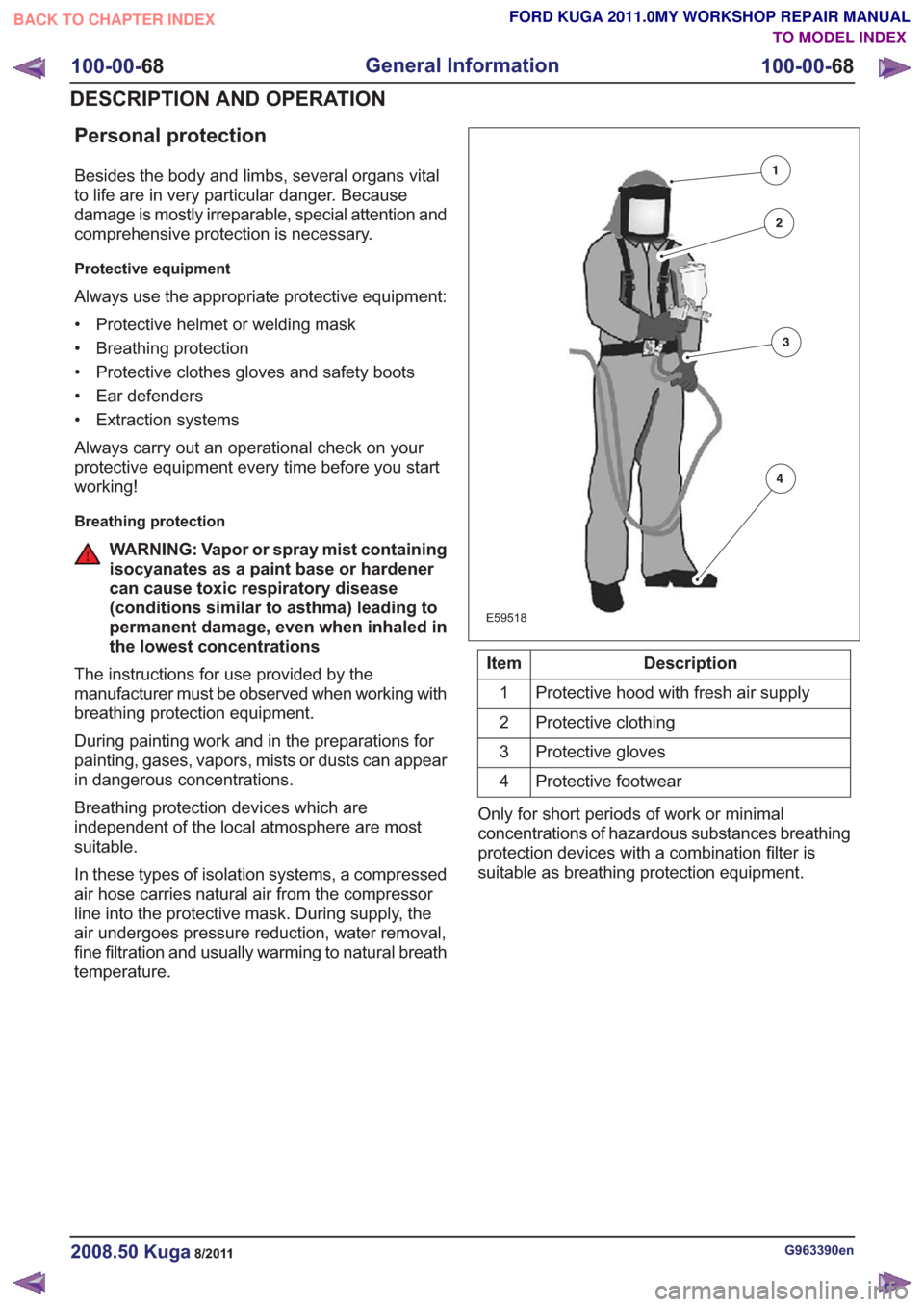
E59518
Description
Item
Protective hood with fresh air supply
1
Protective clothing
2
Protective gloves
3
Protective footwear
4
Only for short periods of work or minimal
concentrations of hazardous substances breathing
protection devices with a combination filter is
suitable as breathing protection equipment.
G963390en2008.50 Kuga8/2011
100-00- 68
General Information
100-00- 68
DESCRIPTION AND OPERATION
TO MODEL INDEX
BACK TO CHAPTER INDEX
FORD KUGA 2011.0MY WORKSHOP REPAIR MANUAL
Page 74 of 2057
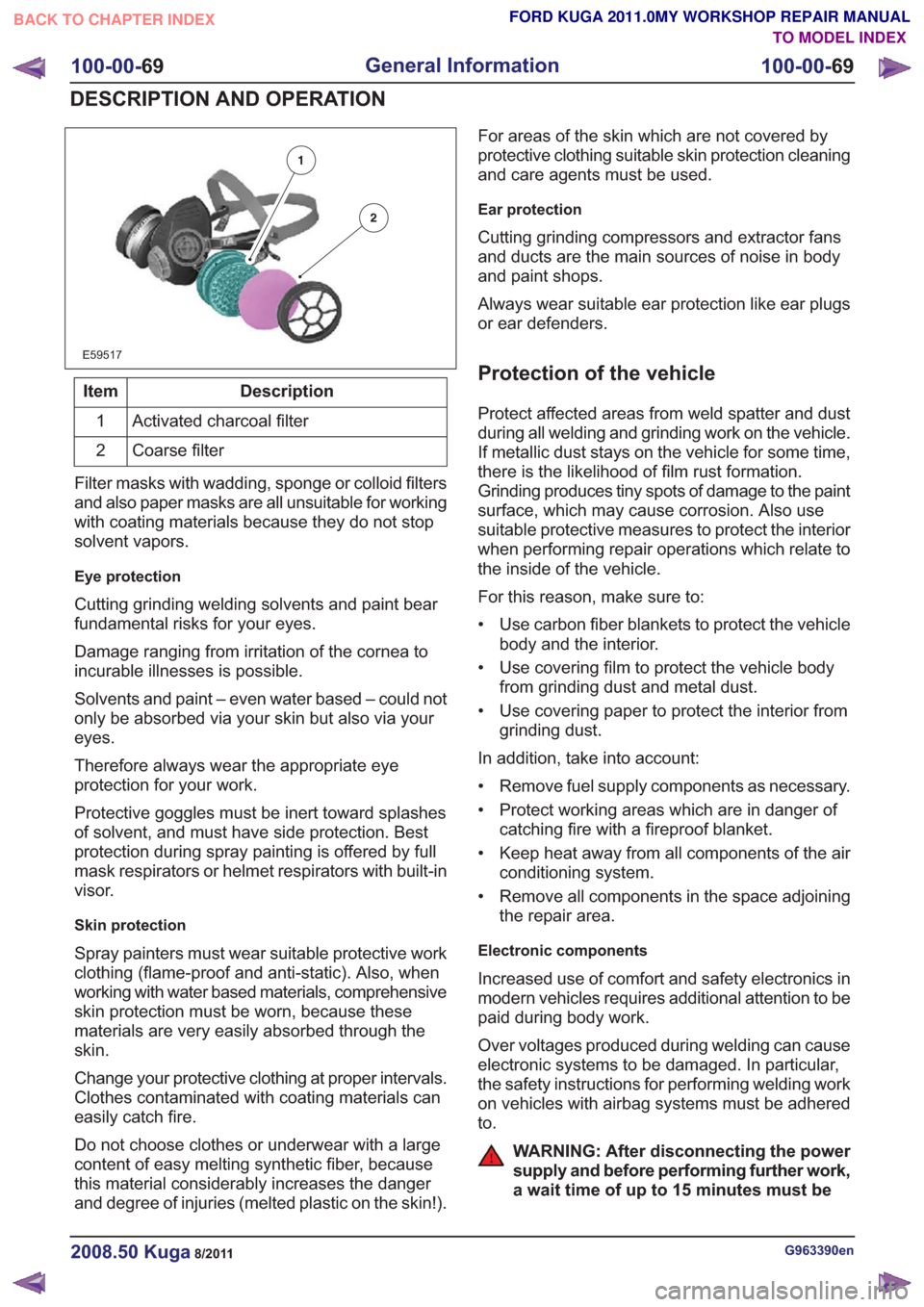
E59517
Description
Item
Activated charcoal filter
1
Coarse filter
2
Filter masks with wadding, sponge or colloid filters
and also paper masks are all unsuitable for working
with coating materials because they do not stop
solvent vapors.
Eye protection
Cutting grinding welding solvents and paint bear
fundamental risks for your eyes.
Damage ranging from irritation of the cornea to
incurable illnesses is possible.
Solvents and paint – even water based – could not
only be absorbed via your skin but also via your
eyes.
Therefore always wear the appropriate eye
protection for your work.
Protective goggles must be inert toward splashes
of solvent, and must have side protection. Best
protection during spray painting is offered by full
mask respirators or helmet respirators with built-in
visor.
Skin protection
Spray painters must wear suitable protective work
clothing (flame-proof and anti-static). Also, when
working with water based materials, comprehensive
skin protection must be worn, because these
materials are very easily absorbed through the
skin.
Change your protective clothing at proper intervals.
Clothes contaminated with coating materials can
easily catch fire.
Do not choose clothes or underwear with a large
content of easy melting synthetic fiber, because
this material considerably increases the danger
and degree of injuries (melted plastic on the skin!). For areas of the skin which are not covered by
protective clothing suitable skin protection cleaning
and care agents must be used.
Ear protection
Cutting grinding compressors and extractor fans
and ducts are the main sources of noise in body
and paint shops.
Always wear suitable ear protection like ear plugs
or ear defenders.
Protection of the vehicle
Protect affected areas from weld spatter and dust
during all welding and grinding work on the vehicle.
If metallic dust stays on the vehicle for some time,
there is the likelihood of film rust formation.
Grinding produces tiny spots of damage to the paint
surface, which may cause corrosion. Also use
suitable protective measures to protect the interior
when performing repair operations which relate to
the inside of the vehicle.
For this reason, make sure to:
• Use carbon fiber blankets to protect the vehicle
body and the interior.
• Use covering film to protect the vehicle body from grinding dust and metal dust.
• Use covering paper to protect the interior from grinding dust.
In addition, take into account:
• Remove fuel supply components as necessary.
• Protect working areas which are in danger of catching fire with a fireproof blanket.
• Keep heat away from all components of the air conditioning system.
• Remove all components in the space adjoining the repair area.
Electronic components
Increased use of comfort and safety electronics in
modern vehicles requires additional attention to be
paid during body work.
Over voltages produced during welding can cause
electronic systems to be damaged. In particular,
the safety instructions for performing welding work
on vehicles with airbag systems must be adhered
to.
WARNING: After disconnecting the power
supply and before performing further work,
a wait time of up to 15 minutes must be
G963390en2008.50 Kuga8/2011
100-00- 69
General Information
100-00- 69
DESCRIPTION AND OPERATION
TO MODEL INDEX
BACK TO CHAPTER INDEX
FORD KUGA 2011.0MY WORKSHOP REPAIR MANUAL
Page 79 of 2057
SECTION 100-04 Noise, Vibration and Harshness
VEHICLE APPLICATION:2008.50 Kuga
PA G E
CONTENTS
DIAGNOSIS AND TESTING
100-04-2
Noise, Vibration and Harshness (NVH) ........................................................................\
......
100-04-2
Inspection and Verification ........................................................................\
..........................
100-04-2
Noise Diagnostic Procedure ........................................................................\
.......................
100-04-3
Road Test ........................................................................\
...................................................
100-04-3
Road Test Quick Checks........................................................................\
............................
100-04-4
Road Conditions ........................................................................\
.........................................
100-04-4
Vehicle Preparation ........................................................................\
....................................
100-04-4
Power Steering Conditions ........................................................................\
.........................
100-04-4
Power Steering Operation Noise Check ........................................................................\
.....
100-04-7
Symptom Chart ........................................................................\
...........................................
100-04-14
Pinpoint Tests ........................................................................\
.............................................
100-04-1
Noise, Vibration and Harshness
100-04- 1
.
TO MODEL INDEX
BACK TO CHAPTER INDEX
FORD KUGA 2011.0MY WORKSHOP REPAIR MANUAL
Page 80 of 2057
Noise Conditions
• Gear noise is typically a howling or whining dueto gear damage or incorrect bearing preload. It
can occur at various speeds and driving
conditions, or it can be continuous.
• Chuckle is a particular rattling noise that sounds like a stick against the spokes of a spinning
bicycle wheel. It occurs while decelerating from
64 km/h (40 mph) and can usually be heard all
the way to a stop. The frequency varies with
vehicle speed.
• Knock is very similar to chuckle, though it may be louder and occurs on acceleration or
deceleration. The teardown will disclose what
has to be corrected.
Clicking, popping or grinding noises may be caused
by the following:
• worn, damaged or incorrectly installed wheel bearing, suspension or brake component.
Check and rule out tires, exhaust and trim items
before disassembling the transmission to diagnose
and correct gear noise.
The noises described under Road Test usually
have specific causes that can be diagnosed by
observation as the unit is disassembled. The initial
clues are the type of noise heard on the road test
and driving conditions.
Vibration Conditions
Vibration at highway speeds may be caused by
the following:
• out-of-balance front or rear wheels.
• out-of-round tires.
Shudder or vibration during acceleration may be
caused by the following:
• damaged powertrain/drivetrain mounts.
• excessively high constant velocity (CV) joint operating angles caused by incorrect ride height.
Check ride height, verify correct spring rate and
check items under inoperative conditions.
Road Test
A gear-driven unit will produce a certain amount
of noise. Some noise is acceptable and may be
audible at certain speeds or under various driving
conditions, as on a newly paved asphalt road. The slight noise is in no way detrimental and must be
considered normal.
The road test and customer interview (if available)
provide information needed to identify the condition
and give direction to the correct starting point for
diagnosis.
1. Make notes throughout the diagnosis routine.
Make sure to write down even the smallest bit
of information, because it may turn out to be the
most important.
2. Do not touch anything until a road test and a thorough visual inspection of the vehicle have
been carried out. Leave the tire pressures and
vehicle load just where they were when the
condition was first observed. Adjusting tire
pressures, vehicle load or making other
adjustments may reduce the condition(s)
intensity to a point where it cannot be identified
clearly. It may also inject something new into
the system, preventing correct diagnosis.
3. Make a visual inspection as part of the preliminary diagnosis routine, writing down
anything that does not look right. Note tire
pressures, but do not adjust them yet. Note
leaking fluids, loose nuts and bolts, or bright
spots where components may be rubbing
against each other. Check the load space for
unusual loads.
4. Road test the vehicle and define the condition by reproducing it several times during the road
test.
5. Carry out the Road Test Quick Checks as soon as the condition is reproduced. This will identify
the correct diagnostic procedure. Carry out the
Road Test Quick Checks more than once to
verify they are providing a valid result.
Remember, the Road Test Quick Checks may
not tell where the concern is, but they will tell
where it is not.
Road Test Quick Checks
1. 24-80 km/h (15-50 mph): with light acceleration,a moaning noise is heard and possibly a
vibration felt in the front floor panel. It is usually
worse at a particular engine speed and at a
particular throttle setting during acceleration at
that speed. It may also produce a moaning
sound, depending on what component is
causing it. REFER to Tip-in Moan in the
Driveline Noise and Vibration Symptom Chart.
2. Acceleration/Deceleration: With slow acceleration and deceleration, a shake is
G37349en2008.50 Kuga8/2011
100-04- 3
Noise, Vibration and Harshness
100-04- 3
DIAGNOSIS AND TESTING
TO MODEL INDEX
BACK TO CHAPTER INDEX
FORD KUGA 2011.0MY WORKSHOP REPAIR MANUAL
Page 81 of 2057
Noise, Vibration and Harshness (NVH)
Inspection and Verification
1. Verify the customer concern.
2. Visually inspect for obvious signs of mechanicalor electrical damage.
3. If an obvious cause for an observed or reported concern is found, correct the cause (if possible)
before proceeding to the next step.
4. If the concern is not visually evident, verify the symptom and REFER to the Symptom Chart.
How to Use this Diagnostic Procedure
Section
• Noise, vibration and harshness (NVH) concernshave become more important as vehicles have
become more sensitive to these vibrations. This
section is designed to aid in identifying these
concerns.
• The section provides diagnostic procedures based on symptom. If the condition occurs at
high speed, for instance, the most likely place
to start is under Shake and Vibration While
Driving.
• The road test procedure will tell how to sort the conditions into categories and how to tell a
vibration from a shake.
• A series of Road Test Quick Checks are provided to make sure that a cause is either
pinpointed or eliminated.
• Name the condition, proceed to the appropriate section and locate the correct diagnosis. When
the condition is identified, the job is partly done.
• Follow the diagnostic procedure as outlined.
• Quick Checks are described within the step, while more involved tests and adjustments are
outlined in General Procedures.
• Always follow each step exactly and make notes to recall important findings later.
Customer Interview
The road test and customer interview (if available)
provide information that will help identify the
concern and will provide direction to the correct
starting point for diagnosis.
Identify the Condition
NVH usually occur in four areas:
• tires
• engine accessories
• suspension
• driveline
It is important, therefore, that an NVH concern be
isolated into its specific area(s) as soon as
possible. The easiest and quickest way to do this
is to carry out the Road Test as outlined. To assist
in the diagnosis and testing procedure(s), use a
suitable approved NVH diagnosis tester.
Noise Diagnostic Procedure
Non-Axle Noise
The five most common sources of non-axle noise
are exhaust, tires, roof racks, trim panels and
transmission.
Therefore, make sure that none of the following
conditions are the cause of the noise before
proceeding with a driveline teardown and
diagnosis.
• In certain conditions, the pitch of the exhaustmay sound very much like gear noise. At other
times, it can be mistaken for a wheel bearing
rumble.
• Tires, especially snow tires, can have a high pitched tread whine or roar, similar to gear
noise. Radial tires may have this characteristic.
Also, any non-standard tire with an unusual
tread construction may emit a roar or whine
noise.
• Trim panels can also cause whistling or whining noise.
• Clunk may be a metallic noise heard when the automatic transaxle is engaged in "R"
(REVERSE) or "D" (DRIVE) or it may occur
when the throttle is applied or released. It is
caused by backlash somewhere in the driveline.
• Bearing rumble sounds like marbles being tumbled. This condition is usually caused by a
damaged wheel bearing.
G37349en2008.50 Kuga8/2011
100-04- 2
Noise, Vibration and Harshness
100-04- 2
DIAGNOSIS AND TESTING
TO MODEL INDEX
BACK TO CHAPTER INDEX
FORD KUGA 2011.0MY WORKSHOP REPAIR MANUAL