100 FORD KUGA 2011 1.G Workshop Manual
[x] Cancel search | Manufacturer: FORD, Model Year: 2011, Model line: KUGA, Model: FORD KUGA 2011 1.GPages: 2057
Page 2018 of 2057
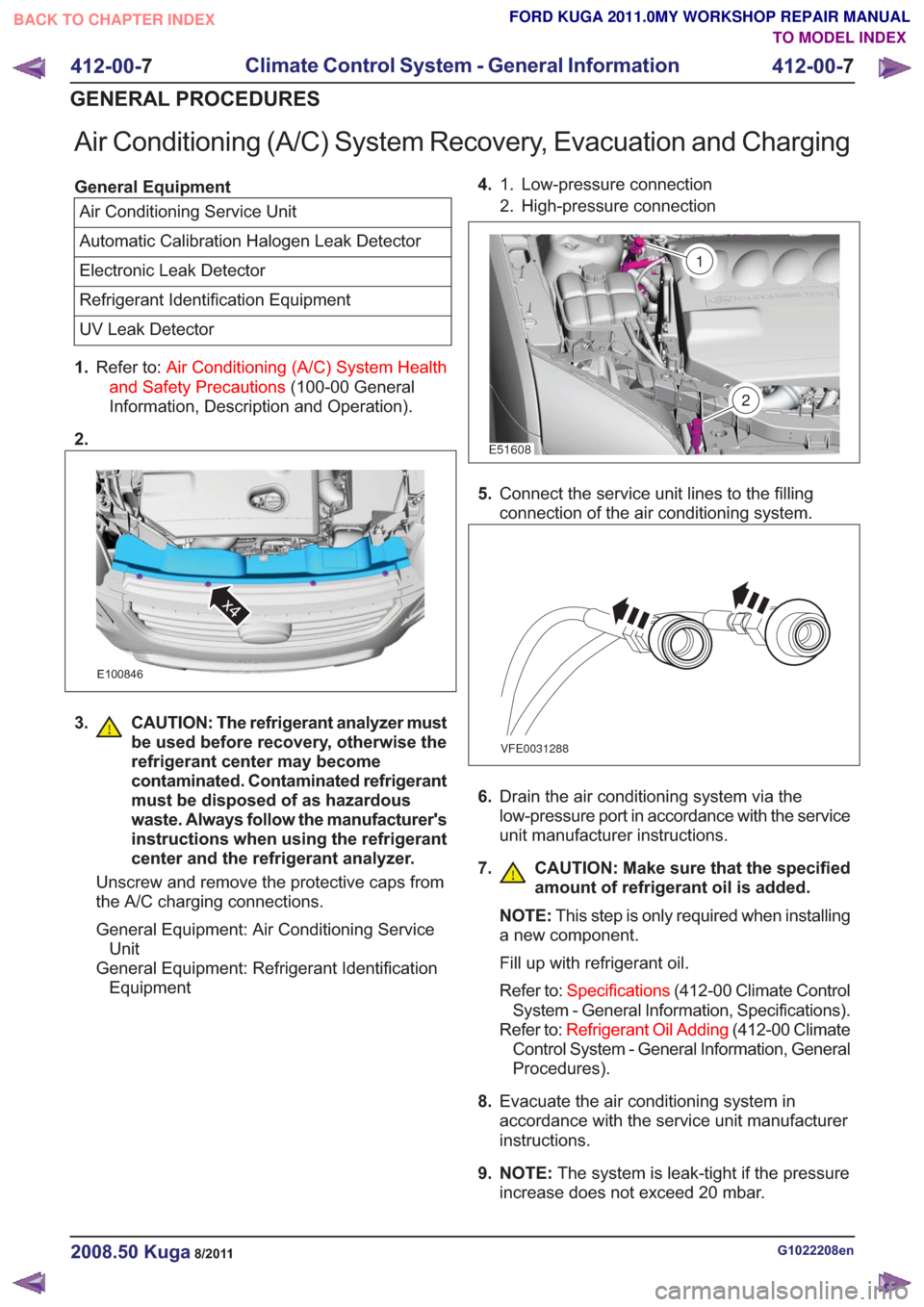
Air Conditioning (A/C) System Recovery, Evacuation and Charging
General EquipmentAir Conditioning Service Unit
Automatic Calibration Halogen Leak Detector
Electronic Leak Detector
Refrigerant Identification Equipment
UV Leak Detector
1. Refer to: Air Conditioning (A/C) System Health
and Safety Precautions (100-00 General
Information, Description and Operation).
2.
E100846
x4
3. CAUTION: The refrigerant analyzer must be used before recovery, otherwise the
refrigerant center may become
contaminated. Contaminated refrigerant
must be disposed of as hazardous
waste. Always follow the manufacturer's
instructions when using the refrigerant
center and the refrigerant analyzer.
Unscrew and remove the protective caps from
the A/C charging connections.
General Equipment: Air Conditioning Service Unit
General Equipment: Refrigerant Identification Equipment 4.
Low-pressure connection
1.
2. High-pressure connection
2
E51608
1
5. Connect the service unit lines to the filling
connection of the air conditioning system.
VFE0031288
6.Drain the air conditioning system via the
low-pressure port in accordance with the service
unit manufacturer instructions.
7. CAUTION: Make sure that the specified amount of refrigerant oil is added.
NOTE:This step is only required when installing
a new component.
Fill up with refrigerant oil.
Refer to: Specifications (412-00 Climate Control
System - General Information, Specifications).
Refer to: Refrigerant Oil Adding (412-00 Climate
Control System - General Information, General
Procedures).
8. Evacuate the air conditioning system in
accordance with the service unit manufacturer
instructions.
9. NOTE: The system is leak-tight if the pressure
increase does not exceed 20 mbar.
G1022208en2008.50 Kuga8/2011
412-00- 7
Climate Control System - General Information
412-00- 7
GENERAL PROCEDURES
TO MODEL INDEX
BACK TO CHAPTER INDEX
FORD KUGA 2011.0MY WORKSHOP REPAIR MANUAL
Page 2020 of 2057
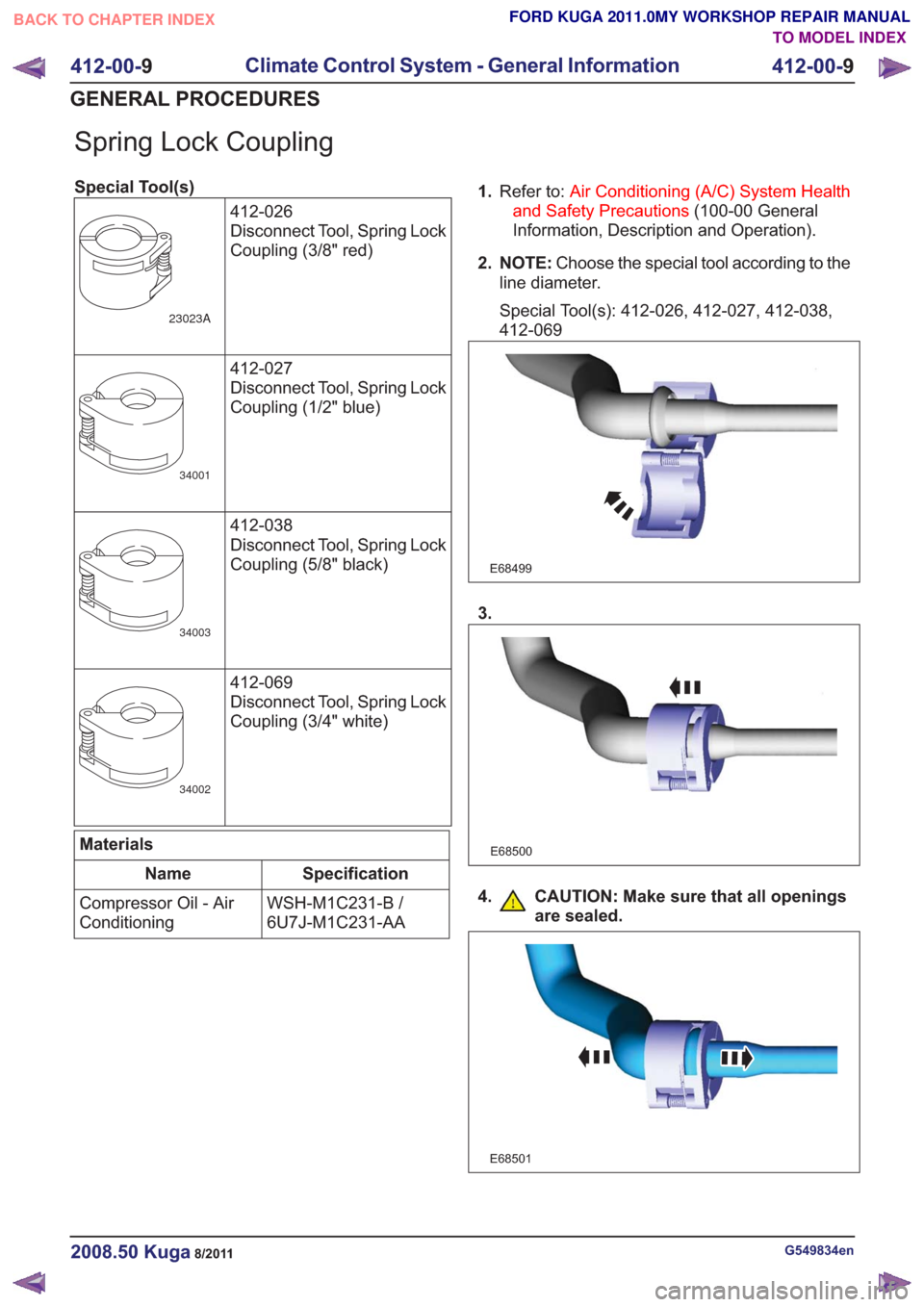
Spring Lock Coupling
Special Tool(s)412-026
Disconnect Tool, Spring Lock
Coupling (3/8" red)
23023A
412-027
Disconnect Tool, Spring Lock
Coupling (1/2" blue)
34001
412-038
Disconnect Tool, Spring Lock
Coupling (5/8" black)
34003
412-069
Disconnect Tool, Spring Lock
Coupling (3/4" white)
34002
Materials
Specification
Name
WSH-M1C231-B /
6U7J-M1C231-AA
Compressor Oil - Air
Conditioning 1.
Refer to: Air Conditioning (A/C) System Health
and Safety Precautions (100-00 General
Information, Description and Operation).
2. NOTE: Choose the special tool according to the
line diameter.
Special Tool(s): 412-026, 412-027, 412-038,
412-069
E68499
3.
E68500
4. CAUTION: Make sure that all openings are sealed.
E68501
G549834en2008.50 Kuga8/2011
412-00- 9
Climate Control System - General Information
412-00- 9
GENERAL PROCEDURES
TO MODEL INDEX
BACK TO CHAPTER INDEX
FORD KUGA 2011.0MY WORKSHOP REPAIR MANUAL
Page 2025 of 2057
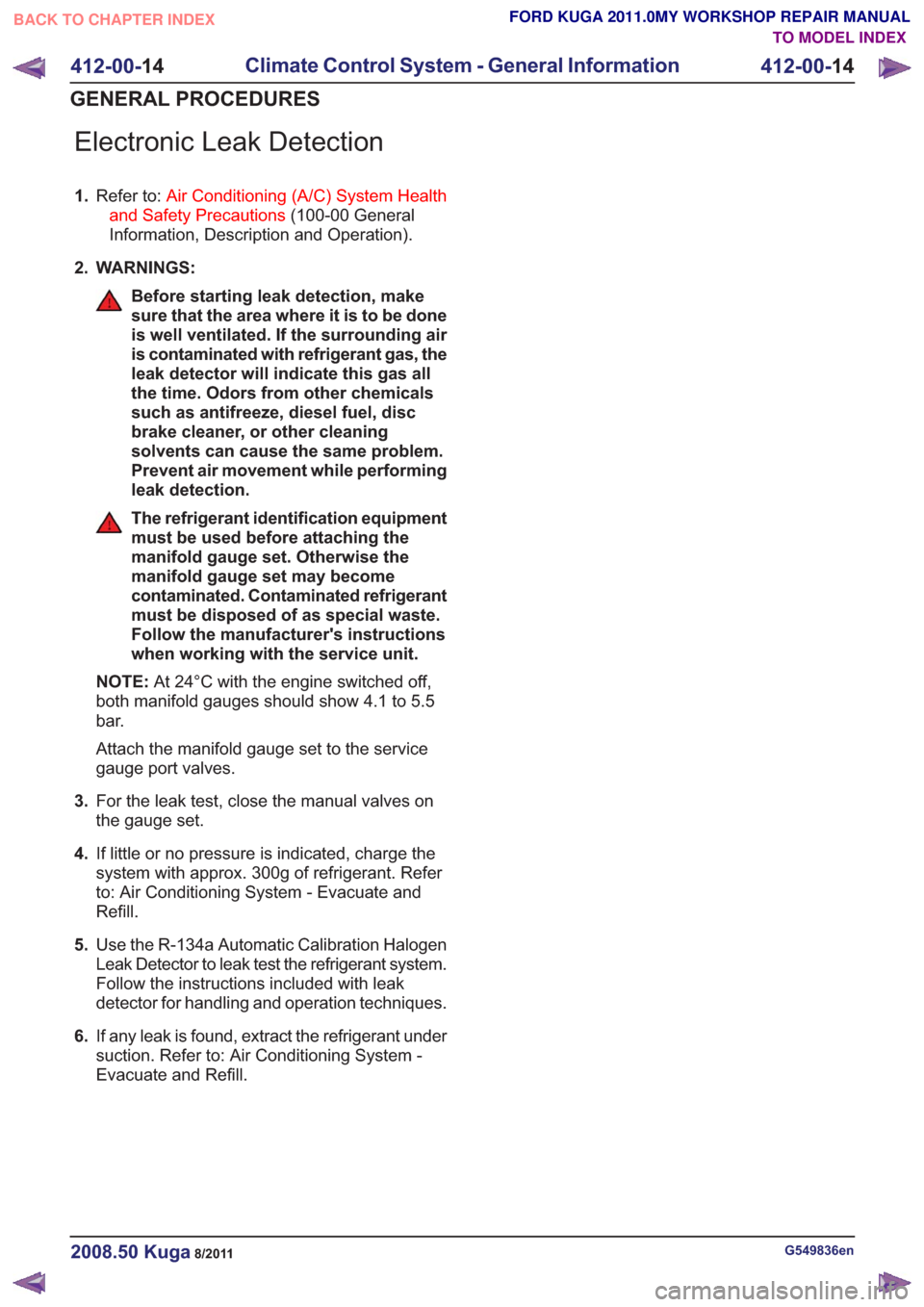
Electronic Leak Detection
1.Refer to: Air Conditioning (A/C) System Health
and Safety Precautions (100-00 General
Information, Description and Operation).
2. WARNINGS:
Before starting leak detection, make
sure that the area where it is to be done
is well ventilated. If the surrounding air
is contaminated with refrigerant gas, the
leak detector will indicate this gas all
the time. Odors from other chemicals
such as antifreeze, diesel fuel, disc
brake cleaner, or other cleaning
solvents can cause the same problem.
Prevent air movement while performing
leak detection.
The refrigerant identification equipment
must be used before attaching the
manifold gauge set. Otherwise the
manifold gauge set may become
contaminated. Contaminated refrigerant
must be disposed of as special waste.
Follow the manufacturer's instructions
when working with the service unit.
NOTE: At 24°C with the engine switched off,
both manifold gauges should show 4.1 to 5.5
bar.
Attach the manifold gauge set to the service
gauge port valves.
3. For the leak test, close the manual valves on
the gauge set.
4. If little or no pressure is indicated, charge the
system with approx. 300g of refrigerant. Refer
to: Air Conditioning System - Evacuate and
Refill.
5. Use the R-134a Automatic Calibration Halogen
Leak Detector to leak test the refrigerant system.
Follow the instructions included with leak
detector for handling and operation techniques.
6. If any leak is found, extract the refrigerant under
suction. Refer to: Air Conditioning System -
Evacuate and Refill.
G549836en2008.50 Kuga8/2011
412-00- 14
Climate Control System - General Information
412-00- 14
GENERAL PROCEDURES
TO MODEL INDEX
BACK TO CHAPTER INDEX
FORD KUGA 2011.0MY WORKSHOP REPAIR MANUAL
Page 2026 of 2057
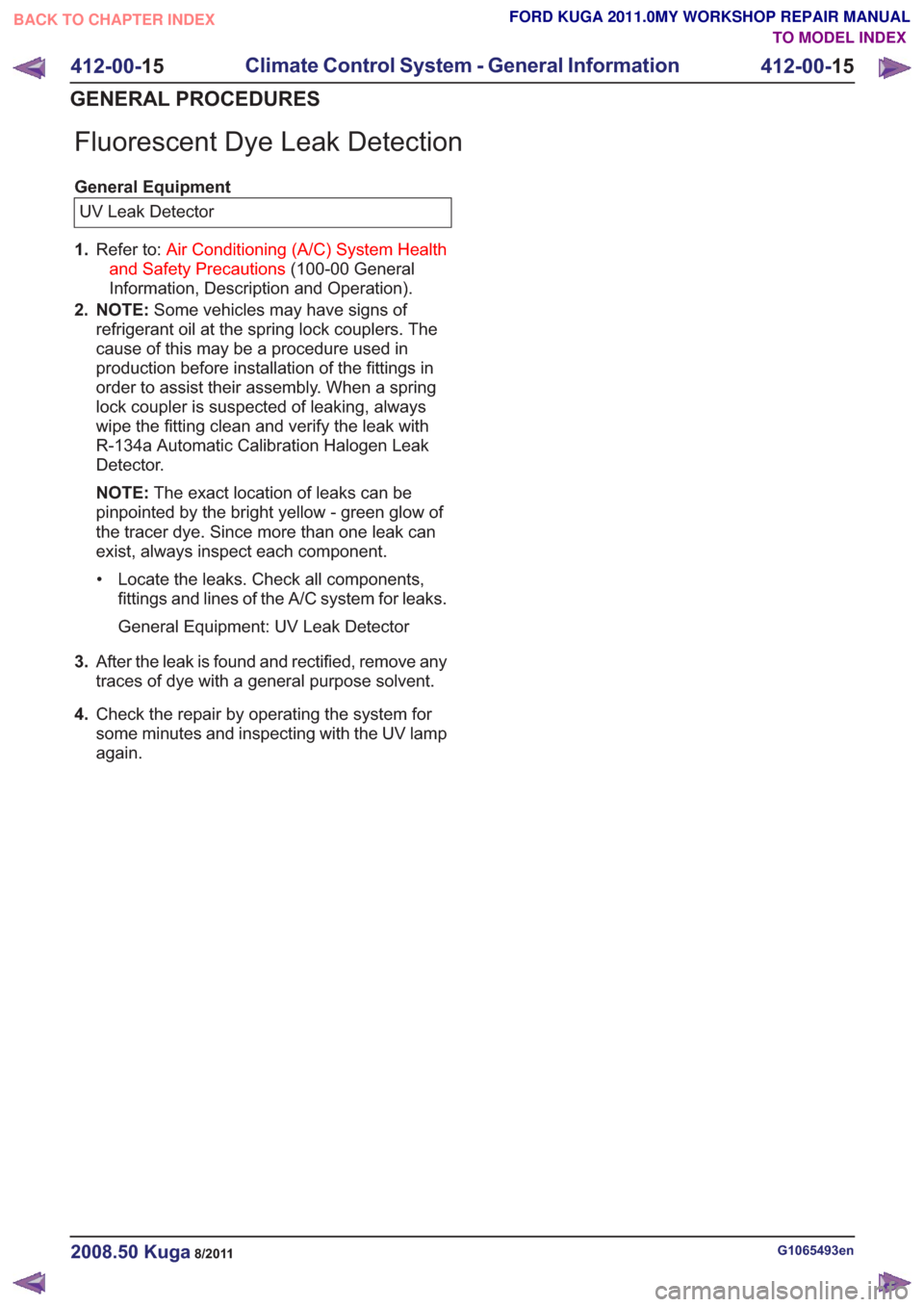
Fluorescent Dye Leak Detection
General EquipmentUV Leak Detector
1. Refer to: Air Conditioning (A/C) System Health
and Safety Precautions (100-00 General
Information, Description and Operation).
2. NOTE: Some vehicles may have signs of
refrigerant oil at the spring lock couplers. The
cause of this may be a procedure used in
production before installation of the fittings in
order to assist their assembly. When a spring
lock coupler is suspected of leaking, always
wipe the fitting clean and verify the leak with
R-134a Automatic Calibration Halogen Leak
Detector.
NOTE: The exact location of leaks can be
pinpointed by the bright yellow - green glow of
the tracer dye. Since more than one leak can
exist, always inspect each component.
• Locate the leaks. Check all components, fittings and lines of the A/C system for leaks.
General Equipment: UV Leak Detector
3. After the leak is found and rectified, remove any
traces of dye with a general purpose solvent.
4. Check the repair by operating the system for
some minutes and inspecting with the UV lamp
again.
G1065493en2008.50 Kuga8/2011
412-00- 15
Climate Control System - General Information
412-00- 15
GENERAL PROCEDURES
TO MODEL INDEX
BACK TO CHAPTER INDEX
FORD KUGA 2011.0MY WORKSHOP REPAIR MANUAL
Page 2050 of 2057
1
2
3
5
4
67
8
9
10
11
E100819
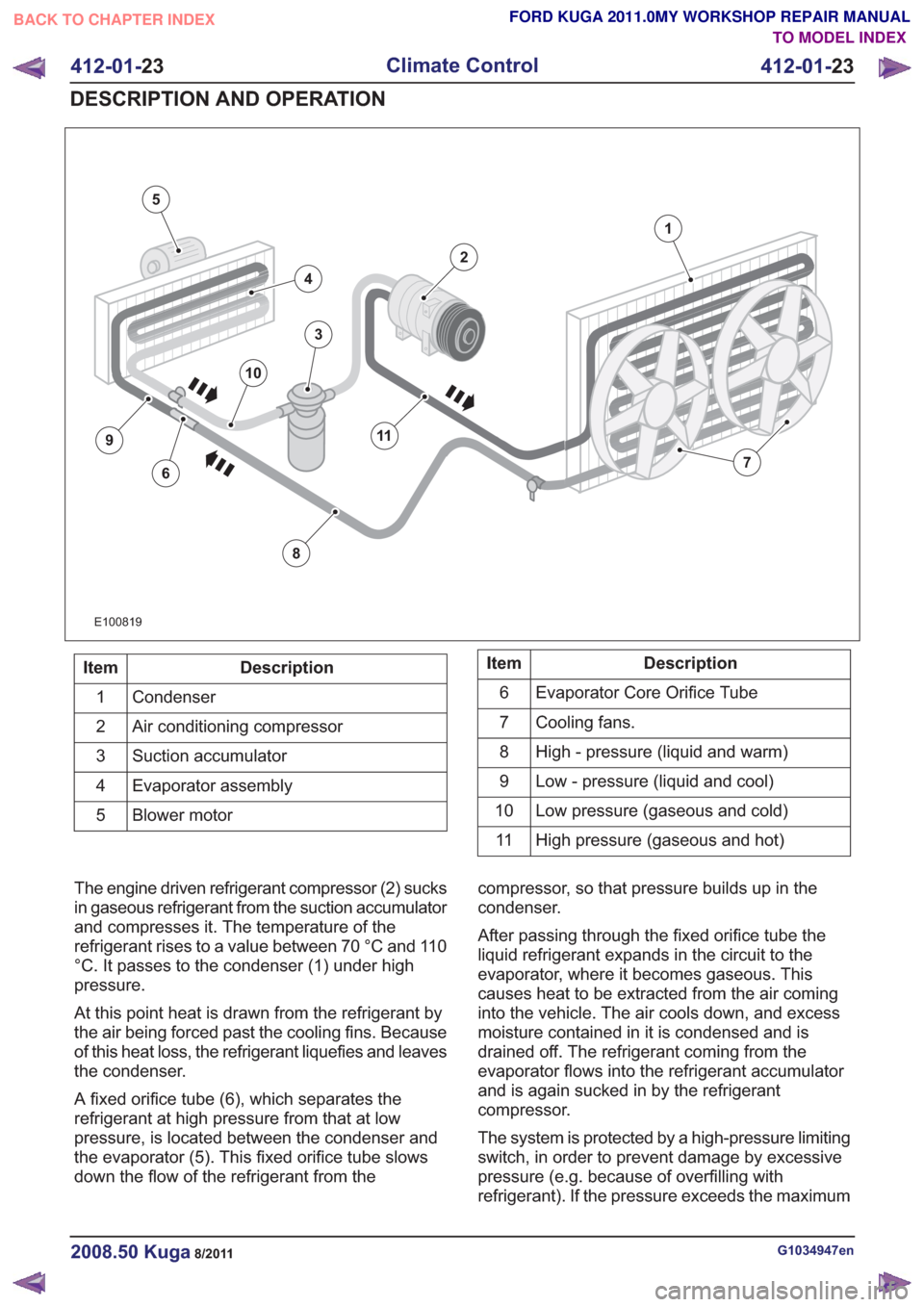
Description
Item
Condenser
1
Air conditioning compressor
2
Suction accumulator
3
Evaporator assembly
4
Blower motor
5Description
Item
Evaporator Core Orifice Tube
6
Cooling fans.
7
High - pressure (liquid and warm)
8
Low - pressure (liquid and cool)
9
Low pressure (gaseous and cold)
10
High pressure (gaseous and hot)
11
The engine driven refrigerant compressor (2) sucks
in gaseous refrigerant from the suction accumulator
and compresses it. The temperature of the
refrigerant rises to a value between 70 °C and 110
°C. It passes to the condenser (1) under high
pressure.
At this point heat is drawn from the refrigerant by
the air being forced past the cooling fins. Because
of this heat loss, the refrigerant liquefies and leaves
the condenser.
A fixed orifice tube (6), which separates the
refrigerant at high pressure from that at low
pressure, is located between the condenser and
the evaporator (5). This fixed orifice tube slows
down the flow of the refrigerant from the compressor, so that pressure builds up in the
condenser.
After passing through the fixed orifice tube the
liquid refrigerant expands in the circuit to the
evaporator, where it becomes gaseous. This
causes heat to be extracted from the air coming
into the vehicle. The air cools down, and excess
moisture contained in it is condensed and is
drained off. The refrigerant coming from the
evaporator flows into the refrigerant accumulator
and is again sucked in by the refrigerant
compressor.
The system is protected by a high-pressure limiting
switch, in order to prevent damage by excessive
pressure (e.g. because of overfilling with
refrigerant). If the pressure exceeds the maximum
G1034947en2008.50 Kuga8/2011
412-01-
23
Climate Control
412-01- 23
DESCRIPTION AND OPERATION
TO MODEL INDEX
BACK TO CHAPTER INDEX
FORD KUGA 2011.0MY WORKSHOP REPAIR MANUAL
Page 2051 of 2057
permitted, the high-pressure switch turns off the
refrigerant compressor.
The compressor on-off cycle is controlled by the
dual pressure switch depending on the pressure
in the refrigerant accumulator. The dual pressure
switch turns the refrigerant compressor off
permanently if the pressure falls below a permitted
value (e.g. if there is a leak).
Component Description
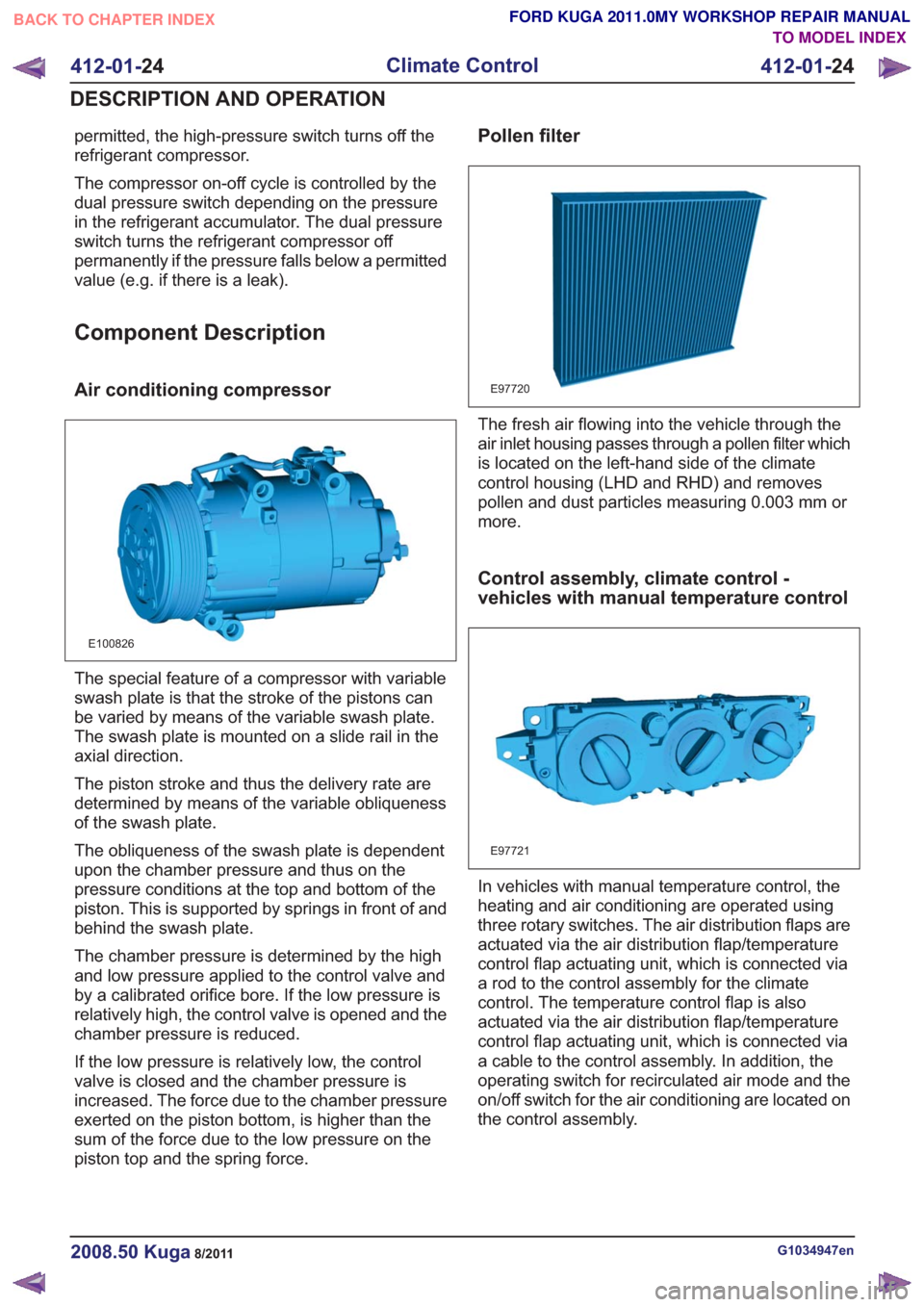
Air conditioning compressor
E100826
The special feature of a compressor with variable
swash plate is that the stroke of the pistons can
be varied by means of the variable swash plate.
The swash plate is mounted on a slide rail in the
axial direction.
The piston stroke and thus the delivery rate are
determined by means of the variable obliqueness
of the swash plate.
The obliqueness of the swash plate is dependent
upon the chamber pressure and thus on the
pressure conditions at the top and bottom of the
piston. This is supported by springs in front of and
behind the swash plate.
The chamber pressure is determined by the high
and low pressure applied to the control valve and
by a calibrated orifice bore. If the low pressure is
relatively high, the control valve is opened and the
chamber pressure is reduced.
If the low pressure is relatively low, the control
valve is closed and the chamber pressure is
increased. The force due to the chamber pressure
exerted on the piston bottom, is higher than the
sum of the force due to the low pressure on the
piston top and the spring force.
Pollen filter
E97720
The fresh air flowing into the vehicle through the
air inlet housing passes through a pollen filter which
is located on the left-hand side of the climate
control housing (LHD and RHD) and removes
pollen and dust particles measuring 0.003 mm or
more.
Control assembly, climate control -
vehicles with manual temperature control
E97721
In vehicles with manual temperature control, the
heating and air conditioning are operated using
three rotary switches. The air distribution flaps are
actuated via the air distribution flap/temperature
control flap actuating unit, which is connected via
a rod to the control assembly for the climate
control. The temperature control flap is also
actuated via the air distribution flap/temperature
control flap actuating unit, which is connected via
a cable to the control assembly. In addition, the
operating switch for recirculated air mode and the
on/off switch for the air conditioning are located on
the control assembly.
G1034947en2008.50 Kuga8/2011
412-01-24
Climate Control
412-01- 24
DESCRIPTION AND OPERATION
TO MODEL INDEX
BACK TO CHAPTER INDEX
FORD KUGA 2011.0MY WORKSHOP REPAIR MANUAL
Page 2053 of 2057
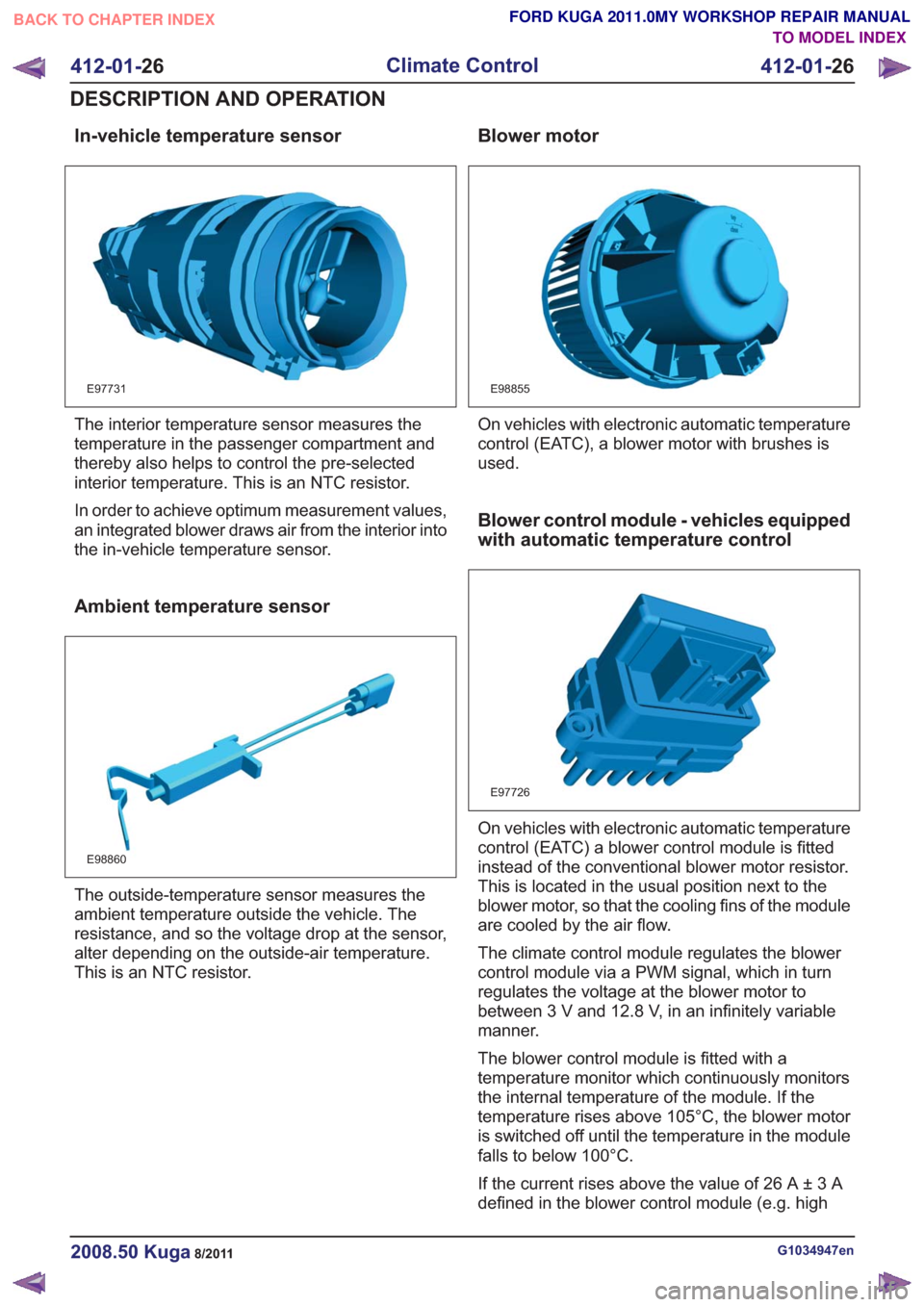
In-vehicle temperature sensor
E97731
The interior temperature sensor measures the
temperature in the passenger compartment and
thereby also helps to control the pre-selected
interior temperature. This is an NTC resistor.
In order to achieve optimum measurement values,
an integrated blower draws air from the interior into
the in-vehicle temperature sensor.
Ambient temperature sensor
E98860
The outside-temperature sensor measures the
ambient temperature outside the vehicle. The
resistance, and so the voltage drop at the sensor,
alter depending on the outside-air temperature.
This is an NTC resistor.
Blower motor
E98855
On vehicles with electronic automatic temperature
control (EATC), a blower motor with brushes is
used.
Blower control module - vehicles equipped
with automatic temperature control
E97726
On vehicles with electronic automatic temperature
control (EATC) a blower control module is fitted
instead of the conventional blower motor resistor.
This is located in the usual position next to the
blower motor, so that the cooling fins of the module
are cooled by the air flow.
The climate control module regulates the blower
control module via a PWM signal, which in turn
regulates the voltage at the blower motor to
between 3 V and 12.8 V, in an infinitely variable
manner.
The blower control module is fitted with a
temperature monitor which continuously monitors
the internal temperature of the module. If the
temperature rises above 105°C, the blower motor
is switched off until the temperature in the module
falls to below 100°C.
If the current rises above the value of 26 A ± 3 A
defined in the blower control module (e.g. high
G1034947en2008.50 Kuga8/2011
412-01-26
Climate Control
412-01- 26
DESCRIPTION AND OPERATION
TO MODEL INDEX
BACK TO CHAPTER INDEX
FORD KUGA 2011.0MY WORKSHOP REPAIR MANUAL
Page 2056 of 2057
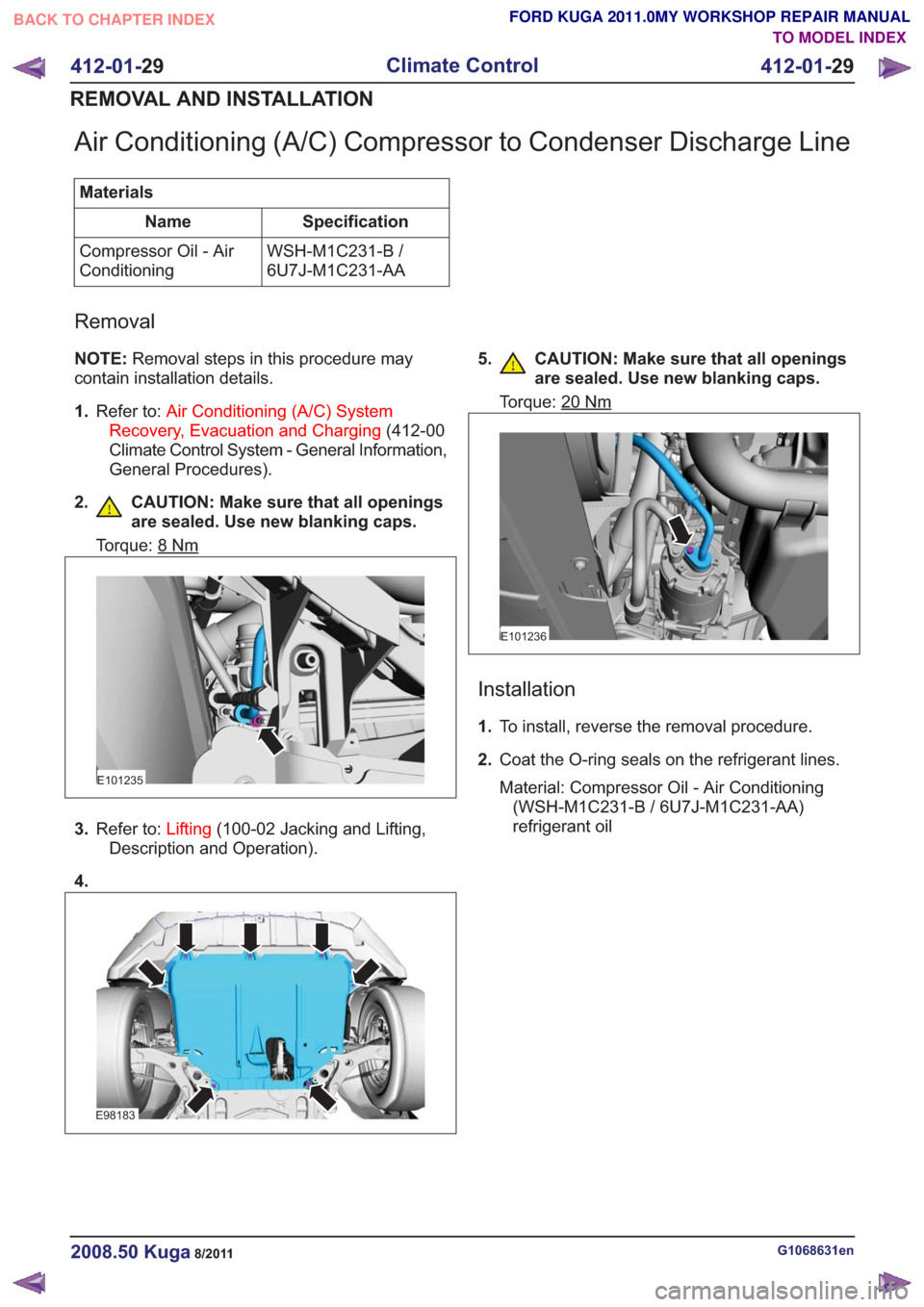
Air Conditioning (A/C) Compressor to Condenser Discharge Line
MaterialsSpecification
Name
WSH-M1C231-B /
6U7J-M1C231-AA
Compressor Oil - Air
Conditioning
Removal
NOTE:
Removal steps in this procedure may
contain installation details.
1. Refer to: Air Conditioning (A/C) System
Recovery, Evacuation and Charging (412-00
Climate Control System - General Information,
General Procedures).
2. CAUTION: Make sure that all openings are sealed. Use new blanking caps.
Torque: 8Nm
E101235
3.Refer to: Lifting(100-02 Jacking and Lifting,
Description and Operation).
4.
E98183
5. CAUTION: Make sure that all openings are sealed. Use new blanking caps.
Torque: 20Nm
E101236
Installation
1.To install, reverse the removal procedure.
2. Coat the O-ring seals on the refrigerant lines.
Material: Compressor Oil - Air Conditioning
(WSH-M1C231-B / 6U7J-M1C231-AA)
refrigerant oil
G1068631en2008.50 Kuga8/2011
412-01- 29
Climate Control
412-01- 29
REMOVAL AND INSTALLATION
TO MODEL INDEX
BACK TO CHAPTER INDEX
FORD KUGA 2011.0MY WORKSHOP REPAIR MANUAL
Page 2057 of 2057
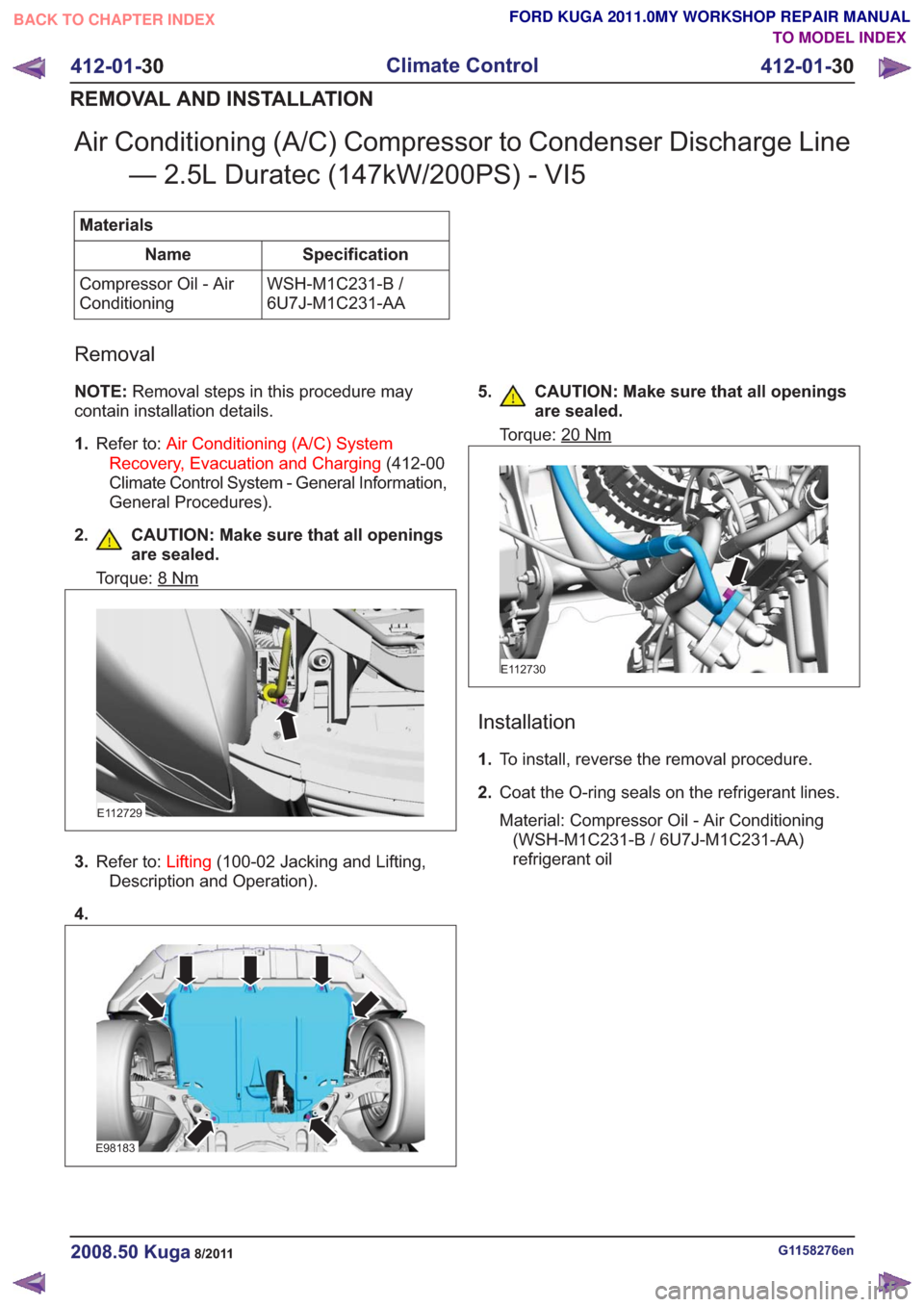
Air Conditioning (A/C) Compressor to Condenser Discharge Line— 2.5L Duratec (147kW/200PS) - VI5
Materials
Specification
Name
WSH-M1C231-B /
6U7J-M1C231-AA
Compressor Oil - Air
Conditioning
Removal
NOTE:
Removal steps in this procedure may
contain installation details.
1. Refer to: Air Conditioning (A/C) System
Recovery, Evacuation and Charging (412-00
Climate Control System - General Information,
General Procedures).
2. CAUTION: Make sure that all openings are sealed.
Torque: 8Nm
E112729
3.Refer to: Lifting(100-02 Jacking and Lifting,
Description and Operation).
4.
E98183
5. CAUTION: Make sure that all openings are sealed.
Torque: 20Nm
E112730
Installation
1.To install, reverse the removal procedure.
2. Coat the O-ring seals on the refrigerant lines.
Material: Compressor Oil - Air Conditioning
(WSH-M1C231-B / 6U7J-M1C231-AA)
refrigerant oil
G1158276en2008.50 Kuga8/2011
412-01- 30
Climate Control
412-01- 30
REMOVAL AND INSTALLATION
TO MODEL INDEX
BACK TO CHAPTER INDEX
FORD KUGA 2011.0MY WORKSHOP REPAIR MANUAL