parking FORD KUGA 2011 1.G Repair Manual
[x] Cancel search | Manufacturer: FORD, Model Year: 2011, Model line: KUGA, Model: FORD KUGA 2011 1.GPages: 2057
Page 1354 of 2057
4. Remove the vacuum hose from the brakebooster. Manifold vacuum should be available
at the brake booster end of the hose with the
engine at idle speed and the transaxle in the
NEUTRAL position. Make sure that all unused
vacuum outlets are correctly capped, hose
connectors are correctly secured and vacuum
hoses are in good condition. When it is
established that manifold vacuum is available
to the brake booster, connect the vacuum hose
to the brake booster and repeat Step 3. If no
downward movement of the brake pedal is felt,
install a new brake booster.
5. Operate the engine a minimum of 10 seconds at approximately 1200 rpm. Stop the engine and
let the vehicle stand for 10 minutes. Then, apply
the brake pedal with approximately 89 N (20 lb)
force. The pedal feel (brake application) should
be the same as that noted with the engine
operating. If the brake pedal feels hard (no
power assist), install a new vacuum check valve
and then repeat the test. If the brake pedal still
feels hard, install a new brake booster. If the
brake pedal movement feels spongy, bleed the
brake system. REFER to: (206-00 Brake System
- General Information)
Brake System Bleeding (General Procedures),
Brake System Pressure Bleeding (General
Procedures),
Component Bleeding (General Procedures).
Brake Master Cylinder
Usually, the first and strongest indicator of anything
wrong with the braking system is a feeling through
the brake pedal. In diagnosing the condition of the
brake master cylinder, check pedal feel as
evidence of a brake concern. Check for the red
brake warning indicator illumination and the fluid
level in the master cylinder reservoir.
Normal Conditions
The following conditions are considered normal
and are not indications that the brake master
cylinder is in need of service.
– Modern brake systems are not designed to
produce as hard a pedal effort as in the past.
Complaints of light pedal efforts should be compared to pedal efforts of another vehicle, of
the same model and year.
– During normal operation of the brake pedal, the fluid level in the reservoir will rise during brake
pedal application and fall during release. The
net fluid level (i.e., after brake pedal application
and release) will remain unchanged.
– A trace of brake fluid will exists on the brake booster shell below the master cylinder
mounting flange. This results from the normal
lubricating action of the master cylinder bore
end seal.
– The fluid level will fall with brake shoe and lining wear.
Abnormal Conditions
NOTE: Prior to performing any diagnosis, make
sure the brake system warning indicator is
functional.
Changes in brake pedal feel or travel are indicators
that something could be wrong with the braking
system. The diagnostic procedure and techniques
use brake pedal feel, warning indicator illumination
and low brake fluid level as indicators in diagnosing
braking system concerns. The following conditions
are considered abnormal and indicate that the
brake master cylinder is in need of service.
– The brake pedal goes down fast. This could be caused by an external or internal leak.
– The brake pedal eases down slowly. This could be caused by an external or internal leak.
– The brake pedal is low and or feels spongy. This condition may be caused by no fluid in the brake
master cylinder reservoir, reservoir cap vent
holes clogged or air in the hydraulic system.
– The brake pedal effort is excessive. This may be caused by a bind or obstruction in the pedal
or linkage, clogged fluid control valve or
insufficient booster vacuum.
– The rear brakes lock up during light pedal force. This may be caused by incorrect tire pressures,
grease or fluid on the brake shoes and linings,
damaged brake shoes and linings, incorrectly
adjusted parking brake, or damaged or
contaminated brake pressure control valves.
– The brake pedal effort is erratic. This condition could be caused by a brake booster malfunction,
extreme caliper piston knock back or incorrectly
installed brake shoes and linings.
– The red brake warning indicator is ON. This may be caused by low fluid level, ignition wire routing
G1058975en2008.50 Kuga8/2011
206-00- 18
Brake System - General Information
206-00- 18
DIAGNOSIS AND TESTING
TO MODEL INDEX
BACK TO CHAPTER INDEX
FORD KUGA 2011.0MY WORKSHOP REPAIR MANUAL
Page 1384 of 2057
SECTION 206-05 Parking Brake and Actuation
VEHICLE APPLICATION:2008.50 Kuga
PA G E
CONTENTS
DESCRIPTION AND OPERATION
206-05-2
Parking Brake (Overview) ........................................................................\
...........................
206-05-2
Overview ........................................................................\
.....................................................
206-05-2
Parking brake cable ........................................................................\
....................................
206-05-3
Parking brake control ........................................................................\
..................................
DIAGNOSIS AND TESTING 206-05-4
Parking Brake ........................................................................\
.............................................
206-05-4
Inspection and Verification ........................................................................\
..........................
206-05-4
Symptom Chart ........................................................................\
...........................................
206-05-5
Pinpoint Tests ........................................................................\
.............................................
GENERAL PROCEDURES 206-05-9
Parking Brake Cable Adjustment ........................................................................\
................
REMOVAL AND INSTALLATION 206-05-11
(12 664 0)
Parking Brake Control ........................................................................\
............
206-05-12
Parking Brake Rear Cables ........................................................................\
........................
206-05-1
Parking Brake and Actuation
206-05- 1
.
TO MODEL INDEX
BACK TO CHAPTER INDEX
FORD KUGA 2011.0MY WORKSHOP REPAIR MANUAL
Page 1385 of 2057
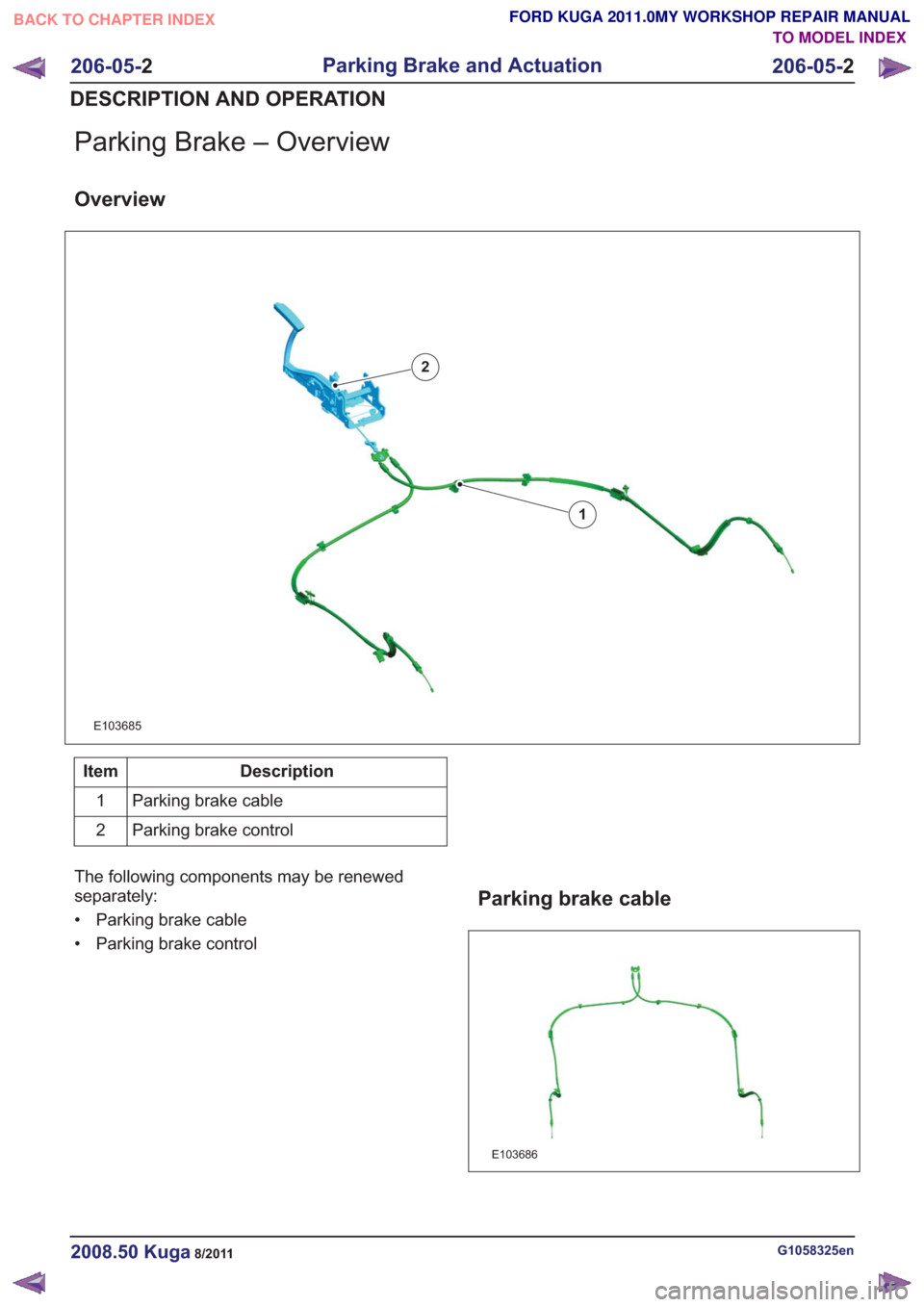
Parking Brake – Overview
Overview
E103685
1
2
Description
Item
Parking brake cable
1
Parking brake control
2
The following components may be renewed
separately:
• Parking brake cable
• Parking brake control
Parking brake cable
E103686
G1058325en2008.50 Kuga8/2011
206-05- 2
Parking Brake and Actuation
206-05- 2
DESCRIPTION AND OPERATION
TO MODEL INDEX
BACK TO CHAPTER INDEX
FORD KUGA 2011.0MY WORKSHOP REPAIR MANUAL
Page 1386 of 2057
The following instructions must be followed when
removing, installing or renewing the parking brake
cable:
• If the parking brake cable is removed, installedor renewed, the parking brake must be adjusted
after the work is completed.
Refer to: Parking Brake Cable Adjustment
(206-05 Parking Brake and Actuation, General
Procedures).
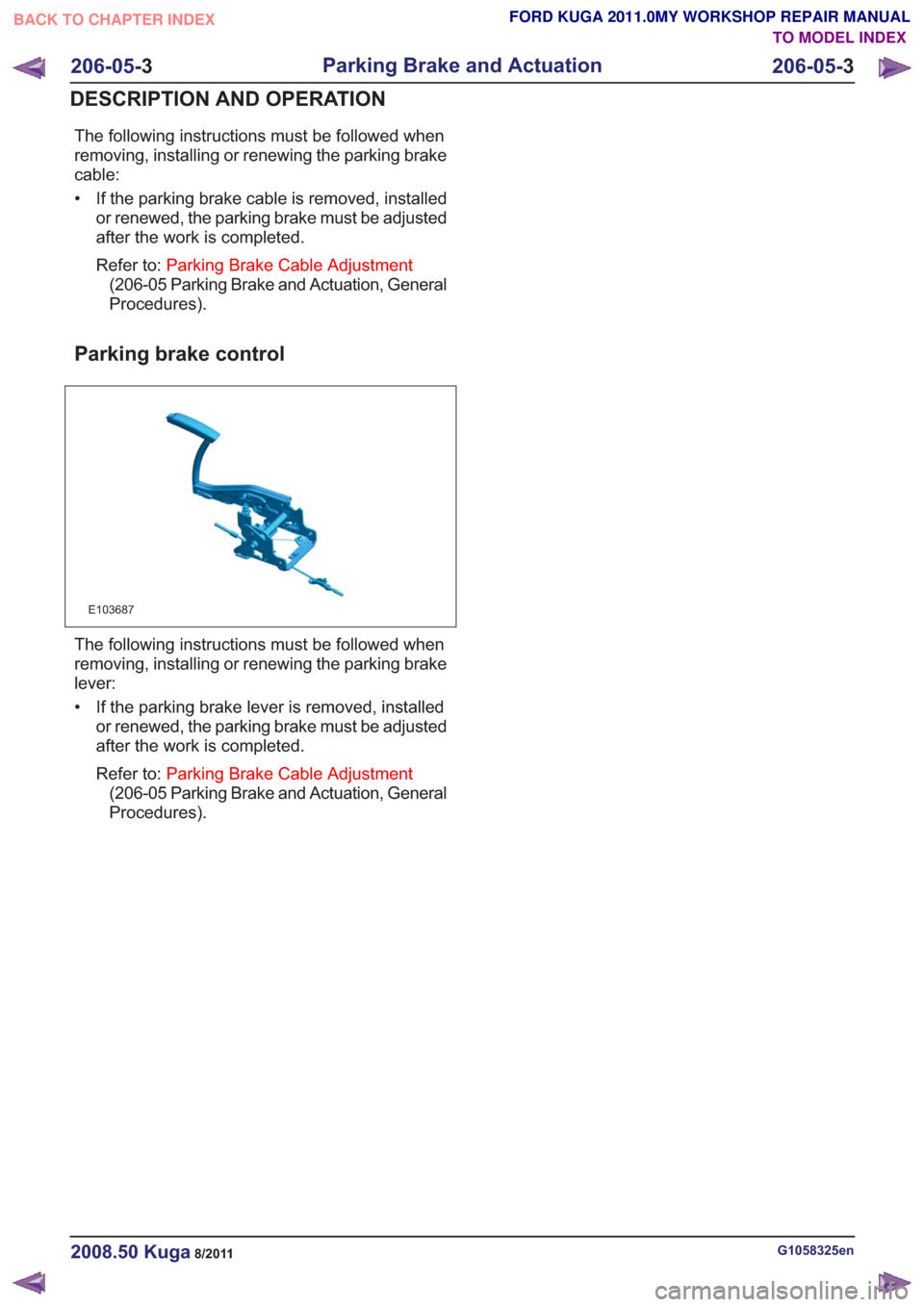
Parking brake control
E103687
The following instructions must be followed when
removing, installing or renewing the parking brake
lever:
• If the parking brake lever is removed, installed or renewed, the parking brake must be adjusted
after the work is completed.
Refer to: Parking Brake Cable Adjustment
(206-05 Parking Brake and Actuation, General
Procedures).
G1058325en2008.50 Kuga8/2011
206-05- 3
Parking Brake and Actuation
206-05- 3
DESCRIPTION AND OPERATION
TO MODEL INDEX
BACK TO CHAPTER INDEX
FORD KUGA 2011.0MY WORKSHOP REPAIR MANUAL
Page 1387 of 2057
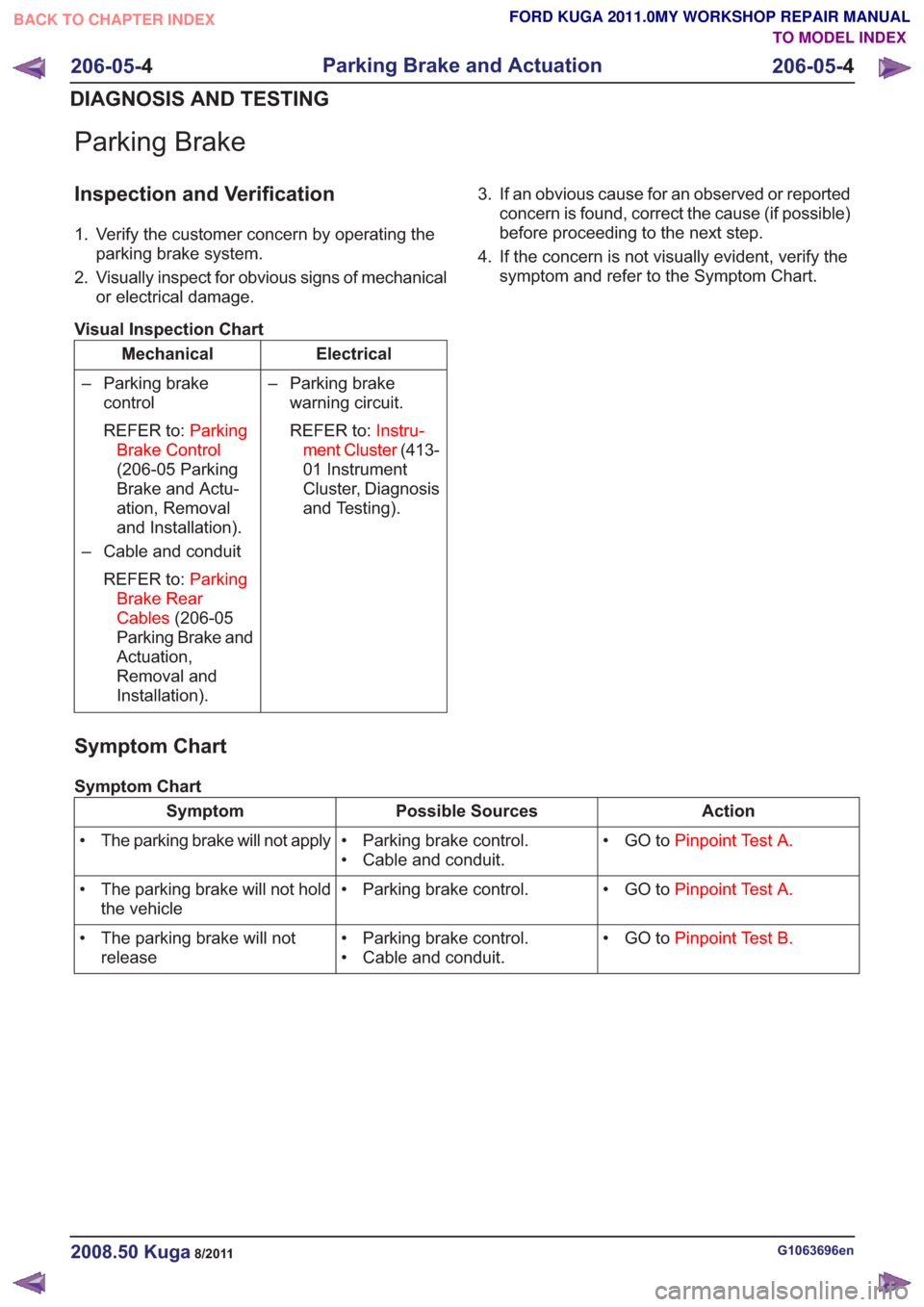
Parking Brake
Inspection and Verification
1. Verify the customer concern by operating theparking brake system.
2. Visually inspect for obvious signs of mechanical or electrical damage.
Visual Inspection Chart
Electrical
Mechanical
– Parking brakewarning circuit.
REFER to: Instru-
ment Cluster (413-
01 Instrument
Cluster, Diagnosis
and Testing).
– Parking brake
control
REFER to: Parking
Brake Control
(206-05 Parking
Brake and Actu-
ation, Removal
and Installation).
– Cable and conduit
REFER to: Parking
Brake Rear
Cables (206-05
Parking Brake and
Actuation,
Removal and
Installation). 3. If an obvious cause for an observed or reported
concern is found, correct the cause (if possible)
before proceeding to the next step.
4. If the concern is not visually evident, verify the symptom and refer to the Symptom Chart.
Symptom Chart
Symptom Chart
Action
Possible Sources
Symptom
• GO toPinpoint Test A.
• Parking brake control.
• Cable and conduit.
• The parking brake will not apply
• GO toPinpoint Test A.
• Parking brake control.
• The parking brake will not hold
the vehicle
• GO toPinpoint Test B.
• Parking brake control.
• Cable and conduit.
• The parking brake will not
release
G1063696en2008.50 Kuga8/2011
206-05- 4
Parking Brake and Actuation
206-05- 4
DIAGNOSIS AND TESTING
TO MODEL INDEX
BACK TO CHAPTER INDEX
FORD KUGA 2011.0MY WORKSHOP REPAIR MANUAL
Page 1388 of 2057
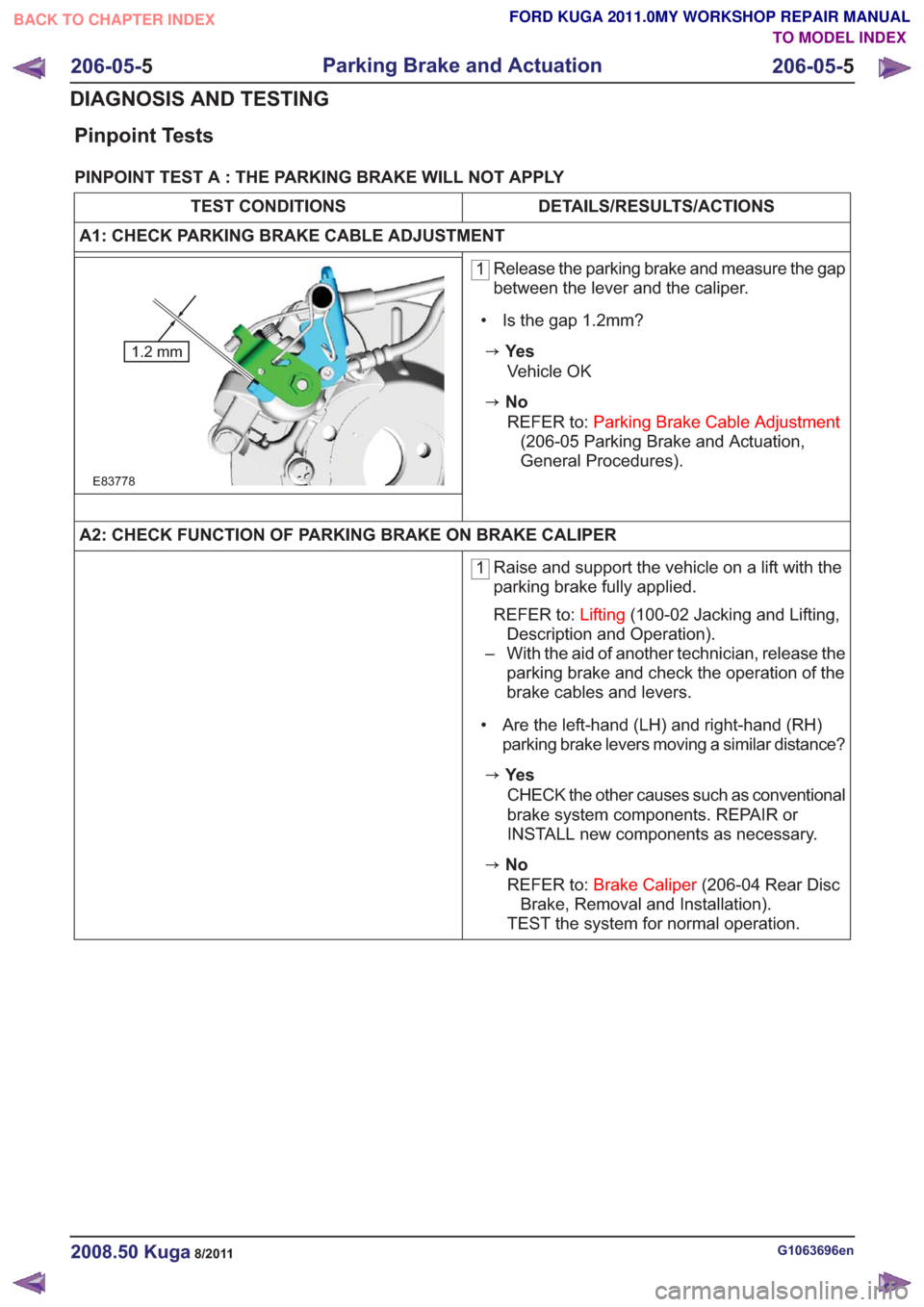
Pinpoint Tests
PINPOINT TEST A : THE PARKING BRAKE WILL NOT APPLY
DETAILS/RESULTS/ACTIONS
TEST CONDITIONS
A1: CHECK PARKING BRAKE CABLE ADJUSTMENT
1 Release the parking brake and measure the gap
between the lever and the caliper.
• Is the gap 1.2mm?
zYe s
E83778
1.2 mm
Vehicle OK
zNo REFER to: Parking Brake Cable Adjustment
(206-05 Parking Brake and Actuation,
General Procedures).
A2: CHECK FUNCTION OF PARKING BRAKE ON BRAKE CALIPER
1 Raise and support the vehicle on a lift with the
parking brake fully applied.
REFER to:
Lifting(100-02 Jacking and Lifting,
Description and Operation).
– With the aid of another technician, release the parking brake and check the operation of the
brake cables and levers.
• Are the left-hand (LH) and right-hand (RH) parking brake levers moving a similar distance?
zYe s
CHECK the other causes such as conventional
brake system components. REPAIR or
INSTALL new components as necessary.
zNoREFER to: Brake Caliper (206-04 Rear Disc
Brake, Removal and Installation).
TEST the system for normal operation.
G1063696en2008.50 Kuga8/2011
206-05- 5
Parking Brake and Actuation
206-05- 5
DIAGNOSIS AND TESTING
TO MODEL INDEX
BACK TO CHAPTER INDEX
FORD KUGA 2011.0MY WORKSHOP REPAIR MANUAL
Page 1389 of 2057
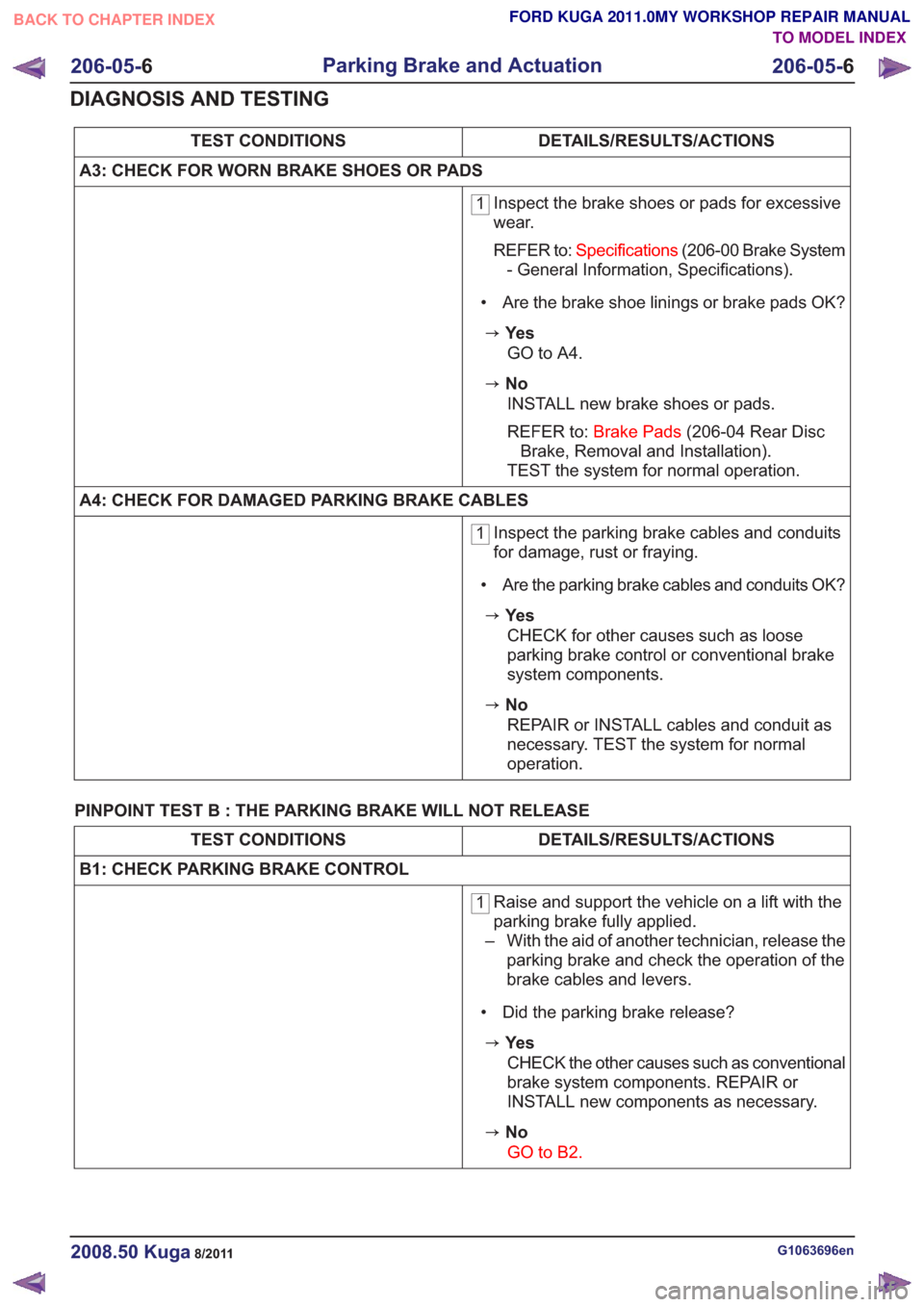
DETAILS/RESULTS/ACTIONS
TEST CONDITIONS
A3: CHECK FOR WORN BRAKE SHOES OR PADS
1 Inspect the brake shoes or pads for excessive
wear.
REFER to:
Specifications (206-00 Brake System
- General Information, Specifications).
• Are the brake shoe linings or brake pads OK?
zYe s GO to A4.
zNoINSTALL new brake shoes or pads.
REFER to: Brake Pads (206-04 Rear Disc
Brake, Removal and Installation).
TEST the system for normal operation.
A4: CHECK FOR DAMAGED PARKING BRAKE CABLES
1 Inspect the parking brake cables and conduits
for damage, rust or fraying.
• Are the parking brake cables and conduits OK?
zYe s CHECK for other causes such as loose
parking brake control or conventional brake
system components.
zNoREPAIR or INSTALL cables and conduit as
necessary. TEST the system for normal
operation.
PINPOINT TEST B : THE PARKING BRAKE WILL NOT RELEASE
DETAILS/RESULTS/ACTIONS
TEST CONDITIONS
B1: CHECK PARKING BRAKE CONTROL
1 Raise and support the vehicle on a lift with the
parking brake fully applied.
– With the aid of another technician, release the parking brake and check the operation of the
brake cables and levers.
• Did the parking brake release?
zYe s CHECK the other causes such as conventional
brake system components. REPAIR or
INSTALL new components as necessary.
zNoGO to B2.
G1063696en2008.50 Kuga8/2011
206-05- 6
Parking Brake and Actuation
206-05- 6
DIAGNOSIS AND TESTING
TO MODEL INDEX
BACK TO CHAPTER INDEX
FORD KUGA 2011.0MY WORKSHOP REPAIR MANUAL
Page 1390 of 2057
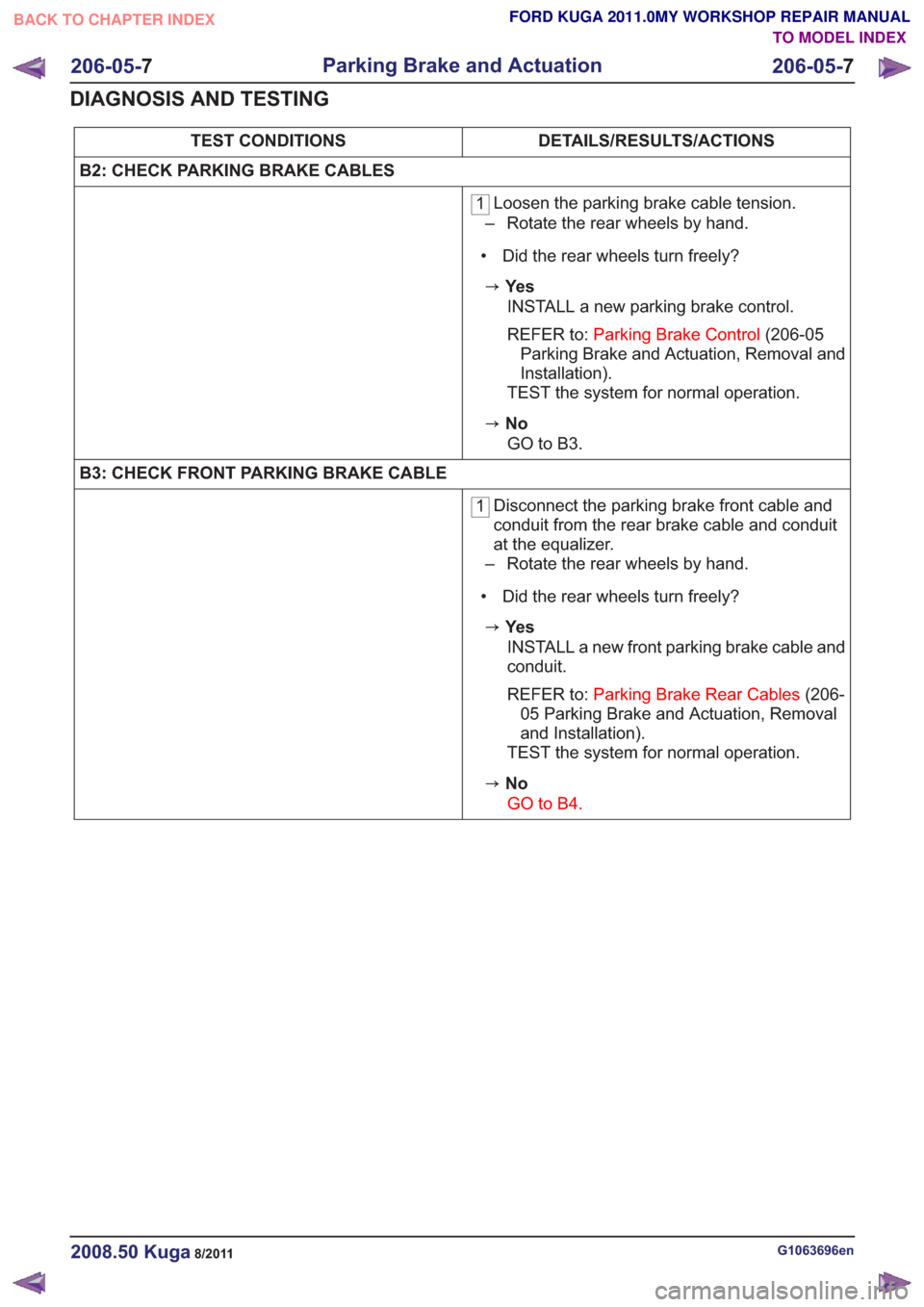
DETAILS/RESULTS/ACTIONS
TEST CONDITIONS
B2: CHECK PARKING BRAKE CABLES
1 Loosen the parking brake cable tension.
– Rotate the rear wheels by hand.
• Did the rear wheels turn freely?
zYe s INSTALL a new parking brake control.
REFER to: Parking Brake Control (206-05
Parking Brake and Actuation, Removal and
Installation).
TEST the system for normal operation.
zNo
GO to B3.
B3: CHECK FRONT PARKING BRAKE CABLE
1 Disconnect the parking brake front cable and
conduit from the rear brake cable and conduit
at the equalizer.
– Rotate the rear wheels by hand.
• Did the rear wheels turn freely?
zYe s INSTALL a new front parking brake cable and
conduit.
REFER to: Parking Brake Rear Cables (206-
05 Parking Brake and Actuation, Removal
and Installation).
TEST the system for normal operation.
zNo
GO to B4.
G1063696en2008.50 Kuga8/2011
206-05- 7
Parking Brake and Actuation
206-05- 7
DIAGNOSIS AND TESTING
TO MODEL INDEX
BACK TO CHAPTER INDEX
FORD KUGA 2011.0MY WORKSHOP REPAIR MANUAL
Page 1391 of 2057
DETAILS/RESULTS/ACTIONS
TEST CONDITIONS
B4: CHECK REAR PARKING BRAKE CABLES
1 Disconnect the parking brake at the rear brakes,
one at a time.
– Rotate the wheel affected by the disconnected parking brake.
• Did the wheel turn freely?
zYe s INSTALL a new parking brake control lever
on the rear drum brakes or caliper assembly
on rear disc brakes.
REFER to: Parking Brake Control (206-05
Parking Brake and Actuation, Removal and
Installation)
/ Brake Caliper (206-04 Rear Disc Brake,
Removal and Installation).
TEST the system for normal operation.
zNo
REFER to: Brake System (206-00 Brake
System - General Information, Diagnosis
and Testing).
G1063696en2008.50 Kuga8/2011
206-05- 8
Parking Brake and Actuation
206-05- 8
DIAGNOSIS AND TESTING
TO MODEL INDEX
BACK TO CHAPTER INDEX
FORD KUGA 2011.0MY WORKSHOP REPAIR MANUAL
Page 1392 of 2057
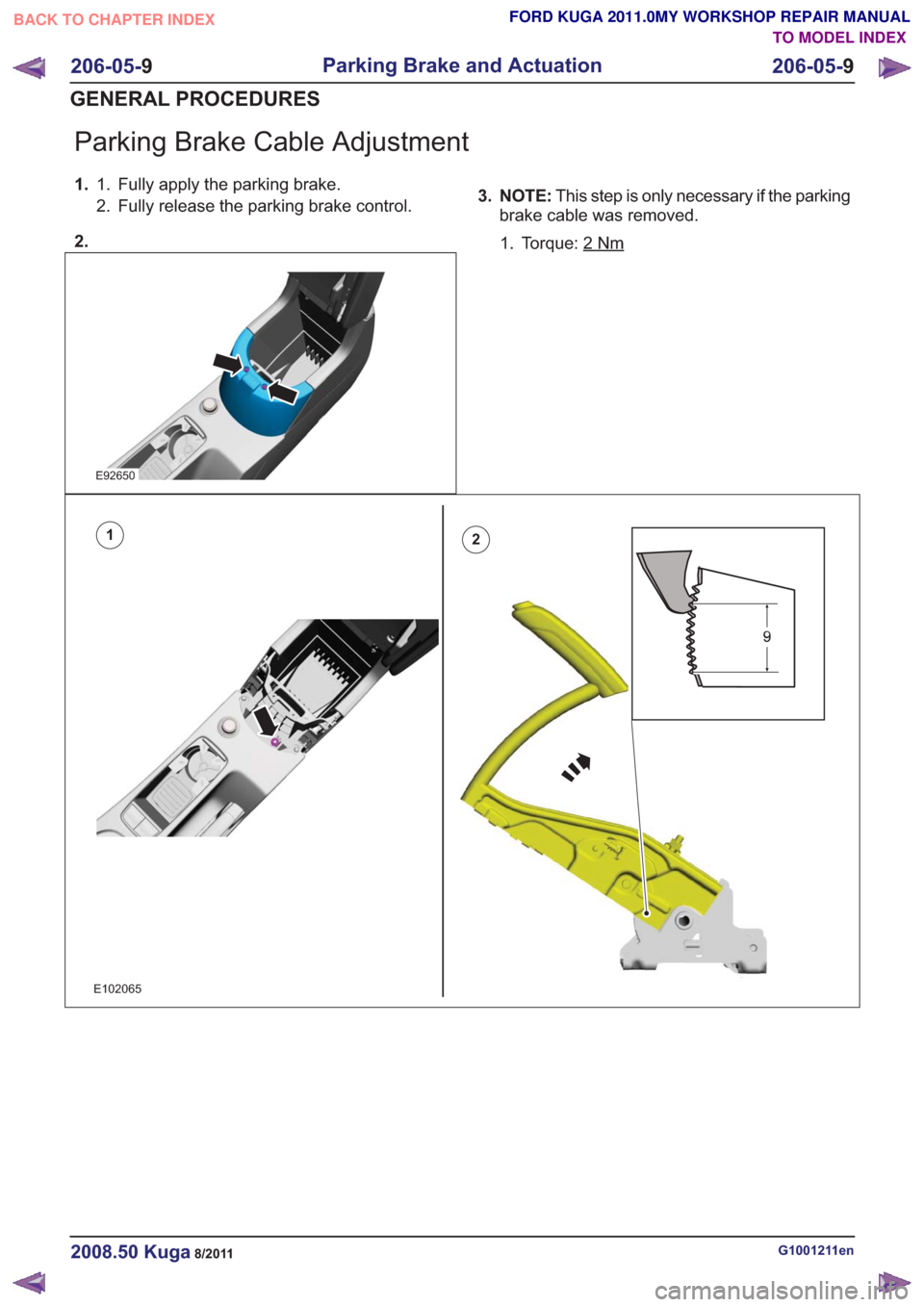
Parking Brake Cable Adjustment
1.Fully apply the parking brake.
1.
2. Fully release the parking brake control.
2.
E92650
3. NOTE: This step is only necessary if the parking
brake cable was removed.
1. Torque: 2
Nm
E102065
21
G1001211en2008.50 Kuga8/2011
206-05- 9
Parking Brake and Actuation
206-05- 9
GENERAL PROCEDURES
TO MODEL INDEX
BACK TO CHAPTER INDEX
FORD KUGA 2011.0MY WORKSHOP REPAIR MANUAL