heating FORD KUGA 2011 1.G Workshop Manual
[x] Cancel search | Manufacturer: FORD, Model Year: 2011, Model line: KUGA, Model: FORD KUGA 2011 1.GPages: 2057
Page 47 of 2057
Exhaust Fumes
These contain asphyxiating, harmful and toxic
chemicals and particles such as carbon oxides,
nitrogen oxides, aldehydes, lead and aromatic
hydrocarbons. Engines should be run only under
conditions of adequate exhaust extraction or
general ventilation and not in confined spaces.
Gasoline (petrol) engine
There may not be adequate warning of odor or of
irritation before toxic or harmful effects arise. These
may be immediate or delayed.
Diesel engine
Soot, discomfort and irritation usually give
adequate warning of hazardous fume
concentrations.
Fibre Insulation
See alsoDusts.
Used in noise and sound insulation.
The fibrous nature of surfaces and cut edges can
cause skin irritation. This is usually a physical and
not a chemical effect.
Precautions should be taken to avoid excessive
skin contact through careful organization of work
practices and the use of gloves.
Fire
See also Welding,Foams,Legal Aspects.
Many of the materials found on or associated with
the repair of vehicles are highly flammable. Some
give off toxic or harmful fumes if burnt.
Observe strict fire safety when storing and handling
flammable materials or solvents, particularly near
electrical equipment or welding processes.
Make sure, before using electrical or welding
equipment, that there is no fire hazard present.
Have a suitable fire extinguisher available when
using welding or heating equipment.
First Aid
Apart from meeting any legal requirements it is
desirable for someone in the workshop to be
trained in First Aid procedures.
Splashes in the eye should be flushed carefully
with clean water for at least ten minutes.
Soiled skin should be washed with soap and water.
In case of cold burns, from alternative fuels, place
affected area in cool to cold water.
Individuals affected by inhalation of gases and
fumes should be removed to fresh air immediately.
If effects persist, consult a doctor.
If liquids are swallowed inadvertently, consult a
doctor giving him the information on the container
or label. Do not induce vomiting unless this action
is indicated on the label.
Fluoroelastomer
See Viton.
Foams - Polyurethane
See also Fire.
Used in sound and noise insulation. Cured foams
used in seat and trim cushioning.
Follow manufacturers instructions.
Unreacted components are irritating and may be
harmful to the skin and eyes. Wear gloves and
goggles.
Individuals with chronic respiratory diseases,
asthma, bronchial medical problems, or histories
of allergic diseases should not work in or near
uncured materials.
The components, vapors or spray mists can cause
direct irritation, sensitivity reactions and may be
toxic or harmful.
Vapors and spray mists must not be inhaled. These
materials must be applied with adequate ventilation
and respiratory protection. Do not remove the
respirator immediately after spraying; wait until the
vapors/mists have cleared.
Burning of the uncured components and the cured
foams can generate toxic and harmful fumes.
Smoking, naked flames or the use of electrical
equipment during foaming operations and until
vapors/mists have cleared should not be allowed.
Any heat cutting of cured foams or partially cured
G566527en2008.50 Kuga8/2011
100-00- 46
General Information
100-00- 46
DESCRIPTION AND OPERATION
TO MODEL INDEX
BACK TO CHAPTER INDEX
FORD KUGA 2011.0MY WORKSHOP REPAIR MANUAL
Page 50 of 2057
foams should be conducted with extraction
ventilation. See also the vehicle Body Repair
Manual.
Freon
SeeAir Conditioning Refrigerant.
Fuels
See also, Fire, Legal Aspects, Chemicalsand
Solvents.
Avoid skin contact with fuel where possible. Should
contact occur, wash the affected skin with soap
and water.
Gasoline (Petrol)
Highly flammable - observe No Smoking policy.
For additional information, refer to: Petrol and
Petrol-Ethanol Fuel Systems Health and Safety
Precautions (100-00 General Information,
Description and Operation).
Gas-oil (Diesel Fuel)
Kerosene (Paraffin)
Used also as heating fuel, solvent and cleaning
agent.
Flammable - observe No Smoking policy.
Irritation of the mouth and throat may result from
swallowing. The main hazard from swallowing
arises if liquid aspiration into the lungs occurs.
Liquid contact dries the skin and can cause
irritation or dermatitis. Splashes in the eye may be
slightly irritating.
In normal circumstances the low volatility does not
give rise to harmful vapors. Exposure to mists and
vapors from kerosene at elevated temperature
should be avoided (mists may arise in dewaxing).
Avoid skin and eye contact and make sure there
is adequate ventilation.
Gas Cylinders
See also Fire. Gases such as oxygen, acetylene, argon and
propane are normally stored in cylinders at
pressures of up to 138 bar (2000 psi) and great
care should be taken in handling these cylinders
to avoid mechanical damage to them or to the valve
gear attached. The contents of each cylinder
should be clearly identified by appropriate
markings.
Cylinders should be stored in well-ventilated
enclosures, and protected from ice and snow, or
direct sunlight. Fuel gases, for example acetylene
and propane, should not be stored in close
proximity to oxygen cylinders.
Care should be exercised to prevent leaks from
gas cylinders and lines, and to avoid sources of
ignition.
Only trained personnel should undertake work
involving gas cylinders.
Gases
See
Gas Cylinders.
Gaskets (Fluoroelastomer)
SeeViton.
General Workshop Tools and
Equipment
It is essential that all tools and equipment are
maintained in good condition and that the correct
safety equipment is used where required.
Never use tools or equipment for any purpose other
than that for which they were designed. Never
overload equipment such as hoists, jacks, axle and
chassis stands or lifting slings. Damage caused by
overloading is not always immediately apparent
and may result in a fatal failure the next time that
the equipment is used.
Do not use damaged or defective tools or
equipment, particularly high-speed equipment such
as grinding wheels. A damaged grinding wheel can
disintegrate without warning and cause serious
injury.
Wear suitable eye protection when using grinding,
chiseling or sand blasting equipment.
Wear a suitable breathing mask when using
abrasive blasting equipment, working with
asbestos-based materials or using spraying
equipment.
G566527en2008.50 Kuga8/2011
100-00- 47
General Information
100-00- 47
DESCRIPTION AND OPERATION
TO MODEL INDEX
BACK TO CHAPTER INDEX
FORD KUGA 2011.0MY WORKSHOP REPAIR MANUAL
Page 62 of 2057
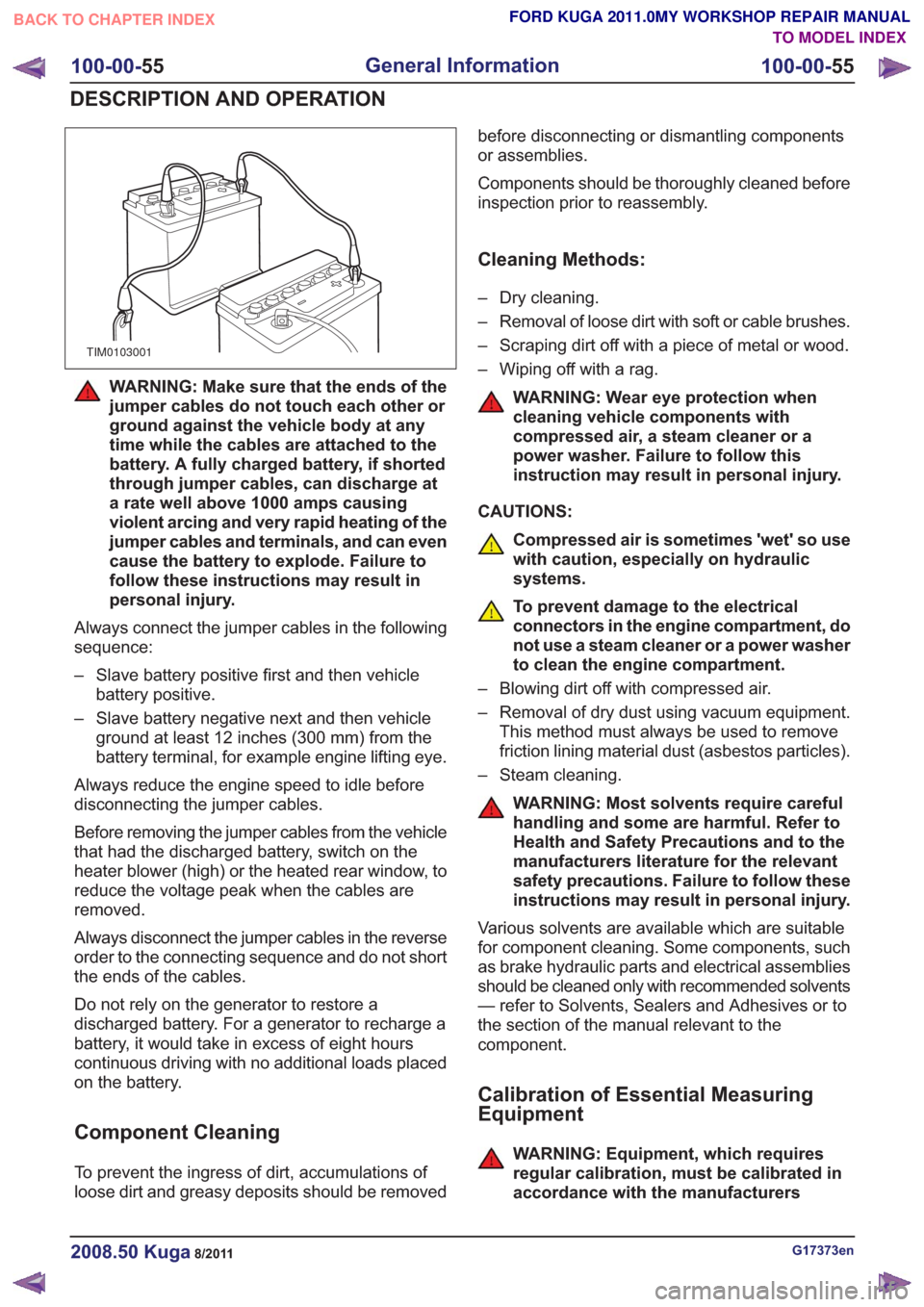
TIM0103001
WARNING: Make sure that the ends of the
jumper cables do not touch each other or
ground against the vehicle body at any
time while the cables are attached to the
battery. A fully charged battery, if shorted
through jumper cables, can discharge at
a rate well above 1000 amps causing
violent arcing and very rapid heating of the
jumper cables and terminals, and can even
cause the battery to explode. Failure to
follow these instructions may result in
personal injury.
Always connect the jumper cables in the following
sequence:
– Slave battery positive first and then vehicle battery positive.
– Slave battery negative next and then vehicle ground at least 12 inches (300 mm) from the
battery terminal, for example engine lifting eye.
Always reduce the engine speed to idle before
disconnecting the jumper cables.
Before removing the jumper cables from the vehicle
that had the discharged battery, switch on the
heater blower (high) or the heated rear window, to
reduce the voltage peak when the cables are
removed.
Always disconnect the jumper cables in the reverse
order to the connecting sequence and do not short
the ends of the cables.
Do not rely on the generator to restore a
discharged battery. For a generator to recharge a
battery, it would take in excess of eight hours
continuous driving with no additional loads placed
on the battery.
Component Cleaning
To prevent the ingress of dirt, accumulations of
loose dirt and greasy deposits should be removed before disconnecting or dismantling components
or assemblies.
Components should be thoroughly cleaned before
inspection prior to reassembly.
Cleaning Methods:
– Dry cleaning.
– Removal of loose dirt with soft or cable brushes.
– Scraping dirt off with a piece of metal or wood.
– Wiping off with a rag.
WARNING: Wear eye protection when
cleaning vehicle components with
compressed air, a steam cleaner or a
power washer. Failure to follow this
instruction may result in personal injury.
CAUTIONS:
Compressed air is sometimes 'wet' so use
with caution, especially on hydraulic
systems.
To prevent damage to the electrical
connectors in the engine compartment, do
not use a steam cleaner or a power washer
to clean the engine compartment.
– Blowing dirt off with compressed air.
– Removal of dry dust using vacuum equipment. This method must always be used to remove
friction lining material dust (asbestos particles).
– Steam cleaning.
WARNING: Most solvents require careful
handling and some are harmful. Refer to
Health and Safety Precautions and to the
manufacturers literature for the relevant
safety precautions. Failure to follow these
instructions may result in personal injury.
Various solvents are available which are suitable
for component cleaning. Some components, such
as brake hydraulic parts and electrical assemblies
should be cleaned only with recommended solvents
— refer to Solvents, Sealers and Adhesives or to
the section of the manual relevant to the
component.
Calibration of Essential Measuring
Equipment
WARNING: Equipment, which requires
regular calibration, must be calibrated in
accordance with the manufacturers
G17373en2008.50 Kuga8/2011
100-00- 55
General Information
100-00- 55
DESCRIPTION AND OPERATION
TO MODEL INDEX
BACK TO CHAPTER INDEX
FORD KUGA 2011.0MY WORKSHOP REPAIR MANUAL
Page 64 of 2057
– that the speedometer, coolant temperaturegauge and tachometer (if equipped) register the
correct readings and operate correctly.
– that the switches and controls operate smoothly and positively, warning and indicator lamps
operate correctly and the direction indicator
control self cancels when the steering is
returned to the straight ahead position.
– that the heating and ventilation systems operate correctly and effectively.
– the brake operation and efficiency.
Brake Testing
WARNING: When brake testing, avoid
breathing the fumes from hot brakes, this
may contain asbestos dust which is
hazardous to health. Failure to follow this
instruction may result in personal injury.
For additional information, refer to: Health
and Safety Precautions (100-00 General
Information, Description and Operation).
CAUTIONS:
Avoid brake testing on busy roads where
it may cause inconvenience or danger to
other road users.
Brake testing which includes heavy brake
applications should not be carried out with
new brake pads/discs or linings/drums
until the components have bedded-in. New
brake friction components will not reach
full efficiency until the bedding-in process
is complete.
Test the brakes at several speeds within the normal
operating range using both light and heavy pedal
pressure. Note any tendency to snatch, pull or
drag, and any undue delay in application or
release.
Allow the vehicle to coast and note any tendency
to pull to one side, or evidence that the brakes are
binding.
After stopping the vehicle (not immediately after a
period of heavy braking), carefully check the brake
temperature. A brake disc or brake drum that feels
hot or is appreciably hotter than the others,
indicates that the brake is binding.
After completion of the test, check for: – oil, coolant, hydraulic, air and fuel leaks.
– abnormal temperature of any moving
components or assemblies, for example wheel
hubs, transmission and axle, which might
indicate over tightness or lack of lubrication.
G17375en2008.50 Kuga8/2011
100-00- 59
General Information
100-00- 59
DESCRIPTION AND OPERATION
TO MODEL INDEX
BACK TO CHAPTER INDEX
FORD KUGA 2011.0MY WORKSHOP REPAIR MANUAL
Page 72 of 2057
Body Repair Health and Safety and General Precautions
General
Appropriate repair methods and carrying out repair
and paint jobs correctly is particularly important to
the operating safety of vehicles and the safety of
people.
WARNING: There is danger of injury
through:
• High voltage when electrical welding. – Do not perform welding work in a dampenvironment or on a wet substrate. Use
suitable insulation underneath.
• Welding spatter and UV radiation. – Wear protective clothing, gloves and weldingmask or welding goggles.
• Fire, explosion and hot surfaces in the work area.
– Always have a suitable fire extinguisheravailable when using welding or heating
equipment.
– Remove flammable substances from the danger area. Remove the fuel tank and fuel
pipes and hoses.
– Welding and grinding near the battery presents the danger of explosion. Remove
the battery before you start working.
– During paint work there is an increased danger of fire or explosion. Prevent any
sparks being created. Fire, open light and
smoking are forbidden.
– Always ventilate the workplace well and use an extraction system.
– Wear protective footwear made from anti-static material.
– Only use tools made of wood, brass or copper to clean stands and extraction ducts.
Do not use tools made of steel.
– Only fill or decant paint materials in a specially marked area. • Inhalation and/or absorption through the skin of
harmful substances.
– Welding fumes grinding dusts and solventvapours can be extremely harmful to the
health.
– Sealants, underbody protection and paint residues must not be burnt down with an
unshielded flame, as this will produce harmful
substances.
– Always ventilate the workplace well and use an extraction system.
– Wear protective clothing.
• Pyrotechnic components. – Disconnect the battery negative clamp andcover the battery terminal.
– Remove any airbag components.
• Noise – Cutting, grinding and alignment work cancause a noise level over 85 dB (A).
– Always wear ear protection.
• High Forces. – The various body areas are subject to veryhigh forces during realignment work. Should
any component suddenly become detached
during this process, there is a very great
danger of injury.
– Pulling chains and pulling shackles must be secured with arrester cables.
As well as these general instructions on the
dangers in body and paint shops, you must
observe:
• All valid local national and international regulations governing Health and Safety at Work
• Safety instructions of material equipment and tool manufacturers
For additional information, refer to: (100-00 General
Information) Solvents, Sealants and Adhesives (Description
and Operation),
Air Conditioning (A/C) System Health and Safety Precautions (Description and Operation),
Supplemental Restraint System (SRS) Health and Safety Precautions (Description and
Operation).
G963390en2008.50 Kuga8/2011
100-00- 67
General Information
100-00- 67
DESCRIPTION AND OPERATION
TO MODEL INDEX
BACK TO CHAPTER INDEX
FORD KUGA 2011.0MY WORKSHOP REPAIR MANUAL
Page 85 of 2057
Before conducting a vehicle test to identify a NVH
concern carry out the following checks.
1. Check the tire pressures and adjust tospecification, as necessary.
2. Make sure the steering system fluid is correct, the system is free of leaks and is operating
correctly.
3. Make sure the vehicle steering system temperature is the same as described at the
customer interview.
4. All evaluations must take place in a relatively quiet location.
5. The heating - air conditioning (A/C) fan and radio must be turned off during evaluations and
the windows closed.Symptom Chart
Power Steering Moan Noise
Test Condition
Listen for steering moan noise with the vehicle
parked, transmission in neutral and all windows
closed in the following test conditions.
1. Engine speed at idle with no steering action.
2. Engine speed at idle with slow 90 degrees persecond turning of the steering wheel.
3. Engine speed at 1250 +/- 50 rpm with no steering action.
4. Engine speed at 1250 +/- 50 rpm with slow 90 degrees per second turning of the steering
wheel.
Action
Possible Sources
Symptom
• CHECK the routing of thepower steering lines.
• CHECK the power steering line clamps are secure.
• CHECK the power steering lines for clearance from the
vehicle body, front axle cross-
member and steering gear.
Power steering lines.
Power steering system moan
noise – A continuous low pitched
humming noise occurs when the
steering wheel is turned and the
steering system is loaded. Noise
frequency changes with engine
rpm changes. Particularly
annoying at lower engine speed. FLUSH the power steering
system.
REFER to:
Power Steering
System Flushing (211-00
Steering System - General
Information, General Proced-
ures).
Incorrect power steering fluid.
Pressure pulses from the power
steering pump. Certain amount
of noise level acceptable, not a
safety critical item.
Power steering pump.
Power Steering Whine Noise
Test Condition
Listen for steering whine noise with the vehicle
parked, transmission in neutral and all windows
closed in the following test conditions. 1. Engine speed at 1800 +/- 50 rpm with no
steering action.
2. Engine speed at 1800 +/- 50 rpm with slow 90 degrees turning of the steering wheel.
3. Engine speed at 3000 +/- 50 rpm with no steering action.
4. Engine speed at 3000 +/- 50 rpm with slow 90 degrees turning of the steering wheel.
G37349en2008.50 Kuga8/2011
100-04- 7
Noise, Vibration and Harshness
100-04- 7
DIAGNOSIS AND TESTING
TO MODEL INDEX
BACK TO CHAPTER INDEX
FORD KUGA 2011.0MY WORKSHOP REPAIR MANUAL
Page 157 of 2057

Auxiliary Climate Control – Overview
Initial start-up of the fuel-fired booster
heater
The fuel-fired booster heater needs to be filled
before being taken into operation for the first time.
Activation of the fuel pump for the fuel-fired booster
heater is controlled by the Ford diagnostic unit.
Lockout
Flame sensor
If the flame goes out independently during
operation of the booster heater, a restart is carried
out. If the booster heater does not ignite within 90
seconds of fuel delivery or if the flame goes out
within 15 minutes of starting, a lockout will be
implemented by the flame sensor.
Lockout can be cancelled by switching the booster
heater off then on again, although this may only
be repeated at most 2 times.
Overheating sensor
In the event of overheating (water shortage, poorly
ventilated coolant circuit), the fuel supply to the
booster heater is interrupted and a lockout occurs.
After the cause of the overheating has been
eliminated, the booster heater can be started again
by switching it off and on, if the coolant temperature
is below 70°C. If the booster heater overheats ten
times in a row, the control unit will be locked.
Unlocking the control unit
Delete the fault memory of the fuel-fired booster
heater after eliminating the cause of the fault using
the Ford diagnostic unit.
G1066980en
2008.50 Kuga 8/2011 412-02-4
Auxiliary Climate Control
412-02-4
DESCRIPTION AND OPERATIONTO MODEL INDEX
BACK TO CHAPTER INDEX
FORD KUGA 2011.0MY WORKSHOP REPAIR MANUAL
Page 165 of 2057
System Operation
Electric Booster Heater
In diesel vehicles which give off little residual heat,
a booster heater is used to heat the passenger
compartment rapidly in the case of low ambient
temperatures.
If the interior temperature has been set to HI, or if
the heater controls have been switched to the
highest setting, the two-zone air conditioning
system sends an "electric booster heater ON"
request signal to the CAN (controller area network)
via the medium speed GEM bus. If a manual air
conditioning system is installed, the signal is
transmitted via a conventional cable connection.
The GEM switches on the electric booster heater
depending on the following parameters:
• Engine coolant temperature is below 60 °C.
• Ambient air temperature is below 10 °C.
• Sufficient generator capacity is available.
The electric booster heater electronics activate
three output stages as a function of a pulse width
modulated signal PWM (pulse width modulation)
generated by the GEM. The output stages switch
the three heating elements of the electric booster
heater ON or OFF individually, whereby the heating
periods of the individual elements can overlap. Due
to the variable switch-on duration, continuously
variable temperature control is possible. The overall
heating power of the three heating elements is
linearly proportional to the PWM signal. If the PWM
signal is below 10% or above 95%, the electric
booster heater is not activated.
The electric booster heater is switched off when
an engine coolant temperature of 70°C or an
ambient air temperature of 20°C is exceeded.
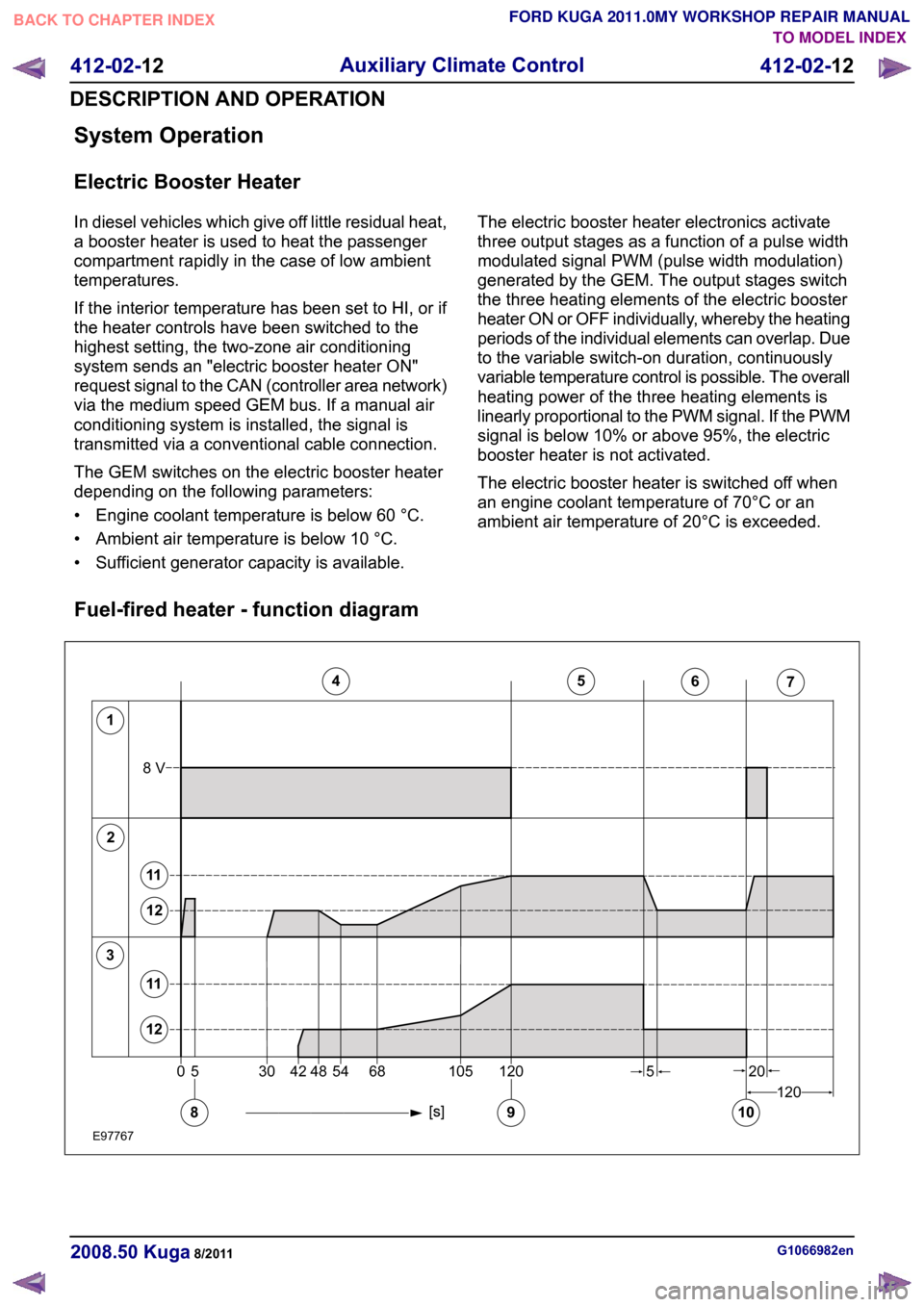
Fuel-fired heater - function diagram G1066982en
2008.50 Kuga 8/2011 412-02-12
Auxiliary Climate Control
412-02-12
DESCRIPTION AND OPERATIONTO MODEL INDEX
BACK TO CHAPTER INDEX
FORD KUGA 2011.0MY WORKSHOP REPAIR MANUAL12345671205304254481201056820108V58911121112E977670
Page 167 of 2057
reprogrammed. However, if the engine hasn't been
run since the last programmed start, the fuel-fired
booster heater will not start up the second time so
as to prevent the battery from being discharged.
The length of time required to pre-heat the vehicle
is calculated in the control unit of the fuel-fired
booster heater and is based on two temperature
values:
• Ambient air temperature: this message is taken
from the GEM via the CAN bus.
• Coolant temperature: this is determined via an internal sensor in the fuel-fired booster heater.
The maximum heating time is 30 minutes at an
outside air temperature of -10 °C or lower. The
heating time decreases proportionally with
increasing ambient temperature until the ambient
temperature is between +15 °C and +20 °C. Then
the minimum heating time is 10 minutes. The
parking heater is deactivated at temperatures
above +20 °C.
The sequence for a programmed start of the
booster heater is as follows:
• Two minutes before the start of the maximum heating time the driver information
system/instrument cluster sends an activation
message to the fuel-fired booster heater via the
CAN bus.
• The fuel-fired booster heater calculates the required heating time and, if necessary, sends
a delay request on the CAN bus.
• At the calculated time, the fuel-fired booster heater starts up. The conditions for start-up are:
engine not running and amount of fuel in the
fuel tank is above 14% of maximum.
• When the coolant temperature reaches +30 °C, the control unit of the fuel-fired booster heater
sends a request to switch on the passenger
compartment blower.
• Eight minutes after the programmed switch-off time, the booster heater stops heating mode
and starts a run-on operation to clean the
system's spark plugs.
• Ten minutes after the switch-off time, the post-cleaning operation is complete. The
additional ten minutes run-on time provides
some leeway in case the driver is late arriving.
After a programmed start-up of the booster heater
it is switched off again after the heating time has
elapsed (or if the fuel level in the fuel tank drops
below 8%). The booster heater stops within 2 minutes of the engine starting. This leaves enough
time to check whether the switch-on conditions for
boost heat mode have been met, thus preventing
the booster heater from having to switch off and
switch back on again. The heater can be switched
off manually at any time from the menu.
Whilst the fuel-fired booster heater is in additional
heating mode and/or parking heating mode, the
instrument cluster receives a fuel consumption
signal; this is used to re-calculate the vehicle's
remaining range and fuel consumption data.
Emergency shutoff
In the event of an accident in which the airbags
are deployed, the control unit of the fuel-fired
booster heater receives a message on the CAN
bus from the restraints control module (RCM).
When this message is received, the booster heater
system switches off immediately.
The booster heater control module deactivates the
system and does not respond to further messages
on the CAN bus. The booster heater control module
needs to be activated with WDS.
Component Description
Electric Booster Heater
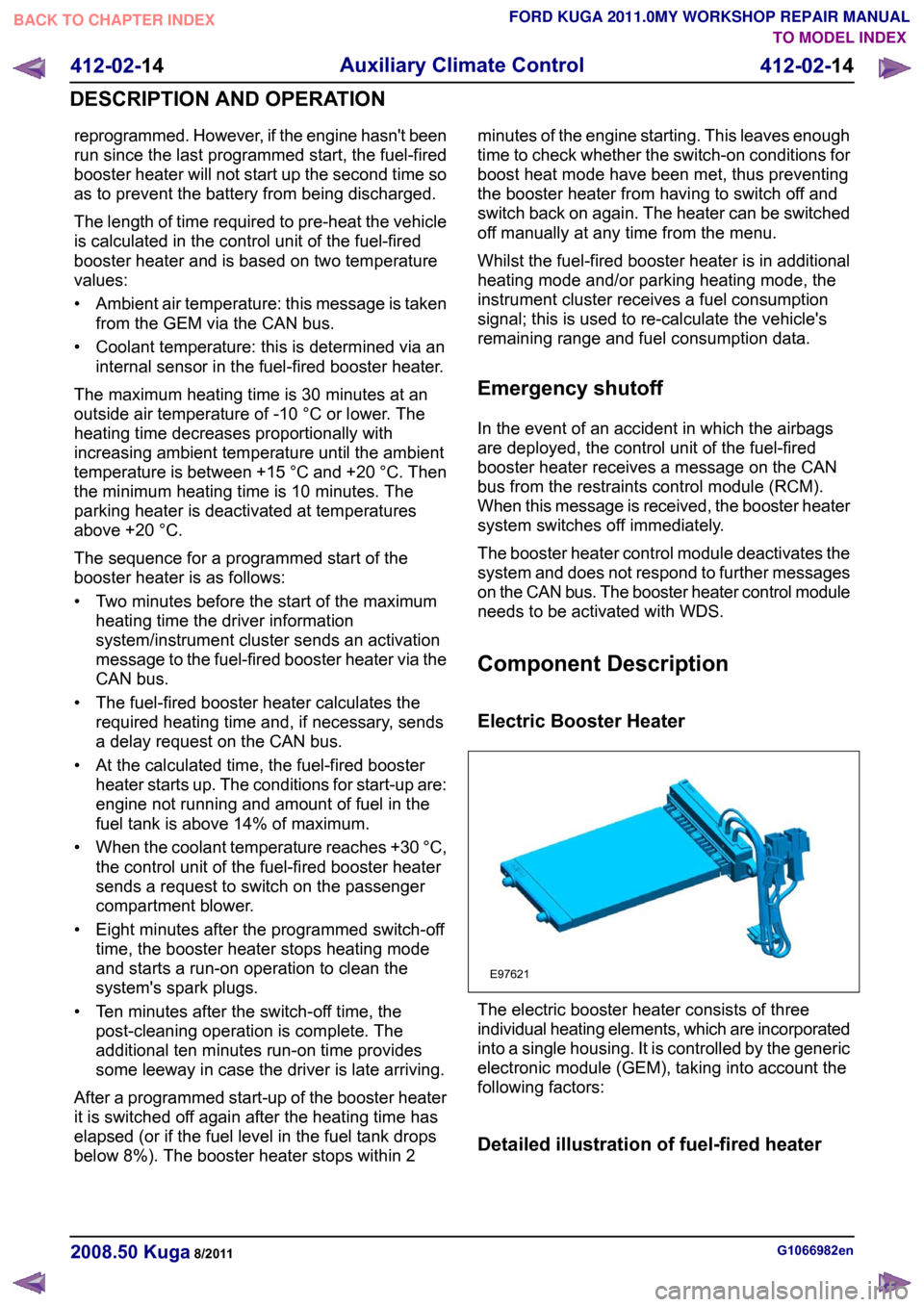
The electric booster heater consists of three
individual heating elements, which are incorporated
into a single housing. It is controlled by the generic
electronic module (GEM), taking into account the
following factors:
Detailed illustration of fuel-fired heater
G1066982en
2008.50 Kuga 8/2011 412-02-14
Auxiliary Climate Control
412-02-14
DESCRIPTION AND OPERATIONTO MODEL INDEX
BACK TO CHAPTER INDEX
FORD KUGA 2011.0MY WORKSHOP REPAIR MANUALE97621
Page 169 of 2057
Description
Item
Combustion chamber
16
'O' Ring
17 Description
Item
Combustion blower motor cover
18
Glow plug wiring harness
19
Flame sensor
If the flame goes out independently during
operation of the booster heater, a restart is carried
out. If the booster heater does not ignite within 90
seconds of fuel delivery or if the flame goes out
within 15 minutes of starting, a lockout will be
implemented by the flame sensor.
Lockout can be cancelled by switching the booster
heater off then on again, although this may only
be repeated at most 2 times.
Overheat Sensor
The overheating sensor enables the fuel-fired
booster heater module to determine the coolant
temperature, protecting the heater from
overheating. The overheating sensor is installed
next to the coolant temperature sensor under a
cover on the top of the fuel-fired heater.
In the event of overheating (lack of water, poorly
ventilated coolant circuit), the fuel supply to the
heater is interrupted and a lockout occurs. After
the cause of the overheating has been eliminated,
the heater can be restarted by switching it off and
on again, if the coolant temperature is below 70°C.
If the heater overheats ten times in a row, the
control unit is locked.
ECT
The fuel-fired booster heater module uses the
temperature sensor to determine the coolant
temperature, which it then uses to set the starting
and stopping time. The coolant temperature sensor
is installed next to the overheating sensor under a
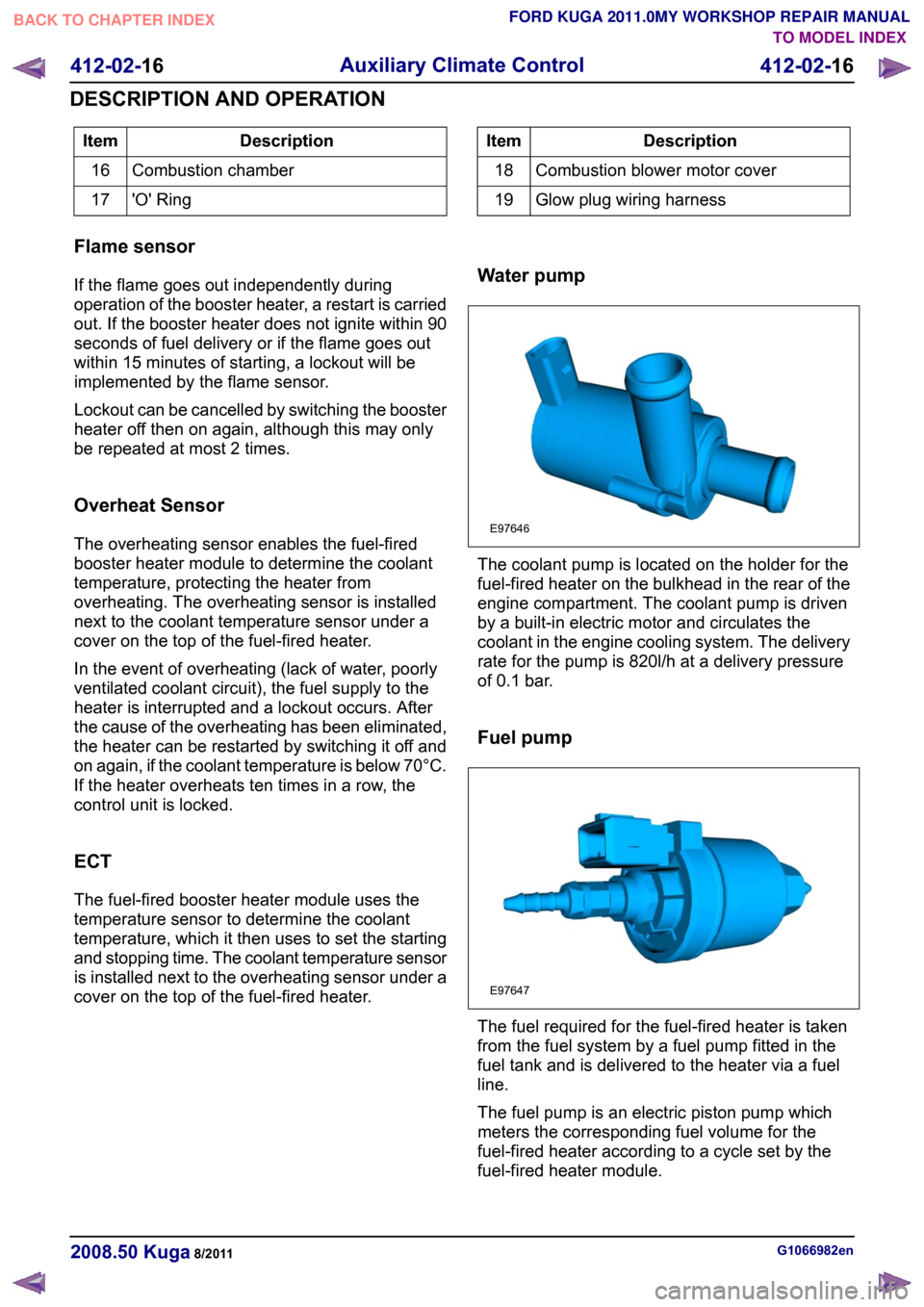
cover on the top of the fuel-fired heater. Water pump The coolant pump is located on the holder for the
fuel-fired heater on the bulkhead in the rear of the
engine compartment. The coolant pump is driven
by a built-in electric motor and circulates the
coolant in the engine cooling system. The delivery
rate for the pump is 820l/h at a delivery pressure
of 0.1 bar.
Fuel pump
The fuel required for the fuel-fired heater is taken
from the fuel system by a fuel pump fitted in the
fuel tank and is delivered to the heater via a fuel
line.
The fuel pump is an electric piston pump which
meters the corresponding fuel volume for the
fuel-fired heater according to a cycle set by the
fuel-fired heater module.
G1066982en
2008.50 Kuga 8/2011 412-02-16
Auxiliary Climate Control
412-02-16
DESCRIPTION AND OPERATIONTO MODEL INDEX
BACK TO CHAPTER INDEX
FORD KUGA 2011.0MY WORKSHOP REPAIR MANUALE97646 E97647