parking FORD KUGA 2011 1.G Workshop Manual
[x] Cancel search | Manufacturer: FORD, Model Year: 2011, Model line: KUGA, Model: FORD KUGA 2011 1.GPages: 2057
Page 36 of 2057
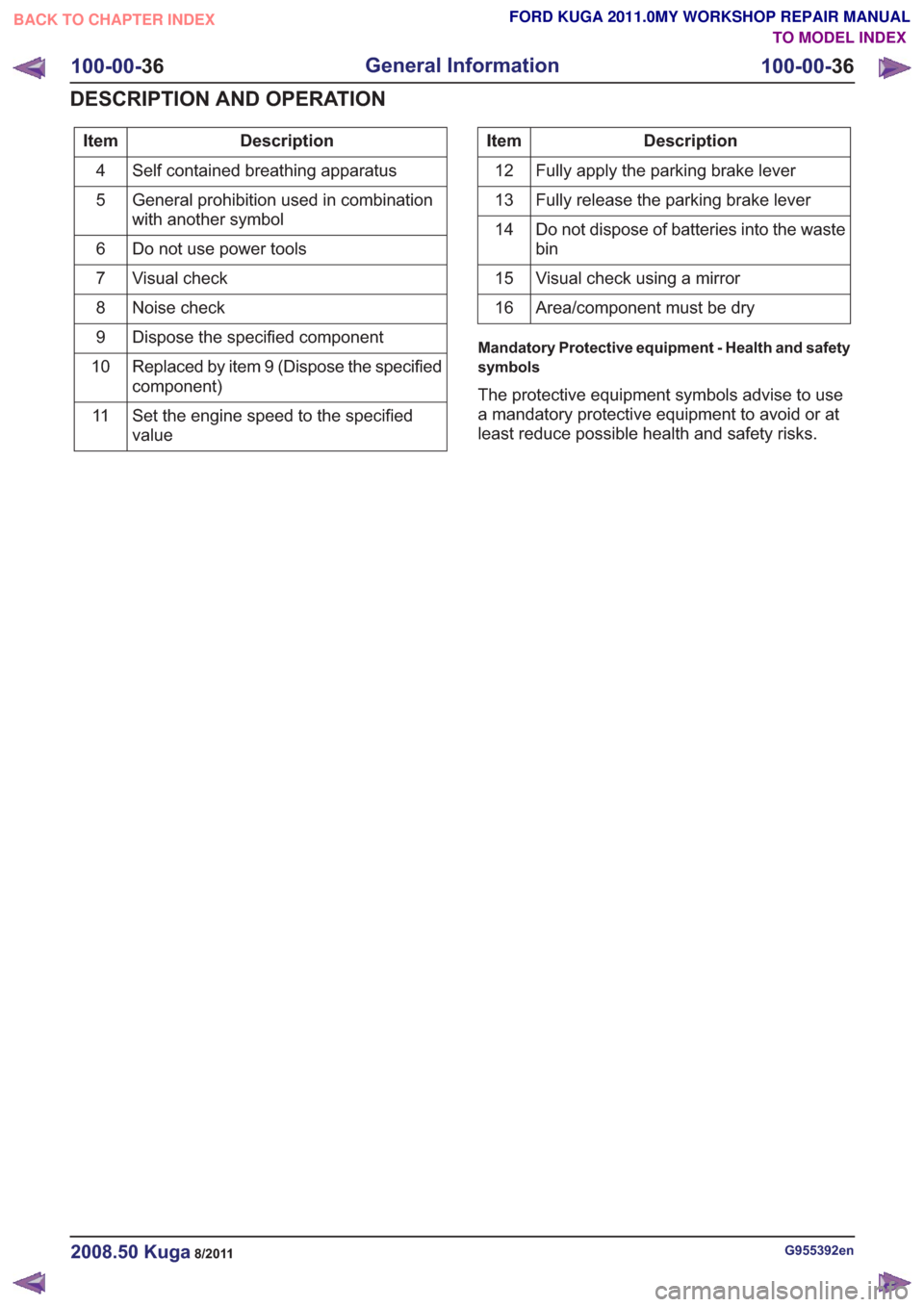
Description
Item
Self contained breathing apparatus
4
General prohibition used in combination
with another symbol
5
Do not use power tools
6
Visual check
7
Noise check
8
Dispose the specified component
9
Replaced by item 9 (Dispose the specified
component)
10
Set the engine speed to the specified
value
11Description
Item
Fully apply the parking brake lever
12
Fully release the parking brake lever
13
Do not dispose of batteries into the waste
bin
14
Visual check using a mirror
15
Area/component must be dry
16
Mandatory Protective equipment - Health and safety
symbols
The protective equipment symbols advise to use
a mandatory protective equipment to avoid or at
least reduce possible health and safety risks.
G955392en2008.50 Kuga8/2011
100-00- 36
General Information
100-00- 36
DESCRIPTION AND OPERATION
TO MODEL INDEX
BACK TO CHAPTER INDEX
FORD KUGA 2011.0MY WORKSHOP REPAIR MANUAL
Page 60 of 2057
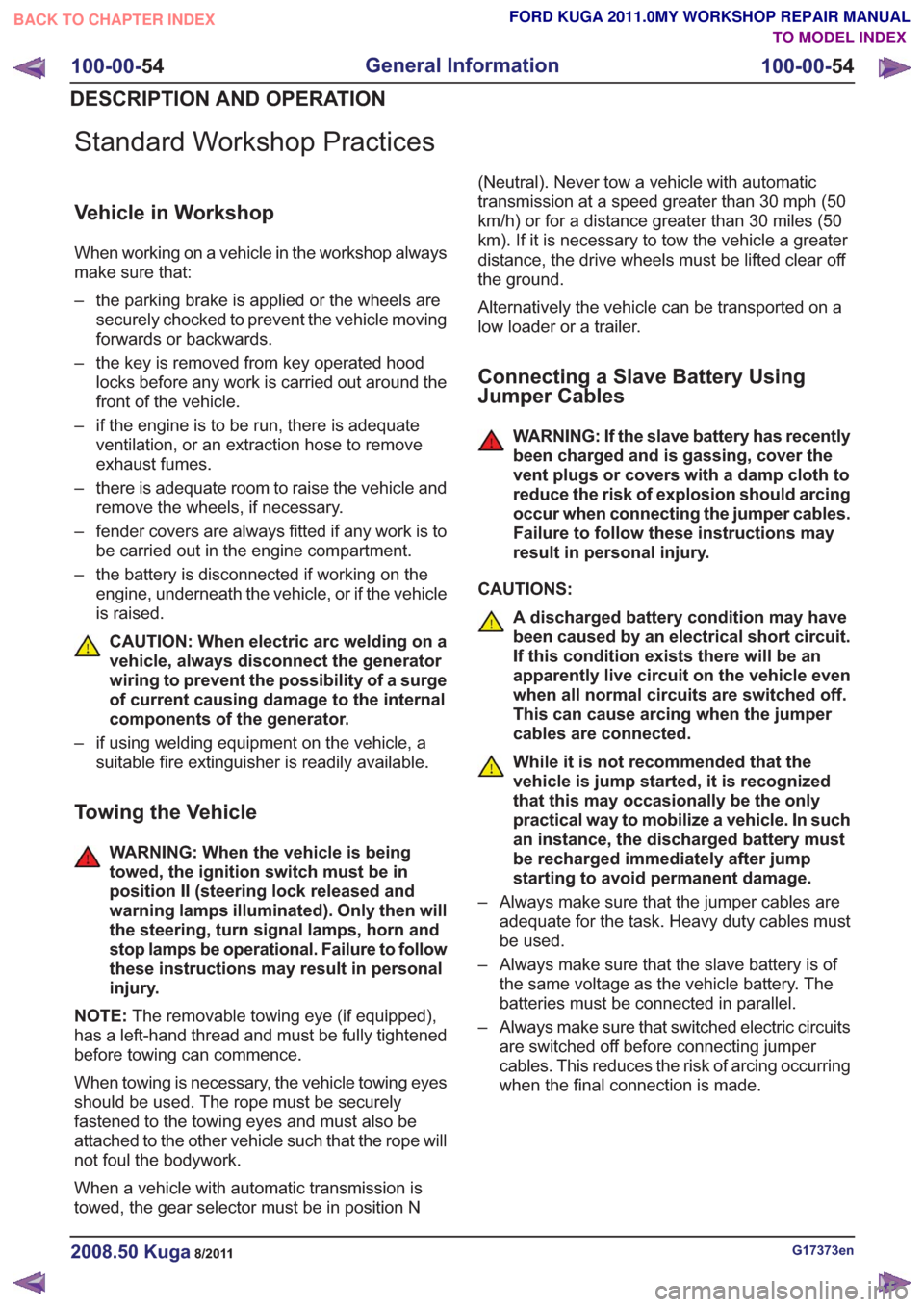
Standard Workshop Practices
Vehicle in Workshop
When working on a vehicle in the workshop always
make sure that:
– the parking brake is applied or the wheels aresecurely chocked to prevent the vehicle moving
forwards or backwards.
– the key is removed from key operated hood locks before any work is carried out around the
front of the vehicle.
– if the engine is to be run, there is adequate ventilation, or an extraction hose to remove
exhaust fumes.
– there is adequate room to raise the vehicle and remove the wheels, if necessary.
– fender covers are always fitted if any work is to be carried out in the engine compartment.
– the battery is disconnected if working on the engine, underneath the vehicle, or if the vehicle
is raised.
CAUTION: When electric arc welding on a
vehicle, always disconnect the generator
wiring to prevent the possibility of a surge
of current causing damage to the internal
components of the generator.
– if using welding equipment on the vehicle, a suitable fire extinguisher is readily available.
Towing the Vehicle
WARNING: When the vehicle is being
towed, the ignition switch must be in
position II (steering lock released and
warning lamps illuminated). Only then will
the steering, turn signal lamps, horn and
stop lamps be operational. Failure to follow
these instructions may result in personal
injury.
NOTE: The removable towing eye (if equipped),
has a left-hand thread and must be fully tightened
before towing can commence.
When towing is necessary, the vehicle towing eyes
should be used. The rope must be securely
fastened to the towing eyes and must also be
attached to the other vehicle such that the rope will
not foul the bodywork.
When a vehicle with automatic transmission is
towed, the gear selector must be in position N (Neutral). Never tow a vehicle with automatic
transmission at a speed greater than 30 mph (50
km/h) or for a distance greater than 30 miles (50
km). If it is necessary to tow the vehicle a greater
distance, the drive wheels must be lifted clear off
the ground.
Alternatively the vehicle can be transported on a
low loader or a trailer.
Connecting a Slave Battery Using
Jumper Cables
WARNING: If the slave battery has recently
been charged and is gassing, cover the
vent plugs or covers with a damp cloth to
reduce the risk of explosion should arcing
occur when connecting the jumper cables.
Failure to follow these instructions may
result in personal injury.
CAUTIONS:
A discharged battery condition may have
been caused by an electrical short circuit.
If this condition exists there will be an
apparently live circuit on the vehicle even
when all normal circuits are switched off.
This can cause arcing when the jumper
cables are connected.
While it is not recommended that the
vehicle is jump started, it is recognized
that this may occasionally be the only
practical way to mobilize a vehicle. In such
an instance, the discharged battery must
be recharged immediately after jump
starting to avoid permanent damage.
– Always make sure that the jumper cables are adequate for the task. Heavy duty cables must
be used.
– Always make sure that the slave battery is of the same voltage as the vehicle battery. The
batteries must be connected in parallel.
– Always make sure that switched electric circuits are switched off before connecting jumper
cables. This reduces the risk of arcing occurring
when the final connection is made.
G17373en2008.50 Kuga8/2011
100-00- 54
General Information
100-00- 54
DESCRIPTION AND OPERATION
TO MODEL INDEX
BACK TO CHAPTER INDEX
FORD KUGA 2011.0MY WORKSHOP REPAIR MANUAL
Page 63 of 2057
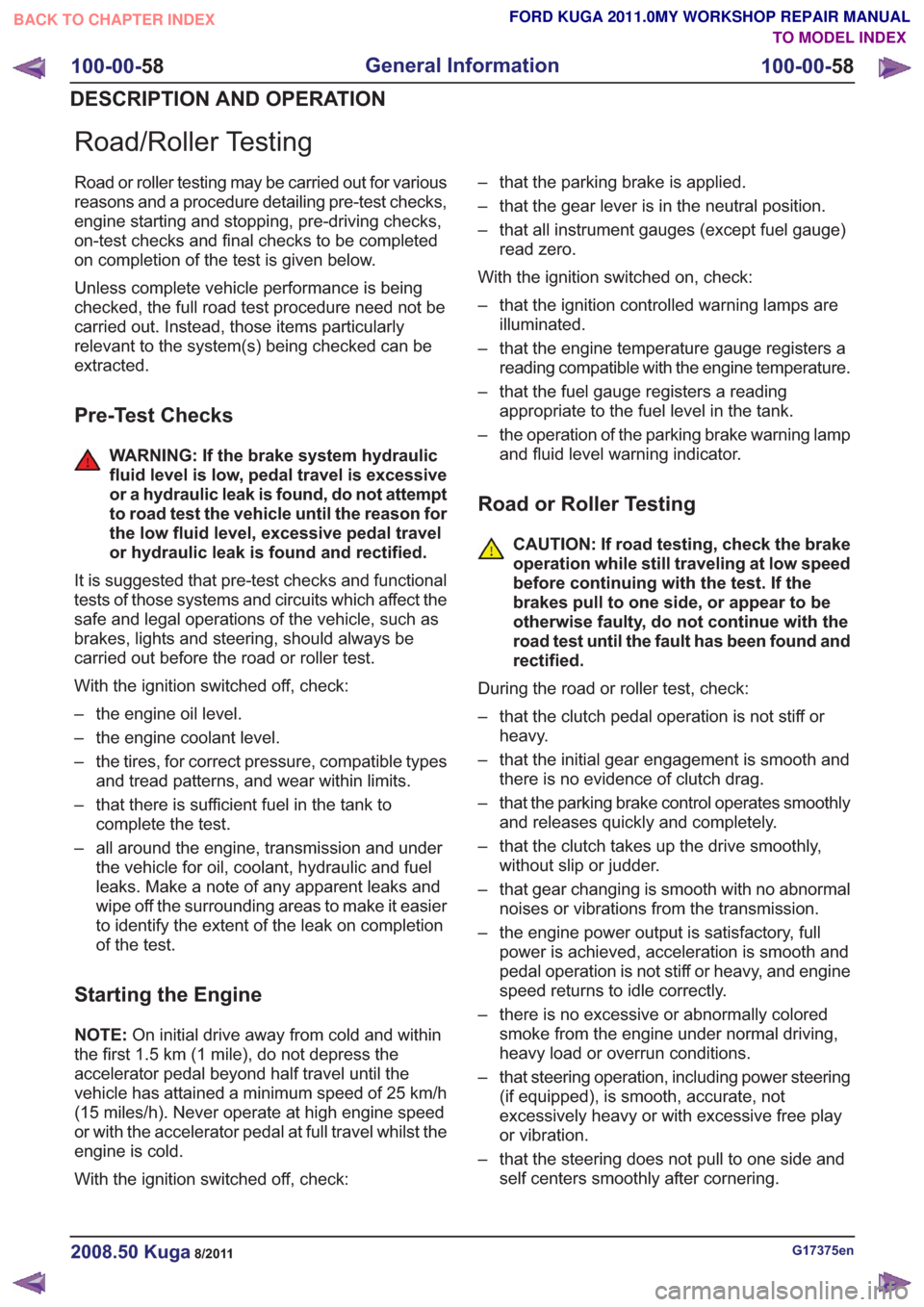
Road/Roller Testing
Road or roller testing may be carried out for various
reasons and a procedure detailing pre-test checks,
engine starting and stopping, pre-driving checks,
on-test checks and final checks to be completed
on completion of the test is given below.
Unless complete vehicle performance is being
checked, the full road test procedure need not be
carried out. Instead, those items particularly
relevant to the system(s) being checked can be
extracted.
Pre-Test Checks
WARNING: If the brake system hydraulic
fluid level is low, pedal travel is excessive
or a hydraulic leak is found, do not attempt
to road test the vehicle until the reason for
the low fluid level, excessive pedal travel
or hydraulic leak is found and rectified.
It is suggested that pre-test checks and functional
tests of those systems and circuits which affect the
safe and legal operations of the vehicle, such as
brakes, lights and steering, should always be
carried out before the road or roller test.
With the ignition switched off, check:
– the engine oil level.
– the engine coolant level.
– the tires, for correct pressure, compatible types and tread patterns, and wear within limits.
– that there is sufficient fuel in the tank to complete the test.
– all around the engine, transmission and under the vehicle for oil, coolant, hydraulic and fuel
leaks. Make a note of any apparent leaks and
wipe off the surrounding areas to make it easier
to identify the extent of the leak on completion
of the test.
Starting the Engine
NOTE: On initial drive away from cold and within
the first 1.5 km (1 mile), do not depress the
accelerator pedal beyond half travel until the
vehicle has attained a minimum speed of 25 km/h
(15 miles/h). Never operate at high engine speed
or with the accelerator pedal at full travel whilst the
engine is cold.
With the ignition switched off, check: – that the parking brake is applied.
– that the gear lever is in the neutral position.
– that all instrument gauges (except fuel gauge)
read zero.
With the ignition switched on, check:
– that the ignition controlled warning lamps are illuminated.
– that the engine temperature gauge registers a reading compatible with the engine temperature.
– that the fuel gauge registers a reading appropriate to the fuel level in the tank.
– the operation of the parking brake warning lamp and fluid level warning indicator.
Road or Roller Testing
CAUTION: If road testing, check the brake
operation while still traveling at low speed
before continuing with the test. If the
brakes pull to one side, or appear to be
otherwise faulty, do not continue with the
road test until the fault has been found and
rectified.
During the road or roller test, check:
– that the clutch pedal operation is not stiff or heavy.
– that the initial gear engagement is smooth and there is no evidence of clutch drag.
– that the parking brake control operates smoothly and releases quickly and completely.
– that the clutch takes up the drive smoothly, without slip or judder.
– that gear changing is smooth with no abnormal noises or vibrations from the transmission.
– the engine power output is satisfactory, full power is achieved, acceleration is smooth and
pedal operation is not stiff or heavy, and engine
speed returns to idle correctly.
– there is no excessive or abnormally colored smoke from the engine under normal driving,
heavy load or overrun conditions.
– that steering operation, including power steering (if equipped), is smooth, accurate, not
excessively heavy or with excessive free play
or vibration.
– that the steering does not pull to one side and self centers smoothly after cornering.
G17375en2008.50 Kuga8/2011
100-00- 58
General Information
100-00- 58
DESCRIPTION AND OPERATION
TO MODEL INDEX
BACK TO CHAPTER INDEX
FORD KUGA 2011.0MY WORKSHOP REPAIR MANUAL
Page 83 of 2057
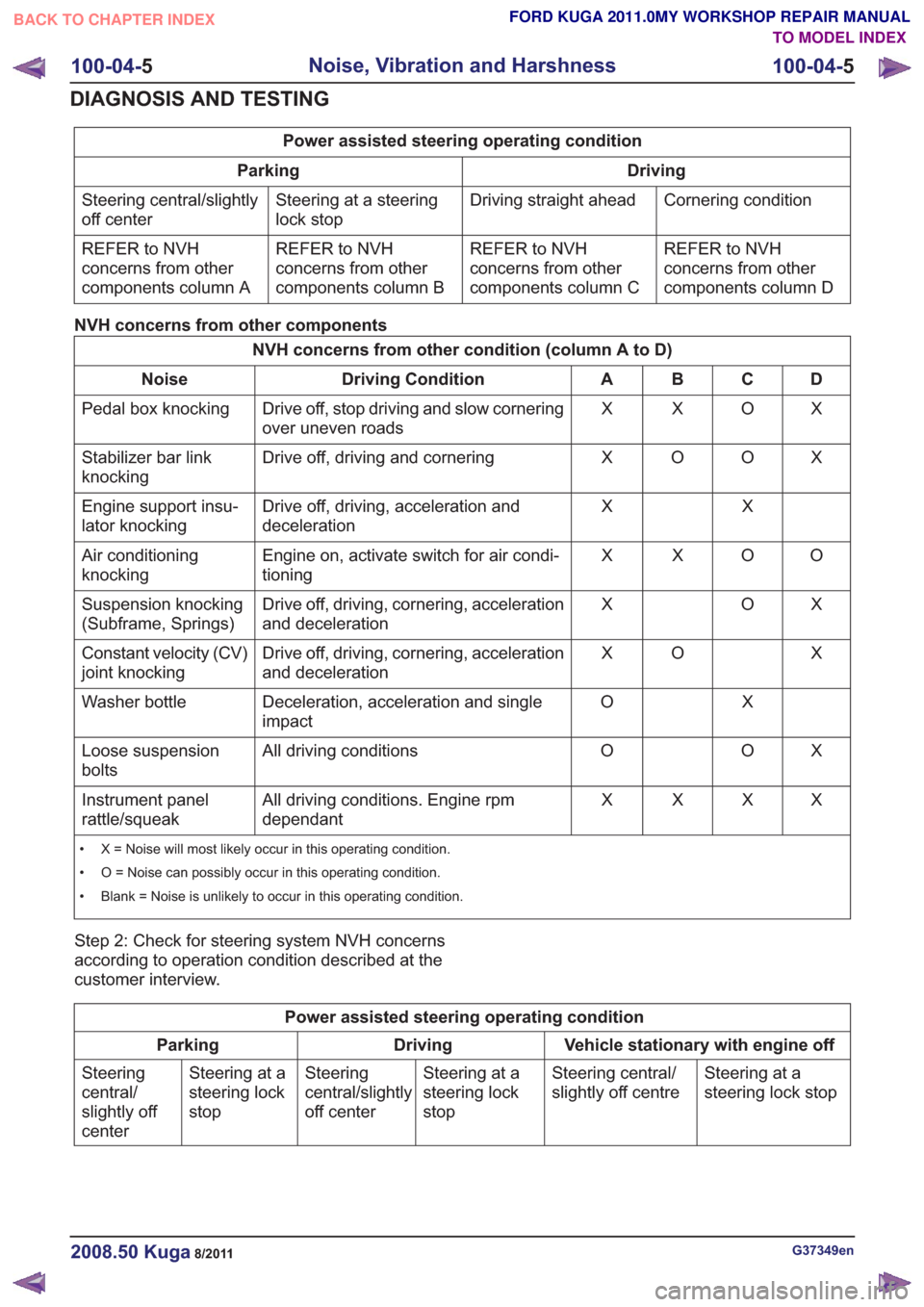
Power assisted steering operating conditionDriving
Parking
Cornering condition
Driving straight ahead
Steering at a steering
lock stop
Steering central/slightly
off center
REFER to NVH
concerns from other
components column D
REFER to NVH
concerns from other
components column C
REFER to NVH
concerns from other
components column B
REFER to NVH
concerns from other
components column A
NVH concerns from other components
NVH concerns from other condition (column A to D) DCBA
Driving Condition
Noise
XOXX
Drive off, stop driving and slow cornering
over uneven roads
Pedal box knocking
XOOX
Drive off, driving and cornering
Stabilizer bar link
knocking
X
X
Drive off, driving, acceleration and
deceleration
Engine support insu-
lator knocking
OOXX
Engine on, activate switch for air condi-
tioning
Air conditioning
knocking
XO
X
Drive off, driving, cornering, acceleration
and deceleration
Suspension knocking
(Subframe, Springs)
X
OX
Drive off, driving, cornering, acceleration
and deceleration
Constant velocity (CV)
joint knocking
X
O
Deceleration, acceleration and single
impact
Washer bottle
XO
O
All driving conditions
Loose suspension
bolts
XXXX
All driving conditions. Engine rpm
dependant
Instrument panel
rattle/squeak
• X = Noise will most likely occur in this operating condition.
• O = Noise can possibly occur in this operating condition.
• Blank = Noise is unlikely to occur in this operating condition.
Step 2: Check for steering system NVH concerns
according to operation condition described at the
customer interview.
Power assisted steering operating condition
Vehicle stationary with engine off
Driving
Parking
Steering at a
steering lock stop
Steering central/
slightly off centre
Steering at a
steering lock
stop
Steering
central/slightly
off center
Steering at a
steering lock
stop
Steering
central/
slightly off
center
G37349en2008.50 Kuga8/2011
100-04-
5
Noise, Vibration and Harshness
100-04- 5
DIAGNOSIS AND TESTING
TO MODEL INDEX
BACK TO CHAPTER INDEX
FORD KUGA 2011.0MY WORKSHOP REPAIR MANUAL
Page 84 of 2057
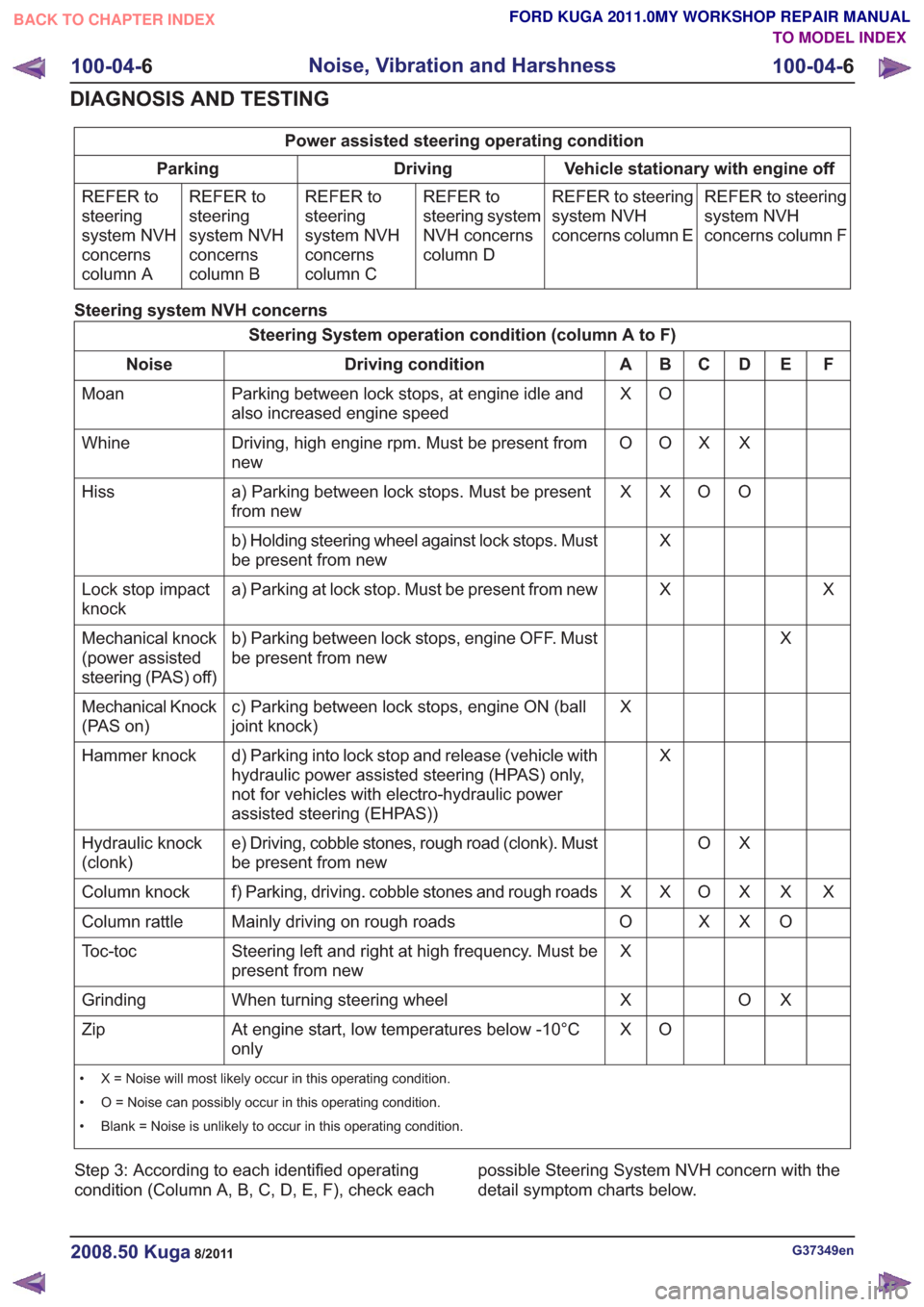
Power assisted steering operating conditionVehicle stationary with engine off
Driving
Parking
REFER to steering
system NVH
concerns column F
REFER to steering
system NVH
concerns column E
REFER to
steering system
NVH concerns
column D
REFER to
steering
system NVH
concerns
column C
REFER to
steering
system NVH
concerns
column B
REFER to
steering
system NVH
concerns
column A
Steering system NVH concerns
Steering System operation condition (column A to F) FEDCBA
Driving condition
Noise
OX
Parking between lock stops, at engine idle and
also increased engine speed
Moan
XXOO
Driving, high engine rpm. Must be present from
new
Whine
OOXX
a) Parking between lock stops. Must be present
from new
Hiss
X
b) Holding steering wheel against lock stops. Must
be present from new
X
X
a) Parking at lock stop. Must be present from new
Lock stop impact
knock
X
b) Parking between lock stops, engine OFF. Must
be present from new
Mechanical knock
(power assisted
steering (PAS) off)
X
c) Parking between lock stops, engine ON (ball
joint knock)
Mechanical Knock
(PAS on)
X
d) Parking into lock stop and release (vehicle with
hydraulic power assisted steering (HPAS) only,
not for vehicles with electro-hydraulic power
assisted steering (EHPAS))
Hammer knock
XO
e) Driving, cobble stones, rough road (clonk). Must
be present from new
Hydraulic knock
(clonk)
XXXOXX
f) Parking, driving. cobble stones and rough roads
Column knock
OXX
O
Mainly driving on rough roads
Column rattle
X
Steering left and right at high frequency. Must be
present from new
Toc-toc
XO
X
When turning steering wheel
Grinding
OX
At engine start, low temperatures below -10°C
only
Zip
• X = Noise will most likely occur in this operating condition.
• O = Noise can possibly occur in this operating condition.
• Blank = Noise is unlikely to occur in this operating condition.
Step 3: According to each identified operating
condition (Column A, B, C, D, E, F), check each possible Steering System NVH concern with the
detail symptom charts below.
G37349en2008.50 Kuga8/2011
100-04-
6
Noise, Vibration and Harshness
100-04- 6
DIAGNOSIS AND TESTING
TO MODEL INDEX
BACK TO CHAPTER INDEX
FORD KUGA 2011.0MY WORKSHOP REPAIR MANUAL
Page 87 of 2057
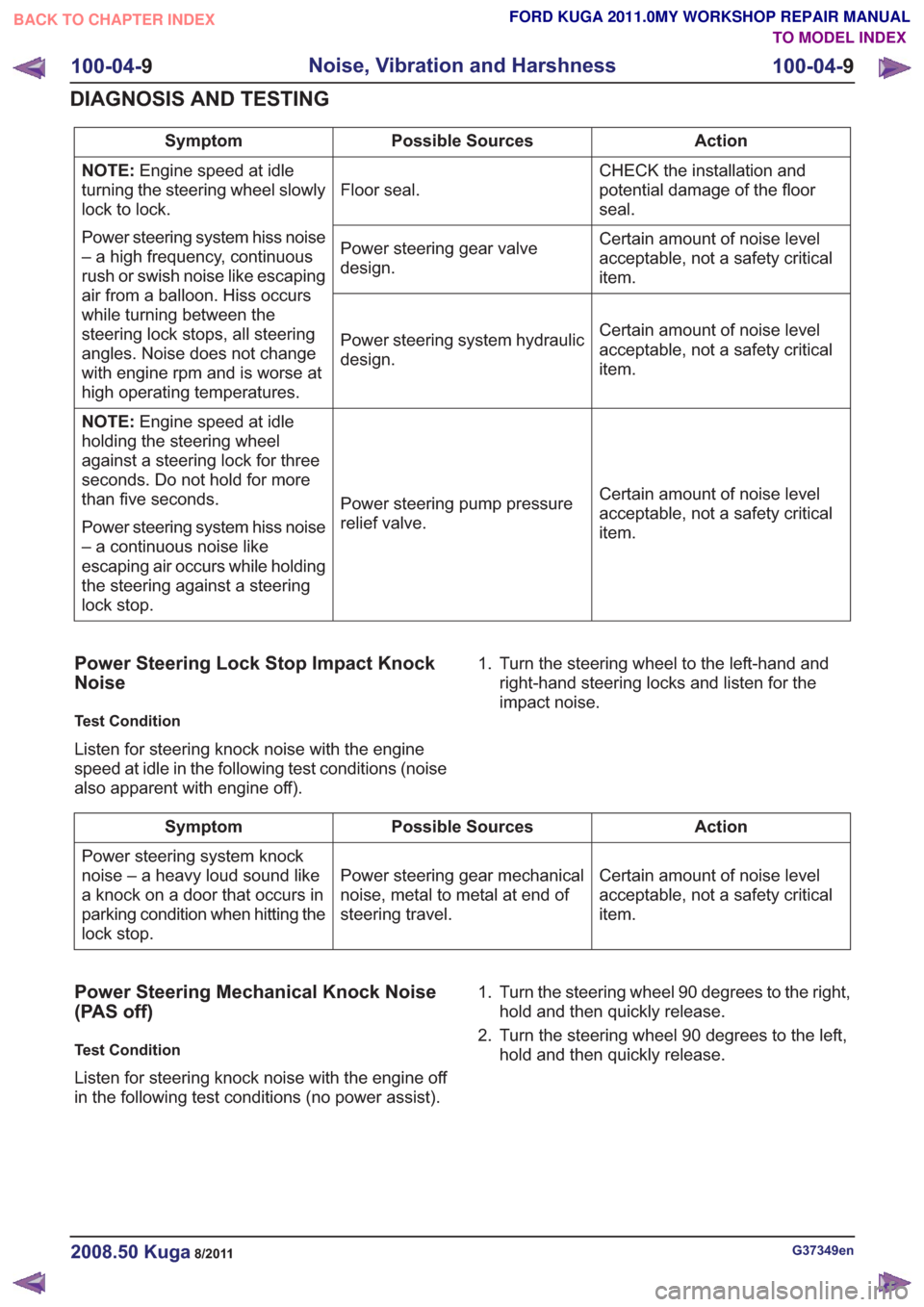
Action
Possible Sources
Symptom
CHECK the installation and
potential damage of the floor
seal.
Floor seal.
NOTE:
Engine speed at idle
turning the steering wheel slowly
lock to lock.
Power steering system hiss noise
– a high frequency, continuous
rush or swish noise like escaping
air from a balloon. Hiss occurs
while turning between the
steering lock stops, all steering
angles. Noise does not change
with engine rpm and is worse at
high operating temperatures. Certain amount of noise level
acceptable, not a safety critical
item.
Power steering gear valve
design.
Certain amount of noise level
acceptable, not a safety critical
item.
Power steering system hydraulic
design.
Certain amount of noise level
acceptable, not a safety critical
item.
Power steering pump pressure
relief valve.
NOTE:
Engine speed at idle
holding the steering wheel
against a steering lock for three
seconds. Do not hold for more
than five seconds.
Power steering system hiss noise
– a continuous noise like
escaping air occurs while holding
the steering against a steering
lock stop.
Power Steering Lock Stop Impact Knock
Noise
Test Condition
Listen for steering knock noise with the engine
speed at idle in the following test conditions (noise
also apparent with engine off). 1. Turn the steering wheel to the left-hand and
right-hand steering locks and listen for the
impact noise.
Action
Possible Sources
Symptom
Certain amount of noise level
acceptable, not a safety critical
item.
Power steering gear mechanical
noise, metal to metal at end of
steering travel.
Power steering system knock
noise – a heavy loud sound like
a knock on a door that occurs in
parking condition when hitting the
lock stop.
Power Steering Mechanical Knock Noise
(PAS off)
Test Condition
Listen for steering knock noise with the engine off
in the following test conditions (no power assist). 1. Turn the steering wheel 90 degrees to the right,
hold and then quickly release.
2. Turn the steering wheel 90 degrees to the left, hold and then quickly release.
G37349en2008.50 Kuga8/2011
100-04- 9
Noise, Vibration and Harshness
100-04- 9
DIAGNOSIS AND TESTING
TO MODEL INDEX
BACK TO CHAPTER INDEX
FORD KUGA 2011.0MY WORKSHOP REPAIR MANUAL
Page 89 of 2057
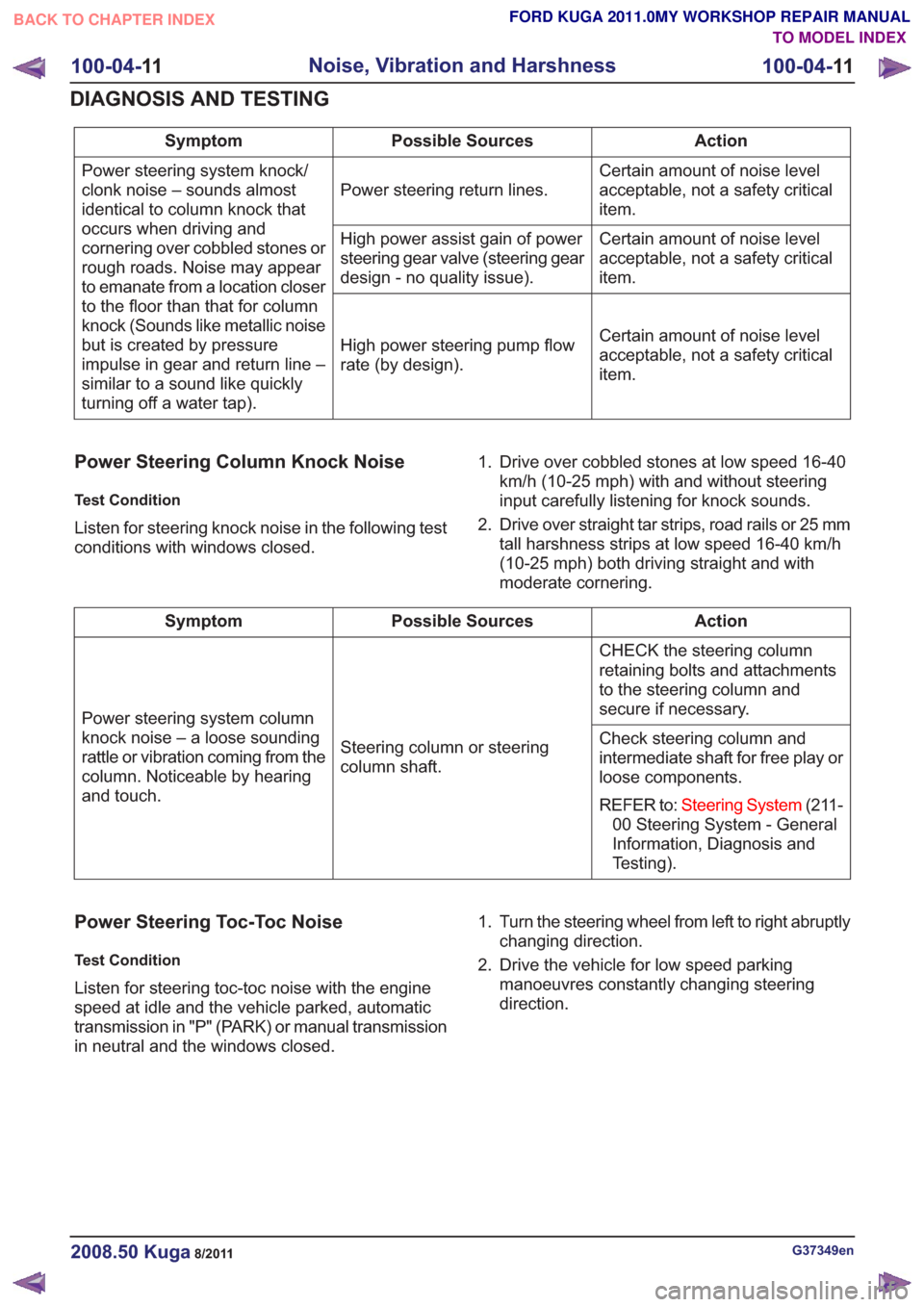
Action
Possible Sources
Symptom
Certain amount of noise level
acceptable, not a safety critical
item.
Power steering return lines.
Power steering system knock/
clonk noise – sounds almost
identical to column knock that
occurs when driving and
cornering over cobbled stones or
rough roads. Noise may appear
to emanate from a location closer
to the floor than that for column
knock (Sounds like metallic noise
but is created by pressure
impulse in gear and return line –
similar to a sound like quickly
turning off a water tap). Certain amount of noise level
acceptable, not a safety critical
item.
High power assist gain of power
steering gear valve (steering gear
design - no quality issue).
Certain amount of noise level
acceptable, not a safety critical
item.
High power steering pump flow
rate (by design).
Power Steering Column Knock Noise
Test Condition
Listen for steering knock noise in the following test
conditions with windows closed. 1. Drive over cobbled stones at low speed 16-40
km/h (10-25 mph) with and without steering
input carefully listening for knock sounds.
2. Drive over straight tar strips, road rails or 25 mm tall harshness strips at low speed 16-40 km/h
(10-25 mph) both driving straight and with
moderate cornering.
Action
Possible Sources
Symptom
CHECK the steering column
retaining bolts and attachments
to the steering column and
secure if necessary.
Steering column or steering
column shaft.
Power steering system column
knock noise – a loose sounding
rattle or vibration coming from the
column. Noticeable by hearing
and touch. Check steering column and
intermediate shaft for free play or
loose components.
REFER to:
Steering System (211-
00 Steering System - General
Information, Diagnosis and
Testing).
Power Steering Toc-Toc Noise
Test Condition
Listen for steering toc-toc noise with the engine
speed at idle and the vehicle parked, automatic
transmission in "P" (PARK) or manual transmission
in neutral and the windows closed. 1. Turn the steering wheel from left to right abruptly
changing direction.
2. Drive the vehicle for low speed parking manoeuvres constantly changing steering
direction.
G37349en2008.50 Kuga8/2011
100-04- 11
Noise, Vibration and Harshness
100-04- 11
DIAGNOSIS AND TESTING
TO MODEL INDEX
BACK TO CHAPTER INDEX
FORD KUGA 2011.0MY WORKSHOP REPAIR MANUAL
Page 90 of 2057
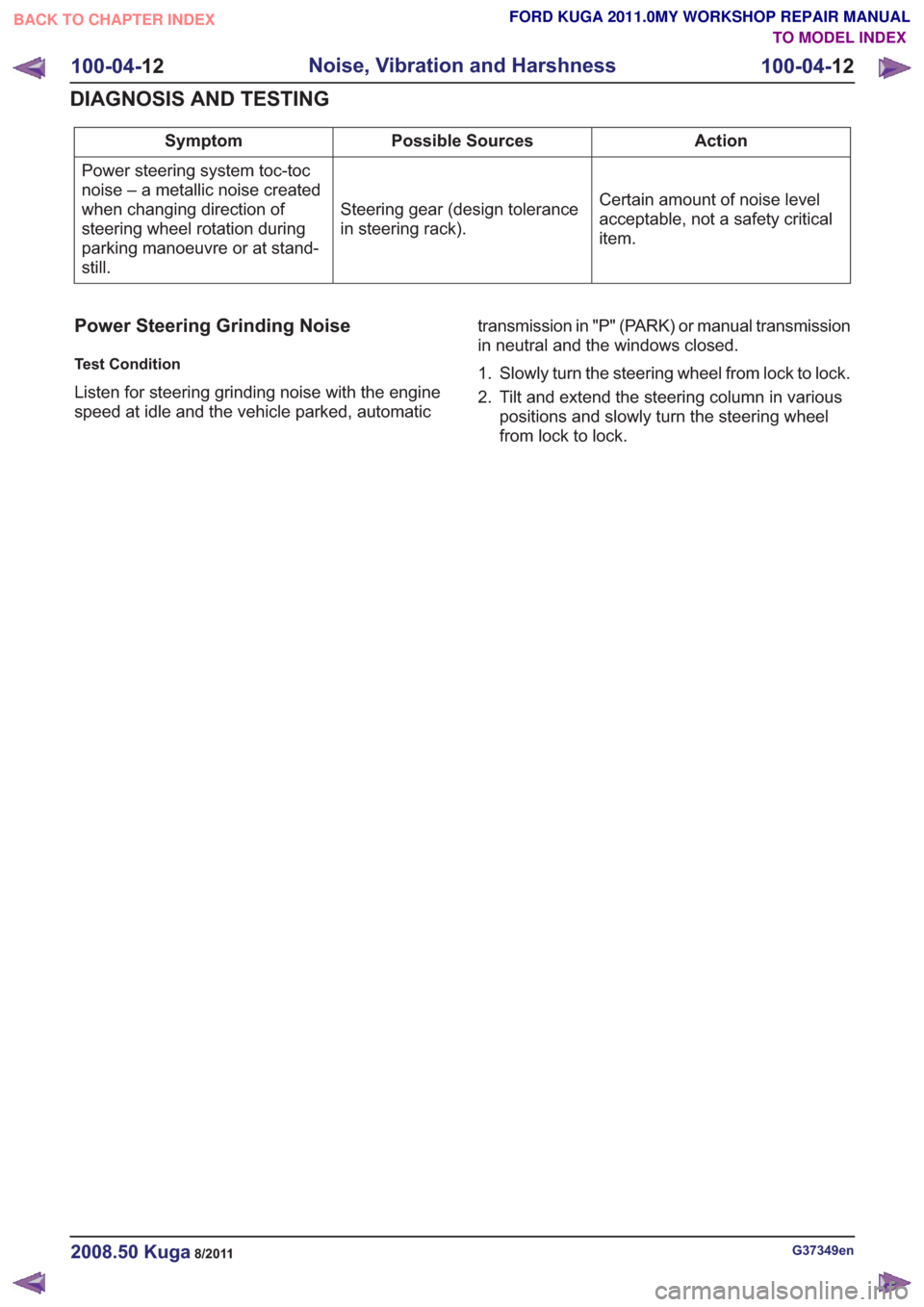
Action
Possible Sources
Symptom
Certain amount of noise level
acceptable, not a safety critical
item.
Steering gear (design tolerance
in steering rack).
Power steering system toc-toc
noise – a metallic noise created
when changing direction of
steering wheel rotation during
parking manoeuvre or at stand-
still.
Power Steering Grinding Noise
Test Condition
Listen for steering grinding noise with the engine
speed at idle and the vehicle parked, automatic transmission in "P" (PARK) or manual transmission
in neutral and the windows closed.
1. Slowly turn the steering wheel from lock to lock.
2. Tilt and extend the steering column in various
positions and slowly turn the steering wheel
from lock to lock.
G37349en2008.50 Kuga8/2011
100-04- 12
Noise, Vibration and Harshness
100-04- 12
DIAGNOSIS AND TESTING
TO MODEL INDEX
BACK TO CHAPTER INDEX
FORD KUGA 2011.0MY WORKSHOP REPAIR MANUAL
Page 166 of 2057
Description
Item
Glow plug
1
Combustion Air Blower
2
Fuel pump
3
Fuel-fired heater on
4
Fuel-fired heater - large regulating step
5
Fuel-fired heater - small regulating step
6 Description
Item
Fuel-fired heater off
7
Blower motor on
8
Flame detection
9
Blower motor off
10
Large regulating step
11
Small regulating step
12
Boost heat mode
When the engine is running, the booster heater
helps the engine to heat the passenger
compartment at low ambient temperatures.
When the coolant temperature reaches 30 °C, the
control unit transmits a switch-on signal for the
passenger compartment blower via the CAN bus.
When the coolant temperature drops, the blower
remains on until the temperature reaches 20 °C
whereupon it is deactivated.
The fuel tank must be filled to at least 14% for the
system to be switched on. If the fuel level drops
below 8% then the system is switched off.
In boost mode, the fuel fired booster heater is only
switched on if all of the following criteria are met:
• Engine speed above 500 rpm. The fuel fired booster heater is not allowed to start up while
the engine is being cranked; this prevents a
shut-down due to low voltage if the battery
charge is low.
• Ambient temperature below 5 °C.
• Fuel level above 14% of total capacity.
• Function is active on the trip computer menu.
One of the following conditions is sufficient to
switch off the booster heater in boost heat mode:
• Engine speed below 500 rpm.
• Ambient temperature above 11 °C.
• Function is active on the trip computer menu.
• Fuel level below 8% of total capacity.
Programmable fuel fired booster heater
The programmable fuel fired booster heater has
two operating modes:
• Instant start
• Programmed start
The heater status is displayed on the instrument
cluster display. The parking heater mode is controlled via a menu in the message centre. The
fuel fired booster heater can be activated and
deactivated via the message centre. (If set to 'Auto'
the system is activated, if set to 'Off' the system is
completely deactivated)
Immediate start-up of the booster
heater
This function enables the fuel-fired booster heater
to be switched on manually when the engine is not
running. This function is activated via the menu on
the driver information system.
The ignition key must be in the II" position before
this menu can be accessed. The timer function of
the booster heater remains active when the ignition
key is in position "0".
After an immediate start-up of the booster heater
it is switched off again after 30 minutes (or if the
fuel level in the fuel tank drops below 8%). The
booster heater stops within 2 minutes of the engine
starting. This leaves enough time to check whether
the switch-on conditions for boost heat mode have
been met, thus preventing the booster heater from
having to switch off and switch back on again. The
heater can be switched off manually at any time
from the menu.
Programmed start-up of the booster
heater
The driver can use a menu to adjust the time at
which the vehicle is to be pre-heated. The following
options are available:
• Time setting. One or two times can be
programmed for each day of the week. It is
possible to program days either individually or
together in groups (Mon-Sun/Mon-Sat/Mon-Fri).
• Time and data setting
With the first option, the fuel-fired booster heater
will start repeatedly without needing to be G1066982en
2008.50 Kuga 8/2011 412-02-13
Auxiliary Climate Control
412-02-13
DESCRIPTION AND OPERATIONTO MODEL INDEX
BACK TO CHAPTER INDEX
FORD KUGA 2011.0MY WORKSHOP REPAIR MANUAL
Page 167 of 2057
reprogrammed. However, if the engine hasn't been
run since the last programmed start, the fuel-fired
booster heater will not start up the second time so
as to prevent the battery from being discharged.
The length of time required to pre-heat the vehicle
is calculated in the control unit of the fuel-fired
booster heater and is based on two temperature
values:
• Ambient air temperature: this message is taken
from the GEM via the CAN bus.
• Coolant temperature: this is determined via an internal sensor in the fuel-fired booster heater.
The maximum heating time is 30 minutes at an
outside air temperature of -10 °C or lower. The
heating time decreases proportionally with
increasing ambient temperature until the ambient
temperature is between +15 °C and +20 °C. Then
the minimum heating time is 10 minutes. The
parking heater is deactivated at temperatures
above +20 °C.
The sequence for a programmed start of the
booster heater is as follows:
• Two minutes before the start of the maximum heating time the driver information
system/instrument cluster sends an activation
message to the fuel-fired booster heater via the
CAN bus.
• The fuel-fired booster heater calculates the required heating time and, if necessary, sends
a delay request on the CAN bus.
• At the calculated time, the fuel-fired booster heater starts up. The conditions for start-up are:
engine not running and amount of fuel in the
fuel tank is above 14% of maximum.
• When the coolant temperature reaches +30 °C, the control unit of the fuel-fired booster heater
sends a request to switch on the passenger
compartment blower.
• Eight minutes after the programmed switch-off time, the booster heater stops heating mode
and starts a run-on operation to clean the
system's spark plugs.
• Ten minutes after the switch-off time, the post-cleaning operation is complete. The
additional ten minutes run-on time provides
some leeway in case the driver is late arriving.
After a programmed start-up of the booster heater
it is switched off again after the heating time has
elapsed (or if the fuel level in the fuel tank drops
below 8%). The booster heater stops within 2 minutes of the engine starting. This leaves enough
time to check whether the switch-on conditions for
boost heat mode have been met, thus preventing
the booster heater from having to switch off and
switch back on again. The heater can be switched
off manually at any time from the menu.
Whilst the fuel-fired booster heater is in additional
heating mode and/or parking heating mode, the
instrument cluster receives a fuel consumption
signal; this is used to re-calculate the vehicle's
remaining range and fuel consumption data.
Emergency shutoff
In the event of an accident in which the airbags
are deployed, the control unit of the fuel-fired
booster heater receives a message on the CAN
bus from the restraints control module (RCM).
When this message is received, the booster heater
system switches off immediately.
The booster heater control module deactivates the
system and does not respond to further messages
on the CAN bus. The booster heater control module
needs to be activated with WDS.
Component Description
Electric Booster Heater
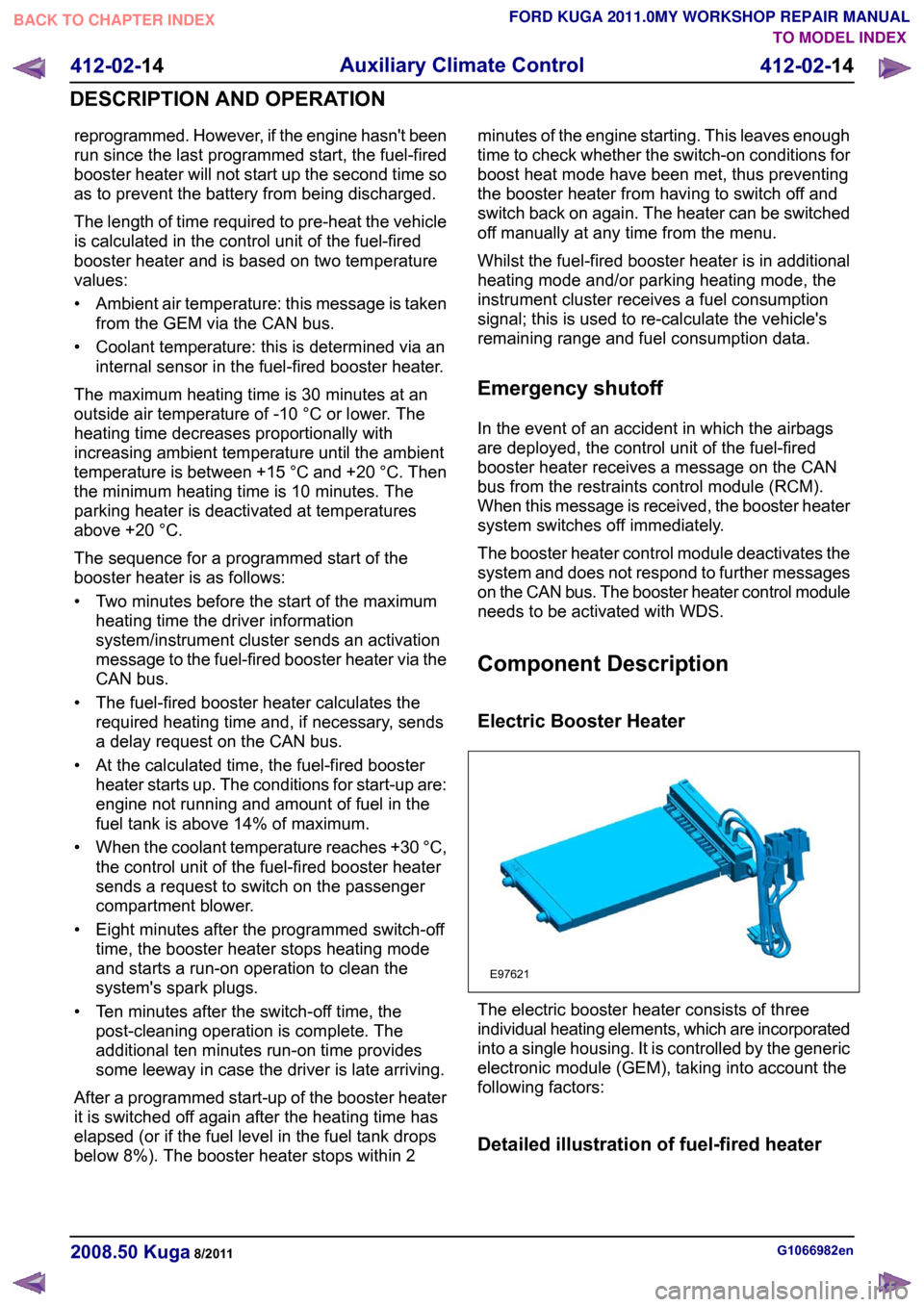
The electric booster heater consists of three
individual heating elements, which are incorporated
into a single housing. It is controlled by the generic
electronic module (GEM), taking into account the
following factors:
Detailed illustration of fuel-fired heater
G1066982en
2008.50 Kuga 8/2011 412-02-14
Auxiliary Climate Control
412-02-14
DESCRIPTION AND OPERATIONTO MODEL INDEX
BACK TO CHAPTER INDEX
FORD KUGA 2011.0MY WORKSHOP REPAIR MANUALE97621