pump FORD KUGA 2011 1.G Workshop Manual
[x] Cancel search | Manufacturer: FORD, Model Year: 2011, Model line: KUGA, Model: FORD KUGA 2011 1.GPages: 2057
Page 85 of 2057
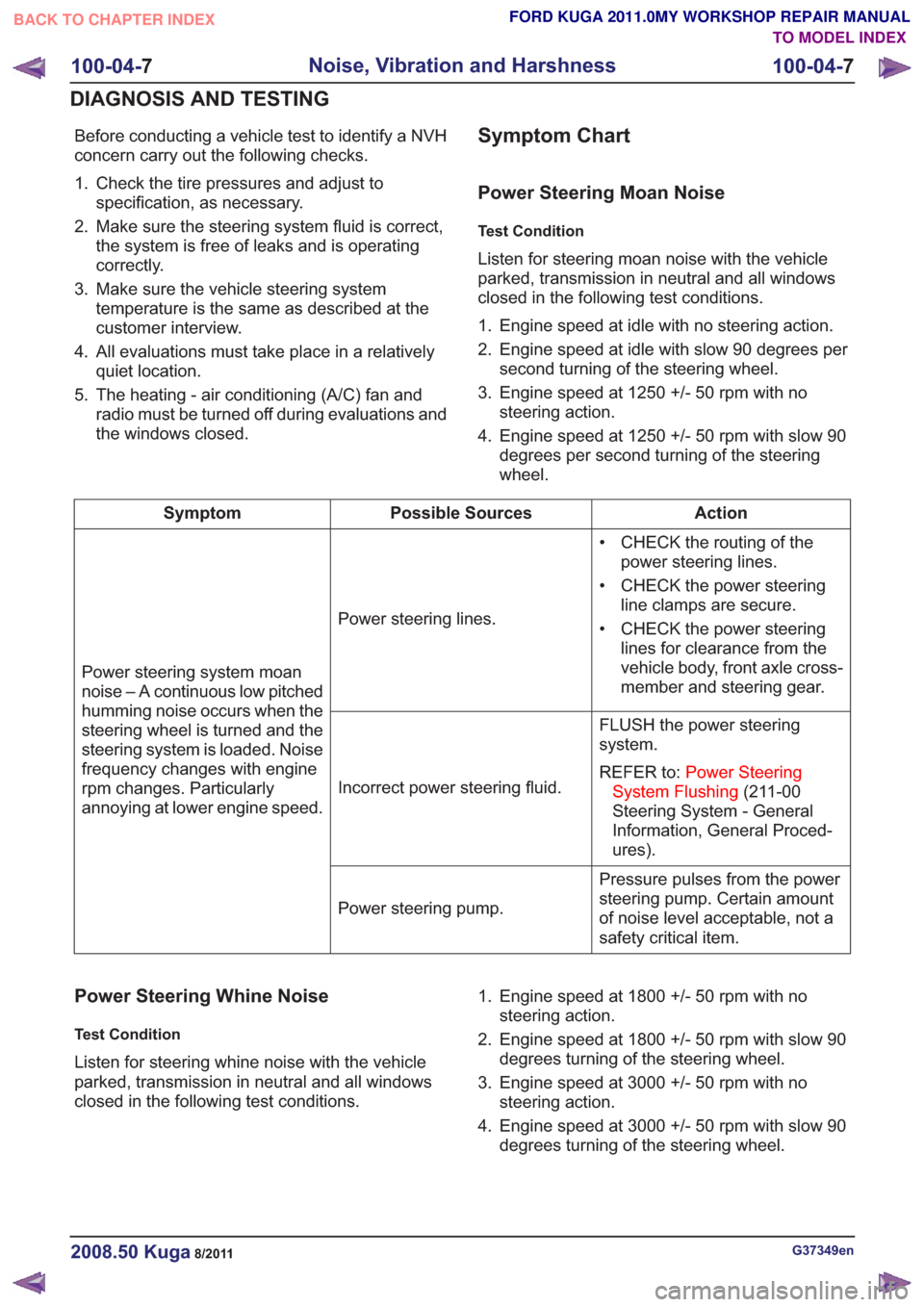
Before conducting a vehicle test to identify a NVH
concern carry out the following checks.
1. Check the tire pressures and adjust tospecification, as necessary.
2. Make sure the steering system fluid is correct, the system is free of leaks and is operating
correctly.
3. Make sure the vehicle steering system temperature is the same as described at the
customer interview.
4. All evaluations must take place in a relatively quiet location.
5. The heating - air conditioning (A/C) fan and radio must be turned off during evaluations and
the windows closed.Symptom Chart
Power Steering Moan Noise
Test Condition
Listen for steering moan noise with the vehicle
parked, transmission in neutral and all windows
closed in the following test conditions.
1. Engine speed at idle with no steering action.
2. Engine speed at idle with slow 90 degrees persecond turning of the steering wheel.
3. Engine speed at 1250 +/- 50 rpm with no steering action.
4. Engine speed at 1250 +/- 50 rpm with slow 90 degrees per second turning of the steering
wheel.
Action
Possible Sources
Symptom
• CHECK the routing of thepower steering lines.
• CHECK the power steering line clamps are secure.
• CHECK the power steering lines for clearance from the
vehicle body, front axle cross-
member and steering gear.
Power steering lines.
Power steering system moan
noise – A continuous low pitched
humming noise occurs when the
steering wheel is turned and the
steering system is loaded. Noise
frequency changes with engine
rpm changes. Particularly
annoying at lower engine speed. FLUSH the power steering
system.
REFER to:
Power Steering
System Flushing (211-00
Steering System - General
Information, General Proced-
ures).
Incorrect power steering fluid.
Pressure pulses from the power
steering pump. Certain amount
of noise level acceptable, not a
safety critical item.
Power steering pump.
Power Steering Whine Noise
Test Condition
Listen for steering whine noise with the vehicle
parked, transmission in neutral and all windows
closed in the following test conditions. 1. Engine speed at 1800 +/- 50 rpm with no
steering action.
2. Engine speed at 1800 +/- 50 rpm with slow 90 degrees turning of the steering wheel.
3. Engine speed at 3000 +/- 50 rpm with no steering action.
4. Engine speed at 3000 +/- 50 rpm with slow 90 degrees turning of the steering wheel.
G37349en2008.50 Kuga8/2011
100-04- 7
Noise, Vibration and Harshness
100-04- 7
DIAGNOSIS AND TESTING
TO MODEL INDEX
BACK TO CHAPTER INDEX
FORD KUGA 2011.0MY WORKSHOP REPAIR MANUAL
Page 86 of 2057
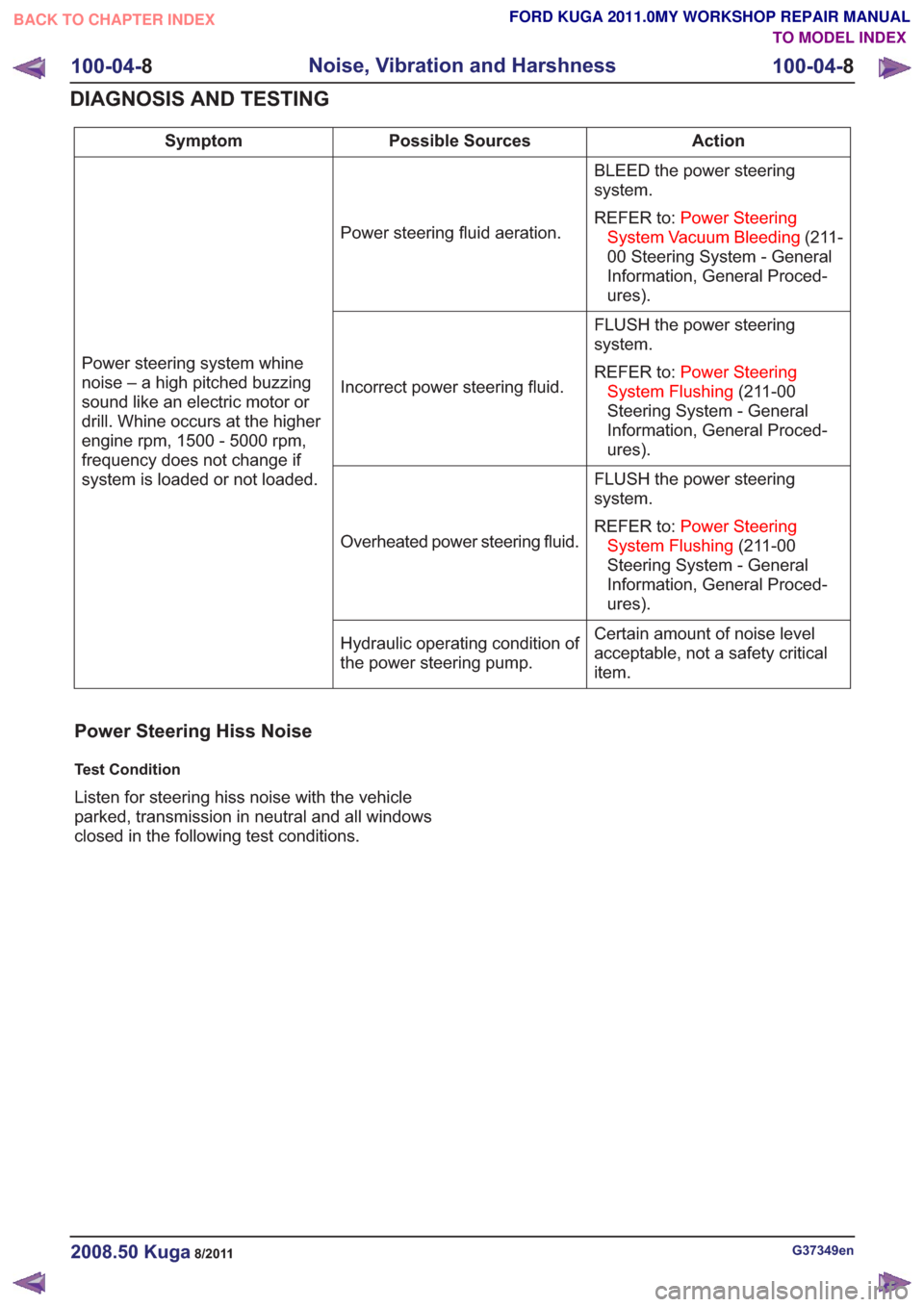
Action
Possible Sources
Symptom
BLEED the power steering
system.
REFER to:Power Steering
System Vacuum Bleeding (211-
00 Steering System - General
Information, General Proced-
ures).
Power steering fluid aeration.
Power steering system whine
noise – a high pitched buzzing
sound like an electric motor or
drill. Whine occurs at the higher
engine rpm, 1500 - 5000 rpm,
frequency does not change if
system is loaded or not loaded. FLUSH the power steering
system.
REFER to:
Power Steering
System Flushing (211-00
Steering System - General
Information, General Proced-
ures).
Incorrect power steering fluid.
FLUSH the power steering
system.
REFER to:Power Steering
System Flushing (211-00
Steering System - General
Information, General Proced-
ures).
Overheated power steering fluid.
Certain amount of noise level
acceptable, not a safety critical
item.
Hydraulic operating condition of
the power steering pump.
Power Steering Hiss Noise
Test Condition
Listen for steering hiss noise with the vehicle
parked, transmission in neutral and all windows
closed in the following test conditions.
G37349en2008.50 Kuga8/2011
100-04-
8
Noise, Vibration and Harshness
100-04- 8
DIAGNOSIS AND TESTING
TO MODEL INDEX
BACK TO CHAPTER INDEX
FORD KUGA 2011.0MY WORKSHOP REPAIR MANUAL
Page 87 of 2057
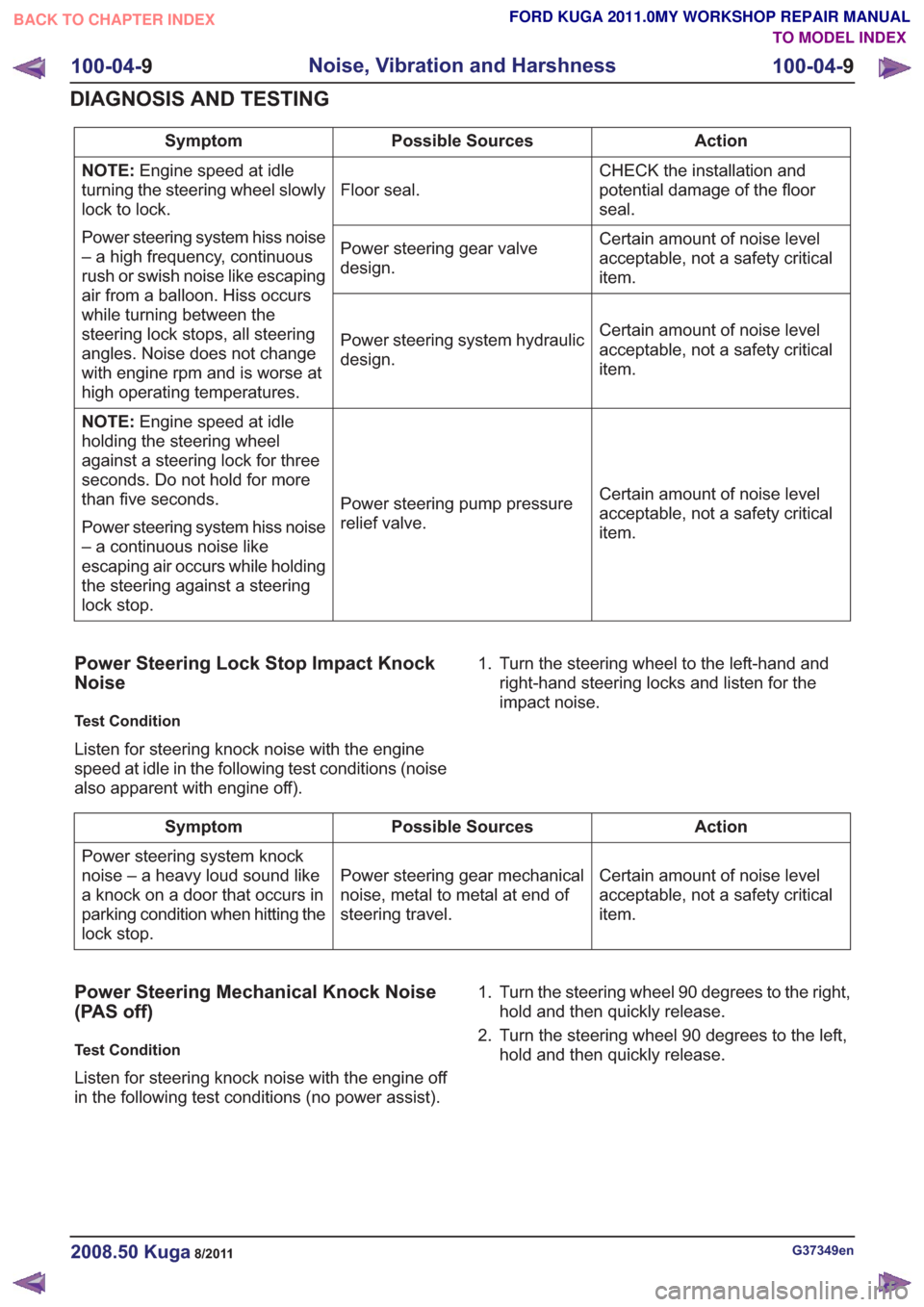
Action
Possible Sources
Symptom
CHECK the installation and
potential damage of the floor
seal.
Floor seal.
NOTE:
Engine speed at idle
turning the steering wheel slowly
lock to lock.
Power steering system hiss noise
– a high frequency, continuous
rush or swish noise like escaping
air from a balloon. Hiss occurs
while turning between the
steering lock stops, all steering
angles. Noise does not change
with engine rpm and is worse at
high operating temperatures. Certain amount of noise level
acceptable, not a safety critical
item.
Power steering gear valve
design.
Certain amount of noise level
acceptable, not a safety critical
item.
Power steering system hydraulic
design.
Certain amount of noise level
acceptable, not a safety critical
item.
Power steering pump pressure
relief valve.
NOTE:
Engine speed at idle
holding the steering wheel
against a steering lock for three
seconds. Do not hold for more
than five seconds.
Power steering system hiss noise
– a continuous noise like
escaping air occurs while holding
the steering against a steering
lock stop.
Power Steering Lock Stop Impact Knock
Noise
Test Condition
Listen for steering knock noise with the engine
speed at idle in the following test conditions (noise
also apparent with engine off). 1. Turn the steering wheel to the left-hand and
right-hand steering locks and listen for the
impact noise.
Action
Possible Sources
Symptom
Certain amount of noise level
acceptable, not a safety critical
item.
Power steering gear mechanical
noise, metal to metal at end of
steering travel.
Power steering system knock
noise – a heavy loud sound like
a knock on a door that occurs in
parking condition when hitting the
lock stop.
Power Steering Mechanical Knock Noise
(PAS off)
Test Condition
Listen for steering knock noise with the engine off
in the following test conditions (no power assist). 1. Turn the steering wheel 90 degrees to the right,
hold and then quickly release.
2. Turn the steering wheel 90 degrees to the left, hold and then quickly release.
G37349en2008.50 Kuga8/2011
100-04- 9
Noise, Vibration and Harshness
100-04- 9
DIAGNOSIS AND TESTING
TO MODEL INDEX
BACK TO CHAPTER INDEX
FORD KUGA 2011.0MY WORKSHOP REPAIR MANUAL
Page 89 of 2057
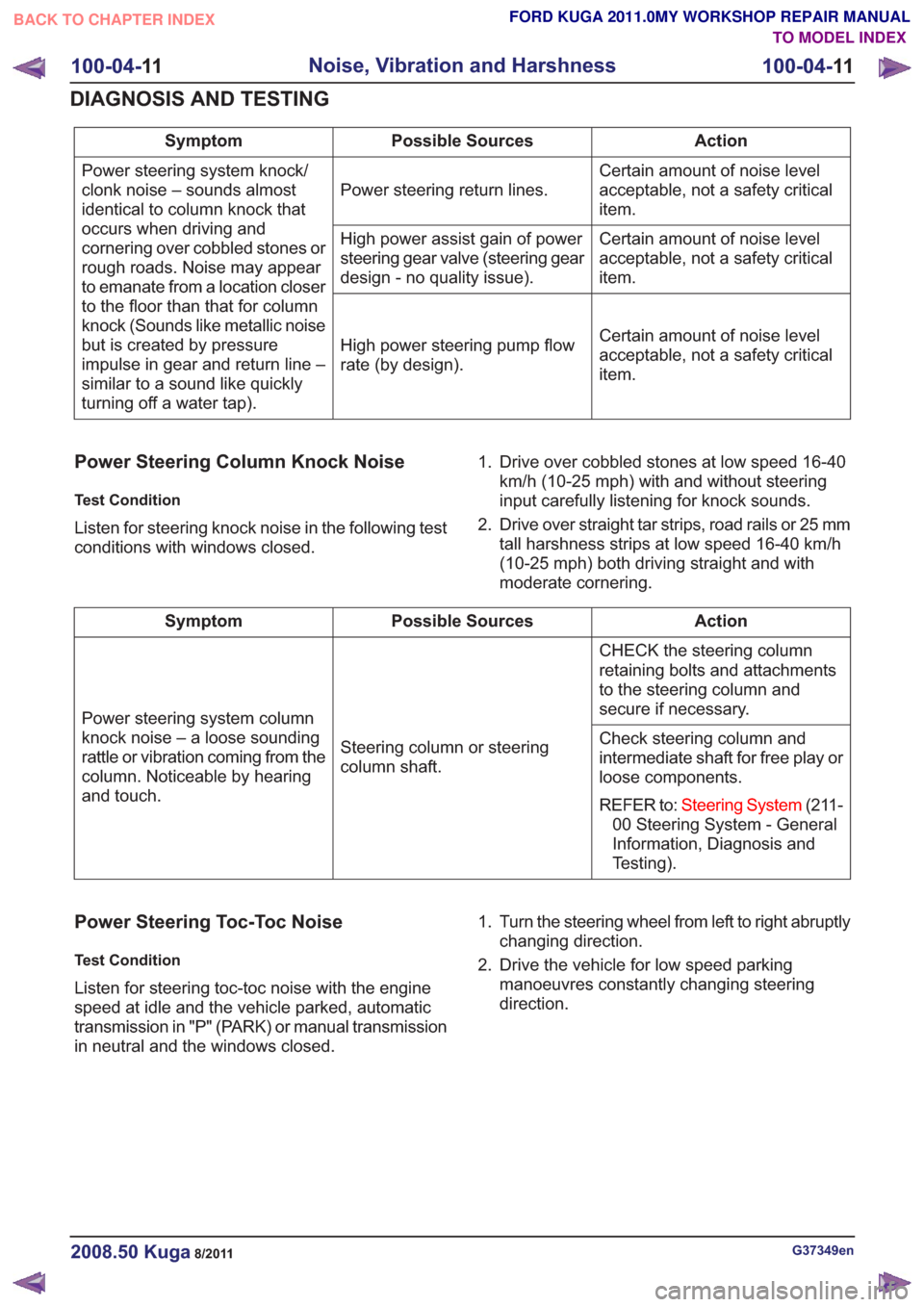
Action
Possible Sources
Symptom
Certain amount of noise level
acceptable, not a safety critical
item.
Power steering return lines.
Power steering system knock/
clonk noise – sounds almost
identical to column knock that
occurs when driving and
cornering over cobbled stones or
rough roads. Noise may appear
to emanate from a location closer
to the floor than that for column
knock (Sounds like metallic noise
but is created by pressure
impulse in gear and return line –
similar to a sound like quickly
turning off a water tap). Certain amount of noise level
acceptable, not a safety critical
item.
High power assist gain of power
steering gear valve (steering gear
design - no quality issue).
Certain amount of noise level
acceptable, not a safety critical
item.
High power steering pump flow
rate (by design).
Power Steering Column Knock Noise
Test Condition
Listen for steering knock noise in the following test
conditions with windows closed. 1. Drive over cobbled stones at low speed 16-40
km/h (10-25 mph) with and without steering
input carefully listening for knock sounds.
2. Drive over straight tar strips, road rails or 25 mm tall harshness strips at low speed 16-40 km/h
(10-25 mph) both driving straight and with
moderate cornering.
Action
Possible Sources
Symptom
CHECK the steering column
retaining bolts and attachments
to the steering column and
secure if necessary.
Steering column or steering
column shaft.
Power steering system column
knock noise – a loose sounding
rattle or vibration coming from the
column. Noticeable by hearing
and touch. Check steering column and
intermediate shaft for free play or
loose components.
REFER to:
Steering System (211-
00 Steering System - General
Information, Diagnosis and
Testing).
Power Steering Toc-Toc Noise
Test Condition
Listen for steering toc-toc noise with the engine
speed at idle and the vehicle parked, automatic
transmission in "P" (PARK) or manual transmission
in neutral and the windows closed. 1. Turn the steering wheel from left to right abruptly
changing direction.
2. Drive the vehicle for low speed parking manoeuvres constantly changing steering
direction.
G37349en2008.50 Kuga8/2011
100-04- 11
Noise, Vibration and Harshness
100-04- 11
DIAGNOSIS AND TESTING
TO MODEL INDEX
BACK TO CHAPTER INDEX
FORD KUGA 2011.0MY WORKSHOP REPAIR MANUAL
Page 91 of 2057
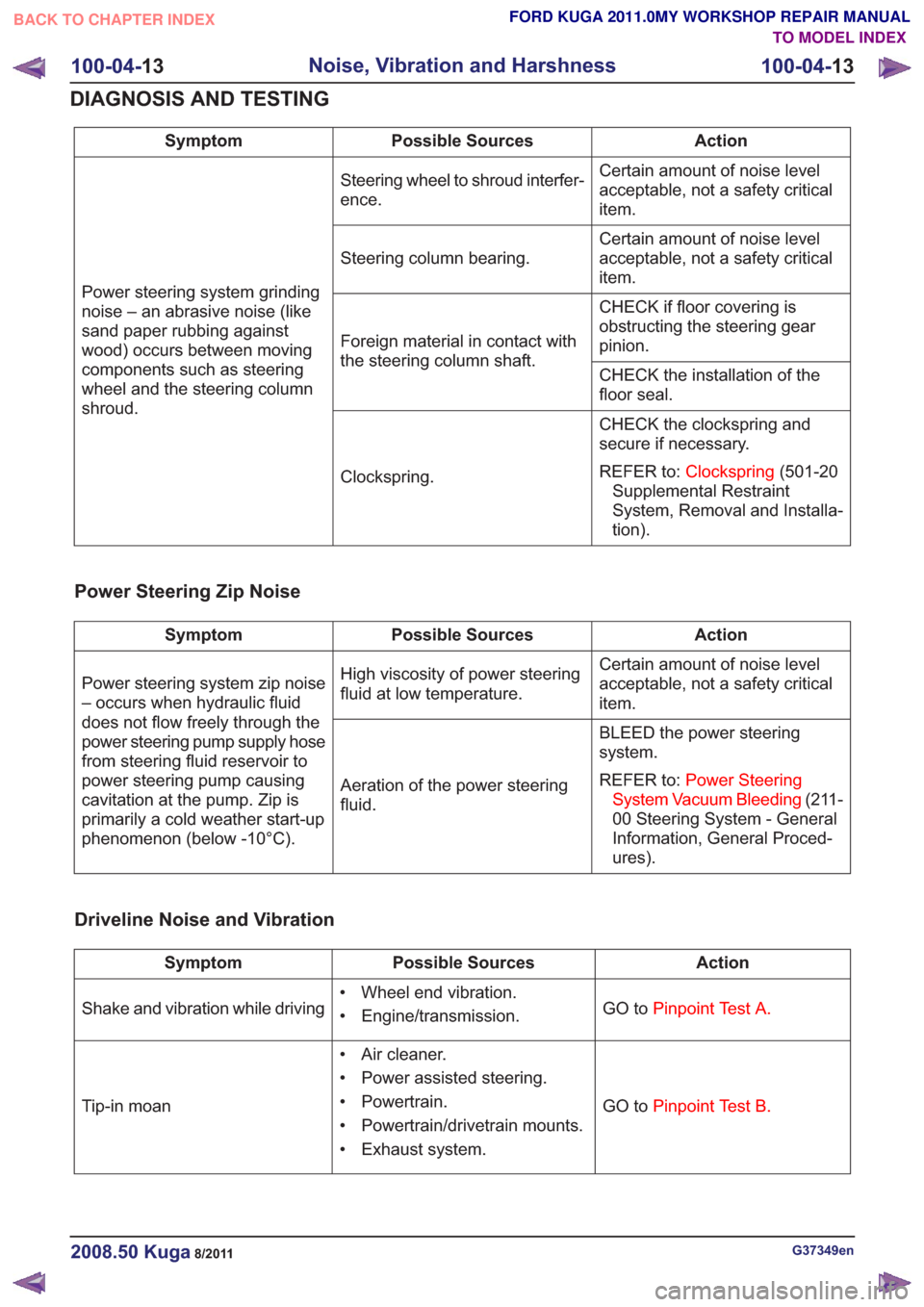
Action
Possible Sources
Symptom
Certain amount of noise level
acceptable, not a safety critical
item.
Steering wheel to shroud interfer-
ence.
Power steering system grinding
noise – an abrasive noise (like
sand paper rubbing against
wood) occurs between moving
components such as steering
wheel and the steering column
shroud. Certain amount of noise level
acceptable, not a safety critical
item.
Steering column bearing.
CHECK if floor covering is
obstructing the steering gear
pinion.
Foreign material in contact with
the steering column shaft.
CHECK the installation of the
floor seal.
CHECK the clockspring and
secure if necessary.
REFER to:Clockspring (501-20
Supplemental Restraint
System, Removal and Installa-
tion).
Clockspring.
Power Steering Zip Noise
Action
Possible Sources
Symptom
Certain amount of noise level
acceptable, not a safety critical
item.
High viscosity of power steering
fluid at low temperature.
Power steering system zip noise
– occurs when hydraulic fluid
does not flow freely through the
power steering pump supply hose
from steering fluid reservoir to
power steering pump causing
cavitation at the pump. Zip is
primarily a cold weather start-up
phenomenon (below -10°C). BLEED the power steering
system.
REFER to:
Power Steering
System Vacuum Bleeding (211-
00 Steering System - General
Information, General Proced-
ures).
Aeration of the power steering
fluid.
Driveline Noise and Vibration
Action
Possible Sources
Symptom
GO toPinpoint Test A.
• Wheel end vibration.
• Engine/transmission.
Shake and vibration while driving
GO toPinpoint Test B.
• Air cleaner.
• Power assisted steering.
• Powertrain.
• Powertrain/drivetrain mounts.
• Exhaust system.
Tip-in moan
G37349en2008.50 Kuga8/2011
100-04-
13
Noise, Vibration and Harshness
100-04- 13
DIAGNOSIS AND TESTING
TO MODEL INDEX
BACK TO CHAPTER INDEX
FORD KUGA 2011.0MY WORKSHOP REPAIR MANUAL
Page 154 of 2057
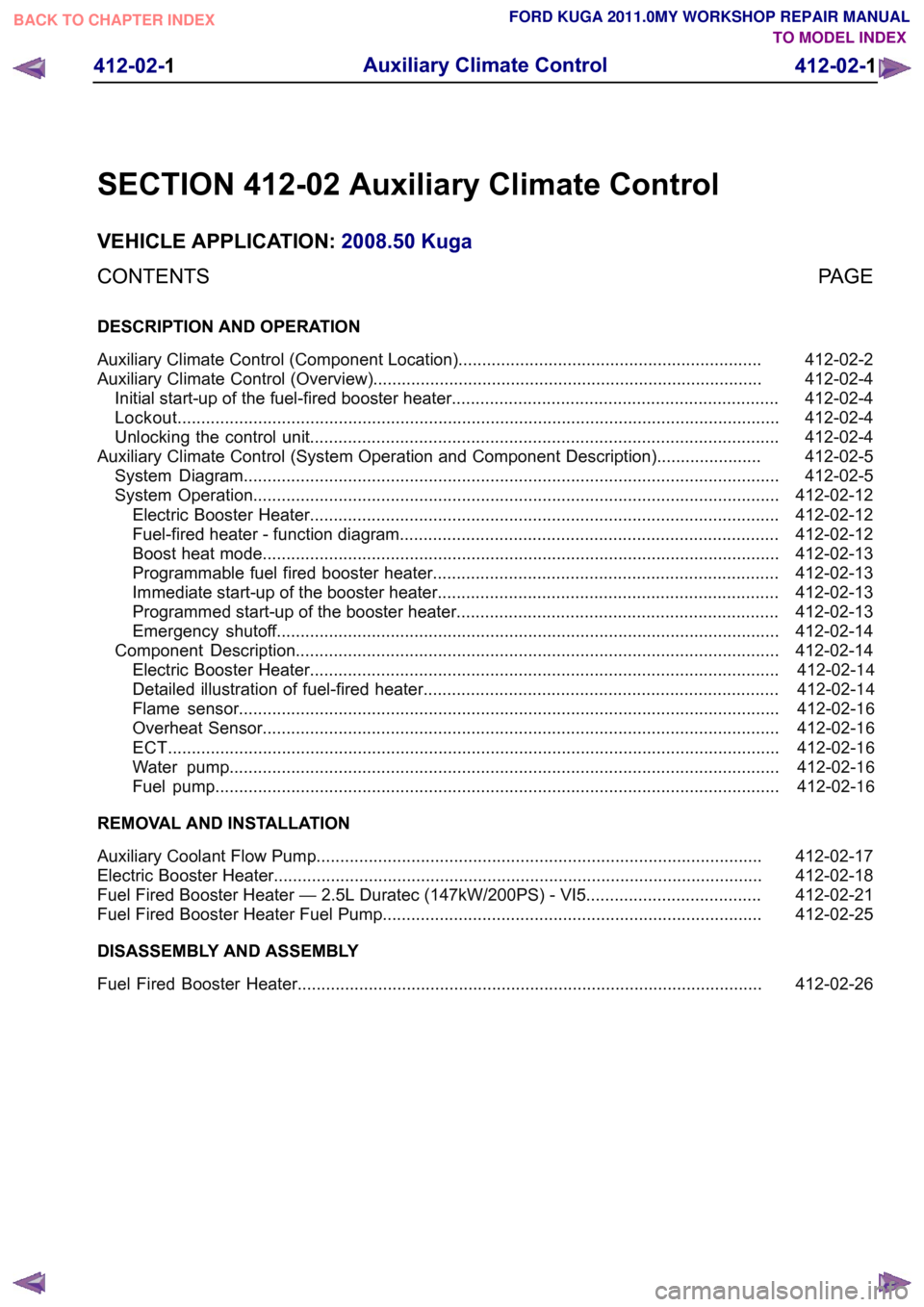
SECTION 412-02 Auxiliary Climate Control
VEHICLE APPLICATION:
2008.50 Kuga
PAGE
CONTENTS
DESCRIPTION AND OPERATION
412-02-2
Auxiliary Climate Control (Component Location) ................................................................
412-02-4
Auxiliary Climate Control (Overview) ..................................................................................
412-02-4
Initial start-up of the fuel-fired booster heater .....................................................................
412-02-4
Lockout ...............................................................................................................................
412-02-4
Unlocking the control unit ...................................................................................................
412-02-5
Auxiliary Climate Control (System Operation and Component Description) ......................
412-02-5
System Diagram.................................................................................................................
412-02-12
System Operation ...............................................................................................................
412-02-12
Electric Booster Heater ...................................................................................................
412-02-12
Fuel-fired heater - function diagram................................................................................
412-02-13
Boost heat mode.............................................................................................................
412-02-13
Programmable fuel fired booster heater .........................................................................
412-02-13
Immediate start-up of the booster heater ........................................................................
412-02-13
Programmed start-up of the booster heater ....................................................................
412-02-14
Emergency shutoff ..........................................................................................................
412-02-14
Component Description ......................................................................................................412-02-14Electric Booster Heater...................................................................................................
412-02-14Detailed illustration of fuel-fired heater ...........................................................................
412-02-16Flame sensor..................................................................................................................
412-02-16Overheat Sensor.............................................................................................................
412-02-16ECT.................................................................................................................................
412-02-16Water pump....................................................................................................................
412-02-16Fuel pump.......................................................................................................................
REMOVAL AND INSTALLATION 412-02-17
Auxiliary Coolant Flow Pump ..............................................................................................
412-02-18
Electric Booster Heater .......................................................................................................
412-02-21
Fuel Fired Booster Heater — 2.5L Duratec (147kW/200PS) - VI5 .....................................
412-02-25
Fuel Fired Booster Heater Fuel Pump ................................................................................
DISASSEMBLY AND ASSEMBLY 412-02-26
Fuel Fired Booster Heater .................................................................................................. 412-02-1
Auxiliary Climate Control
412-02-1
.
TO MODEL INDEX
BACK TO CHAPTER INDEX
FORD KUGA 2011.0MY WORKSHOP REPAIR MANUAL
Page 156 of 2057
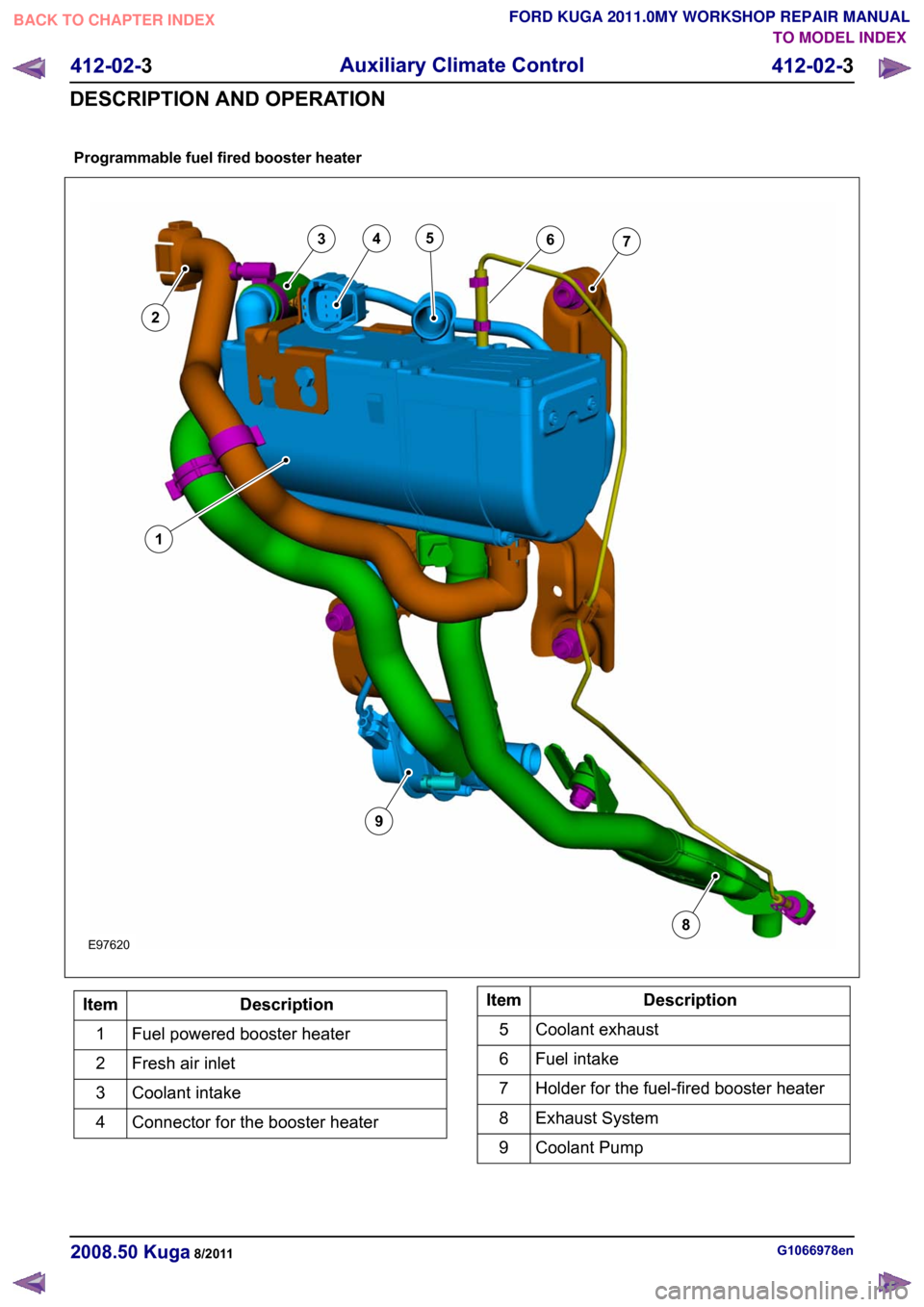
Programmable fuel fired booster heater
Description
Item
Fuel powered booster heater
1
Fresh air inlet
2
Coolant intake
3
Connector for the booster heater
4 Description
Item
Coolant exhaust
5
Fuel intake
6
Holder for the fuel-fired booster heater
7
Exhaust System
8
Coolant Pump
9 G1066978en
2008.50 Kuga 8/2011 412-02-3
Auxiliary Climate Control
412-02-3
DESCRIPTION AND OPERATIONTO MODEL INDEX
BACK TO CHAPTER INDEX
FORD KUGA 2011.0MY WORKSHOP REPAIR MANUAL269835471E97620
Page 157 of 2057
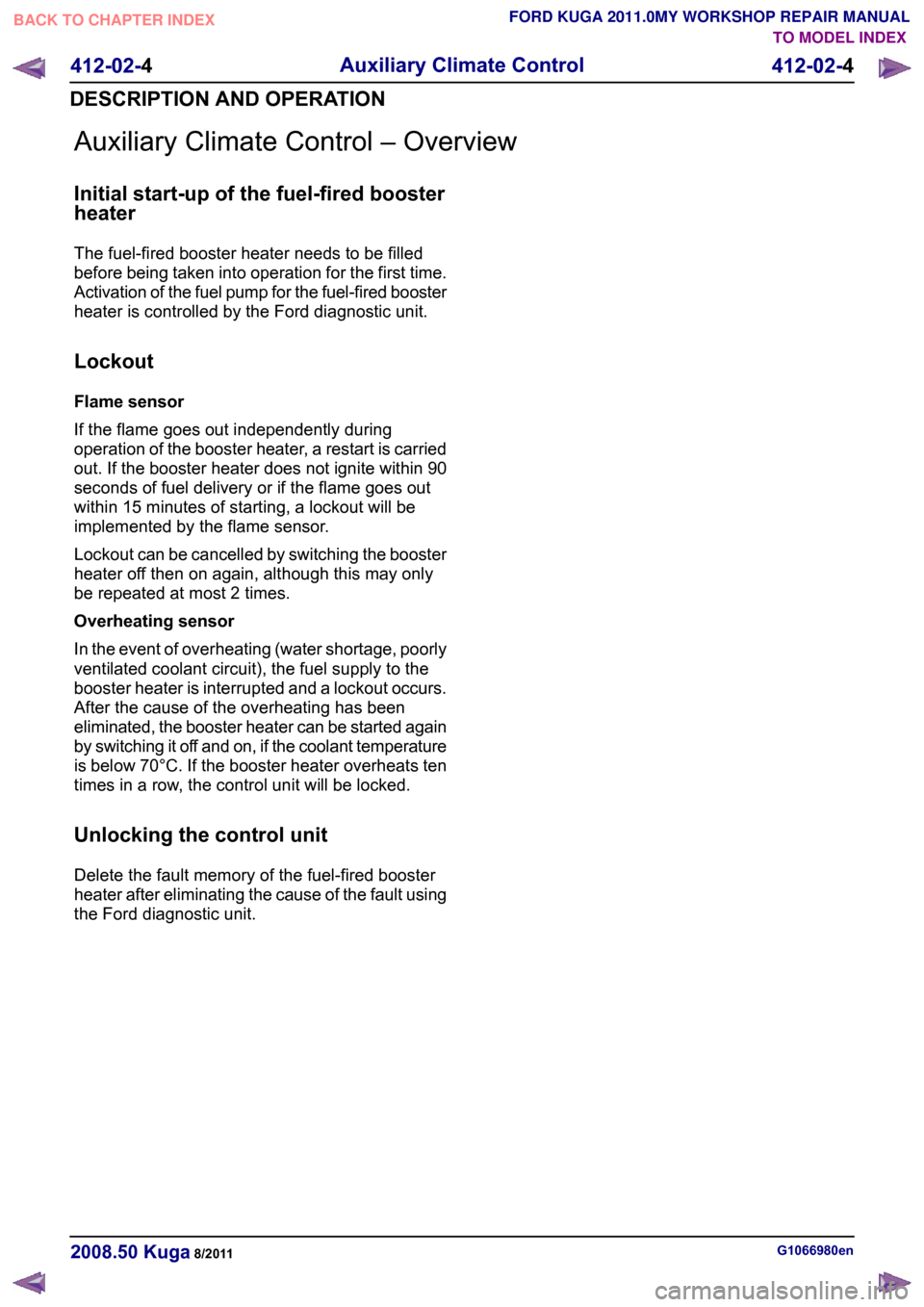
Auxiliary Climate Control – Overview
Initial start-up of the fuel-fired booster
heater
The fuel-fired booster heater needs to be filled
before being taken into operation for the first time.
Activation of the fuel pump for the fuel-fired booster
heater is controlled by the Ford diagnostic unit.
Lockout
Flame sensor
If the flame goes out independently during
operation of the booster heater, a restart is carried
out. If the booster heater does not ignite within 90
seconds of fuel delivery or if the flame goes out
within 15 minutes of starting, a lockout will be
implemented by the flame sensor.
Lockout can be cancelled by switching the booster
heater off then on again, although this may only
be repeated at most 2 times.
Overheating sensor
In the event of overheating (water shortage, poorly
ventilated coolant circuit), the fuel supply to the
booster heater is interrupted and a lockout occurs.
After the cause of the overheating has been
eliminated, the booster heater can be started again
by switching it off and on, if the coolant temperature
is below 70°C. If the booster heater overheats ten
times in a row, the control unit will be locked.
Unlocking the control unit
Delete the fault memory of the fuel-fired booster
heater after eliminating the cause of the fault using
the Ford diagnostic unit.
G1066980en
2008.50 Kuga 8/2011 412-02-4
Auxiliary Climate Control
412-02-4
DESCRIPTION AND OPERATIONTO MODEL INDEX
BACK TO CHAPTER INDEX
FORD KUGA 2011.0MY WORKSHOP REPAIR MANUAL
Page 166 of 2057
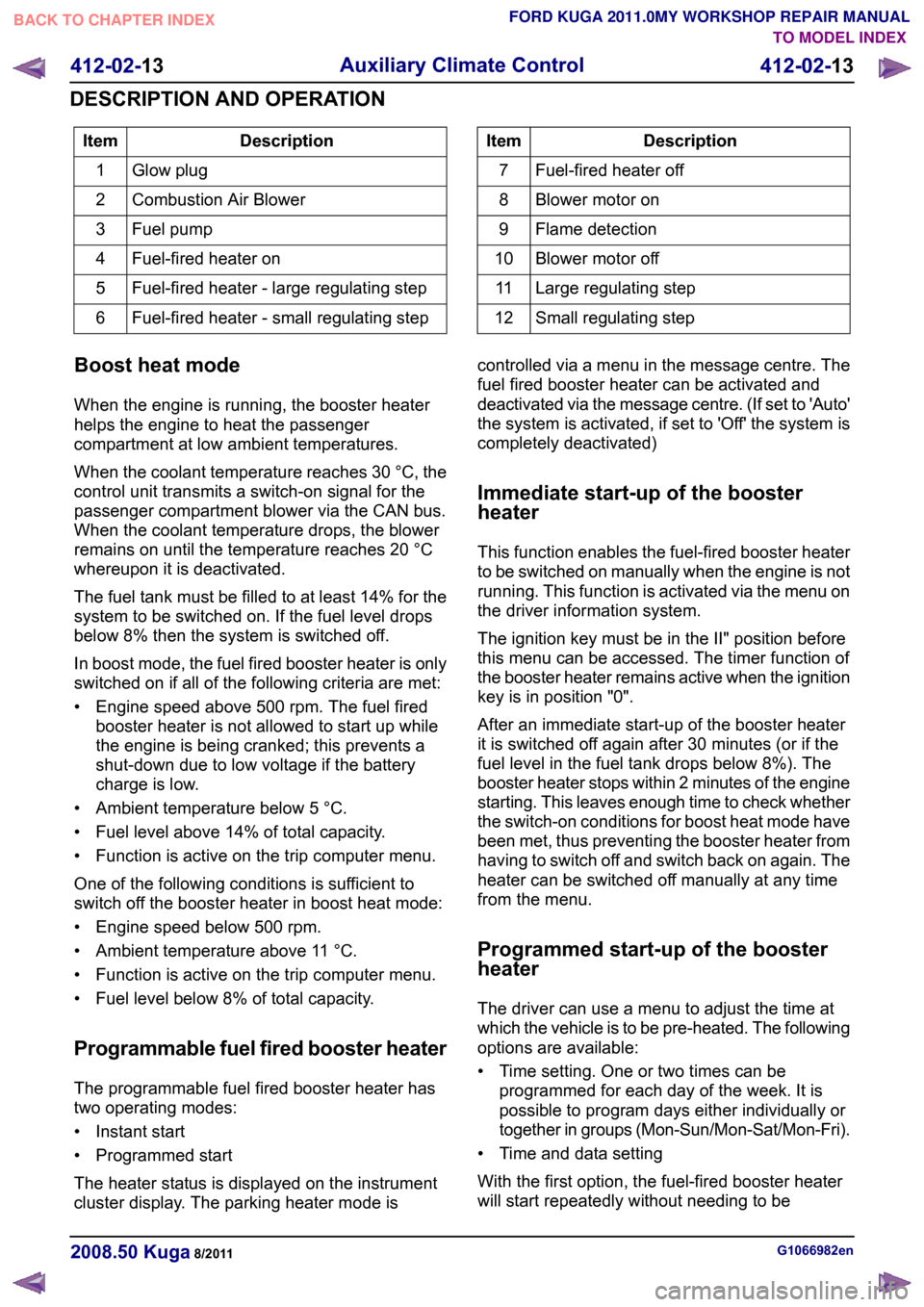
Description
Item
Glow plug
1
Combustion Air Blower
2
Fuel pump
3
Fuel-fired heater on
4
Fuel-fired heater - large regulating step
5
Fuel-fired heater - small regulating step
6 Description
Item
Fuel-fired heater off
7
Blower motor on
8
Flame detection
9
Blower motor off
10
Large regulating step
11
Small regulating step
12
Boost heat mode
When the engine is running, the booster heater
helps the engine to heat the passenger
compartment at low ambient temperatures.
When the coolant temperature reaches 30 °C, the
control unit transmits a switch-on signal for the
passenger compartment blower via the CAN bus.
When the coolant temperature drops, the blower
remains on until the temperature reaches 20 °C
whereupon it is deactivated.
The fuel tank must be filled to at least 14% for the
system to be switched on. If the fuel level drops
below 8% then the system is switched off.
In boost mode, the fuel fired booster heater is only
switched on if all of the following criteria are met:
• Engine speed above 500 rpm. The fuel fired booster heater is not allowed to start up while
the engine is being cranked; this prevents a
shut-down due to low voltage if the battery
charge is low.
• Ambient temperature below 5 °C.
• Fuel level above 14% of total capacity.
• Function is active on the trip computer menu.
One of the following conditions is sufficient to
switch off the booster heater in boost heat mode:
• Engine speed below 500 rpm.
• Ambient temperature above 11 °C.
• Function is active on the trip computer menu.
• Fuel level below 8% of total capacity.
Programmable fuel fired booster heater
The programmable fuel fired booster heater has
two operating modes:
• Instant start
• Programmed start
The heater status is displayed on the instrument
cluster display. The parking heater mode is controlled via a menu in the message centre. The
fuel fired booster heater can be activated and
deactivated via the message centre. (If set to 'Auto'
the system is activated, if set to 'Off' the system is
completely deactivated)
Immediate start-up of the booster
heater
This function enables the fuel-fired booster heater
to be switched on manually when the engine is not
running. This function is activated via the menu on
the driver information system.
The ignition key must be in the II" position before
this menu can be accessed. The timer function of
the booster heater remains active when the ignition
key is in position "0".
After an immediate start-up of the booster heater
it is switched off again after 30 minutes (or if the
fuel level in the fuel tank drops below 8%). The
booster heater stops within 2 minutes of the engine
starting. This leaves enough time to check whether
the switch-on conditions for boost heat mode have
been met, thus preventing the booster heater from
having to switch off and switch back on again. The
heater can be switched off manually at any time
from the menu.
Programmed start-up of the booster
heater
The driver can use a menu to adjust the time at
which the vehicle is to be pre-heated. The following
options are available:
• Time setting. One or two times can be
programmed for each day of the week. It is
possible to program days either individually or
together in groups (Mon-Sun/Mon-Sat/Mon-Fri).
• Time and data setting
With the first option, the fuel-fired booster heater
will start repeatedly without needing to be G1066982en
2008.50 Kuga 8/2011 412-02-13
Auxiliary Climate Control
412-02-13
DESCRIPTION AND OPERATIONTO MODEL INDEX
BACK TO CHAPTER INDEX
FORD KUGA 2011.0MY WORKSHOP REPAIR MANUAL
Page 169 of 2057
Description
Item
Combustion chamber
16
'O' Ring
17 Description
Item
Combustion blower motor cover
18
Glow plug wiring harness
19
Flame sensor
If the flame goes out independently during
operation of the booster heater, a restart is carried
out. If the booster heater does not ignite within 90
seconds of fuel delivery or if the flame goes out
within 15 minutes of starting, a lockout will be
implemented by the flame sensor.
Lockout can be cancelled by switching the booster
heater off then on again, although this may only
be repeated at most 2 times.
Overheat Sensor
The overheating sensor enables the fuel-fired
booster heater module to determine the coolant
temperature, protecting the heater from
overheating. The overheating sensor is installed
next to the coolant temperature sensor under a
cover on the top of the fuel-fired heater.
In the event of overheating (lack of water, poorly
ventilated coolant circuit), the fuel supply to the
heater is interrupted and a lockout occurs. After
the cause of the overheating has been eliminated,
the heater can be restarted by switching it off and
on again, if the coolant temperature is below 70°C.
If the heater overheats ten times in a row, the
control unit is locked.
ECT
The fuel-fired booster heater module uses the
temperature sensor to determine the coolant
temperature, which it then uses to set the starting
and stopping time. The coolant temperature sensor
is installed next to the overheating sensor under a
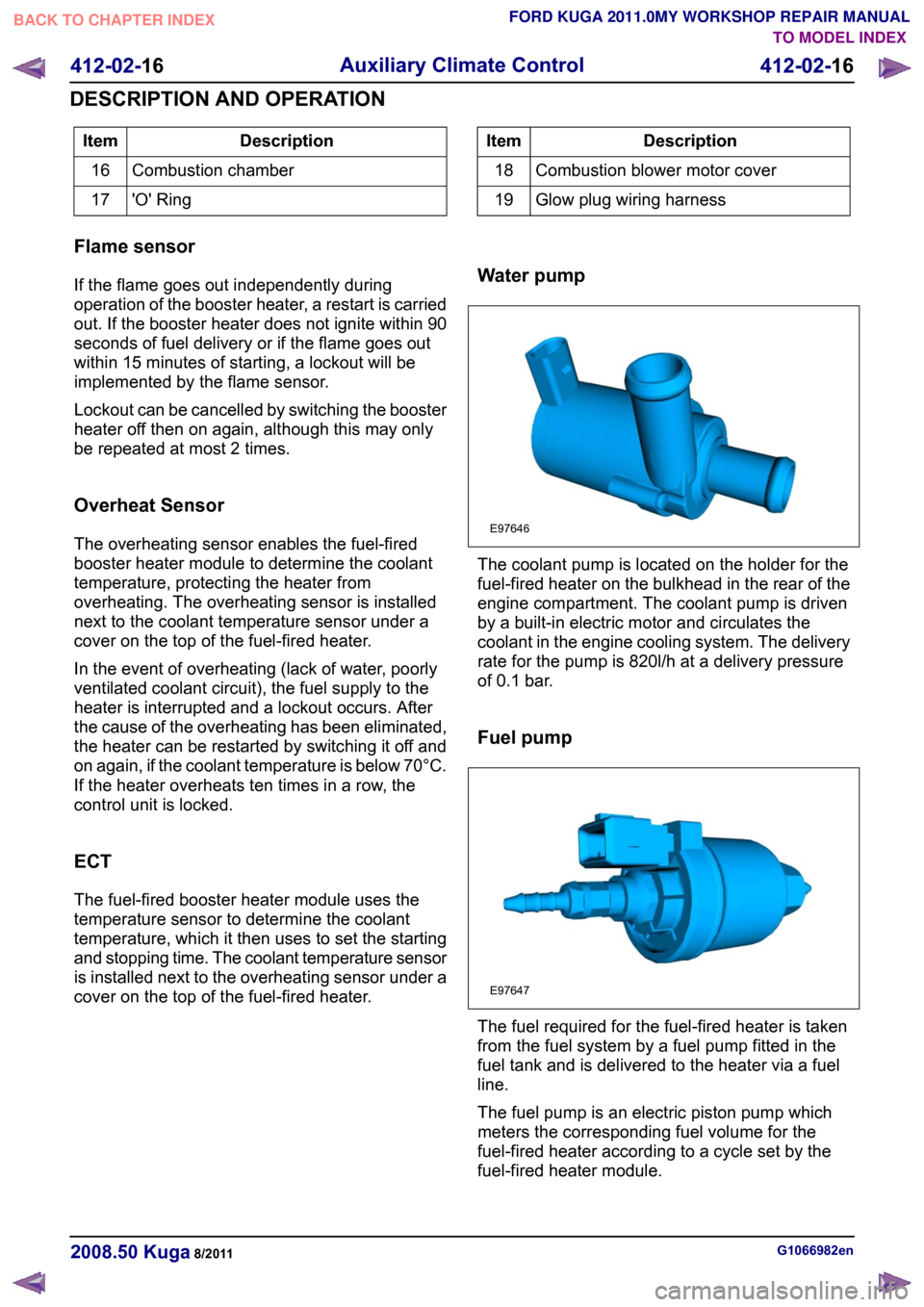
cover on the top of the fuel-fired heater. Water pump The coolant pump is located on the holder for the
fuel-fired heater on the bulkhead in the rear of the
engine compartment. The coolant pump is driven
by a built-in electric motor and circulates the
coolant in the engine cooling system. The delivery
rate for the pump is 820l/h at a delivery pressure
of 0.1 bar.
Fuel pump
The fuel required for the fuel-fired heater is taken
from the fuel system by a fuel pump fitted in the
fuel tank and is delivered to the heater via a fuel
line.
The fuel pump is an electric piston pump which
meters the corresponding fuel volume for the
fuel-fired heater according to a cycle set by the
fuel-fired heater module.
G1066982en
2008.50 Kuga 8/2011 412-02-16
Auxiliary Climate Control
412-02-16
DESCRIPTION AND OPERATIONTO MODEL INDEX
BACK TO CHAPTER INDEX
FORD KUGA 2011.0MY WORKSHOP REPAIR MANUALE97646 E97647