warning FORD MONDEO 2006 2.G Repair Manual
[x] Cancel search | Manufacturer: FORD, Model Year: 2006, Model line: MONDEO, Model: FORD MONDEO 2006 2.GPages: 198, PDF Size: 4.69 MB
Page 121 of 198
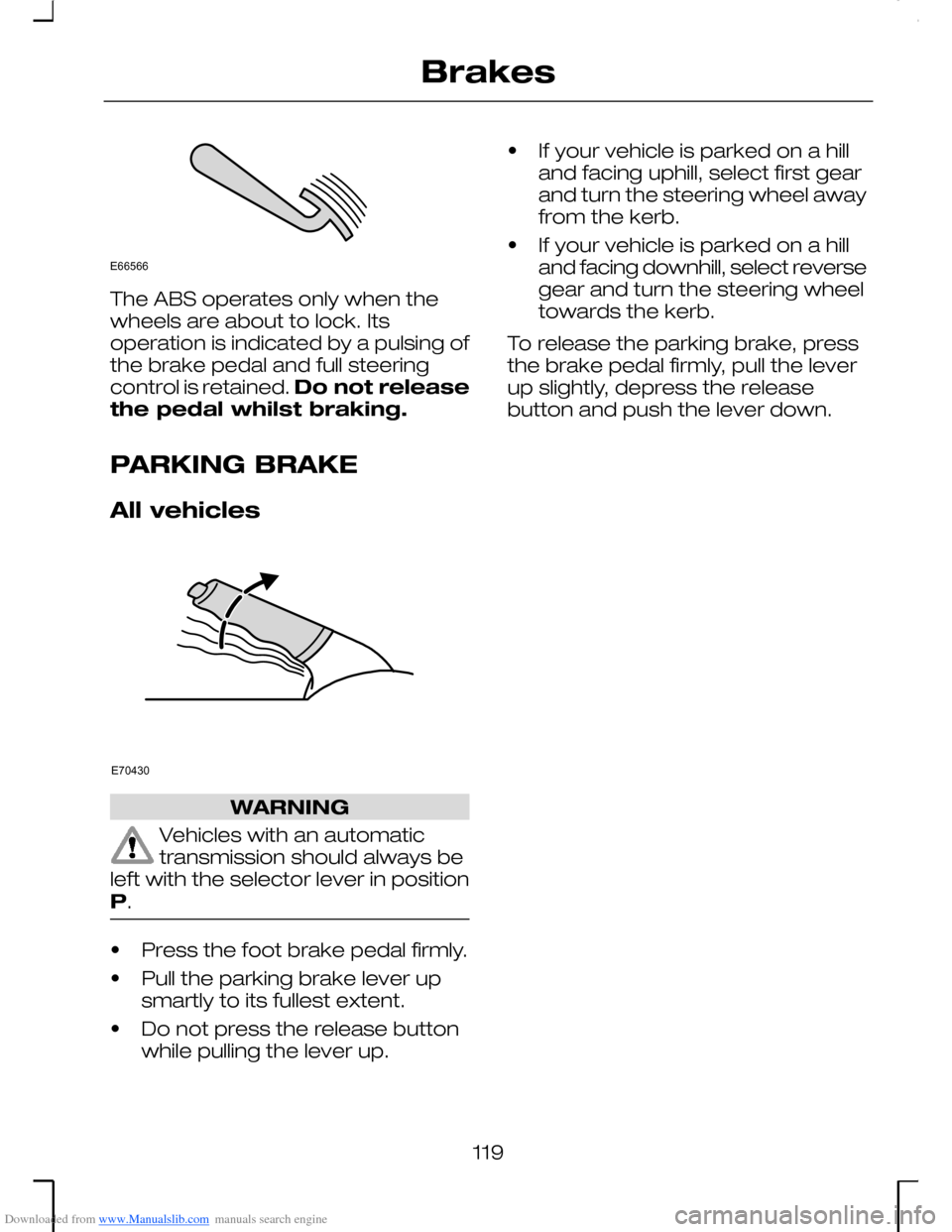
Downloaded from www.Manualslib.com manuals search engine The ABS operates only when thewheels are about to lock. Itsoperation is indicated by a pulsing ofthe brake pedal and full steeringcontrol is retained. Do not releasethe pedal whilst braking.
PARKING BRAKE
All vehicles
WARNING
Vehicles with an automatictransmission should always beleft with the selector lever in positionP.
•Press the foot brake pedal firmly.
•Pull the parking brake lever upsmartly to its fullest extent.
•Do not press the release buttonwhile pulling the lever up.
•If your vehicle is parked on a hilland facing uphill, select first gearand turn the steering wheel awayfrom the kerb.
•If your vehicle is parked on a hilland facing downhill, select reversegear and turn the steering wheeltowards the kerb.
To release the parking brake, pressthe brake pedal firmly, pull the leverup slightly, depress the releasebutton and push the lever down.
119
BrakesE66566 E70430
Page 122 of 198
Downloaded from www.Manualslib.com manuals search engine PRINCIPLE OF
OPERATION
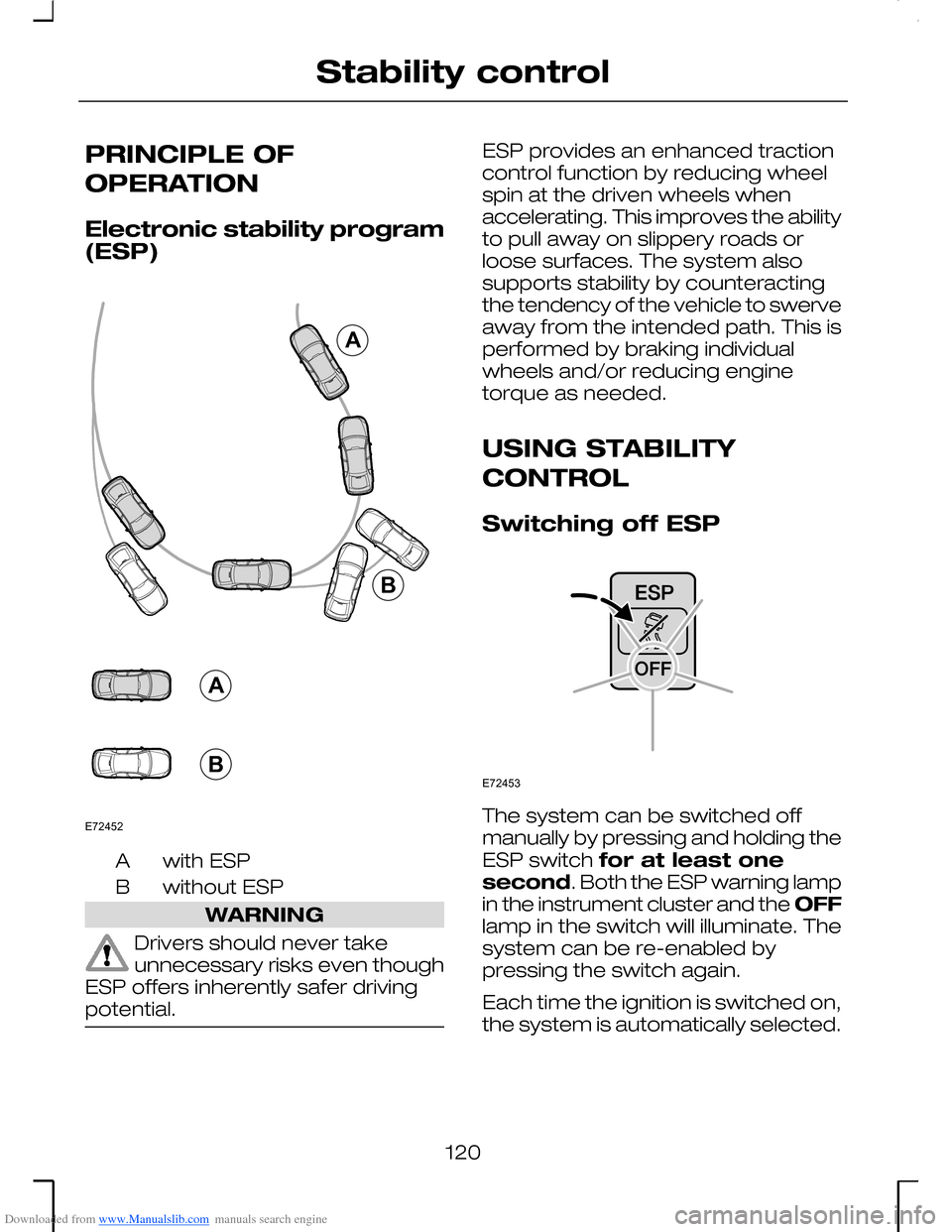
Electronic stability program(ESP)
with ESPA
without ESPB
WARNING
Drivers should never takeunnecessary risks even thoughESP offers inherently safer drivingpotential.
ESP provides an enhanced tractioncontrol function by reducing wheelspin at the driven wheels whenaccelerating. This improves the abilityto pull away on slippery roads orloose surfaces. The system alsosupports stability by counteractingthe tendency of the vehicle to swerveaway from the intended path. This isperformed by braking individualwheels and/or reducing enginetorque as needed.
USING STABILITY
CONTROL
Switching off ESP
The system can be switched offmanually by pressing and holding theESP switch for at least onesecond. Both the ESP warning lampin the instrument cluster and the OFFlamp in the switch will illuminate. Thesystem can be re-enabled bypressing the switch again.
Each time the ignition is switched on,the system is automatically selected.
120
Stability controlAABBE72452 E72453
Page 123 of 198
Downloaded from www.Manualslib.com manuals search engine PRINCIPLE OF
OPERATION
WARNING
Drivers should never takeunnecessary risks even thoughthe system offers inherently saferdriving potential.
The system reduces wheel spin atthe driven wheels at speeds up to 40km/h (25 mph).
The system may become activewhen accelerating on a slippery roador loose surface, or when pullingaway on a hill.
USING TRACTION
CONTROL
Note: If the indicator lamp does notilluminate when the ignition isswitched on or stays illuminatedwhilst driving, it indicates amalfunction. During a malfunction thesystem will be switched off. Have thesystem checked by an expert.
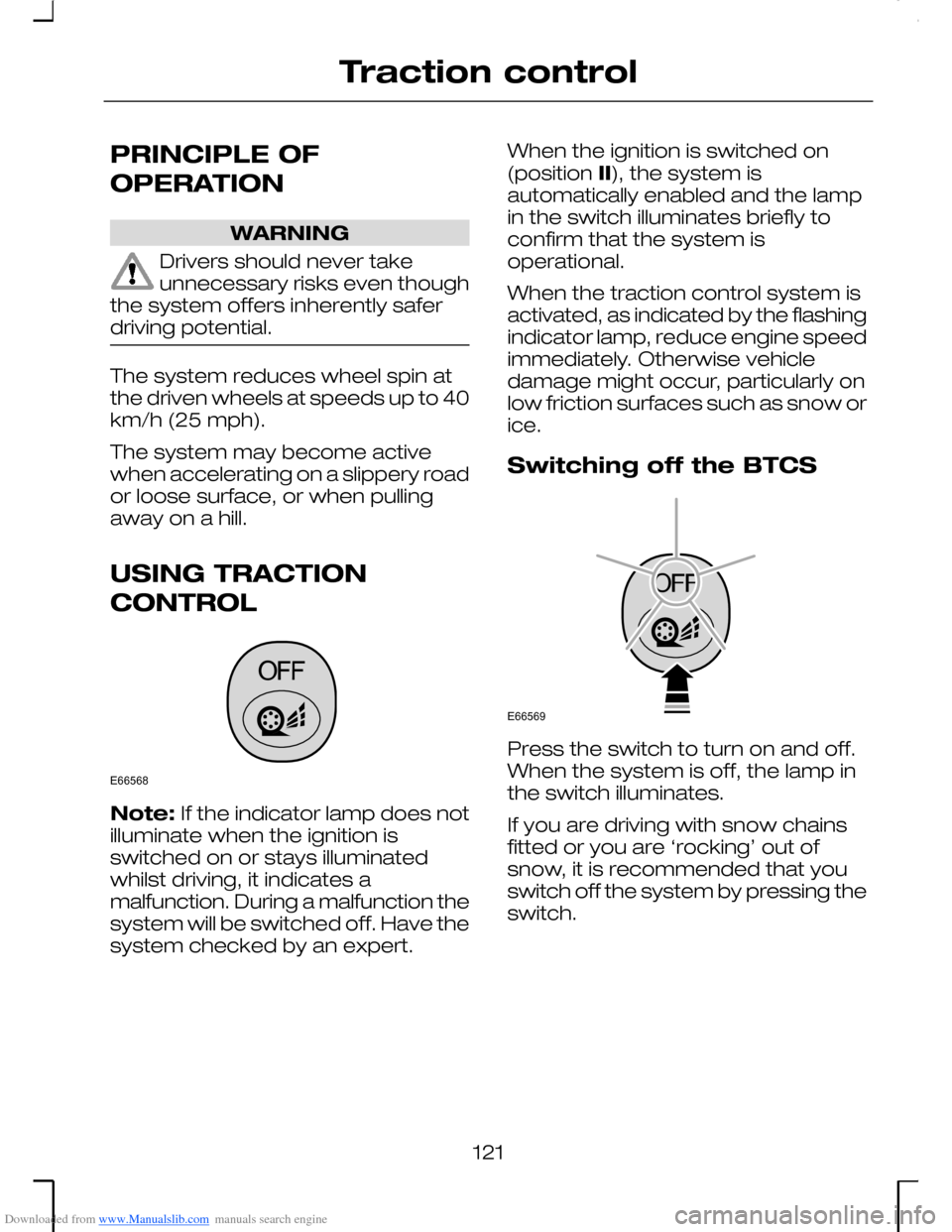
When the ignition is switched on(position II), the system isautomatically enabled and the lampin the switch illuminates briefly toconfirm that the system isoperational.
When the traction control system isactivated, as indicated by the flashingindicator lamp, reduce engine speedimmediately. Otherwise vehicledamage might occur, particularly onlow friction surfaces such as snow orice.
Switching off the BTCS
Press the switch to turn on and off.When the system is off, the lamp inthe switch illuminates.
If you are driving with snow chainsfitted or you are ‘rocking’ out ofsnow, it is recommended that youswitch off the system by pressing theswitch.
121
Traction controlE66568 E66569
Page 125 of 198
Downloaded from www.Manualslib.com manuals search engine PRINCIPLE OF
OPERATION
WARNING
The parking aid is an auxiliarysystem which is not intended torelieve the driver of his responsibilityfor exercising due care and attentionwhen reversing. In particular, someobjects close to the vehicle (approx.30 cm) and above or below thesensors may not be detected by thepark distance sensor and causedamage to the vehicle. Ultrasonicwaves, heavy rain and/or conditionscausing disruptive reflections maylead to objects not being detectedby the sensors. In addition, objectswhich absorb ultrasonic waves maynot always be detected due to theirunfavourable surface characteristics.
USING THE PARKING AID
WARNING
Be careful when a tow bar isinstalled.
Note: If the vehicle is fitted with anoriginal Ford fixed tow bar, particularcare must be taken when reversing.
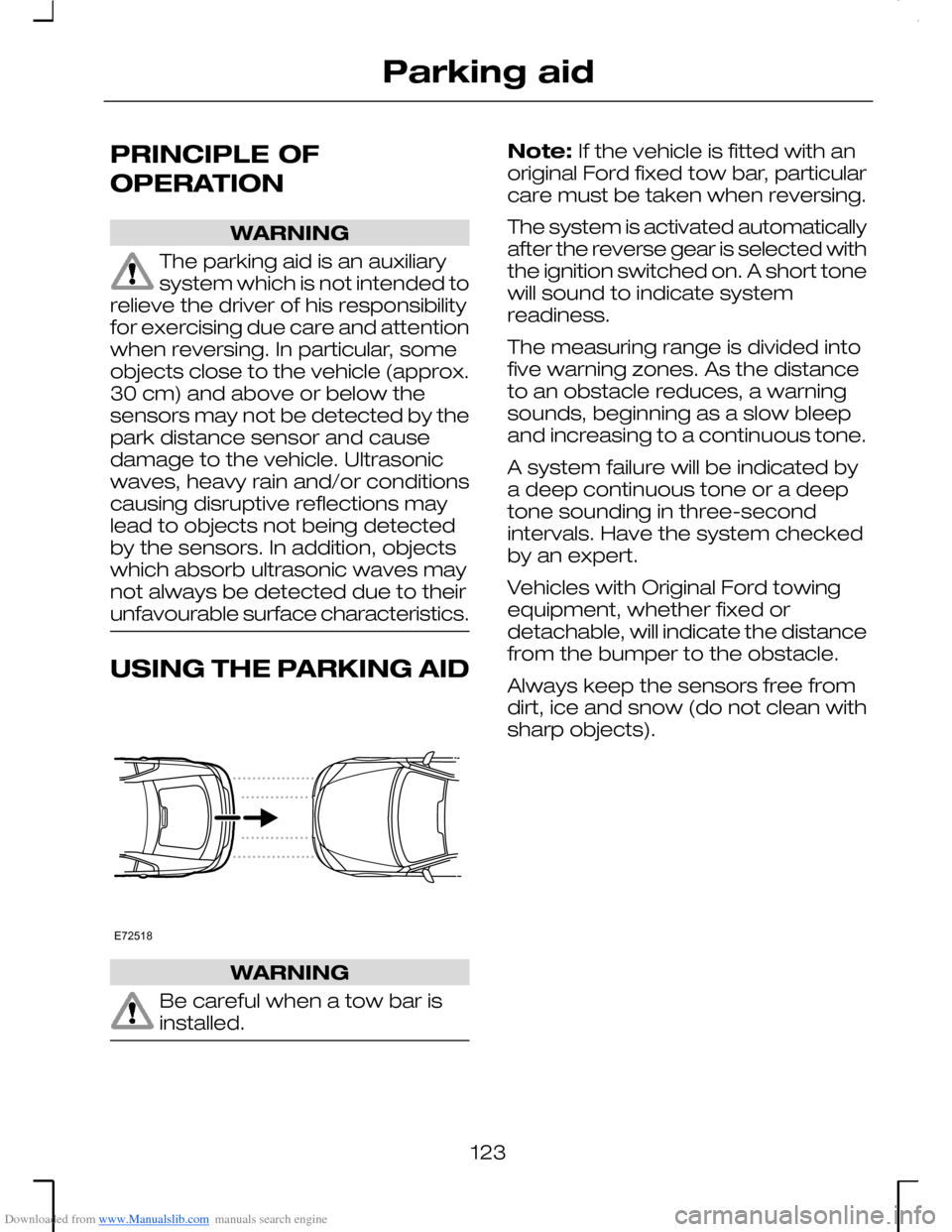
The system is activated automaticallyafter the reverse gear is selected withthe ignition switched on. A short tonewill sound to indicate systemreadiness.
The measuring range is divided intofive warning zones. As the distanceto an obstacle reduces, a warningsounds, beginning as a slow bleepand increasing to a continuous tone.
A system failure will be indicated bya deep continuous tone or a deeptone sounding in three-secondintervals. Have the system checkedby an expert.
Vehicles with Original Ford towingequipment, whether fixed ordetachable, will indicate the distancefrom the bumper to the obstacle.
Always keep the sensors free fromdirt, ice and snow (do not clean withsharp objects).
123
Parking aidE72518
Page 126 of 198
Downloaded from www.Manualslib.com manuals search engine PRINCIPLE OF
OPERATION
WARNING
Don not use cruise control inheavy traffic, on twisty roads orwhen the road surface is slippery.
The cruise control systemautomatically adjusts the poweroutput of the engine to maintain thestored speed. When travellingdownhill, vehicle speed may increaseabove the stored speed as thesystem does not apply the brakes.In this case, changing down a gearand then pressing the RES buttonmay assist the system in returningthe vehicle to the stored speed.
The system will not function until thevehicle speed is above 40 km/h (25mph). On vehicles with a dieselengine, the system will not functionin first or second gear.
USING CRUISE CONTROL
Switching cruise control onand off
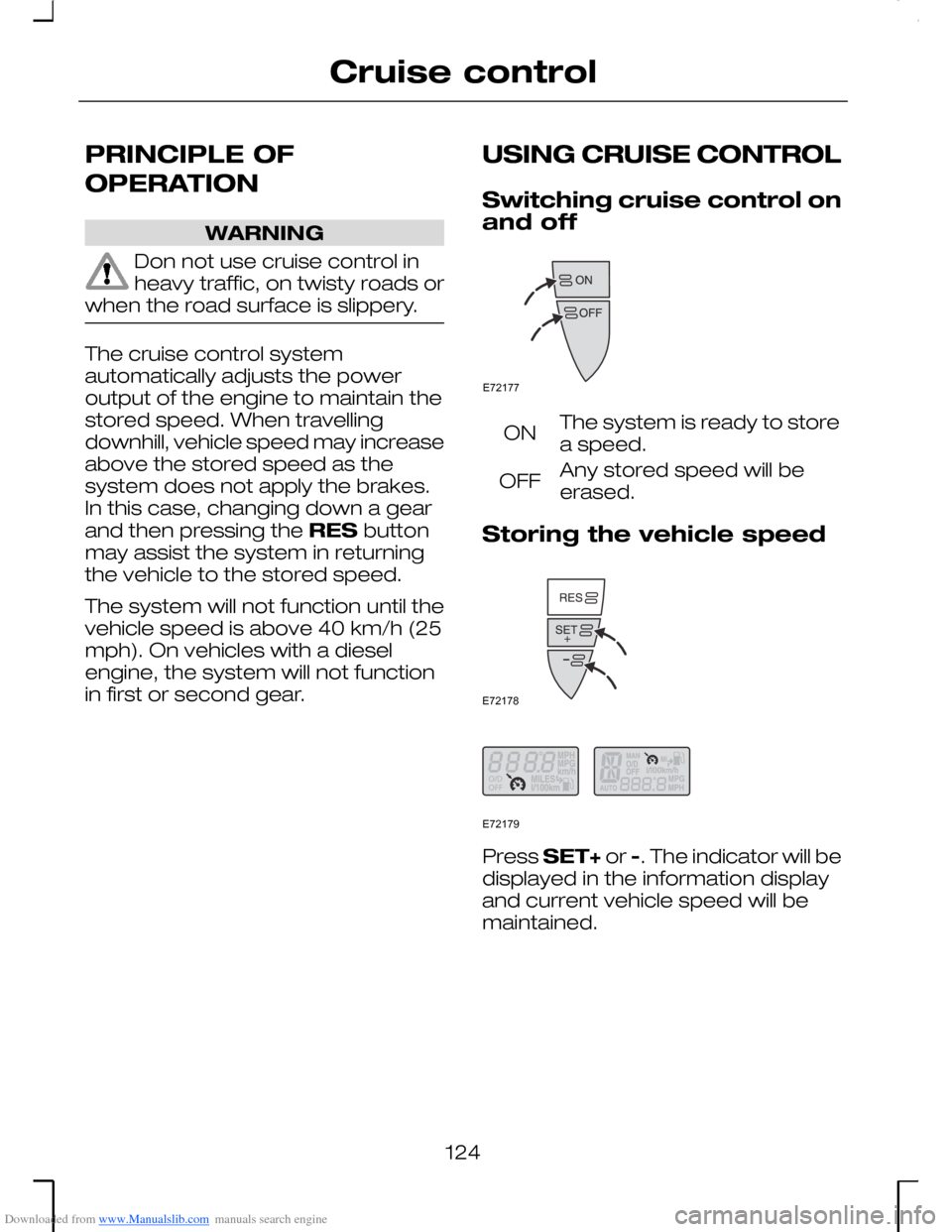
The system is ready to storea speed.ON
Any stored speed will beerased.OFF
Storing the vehicle speed
Press SET+ or -. The indicator will bedisplayed in the information displayand current vehicle speed will bemaintained.
124
Cruise controlE72177 E72178 E72179
Page 128 of 198
Downloaded from www.Manualslib.com manuals search engine GENERAL INFORMATION
WARNINGS
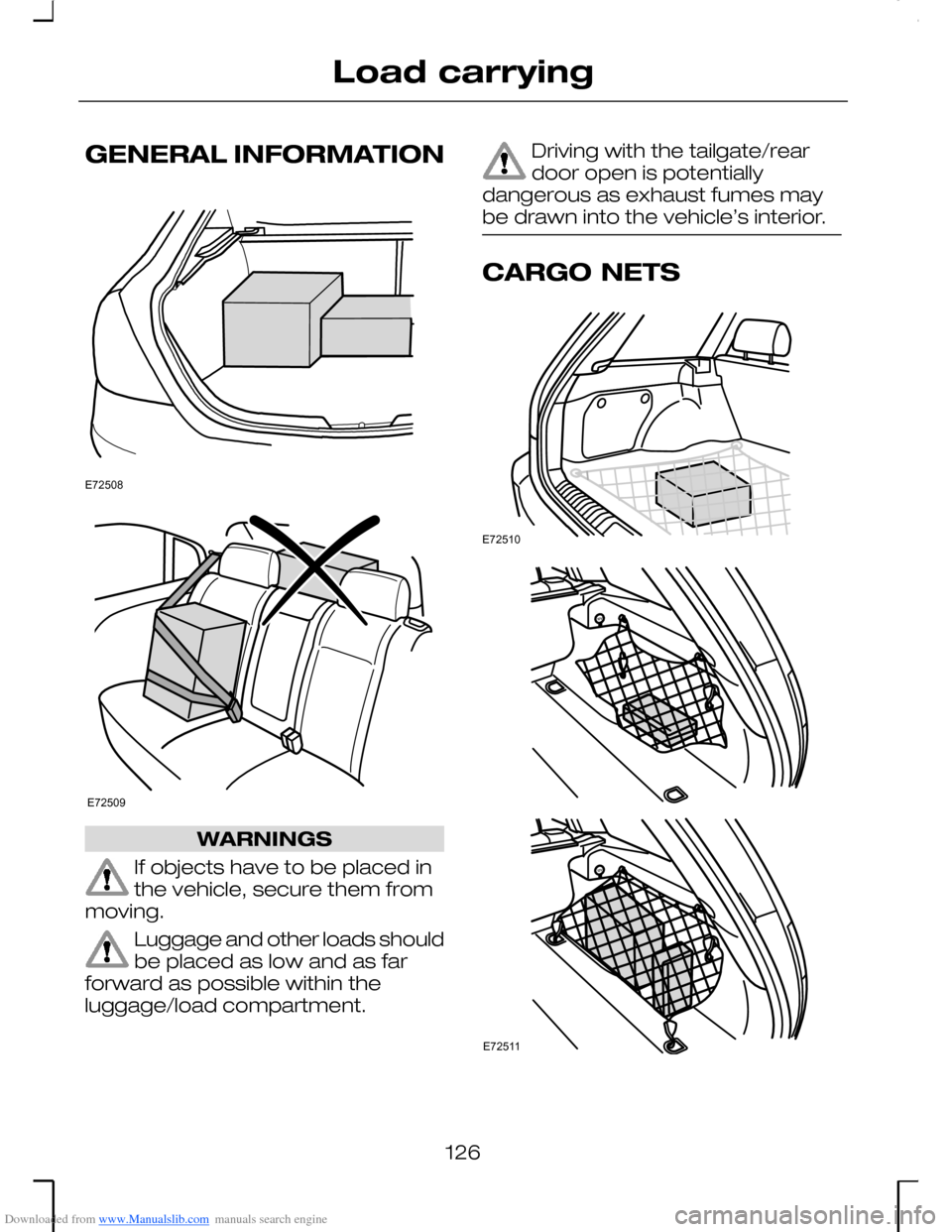
If objects have to be placed inthe vehicle, secure them frommoving.
Luggage and other loads shouldbe placed as low and as farforward as possible within theluggage/load compartment.
Driving with the tailgate/reardoor open is potentiallydangerous as exhaust fumes maybe drawn into the vehicle’s interior.
CARGO NETS
126
Load carryingE72508 E72509 E72510 E72511
Page 129 of 198
Downloaded from www.Manualslib.com manuals search engine A luggage net can be attached to thefour retaining points on the load areafloor. It can prevent objects slidingaround.
LUGGAGE COVERS
WARNING
Do not place objects on theluggage cover.
5-door
Removal
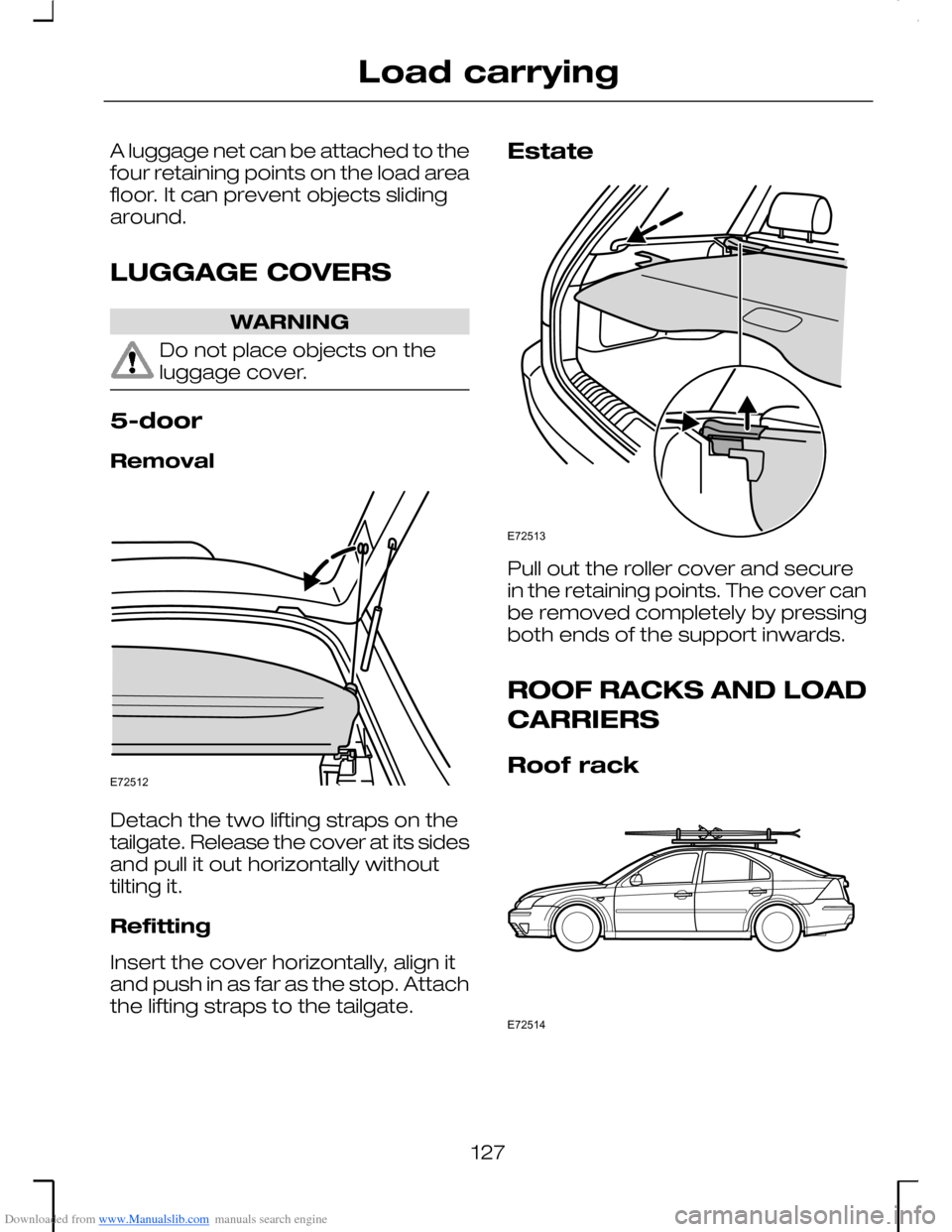
Detach the two lifting straps on thetailgate. Release the cover at its sidesand pull it out horizontally withouttilting it.
Refitting
Insert the cover horizontally, align itand push in as far as the stop. Attachthe lifting straps to the tailgate.
Estate
Pull out the roller cover and securein the retaining points. The cover canbe removed completely by pressingboth ends of the support inwards.
ROOF RACKS AND LOAD
CARRIERS
Roof rack
127
Load carryingE72512 E72513 E72514
Page 130 of 198
Downloaded from www.Manualslib.com manuals search engine WARNING
Driving with a roof load can havea negative influence on thedriveability of the vehicle.
Roof rails (Estate)
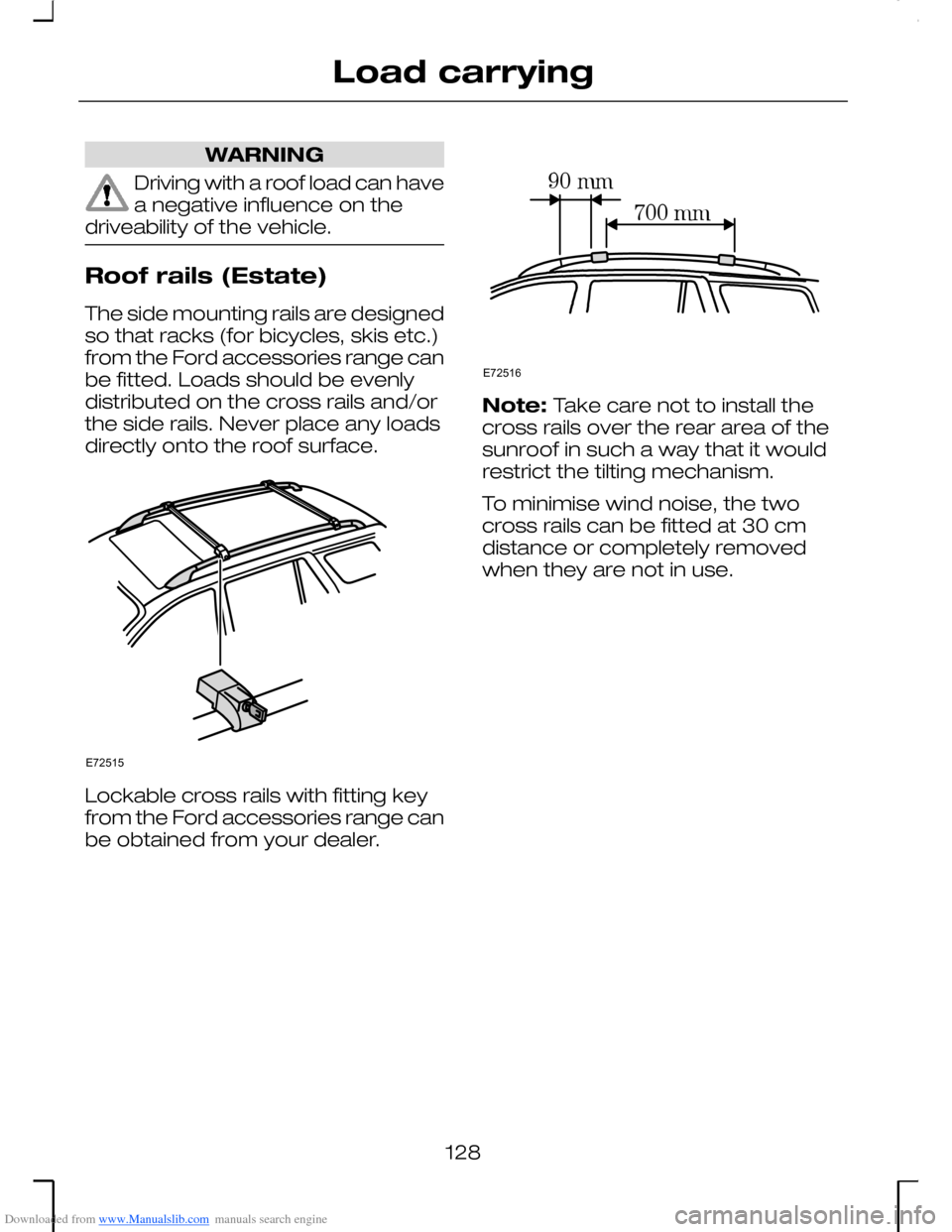
The side mounting rails are designedso that racks (for bicycles, skis etc.)from the Ford accessories range canbe fitted. Loads should be evenlydistributed on the cross rails and/orthe side rails. Never place any loadsdirectly onto the roof surface.
Lockable cross rails with fitting keyfrom the Ford accessories range canbe obtained from your dealer.
Note: Take care not to install thecross rails over the rear area of thesunroof in such a way that it wouldrestrict the tilting mechanism.
To minimise wind noise, the twocross rails can be fitted at 30 cmdistance or completely removedwhen they are not in use.
128
Load carryingE72515 E72516
Page 131 of 198
Downloaded from www.Manualslib.com manuals search engine TOWING A TRAILER
Note: Mondeo ST vehicles are notapproved for trailer towing.
The maximum vehicle and trailerpayloads represent technicallybinding values for gradients up to 12% and at an altitude of 1 000 metresabove sea level. In high altituderegions, thinner atmosphere canreduce engine performance so thefollowing restrictions will apply:
Above 1 000 metres, the stipulatedmaximum permitted gross trainweight must be reduced by 10 % forevery 1 000 metres in altitude.
Steep gradients
WARNING
The overrun brake on a trailer isnot controlled by the anti-lockbraking system.
Change down in plenty of timebefore downhill gradients.
For vehicles with an automatictransmission, if downhill modeprovides insufficient braking thenselect manual mode and second orfirst gear as necessary.
ESSENTIAL TOWING
CHECKS
WARNING
If any of the following conditionscannot be met, do not use thetow bar and have it inspected by anexpert.
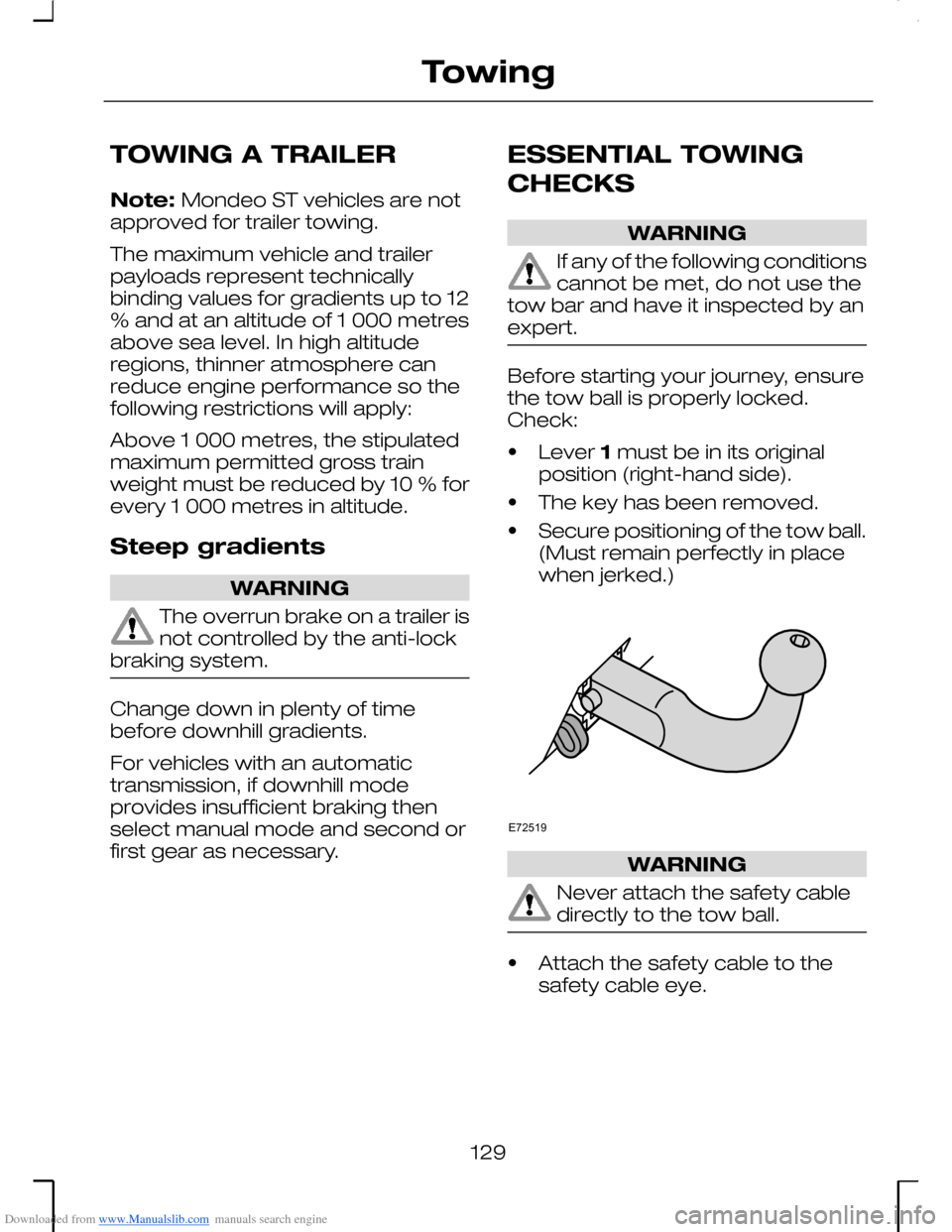
Before starting your journey, ensurethe tow ball is properly locked.Check:
•Lever 1 must be in its originalposition (right-hand side).
•The key has been removed.
•Secure positioning of the tow ball.(Must remain perfectly in placewhen jerked.)
WARNING
Never attach the safety cabledirectly to the tow ball.
•Attach the safety cable to thesafety cable eye.
129
TowingE72519
Page 132 of 198
Downloaded from www.Manualslib.com manuals search engine DETACHABLE TOW BALL
WARNINGS
Remove and reinstall the towball regularly to keep the lockingmechanism working smoothly.
Do not use any tools formounting/dismounting the towball. Do not modify the trailercoupling. Do not disassemble/repairthe tow ball.
To avoid risk of injury, neverunlock the tow ball with thetrailer attached.
To avoid risk of injury, neverleave the detached tow ballunsecured inside the vehicle.
Note: When the tow ball is not inuse, always remove it and secure itwith the strap to the eye on theright-hand side in the rear of theluggage compartment.
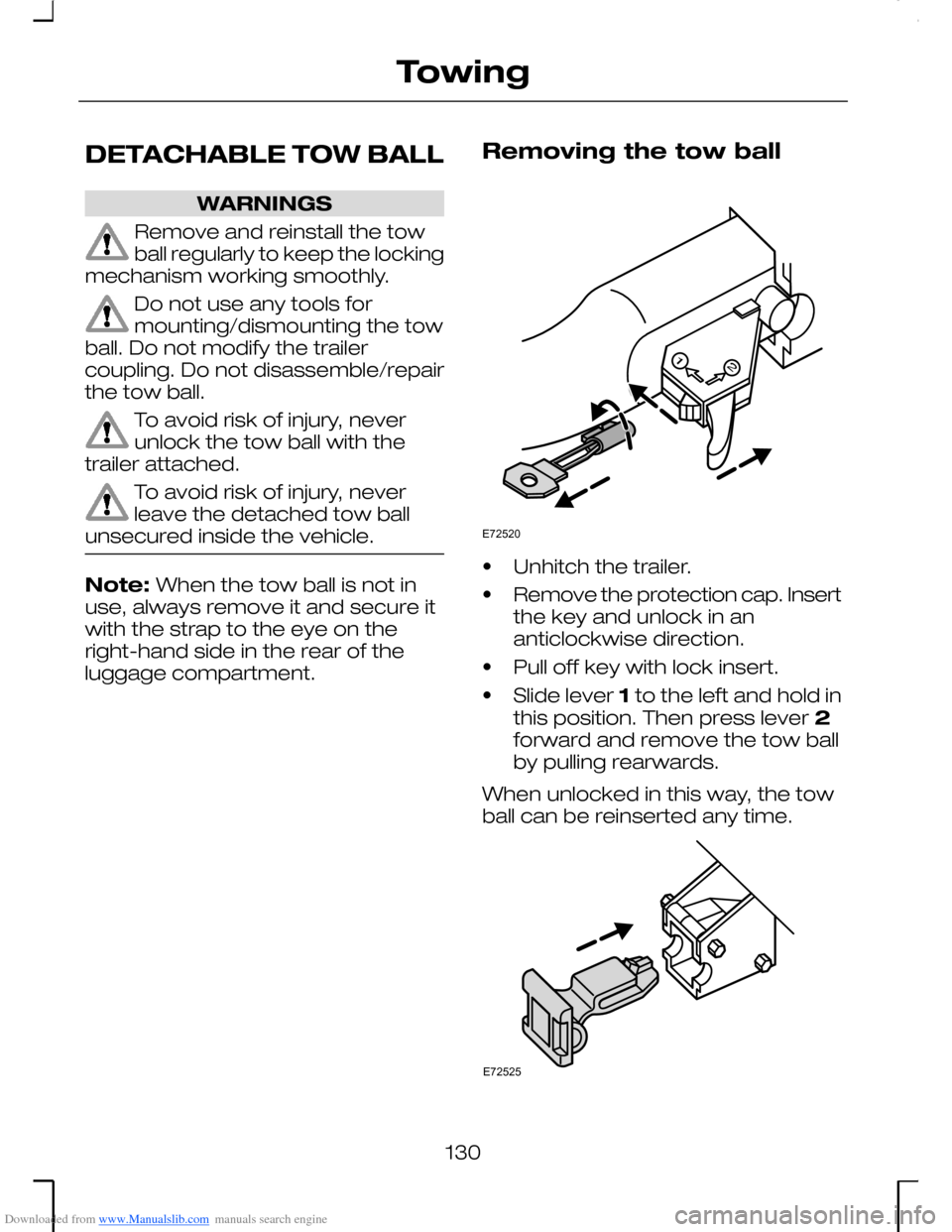
Removing the tow ball
•Unhitch the trailer.
•Remove the protection cap. Insertthe key and unlock in ananticlockwise direction.
•Pull off key with lock insert.
•Slide lever 1 to the left and hold inthis position. Then press lever 2forward and remove the tow ballby pulling rearwards.
When unlocked in this way, the towball can be reinserted any time.
130
TowingE72520 E72525