warning FORD MONDEO 2006 2.G Workshop Manual
[x] Cancel search | Manufacturer: FORD, Model Year: 2006, Model line: MONDEO, Model: FORD MONDEO 2006 2.GPages: 198, PDF Size: 4.69 MB
Page 99 of 198
Downloaded from www.Manualslib.com manuals search engine SUN VISORS
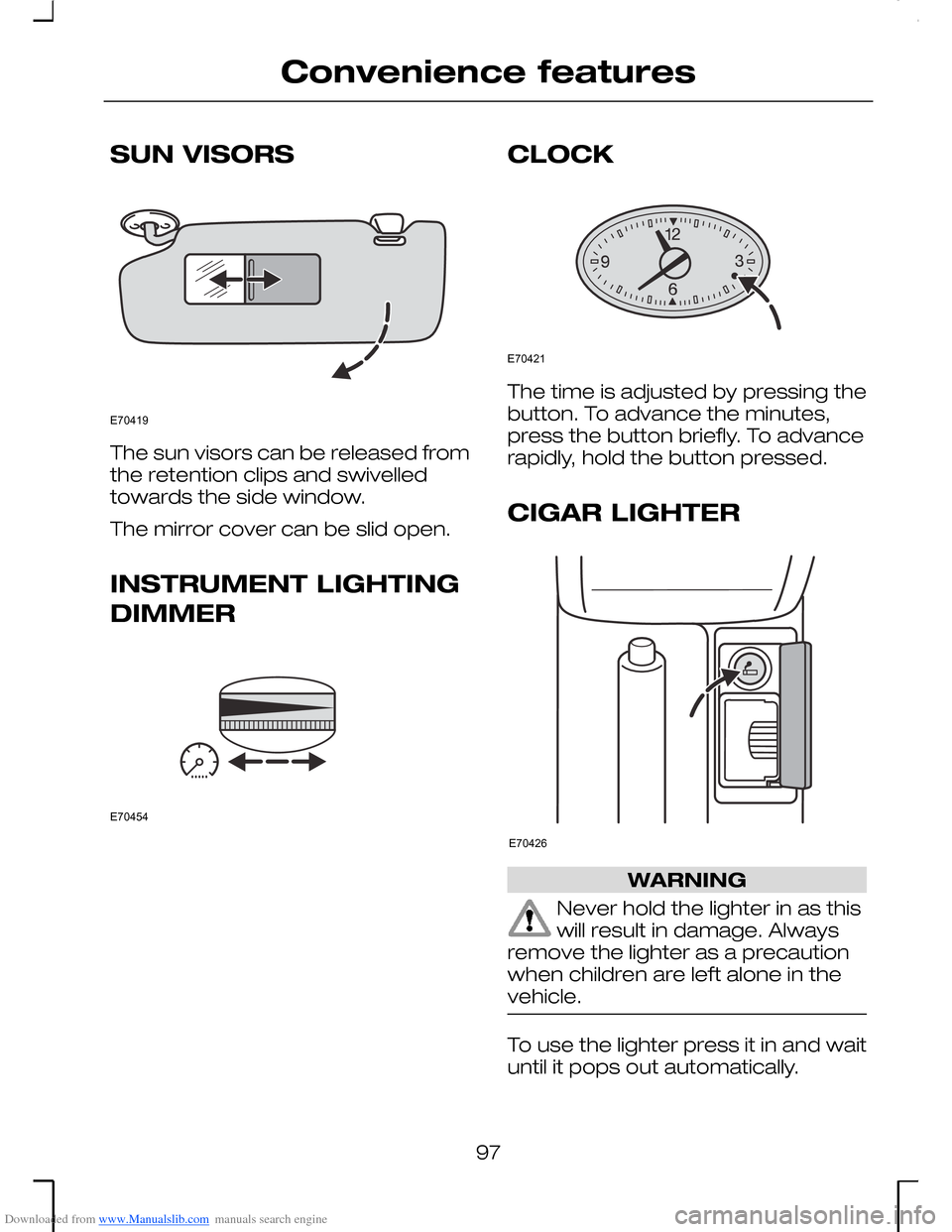
The sun visors can be released fromthe retention clips and swivelledtowards the side window.
The mirror cover can be slid open.
INSTRUMENT LIGHTING
DIMMER
CLOCK
The time is adjusted by pressing thebutton. To advance the minutes,press the button briefly. To advancerapidly, hold the button pressed.
CIGAR LIGHTER
WARNING
Never hold the lighter in as thiswill result in damage. Alwaysremove the lighter as a precautionwhen children are left alone in thevehicle.
To use the lighter press it in and waituntil it pops out automatically.
97
Convenience featuresE70419 E70454 E70421 E70426
Page 101 of 198
Downloaded from www.Manualslib.com manuals search engine AUXILIARY POWER
SOCKETS
Estate
The auxiliary power socket is locatedin the right-hand side trim panel ofthe luggage compartment.
The auxiliary power socket can alsobe used to power 12 volt applianceshaving a current rating of maximum10 amperes. However, if the engineis not running, this will cause thebattery to discharge.
When connecting appliances, useonly specified connectors from theFord Accessory range or connectorsfor use with SAE standard sockets.
CUP HOLDERS
WARNING
Do not place hot drinks in thecup holders whilst driving −there is a risk of scalding.
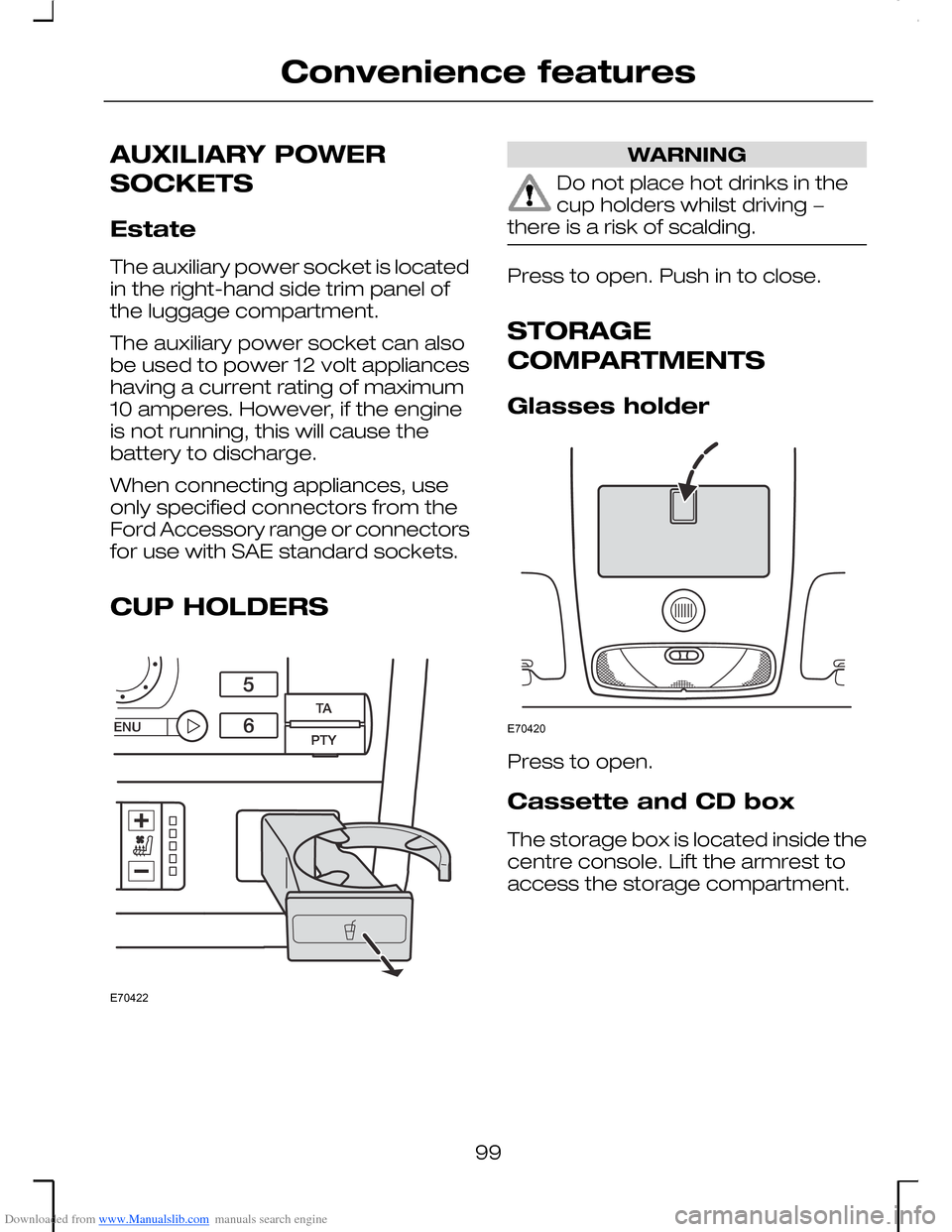
Press to open. Push in to close.
STORAGE
COMPARTMENTS
Glasses holder
Press to open.
Cassette and CD box
The storage box is located inside thecentre console. Lift the armrest toaccess the storage compartment.
99
Convenience featuresE70422 E70420
Page 102 of 198
Downloaded from www.Manualslib.com manuals search engine GENERAL INFORMATION
General points on starting
If the battery has been disconnectedthe vehicle may exhibit some unusualdriving characteristics for approx. 8kilometres (5 miles) afterreconnecting the battery.
This is because the enginemanagement system must realignitself with the engine. Any unusualdriving characteristics during thisperiod may be disregarded.
Starting the engine bytowing or pushing
WARNING
To prevent damage you mustnot push or tow start yourvehicle. Use booster cables and abooster battery. See Using boostercables (page 158).
IGNITION SWITCH
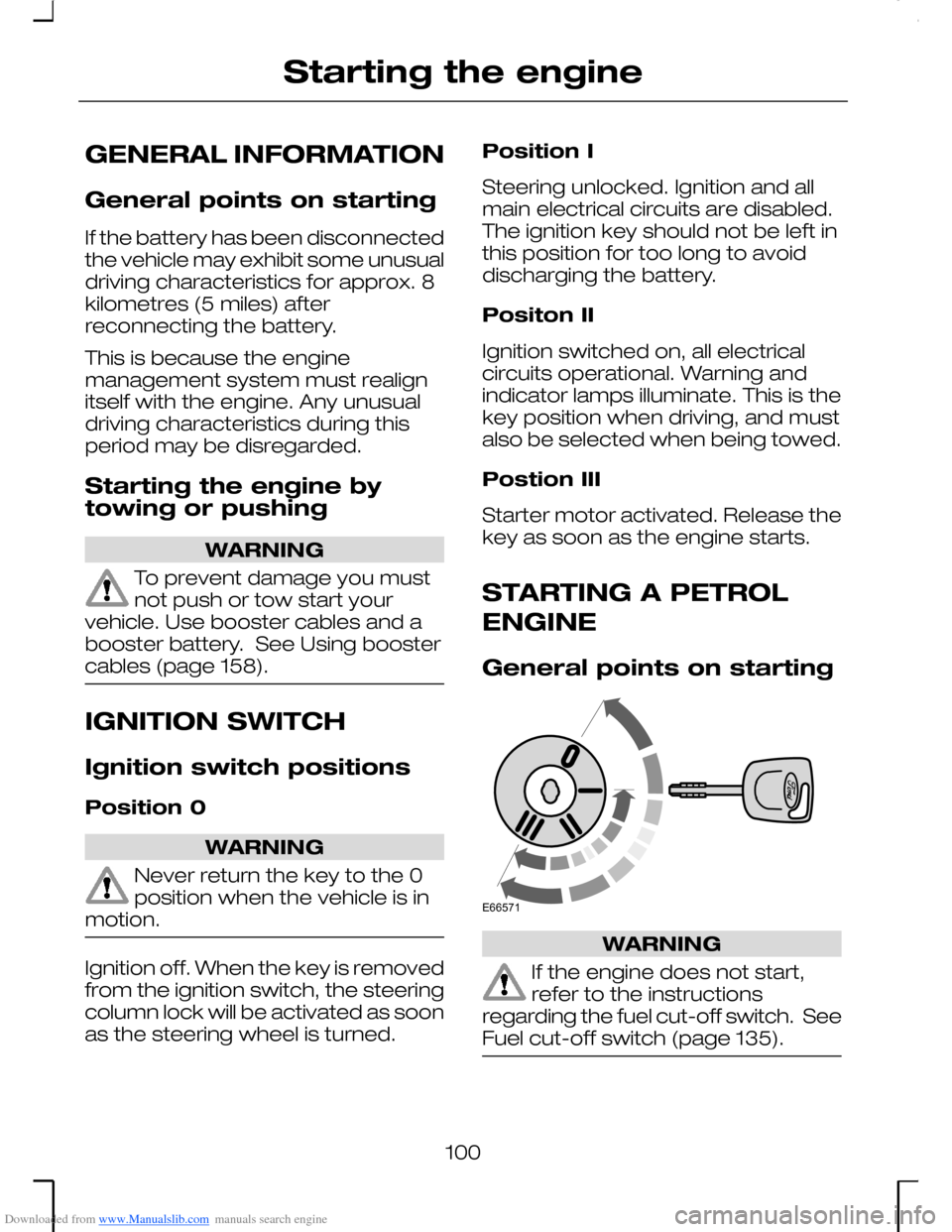
Ignition switch positions
Position 0
WARNING
Never return the key to the 0position when the vehicle is inmotion.
Ignition off. When the key is removedfrom the ignition switch, the steeringcolumn lock will be activated as soonas the steering wheel is turned.
Position I
Steering unlocked. Ignition and allmain electrical circuits are disabled.The ignition key should not be left inthis position for too long to avoiddischarging the battery.
Positon II
Ignition switched on, all electricalcircuits operational. Warning andindicator lamps illuminate. This is thekey position when driving, and mustalso be selected when being towed.
Postion III
Starter motor activated. Release thekey as soon as the engine starts.
STARTING A PETROL
ENGINE
General points on starting
WARNING
If the engine does not start,refer to the instructionsregarding the fuel cut-off switch. SeeFuel cut-off switch (page 135).
100
Starting the engineE66571
Page 103 of 198
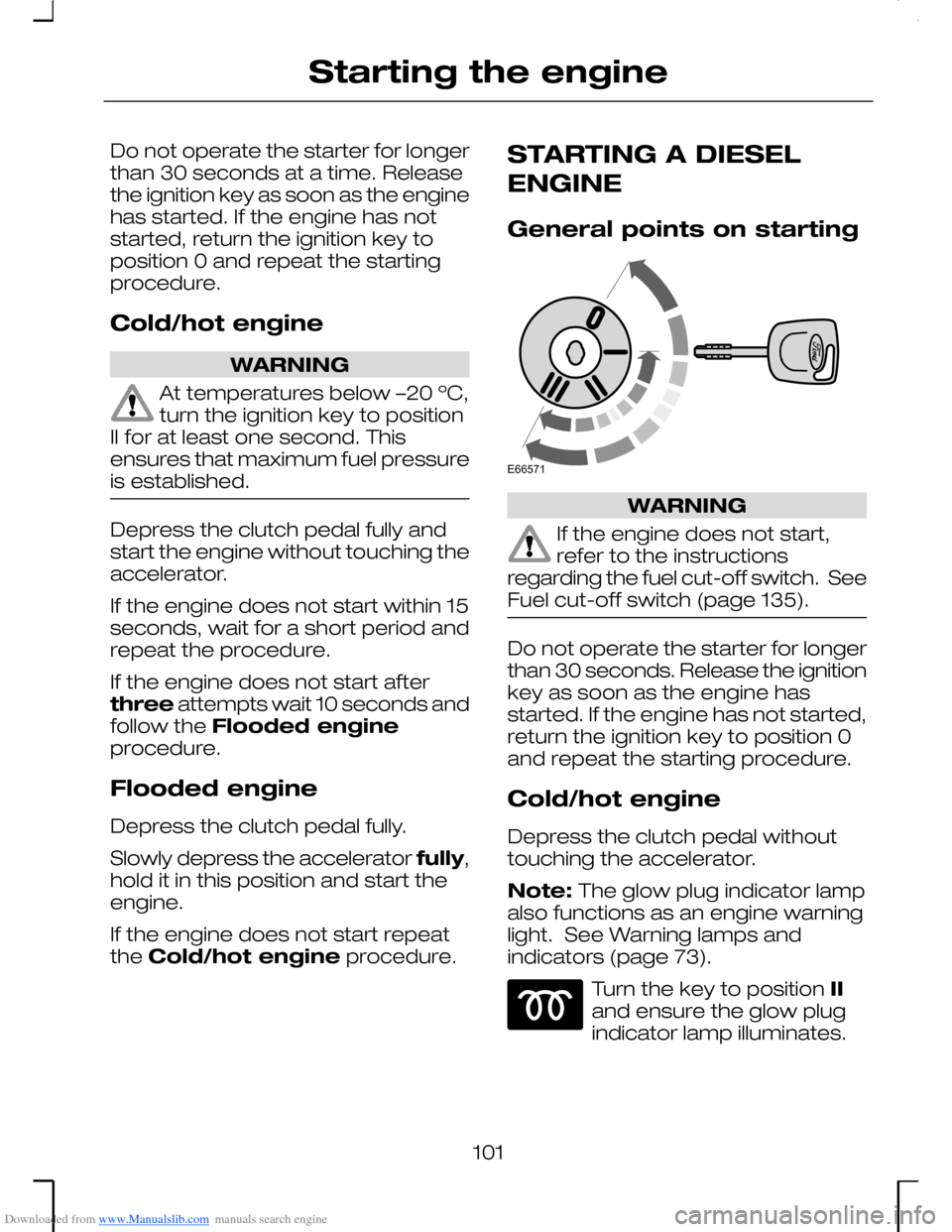
Downloaded from www.Manualslib.com manuals search engine Do not operate the starter for longerthan 30 seconds at a time. Releasethe ignition key as soon as the enginehas started. If the engine has notstarted, return the ignition key toposition 0 and repeat the startingprocedure.
Cold/hot engine
WARNING
At temperatures below –20 ºC,turn the ignition key to positionII for at least one second. Thisensures that maximum fuel pressureis established.
Depress the clutch pedal fully andstart the engine without touching theaccelerator.
If the engine does not start within 15seconds, wait for a short period andrepeat the procedure.
If the engine does not start afterthree attempts wait 10 seconds andfollow the Flooded engineprocedure.
Flooded engine
Depress the clutch pedal fully.
Slowly depress the accelerator fully,hold it in this position and start theengine.
If the engine does not start repeatthe Cold/hot engine procedure.
STARTING A DIESEL
ENGINE
General points on starting
WARNING
If the engine does not start,refer to the instructionsregarding the fuel cut-off switch. SeeFuel cut-off switch (page 135).
Do not operate the starter for longerthan 30 seconds. Release the ignitionkey as soon as the engine hasstarted. If the engine has not started,return the ignition key to position 0and repeat the starting procedure.
Cold/hot engine
Depress the clutch pedal withouttouching the accelerator.
Note: The glow plug indicator lampalso functions as an engine warninglight. See Warning lamps andindicators (page 73).
Turn the key to position IIand ensure the glow plugindicator lamp illuminates.
101
Starting the engineE66571
Page 105 of 198
Downloaded from www.Manualslib.com manuals search engine SAFETY PRECAUTIONS
WARNINGS
To avoid fuel spillage that couldbe hazardous to other roadusers, always stop refuelling after thefuel nozzle stops the second time.Additional fuel will fill the expansionspace in the fuel tank which couldlead to fuel overflowing.
The fuel system is underpressure. There is a risk of injuryif the fuel system is leaking. Do notuse any kind of flames or heat nearthe fuel system.
FUEL QUALITY
Use only high quality fuel without anysupplemental additives or otherengine treatments.
Vehicles with a petrolengine
Use unleaded petrol according tospecification EN 228 or equivalentwith minimum 95 octane. Leadedfuel or fuel/additives containing othermetallic compounds (e.g.manganese-based) may damagethe emission system.
Vehicles with a dieselengine
Use diesel fuel according tospecification EN 590 or equivalent.Do not mix it with any oil, petrol orother liquids. Diesel fuels whichcontain a mix of up to 5 % RME (biodiesel) are acceptable.
Prolonged use of supplementaladditives to prevent fuel waxing is notrecommended. Do not addkerosene, paraffin or petrol to dieselfuels.
CATALYTIC CONVERTER
Driving with a catalyticconverter
Avoid running out of fuel.
Avoid unnecessarily long enginecranking periods.
Do not run the engine with adisconnected spark plug.
Do not push-start or tow-starting thevehicle; use booster cables. SeeUsing booster cables (page 158).
Never switch off the ignition whiledriving.
Parking
WARNING
It is important to avoid parking,idling or operating the vehicle ondry leaves or dry grass. Even whenthe engine is switched off, theexhaust will continue to radiate aconsiderable amount of heat for ashort period creating a potential firehazard.
103
Fuel and refuelling
Page 106 of 198
Downloaded from www.Manualslib.com manuals search engine FUEL FILLER FLAP
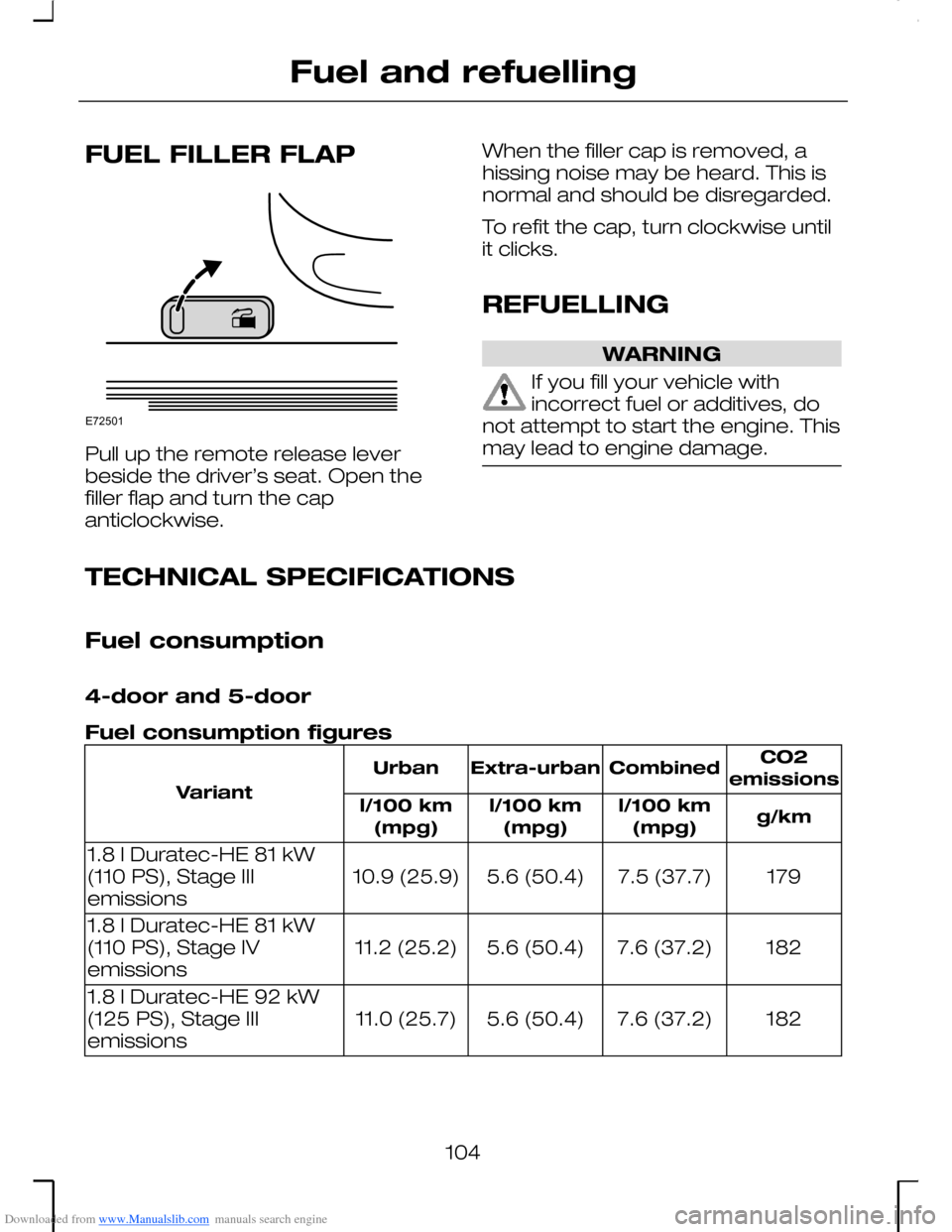
Pull up the remote release leverbeside the driver’s seat. Open thefiller flap and turn the capanticlockwise.
When the filler cap is removed, ahissing noise may be heard. This isnormal and should be disregarded.
To refit the cap, turn clockwise untilit clicks.
REFUELLING
WARNING
If you fill your vehicle withincorrect fuel or additives, donot attempt to start the engine. Thismay lead to engine damage.
TECHNICAL SPECIFICATIONS
Fuel consumption
4-door and 5-door
Fuel consumption figures
CO2emissionsCombinedExtra-urbanUrban
Variant
g/kml/100 km(mpg)l/100 km(mpg)l/100 km(mpg)
1797.5 (37.7)5.6 (50.4)10.9 (25.9)1.8 l Duratec-HE 81 kW(110 PS), Stage IIIemissions
1827.6 (37.2)5.6 (50.4)11.2 (25.2)1.8 l Duratec-HE 81 kW(110 PS), Stage IVemissions
1827.6 (37.2)5.6 (50.4)11.0 (25.7)1.8 l Duratec-HE 92 kW(125 PS), Stage IIIemissions
104
Fuel and refuellingE72501
Page 111 of 198
Downloaded from www.Manualslib.com manuals search engine MANUAL TRANSMISSION
WARNINGS
Engage reverse gear only whenthe vehicle is stationary.
Do not apply any undue lateralforce to the gear lever whenchanging from 5th to 4th gear as thiscould lead to the inadvertentselection of 2nd gear.
To avoid shifting noises whenengaging the reverse gear, waitapproximately three seconds withthe clutch depressed when thevehicle is stationary.
Vehicles with 1.8 l Duratec-SCi enginereach the maximum speed only infifth gear.
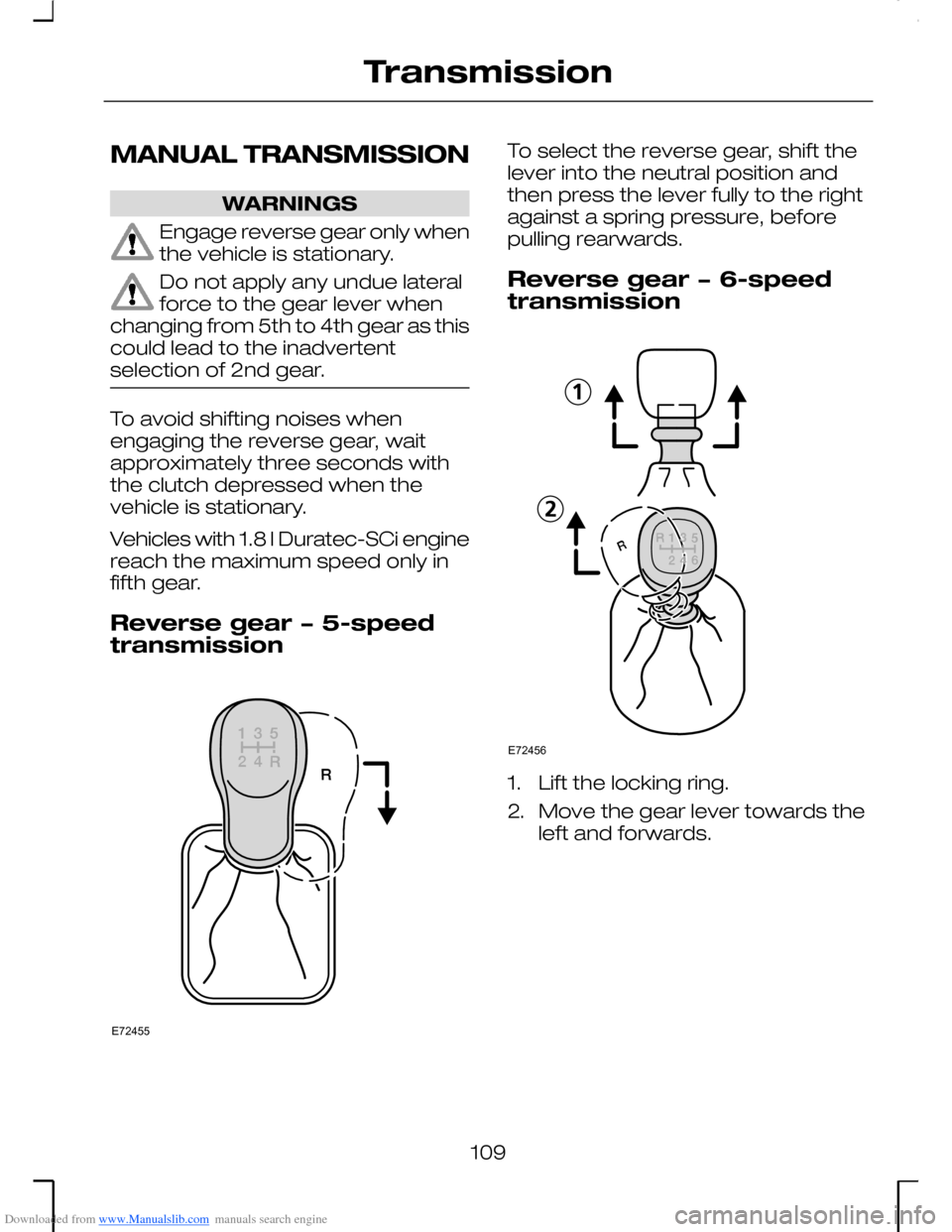
Reverse gear − 5-speedtransmission
To select the reverse gear, shift thelever into the neutral position andthen press the lever fully to the rightagainst a spring pressure, beforepulling rearwards.
Reverse gear − 6-speedtransmission
1.Lift the locking ring.
2.Move the gear lever towards theleft and forwards.
109
TransmissionE72455 E72456
Page 112 of 198
Downloaded from www.Manualslib.com manuals search engine AUTOMATIC
TRANSMISSION
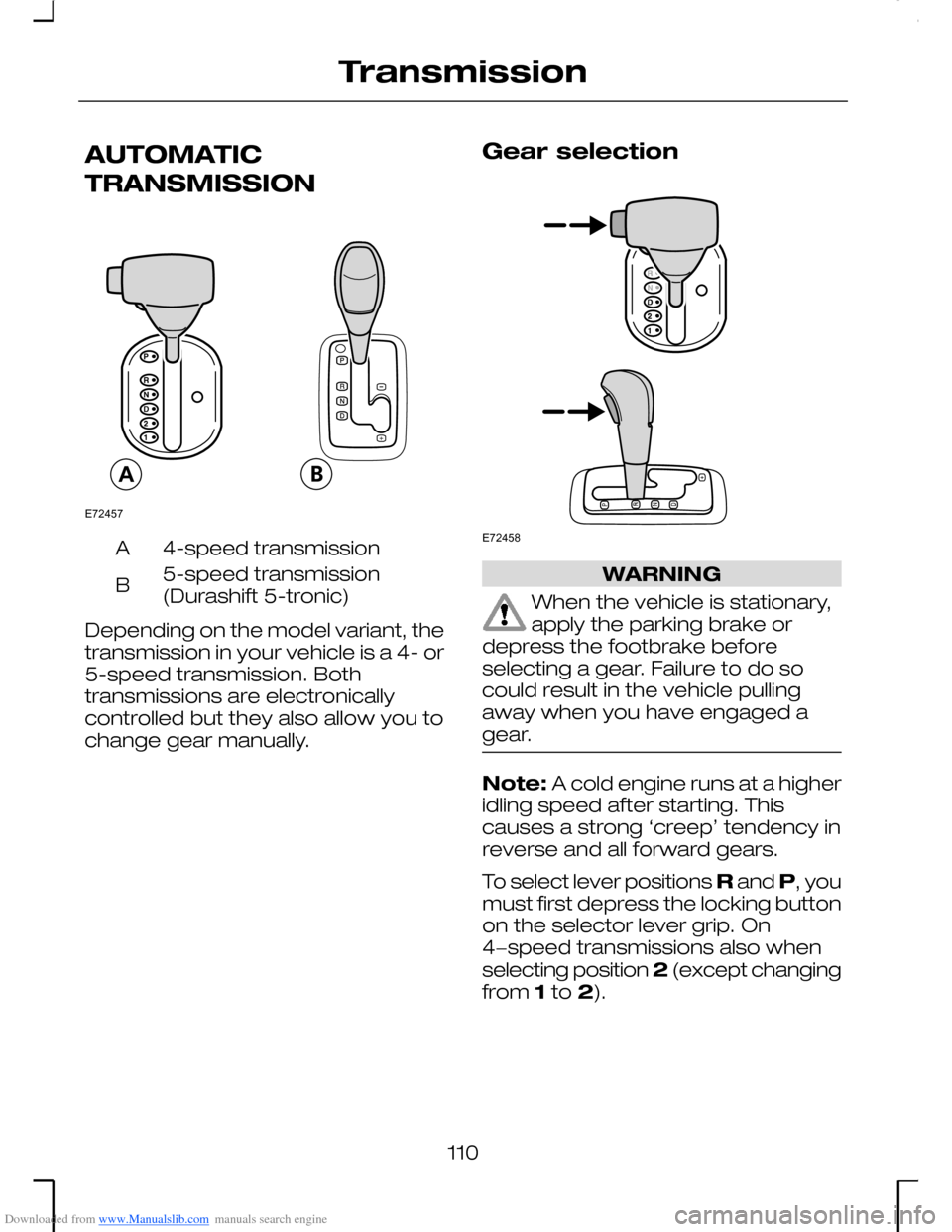
4-speed transmissionA
5-speed transmission(Durashift 5-tronic)B
Depending on the model variant, thetransmission in your vehicle is a 4- or5-speed transmission. Bothtransmissions are electronicallycontrolled but they also allow you tochange gear manually.
Gear selection
WARNING
When the vehicle is stationary,apply the parking brake ordepress the footbrake beforeselecting a gear. Failure to do socould result in the vehicle pullingaway when you have engaged agear.
Note: A cold engine runs at a higheridling speed after starting. Thiscauses a strong ‘creep’ tendency inreverse and all forward gears.
To select lever positions R and P, youmust first depress the locking buttonon the selector lever grip. On4−speed transmissions also whenselecting position 2 (except changingfrom 1 to 2).
110
TransmissionE72457 E72458
Page 113 of 198
Downloaded from www.Manualslib.com manuals search engine P = Park
WARNINGS
This position should be selectedonly when the vehicle isstationary.
Always apply the parking brakeand make sure that the selectorlever is securely latched in P. Turn offthe ignition whenever you leave thevehicle.
If position P is not selected, awarning chime will sound whenthe driver’s door is opened.
In this position, the transmission islocked.
The engine should be started withthe selector lever in position P. Ifnecessary, it can also be started inposition N.
After starting the engine, the levercan be moved out of this positiononly when the foot brake isdepressed and the lockingbutton pressed in.
R = Reverse
WARNING
This position should be selectedonly when the vehicle isstationary and the engine is idling.
Depress the brake pedal whenselecting R.
N = Neutral
WARNING
In this position, you have todepress the brake pedal orapply the parking brake to preventthe vehicle from moving.
In this position no power istransmitted to the drive wheels.
D = Drive
This is the normal driving position.When the brake is released, thevehicle will creep. All forward gearsare selected automatically dependingon driving conditions.
+/− = Gears 1−5 (5-speedtransmission)
When shifting manually, gears 1, 2,3, 4 and 5 can be selected.
2 = Gear 2 (4-speedtransmission)
The transmission remainspermanently in second gear. Thisposition should be selected on downhill gradients to avoid unnecessaryuse of the brakes, and on long uphillgradients and twisty roads. It can alsobe used for initial start-off on icyroads.
111
TransmissionE66565
Page 120 of 198
Downloaded from www.Manualslib.com manuals search engine PRINCIPLE OF
OPERATION
Dual circuit braking system
WARNING
If a brake circuit fails, you will atfirst experience a softer feel tothe brake pedal. You will then needto exert a greater force on the brakepedal, and make allowance forincreased stopping distances. Havethe braking system checked by anexpert before continuing yourjourney.
Your vehicle is equipped with adiagonally split dual circuit brakingsystem. If one of the brake circuitsfails, the other remains operative.
Disc brakes
Wet brake discs result in reducedbraking efficiency.
After leaving a carwash or driving thevehicle through water, dab the brakepedal while driving to remove the filmof water.
Emergency brake assist
WARNING
Emergency brake assist is anadditional system which is notintended to relieve the driver of hisresponsibility for exercising due careand attention when driving.
Emergency brake assist is able todetect an emergency brakingsituation by measuring the rate atwhich the brake pedal is applied. Itautomatically provides maximumbraking efficiency as long as thepedal is applied. This can reducestopping distances in criticalsituations.
HINTS ON DRIVING WITH
ABS
WARNING
Although the ABS ensuresoptimum braking efficiency,stopping distances can vary greatlydepending on the road surface andconditions. Use of the ABS cannoteliminate the dangers inherent indriving too close to the vehicle in frontof you, aquaplaning, excessivecornering speed or poor roadsurfaces.
118
BrakesE66564 E66565