wheel FORD MONDEO 2014 4.G Repair Manual
[x] Cancel search | Manufacturer: FORD, Model Year: 2014, Model line: MONDEO, Model: FORD MONDEO 2014 4.GPages: 446, PDF Size: 29.09 MB
Page 253 of 446
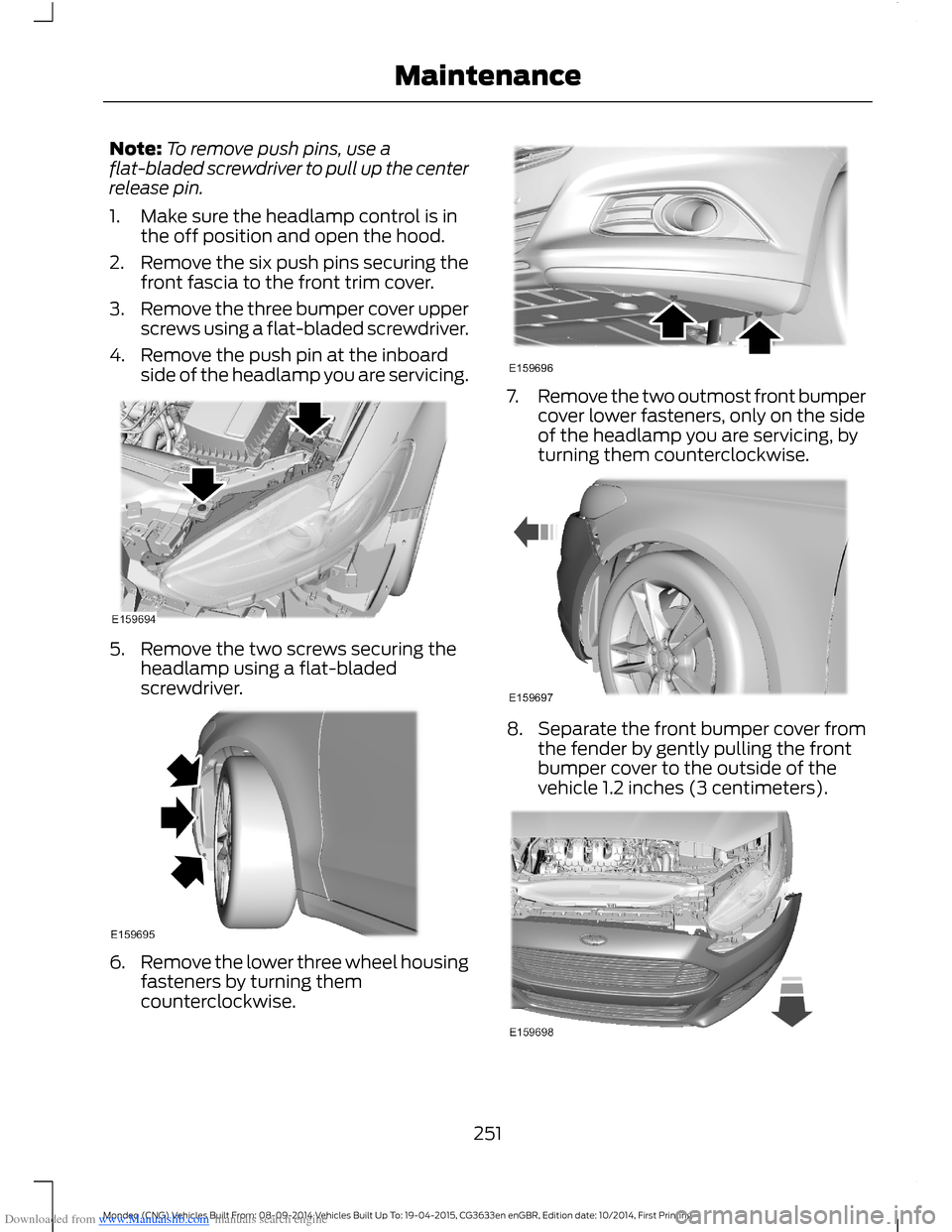
Downloaded from www.Manualslib.com manuals search engine Note:To remove push pins, use aflat-bladed screwdriver to pull up the centerrelease pin.
1.Make sure the headlamp control is inthe off position and open the hood.
2.Remove the six push pins securing thefront fascia to the front trim cover.
3.Remove the three bumper cover upperscrews using a flat-bladed screwdriver.
4.Remove the push pin at the inboardside of the headlamp you are servicing.
5.Remove the two screws securing theheadlamp using a flat-bladedscrewdriver.
6.Remove the lower three wheel housingfasteners by turning themcounterclockwise.
7.Remove the two outmost front bumpercover lower fasteners, only on the sideof the headlamp you are servicing, byturning them counterclockwise.
8.Separate the front bumper cover fromthe fender by gently pulling the frontbumper cover to the outside of thevehicle 1.2 inches (3 centimeters).
251Mondeo (CNG) Vehicles Built From: 08-09-2014 Vehicles Built Up To: 19-04-2015, CG3633en enGBR, Edition date: 10/2014, First PrintingMaintenance
Page 254 of 446
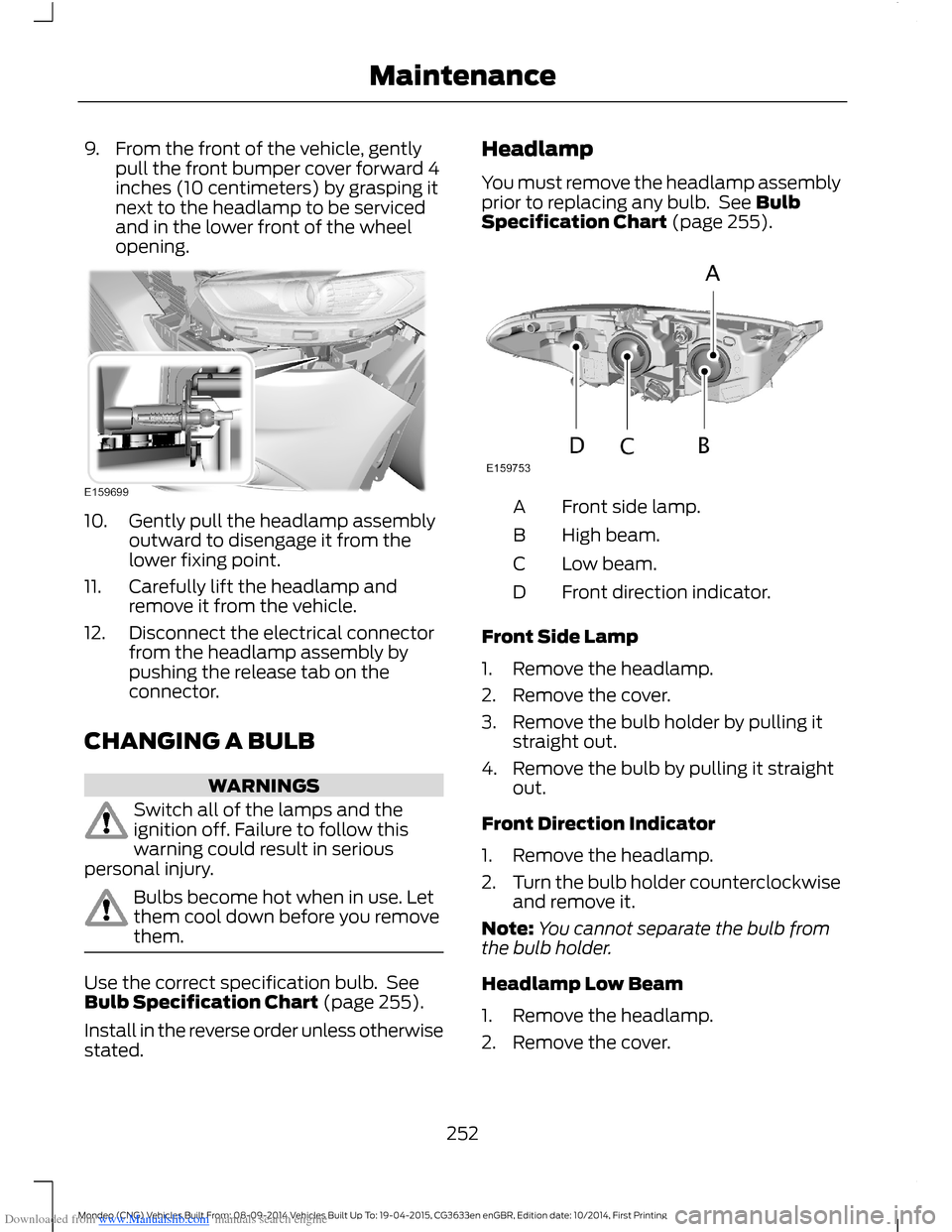
Downloaded from www.Manualslib.com manuals search engine 9.From the front of the vehicle, gentlypull the front bumper cover forward 4inches (10 centimeters) by grasping itnext to the headlamp to be servicedand in the lower front of the wheelopening.
10.Gently pull the headlamp assemblyoutward to disengage it from thelower fixing point.
11.Carefully lift the headlamp andremove it from the vehicle.
12.Disconnect the electrical connectorfrom the headlamp assembly bypushing the release tab on theconnector.
CHANGING A BULB
WARNINGS
Switch all of the lamps and theignition off. Failure to follow thiswarning could result in seriouspersonal injury.
Bulbs become hot when in use. Letthem cool down before you removethem.
Use the correct specification bulb. SeeBulb Specification Chart (page 255).
Install in the reverse order unless otherwisestated.
Headlamp
You must remove the headlamp assemblyprior to replacing any bulb. See BulbSpecification Chart (page 255).
Front side lamp.A
High beam.B
Low beam.C
Front direction indicator.D
Front Side Lamp
1.Remove the headlamp.
2.Remove the cover.
3.Remove the bulb holder by pulling itstraight out.
4.Remove the bulb by pulling it straightout.
Front Direction Indicator
1.Remove the headlamp.
2.Turn the bulb holder counterclockwiseand remove it.
Note:You cannot separate the bulb fromthe bulb holder.
Headlamp Low Beam
1.Remove the headlamp.
2.Remove the cover.
252Mondeo (CNG) Vehicles Built From: 08-09-2014 Vehicles Built Up To: 19-04-2015, CG3633en enGBR, Edition date: 10/2014, First PrintingMaintenance
Page 260 of 446
Downloaded from www.Manualslib.com manuals search engine Note: Do not use razor blades or othersharp objects to clean or remove decalsfrom the inside of the heated rear window.The vehicle warranty does not coverdamage caused to the heated rear windowgrid lines.
CLEANING THE INTERIOR
Note:Do not allow air fresheners and handsanitizers to spill on interior surfaces. If aspill occurs, wipe off immediately. Damagemay not be covered by your warranty.
Safety Belts
Note:Do not use abrasives, or chemicalsolvents to clean them.
Note:Do not allow moisture to penetratethe safety belt retractor mechanism.
Clean them with interior cleaner or waterapplied with a soft sponge. Let them drynaturally, away from artificial heat.
Instrument Cluster Screens, LCDScreens and Radio Screens
Note:Do not use abrasives, alcoholicsolvents or chemical solvents to clean them.
Rear Windows
Note:Do not use any abrasive materials toclean the interior of the rear windows.
Note:Do not install stickers or labels to theinterior of the rear windows.
REPAIRING MINOR PAINT
DAMAGE
You should repair paintwork damagecaused by stones from the road or minorscratches as soon as possible. A choice ofproducts are available from an authorizeddealer.
Remove particles such as bird droppings,tree sap, insect deposits, tar spots, roadsalt and industrial fallout before repairingpaint chips.
Always read and follow the manufacturer’sinstructions before using the products.
CLEANING THE ALLOY
WHEELS
Note:Do not apply a cleaning chemical towarm or hot wheel rims and covers.
Note:Industrial-strength (heavy-duty)cleaners, or cleaning chemicals, incombination with brush agitation to removebrake dust and dirt, could wear away theclear coat finish over a period of time.
Note:Do not use hydrofluoric acid-basedor high caustic-based wheel cleaners, steelwool, fuels or strong household detergent.
Note:If you intend parking your vehicle foran extended period after cleaning thewheels with a wheel cleaner, drive yourvehicle for a few minutes before doing so.This will reduce the risk of increasedcorrosion of the brake discs, brake pads andlinings.
Note:Some automatic car washes maycause damage to the finish on your wheelrims and covers.
Alloy wheels and wheel covers are coatedwith a clear coat paint finish. To maintaintheir condition we recommend that you:
•Clean them weekly with therecommended wheel and tire cleaner.
•Use a sponge to remove heavydeposits of dirt and brake dustaccumulation.
•Rinse them thoroughly with apressurized stream of water when youhave completed the cleaning process.
258Mondeo (CNG) Vehicles Built From: 08-09-2014 Vehicles Built Up To: 19-04-2015, CG3633en enGBR, Edition date: 10/2014, First PrintingVehicle Care
Page 261 of 446
Downloaded from www.Manualslib.com manuals search engine We recommend that you use Ford servicewheel cleaner. Make sure that you readand follow the manufacturer’s instructions.
Using other non-recommended cleaningproducts can result in severe andpermanent cosmetic damage.
259Mondeo (CNG) Vehicles Built From: 08-09-2014 Vehicles Built Up To: 19-04-2015, CG3633en enGBR, Edition date: 10/2014, First PrintingVehicle Care
Page 262 of 446
Downloaded from www.Manualslib.com manuals search engine GENERAL INFORMATION
A decal with tire pressure data is locatedin the driver’s door opening.
Check and set the tire pressure at theambient temperature in which you areintending to drive your vehicle and whenthe tires are cold.
Note:Check your tire pressures regularly tooptimize fuel economy.
Note:Use only approved wheel and tiresizes. Using other sizes could damage yourvehicle and will make the National TypeApproval invalid.
Note:If you change the diameter of the tiresfrom that fitted at the factory, thespeedometer may not display the correctspeed. Take your vehicle to an authorizeddealer to have the engine managementsystem reprogrammed.
Note:If you intend to change the size of thewheels from that fitted at the factory, checkthe suitability with an authorized dealer.
TEMPORARY MOBILITY KIT
Your vehicle may not have a spare wheeland tire. In these cases it will be suppliedwith a temporary mobility kit which willonly repair one damaged tire.
The kit is located in the spare wheel well.
General Information
WARNINGS
Depending on the type and extent oftire damage, some tires can only bepartially sealed or not sealed at all.Loss of tire pressure can affect vehiclehandling, leading to loss of vehicle control.
Do not use the temporary mobilitykit on a previously damaged tire. Forexample, when a tire has been drivenunder inflated.
WARNINGS
Do not use the temporary mobilitykit on run flat tires.
Do not use the temporary mobilitykit to repair the sidewall of adamaged tire.
The temporary mobility kit seals most tirepunctures with a diameter of up to ¼ in (6mm) to temporarily restore mobility.
You must observe the following rules whenusing the temporary mobility kit:
•Drive with caution and avoid makingsudden steering or driving manoeuvresespecially if your vehicle is heavilyloaded or towing a trailer.
•Only continue your journey to the nextvehicle or tire dealer or drive amaximum distance of 125 mi (200 km).
•Do not exceed a maximum speed of50 mph (80 km/h).
•Keep the temporary mobility kit out ofthe reach of children.
•Only use the temporary mobility kitwhen the ambient temperature isbetween -30° and 70° C (-22° and158° F).
Using the Temporary Mobility Kit
WARNINGS
Park your vehicle so that you do notobstruct the flow of traffic or placeyourself in any danger and set up awarning triangle.
Compressed air can act as anexplosive or propellant.
Never leave the temporary mobilitykit unattended while in use.
Do not keep the compressoroperating for longer than 10 minutes.
260Mondeo (CNG) Vehicles Built From: 08-09-2014 Vehicles Built Up To: 19-04-2015, CG3633en enGBR, Edition date: 10/2014, First PrintingWheels and Tires
Page 263 of 446
Downloaded from www.Manualslib.com manuals search engine WARNINGS
You must only use the temporarymobility kit for the vehicle with whichit was supplied.
Before you use the temporary mobility kit:
•Apply the parking brake.
•Do not attempt to remove foreignmaterial that is penetrating the tire, forexample, nails or screws.
•Leave the engine running while thetemporary mobility kit is in use. If yourvehicle is in an enclosed or poorlyventilated area use the temporarymobility kit with the engine switchedoff.
•You must replace the sealant bottlewith a new one before the expiry datewhich is printed on the top of sealantbottle.
•Inform all vehicle users that a tire hasbeen repaired using the temporarymobility kit. Make them aware of thespecial driving conditions that apply.
Inflating the Tire
WARNINGS
Check the sidewall of the tire prior tousing the temporary mobility kit. Ifthere are any cracks, bumps orsimilar damage do not attempt to inflatethe tire.
Do not stand directly beside the tirewhile the compressor is operating.
Watch the sidewall of the tire. If anycracks, bumps or similar damageappears, switch off the compressorimmediately and deflate the tire using thepressure relief valve B.
WARNINGS
The sealant contains natural rubberlatex. Avoid contact with skin orclothing. If this happens, rinse theaffected areas immediately with plenty ofwater and contact a physician.
If the tire inflation pressure does notreach the recommended pressurewithin 10 minutes, the tire may havesuffered excessive damage, making atemporary repair impossible. Do notcontinue driving with this tire.
Screwing the sealant bottle onto thebottle holder will pierce the seal ofthe sealant bottle. Do not unscrewthe sealant bottle from the bottle holderprior to completing a temporary repair asthe sealant will escape.
If you experience heavy vibrations,unsteady steering behavior or noiseswhile driving, reduce your speed anddrive with caution to a place where it issafe for you to stop your vehicle. Recheckthe tire and its pressure. If the tire pressureis less than 45 psi (3 bar) or if there are anycracks, bumps or similar damage visible,do not continue driving with this tire.
261Mondeo (CNG) Vehicles Built From: 08-09-2014 Vehicles Built Up To: 19-04-2015, CG3633en enGBR, Edition date: 10/2014, First PrintingWheels and Tires
Page 264 of 446
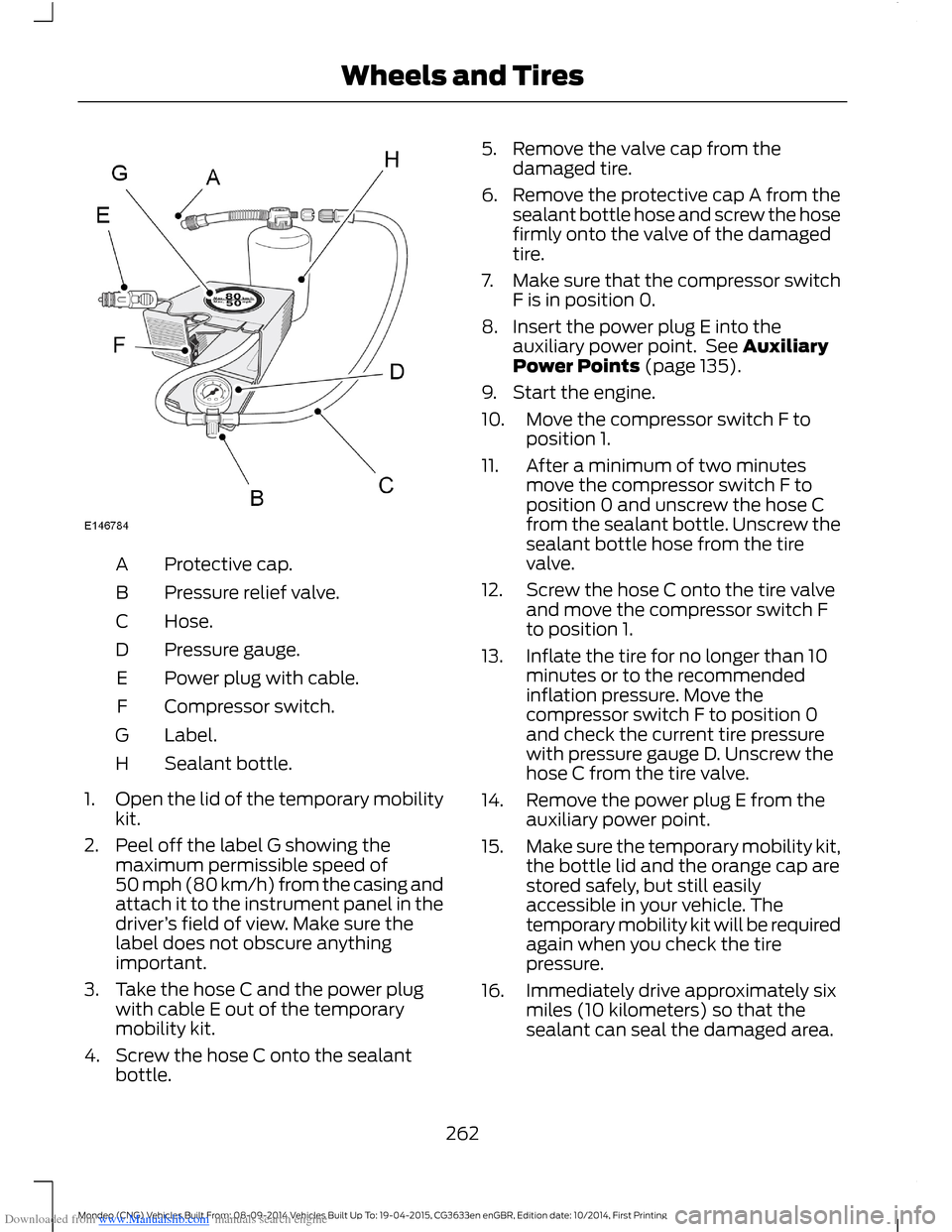
Downloaded from www.Manualslib.com manuals search engine Protective cap.A
Pressure relief valve.B
Hose.C
Pressure gauge.D
Power plug with cable.E
Compressor switch.F
Label.G
Sealant bottle.H
1.Open the lid of the temporary mobilitykit.
2.Peel off the label G showing themaximum permissible speed of50 mph (80 km/h) from the casing andattach it to the instrument panel in thedriver’s field of view. Make sure thelabel does not obscure anythingimportant.
3.Take the hose C and the power plugwith cable E out of the temporarymobility kit.
4.Screw the hose C onto the sealantbottle.
5.Remove the valve cap from thedamaged tire.
6.Remove the protective cap A from thesealant bottle hose and screw the hosefirmly onto the valve of the damagedtire.
7.Make sure that the compressor switchF is in position 0.
8.Insert the power plug E into theauxiliary power point. See AuxiliaryPower Points (page 135).
9.Start the engine.
10.Move the compressor switch F toposition 1.
11.After a minimum of two minutesmove the compressor switch F toposition 0 and unscrew the hose Cfrom the sealant bottle. Unscrew thesealant bottle hose from the tirevalve.
12.Screw the hose C onto the tire valveand move the compressor switch Fto position 1.
13.Inflate the tire for no longer than 10minutes or to the recommendedinflation pressure. Move thecompressor switch F to position 0and check the current tire pressurewith pressure gauge D. Unscrew thehose C from the tire valve.
14.Remove the power plug E from theauxiliary power point.
15.Make sure the temporary mobility kit,the bottle lid and the orange cap arestored safely, but still easilyaccessible in your vehicle. Thetemporary mobility kit will be requiredagain when you check the tirepressure.
16.Immediately drive approximately sixmiles (10 kilometers) so that thesealant can seal the damaged area.
262Mondeo (CNG) Vehicles Built From: 08-09-2014 Vehicles Built Up To: 19-04-2015, CG3633en enGBR, Edition date: 10/2014, First PrintingWheels and Tires
Page 265 of 446
Downloaded from www.Manualslib.com manuals search engine Note:When pumping in the sealant throughthe tire valve, the pressure may rise up to87 psi (6 bar) but will drop again after about30 seconds.
WARNING
If you experience heavy vibrations,unsteady steering behavior or noiseswhile driving, reduce your speed anddrive with caution to a place where it issafe for you to stop your vehicle. Recheckthe tire and its pressure. If the tire pressureis less than the recommended pressure orif there are any cracks, bumps or similardamage visible, do not continue drivingwith this tire.
Checking the Tire Pressure
WARNING
Before driving make sure the tire isadjusted to the recommendedinflation pressure. See TirePressures (page 273). Monitor the tirepressure until the sealed tire is replaced.
1.Stop your vehicle after driving aboutsix miles (10 kilometers). Check, andwhere necessary, adjust the pressureof the damaged tire.
2.Attach the temporary mobility kit andcheck the tire pressure from thepressure gauge D.
3.If the pressure of the sealant-filled tireis more than the recommendedpressure, adjust it to the recommendedpressure. See Tire Pressures (page273).
4.Follow the inflation procedure onceagain to inflate the tire.
5.Check the tire pressure again from thepressure gauge D. If the tire pressure istoo high, deflate the tire to thespecified pressure using the pressurerelief valve B.
6.If the tire pressure is less than therecommended pressure, repeat steps13 to 16 and steps 1 to 5 (Checking theTire Pressure).
7.Once you have inflated the tire to itscorrect tire pressure, move thecompressor switch F to position 0,remove the power plug E from theauxiliary power point, unscrew thesealant bottle hose, fasten the valvecap and replace the protective cap A.
8.Drive to the nearest tire specialist toget the damaged tire replaced. Beforethe tire is removed from the wheel,inform the tire specialist that the tirecontains sealant. Renew the sealantbottle as soon as possible after it hasbeen used once.
Note:The temporary mobility kit onlyprovides an emergency repair. Regulationsconcerning tire repair after using thetemporary mobility kit may differ fromcountry to country. You should consult a tirespecialist for advice.
Empty sealant bottles can be disposed oftogether with normal household waste.Return remaining sealant to an authorizeddealer or dispose of it in compliance withlocal waste disposal regulations.
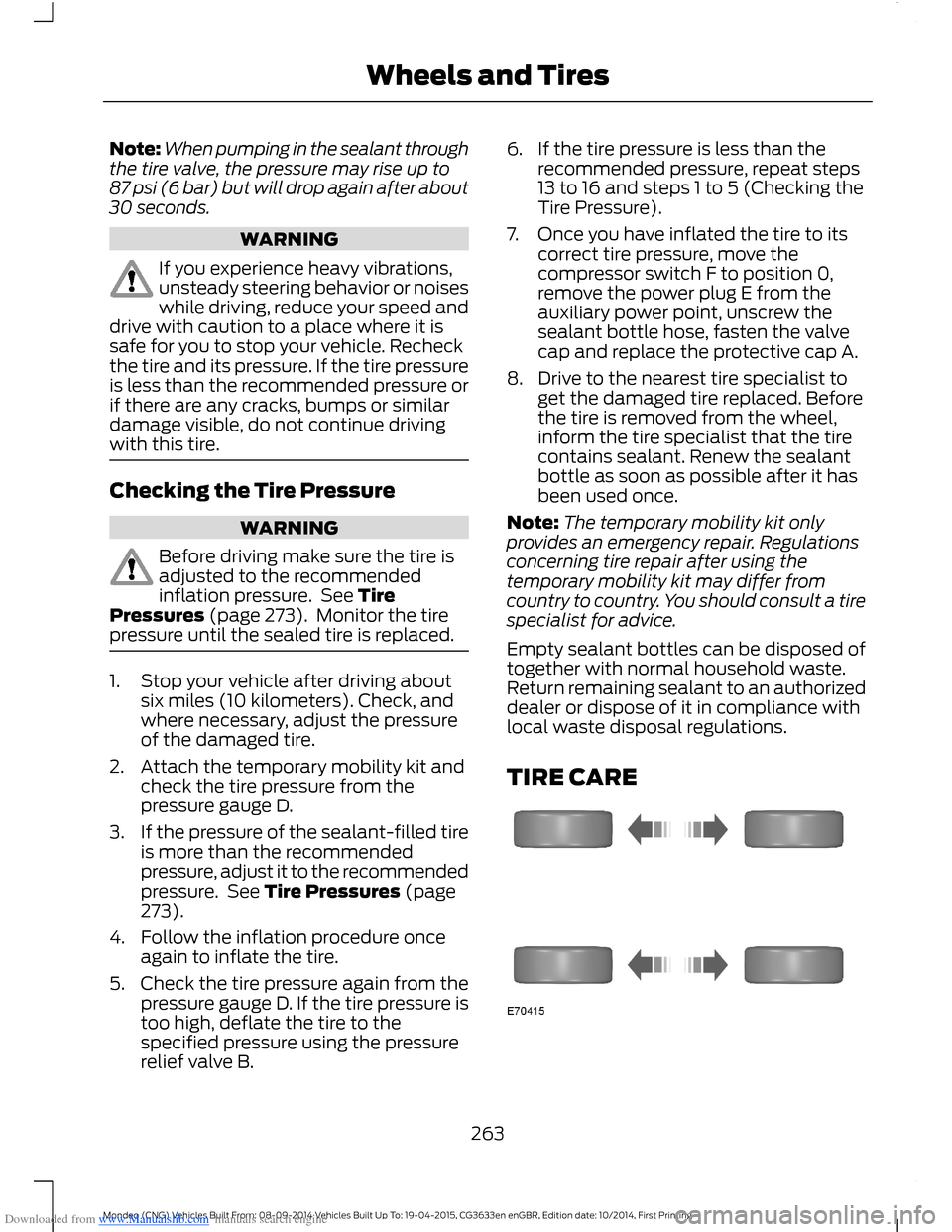
TIRE CARE
263Mondeo (CNG) Vehicles Built From: 08-09-2014 Vehicles Built Up To: 19-04-2015, CG3633en enGBR, Edition date: 10/2014, First PrintingWheels and Tires
Page 266 of 446
Downloaded from www.Manualslib.com manuals search engine To make sure the front and rear tires ofyour vehicle wear evenly and last longer,we recommend that you swap the tiresfrom front to rear and vice versa at regularintervals of between 3000 and 6000 miles(5000 and 10000 kilometers).
WARNING
Do not scrub the sidewalls of thetires when you are parking.
If you have to mount a curb, do so slowlyand approach it with the wheels atright-angles to the curb.
Examine the tires regularly for cuts, foreignobjects and uneven wear of the tread.Uneven wear could mean that the wheelalignment is outside specification.
Check the tire pressures (including thespare) when cold, every two weeks.
USING WINTER TIRES
If winter tires are used you must inflatethem to the same tire pressures as thoselisted in the tire pressure table. See TirePressures (page 273).
USING SNOW CHAINS
WARNINGS
Do not exceed 30 mph (50 km/h).
Do not use snow chains on snow-freeroads.
Only fit snow chains to specifiedtires.
If your vehicle has wheel trims,remove them before fitting snowchains.
Only use snow chains of 10 millimeters orsmaller.
Only use snow chains on the front wheels.
Note:The anti-lock braking system willcontinue to operate normally.
Vehicles with Stability Control
When stability control is on, your vehiclemay exhibit some unusual drivingcharacteristics. To reduce this, switchtraction control off. See Using StabilityControl (page 166).
TIRE PRESSURE MONITORING
SYSTEM
WARNING
The tire pressure monitoring systemis not a substitute for manuallychecking tire pressures. You shouldperiodically check tire pressures using apressure gauge. Failure to correctlymaintain tire pressures could increase therisk of tire failure, loss of control, vehiclerollover and personal injury.
You must check the tire pressures(including the spare tire where applicable)every two weeks when the tires are cold.
You must inflate the tires to the correctpressure.
See Wheels and Tires (page 260).The tirepressures are also on the tire inflationpressure label (located on the edge ofdriver door or the B-Pillar).
264Mondeo (CNG) Vehicles Built From: 08-09-2014 Vehicles Built Up To: 19-04-2015, CG3633en enGBR, Edition date: 10/2014, First PrintingWheels and Tires
Page 267 of 446
Downloaded from www.Manualslib.com manuals search engine As a driver assistance feature, your vehiclehas a tire pressure monitoring system. Awarning lamp will illuminate when one ormore of the tires are significantlyunder-inflated. If the low tire pressurewarning lamp illuminates, you should stopyour vehicle as soon as it is safe to do so,check the tires and inflate them to thecorrect pressure.
Driving on under-inflated tires can:
•Cause them to overheat.
•Lead to tire failure.
•Reduce fuel efficiency.
•Reduce tire life.
•Affect vehicle handling or stoppingability.
The system is not a substitute for correcttire maintenance.
You must maintain the correct tirepressures, even if low tire pressure has notilluminated the warning lamp.
The tire pressure monitoring system has asystem malfunction indicator to warn youwhen the system is not operating correctly.The malfunction indicator and low tirepressure warning lamp have a combinedfunction. When the system detects amalfunction, the warning lamp will flashfor approximately one minute and thenremain illuminated. This sequence willoccur every time you switch the ignition onwhile the malfunction remains. The systemhas detected a fault that requires service.
When the malfunction indicator isilluminated, the system may not be ableto detect or signal low tire pressures. Amalfunction may occur for a variety ofreasons, including the installation of areplacement tire or wheel that preventsthe system from functioning correctly.Always check the tire pressure monitoringsystem malfunction warning after
replacing one or more tires or wheels onyour vehicle. Make sure the replacementtires or wheels allow the system tocontinue to function correctly. See Whenthe Temporary Spare Tire is Installedin this section.
Changing Tires With a TirePressure Monitoring System
You should always have tires serviced byan authorized dealer.
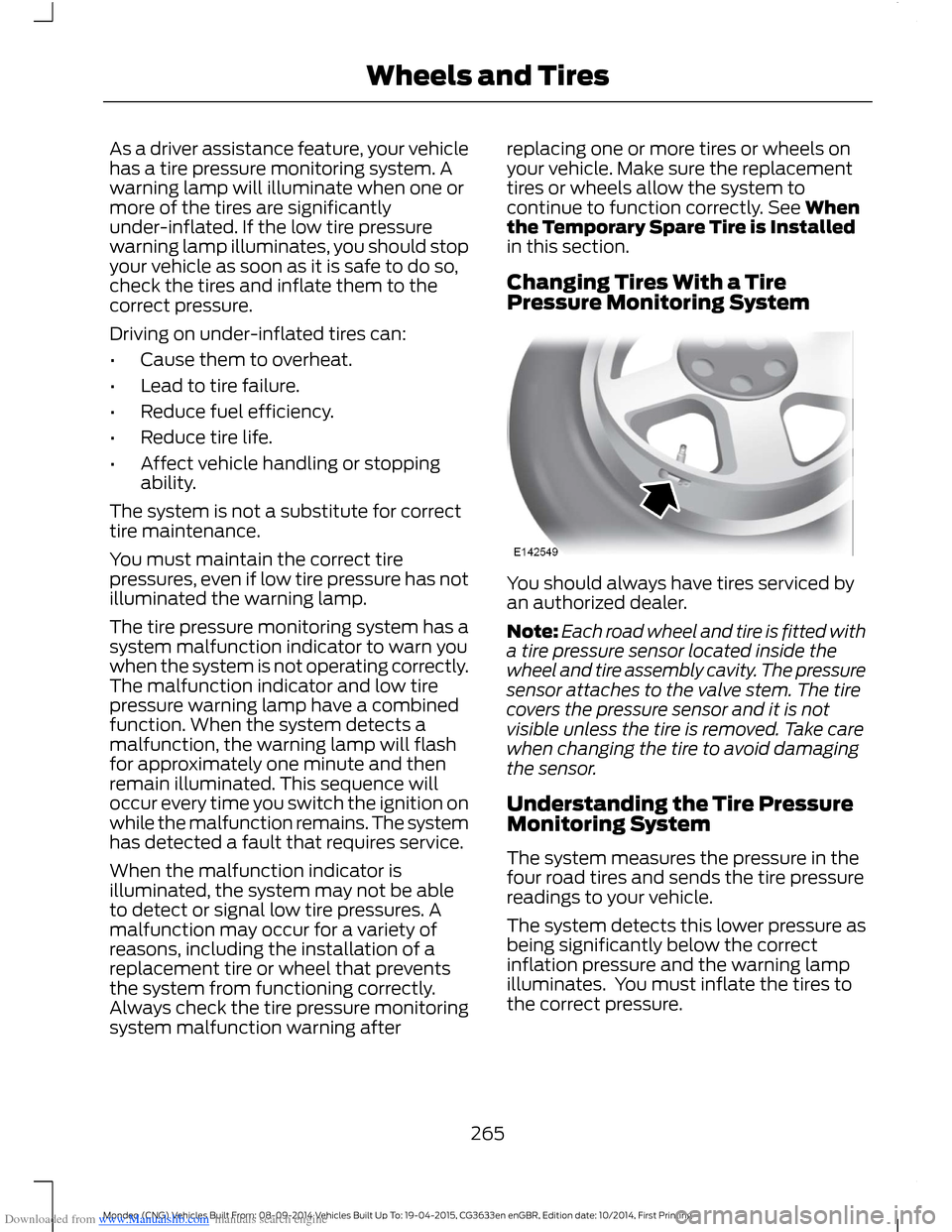
Note:Each road wheel and tire is fitted witha tire pressure sensor located inside thewheel and tire assembly cavity. The pressuresensor attaches to the valve stem. The tirecovers the pressure sensor and it is notvisible unless the tire is removed. Take carewhen changing the tire to avoid damagingthe sensor.
Understanding the Tire PressureMonitoring System
The system measures the pressure in thefour road tires and sends the tire pressurereadings to your vehicle.
The system detects this lower pressure asbeing significantly below the correctinflation pressure and the warning lampilluminates. You must inflate the tires tothe correct pressure.
265Mondeo (CNG) Vehicles Built From: 08-09-2014 Vehicles Built Up To: 19-04-2015, CG3633en enGBR, Edition date: 10/2014, First PrintingWheels and Tires