engine FORD MUSTANG 1998 4.G Owner's Guide
[x] Cancel search | Manufacturer: FORD, Model Year: 1998, Model line: MUSTANG, Model: FORD MUSTANG 1998 4.GPages: 192, PDF Size: 1.67 MB
Page 104 of 192
limitation could result in serious damage to the
vehicle and/or personal injury.
TRAILER TOWING
Your vehicle is capable of towing a trailer up to
454 kg (1 000 lbs.) gross trailer weight with a
maximum tongue load of 45 kg (100 lbs.). Do not
tow a trailer until your vehicle has been driven at
least 800 km (500 miles).
Towing a trailer places an additional load on your
vehicle's engine, transmission, axles, brakes, tires
and suspension. Inspect these components carefully
after towing.
Do not exceed the GVWR or the GAWR
specified on the Safety Compliance
Certification Label.
Towing trailers beyond the maximum
recommended gross trailer weight could
result in engine damage, transmission/axle damage,
structural damage, loss of control, and personal
injury.
Preparing to tow
Use the proper equipment for towing a trailer, and
make sure it is properly attached to your vehicle.
See your dealer or a reliable trailer dealer if you
require assistance.
Safety chains
Always connect the trailer's safety chains to the
vehicle. To connect the trailer's safety chains, cross
the chains under the trailer tongue and allow slack
for turning corners.
If you use a rental trailer, follow the instructions that
the rental agency gives to you.
Do not attach safety chains to the bumper.
Driving
104
Page 106 of 192

Servicing after towing
If you tow a trailer for long distances, your vehicle
will require more frequent service intervals. Refer to
your Scheduled Maintenance guide for more
information.
Trailer towing tips
²Practice turning, stopping and backing up in an
area before starting on a trip to get the feel of the
vehicle trailer combination. When turning, make
wider turns so the trailer wheels will clear curbs
and other obstacles.
²Allow more distance for stopping with a trailer
attached.
²The trailer tongue weight should be 10% of the
loaded trailer weight.
²After you have traveled 80 km (50 miles),
thoroughly check your hitch, electrical
connections and trailer wheel lug nuts.
²When stopped in traffic for long periods of time in
hot weather, place the gearshift in P (Park) and
increase idle speed. This aids engine cooling and
air conditioner efficiency.
²Vehicles with trailers should not be parked on a
grade. If you must park on a grade, place wheel
chocks under the trailer's wheels.
DRIVING THROUGH WATER
Do not drive quickly through standing water,
especially if the depth is unknown. Traction or brake
capability may be limited and if the ignition system
gets wet, your engine may stall. Water may also
enter your engine's air intake and severely damage
your engine.
If driving through deep or standing water is
unavoidable, proceed very slowly. Never drive
through water that is higher than the bottom of the
hubs.
Driving
106
Page 108 of 192
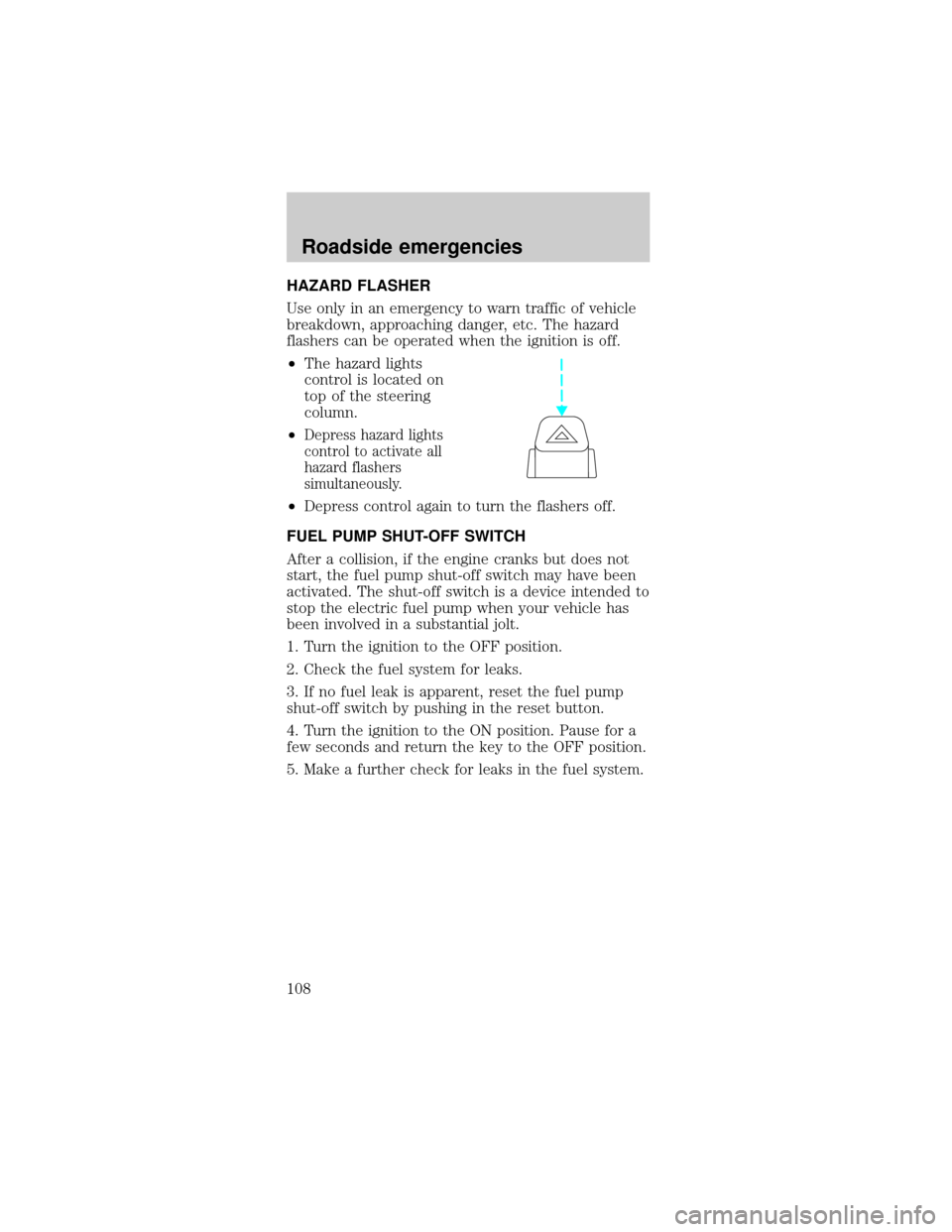
HAZARD FLASHER
Use only in an emergency to warn traffic of vehicle
breakdown, approaching danger, etc. The hazard
flashers can be operated when the ignition is off.
²The hazard lights
control is located on
top of the steering
column.
²
Depress hazard lights
control to activate all
hazard flashers
simultaneously.
²Depress control again to turn the flashers off.
FUEL PUMP SHUT-OFF SWITCH
After a collision, if the engine cranks but does not
start, the fuel pump shut-off switch may have been
activated. The shut-off switch is a device intended to
stop the electric fuel pump when your vehicle has
been involved in a substantial jolt.
1. Turn the ignition to the OFF position.
2. Check the fuel system for leaks.
3. If no fuel leak is apparent, reset the fuel pump
shut-off switch by pushing in the reset button.
4. Turn the ignition to the ON position. Pause for a
few seconds and return the key to the OFF position.
5. Make a further check for leaks in the fuel system.
Roadside emergencies
108
Page 111 of 192
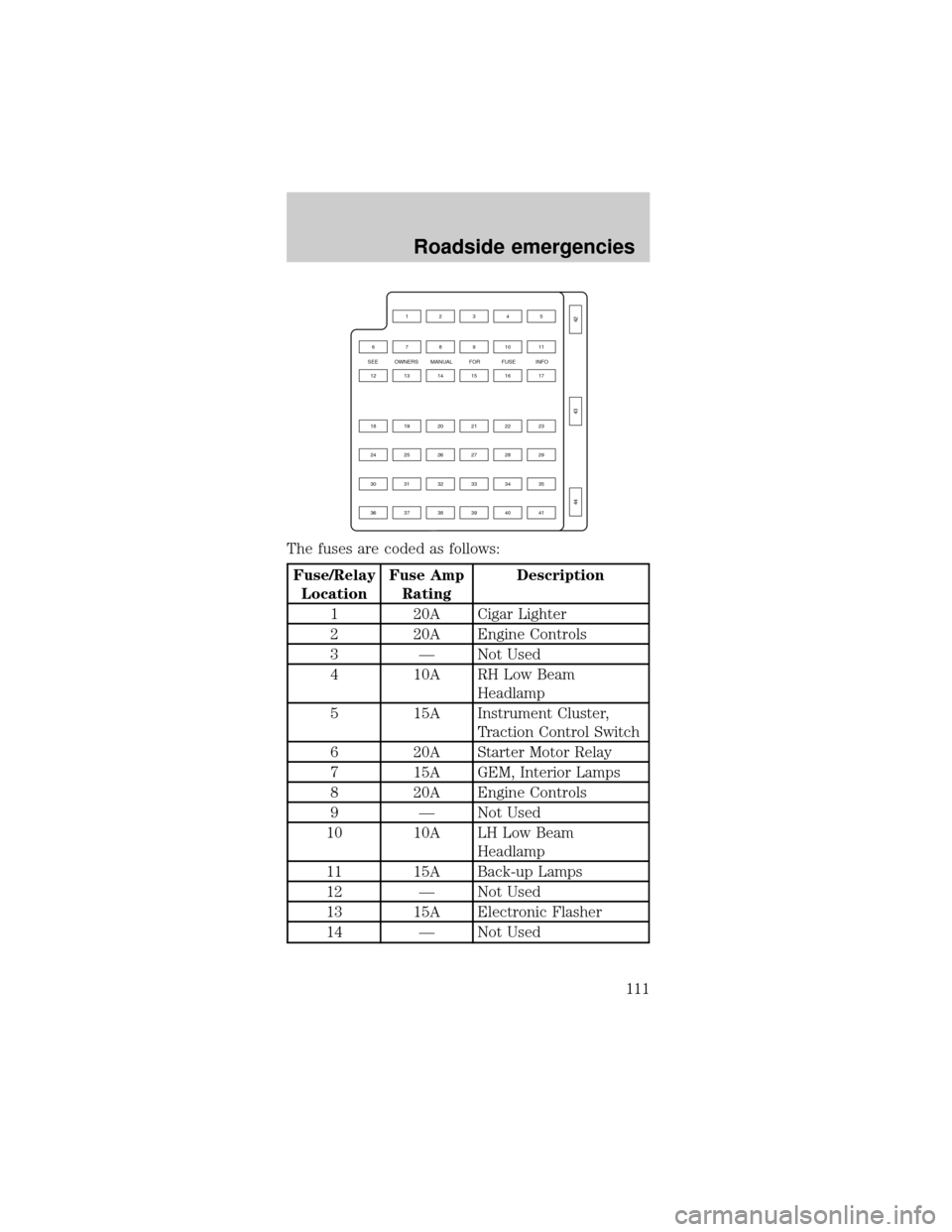
The fuses are coded as follows:
Fuse/Relay
LocationFuse Amp
RatingDescription
1 20A Cigar Lighter
2 20A Engine Controls
3 Ð Not Used
4 10A RH Low Beam
Headlamp
5 15A Instrument Cluster,
Traction Control Switch
6 20A Starter Motor Relay
7 15A GEM, Interior Lamps
8 20A Engine Controls
9 Ð Not Used
10 10A LH Low Beam
Headlamp
11 15A Back-up Lamps
12 Ð Not Used
13 15A Electronic Flasher
14 Ð Not Used
SEE OWNERS MANUAL FOR FUSE INFO
4212345
76891011
131214151617
191820212223
252426272829
313032333435
373638394041
43
44
Roadside emergencies
111
Page 112 of 192
Fuse/Relay
LocationFuse Amp
RatingDescription
15 15A Power Lumbar
16 Ð Not Used
17 15A Speed Control Servo,
Shift Lock Actuator
18 15A Electronic Flasher
19 15A Power Mirror Switch,
GEM, Anti-Theft Relay,
Power Door Locks,
Door Ajar Switches
20 15A Convertible Top Switch
21 5A Instrument Cluster and
Engine Control Memory
22 Ð Not Used
23 15A A/C Clutch, Defogger
Switch
24 30A Climate Control Blower
Motor
25 25A Luggage Compartment
Lid Release
26 30A Wiper/Washer Motor,
Wiper Relays
27 25A Radio
28 15A GEM, Overdrive Cancel
Switch
29 15A ABS Module
30 15A DRL Module
31 10A Data Link Connector
32 15A Radio, CD Player, GEM
33 15A Stop Lamp Switch,
Speed Control
Deactivation Switch
Roadside emergencies
112
Page 113 of 192
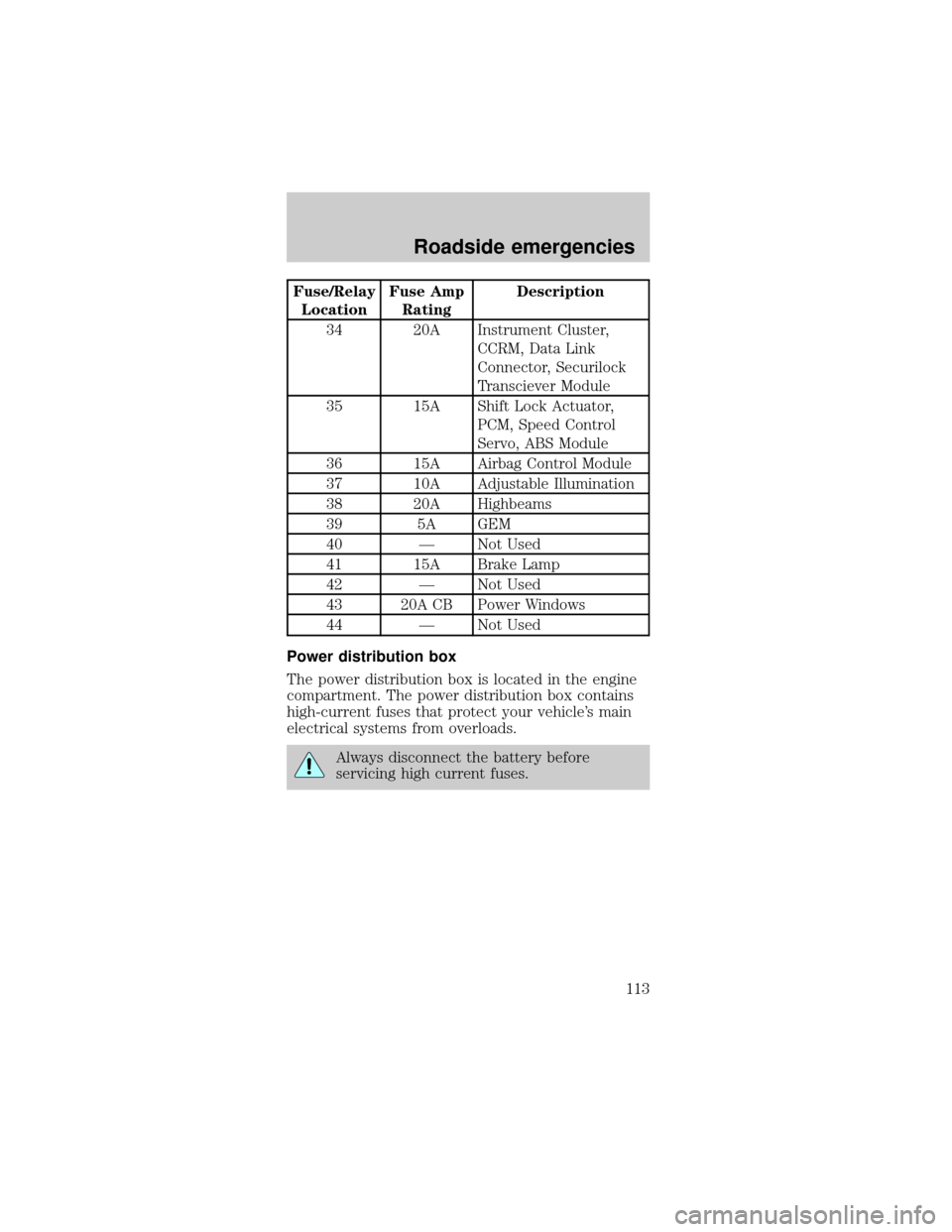
Fuse/Relay
LocationFuse Amp
RatingDescription
34 20A Instrument Cluster,
CCRM, Data Link
Connector, Securilock
Transciever Module
35 15A Shift Lock Actuator,
PCM, Speed Control
Servo, ABS Module
36 15A Airbag Control Module
37 10A Adjustable Illumination
38 20A Highbeams
39 5A GEM
40 Ð Not Used
41 15A Brake Lamp
42 Ð Not Used
43 20A CB Power Windows
44 Ð Not Used
Power distribution box
The power distribution box is located in the engine
compartment. The power distribution box contains
high-current fuses that protect your vehicle's main
electrical systems from overloads.
Always disconnect the battery before
servicing high current fuses.
Roadside emergencies
113
Page 117 of 192
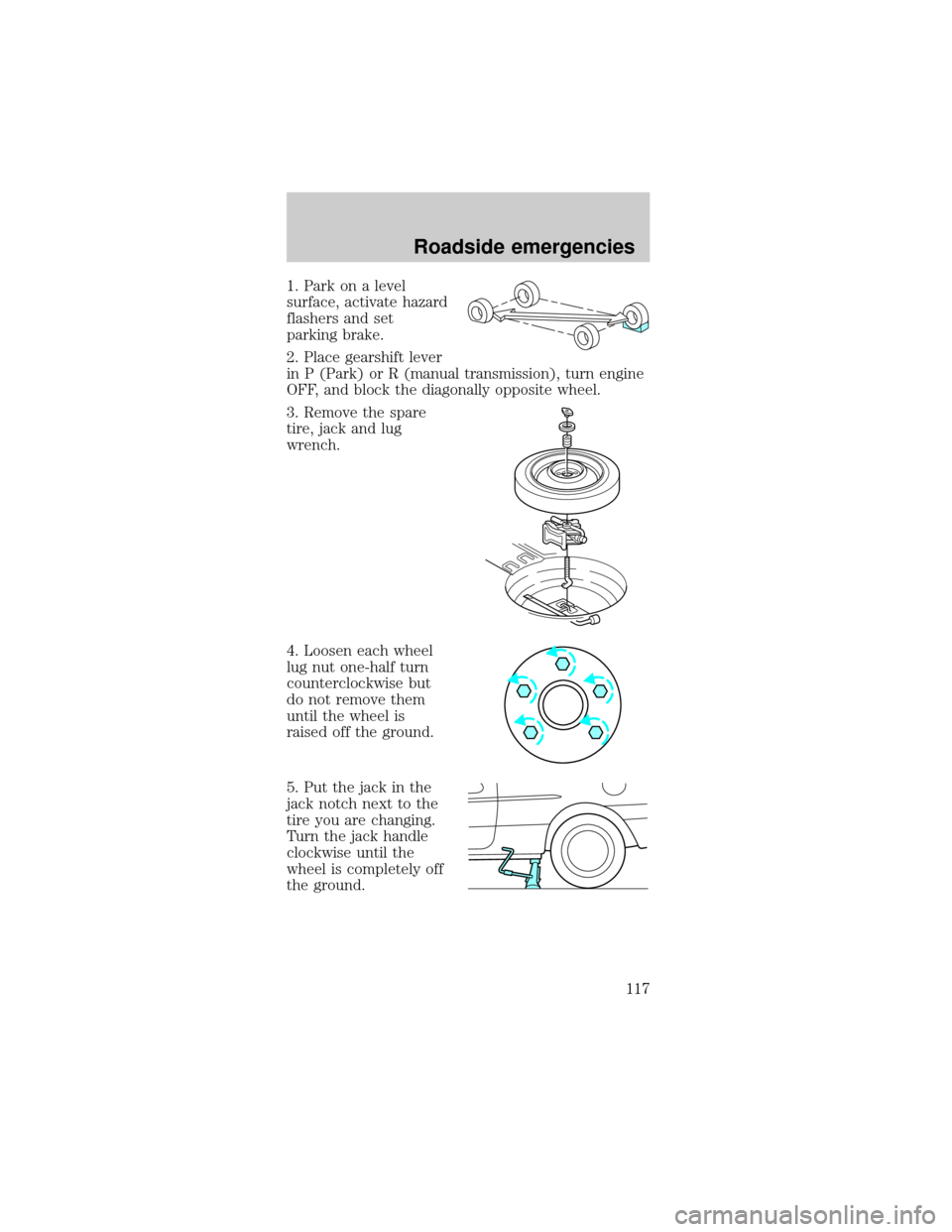
1. Park on a level
surface, activate hazard
flashers and set
parking brake.
2. Place gearshift lever
in P (Park) or R (manual transmission), turn engine
OFF, and block the diagonally opposite wheel.
3. Remove the spare
tire, jack and lug
wrench.
4. Loosen each wheel
lug nut one-half turn
counterclockwise but
do not remove them
until the wheel is
raised off the ground.
5. Put the jack in the
jack notch next to the
tire you are changing.
Turn the jack handle
clockwise until the
wheel is completely off
the ground.
Roadside emergencies
117
Page 118 of 192
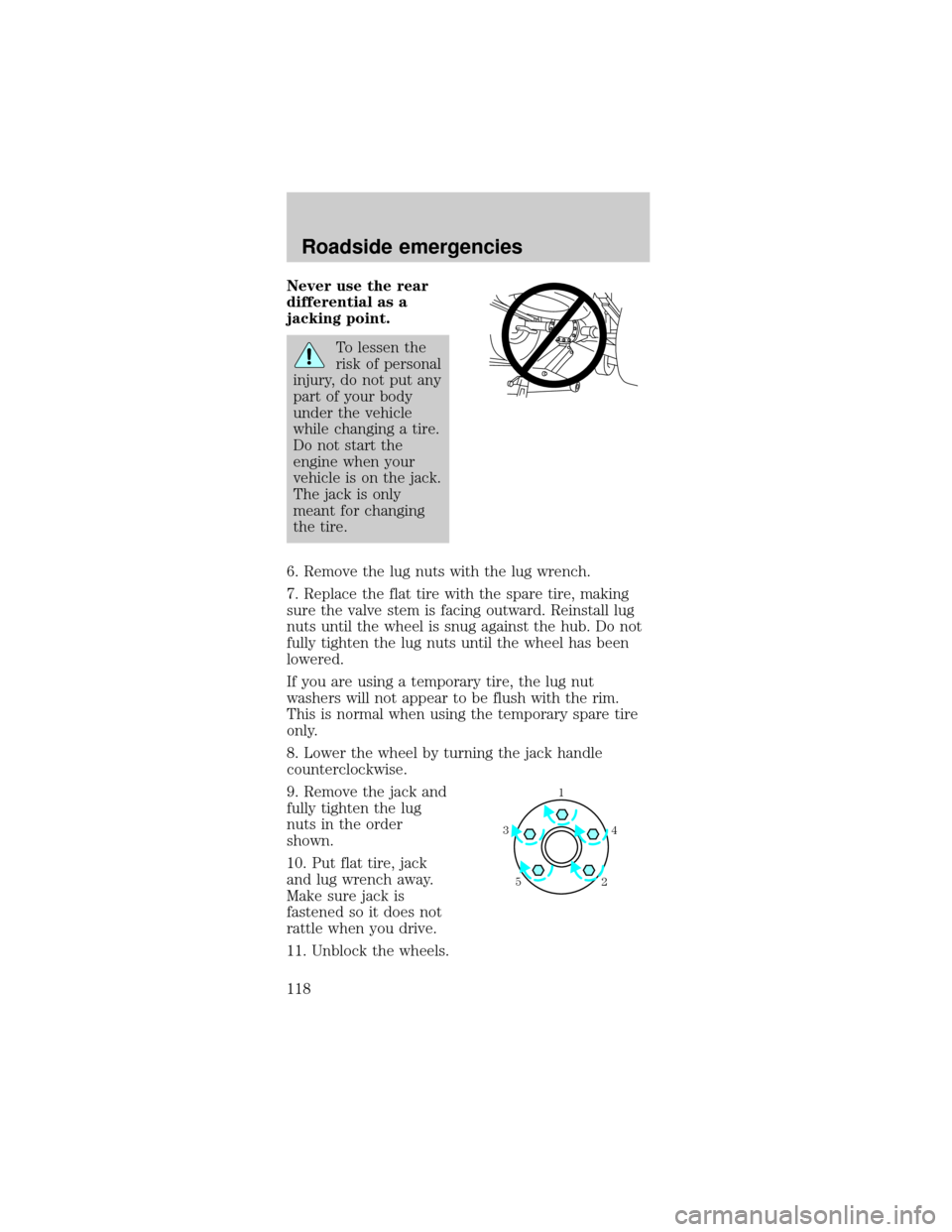
Never use the rear
differential as a
jacking point.
To lessen the
risk of personal
injury, do not put any
part of your body
under the vehicle
while changing a tire.
Do not start the
engine when your
vehicle is on the jack.
The jack is only
meant for changing
the tire.
6. Remove the lug nuts with the lug wrench.
7. Replace the flat tire with the spare tire, making
sure the valve stem is facing outward. Reinstall lug
nuts until the wheel is snug against the hub. Do not
fully tighten the lug nuts until the wheel has been
lowered.
If you are using a temporary tire, the lug nut
washers will not appear to be flush with the rim.
This is normal when using the temporary spare tire
only.
8. Lower the wheel by turning the jack handle
counterclockwise.
9. Remove the jack and
fully tighten the lug
nuts in the order
shown.
10. Put flat tire, jack
and lug wrench away.
Make sure jack is
fastened so it does not
rattle when you drive.
11. Unblock the wheels.
1
4 3
52
Roadside emergencies
118
Page 120 of 192
JUMP STARTING YOUR VEHICLE
The gases around the battery can explode if
exposed to flames, sparks, or lit cigarettes.
An explosion could result in injury or vehicle
damage.
Do not push start your vehicle. You could
damage the catalytic converter.
Batteries contain sulfuric acid which can
burn skin, eyes, and clothing, if contacted.
Do not attempt to push start your vehicle.
Automatic transmissions do not have
push-start capability.
Preparing your vehicle
1.Use only a 12±volt supply to start your
vehicle.
2. Do not disconnect the battery of the disabled
vehicle as this could damage the vehicle's electrical
system.
3. Park the booster vehicle close to the hood of the
disabled vehicle making sure the two vehiclesdo
nottouch. Set the parking brake on both vehicles
and stay clear of the engine cooling fan and other
moving parts.
4. Check all battery terminals and remove any
excessive corrosion before you attach the battery
cables. Ensure that vent caps are tight and level.
5. Turn the heater fan on in both vehicles to protect
any electrical surges. Turn all other accessories off.
Roadside emergencies
120
Page 122 of 192
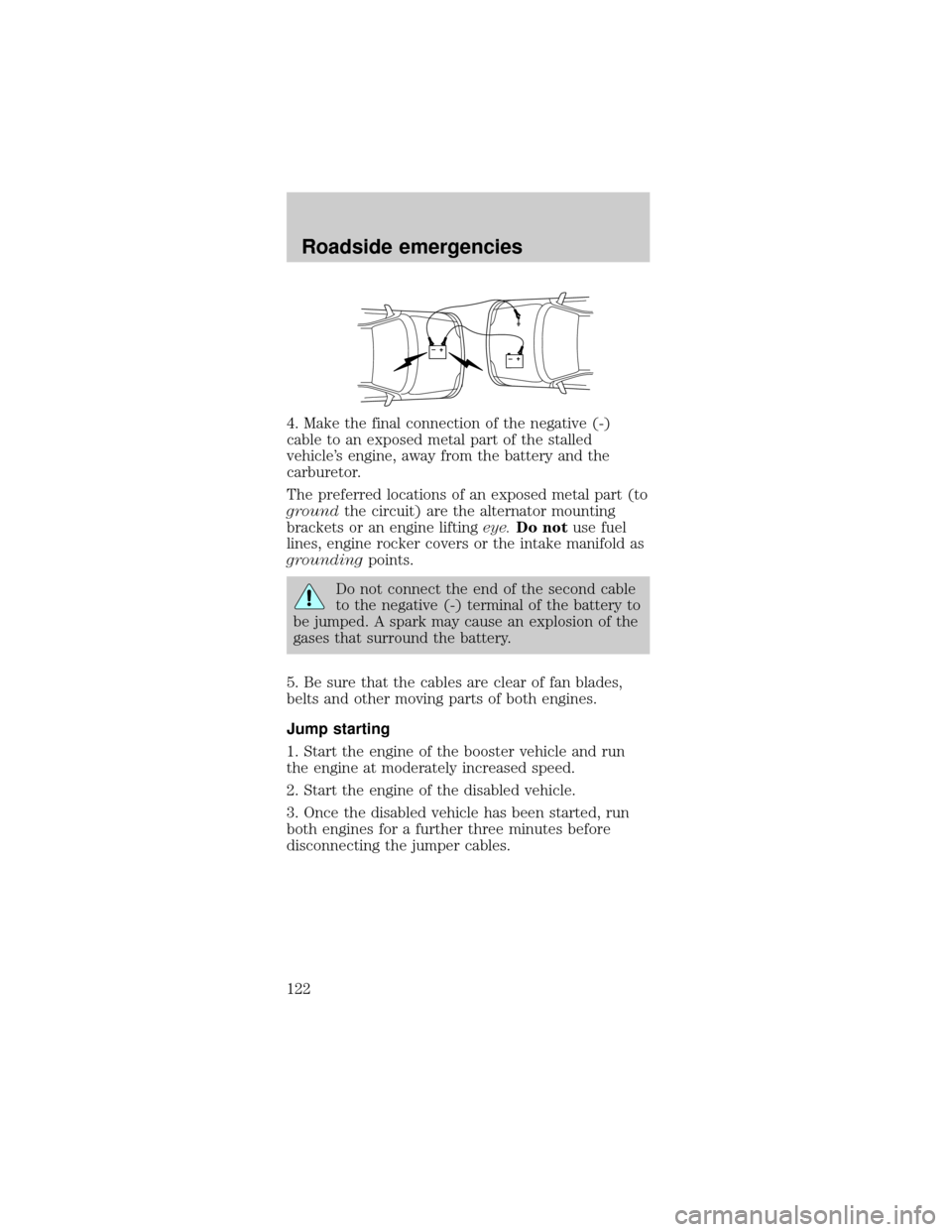
4. Make the final connection of the negative (-)
cable to an exposed metal part of the stalled
vehicle's engine, away from the battery and the
carburetor.
The preferred locations of an exposed metal part (to
groundthe circuit) are the alternator mounting
brackets or an engine liftingeye.Do notuse fuel
lines, engine rocker covers or the intake manifold as
groundingpoints.
Do not connect the end of the second cable
to the negative (-) terminal of the battery to
be jumped. A spark may cause an explosion of the
gases that surround the battery.
5. Be sure that the cables are clear of fan blades,
belts and other moving parts of both engines.
Jump starting
1. Start the engine of the booster vehicle and run
the engine at moderately increased speed.
2. Start the engine of the disabled vehicle.
3. Once the disabled vehicle has been started, run
both engines for a further three minutes before
disconnecting the jumper cables.
+–+–
Roadside emergencies
122