ignition FORD MUSTANG 1998 4.G Owner's Guide
[x] Cancel search | Manufacturer: FORD, Model Year: 1998, Model line: MUSTANG, Model: FORD MUSTANG 1998 4.GPages: 192, PDF Size: 1.67 MB
Page 100 of 192
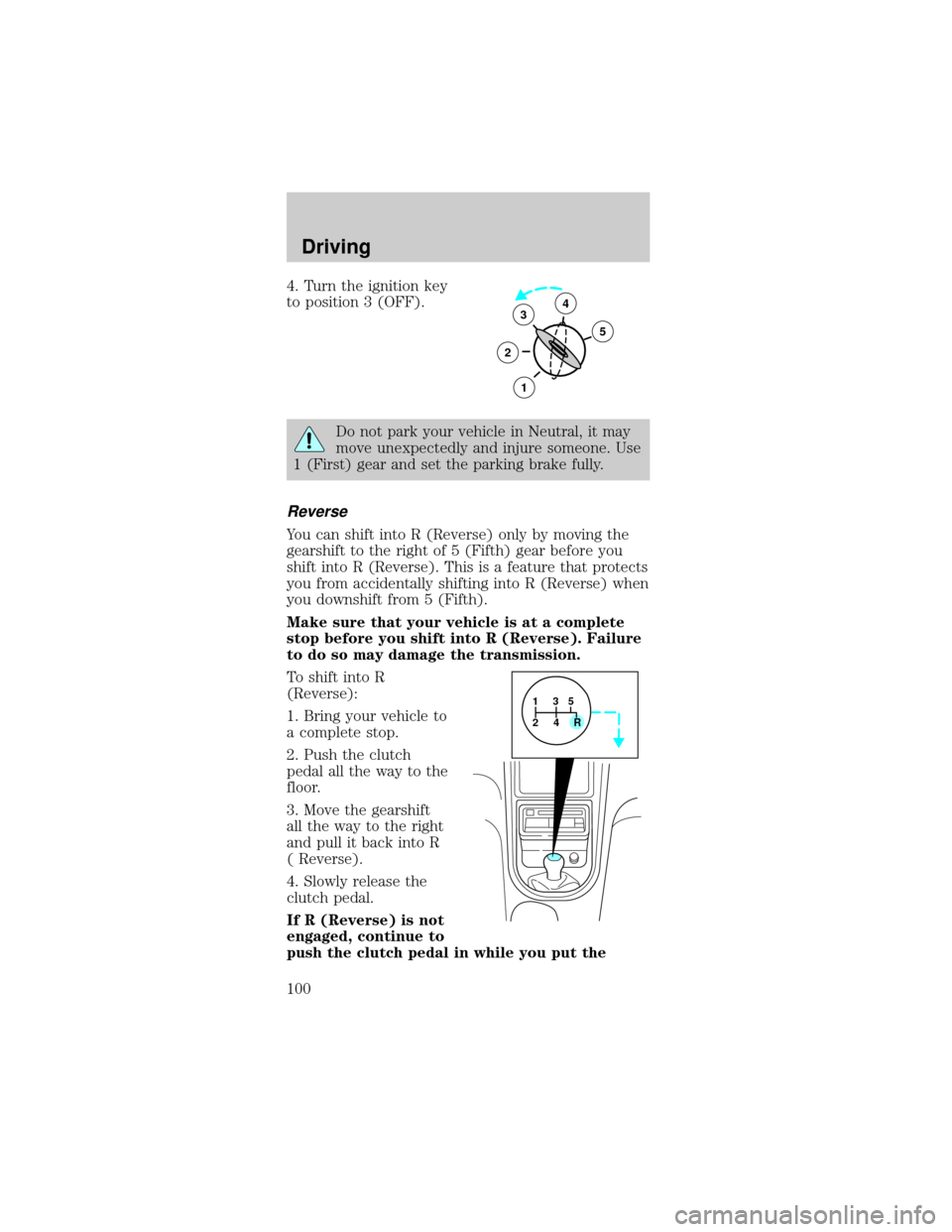
4. Turn the ignition key
to position 3 (OFF).
Do not park your vehicle in Neutral, it may
move unexpectedly and injure someone. Use
1 (First) gear and set the parking brake fully.
Reverse
You can shift into R (Reverse) only by moving the
gearshift to the right of 5 (Fifth) gear before you
shift into R (Reverse). This is a feature that protects
you from accidentally shifting into R (Reverse) when
you downshift from 5 (Fifth).
Make sure that your vehicle is at a complete
stop before you shift into R (Reverse). Failure
to do so may damage the transmission.
To shift into R
(Reverse):
1. Bring your vehicle to
a complete stop.
2. Push the clutch
pedal all the way to the
floor.
3. Move the gearshift
all the way to the right
and pull it back into R
( Reverse).
4. Slowly release the
clutch pedal.
If R (Reverse) is not
engaged, continue to
push the clutch pedal in while you put the
3
2
1
5
4
1
24R3
5
Driving
100
Page 101 of 192
gearshift back into Neutral. Then, release the
clutch pedal for a moment and repeat steps 2
through 4.
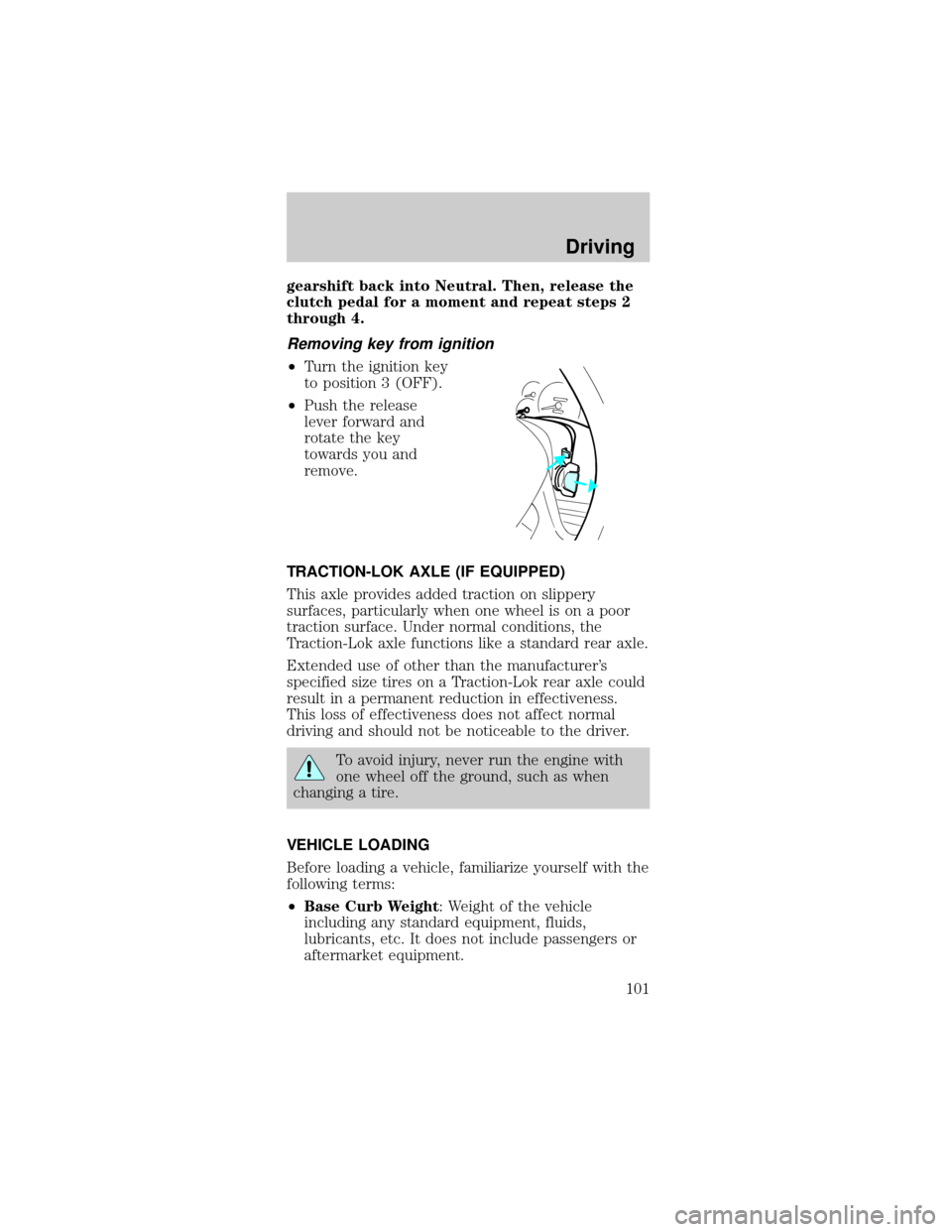
Removing key from ignition
²Turn the ignition key
to position 3 (OFF).
²Push the release
lever forward and
rotate the key
towards you and
remove.
TRACTION-LOK AXLE (IF EQUIPPED)
This axle provides added traction on slippery
surfaces, particularly when one wheel is on a poor
traction surface. Under normal conditions, the
Traction-Lok axle functions like a standard rear axle.
Extended use of other than the manufacturer's
specified size tires on a Traction-Lok rear axle could
result in a permanent reduction in effectiveness.
This loss of effectiveness does not affect normal
driving and should not be noticeable to the driver.
To avoid injury, never run the engine with
one wheel off the ground, such as when
changing a tire.
VEHICLE LOADING
Before loading a vehicle, familiarize yourself with the
following terms:
²Base Curb Weight: Weight of the vehicle
including any standard equipment, fluids,
lubricants, etc. It does not include passengers or
aftermarket equipment.
Driving
101
Page 106 of 192

Servicing after towing
If you tow a trailer for long distances, your vehicle
will require more frequent service intervals. Refer to
your Scheduled Maintenance guide for more
information.
Trailer towing tips
²Practice turning, stopping and backing up in an
area before starting on a trip to get the feel of the
vehicle trailer combination. When turning, make
wider turns so the trailer wheels will clear curbs
and other obstacles.
²Allow more distance for stopping with a trailer
attached.
²The trailer tongue weight should be 10% of the
loaded trailer weight.
²After you have traveled 80 km (50 miles),
thoroughly check your hitch, electrical
connections and trailer wheel lug nuts.
²When stopped in traffic for long periods of time in
hot weather, place the gearshift in P (Park) and
increase idle speed. This aids engine cooling and
air conditioner efficiency.
²Vehicles with trailers should not be parked on a
grade. If you must park on a grade, place wheel
chocks under the trailer's wheels.
DRIVING THROUGH WATER
Do not drive quickly through standing water,
especially if the depth is unknown. Traction or brake
capability may be limited and if the ignition system
gets wet, your engine may stall. Water may also
enter your engine's air intake and severely damage
your engine.
If driving through deep or standing water is
unavoidable, proceed very slowly. Never drive
through water that is higher than the bottom of the
hubs.
Driving
106
Page 108 of 192
HAZARD FLASHER
Use only in an emergency to warn traffic of vehicle
breakdown, approaching danger, etc. The hazard
flashers can be operated when the ignition is off.
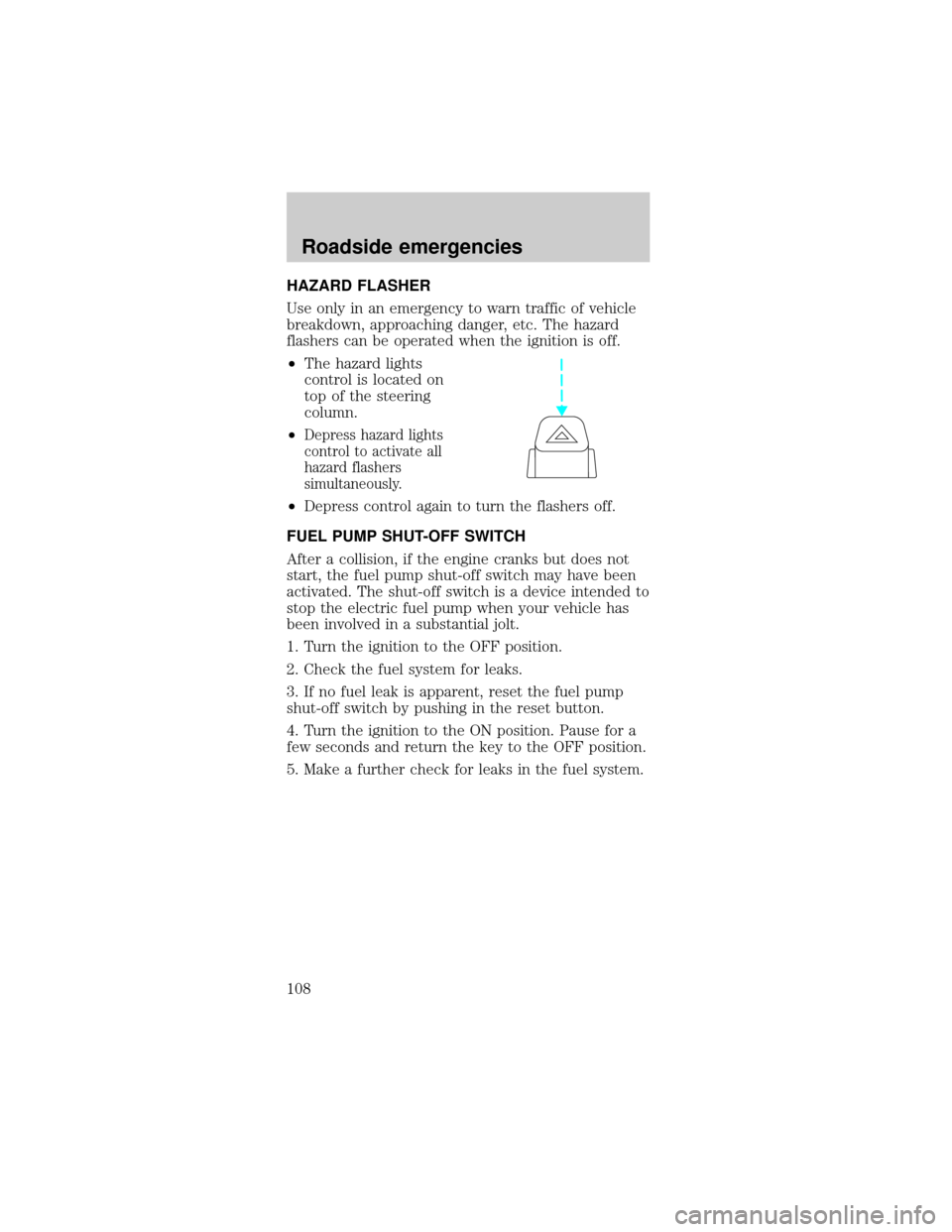
²The hazard lights
control is located on
top of the steering
column.
²
Depress hazard lights
control to activate all
hazard flashers
simultaneously.
²Depress control again to turn the flashers off.
FUEL PUMP SHUT-OFF SWITCH
After a collision, if the engine cranks but does not
start, the fuel pump shut-off switch may have been
activated. The shut-off switch is a device intended to
stop the electric fuel pump when your vehicle has
been involved in a substantial jolt.
1. Turn the ignition to the OFF position.
2. Check the fuel system for leaks.
3. If no fuel leak is apparent, reset the fuel pump
shut-off switch by pushing in the reset button.
4. Turn the ignition to the ON position. Pause for a
few seconds and return the key to the OFF position.
5. Make a further check for leaks in the fuel system.
Roadside emergencies
108
Page 114 of 192
Always replace the cover to the Power
Distribution Box before reconnecting the
battery or refilling fluid reservoirs.
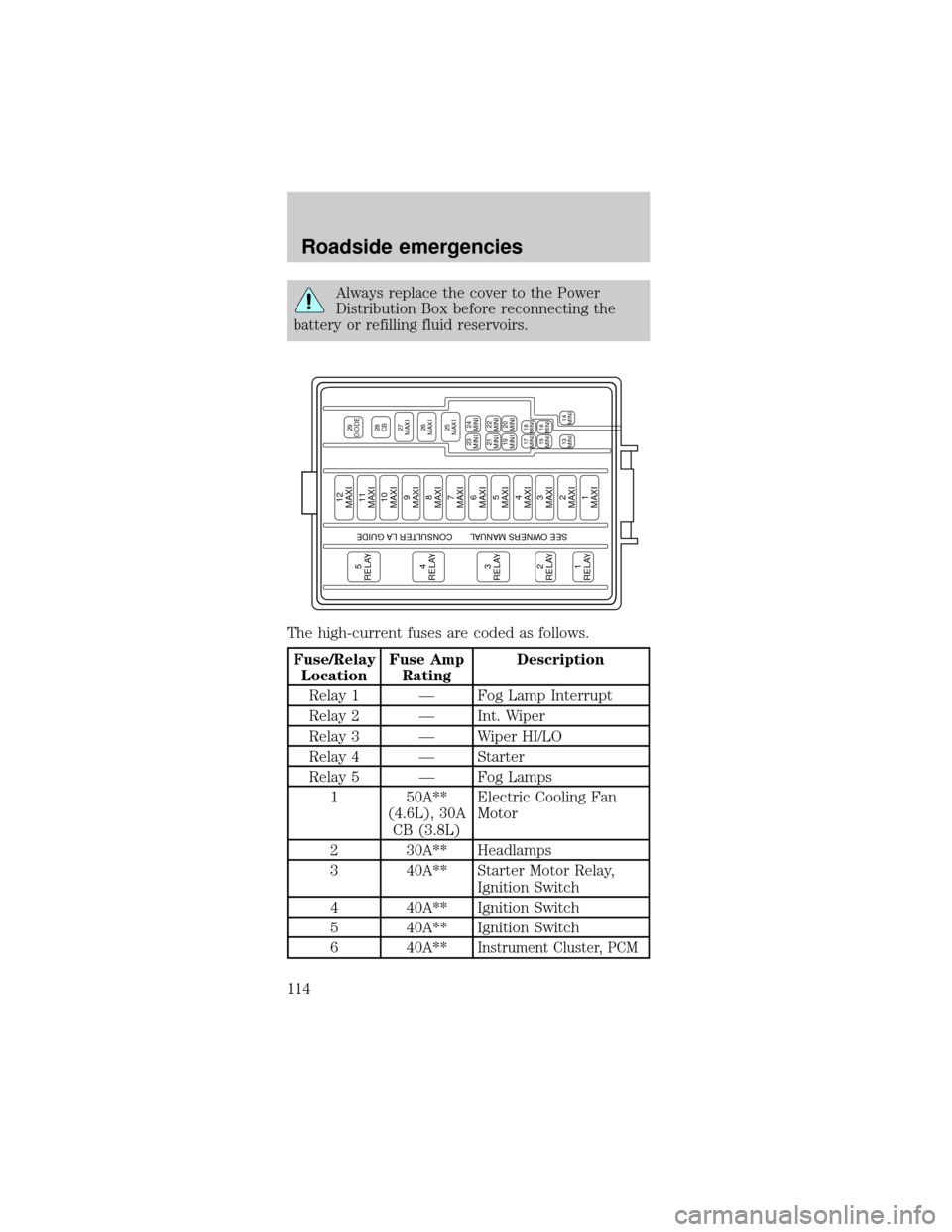
The high-current fuses are coded as follows.
Fuse/Relay
LocationFuse Amp
RatingDescription
Relay 1 Ð Fog Lamp Interrupt
Relay 2 Ð Int. Wiper
Relay 3 Ð Wiper HI/LO
Relay 4 Ð Starter
Relay 5 Ð Fog Lamps
1 50A**
(4.6L), 30A
CB (3.8L)Electric Cooling Fan
Motor
2 30A** Headlamps
3 40A** Starter Motor Relay,
Ignition Switch
4 40A** Ignition Switch
5 40A** Ignition Switch
6 40A**
Instrument Cluster, PCM
5
RELAY4
RELAY3
RELAY2
RELAY1
RELAY
12
MAXI
29
DIODE28
CB27
MAXI26
MAXI25
MAXI23
MINI
24
MINI
21
MINI
22
MINI
19
MINI17
MINI18
MINI15
MINI13
MINI
14
MINI16
MINI20
MINI
11
MAXI10
MAXI9
MAXI8
MAXI7
MAXI6
MAXI5
MAXI4
MAXI3
MAXI2
MAXI1
MAXI
SEE OWNERS MANUAL CONSULTER LA GUIDE
Roadside emergencies
114
Page 163 of 192

EPA window sticker
Every new vehicle should have the EPA window
sticker. Contact your dealer if the window sticker is
not supplied with your vehicle. The EPA window
sticker should be your guide for the fuel economy
comparisons with other vehicles.
It is important to note the box in the lower left
corner of the window sticker. These numbers
represent the Range of Km/L (MPG) expected on
the vehicle, depending upon the driver's method of
operation and conditions.
EMISSION CONTROL SYSTEM
Your vehicle is equipped with various emission
control components and a catalytic converter which
will enable your vehicle to comply with applicable
exhaust emission standards. To make sure that the
catalytic converter and other emission control
components continue to work properly:
²Use only unleaded fuel.
²Avoid running out of fuel.
²Do not turn off the ignition while your vehicle is
moving, especially at high speeds.
²Have the items listed in your Scheduled
Maintenance Guide performed according to the
specified schedule.
The scheduled maintenance items listed in the
Scheduled Maintenance Guide are essential to the
life and performance of your vehicle and to its
emissions system.
If other than Ford, Motorcraft or Ford-authorized
parts are used for maintenance replacements or for
service of components affecting emission control,
such non-Ford parts should be equivalent to genuine
Ford Motor Company parts in performance and
durability.
Maintenance and care
163
Page 182 of 192
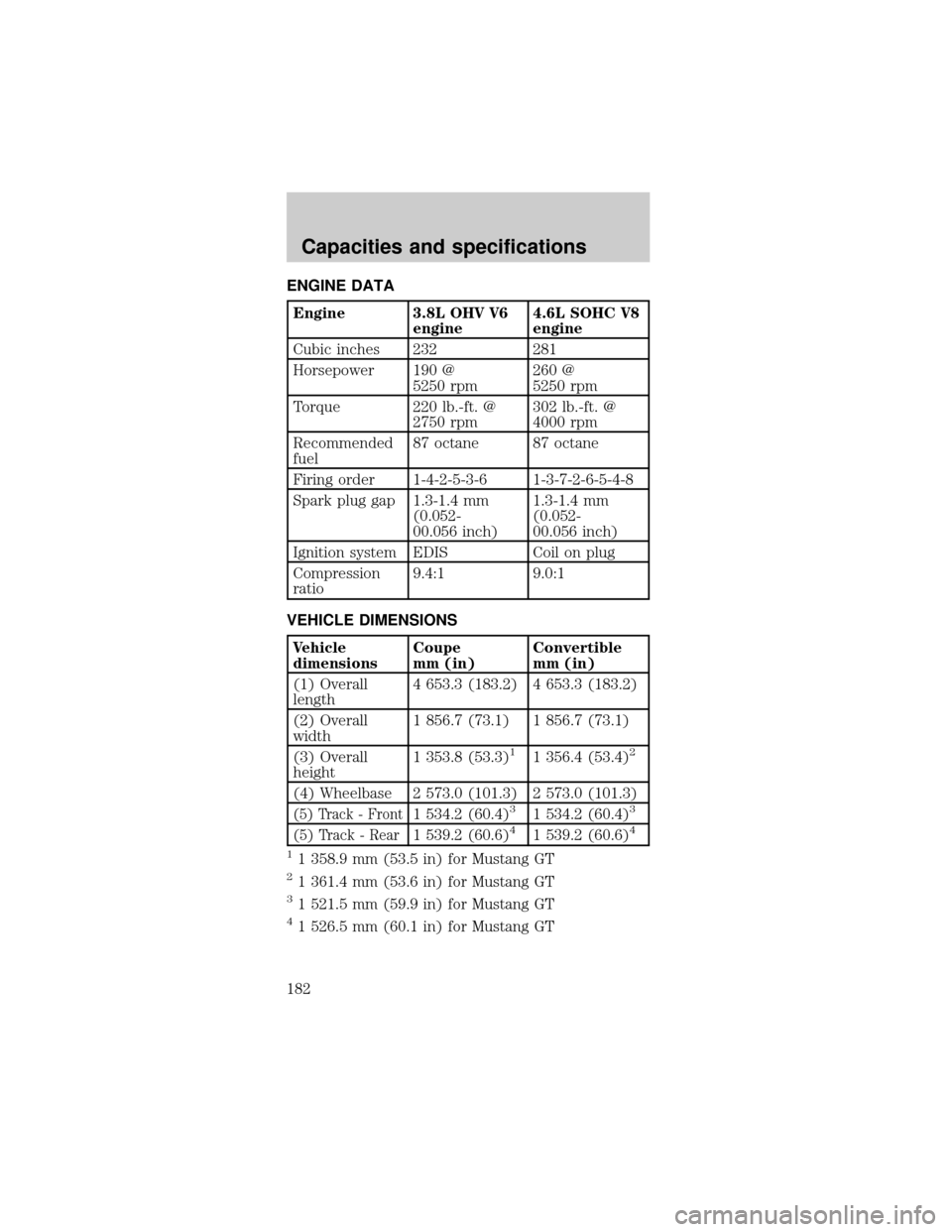
ENGINE DATA
Engine 3.8L OHV V6
engine4.6L SOHC V8
engine
Cubic inches 232 281
Horsepower 190 @
5250 rpm260 @
5250 rpm
Torque 220 lb.-ft. @
2750 rpm302 lb.-ft. @
4000 rpm
Recommended
fuel87 octane 87 octane
Firing order 1-4-2-5-3-6 1-3-7-2-6-5-4-8
Spark plug gap 1.3-1.4 mm
(0.052-
00.056 inch)1.3-1.4 mm
(0.052-
00.056 inch)
Ignition system EDIS Coil on plug
Compression
ratio9.4:1 9.0:1
VEHICLE DIMENSIONS
Vehicle
dimensionsCoupe
mm (in)Convertible
mm (in)
(1) Overall
length4 653.3 (183.2) 4 653.3 (183.2)
(2) Overall
width1 856.7 (73.1) 1 856.7 (73.1)
(3) Overall
height1 353.8 (53.3)
11 356.4 (53.4)2
(4) Wheelbase 2 573.0 (101.3) 2 573.0 (101.3)
(5) Track - Front1 534.2 (60.4)31 534.2 (60.4)3
(5) Track - Rear1 539.2 (60.6)41 539.2 (60.6)4
1
1 358.9 mm (53.5 in) for Mustang GT
21 361.4 mm (53.6 in) for Mustang GT
31 521.5 mm (59.9 in) for Mustang GT
41 526.5 mm (60.1 in) for Mustang GT
Capacities and specifications
182
Page 187 of 192

Fuel
choosing
the right fuel ......... 156
comparisons with EPA
fuel economy
estimates ............... 163
detergent in fuel ... 158
filling your vehicle
with fuel ......... 154,155
gauge ....................... 12
quality .................... 157
running
out of fuel ............. 158
safety information
relating to automotive
fuels ....................... 154
Fuses ................. 109,110
Gas mileage (see
Fuel economy) ........ 159
160,161,162
Gauges ....................... 12
engine coolant
temperature gauge . 13
engine oil pressure
gauge ....................... 15
Hazard flashers ....... 108
Head restraints ......... 63
Headlamps
aiming ............. 170,171
bulb
specifications ........ 170
high beam ............ 7,44
warning chime ........ 11
Heating ...................... 18
heating and air
conditioning
system ................ 18,20
Hood ........................ 128
Ignition ..................... 182
Inspection/maintenance
(I/M) testing ............ 164
Instrument panel ........ 6cleaning ................. 175
Keys
key in ignition
chime ....................... 11
positions of the
ignition .................... 45
removing from the
ignition .................. 101
Lamps
daytime
running light ........... 16
fog lamps ................. 52
headlamps ............... 16
headlamps, flash to
pass .......................... 44
instrument panel,
dimming ................... 17
interior
lamps ......... 49,169,170
replacing bulbs ..... 165
166,167,168,169
Lane change indicator
(see Turn signal) ...... 43
Lights, warning and
indicator
air bag ........................ 7
anti-lock brakes
(ABS) ...................... 10
anti-theft ................... 7
brake ........................ 10
charging system ........ 7
check coolant .......... 11
low fuel ...................... 9
overdrive off .............. 9
safety belt ................. 7
service engine soon .. 8
turn signal indicator . 6
Lumbar support,
seats ...................... 65,66
Manual transmission
reverse ................... 100
Index
187