ABS FORD MUSTANG 1999 4.G User Guide
[x] Cancel search | Manufacturer: FORD, Model Year: 1999, Model line: MUSTANG, Model: FORD MUSTANG 1999 4.GPages: 216, PDF Size: 1.72 MB
Page 117 of 216
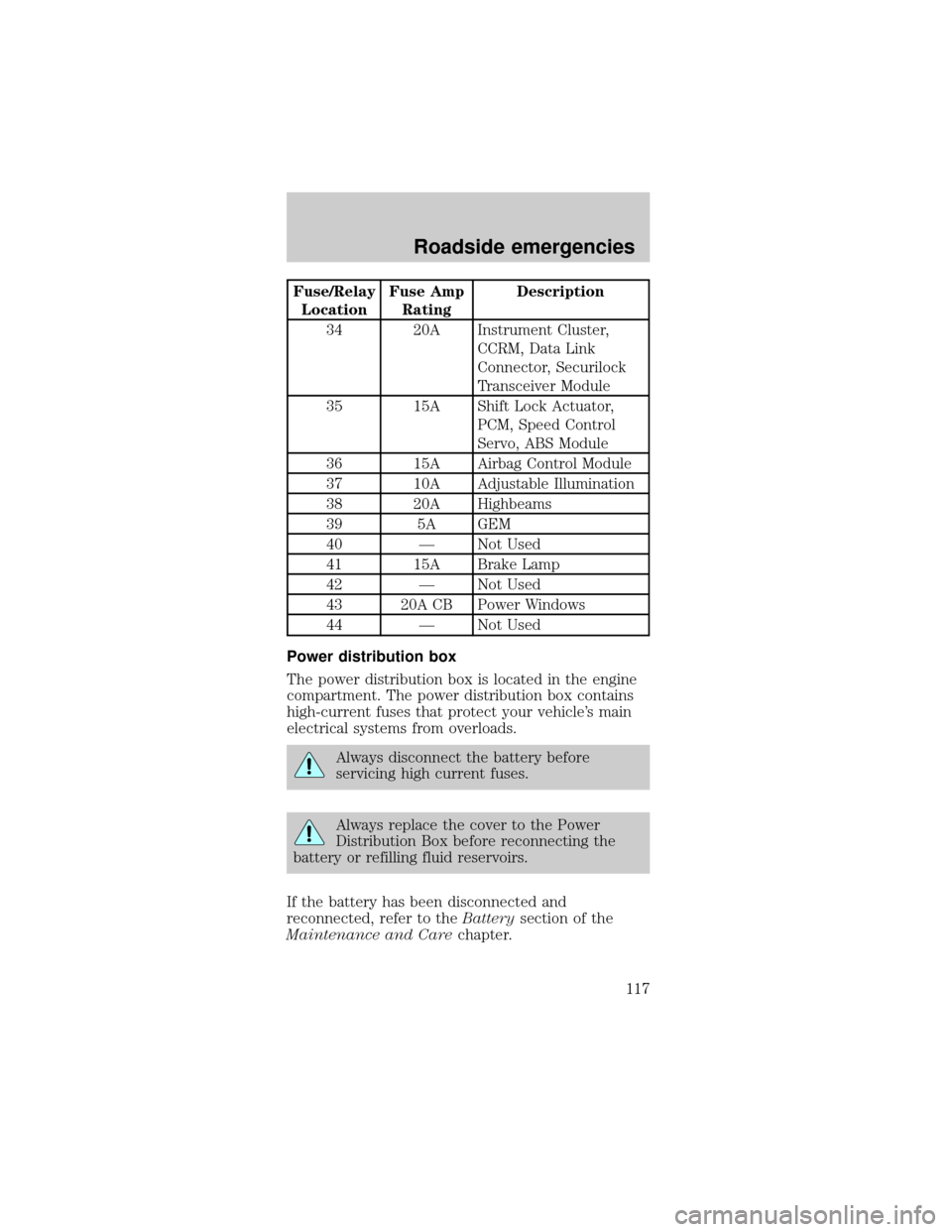
Fuse/Relay
LocationFuse Amp
RatingDescription
34 20A Instrument Cluster,
CCRM, Data Link
Connector, Securilock
Transceiver Module
35 15A Shift Lock Actuator,
PCM, Speed Control
Servo, ABS Module
36 15A Airbag Control Module
37 10A Adjustable Illumination
38 20A Highbeams
39 5A GEM
40 Ð Not Used
41 15A Brake Lamp
42 Ð Not Used
43 20A CB Power Windows
44 Ð Not Used
Power distribution box
The power distribution box is located in the engine
compartment. The power distribution box contains
high-current fuses that protect your vehicle's main
electrical systems from overloads.
Always disconnect the battery before
servicing high current fuses.
Always replace the cover to the Power
Distribution Box before reconnecting the
battery or refilling fluid reservoirs.
If the battery has been disconnected and
reconnected, refer to theBatterysection of the
Maintenance and Carechapter.
Roadside emergencies
117
Page 118 of 216
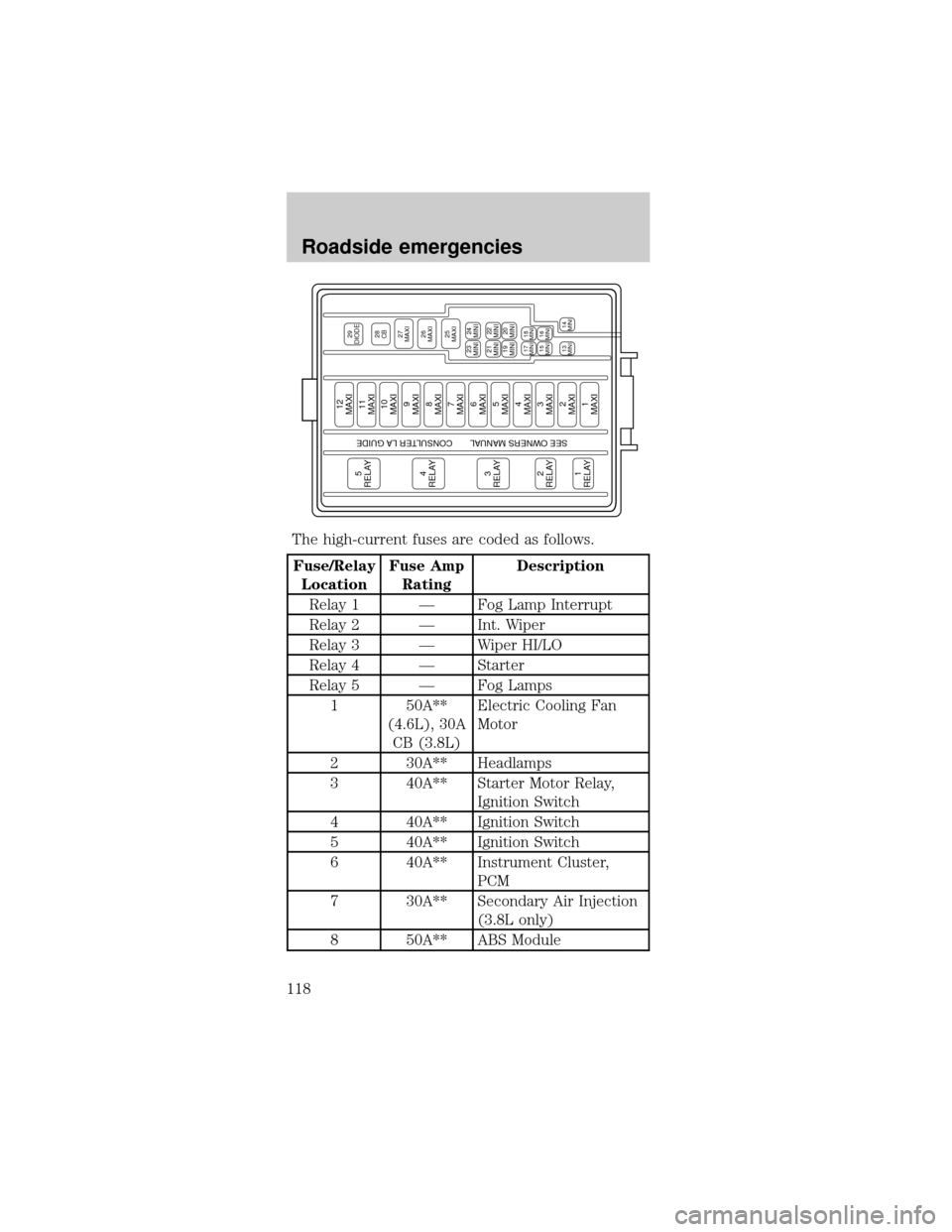
The high-current fuses are coded as follows.
Fuse/Relay
LocationFuse Amp
RatingDescription
Relay 1 Ð Fog Lamp Interrupt
Relay 2 Ð Int. Wiper
Relay 3 Ð Wiper HI/LO
Relay 4 Ð Starter
Relay 5 Ð Fog Lamps
1 50A**
(4.6L), 30A
CB (3.8L)Electric Cooling Fan
Motor
2 30A** Headlamps
3 40A** Starter Motor Relay,
Ignition Switch
4 40A** Ignition Switch
5 40A** Ignition Switch
6 40A** Instrument Cluster,
PCM
7 30A** Secondary Air Injection
(3.8L only)
8 50A** ABS Module
5
RELAY4
RELAY3
RELAY2
RELAY1
RELAY
12
MAXI
29
DIODE28
CB27
MAXI26
MAXI25
MAXI23
MINI
24
MINI
21
MINI
22
MINI
19
MINI17
MINI18
MINI15
MINI13
MINI
14
MINI16
MINI20
MINI
11
MAXI10
MAXI9
MAXI8
MAXI7
MAXI6
MAXI5
MAXI4
MAXI3
MAXI2
MAXI1
MAXI
SEE OWNERS MANUAL CONSULTER LA GUIDE
Roadside emergencies
118
Page 160 of 216
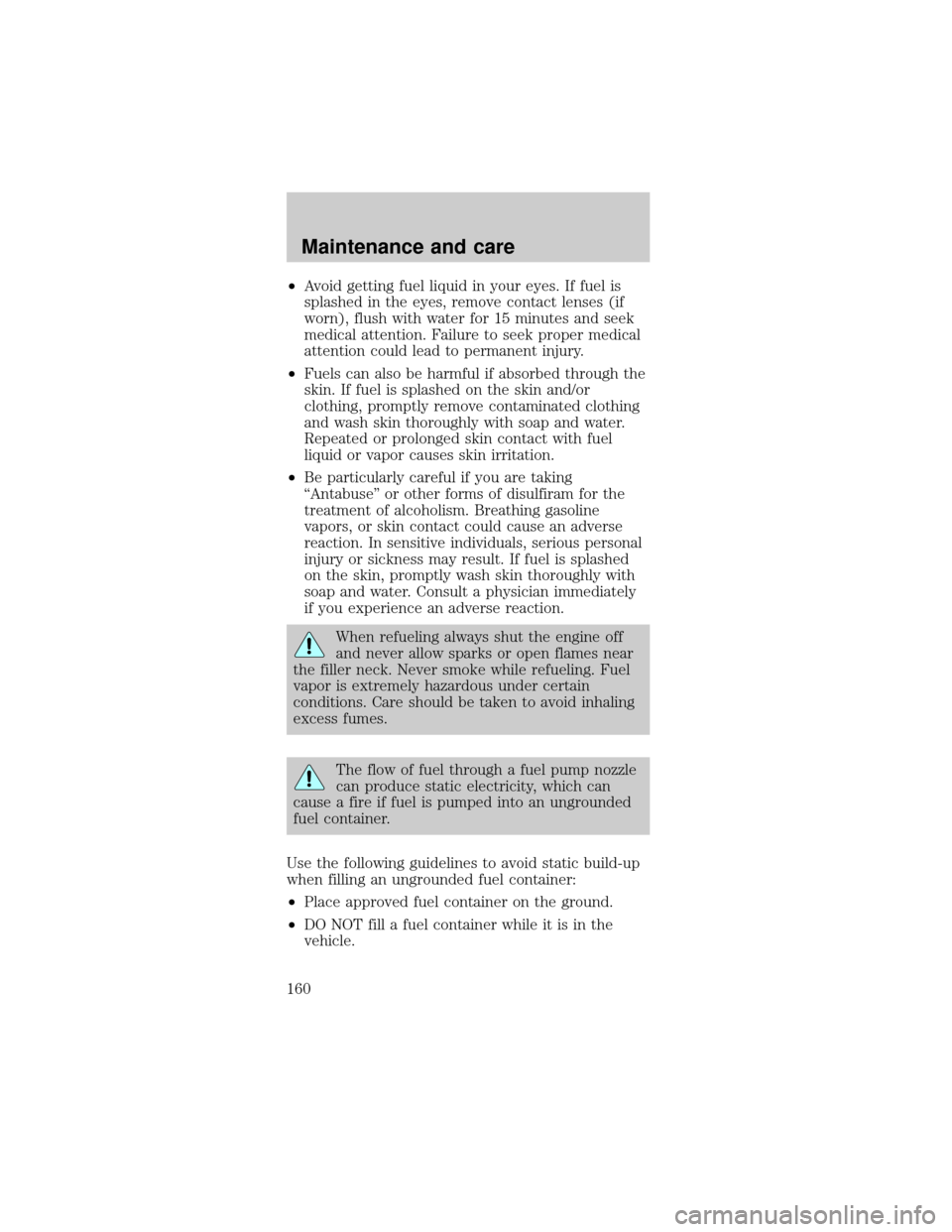
²Avoid getting fuel liquid in your eyes. If fuel is
splashed in the eyes, remove contact lenses (if
worn), flush with water for 15 minutes and seek
medical attention. Failure to seek proper medical
attention could lead to permanent injury.
²Fuels can also be harmful if absorbed through the
skin. If fuel is splashed on the skin and/or
clothing, promptly remove contaminated clothing
and wash skin thoroughly with soap and water.
Repeated or prolonged skin contact with fuel
liquid or vapor causes skin irritation.
²Be particularly careful if you are taking
ªAntabuseº or other forms of disulfiram for the
treatment of alcoholism. Breathing gasoline
vapors, or skin contact could cause an adverse
reaction. In sensitive individuals, serious personal
injury or sickness may result. If fuel is splashed
on the skin, promptly wash skin thoroughly with
soap and water. Consult a physician immediately
if you experience an adverse reaction.
When refueling always shut the engine off
and never allow sparks or open flames near
the filler neck. Never smoke while refueling. Fuel
vapor is extremely hazardous under certain
conditions. Care should be taken to avoid inhaling
excess fumes.
The flow of fuel through a fuel pump nozzle
can produce static electricity, which can
cause a fire if fuel is pumped into an ungrounded
fuel container.
Use the following guidelines to avoid static build-up
when filling an ungrounded fuel container:
²Place approved fuel container on the ground.
²DO NOT fill a fuel container while it is in the
vehicle.
Maintenance and care
160
Page 161 of 216
²Keep the fuel pump nozzle in contact with the
fuel container while filling.
²DO NOT use a device that would hold the fuel
pump handle in the fill position.
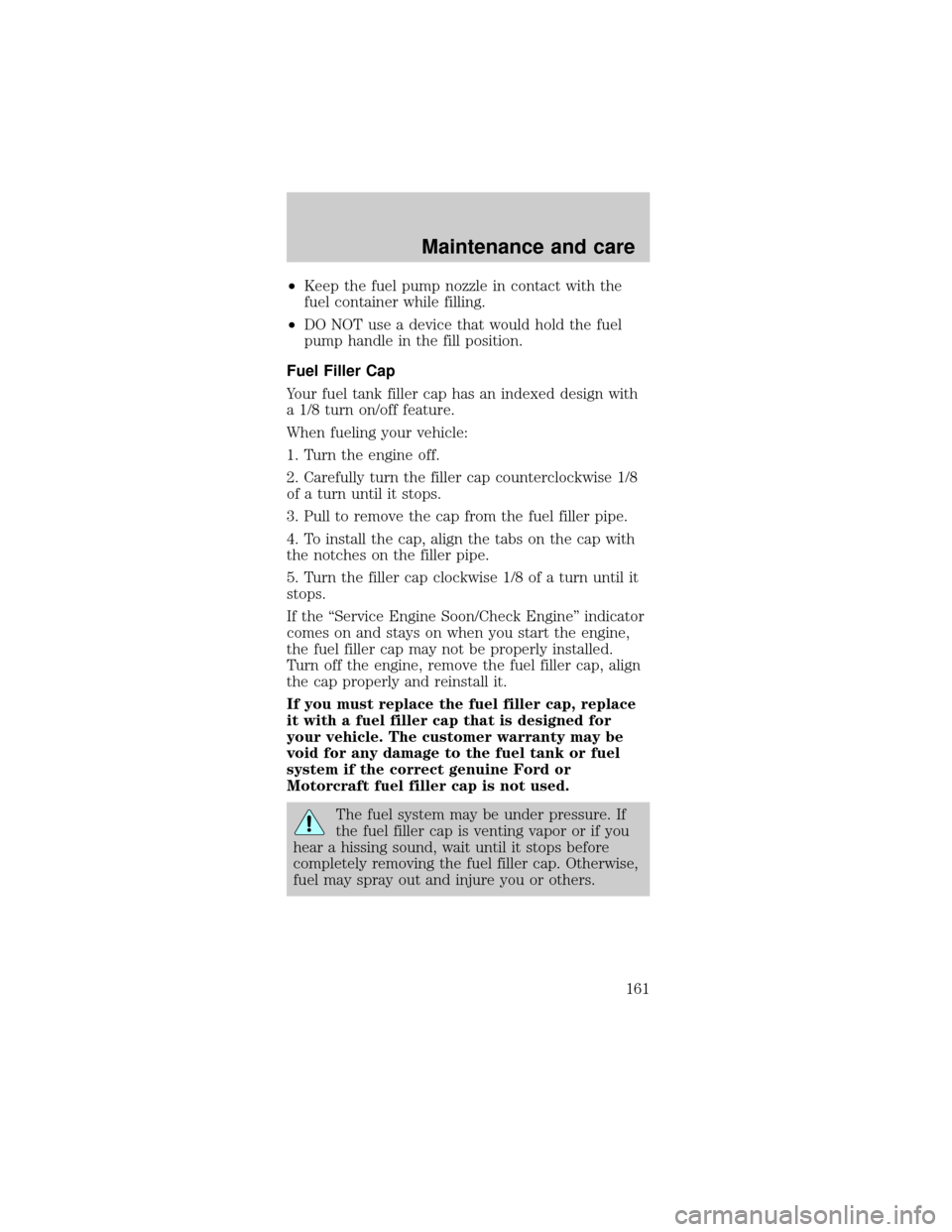
Fuel Filler Cap
Your fuel tank filler cap has an indexed design with
a 1/8 turn on/off feature.
When fueling your vehicle:
1. Turn the engine off.
2. Carefully turn the filler cap counterclockwise 1/8
of a turn until it stops.
3. Pull to remove the cap from the fuel filler pipe.
4. To install the cap, align the tabs on the cap with
the notches on the filler pipe.
5. Turn the filler cap clockwise 1/8 of a turn until it
stops.
If the ªService Engine Soon/Check Engineº indicator
comes on and stays on when you start the engine,
the fuel filler cap may not be properly installed.
Turn off the engine, remove the fuel filler cap, align
the cap properly and reinstall it.
If you must replace the fuel filler cap, replace
it with a fuel filler cap that is designed for
your vehicle. The customer warranty may be
void for any damage to the fuel tank or fuel
system if the correct genuine Ford or
Motorcraft fuel filler cap is not used.
The fuel system may be under pressure. If
the fuel filler cap is venting vapor or if you
hear a hissing sound, wait until it stops before
completely removing the fuel filler cap. Otherwise,
fuel may spray out and injure you or others.
Maintenance and care
161
Page 172 of 216
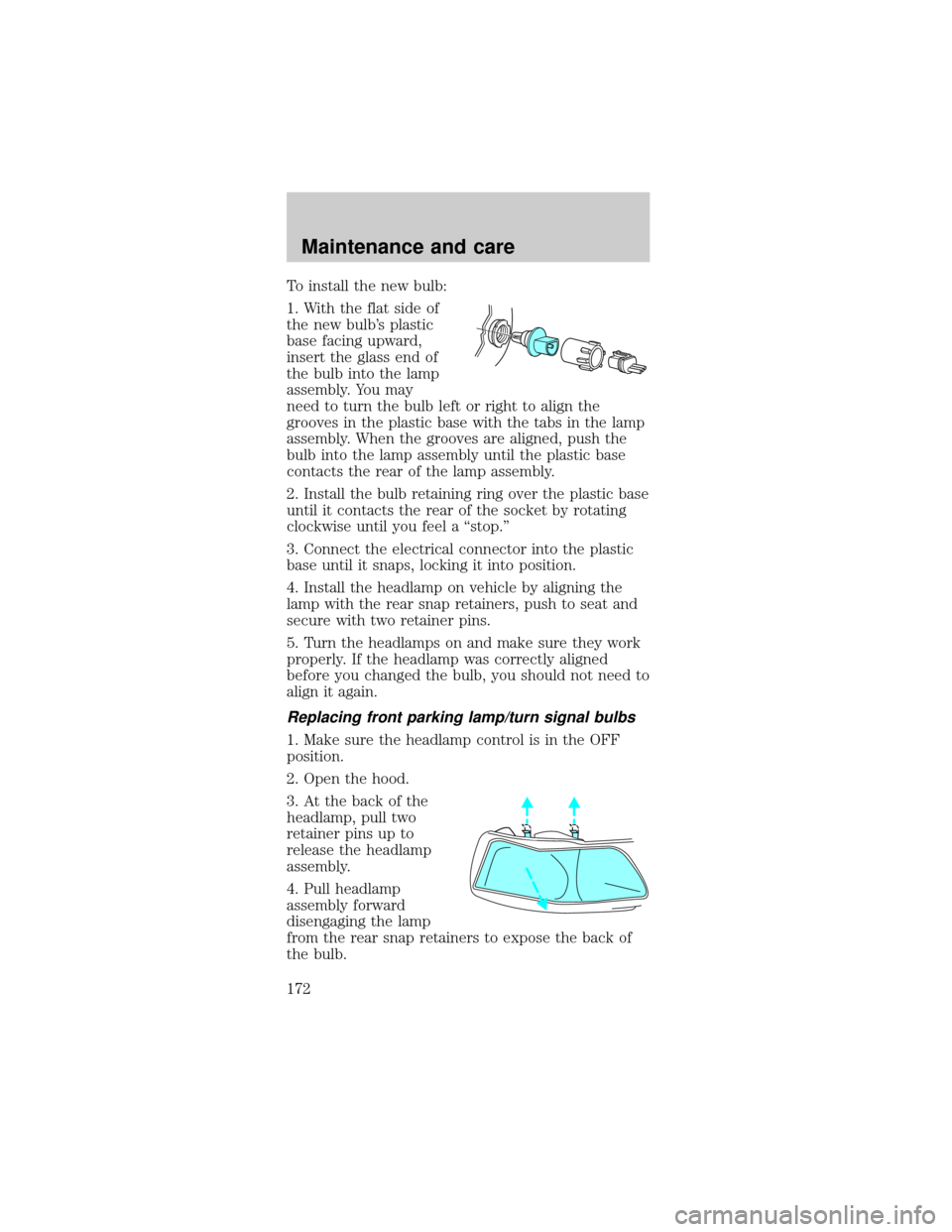
To install the new bulb:
1. With the flat side of
the new bulb's plastic
base facing upward,
insert the glass end of
the bulb into the lamp
assembly. You may
need to turn the bulb left or right to align the
grooves in the plastic base with the tabs in the lamp
assembly. When the grooves are aligned, push the
bulb into the lamp assembly until the plastic base
contacts the rear of the lamp assembly.
2. Install the bulb retaining ring over the plastic base
until it contacts the rear of the socket by rotating
clockwise until you feel a ªstop.º
3. Connect the electrical connector into the plastic
base until it snaps, locking it into position.
4. Install the headlamp on vehicle by aligning the
lamp with the rear snap retainers, push to seat and
secure with two retainer pins.
5. Turn the headlamps on and make sure they work
properly. If the headlamp was correctly aligned
before you changed the bulb, you should not need to
align it again.
Replacing front parking lamp/turn signal bulbs
1. Make sure the headlamp control is in the OFF
position.
2. Open the hood.
3. At the back of the
headlamp, pull two
retainer pins up to
release the headlamp
assembly.
4. Pull headlamp
assembly forward
disengaging the lamp
from the rear snap retainers to expose the back of
the bulb.
Maintenance and care
172
Page 207 of 216

Air bag supplemental
restraint system ........ 74
and child
safety seats ............. 76
description .............. 74
disposal .................... 79
driver air bag .......... 77
indicator light ...... 7,78
operation ................. 77
passenger air bag ... 77
Air cleaner filter ..... 182
Air conditioning ........ 18
manual heating
and air conditioning
system ..................... 18
Anti-theft
system .............. 60,61,62
warning light ............. 7
Automatic
transmission .............. 97
driving an automatic
overdrive ................. 98
fluid,
refill capacities ...... 183
fluid,
specification .......... 188
Axle
lubricant
specifications ........ 188
refill capacities ...... 183
traction lok ............ 105
Battery ..................... 150
acid, treating
emergencies .......... 150
charging system
warning light ............. 7
jumping a disabled
battery ................... 123
maintenance-free .. 150
replacement,
specifications ........ 182
servicing ................ 150voltage gauge .......... 15
Brakes ................... 92,94
anti-lock .............. 92,93
anti-lock brake
system (ABS)
warning light ...... 10,93
brake
warning light ........... 10
fluid, checking
and adding ............ 137
fluid,
refill capacities ...... 183
fluid,
specifications . 185,188
lubricant
specifications . 185,188
parking .................... 94
shift interlock .......... 97
Break-in period ........... 2
Capacities for
refilling fluids .......... 183
Child safety
restraints ................... 80
child safety belts .... 80
child safety seats .... 81
Child safety seats ...... 81
attaching with
tether straps ........... 85
built-in child seat ... 81
in front seat ............ 83
in rear seat .............. 83
tether anchorage
hardware ................. 85
Cleaning
your vehicle ............. 176
engine
compartment ......... 178
exterior ........... 178,181
exterior lamps ....... 179
instrument panel .. 180
interior ................... 180
plastic parts .......... 179
Index
207
Page 210 of 216

Infant seats
(see Safety seats) ..... 81
Inspection/maintenance
(I/M) testing ............ 169
Instrument panel ........ 6
cleaning ................. 180
lighting up panel
and interior ............. 17
location of
components ............... 6
Jump-starting your
vehicle ...................... 123
Keys
key in ignition
chime ....................... 11
positions of the
ignition .................... 45
removing from the
ignition .................. 105
Lamps
cargo lamps ............. 17
daytime
running light ........... 16
fog lamps ................. 53
headlamps ........ 16,171
headlamps,
flash to pass ............ 45
instrument panel,
dimming ................... 17
interior lamps ......... 50
174,175
replacing
bulbs ............... 170,171
172,173,174
Lane change indicator
(see Turn signal) ...... 44
Lights, warning and
indicator ...................... 6
air bag ........................ 7
anti-lock brakes
(ABS) ................. 10,93
anti-theft ................... 7brake ........................ 10
charging system ........ 7
check coolant .......... 10
high beam ................. 7
low fuel ...................... 9
overdrive off .............. 9
safety belt ................. 7
service engine soon .. 8
traction
control active .......... 10
turn signal
indicator .................... 6
Load limits ............... 106
GAWR .................... 106
GVWR .................... 106
trailer towing ........ 106
Locks
doors ........................ 51
Lubricant
specifications .... 185,188
Lumbar support,
seats ........................... 66
Manual
transmission ............ 102
fluid capacities ...... 183
lubricant
specifications ........ 188
reverse ................... 104
Mirrors
side view mirrors
(power) ................... 51
Motorcraft
parts .................. 163,182
Octane rating .......... 162
Odometer ................... 13
Panic alarm feature,
remote entry
system ........................ 58
Parking brake ............ 94
Parts (see
Motorcraft parts) .... 182
Index
210