automatic transmission FORD MUSTANG 1999 4.G User Guide
[x] Cancel search | Manufacturer: FORD, Model Year: 1999, Model line: MUSTANG, Model: FORD MUSTANG 1999 4.GPages: 216, PDF Size: 1.72 MB
Page 133 of 216
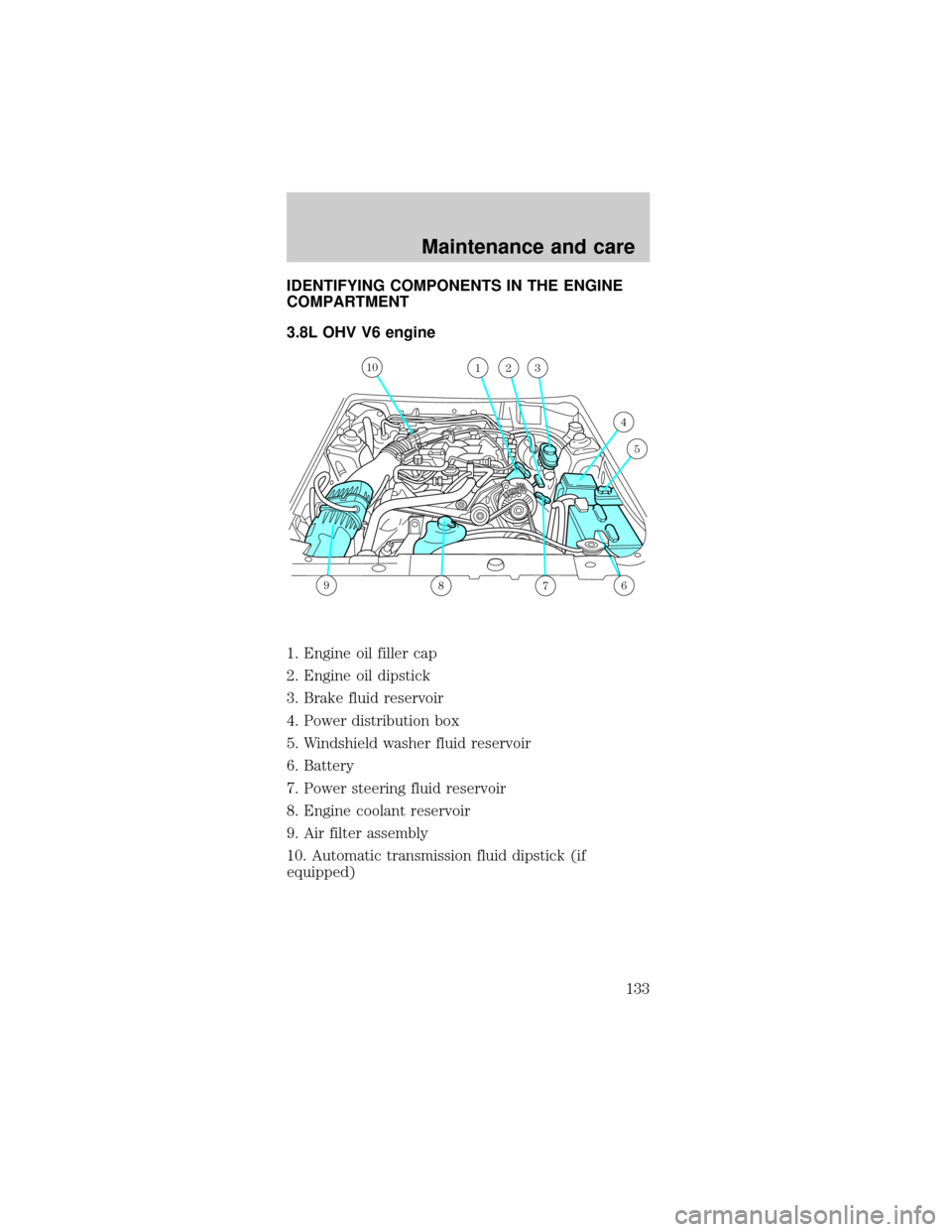
IDENTIFYING COMPONENTS IN THE ENGINE
COMPARTMENT
3.8L OHV V6 engine
1. Engine oil filler cap
2. Engine oil dipstick
3. Brake fluid reservoir
4. Power distribution box
5. Windshield washer fluid reservoir
6. Battery
7. Power steering fluid reservoir
8. Engine coolant reservoir
9. Air filter assembly
10. Automatic transmission fluid dipstick (if
equipped)
6
1023
4
5
789
1
Maintenance and care
133
Page 134 of 216
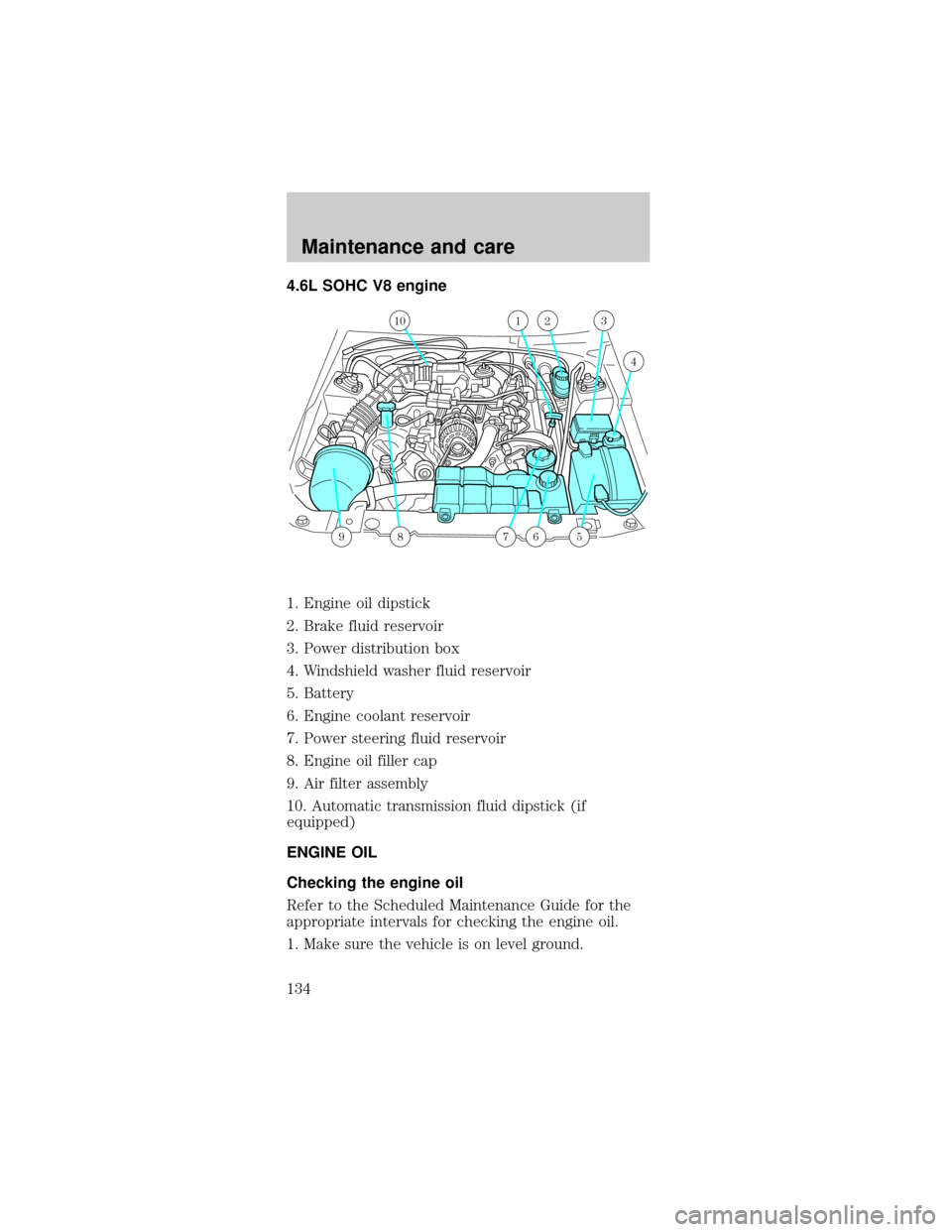
4.6L SOHC V8 engine
1. Engine oil dipstick
2. Brake fluid reservoir
3. Power distribution box
4. Windshield washer fluid reservoir
5. Battery
6. Engine coolant reservoir
7. Power steering fluid reservoir
8. Engine oil filler cap
9. Air filter assembly
10. Automatic transmission fluid dipstick (if
equipped)
ENGINE OIL
Checking the engine oil
Refer to the Scheduled Maintenance Guide for the
appropriate intervals for checking the engine oil.
1. Make sure the vehicle is on level ground.
56798
23
4
110
Maintenance and care
134
Page 135 of 216
2. Turn the engine off and wait a few minutes for
the oil to drain into the oil pan.
3. Set the parking brake and ensure the gearshift is
securely latched in P (Park) (automatic
transmissions) or 1 (First) (manual transmissions).
4. Open the hood. Protect yourself from engine heat.
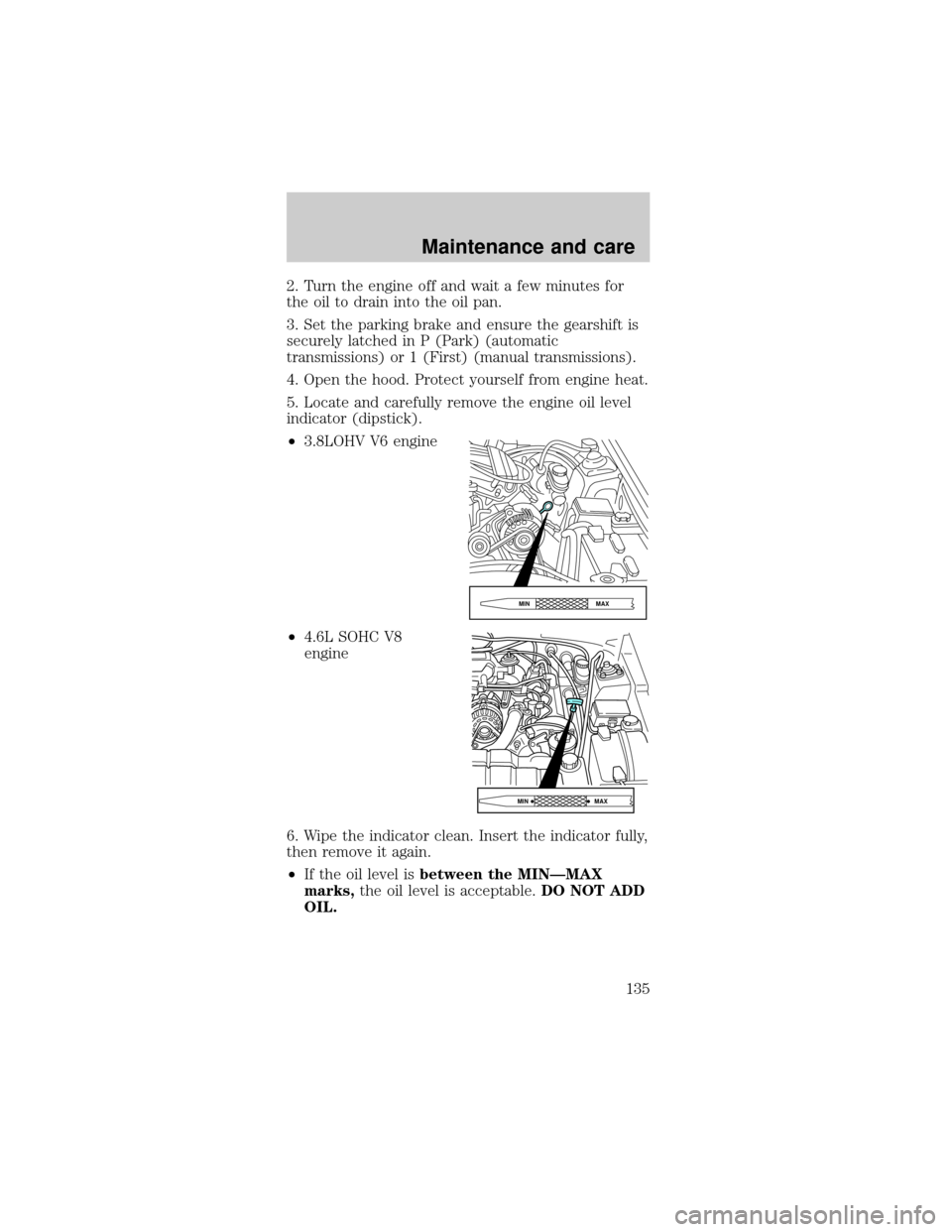
5. Locate and carefully remove the engine oil level
indicator (dipstick).
²3.8LOHV V6 engine
²4.6L SOHC V8
engine
6. Wipe the indicator clean. Insert the indicator fully,
then remove it again.
²If the oil level isbetween the MINÐMAX
marks,the oil level is acceptable.DO NOT ADD
OIL.
MAX MIN
MAX MIN
Maintenance and care
135
Page 146 of 216
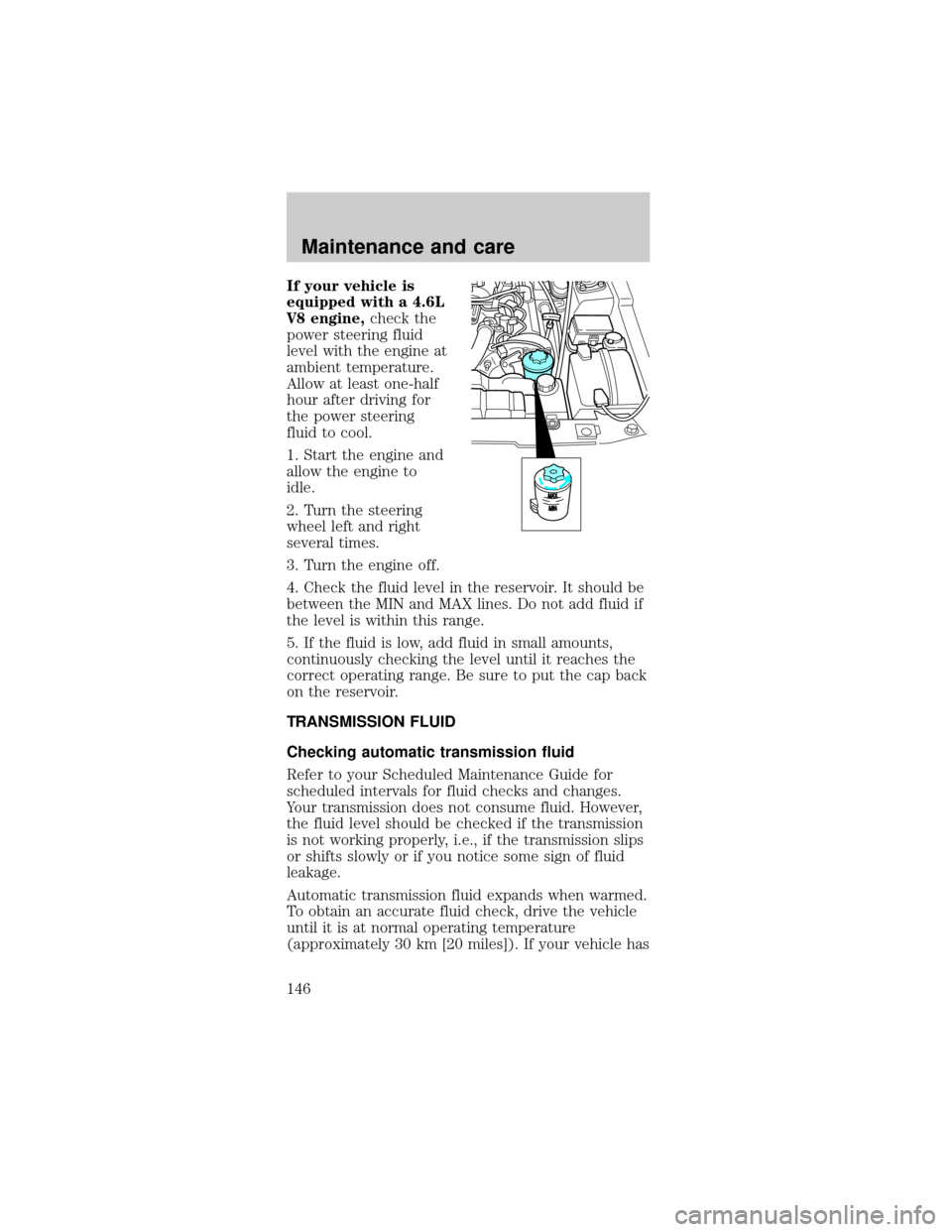
If your vehicle is
equipped with a 4.6L
V8 engine,check the
power steering fluid
level with the engine at
ambient temperature.
Allow at least one-half
hour after driving for
the power steering
fluid to cool.
1. Start the engine and
allow the engine to
idle.
2. Turn the steering
wheel left and right
several times.
3. Turn the engine off.
4. Check the fluid level in the reservoir. It should be
between the MIN and MAX lines. Do not add fluid if
the level is within this range.
5. If the fluid is low, add fluid in small amounts,
continuously checking the level until it reaches the
correct operating range. Be sure to put the cap back
on the reservoir.
TRANSMISSION FLUID
Checking automatic transmission fluid
Refer to your Scheduled Maintenance Guide for
scheduled intervals for fluid checks and changes.
Your transmission does not consume fluid. However,
the fluid level should be checked if the transmission
is not working properly, i.e., if the transmission slips
or shifts slowly or if you notice some sign of fluid
leakage.
Automatic transmission fluid expands when warmed.
To obtain an accurate fluid check, drive the vehicle
until it is at normal operating temperature
(approximately 30 km [20 miles]). If your vehicle has
MAXMIN
Maintenance and care
146
Page 148 of 216
![FORD MUSTANG 1999 4.G User Guide could result when the vehicle reaches normal
operating temperature.
The transmission fluid
should be in this range
if at normal operating
temperature (66ÉC-77ÉC [150ÉF-170ÉF]).
The transmission fl](/img/11/5206/w960_5206-147.png "FORD MUSTANG 1999 4.G User Guide could result when the vehicle reaches normal
operating temperature.
The transmission fluid
should be in this range
if at normal operating
temperature (66ÉC-77ÉC [150ÉF-170ÉF]).
The transmission fl")
could result when the vehicle reaches normal
operating temperature.
The transmission fluid
should be in this range
if at normal operating
temperature (66ÉC-77ÉC [150ÉF-170ÉF]).
The transmission fluid
should be in this range
if at ambient
temperature (10ÉC-35ÉC [50ÉF-95ÉF]).
High fluid level
Fluid levels above the
safe range may result
in transmission failure.
An overfill condition of transmission fluid may cause
shift and/or engagement concerns and/or possible
damage.
High fluid levels can be caused by an overheating
condition.
Adjusting automatic transmission fluid levels
Before adding any fluid, make sure the correct type
is used. The type of fluid used is normally indicated
on the dipstick and/or dipstick handle and also in
theLubricant specificationssection in the
Capacities and specificationschapter.
Use of a non-approved automatic transmission
fluid may cause internal transmission
component damage.
If necessary, add fluid in 250 mL (1/2 pint)
increments through the filler tube until the level is
correct.
If an overfill occurs,
excess fluid should be
removed by a qualified
technician.
Maintenance and care
148
Page 151 of 216
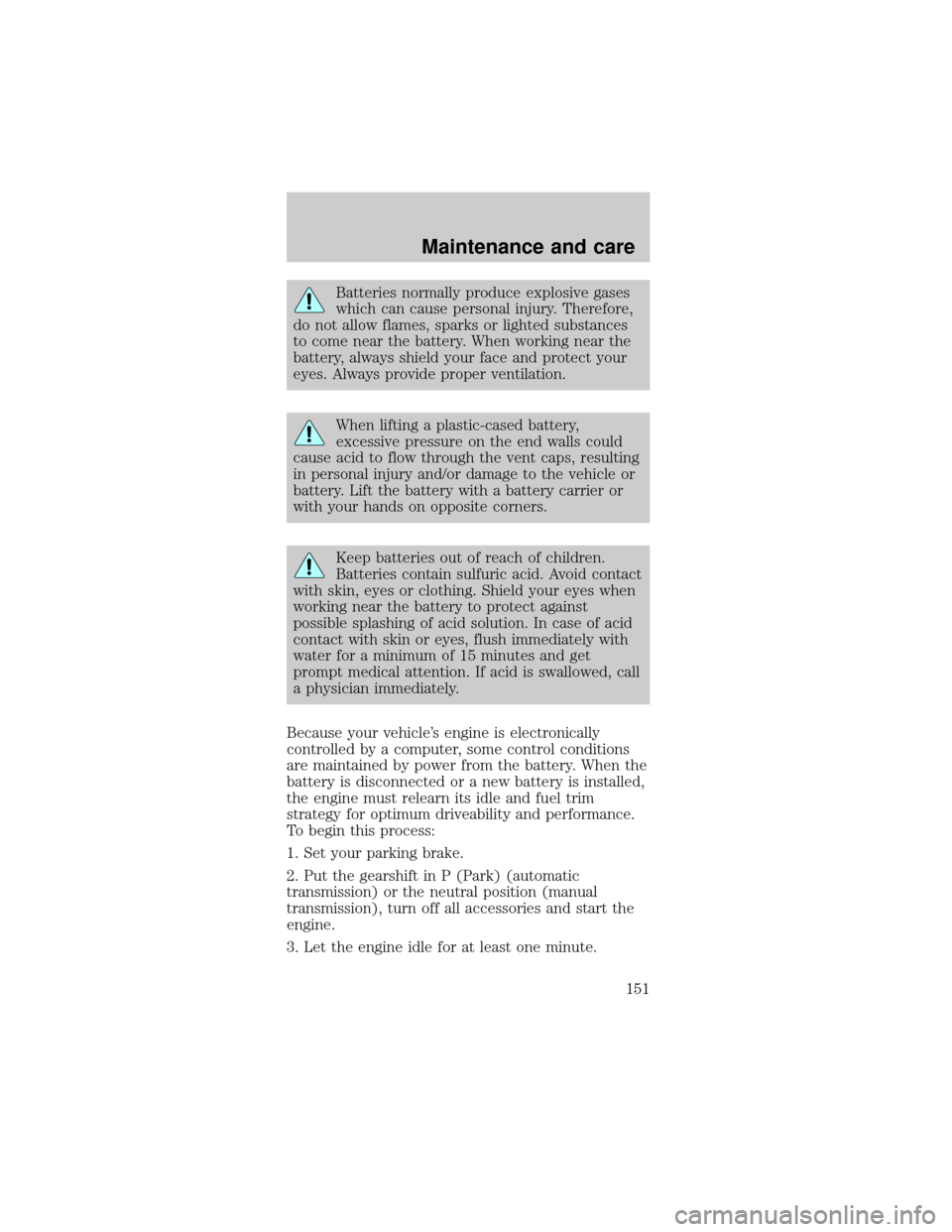
Batteries normally produce explosive gases
which can cause personal injury. Therefore,
do not allow flames, sparks or lighted substances
to come near the battery. When working near the
battery, always shield your face and protect your
eyes. Always provide proper ventilation.
When lifting a plastic-cased battery,
excessive pressure on the end walls could
cause acid to flow through the vent caps, resulting
in personal injury and/or damage to the vehicle or
battery. Lift the battery with a battery carrier or
with your hands on opposite corners.
Keep batteries out of reach of children.
Batteries contain sulfuric acid. Avoid contact
with skin, eyes or clothing. Shield your eyes when
working near the battery to protect against
possible splashing of acid solution. In case of acid
contact with skin or eyes, flush immediately with
water for a minimum of 15 minutes and get
prompt medical attention. If acid is swallowed, call
a physician immediately.
Because your vehicle's engine is electronically
controlled by a computer, some control conditions
are maintained by power from the battery. When the
battery is disconnected or a new battery is installed,
the engine must relearn its idle and fuel trim
strategy for optimum driveability and performance.
To begin this process:
1. Set your parking brake.
2. Put the gearshift in P (Park) (automatic
transmission) or the neutral position (manual
transmission), turn off all accessories and start the
engine.
3. Let the engine idle for at least one minute.
Maintenance and care
151
Page 185 of 216
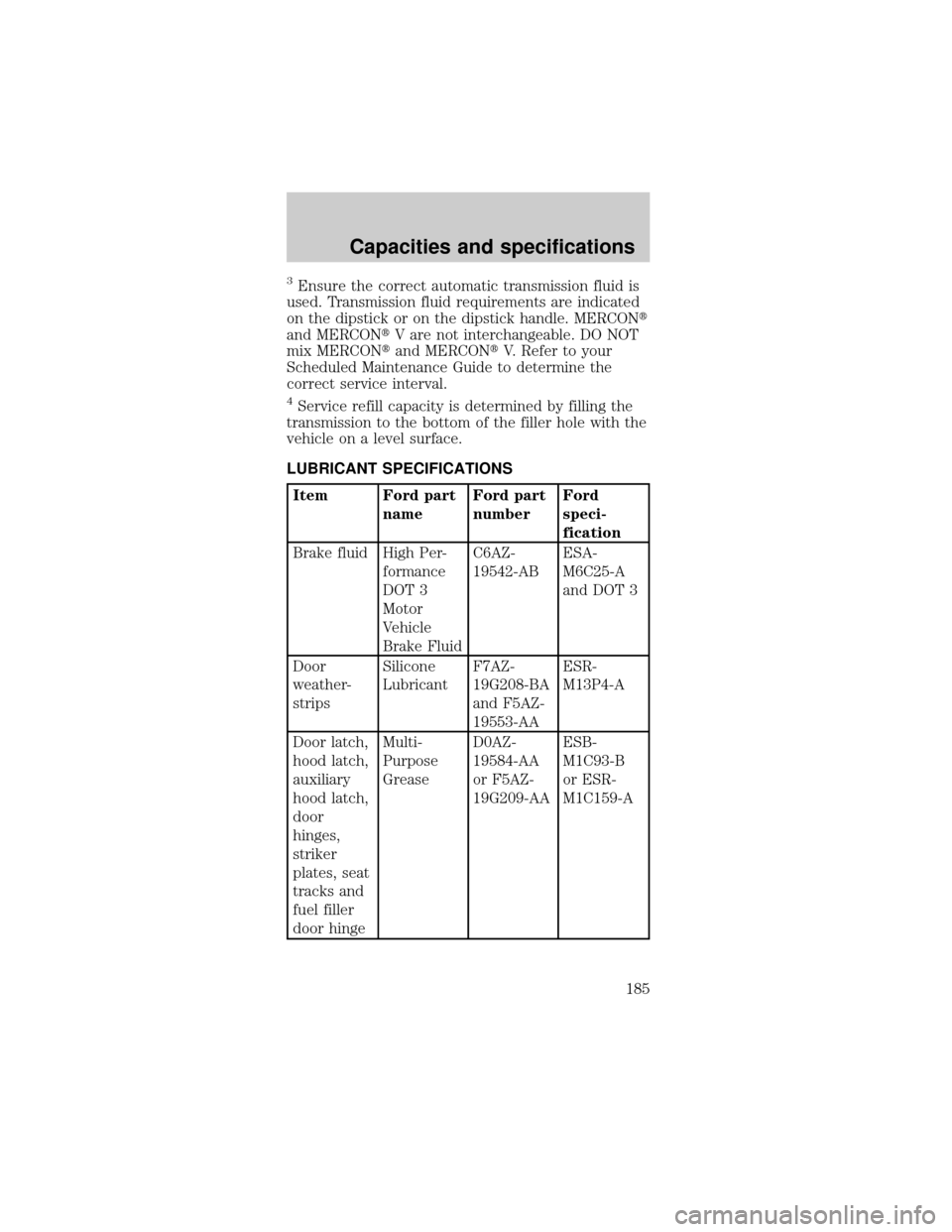
3Ensure the correct automatic transmission fluid is
used. Transmission fluid requirements are indicated
on the dipstick or on the dipstick handle. MERCONt
and MERCONtV are not interchangeable. DO NOT
mix MERCONtand MERCONtV. Refer to your
Scheduled Maintenance Guide to determine the
correct service interval.
4Service refill capacity is determined by filling the
transmission to the bottom of the filler hole with the
vehicle on a level surface.
LUBRICANT SPECIFICATIONS
Item Ford part
nameFord part
numberFord
speci-
fication
Brake fluid High Per-
formance
DOT 3
Motor
Vehicle
Brake FluidC6AZ-
19542-ABESA-
M6C25-A
and DOT 3
Door
weather-
stripsSilicone
LubricantF7AZ-
19G208-BA
and F5AZ-
19553-AAESR-
M13P4-A
Door latch,
hood latch,
auxiliary
hood latch,
door
hinges,
striker
plates, seat
tracks and
fuel filler
door hingeMulti-
Purpose
GreaseD0AZ-
19584-AA
or F5AZ-
19G209-AAESB-
M1C93-B
or ESR-
M1C159-A
Capacities and specifications
185
Page 186 of 216
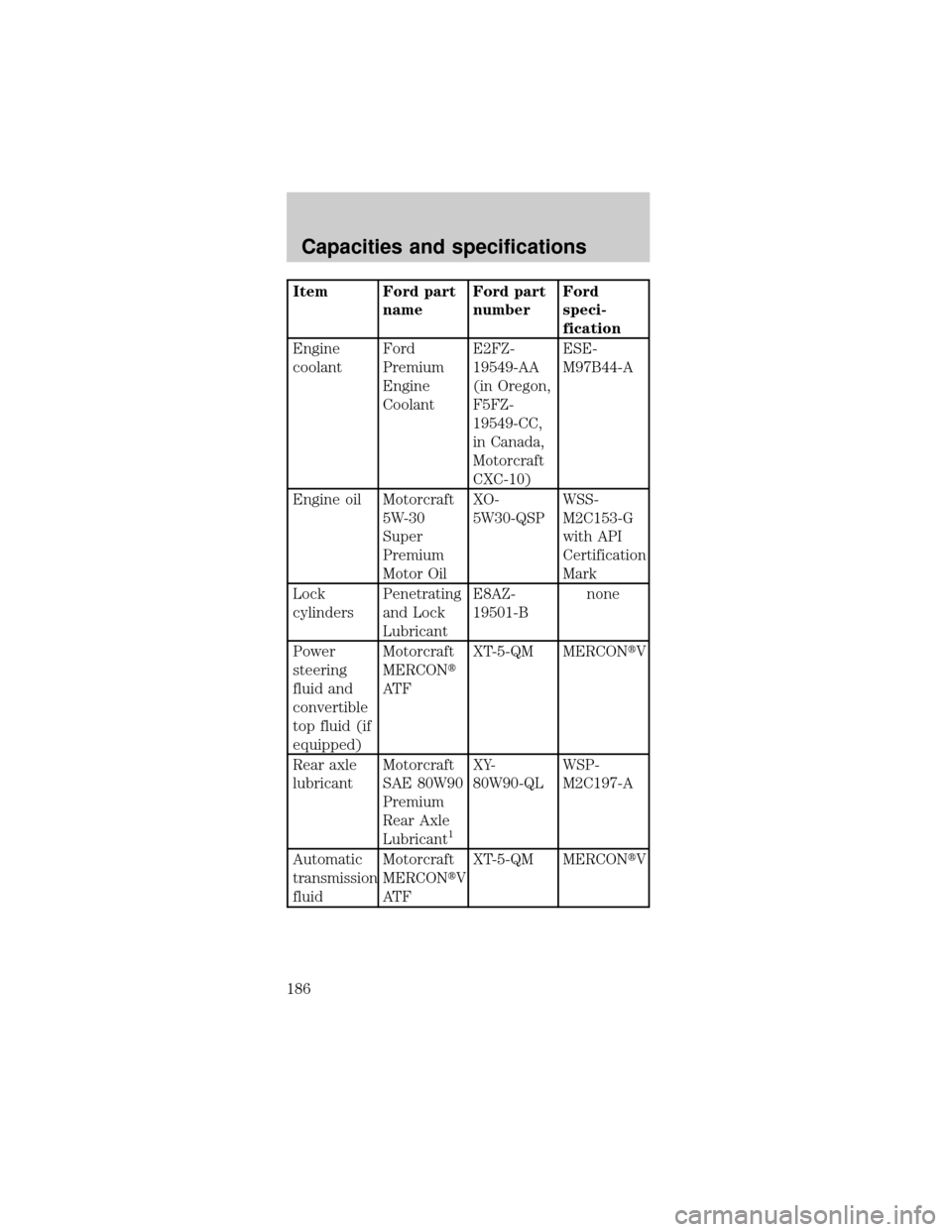
Item Ford part
nameFord part
numberFord
speci-
fication
Engine
coolantFord
Premium
Engine
CoolantE2FZ-
19549-AA
(in Oregon,
F5FZ-
19549-CC,
in Canada,
Motorcraft
CXC-10)ESE-
M97B44-A
Engine oil Motorcraft
5W-30
Super
Premium
Motor OilXO-
5W30-QSPWSS-
M2C153-G
with API
Certification
Mark
Lock
cylindersPenetrating
and Lock
LubricantE8AZ-
19501-Bnone
Power
steering
fluid and
convertible
top fluid (if
equipped)Motorcraft
MERCONt
AT FXT-5-QM MERCONtV
Rear axle
lubricantMotorcraft
SAE 80W90
Premium
Rear Axle
Lubricant
1
XY-
80W90-QLWSP-
M2C197-A
Automatic
transmission
fluidMotorcraft
MERCONtV
AT FXT-5-QM MERCONtV
Capacities and specifications
186
Page 207 of 216

Air bag supplemental
restraint system ........ 74
and child
safety seats ............. 76
description .............. 74
disposal .................... 79
driver air bag .......... 77
indicator light ...... 7,78
operation ................. 77
passenger air bag ... 77
Air cleaner filter ..... 182
Air conditioning ........ 18
manual heating
and air conditioning
system ..................... 18
Anti-theft
system .............. 60,61,62
warning light ............. 7
Automatic
transmission .............. 97
driving an automatic
overdrive ................. 98
fluid,
refill capacities ...... 183
fluid,
specification .......... 188
Axle
lubricant
specifications ........ 188
refill capacities ...... 183
traction lok ............ 105
Battery ..................... 150
acid, treating
emergencies .......... 150
charging system
warning light ............. 7
jumping a disabled
battery ................... 123
maintenance-free .. 150
replacement,
specifications ........ 182
servicing ................ 150voltage gauge .......... 15
Brakes ................... 92,94
anti-lock .............. 92,93
anti-lock brake
system (ABS)
warning light ...... 10,93
brake
warning light ........... 10
fluid, checking
and adding ............ 137
fluid,
refill capacities ...... 183
fluid,
specifications . 185,188
lubricant
specifications . 185,188
parking .................... 94
shift interlock .......... 97
Break-in period ........... 2
Capacities for
refilling fluids .......... 183
Child safety
restraints ................... 80
child safety belts .... 80
child safety seats .... 81
Child safety seats ...... 81
attaching with
tether straps ........... 85
built-in child seat ... 81
in front seat ............ 83
in rear seat .............. 83
tether anchorage
hardware ................. 85
Cleaning
your vehicle ............. 176
engine
compartment ......... 178
exterior ........... 178,181
exterior lamps ....... 179
instrument panel .. 180
interior ................... 180
plastic parts .......... 179
Index
207
Page 212 of 216

Traction control ........ 95
active light .............. 10
Traction-lok
rear axle .................. 105
Transmission
automatic
operation ................. 97
fluid, checking
and adding
(automatic) ........... 146
fluid, checking and
adding (manual) ... 149
fluid,
refill capacities ...... 183
lubricant
specifications ........ 188
manual operation .. 102
Trip odometer ........... 14
Trunk
remote release ... 44,58
Turn signal ............. 6,44
Vehicle dimensions . 188
Vehicle Identification
Number (VIN) ......... 190Vehicle loading ........ 106
Ventilating
your vehicle ............... 91
Warning chimes ......... 11
Warning lights
(see Lights) ................. 6
Washer fluid ............ 140
Water,
Driving through ....... 111
Wheels
anti-theft
lug nuts ................. 123
Windows
power ....................... 50
Windshield washer
fluid and wipers
checking
and cleaning .......... 152
operation ................. 44
replacing
wiper blades .......... 153
Wrecker towing ....... 128
Index
212