fuel FORD MUSTANG 1999 4.G User Guide
[x] Cancel search | Manufacturer: FORD, Model Year: 1999, Model line: MUSTANG, Model: FORD MUSTANG 1999 4.GPages: 216, PDF Size: 1.72 MB
Page 96 of 216
controlled by automatically applying and releasing
the rear brakes in conjunction with engine torque
reductions. Engine torque reduction is realized via
the fully electronic spark and fuel injection systems.
This process is very sensitive to driving conditions
and very fast acting. The rear wheels ªsearchº for
optimum traction several times a second and
adjustments are made accordingly.
The Traction Controlysystem will allow your
vehicle to make better use of available traction on
slippery surfaces. The system is a driver aid which
makes your vehicle easier to handle primarily on
snow, ice covered and gravel roads.
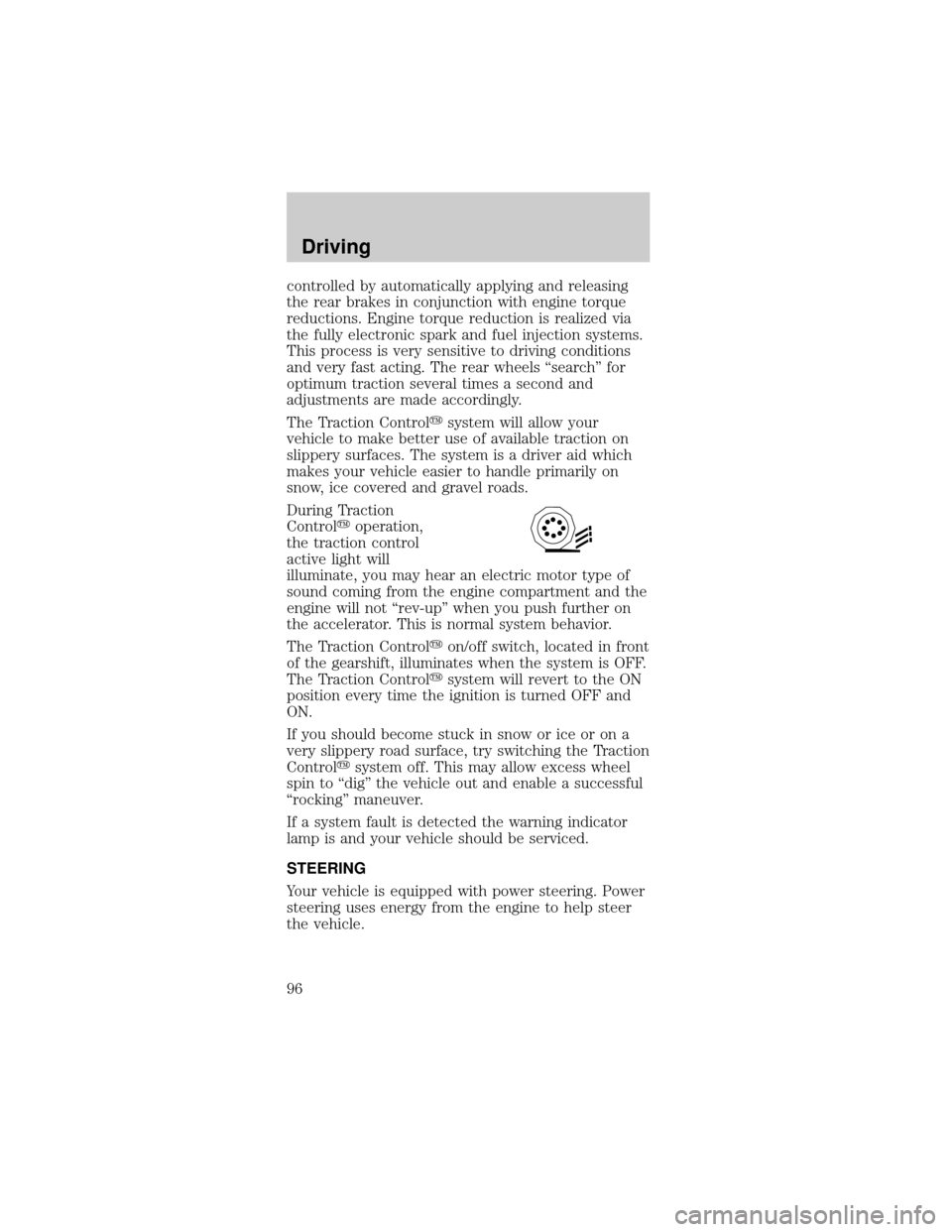
During Traction
Controlyoperation,
the traction control
active light will
illuminate, you may hear an electric motor type of
sound coming from the engine compartment and the
engine will not ªrev-upº when you push further on
the accelerator. This is normal system behavior.
The Traction Controlyon/off switch, located in front
of the gearshift, illuminates when the system is OFF.
The Traction Controlysystem will revert to the ON
position every time the ignition is turned OFF and
ON.
If you should become stuck in snow or ice or on a
very slippery road surface, try switching the Traction
Controlysystem off. This may allow excess wheel
spin to ªdigº the vehicle out and enable a successful
ªrockingº maneuver.
If a system fault is detected the warning indicator
lamp is and your vehicle should be serviced.
STEERING
Your vehicle is equipped with power steering. Power
steering uses energy from the engine to help steer
the vehicle.
Driving
96
Page 100 of 216
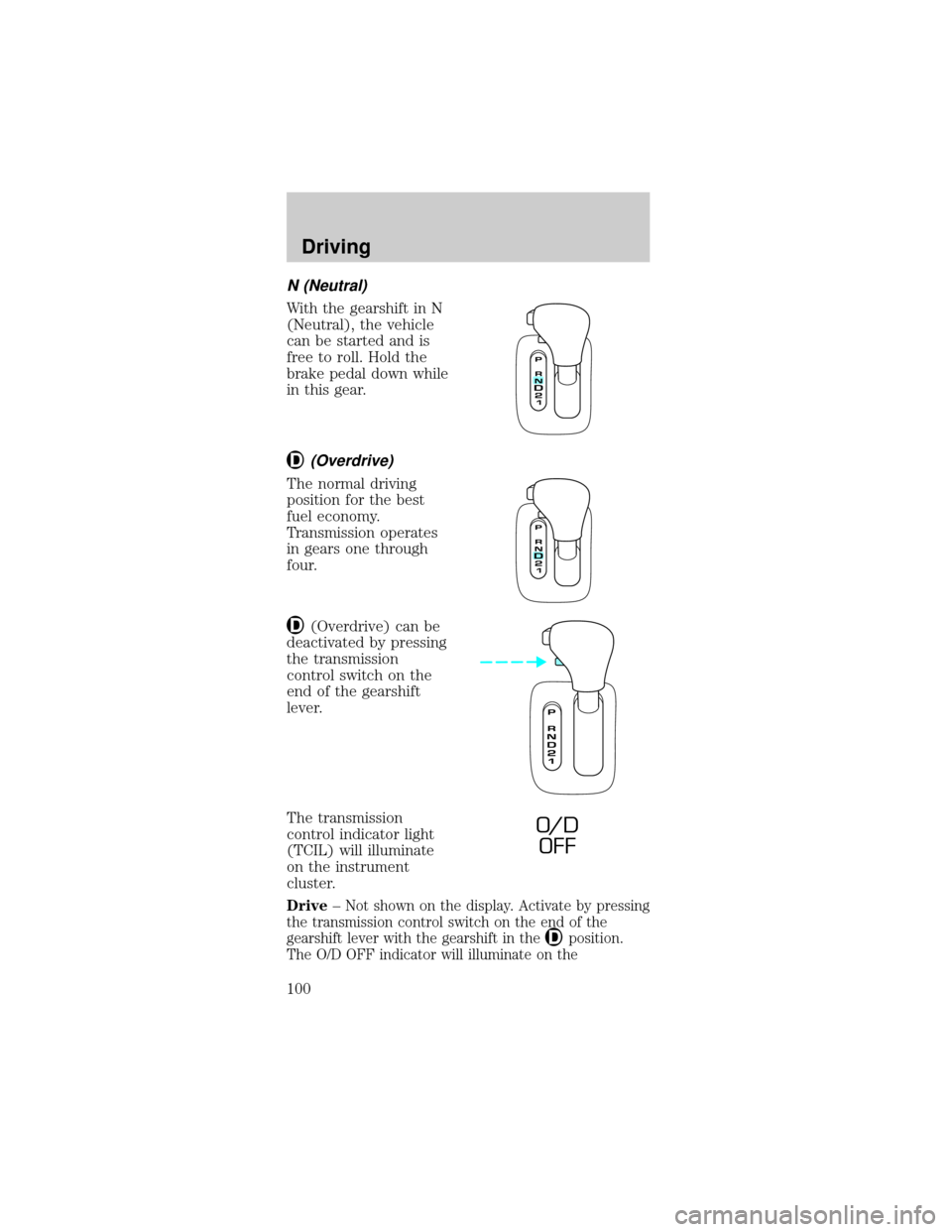
N (Neutral)
With the gearshift in N
(Neutral), the vehicle
can be started and is
free to roll. Hold the
brake pedal down while
in this gear.
(Overdrive)
The normal driving
position for the best
fuel economy.
Transmission operates
in gears one through
four.
(Overdrive) can be
deactivated by pressing
the transmission
control switch on the
end of the gearshift
lever.
The transmission
control indicator light
(TCIL) will illuminate
on the instrument
cluster.
Drive±
Not shown on the display. Activate by pressing
the transmission control switch on the end of the
gearshift lever with the gearshift in the
position.
The O/D OFF indicator will illuminate on the
O/ D
OFF
Driving
100
Page 103 of 216
Recommended shift speeds
Do not downshift into 1 (first) when your
vehicle is moving faster then 24 km/h (15 mph).
This will damage the clutch.
Upshift according to the following chart:
Upshifts when accelerating
(recommended for best fuel economy)
Shift from:
1 - 2 18 km/h (11 mph)
2 - 3 31 km/h (19 mph)
3 - 4 48 km/h (30 mph)
4 - 5 64 km/h (40 mph)
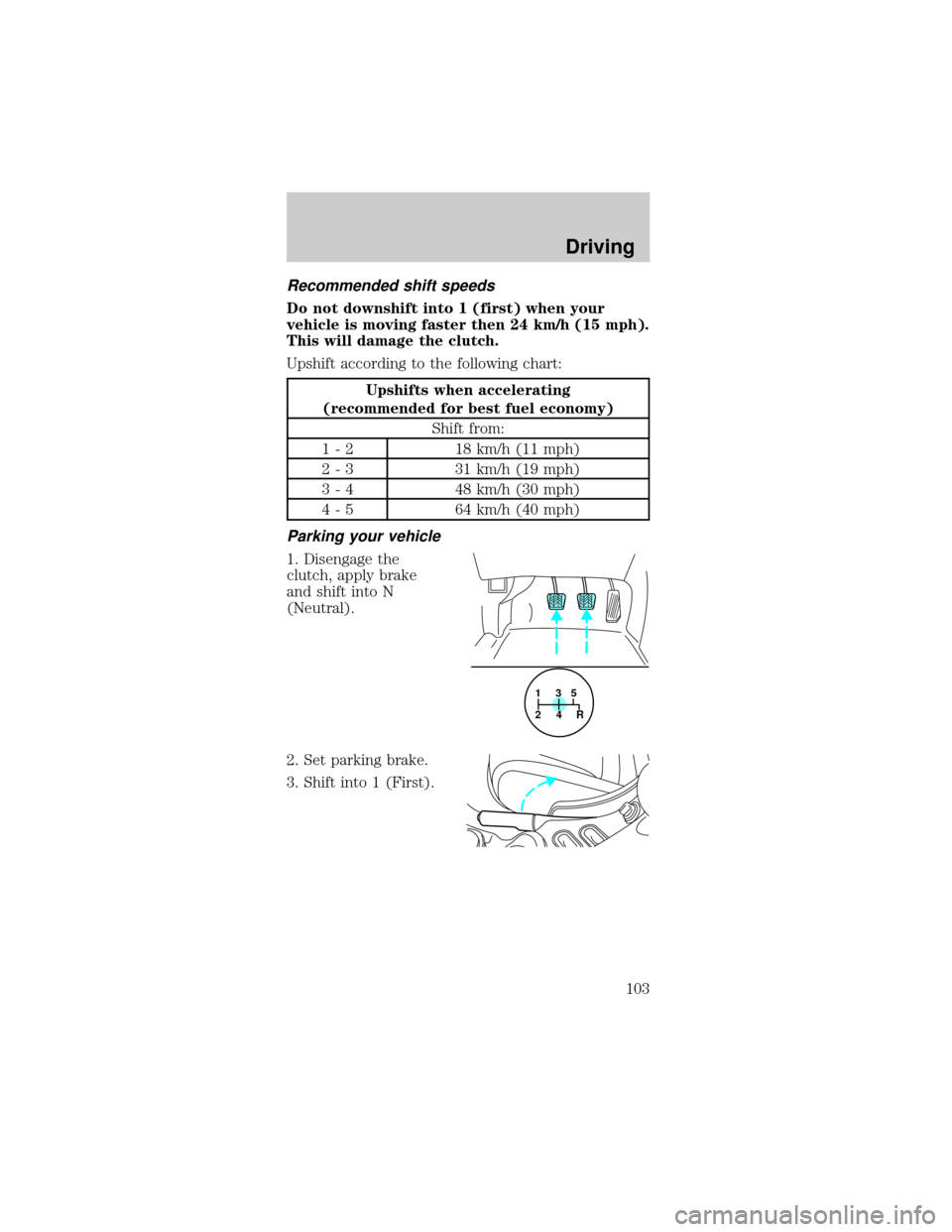
Parking your vehicle
1. Disengage the
clutch, apply brake
and shift into N
(Neutral).
2. Set parking brake.
3. Shift into 1 (First).
1
24R3
5
Driving
103
Page 109 of 216
If you use a rental trailer, follow the instructions that
the rental agency gives to you.
Do not attach safety chains to the bumper.
Trailer brakes
Electric brakes and manual, automatic or surge-type
brakes are safe if installed properly and adjusted to
the manufacturer's specifications. The trailer brakes
must meet local and Federal regulations.
Do not connect a trailer's hydraulic brake
system directly to your vehicle's brake
system. Your vehicle may not have enough braking
power and your chances of having a collision
greatly increase.
The braking system of the tow vehicle is rated for
operation at the GVWR not GCWR.
Trailer lamps
Trailer lamps are required on most towed vehicles.
Make sure your trailer lamps conform to local and
Federal regulations. See your dealer or trailer rental
agency for proper instructions and equipment for
hooking up trailer lamps.
Driving while you tow
Do not drive faster than 88 km/h (55 mph) when
towing a trailer.
Speed control may shut off if you are towing on
long, steep grades.
When towing a trailer:
²Use a lower gear when towing up or down steep
hills. This will eliminate excessive downshifting
and upshifting for optimum fuel economy and
transmission cooling.
²Anticipate stops and brake gradually.
Driving
109
Page 112 of 216
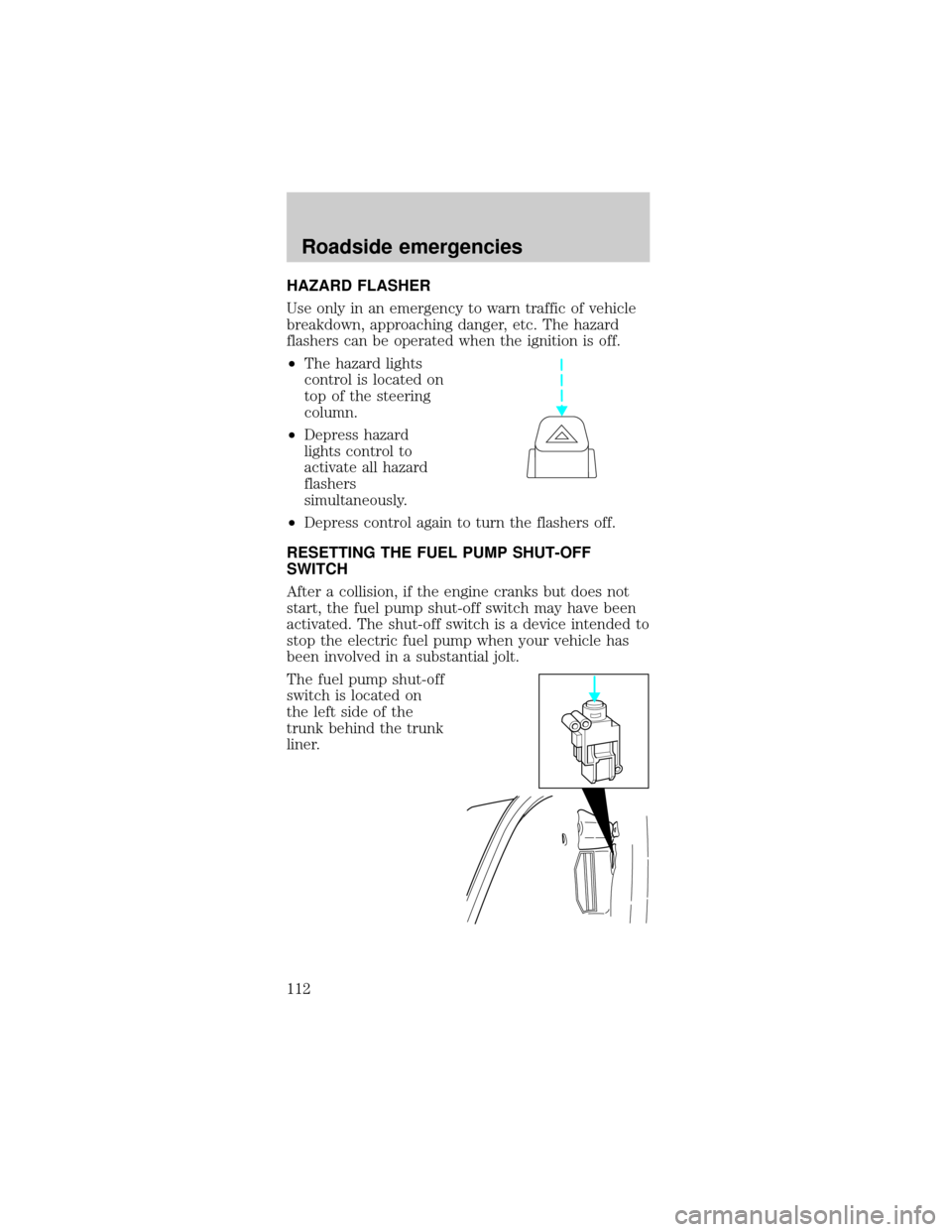
HAZARD FLASHER
Use only in an emergency to warn traffic of vehicle
breakdown, approaching danger, etc. The hazard
flashers can be operated when the ignition is off.
²The hazard lights
control is located on
top of the steering
column.
²Depress hazard
lights control to
activate all hazard
flashers
simultaneously.
²Depress control again to turn the flashers off.
RESETTING THE FUEL PUMP SHUT-OFF
SWITCH
After a collision, if the engine cranks but does not
start, the fuel pump shut-off switch may have been
activated. The shut-off switch is a device intended to
stop the electric fuel pump when your vehicle has
been involved in a substantial jolt.
The fuel pump shut-off
switch is located on
the left side of the
trunk behind the trunk
liner.
Roadside emergencies
112
Page 113 of 216
Use the following procedure to reset the fuel pump
shut-off switch.
1. Turn the ignition to the OFF position.
2. Check the fuel system for leaks.
3. If no fuel leak is apparent, reset the fuel pump
shut-off switch by pushing in on the reset button.
4. Turn the ignition to the ON position. Pause for a
few seconds and return the key to the OFF position.
5. Make a further check for leaks in the fuel system.
FUSES AND RELAYS
Fuses
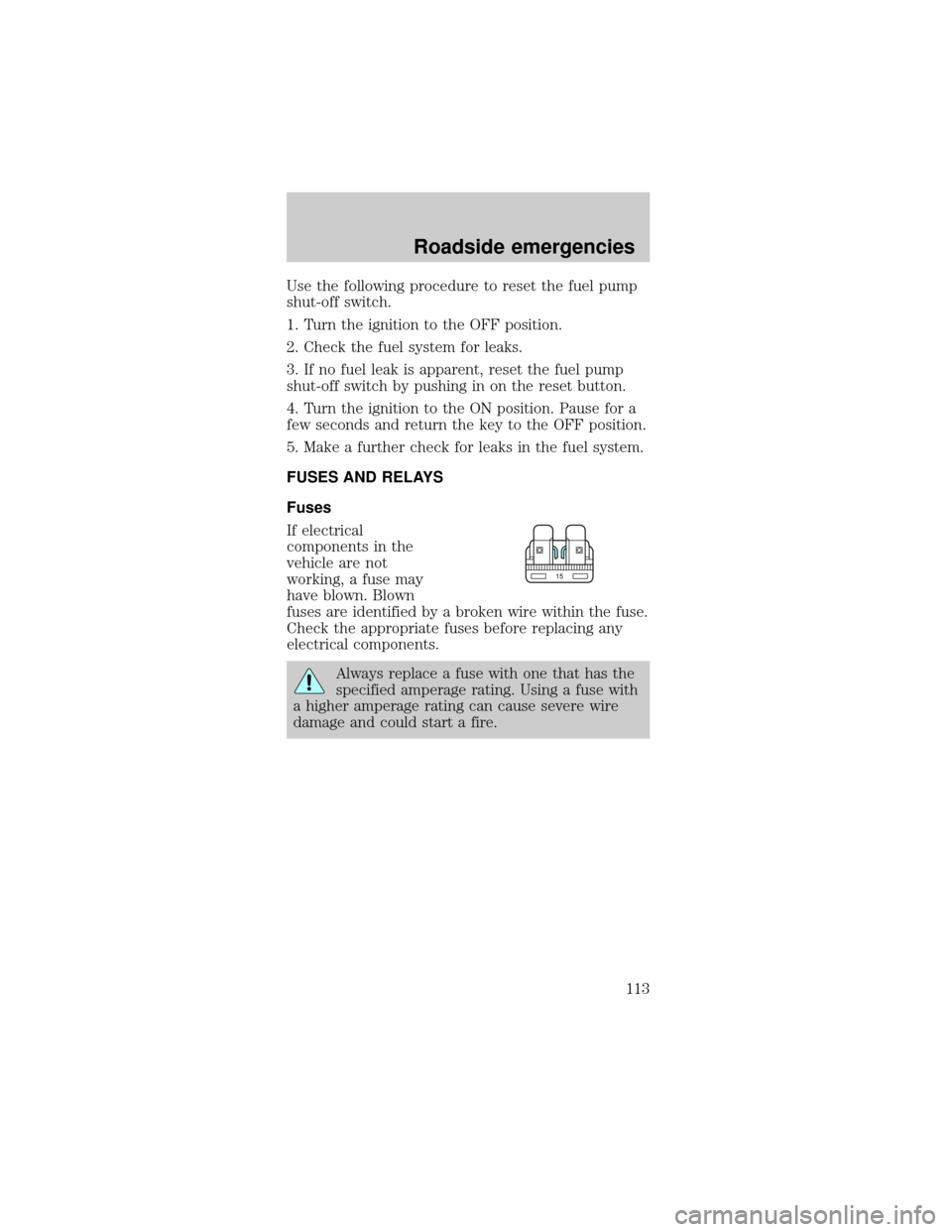
If electrical
components in the
vehicle are not
working, a fuse may
have blown. Blown
fuses are identified by a broken wire within the fuse.
Check the appropriate fuses before replacing any
electrical components.
Always replace a fuse with one that has the
specified amperage rating. Using a fuse with
a higher amperage rating can cause severe wire
damage and could start a fire.
15
Roadside emergencies
113
Page 119 of 216
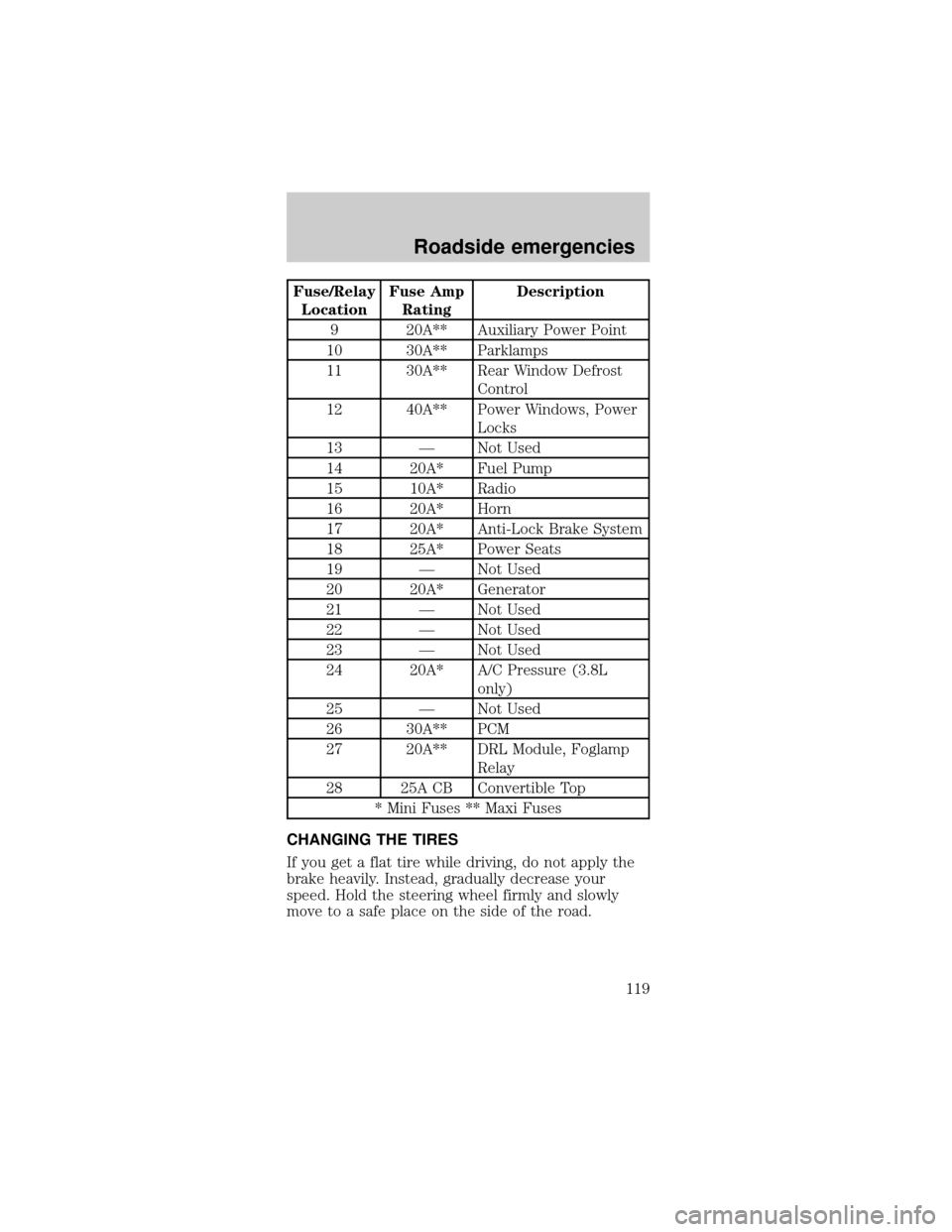
Fuse/Relay
LocationFuse Amp
RatingDescription
9 20A** Auxiliary Power Point
10 30A** Parklamps
11 30A** Rear Window Defrost
Control
12 40A** Power Windows, Power
Locks
13 Ð Not Used
14 20A* Fuel Pump
15 10A* Radio
16 20A* Horn
17 20A* Anti-Lock Brake System
18 25A* Power Seats
19 Ð Not Used
20 20A* Generator
21 Ð Not Used
22 Ð Not Used
23 Ð Not Used
24 20A* A/C Pressure (3.8L
only)
25 Ð Not Used
26 30A** PCM
27 20A** DRL Module, Foglamp
Relay
28 25A CB Convertible Top
* Mini Fuses ** Maxi Fuses
CHANGING THE TIRES
If you get a flat tire while driving, do not apply the
brake heavily. Instead, gradually decrease your
speed. Hold the steering wheel firmly and slowly
move to a safe place on the side of the road.
Roadside emergencies
119
Page 126 of 216
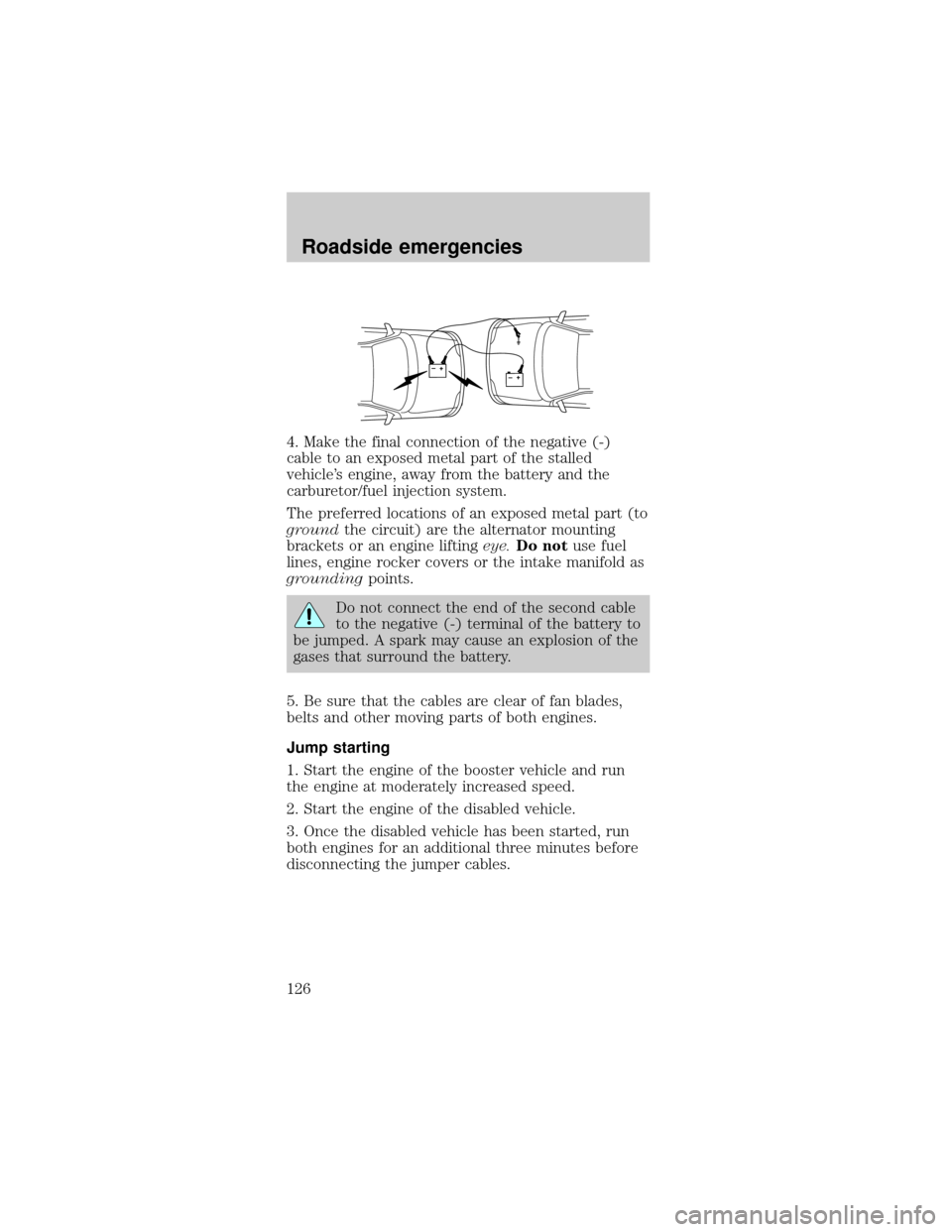
4. Make the final connection of the negative (-)
cable to an exposed metal part of the stalled
vehicle's engine, away from the battery and the
carburetor/fuel injection system.
The preferred locations of an exposed metal part (to
groundthe circuit) are the alternator mounting
brackets or an engine liftingeye.Do notuse fuel
lines, engine rocker covers or the intake manifold as
groundingpoints.
Do not connect the end of the second cable
to the negative (-) terminal of the battery to
be jumped. A spark may cause an explosion of the
gases that surround the battery.
5. Be sure that the cables are clear of fan blades,
belts and other moving parts of both engines.
Jump starting
1. Start the engine of the booster vehicle and run
the engine at moderately increased speed.
2. Start the engine of the disabled vehicle.
3. Once the disabled vehicle has been started, run
both engines for an additional three minutes before
disconnecting the jumper cables.
+–+–
Roadside emergencies
126
Page 130 of 216

SERVICE RECOMMENDATIONS
To help you service your vehicle:
²We highlight do-it-yourself items in the engine
compartment for easy location.
²We provide a Scheduled Maintenance Guide which
makes tracking routine service easy.
If your vehicle requires professional service, your
dealership can provide necessary parts and service.
Check your ªWarranty Guideº to find out which parts
and services are covered.
Use only recommended fuels, lubricants, fluids and
service parts conforming to specifications. Motorcraft
parts are designed and built to provide the best
performance in your vehicle.
PRECAUTIONS WHEN SERVICING YOUR
VEHICLE
Be especially careful when inspecting or servicing
your vehicle.
²Do not work on a hot engine.
²When the engine is running, keep loose clothing,
jewelry or long hair away from moving parts.
²Do not work on a vehicle with the engine running
in an enclosed space, unless you are sure you
have enough ventilation.
²Keep all lit cigarettes, open flames and other lit
material away from the battery and all fuel related
parts.
If you disconnect the battery, the engine must
ªrelearnº its idle conditions before your vehicle will
drive properly, as explained in theBatterysection in
this chapter.
Working with the engine off
²Automatic transmission:
1. Set the parking brake and ensure the gearshift is
securely latched in P (Park).
Maintenance and care
130
Page 140 of 216
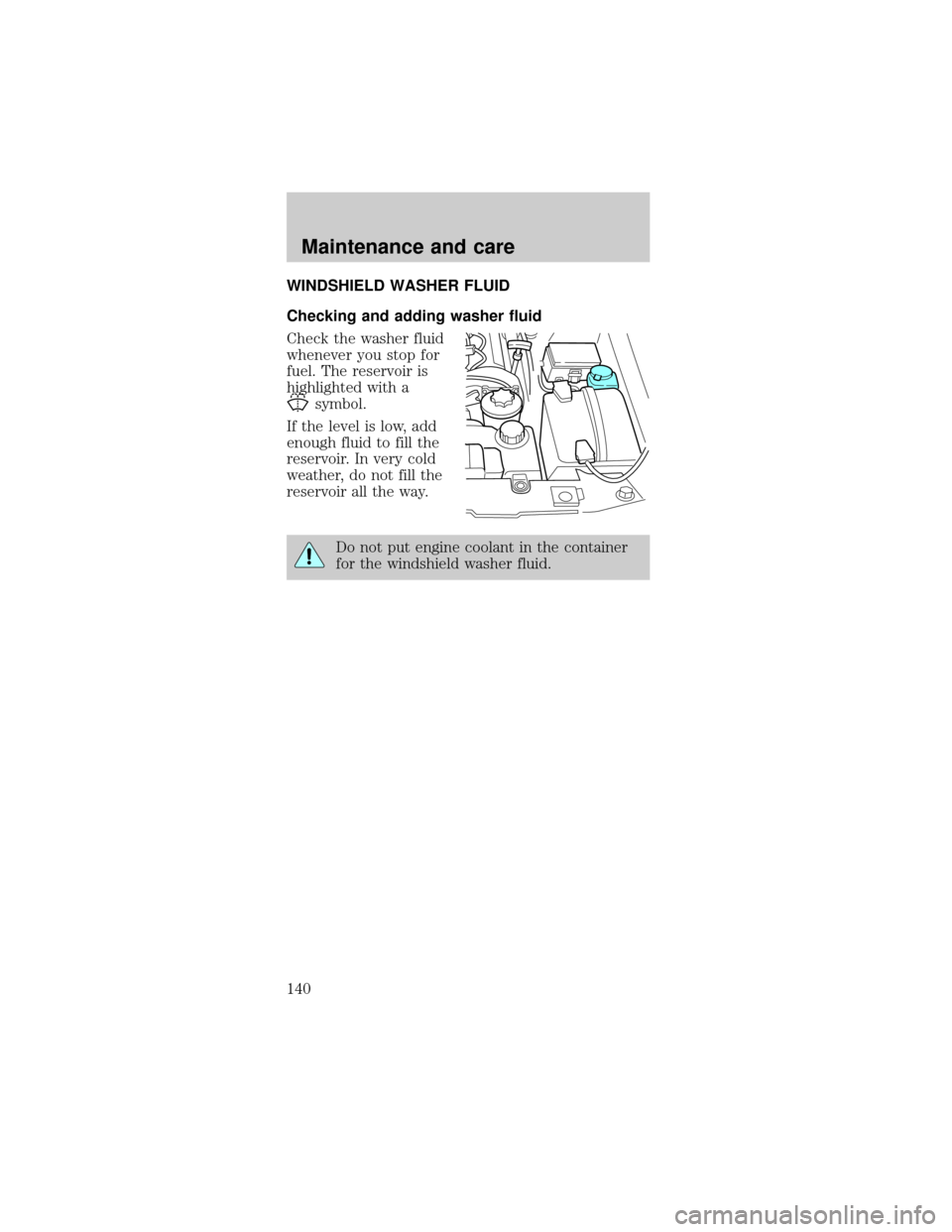
WINDSHIELD WASHER FLUID
Checking and adding washer fluid
Check the washer fluid
whenever you stop for
fuel. The reservoir is
highlighted with a
symbol.
If the level is low, add
enough fluid to fill the
reservoir. In very cold
weather, do not fill the
reservoir all the way.
Do not put engine coolant in the container
for the windshield washer fluid.
Maintenance and care
140