engine FORD MUSTANG 2000 4.G User Guide
[x] Cancel search | Manufacturer: FORD, Model Year: 2000, Model line: MUSTANG, Model: FORD MUSTANG 2000 4.GPages: 224, PDF Size: 1.86 MB
Page 15 of 224
This gauge indicates the temperature of the engine
coolant, not the coolant level. If the coolant is not at
its proper level the gauge indication will not be
accurate.
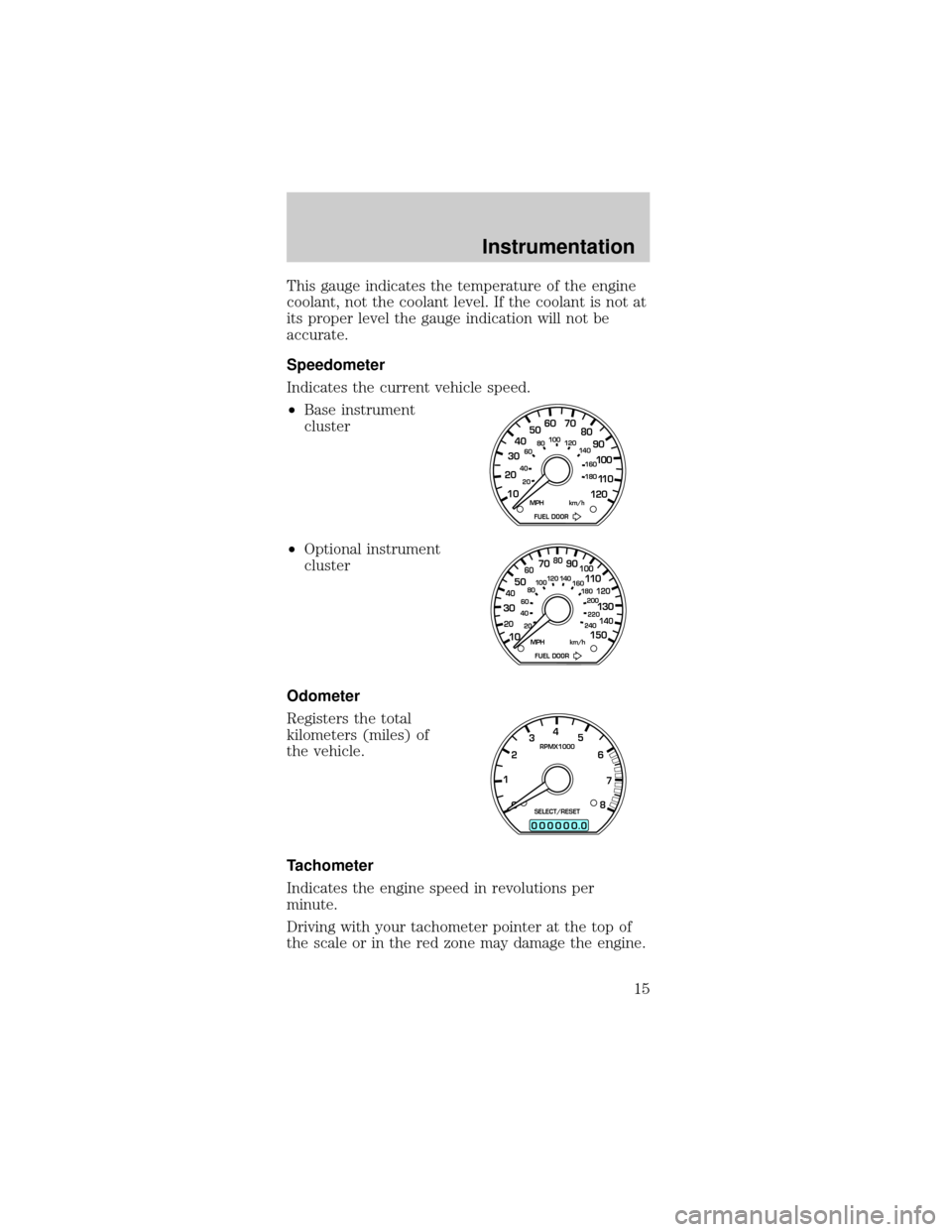
Speedometer
Indicates the current vehicle speed.
²Base instrument
cluster
²Optional instrument
cluster
Odometer
Registers the total
kilometers (miles) of
the vehicle.
Tachometer
Indicates the engine speed in revolutions per
minute.
Driving with your tachometer pointer at the top of
the scale or in the red zone may damage the engine.
10 203020 406080100
120
140
160
180
405060 70
80
90
100
11 0
120
FUEL DOOR MPH km/h
102040608020 40608010 012 0 14 0
160
180
200
220
240
100
120
140
305070 90
110
13 0
150
FUEL DOOR MPH km/h
0
00000 00
4
5
6
7
8 3
2
1RPMX1000
SELECT/RESET
.
Instrumentation
15
Page 17 of 224

Engine oil pressure gauge
This shows the engine
oil pressure in the
system. Sufficient
pressure exists as long
as the needle remains in the normal range (the area
between the ªLº and ªHº).
If the gauge indicates low pressure, stop the vehicle
as soon as safely possible and switch off the engine
immediately. Check the oil level. Add oil if needed
(refer toEngine oilin theMaintenance and care
chapter). If the oil level is correct, have your vehicle
checked at your dealership or by a qualified
technician.
LH
Instrumentation
17
Page 41 of 224
FLASH TO PASS
Pull toward you to
activate and release to
deactivate.
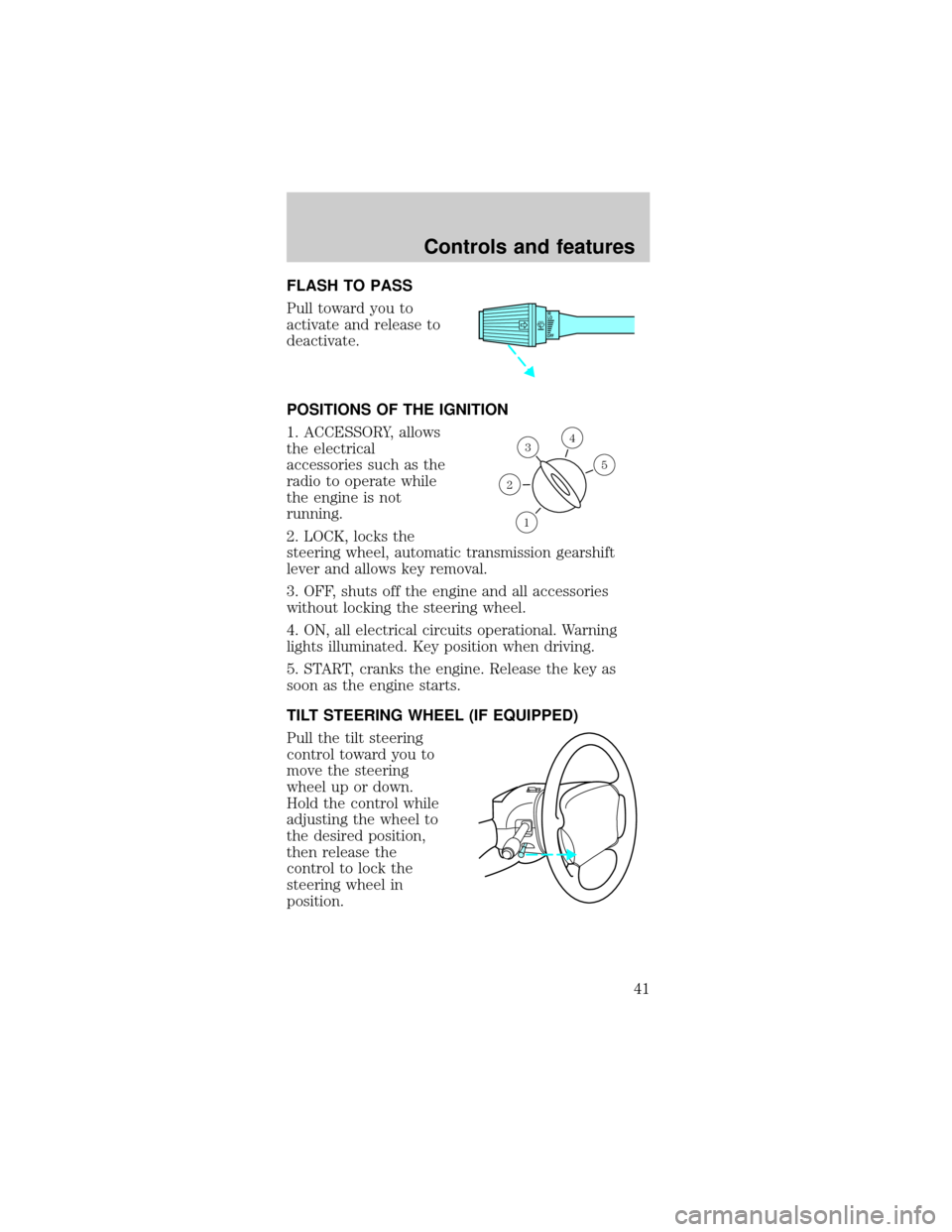
POSITIONS OF THE IGNITION
1. ACCESSORY, allows
the electrical
accessories such as the
radio to operate while
the engine is not
running.
2. LOCK, locks the
steering wheel, automatic transmission gearshift
lever and allows key removal.
3. OFF, shuts off the engine and all accessories
without locking the steering wheel.
4. ON, all electrical circuits operational. Warning
lights illuminated. Key position when driving.
5. START, cranks the engine. Release the key as
soon as the engine starts.
TILT STEERING WHEEL (IF EQUIPPED)
Pull the tilt steering
control toward you to
move the steering
wheel up or down.
Hold the control while
adjusting the wheel to
the desired position,
then release the
control to lock the
steering wheel in
position.
OFFHI
LO
3
1
2
5
4
Controls and features
41
Page 57 of 224
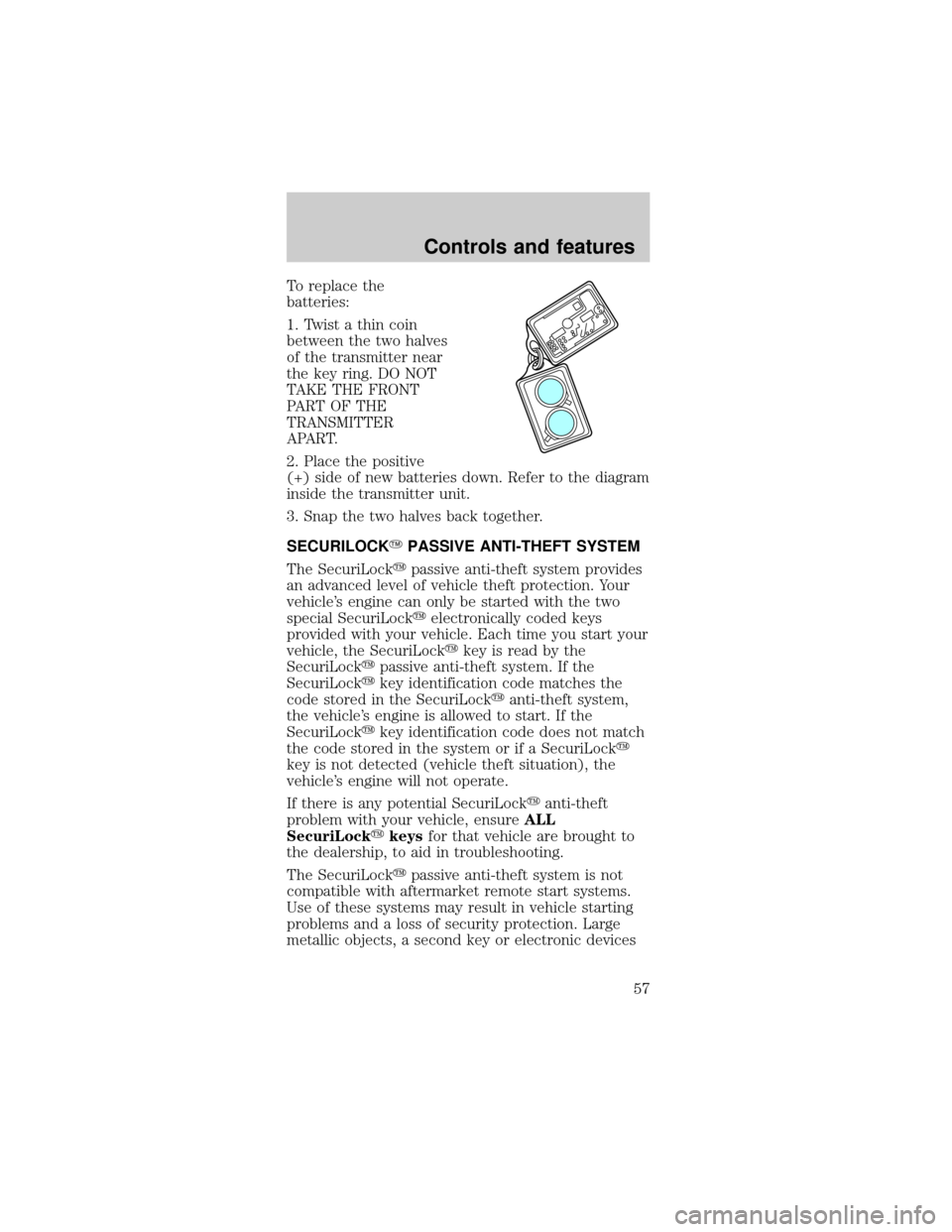
To replace the
batteries:
1. Twist a thin coin
between the two halves
of the transmitter near
the key ring. DO NOT
TAKE THE FRONT
PART OF THE
TRANSMITTER
APART.
2. Place the positive
(+) side of new batteries down. Refer to the diagram
inside the transmitter unit.
3. Snap the two halves back together.
SECURILOCKYPASSIVE ANTI-THEFT SYSTEM
The SecuriLockypassive anti-theft system provides
an advanced level of vehicle theft protection. Your
vehicle's engine can only be started with the two
special SecuriLockyelectronically coded keys
provided with your vehicle. Each time you start your
vehicle, the SecuriLockykey is read by the
SecuriLockypassive anti-theft system. If the
SecuriLockykey identification code matches the
code stored in the SecuriLockyanti-theft system,
the vehicle's engine is allowed to start. If the
SecuriLockykey identification code does not match
the code stored in the system or if a SecuriLocky
key is not detected (vehicle theft situation), the
vehicle's engine will not operate.
If there is any potential SecuriLockyanti-theft
problem with your vehicle, ensureALL
SecuriLockykeysfor that vehicle are brought to
the dealership, to aid in troubleshooting.
The SecuriLockypassive anti-theft system is not
compatible with aftermarket remote start systems.
Use of these systems may result in vehicle starting
problems and a loss of security protection. Large
metallic objects, a second key or electronic devices
Controls and features
57
Page 58 of 224

used to purchase gasoline or similar items on the
same key ring as the PATS ignition key may cause
vehicle starting problems. If present, you need to
keep these objects from touching the PATS ignition
key while starting the engine. These objects cannot
damage the PATS ignition key, but can cause a
momentary problem if they are too close to the key
during engine start. If a problem occurs, turn the
ignition OFF and restart the engine with all other
objects on the key ring held away from the ignition
key. Check to make sure the encoded ignition key is
an approved Ford encoded ignition key.
Spare SecuriLockykeys can be purchased from
your dealership and programmed to your
SecuriLockypassive anti-theft system. Refer to
Programming spare SecuriLockykeysfor more
information.
If one or both of your SecuriLockykeys are lost or
stolen and you want to ensure the lost or stolen key
will not operate your vehicle, bring your vehicle and
all available SecuriLockykeys to your dealership for
reinitialization.
Theft indicator
The theft indicator on the instrument cluster will
operate as follows:
²When the ignition is OFF, the theft indicator will
flash briefly every two seconds to indicate the
SecuriLockysystem is protecting your vehicle.
²When the ignition is turned to ON or START, the
theft indicator will light for three seconds and
then go out. If the theft indicator stays on for an
extended period of time or flashes rapidly, have
the system serviced by your dealership or a
qualified technician.
Programming spare SecuriLockYkeys
Spare SecuriLockykeys can be purchased from
your dealership and programmed to your
SecuriLockypassive anti-theft system (up to a total
Controls and features
58
Page 59 of 224

of eight keys). Your dealership can program your
new SecuriLockykey(s) to your vehicle or you can
do it yourself using the following simple procedure.
To program a new SecuriLockykey yourself, you
will need two previously programmed SecuriLocky
keys (keys that already operate your vehicle's
engine). If two previously programmed SecuriLocky
keys are not available (one or both of your original
keys were lost or stolen), you must bring your
vehicle to your dealership to have the spare
SecuriLockykey(s) programmed.
Procedure to program spare SecuriLockYkeys
to your vehicle
New SecuriLockykeys must have the correct
mechanical key cut for your vehicle.
Conventional (non-SecuriLocky) keyscannotbe
programmed to your vehicle.
You will need to have two previously programmed
SecuriLockykeys and the new unprogrammed
SecuriLockykey readily accessible for the
procedure. Please read and understand the entire
procedure before you begin.
1. Insert the first previously programmed
SecuriLockykey into the ignition and turn the
ignition from OFF to ON (maintain ignition in ON
for at least one second).
2. Turn ignition to OFF and remove the first
SecuriLockykey from the ignition.
3. Within five seconds of turning the ignition to OFF,
insert the second previously programmed
SecuriLockykey into the ignition and turn the
ignition from OFF to ON (maintain ignition in ON
for at least one second but no more than five
seconds).
4. Turn the ignition to OFF and remove the second
SecuriLockykey from the ignition.
5. Within 10 seconds of turning the ignition to OFF,
insert the unprogrammed SecuriLockykey (new
Controls and features
59
Page 60 of 224

key/valet key) into the ignition and turn the ignition
from OFF to ON (maintain ignition in ON for at least
one second). This step will program your new
SecuriLockykey.
6. To program additional SecuriLockykey(s), repeat
this procedure from step 1.
If the programming procedure was successful, the
new SecuriLockykey(s) will start the vehicle's
engine. The theft indicator (located on the
instrument cluster) will light for three seconds and
then go out.
If the programming procedure was not successful,
the new SecuriLockykey(s) will not operate the
vehicle's engine. The theft indicator will flash on and
off. Wait at least one minute and then repeat the
procedure from step 1. If failure repeats, bring your
vehicle to your dealership to have the spare
SecuriLockykey(s) programmed.
INTERIOR LUGGAGE COMPARTMENT
RELEASE (IF EQUIPPED)
Your vehicle is equipped with a mechanical interior
luggage compartment release handle that provides a
means of escape for children and adults in the event
they become locked inside the luggage
compartment.
Adults are advised to familiarize themselves with the
operation and location of the release handle.
Controls and features
60
Page 73 of 224
Do not sit on top of a buckled safety belt to
avoid the Belt Minder chime. Sitting on the
safety belt will increase risk of injury in an
accident. To disable (one-time) or deactivate the
Belt Minder feature please follow the directions
stated below.
One time disable
Anytime the safety belt is buckled and then
unbuckled during an ignition ON cycle, Belt Minder
will be disabled for that ignition cycle only.
Deactivating/activating the belt minder feature
Read steps1-9thoroughly before proceeding
with the deactivation/activation programming
procedure.
The Belt Minder feature can be deactivated/activated
by performing the following procedure:
Before following the procedure, make sure that:
²the parking brake is set
²the gearshift is in P (Park) (automatic
transmission) or the neutral position (manual
transmission).
²the ignition switch is in the OFF position
²all vehicle doors are closed
²the driver's safety belt is unbuckled
²the parklamps/headlamps are in OFF position (If
vehicle is equipped with Autolamps, this will not
affect the procedure.)
To reduce the risk of injury, do not
deactivate/activate the Belt Minder feature
while driving the vehicle.
1. Turn the ignition switch to the RUN (or ON)
position. (DO NOT START THE ENGINE)
Seating and safety restraints
73
Page 90 of 224
PREPARING TO START YOUR VEHICLE
Engine starting is controlled by the powertrain
control system. This system meets all Canadian
Interference-Causing Equipment standard
requirements regulating the impulse electrical field
strength of radio noise.
When starting a fuel-injected engine, avoid pressing
the accelerator before or during starting. Only use
the accelerator when you have difficulty starting the
engine. For more information on starting the vehicle,
refer toStarting the enginein this chapter.
Extended idling at high engine speeds can
produce very high temperatures in the
engine and exhaust system, creating the risk of
fire or other damage.
Do not park, idle, or drive your vehicle in
dry grass or other dry ground cover. The
emission system heats up the engine compartment
and exhaust system, which can start a fire.
Do not start your vehicle in a closed garage
or in other enclosed areas. Exhaust fumes
can be toxic. Always open the garage door before
you start the engine. SeeGuarding against
exhaust fumesin this chapter for more
instructions.
If you smell exhaust fumes inside your
vehicle, have your dealer inspect your
vehicle immediately. Do not drive if you smell
exhaust fumes.
Starting
90
Page 91 of 224
Important safety precautions
A computer system controls the engine's idle
revolutions per minute (RPM). When the engine
starts, the idle RPM runs faster to warm the engine.
If the engine idle speed does not slow down
automatically, have the vehicle checked. Do not
allow the vehicle to idle for more than 10 minutes at
high engine RPM.
Before starting the vehicle:
1. Make sure all vehicle occupants have buckled
their safety belts. For more information on safety
belts and their proper usage, refer to theSeating
and safety restraintschapter.
2. Make sure the headlamps and vehicle accessories
are off.
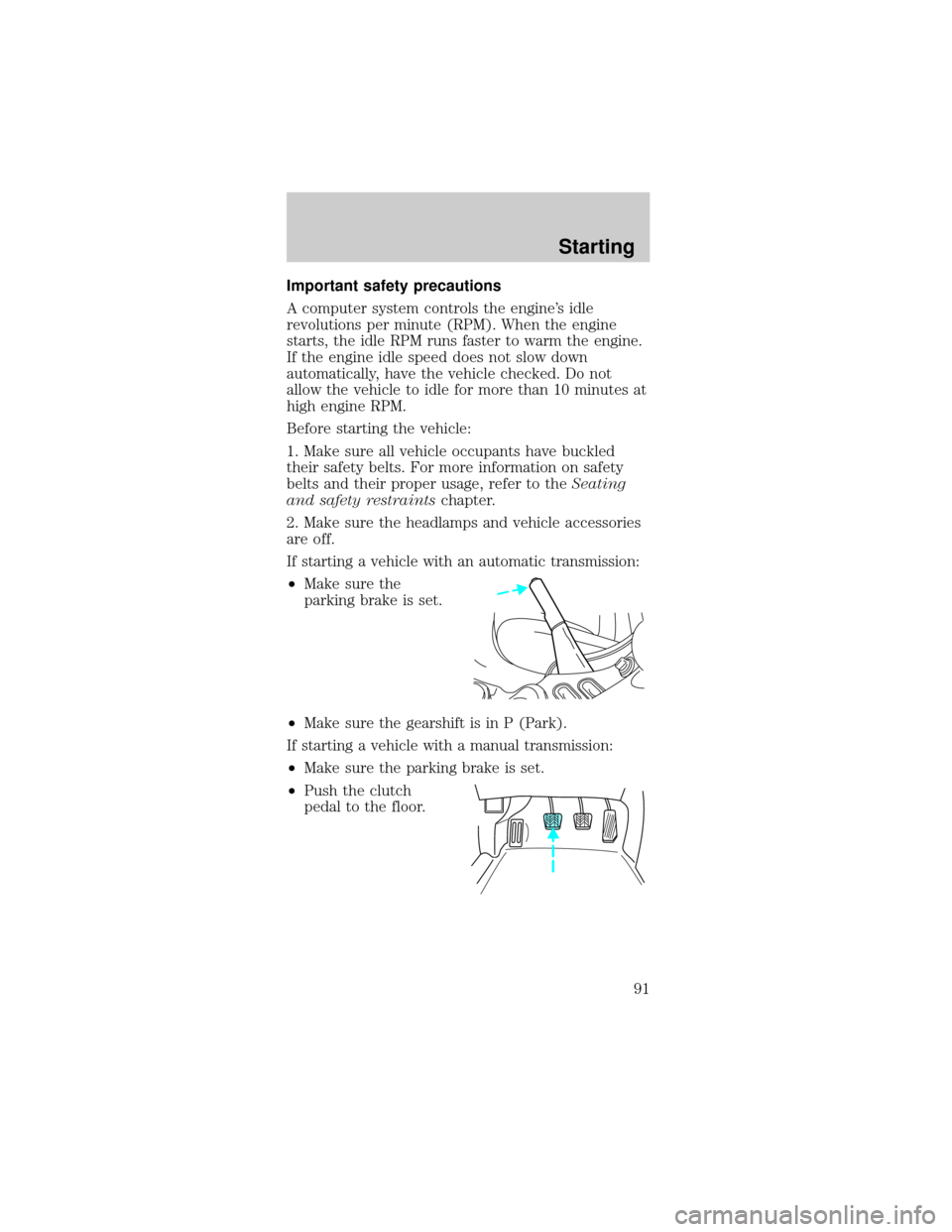
If starting a vehicle with an automatic transmission:
²Make sure the
parking brake is set.
²Make sure the gearshift is in P (Park).
If starting a vehicle with a manual transmission:
²Make sure the parking brake is set.
²Push the clutch
pedal to the floor.
Starting
91