wheel FORD MUSTANG 2000 4.G Owner's Manual
[x] Cancel search | Manufacturer: FORD, Model Year: 2000, Model line: MUSTANG, Model: FORD MUSTANG 2000 4.GPages: 224, PDF Size: 1.86 MB
Page 152 of 224
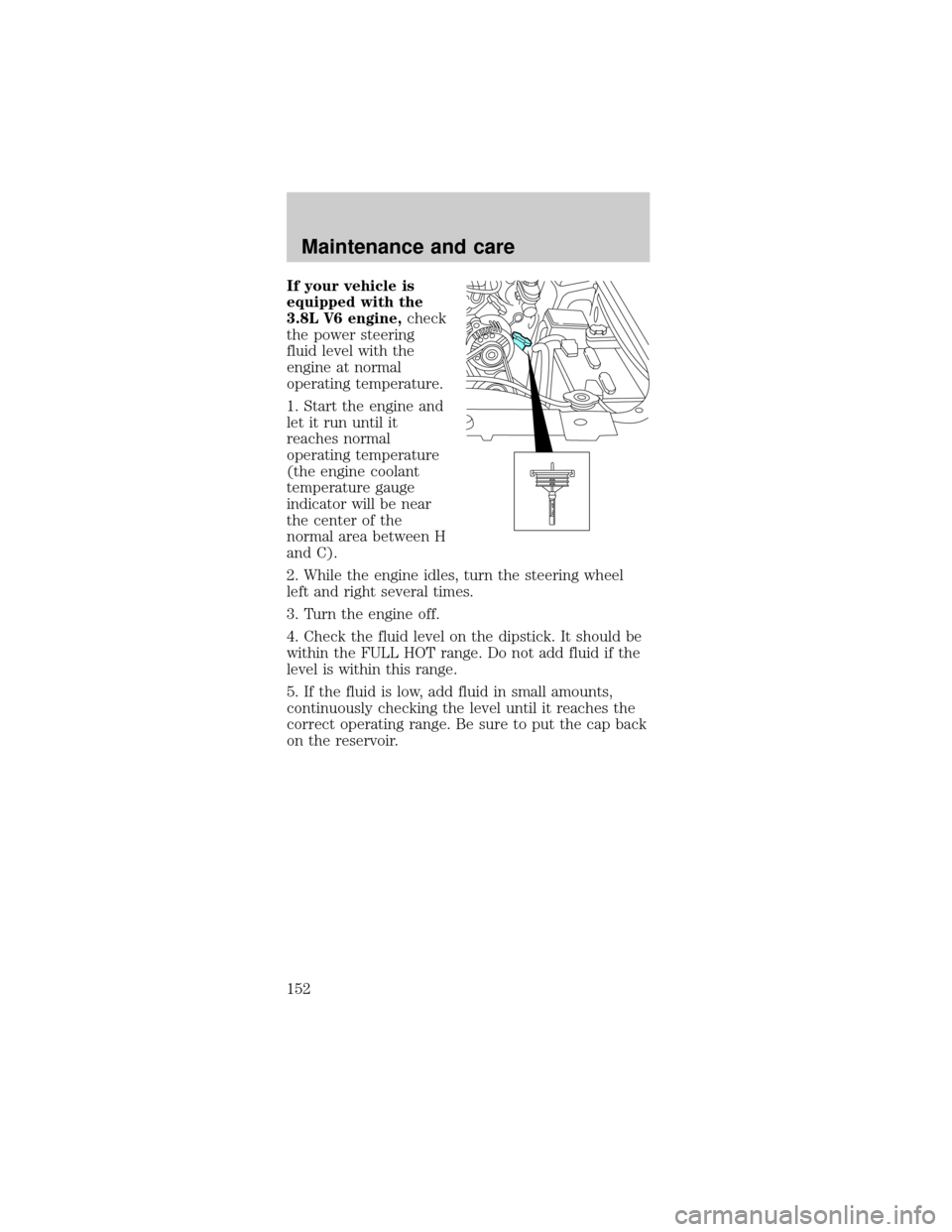
If your vehicle is
equipped with the
3.8L V6 engine,check
the power steering
fluid level with the
engine at normal
operating temperature.
1. Start the engine and
let it run until it
reaches normal
operating temperature
(the engine coolant
temperature gauge
indicator will be near
the center of the
normal area between H
and C).
2. While the engine idles, turn the steering wheel
left and right several times.
3. Turn the engine off.
4. Check the fluid level on the dipstick. It should be
within the FULL HOT range. Do not add fluid if the
level is within this range.
5. If the fluid is low, add fluid in small amounts,
continuously checking the level until it reaches the
correct operating range. Be sure to put the cap back
on the reservoir.
FILL
HOT
Maintenance and care
152
Page 153 of 224
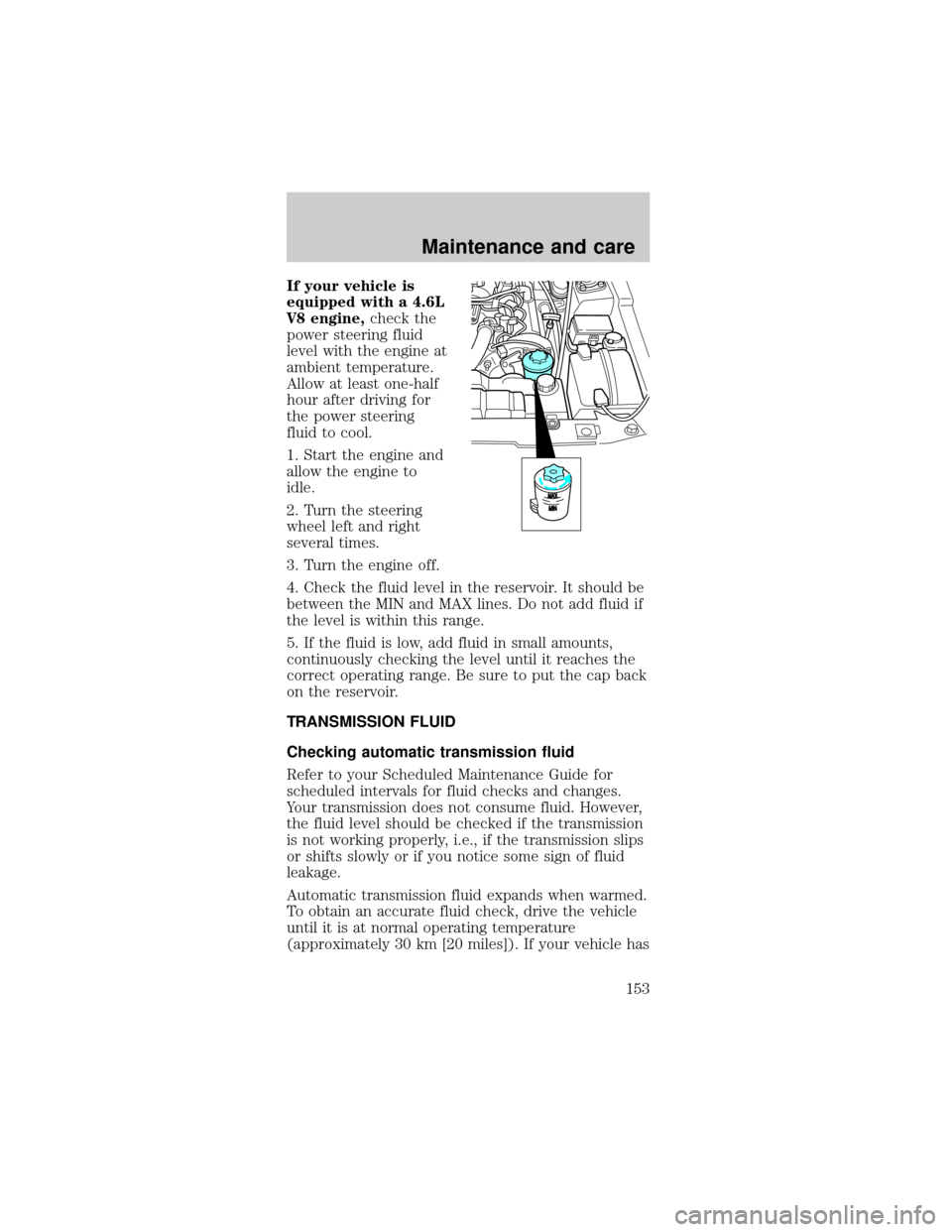
If your vehicle is
equipped with a 4.6L
V8 engine,check the
power steering fluid
level with the engine at
ambient temperature.
Allow at least one-half
hour after driving for
the power steering
fluid to cool.
1. Start the engine and
allow the engine to
idle.
2. Turn the steering
wheel left and right
several times.
3. Turn the engine off.
4. Check the fluid level in the reservoir. It should be
between the MIN and MAX lines. Do not add fluid if
the level is within this range.
5. If the fluid is low, add fluid in small amounts,
continuously checking the level until it reaches the
correct operating range. Be sure to put the cap back
on the reservoir.
TRANSMISSION FLUID
Checking automatic transmission fluid
Refer to your Scheduled Maintenance Guide for
scheduled intervals for fluid checks and changes.
Your transmission does not consume fluid. However,
the fluid level should be checked if the transmission
is not working properly, i.e., if the transmission slips
or shifts slowly or if you notice some sign of fluid
leakage.
Automatic transmission fluid expands when warmed.
To obtain an accurate fluid check, drive the vehicle
until it is at normal operating temperature
(approximately 30 km [20 miles]). If your vehicle has
MAXMIN
Maintenance and care
153
Page 162 of 224
Temperature A B C
The temperature grades are A (the highest), B, and
C, representing the tire's resistance to the
generation of heat and its ability to dissipate heat
when tested under controlled conditions on a
specified indoor laboratory test wheel. Sustained
high temperature can cause the material of the tire
to degenerate and reduce tire life, and excessive
temperature can lead to sudden tire failure. The
grade C corresponds to a level of performance which
all passenger car tires must meet under the Federal
Motor Vehicle Safety Standard No. 109. Grades B
and A represent higher levels of performance on the
laboratory test wheel than the minimum required by
law.
The temperature grade for this tire is
established for a tire that is properly inflated
and not overloaded. Excessive speed,
underinflation, or excessive loading, either
separately or in combination, can cause heat
buildup and possible tire failure.
SERVICING YOUR TIRES
Checking the tire pressure
²Use an accurate tire pressure gauge.
²Check the tire pressure when tires are cold, after
the vehicle has been parked for at least one hour
or has been driven less than 5 km (3 miles).
²Adjust tire pressure to recommended
specifications found on the tire pressure label
inside the glove compartment door.
Improperly inflated tires can affect vehicle
handling and can fail suddenly, possibly
resulting in loss of vehicle control.
Maintenance and care
162
Page 165 of 224
chains. Use chains on the tires only in an emergency
or if the law requires them.
Follow these guidelines when using snow tires and
chains:
²Chains may damage aluminum wheels.
²Use only Cable Type chains with size P225/55R16
or 245/45ZR17 tires. Use of SAE Class S chains
may damage vehicle.
²SAE Class S chains may be used on P205/65R15
tires.
²Install chains securely, verifying that the chains do
not touch any wiring, brake lines or fuel lines.
²Drive cautiously. If you hear the chains rub or
bang against your vehicle, stop and re-tighten the
chains. If this does not work, remove the chains
to prevent damage to your vehicle.
²If possible, avoid fully loading your vehicle.
²Remove the tire chains when they are no longer
needed. Do not use tire chains on dry roads.
²The suspension insulation and bumpers will help
prevent vehicle damage. Do not remove these
components from your vehicle when using snow
tires and chains.
WHAT YOU SHOULD KNOW ABOUT
AUTOMOTIVE FUELS
Important safety precautions
Do not overfill the fuel tank. The pressure in
an overfilled tank may cause leakage and
lead to fuel spray and fire.
Maintenance and care
165
Page 174 of 224

²Revving the engine before turning it off may
reduce fuel economy.
²Using the air conditioner or defroster may reduce
fuel economy.
²You may want to turn off the speed control in
hilly terrain if unnecessary shifting between third
and fourth gear occurs. Unnecessary shifting of
this type could result in reduced fuel economy.
²Warming up a vehicle on cold mornings is not
required and may reduce fuel economy.
²Resting your foot on the brake pedal while driving
may reduce fuel economy.
²Combine errands and minimize stop-and-go
driving.
Maintenance
²Keep tires properly inflated and use only
recommended size.
²Operating a vehicle with the wheels out of
alignment will reduce fuel economy.
²Use recommended engine oil. Refer toLubricant
Specifications.
²Perform all regularly scheduled maintenance
items. Follow the recommended maintenance
schedule and owner maintenance checks found in
your vehicle Scheduled Maintenance Guide.
Conditions
²Heavily loading a vehicle or towing a trailer may
reduce fuel economy at any speed.
²Carrying unnecessary weight may reduce fuel
economy (approximately 0.4 km/L [1 mpg] is lost
for every 180 kg [400 lb] of weight carried).
²Adding certain accessories to your vehicle (for
example bug deflectors, rollbars/light bars,
running boards, ski/luggage racks) may reduce
fuel economy.
Maintenance and care
174
Page 186 of 224

Remove particles such as bird droppings, tree sap,
insect remains, tar spots, road salt and industrial
fallout immediately.
Cleaning the wheels
Wash with the same detergent as the body of your
vehicle. Do not use acid-based or alcohol-based
wheel cleaners, steel wool, fuel or strong detergents.
Never use abrasives that will damage the finish of
special wheel surfaces. Use a tar remover to remove
grease and tar.
The brushes used in some automatic car washes may
damage the finish on your wheels. Before going to a
car wash, find out if the brushes are abrasive.
Cleaning non-painted plastic exterior parts
Use vinyl cleaner for routine cleaning. Clean with a
tar remover if necessary. Do not clean plastic parts
with thinners, solvents or petroleum-based cleaners.
Underbody
Flush the complete underside of vehicle frequently.
Keep body drain holes unplugged. Inspect for road
damage.
Cleaning mirrors
Do not clean your mirrors with a dry cloth or
abrasive materials. Use a soft cloth and mild
detergent and water. Be careful when removing ice
from outside mirrors because you may damage the
reflective surface.
Cleaning the exterior lamps
Wash with the same detergent as the exterior of
your vehicle. If necessary, use a tar remover such as
Ford Extra Strength Tar and Road Oil Remover
(B7A-19520±AA).
To avoid scratching the lamps, do not use a dry
paper towel, chemical solvents or abrasive cleaners.
Maintenance and care
186
Page 188 of 224
²Do not spray with cold water to avoid cracking
the engine block or other engine components.
²Never apply anything to the drive belt (including
belt dressing).
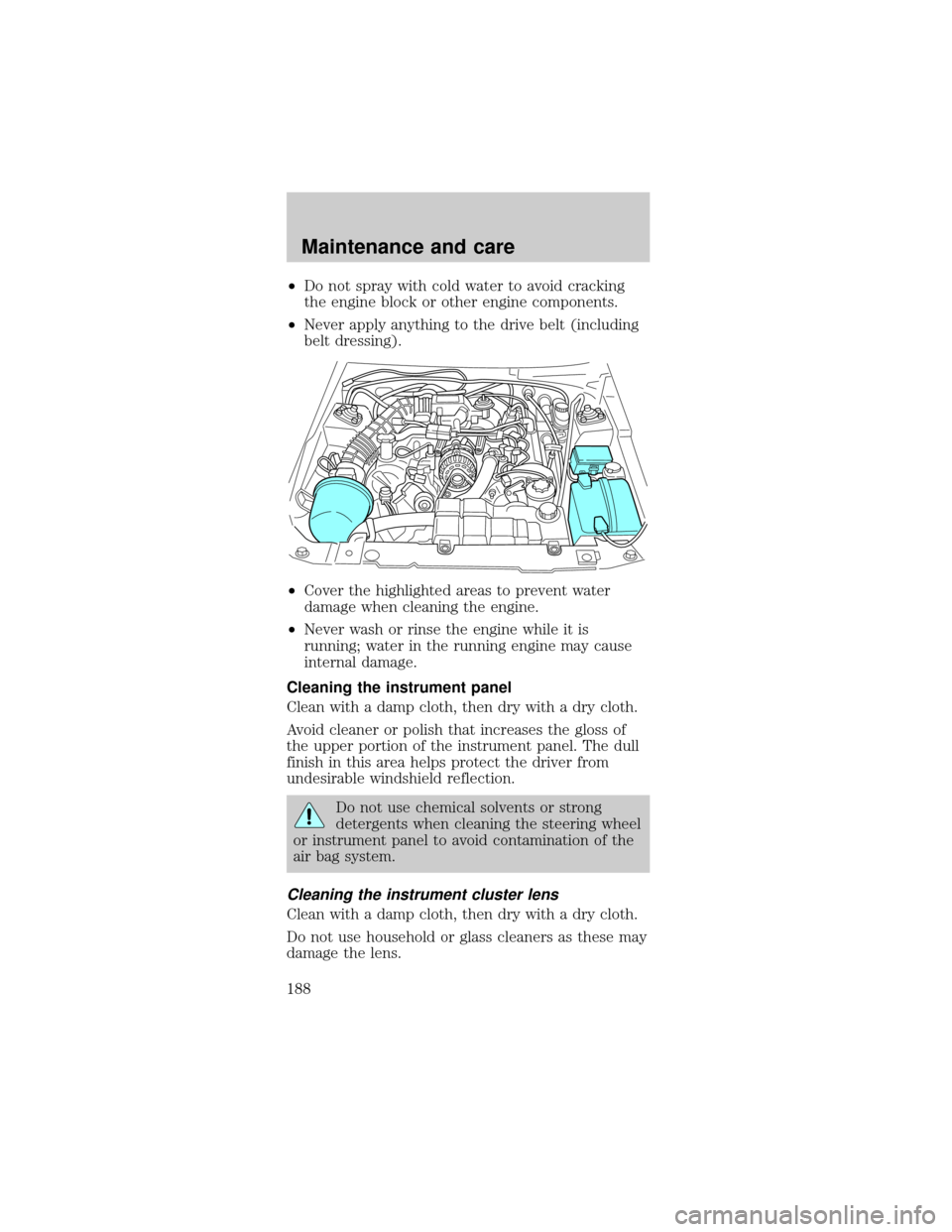
²Cover the highlighted areas to prevent water
damage when cleaning the engine.
²Never wash or rinse the engine while it is
running; water in the running engine may cause
internal damage.
Cleaning the instrument panel
Clean with a damp cloth, then dry with a dry cloth.
Avoid cleaner or polish that increases the gloss of
the upper portion of the instrument panel. The dull
finish in this area helps protect the driver from
undesirable windshield reflection.
Do not use chemical solvents or strong
detergents when cleaning the steering wheel
or instrument panel to avoid contamination of the
air bag system.
Cleaning the instrument cluster lens
Clean with a damp cloth, then dry with a dry cloth.
Do not use household or glass cleaners as these may
damage the lens.
Maintenance and care
188
Page 194 of 224
1Add 118 ml (4 oz.) of Additive Friction Modifier C8AZ-19B546-A or
equivalent meeting Ford specification EST-M2C118-A for complete
refill of Traction-Lok axles.
Ford design rear axles contain a synthetic lubricant that does not
require changing unless the axle has been submerged in water.
2Ensure the correct automatic transmission fluid is used.
Transmission fluid requirements are indicated on the dipstick or on
the dipstick handle. MERCONtand MERCONtV are not
interchangeable. DO NOT mix MERCONtand MERCONtV. Refer to
your Scheduled Maintenance Guide to determine the correct service
interval.
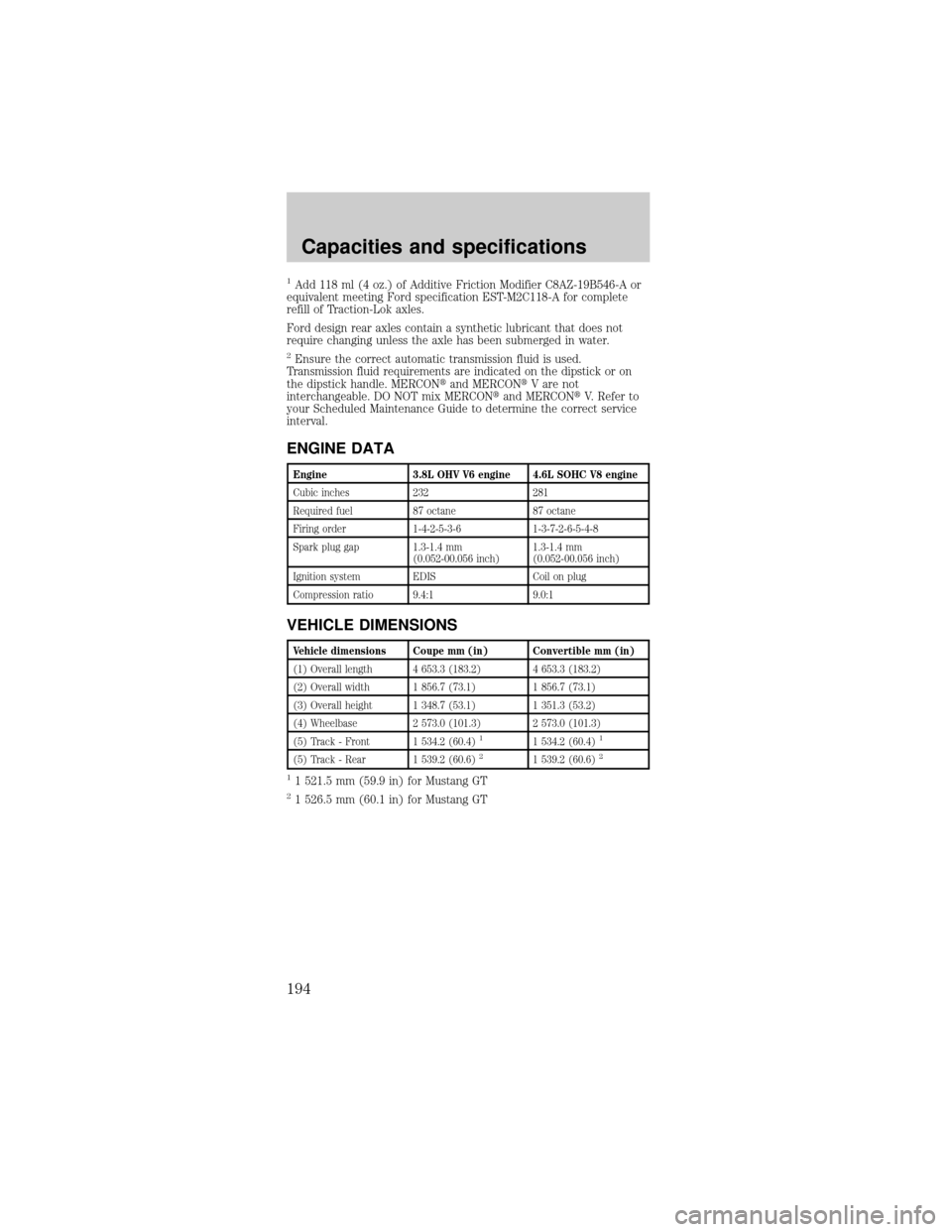
ENGINE DATA
Engine 3.8L OHV V6 engine 4.6L SOHC V8 engine
Cubic inches 232 281
Required fuel 87 octane 87 octane
Firing order 1-4-2-5-3-6 1-3-7-2-6-5-4-8
Spark plug gap 1.3-1.4 mm
(0.052-00.056 inch)1.3-1.4 mm
(0.052-00.056 inch)
Ignition system EDIS Coil on plug
Compression ratio 9.4:1 9.0:1
VEHICLE DIMENSIONS
Vehicle dimensions Coupe mm (in) Convertible mm (in)
(1) Overall length 4 653.3 (183.2) 4 653.3 (183.2)
(2) Overall width 1 856.7 (73.1) 1 856.7 (73.1)
(3) Overall height 1 348.7 (53.1) 1 351.3 (53.2)
(4) Wheelbase 2 573.0 (101.3) 2 573.0 (101.3)
(5) Track - Front 1 534.2 (60.4)
11 534.2 (60.4)1
(5) Track - Rear 1 539.2 (60.6)21 539.2 (60.6)2
11 521.5 mm (59.9 in) for Mustang GT21 526.5 mm (60.1 in) for Mustang GT
Capacities and specifications
194
Page 208 of 224
greater. See your dealer for complete warranty
information and availability.
Not all accessories are available for all models.
Vehicle Security
Styled wheel protector locks
Vehicle security systems
Comfort and convenience
Ash Cup
Cargo nets
Cargo organizers
Dash trim
Electrochromic mirror with compass
Electrochromic mirror with compass and
temperature display
Engine block heaters
Travel equipment
Auto headlamps with daytime running lights (DRL)
Cassette holder
Daytime running lights (DRL)
Fog lights
Heavy-duty battery
Removable luggage rack
Removable luggage rack adapters
Soft luggage cover
Speed control
Protection and appearance equipment
Air bag anti-theft locks
Cargo liners, interior
Carpet floor mats
Customer assistance
208
Page 213 of 224

Cleaning
your vehicle ............. 184
engine
compartment ......... 187
exterior ........... 185,186
exterior lamps ....... 186
instrument panel .. 188
instrument
panel lens .............. 188
interior ............ 189,190
mirrors ................... 186
plastic parts .......... 186
safety belts ............ 189
washing .................. 184
waxing ................... 185
wheels .................... 186
windows ................ 189
wiper blades .......... 187
woodtone trim ...... 189
Climate control
(see Air conditioning
or Heating) ................ 20
Clock .......................... 34
Clutch
adjusting ................ 142
operation
while driving ......... 106
recommended
shift speeds ........... 107
Console ...................... 47
Controls
power seat ............... 63
Convertible ................ 48
cleaning ................. 187
installation
of the boot .............. 49
lowering the
convertible top ........ 48
raising the
convertible top ........ 51Coolant
checking
and adding ............ 143
low coolant light ..... 12
refill
capacities ........ 150,191
specifications.. 193,194
Cruise control (see
Speed control) .......... 42
Customer
Assistance ................ 116
Ford accessories for
your vehicle .......... 206
Ford Extended
Service Plan .......... 197
Getting assistance
outside the U.S.
and Canada ........... 205
Getting roadside
assistance .............. 116
Getting the service
you need ............... 198
Ordering
additional owner's
literature ............... 210
The Dispute
Settlement
Board ..................... 200
Utilizing the
Mediation/
Arbitration
Program ................. 204
Daytime running
lamps (see Lamps) ... 18
Defrost
rear window ............ 19
Dipstick
automatic
transmission fluid... 153
engine oil ............... 137
Index
213