fuel FORD MUSTANG 2002 4.G Owner's Manual
[x] Cancel search | Manufacturer: FORD, Model Year: 2002, Model line: MUSTANG, Model: FORD MUSTANG 2002 4.GPages: 264, PDF Size: 2.56 MB
Page 170 of 264
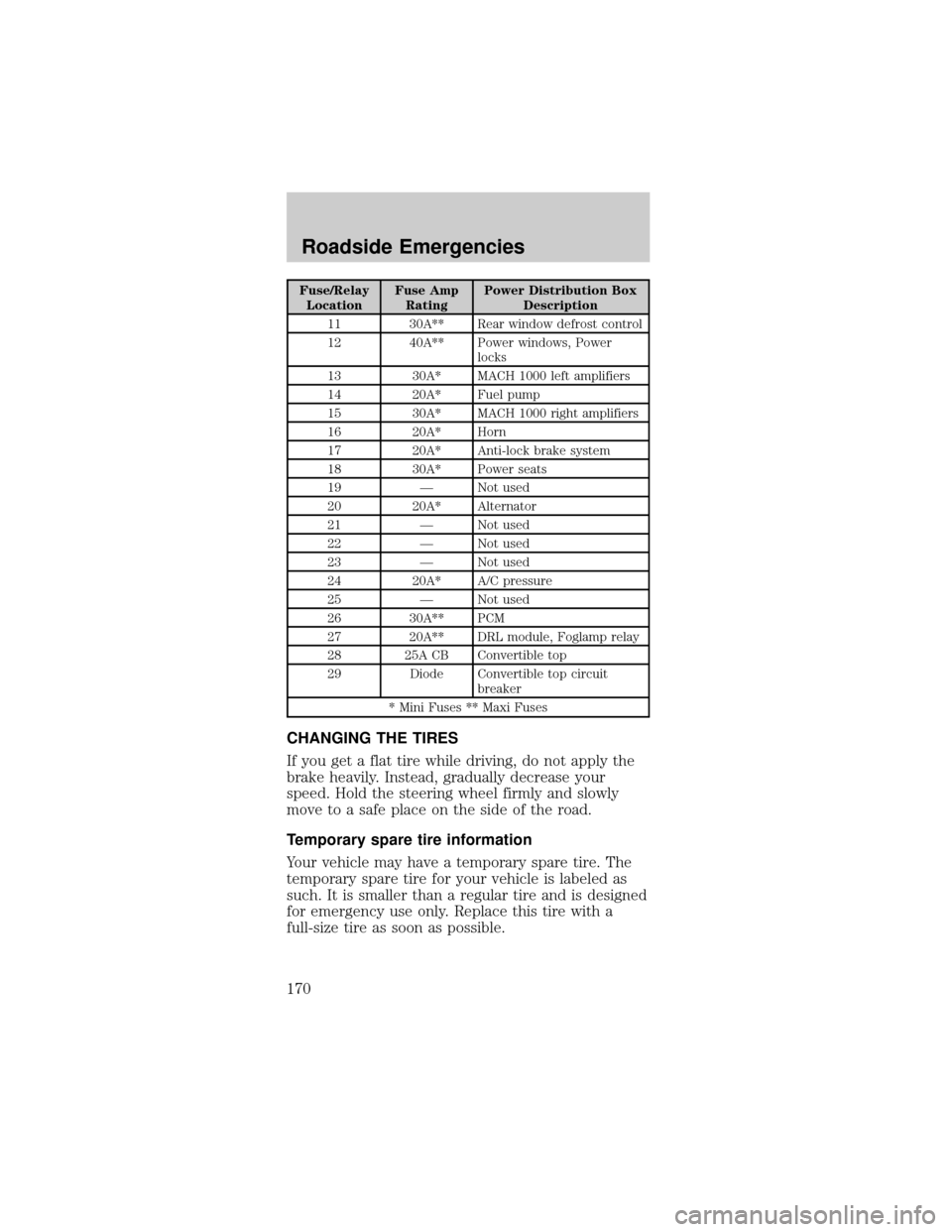
Fuse/Relay
LocationFuse Amp
RatingPower Distribution Box
Description
11 30A** Rear window defrost control
12 40A** Power windows, Power
locks
13 30A* MACH 1000 left amplifiers
14 20A* Fuel pump
15 30A* MACH 1000 right amplifiers
16 20A* Horn
17 20A* Anti-lock brake system
18 30A* Power seats
19 Ð Not used
20 20A* Alternator
21 Ð Not used
22 Ð Not used
23 Ð Not used
24 20A* A/C pressure
25 Ð Not used
26 30A** PCM
27 20A** DRL module, Foglamp relay
28 25A CB Convertible top
29 Diode Convertible top circuit
breaker
* Mini Fuses ** Maxi Fuses
CHANGING THE TIRES
If you get a flat tire while driving, do not apply the
brake heavily. Instead, gradually decrease your
speed. Hold the steering wheel firmly and slowly
move to a safe place on the side of the road.
Temporary spare tire information
Your vehicle may have a temporary spare tire. The
temporary spare tire for your vehicle is labeled as
such. It is smaller than a regular tire and is designed
for emergency use only. Replace this tire with a
full-size tire as soon as possible.
Roadside Emergencies
170
Page 176 of 264
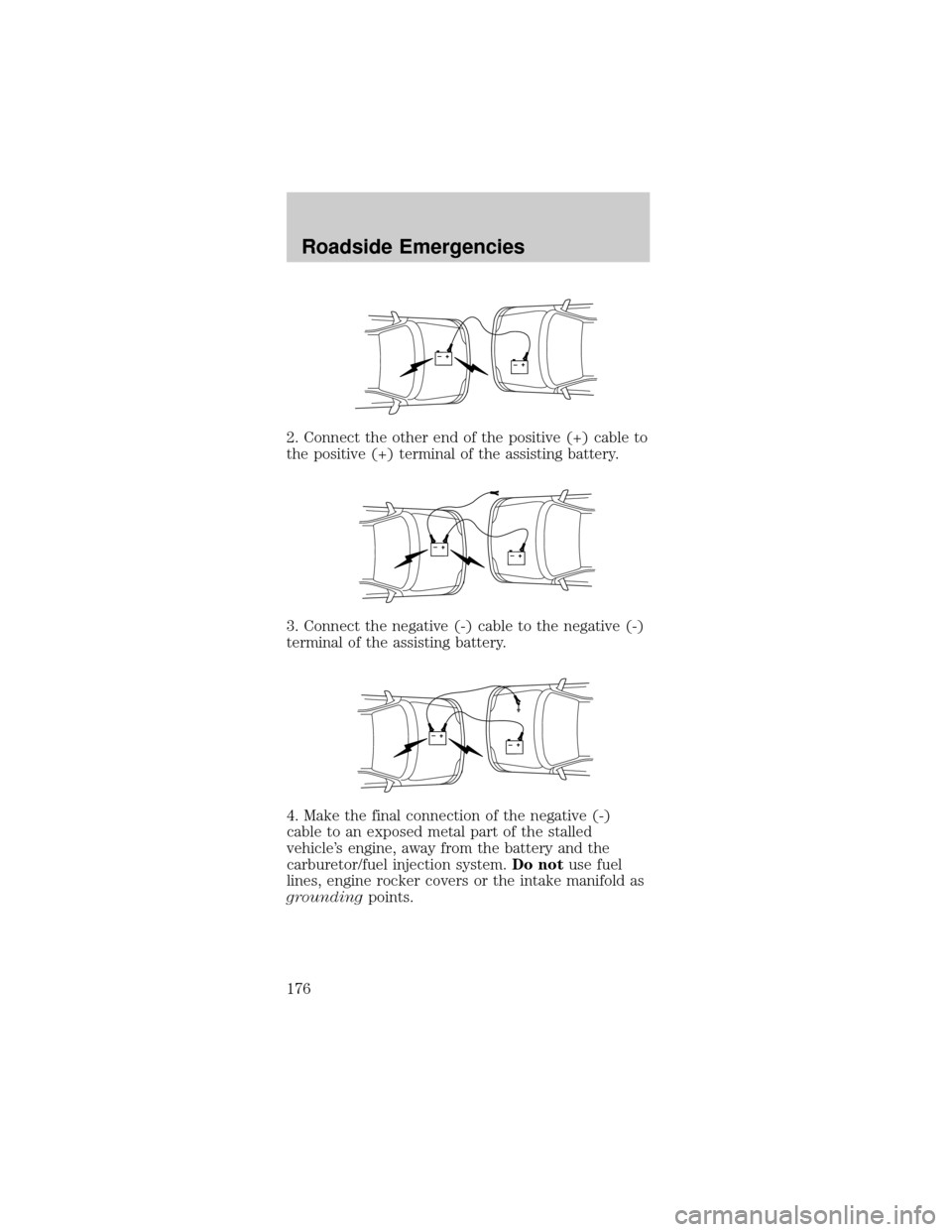
2. Connect the other end of the positive (+) cable to
the positive (+) terminal of the assisting battery.
3. Connect the negative (-) cable to the negative (-)
terminal of the assisting battery.
4. Make the final connection of the negative (-)
cable to an exposed metal part of the stalled
vehicle's engine, away from the battery and the
carburetor/fuel injection system.Do notuse fuel
lines, engine rocker covers or the intake manifold as
groundingpoints.
+–+–
+–+–
+–+–
Roadside Emergencies
176
Page 177 of 264
Do not connect the end of the second cable
to the negative (-) terminal of the battery to
be jumped. A spark may cause an explosion of the
gases that surround the battery.
5. Ensure that the cables are clear of fan blades,
belts, moving parts of both engines, or any fuel
delivery system parts.
Jump starting
1. Start the engine of the booster vehicle and run
the engine at moderately increased speed.
2. Start the engine of the disabled vehicle.
3. Once the disabled vehicle has been started, run
both engines for an additional three minutes before
disconnecting the jumper cables.
Removing the jumper cables
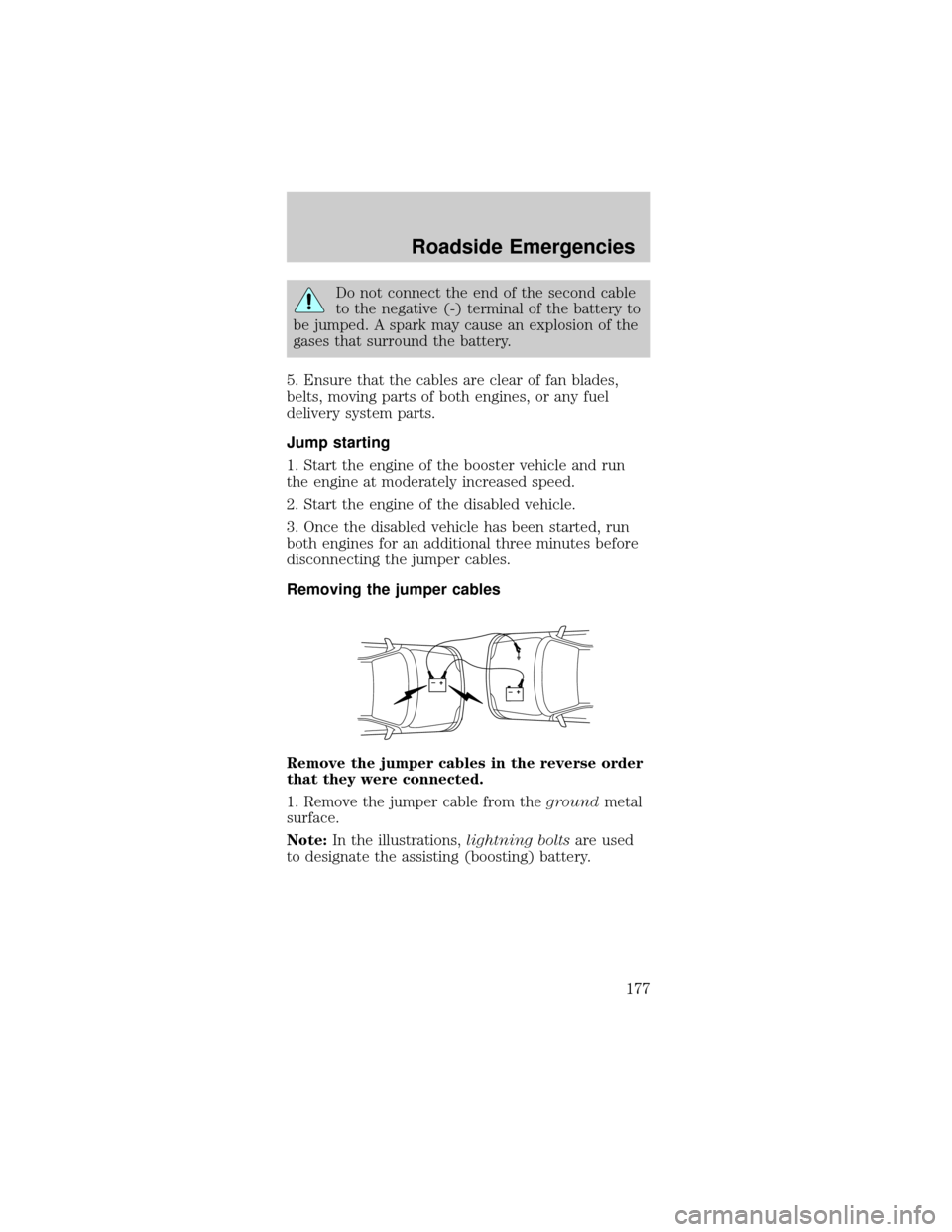
Remove the jumper cables in the reverse order
that they were connected.
1. Remove the jumper cable from thegroundmetal
surface.
Note:In the illustrations,lightning boltsare used
to designate the assisting (boosting) battery.
+–+–
Roadside Emergencies
177
Page 188 of 264
GETTING ASSISTANCE OUTSIDE THE U.S. AND
CANADA
Before exporting your vehicle to a foreign country,
contact the appropriate foreign embassy or
consulate. These officials can inform you of local
vehicle registration regulations and where to find
unleaded fuel.
If you cannot find unleaded fuel or can only get fuel
with an anti-knock index lower than is
recommended for your vehicle, contact a district or
owner relations/customer relationship office.
The use of leaded fuel in your vehicle without
proper conversion may damage the effectiveness of
your emission control system and may cause engine
knocking or serious engine damage. Ford Motor
Company/Ford of Canada is not responsible for any
damage caused by use of improper fuel.
In the United States, using leaded fuel may also
result in difficulty importing your vehicle back into
the U.S.
If your vehicle must be serviced while you are
traveling or living in Central or South America, the
Caribbean, or the Middle East, contact the nearest
Ford dealership. If the dealership cannot help you,
write or call:
FORD MOTOR COMPANY
WORLDWIDE DIRECT MARKET OPERATIONS
1555 Fairlane Drive
Fairlane Business Park #3
Allen Park, Michigan 48101
U.S.A.
Telephone: (313) 594-4857
FAX: (313) 390-0804
If you are in another foreign country, contact the
nearest Ford dealership. If the dealership employees
cannot help you, they can direct you to the nearest
Ford affiliate office.
Customer Assistance
188
Page 192 of 264
WASHING THE EXTERIOR OF YOUR VEHICLE
Never wash a vehicle
that is ªhot to the
touchº or during
exposure to strong,
direct sunlight. It is
recommended that you
wash your vehicle
regularly with cool or
lukewarm water and a
neutral Ph shampoo, such as Detail Wash (ZC-3±A),
which is available from your authorized Ford,
Lincoln or Mercury dealer. Always use a clean
sponge or carwash mitt with plenty of water for best
results. Dry the vehicle with a chamois or soft terry
cloth towel in order to eliminate water spotting.
Never use strong household detergents or soap,
such as dish washing or laundry liquid. These
products can discolor and spot painted
surfaces.
It is especially important to wash the vehicle
regularly during winter months, as dirt and road salt
are difficult to remove and do cause damage to the
vehicle.
Items such as gasoline, diesel fuel, bird droppings
and insect deposits should be washed and sponged
off as soon as possible. Deposits not removed
promptly can cause damage to the vehicle's
paintwork and trim over time.
Remove any exterior accessories, such as
antennas, before entering a car wash.
PROTECTING THE PAINT FINISH OF YOUR
VEHICLE
Applying a polymer paint sealant to your vehicle on
a regular basis will assist in reducing minor
scratches and paint damage.
Cleaning
192
Page 194 of 264

Do not use hydrofluoric acid-based or high
caustic-based wheel cleaners, steel wool, fuels
or strong household detergents for soiled
wheel rims and covers.
Never apply any cleaning chemical to hot or warm
wheel rims or covers.
Clean wheel rims and covers with Detail Wash
(ZC-3±A), which is available from your authorized
Ford, Lincoln or Mercury dealer. Spray cleaner on
cool wheel rims or covers and allow to set for 2±5
minutes. Agitate the area with a sponge and rinse off
with plenty of water.
Use Extra Strength Tar and Road Oil Removal
(B7A-19520±AA), available from your authorized
Ford, Lincoln or Mercury dealer, in order to remove
tar and grease from wheel rims and covers.
CLEANING THE ENGINE
Engines are more efficient when they are clean
because grease and dirt buildup keep the engine
warmer than normal. When washing:
²The engine must be cool to the touch before
spraying with water.
²Never spray a hot engine with cold water, as
damage to the engine block or engine
components may occur.
²Use caution when using a self-serve power washer
(1000psi maximum pressure) to clean the engine,
as the high-pressure fluid could penetrate the
sealed parts and cause damage.
²Never apply anything to any exposed belts in
the engine compartment, including belt
dressing.
For general cleaning of the engine and engine
compartment, spray Engine Shampoo and Degreaser
(F4AZ-19A536±A) on all parts that require cleaning
and pressure rinse the area with cool water.
Cleaning
194
Page 197 of 264

Do not clean the windshield or rear window
glass with abrasives, as they may cause
scratches.
Do not use fuel, kerosene, or paint thinner to
clean the windshield, rear window or the wiper
blades as damage may occur.
Clean the outside of the windshield or rear window
with a non-abrasive cleaner such as Ultra Clear Spray
Glass Cleaner (E4AZ-19C507±AA), available from your
authorized Ford, Lincoln or Mercury dealer. If after
cleaning the glass surface, the water sheets from the
glass (e.g., does not bead), then the window is clean.
The windshield, rear window and wiper blades should
be cleaned regularly. Wiper blades can be cleaned with
isopropyl (rubbing) alcohol or windshield washer
solution. Be sure to replace wiper blades when they
appear worn or do not function properly.
CONVERTIBLE TOP AND PADDED MOLDING
CARE
To avoid damage to the vinyl top and moldings, wash
with Triple Clean (EOAZ-19526±AA), which is
available from your authorized Ford, Lincoln or
Mercury dealer. Do not use stiff bristle brushes or
abrasive materials or cleaners.
Hot waxes applied by commercial car washes can
affect the cleanability of vinyl material.
Using high water pressure or wand-type car washes
against the convertible top and windows may cause
water leaks and possible seal damage.
CLEANING THE INSTRUMENT PANEL
Clean the instrument panel with a damp cloth, then
dry with a dry cloth.
Avoid cleaners or polish that increase the gloss of
the upper portion of the instrument panel. The dull
finish in this area helps protect the driver from
undesirable windshield reflection.
Cleaning
197
Page 201 of 264
SERVICE RECOMMENDATIONS
To help you service your vehicle:
²We highlight do-it-yourself items in the engine
compartment for easy location.
²We provide a scheduled maintenance guide which
makes tracking routine service easy.
If your vehicle requires professional service, your
dealership can provide the necessary parts and
service. Check yourWarranty Guideto find out
which parts and services are covered.
Use only recommended fuels, lubricants, fluids and
service parts conforming to specifications. Motorcraft
parts are designed and built to provide the best
performance in your vehicle.
PRECAUTIONS WHEN SERVICING YOUR
VEHICLE
Be especially careful when inspecting or servicing
your vehicle.
²Do not work on a hot engine.
²When the engine is running, keep loose clothing,
jewelry or long hair away from moving parts.
²Do not work on a vehicle with the engine running
in an enclosed space, unless you are sure you
have enough ventilation.
²Keep all lit cigarettes, open flames and other lit
material away from the battery and all fuel related
parts.
If you disconnect the battery, the engine must
ªrelearnº its idle conditions before your vehicle will
drive properly, as explained in theBatterysection in
this chapter.
Working with the engine off
²Automatic transmission:
1. Set the parking brake and ensure the gearshift is
securely latched in P (Park).
Maintenance and Specifications
201
Page 206 of 264
WINDSHIELD WASHER FLUID
Washer fluid
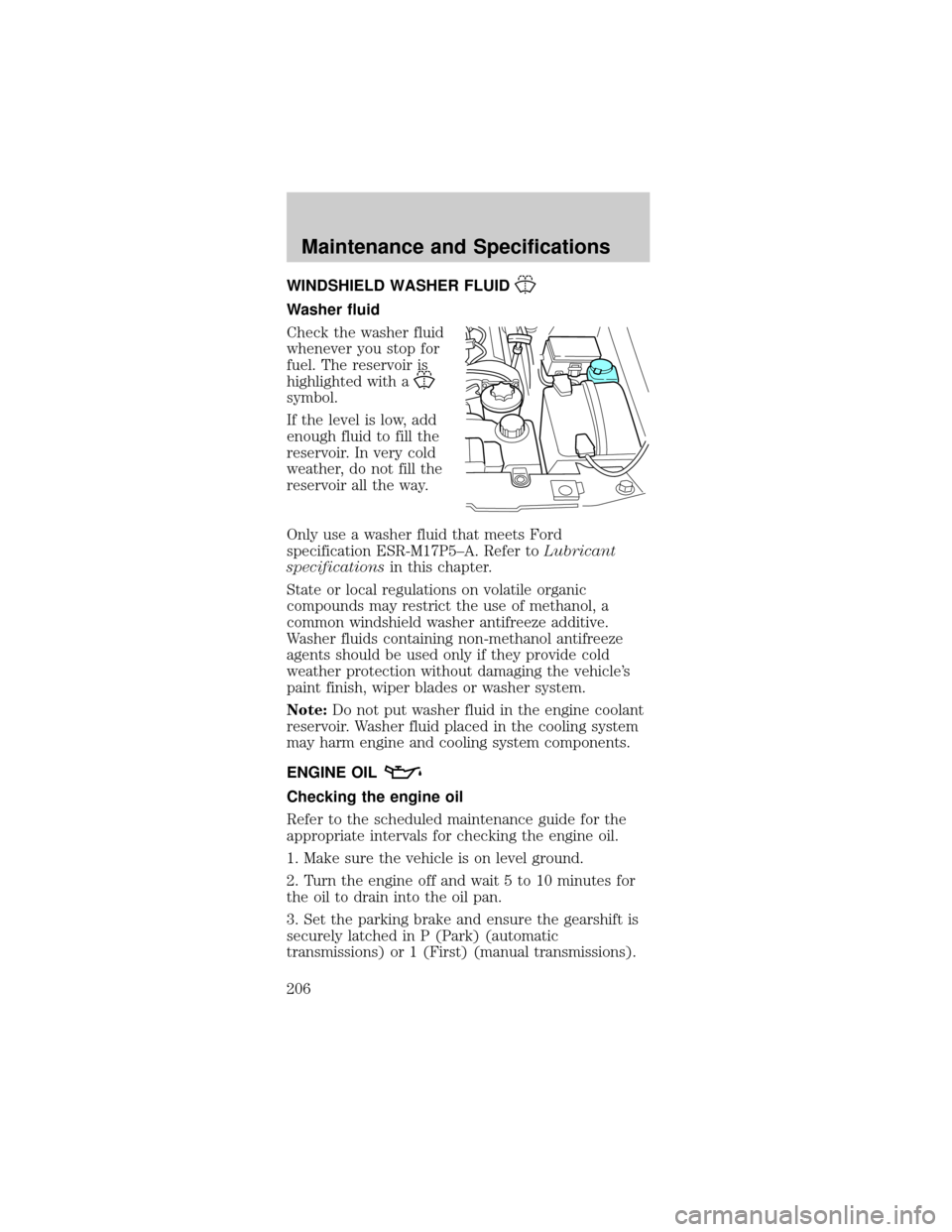
Check the washer fluid
whenever you stop for
fuel. The reservoir is
highlighted with a
symbol.
If the level is low, add
enough fluid to fill the
reservoir. In very cold
weather, do not fill the
reservoir all the way.
Only use a washer fluid that meets Ford
specification ESR-M17P5±A. Refer toLubricant
specificationsin this chapter.
State or local regulations on volatile organic
compounds may restrict the use of methanol, a
common windshield washer antifreeze additive.
Washer fluids containing non-methanol antifreeze
agents should be used only if they provide cold
weather protection without damaging the vehicle's
paint finish, wiper blades or washer system.
Note:Do not put washer fluid in the engine coolant
reservoir. Washer fluid placed in the cooling system
may harm engine and cooling system components.
ENGINE OIL
Checking the engine oil
Refer to the scheduled maintenance guide for the
appropriate intervals for checking the engine oil.
1. Make sure the vehicle is on level ground.
2. Turn the engine off and wait 5 to 10 minutes for
the oil to drain into the oil pan.
3. Set the parking brake and ensure the gearshift is
securely latched in P (Park) (automatic
transmissions) or 1 (First) (manual transmissions).
Maintenance and Specifications
206
Page 209 of 264
4. Install the indicator and ensure it is fully seated.
5. Fully install the engine oil filler cap by turning the
filler cap clockwise 1/4 of a turn until three clicks
are heard or until the cap is fully seated.
To avoid possible oil loss, DO NOT operate the
vehicle with the engine oil level indicator
and/or the engine oil filler cap removed.
Engine oil and filter recommendations
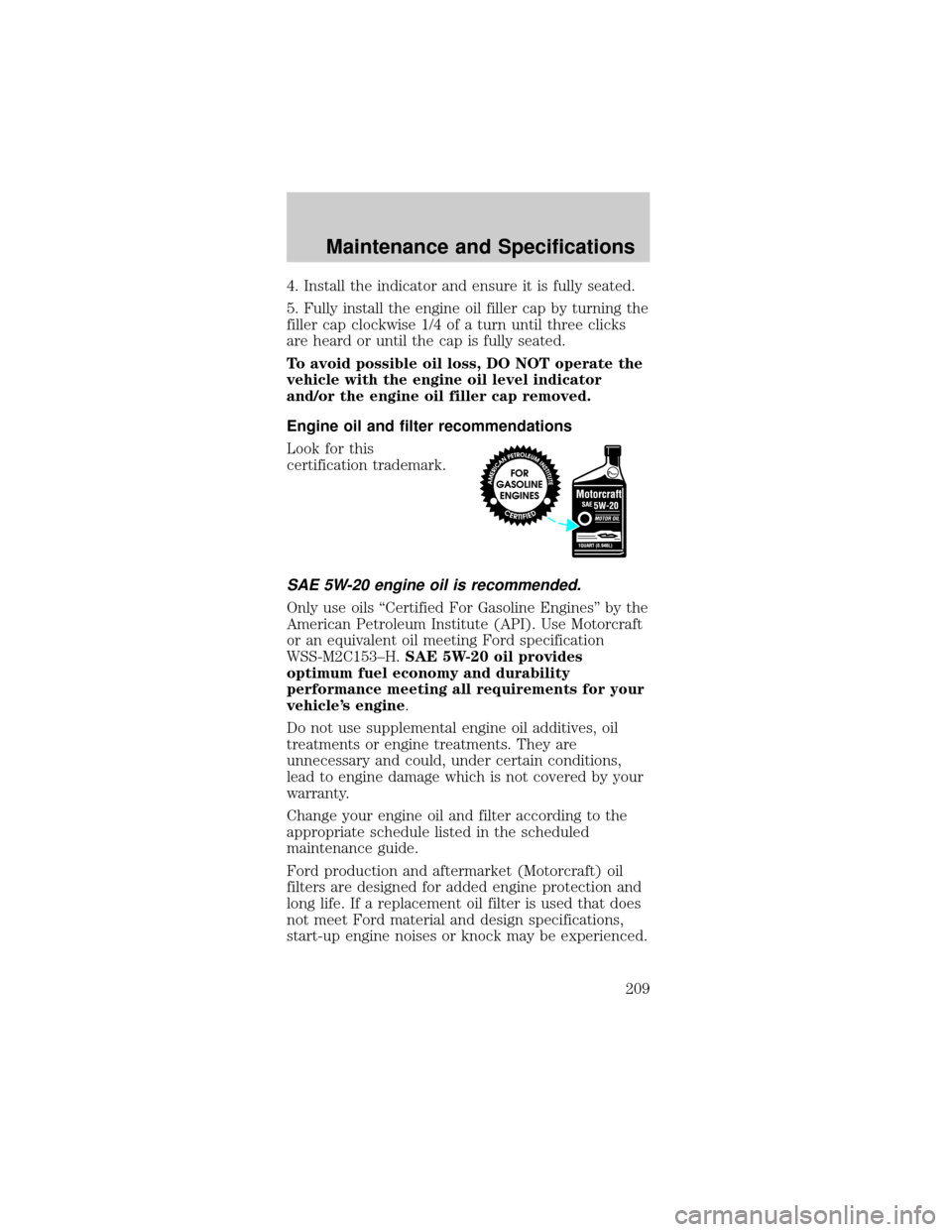
Look for this
certification trademark.
SAE 5W-20 engine oil is recommended.
Only use oils ªCertified For Gasoline Enginesº by the
American Petroleum Institute (API). Use Motorcraft
or an equivalent oil meeting Ford specification
WSS-M2C153±H.SAE 5W-20 oil provides
optimum fuel economy and durability
performance meeting all requirements for your
vehicle's engine.
Do not use supplemental engine oil additives, oil
treatments or engine treatments. They are
unnecessary and could, under certain conditions,
lead to engine damage which is not covered by your
warranty.
Change your engine oil and filter according to the
appropriate schedule listed in the scheduled
maintenance guide.
Ford production and aftermarket (Motorcraft) oil
filters are designed for added engine protection and
long life. If a replacement oil filter is used that does
not meet Ford material and design specifications,
start-up engine noises or knock may be experienced.
Maintenance and Specifications
209