oil temperature FORD MUSTANG 2002 4.G Owners Manual
[x] Cancel search | Manufacturer: FORD, Model Year: 2002, Model line: MUSTANG, Model: FORD MUSTANG 2002 4.GPages: 264, PDF Size: 2.56 MB
Page 9 of 264
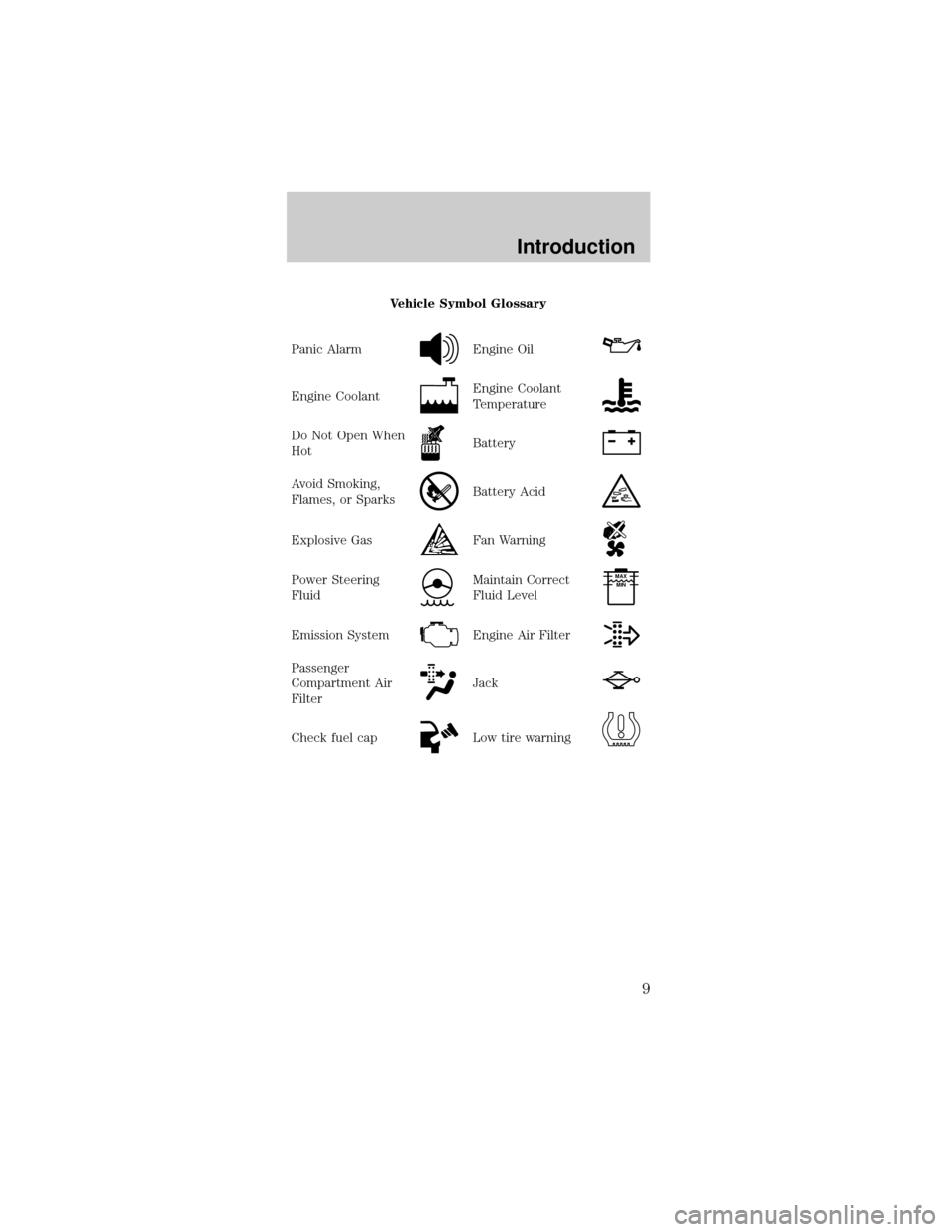
Vehicle Symbol Glossary
Panic Alarm
Engine Oil
Engine CoolantEngine Coolant
Temperature
Do Not Open When
HotBattery
Avoid Smoking,
Flames, or SparksBattery Acid
Explosive GasFan Warning
Power Steering
FluidMaintain Correct
Fluid LevelMAX
MIN
Emission SystemEngine Air Filter
Passenger
Compartment Air
FilterJack
Check fuel capLow tire warning
Introduction
9
Page 17 of 264
Never remove the coolant reservoir cap
while the engine is running or hot. Steam
and scalding liquid from a hot cooling system can
burn you badly.
This gauge indicates the temperature of the engine
coolant, not the coolant level. If the coolant is not at
its proper level the gauge indication will not be
accurate.
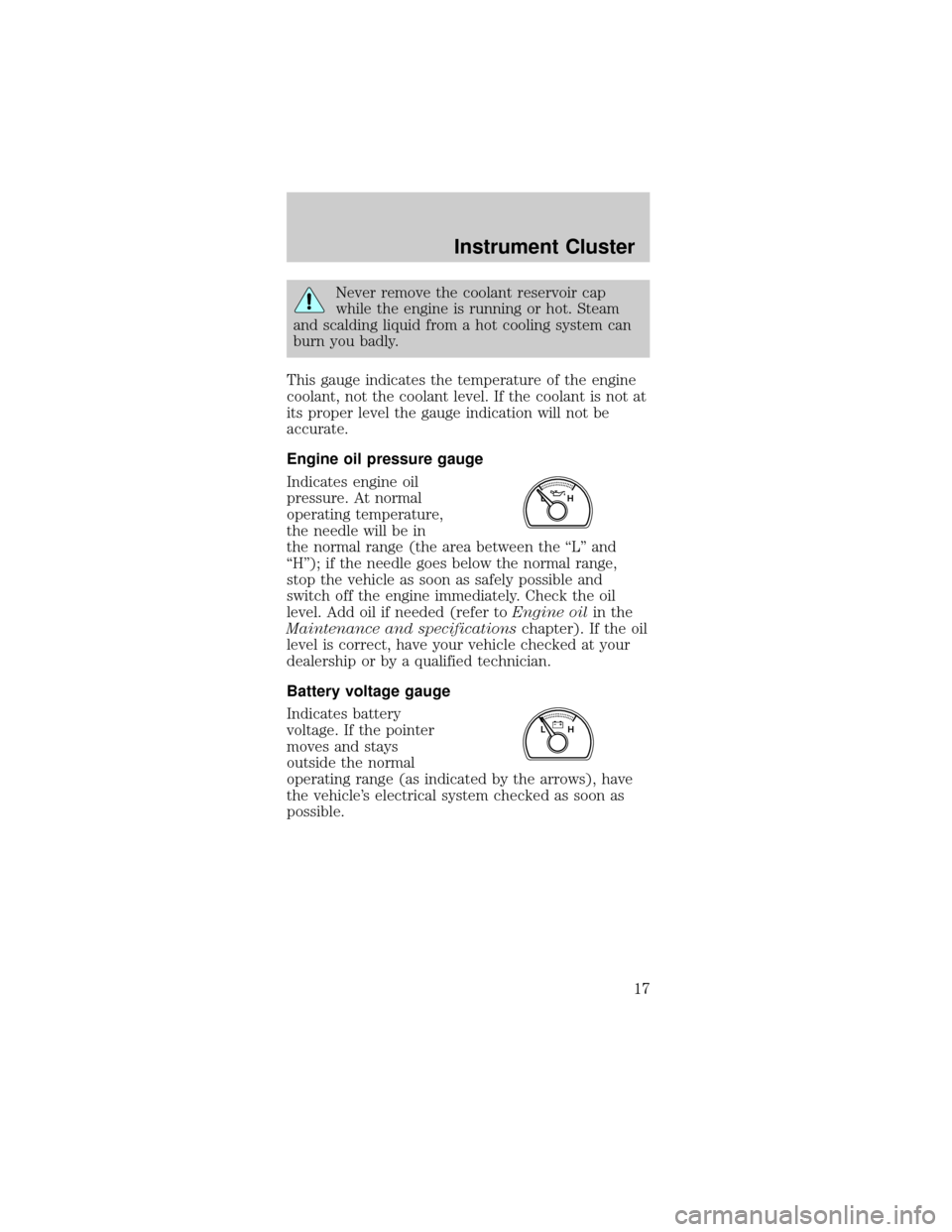
Engine oil pressure gauge
Indicates engine oil
pressure. At normal
operating temperature,
the needle will be in
the normal range (the area between the ªLº and
ªHº); if the needle goes below the normal range,
stop the vehicle as soon as safely possible and
switch off the engine immediately. Check the oil
level. Add oil if needed (refer toEngine oilin the
Maintenance and specificationschapter). If the oil
level is correct, have your vehicle checked at your
dealership or by a qualified technician.
Battery voltage gauge
Indicates battery
voltage. If the pointer
moves and stays
outside the normal
operating range (as indicated by the arrows), have
the vehicle's electrical system checked as soon as
possible.
LH
LH
Instrument Cluster
17
Page 210 of 264
It is recommended you use the appropriate
Motorcraft oil filter (or another brand meeting Ford
specifications) for your engine application.
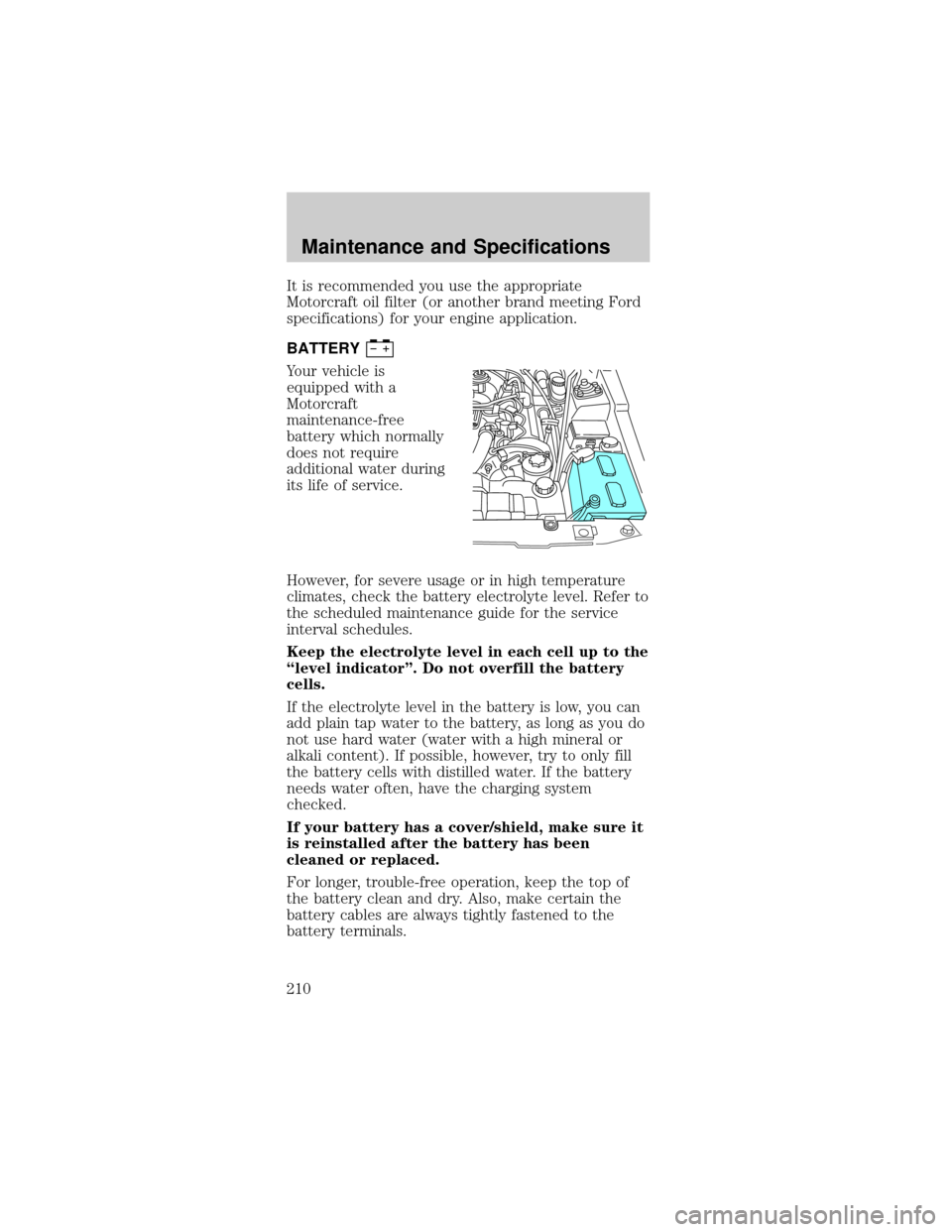
BATTERY
Your vehicle is
equipped with a
Motorcraft
maintenance-free
battery which normally
does not require
additional water during
its life of service.
However, for severe usage or in high temperature
climates, check the battery electrolyte level. Refer to
the scheduled maintenance guide for the service
interval schedules.
Keep the electrolyte level in each cell up to the
ªlevel indicatorº. Do not overfill the battery
cells.
If the electrolyte level in the battery is low, you can
add plain tap water to the battery, as long as you do
not use hard water (water with a high mineral or
alkali content). If possible, however, try to only fill
the battery cells with distilled water. If the battery
needs water often, have the charging system
checked.
If your battery has a cover/shield, make sure it
is reinstalled after the battery has been
cleaned or replaced.
For longer, trouble-free operation, keep the top of
the battery clean and dry. Also, make certain the
battery cables are always tightly fastened to the
battery terminals.
Maintenance and Specifications
210
Page 261 of 264

low fuel warning
light .......................... 13
octane rating.. 225, 251
quality .................... 226
running out of fuel 226
safety information
relating to automotive
fuels ....................... 221
Fuses ................ 165±166
G
Gas cap
(see Fuel cap) ... 13, 224
Gas mileage (see
Fuel economy) ........ 227
Gauges ....................... 16
battery voltage
gauge ....................... 17
engine coolant
temperature gauge... 16
engine oil pressure
gauge ....................... 17
fuel gauge ................ 18
odometer ................. 18
speedometer ........... 18
tachometer .............. 19
trip odometer .......... 19
GAWR (Gross Axle
Weight Rating) ........ 158
definition ............... 158
driving with a
heavy load ............. 158
location .................. 158
GVWR (Gross Vehicle
Weight Rating) ........ 158
calculating ............. 158
definition ............... 158
driving with a
heavy load ............. 158
location .................. 158H
Hazard flashers ....... 163
Head restraints ....... 104
Headlamps ................. 71
aiming ...................... 73
bulb specifications .. 75
daytime running
lights ........................ 71
flash to pass ............ 72
high beam ......... 10, 72
replacing bulbs ....... 76
turning on and off .. 71
warning chime ........ 15
Heating
heating and air
conditioning
system ..................... 67
Hood ........................ 203
I
Ignition ............. 136, 251
removing the key .. 157
Infant seats
(see Safety seats) ... 128
Inspection/maintenance
(I/M) testing ............ 233
Instrument panel
cleaning ................. 197
cluster .............. 10, 198
lighting up panel
and interior ............. 72
J
Jack .......................... 170
positioning ............. 170
storage ................... 170
Jump-starting your
vehicle ...................... 174
Index
261