spark FORD MUSTANG 2002 4.G Owners Manual
[x] Cancel search | Manufacturer: FORD, Model Year: 2002, Model line: MUSTANG, Model: FORD MUSTANG 2002 4.GPages: 264, PDF Size: 2.56 MB
Page 9 of 264
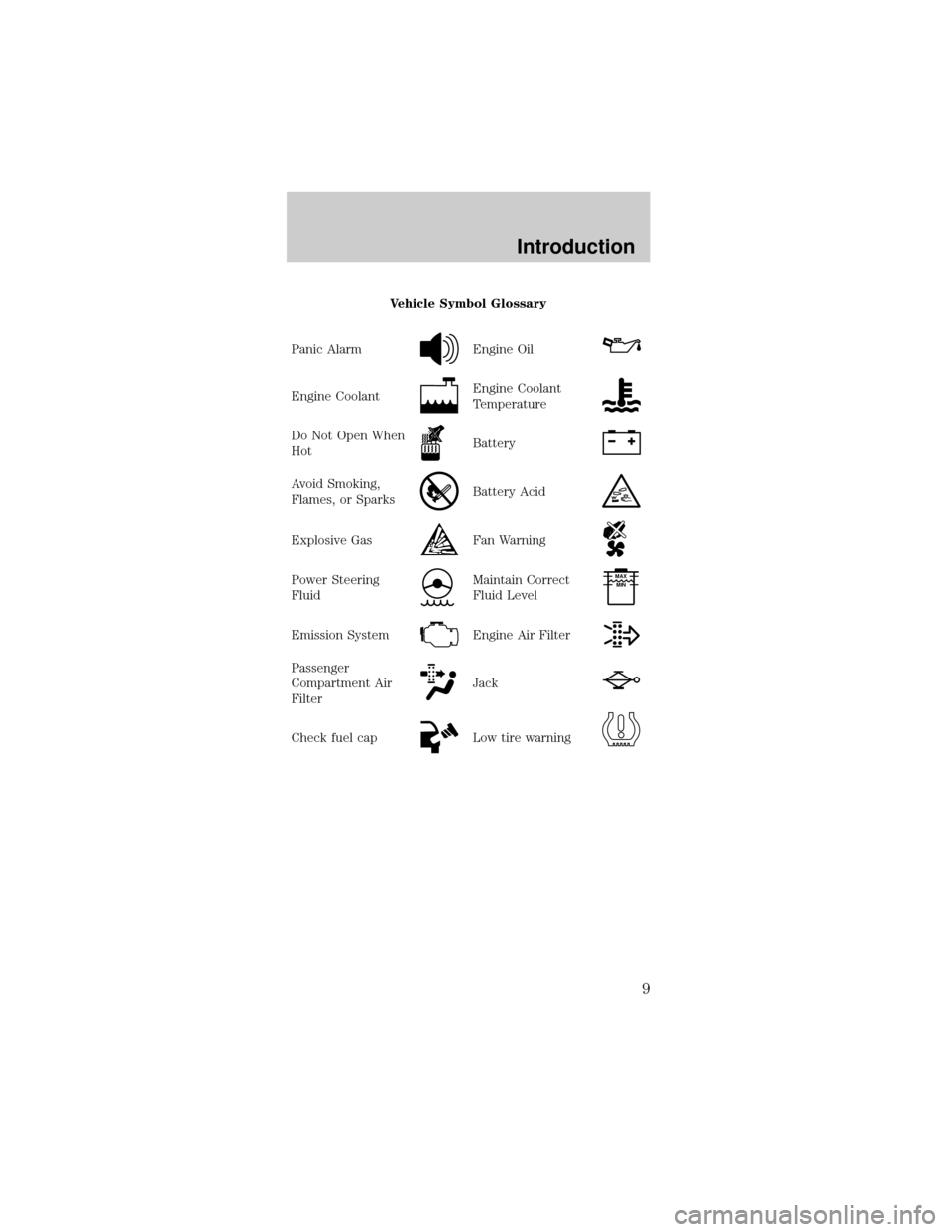
Vehicle Symbol Glossary
Panic Alarm
Engine Oil
Engine CoolantEngine Coolant
Temperature
Do Not Open When
HotBattery
Avoid Smoking,
Flames, or SparksBattery Acid
Explosive GasFan Warning
Power Steering
FluidMaintain Correct
Fluid LevelMAX
MIN
Emission SystemEngine Air Filter
Passenger
Compartment Air
FilterJack
Check fuel capLow tire warning
Introduction
9
Page 146 of 264
reductions. Engine torque reduction is realized via
the fully electronic spark and fuel injection systems.
This process is very sensitive to driving conditions
and very fast acting. The rear wheels ªsearchº for
optimum traction several times a second and
adjustments are made accordingly.
The Traction Controlysystem will allow your
vehicle to make better use of available traction on
slippery surfaces. The system is a driver aid which
makes your vehicle easier to handle primarily on
snow, ice covered and gravel roads.
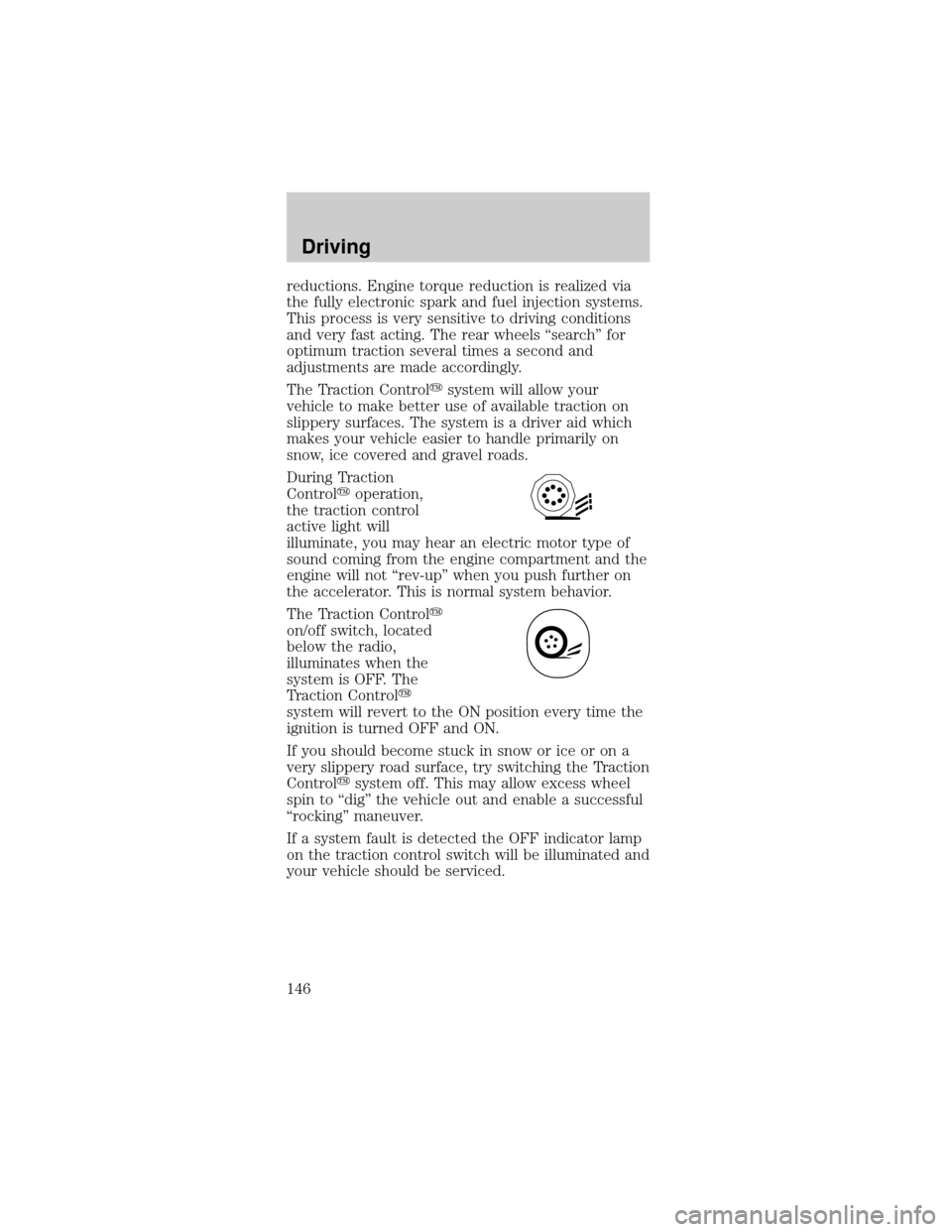
During Traction
Controlyoperation,
the traction control
active light will
illuminate, you may hear an electric motor type of
sound coming from the engine compartment and the
engine will not ªrev-upº when you push further on
the accelerator. This is normal system behavior.
The Traction Controly
on/off switch, located
below the radio,
illuminates when the
system is OFF. The
Traction Controly
system will revert to the ON position every time the
ignition is turned OFF and ON.
If you should become stuck in snow or ice or on a
very slippery road surface, try switching the Traction
Controlysystem off. This may allow excess wheel
spin to ªdigº the vehicle out and enable a successful
ªrockingº maneuver.
If a system fault is detected the OFF indicator lamp
on the traction control switch will be illuminated and
your vehicle should be serviced.
Driving
146
Page 174 of 264
Anti-theft lug nuts (if equipped)
If your vehicle is equipped with this feature, one of
the lug nuts on each wheel must be removed and
replaced with a special key. The key and registration
card are attached to the lug wrench and stored with
the spare tire. If you lose the key, send the
registration card to the manufacturer (not the
dealer) to get a replacement key. If the lug
wrench/lug nut key assembly is lost, see your
nearest Ford or Lincoln Mercury dealer who has
access to the master set of keys.Do not use an
impact wrench with the anti-theft key.
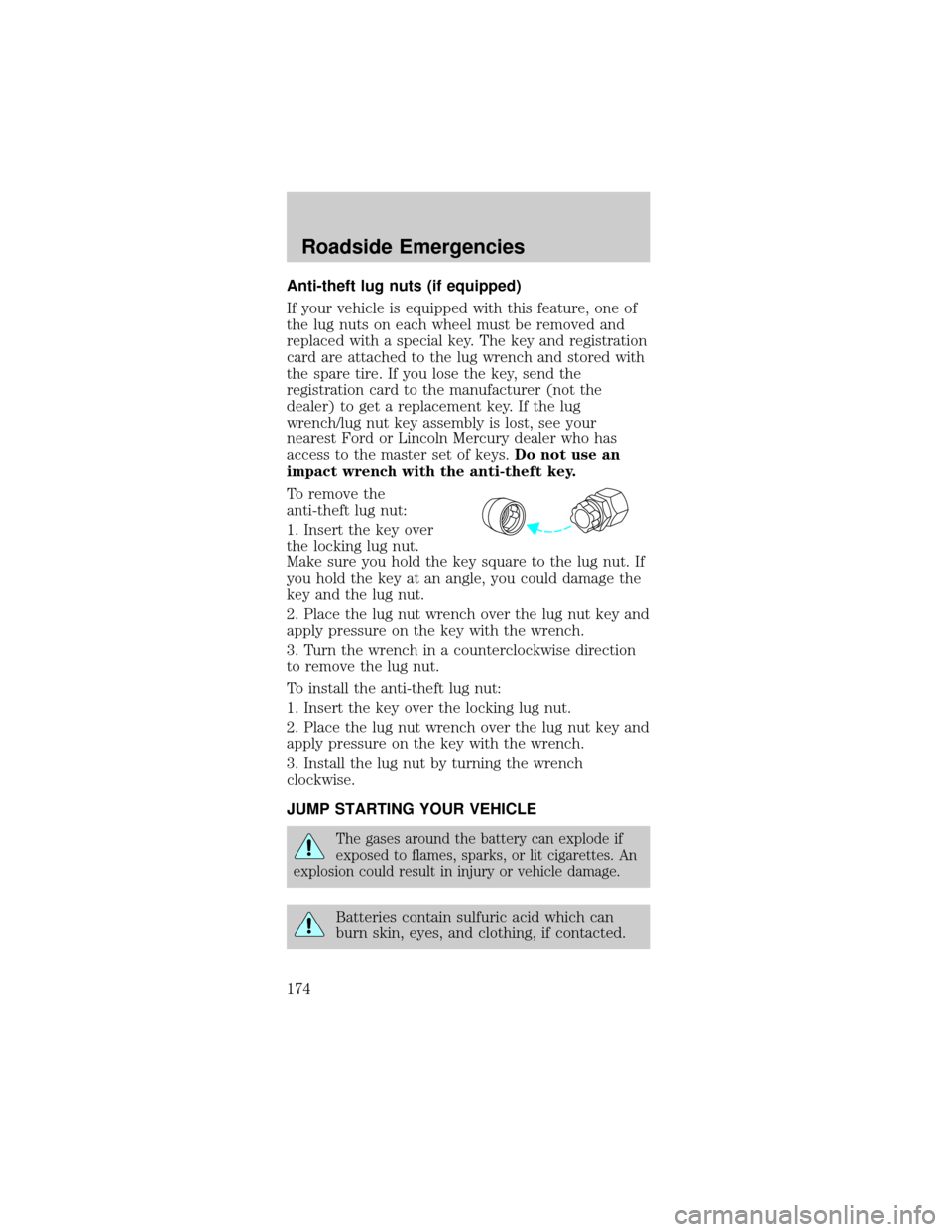
To remove the
anti-theft lug nut:
1. Insert the key over
the locking lug nut.
Make sure you hold the key square to the lug nut. If
you hold the key at an angle, you could damage the
key and the lug nut.
2. Place the lug nut wrench over the lug nut key and
apply pressure on the key with the wrench.
3. Turn the wrench in a counterclockwise direction
to remove the lug nut.
To install the anti-theft lug nut:
1. Insert the key over the locking lug nut.
2. Place the lug nut wrench over the lug nut key and
apply pressure on the key with the wrench.
3. Install the lug nut by turning the wrench
clockwise.
JUMP STARTING YOUR VEHICLE
The gases around the battery can explode if
exposed to flames, sparks, or lit cigarettes. An
explosion could result in injury or vehicle damage.
Batteries contain sulfuric acid which can
burn skin, eyes, and clothing, if contacted.
Roadside Emergencies
174
Page 177 of 264
Do not connect the end of the second cable
to the negative (-) terminal of the battery to
be jumped. A spark may cause an explosion of the
gases that surround the battery.
5. Ensure that the cables are clear of fan blades,
belts, moving parts of both engines, or any fuel
delivery system parts.
Jump starting
1. Start the engine of the booster vehicle and run
the engine at moderately increased speed.
2. Start the engine of the disabled vehicle.
3. Once the disabled vehicle has been started, run
both engines for an additional three minutes before
disconnecting the jumper cables.
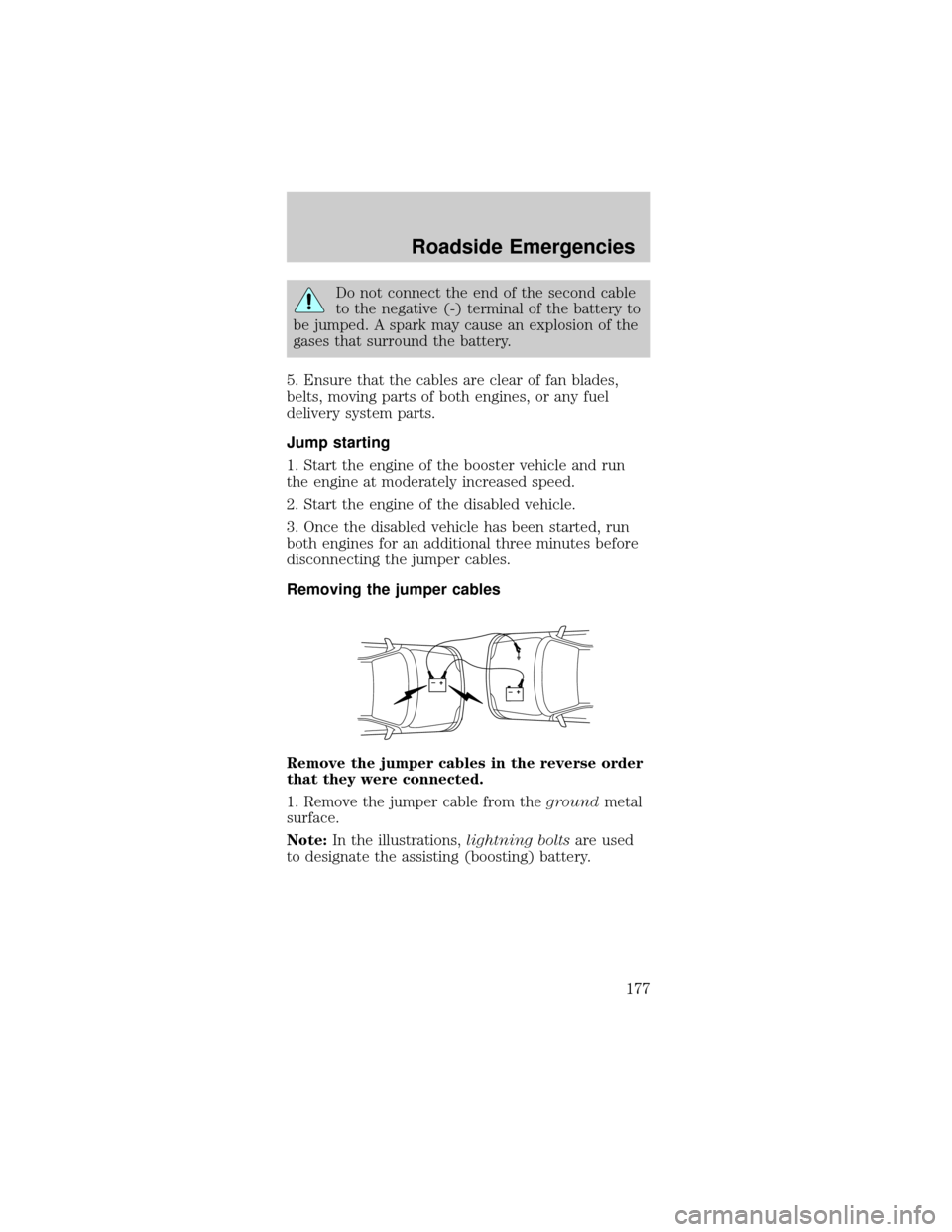
Removing the jumper cables
Remove the jumper cables in the reverse order
that they were connected.
1. Remove the jumper cable from thegroundmetal
surface.
Note:In the illustrations,lightning boltsare used
to designate the assisting (boosting) battery.
+–+–
Roadside Emergencies
177
Page 211 of 264
If you see any corrosion on the battery or terminals,
remove the cables from the terminals and clean with
a wire brush. You can neutralize the acid with a
solution of baking soda and water.
Batteries normally produce explosive gases
which can cause personal injury. Therefore,
do not allow flames, sparks or lighted substances
to come near the battery. When working near the
battery, always shield your face and protect your
eyes. Always provide proper ventilation.
When lifting a plastic-cased battery,
excessive pressure on the end walls could
cause acid to flow through the vent caps, resulting
in personal injury and/or damage to the vehicle or
battery. Lift the battery with a battery carrier or
with your hands on opposite corners.
Keep batteries out of reach of children.
Batteries contain sulfuric acid. Avoid contact
with skin, eyes or clothing. Shield your eyes when
working near the battery to protect against
possible splashing of acid solution. In case of acid
contact with skin or eyes, flush immediately with
water for a minimum of 15 minutes and get
prompt medical attention. If acid is swallowed, call
a physician immediately.
Battery posts, terminals and related
accessories contain lead and lead
compounds.Wash hands after handling.
Because your vehicle's engine is electronically
controlled by a computer, some control conditions
are maintained by power from the battery. When the
battery is disconnected or a new battery is installed,
the engine must relearn its idle and fuel trim
strategy for optimum driveability and performance.
Maintenance and Specifications
211
Page 223 of 264
²Avoid inhaling fuel vapors. Inhaling too much fuel
vapor of any kind can lead to eye and respiratory
tract irritation. In severe cases, excessive or
prolonged breathing of fuel vapor can cause
serious illness and permanent injury.
²Avoid getting fuel liquid in your eyes. If fuel is
splashed in the eyes, remove contact lenses (if
worn), flush with water for 15 minutes and seek
medical attention. Failure to seek proper medical
attention could lead to permanent injury.
²Fuels can also be harmful if absorbed through the
skin. If fuel is splashed on the skin and/or
clothing, promptly remove contaminated clothing
and wash skin thoroughly with soap and water.
Repeated or prolonged skin contact with fuel
liquid or vapor causes skin irritation.
²Be particularly careful if you are taking
ªAntabuseº or other forms of disulfiram for the
treatment of alcoholism. Breathing gasoline
vapors, or skin contact could cause an adverse
reaction. In sensitive individuals, serious personal
injury or sickness may result. If fuel is splashed
on the skin, promptly wash skin thoroughly with
soap and water. Consult a physician immediately
if you experience an adverse reaction.
When refueling always shut the engine off
and never allow sparks or open flames near
the filler neck. Never smoke while refueling. Fuel
vapor is extremely hazardous under certain
conditions. Care should be taken to avoid inhaling
excess fumes.
The flow of fuel through a fuel pump nozzle
can produce static electricity, which can
cause a fire if fuel is pumped into an ungrounded
fuel container.
Maintenance and Specifications
223
Page 246 of 264
²Drive cautiously. If you hear the chains rub or
bang against your vehicle, stop and re-tighten the
chains. If this does not work, remove the chains
to prevent damage to your vehicle.
²If possible, avoid fully loading your vehicle.
²Remove the tire chains when they are no longer
needed. Do not use tire chains on dry roads.
²The suspension insulation and bumpers will help
prevent vehicle damage. Do not remove these
components from your vehicle when using snow
tires and chains.
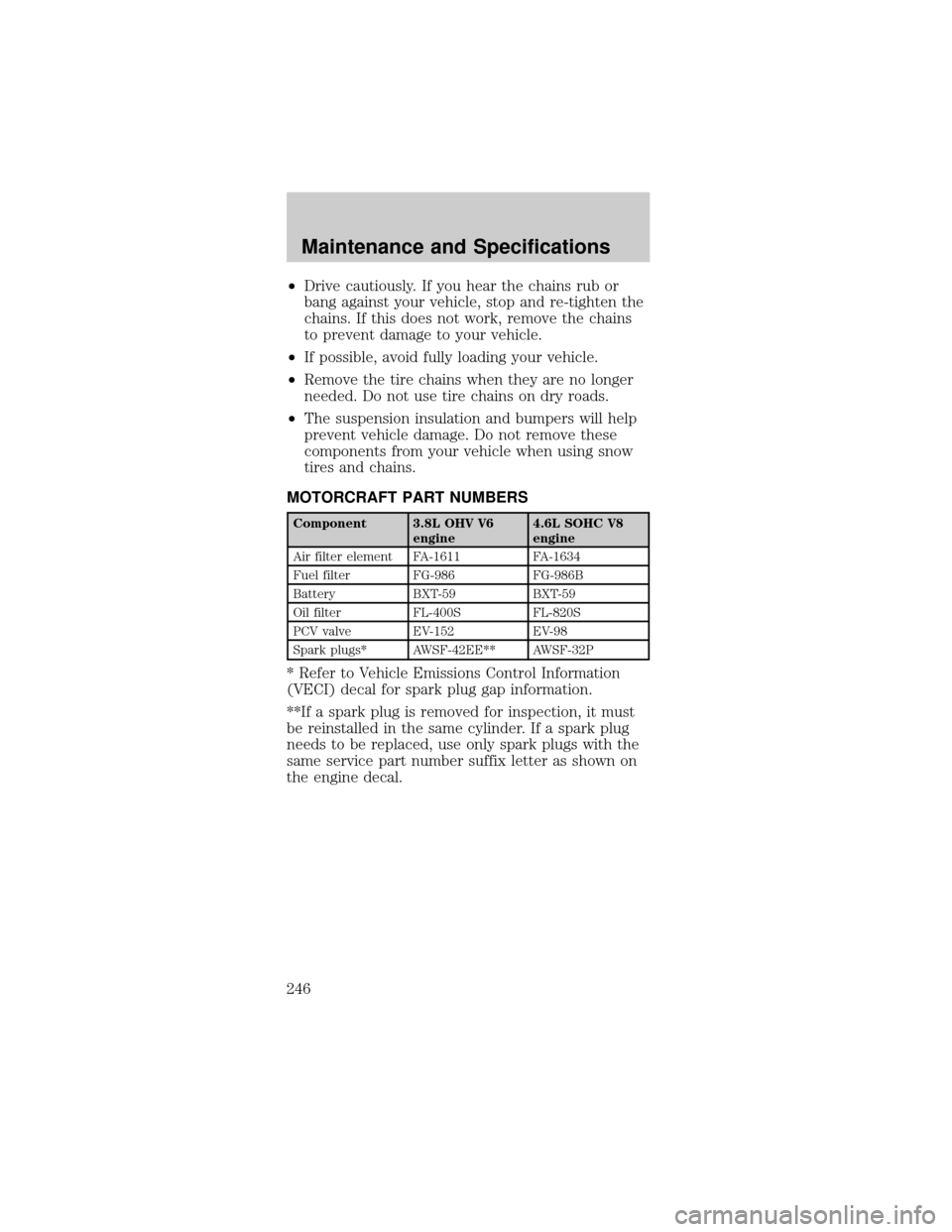
MOTORCRAFT PART NUMBERS
Component 3.8L OHV V6
engine4.6L SOHC V8
engine
Air filter element FA-1611 FA-1634
Fuel filter FG-986 FG-986B
Battery BXT-59 BXT-59
Oil filter FL-400S FL-820S
PCV valve EV-152 EV-98
Spark plugs* AWSF-42EE** AWSF-32P
* Refer to Vehicle Emissions Control Information
(VECI) decal for spark plug gap information.
**If a spark plug is removed for inspection, it must
be reinstalled in the same cylinder. If a spark plug
needs to be replaced, use only spark plugs with the
same service part number suffix letter as shown on
the engine decal.
Maintenance and Specifications
246
Page 251 of 264
1Add 118 ml (4 oz.) of Additive Friction Modifier
C8AZ-19B546-A or equivalent meeting Ford
specification EST-M2C118-A for complete refill of
Traction-Lok axles.
Ford design rear axles contain a synthetic lubricant
that does not require changing unless the axle has
been submerged in water.
2Ensure the correct automatic transmission fluid is
used. Transmission fluid requirements are indicated
on the dipstick or on the dipstick handle. MERCONt
and MERCONtV are not interchangeable. DO NOT
mix MERCONtand MERCONtV. Refer to your
scheduled maintenance guide to determine the
correct service interval.
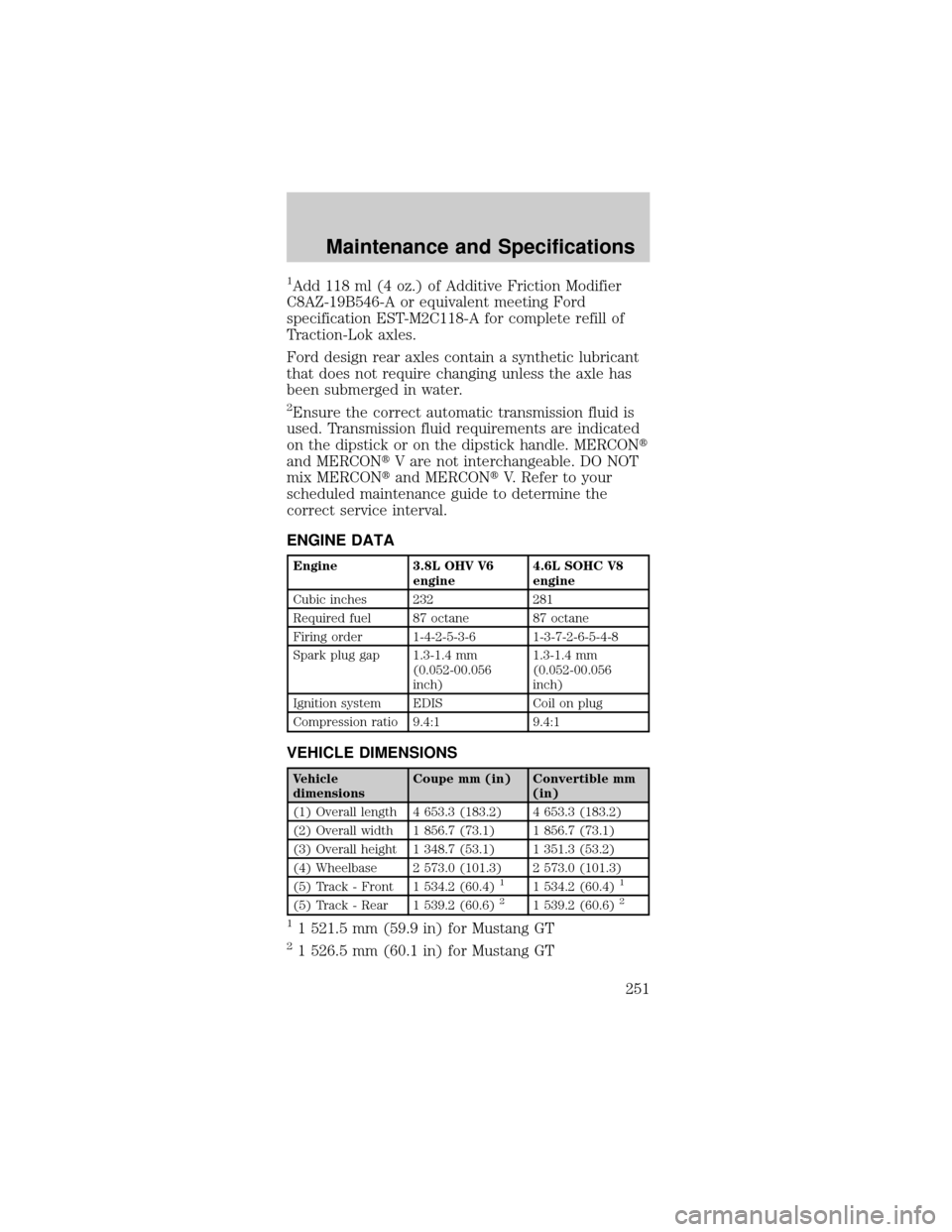
ENGINE DATA
Engine 3.8L OHV V6
engine4.6L SOHC V8
engine
Cubic inches 232 281
Required fuel 87 octane 87 octane
Firing order 1-4-2-5-3-6 1-3-7-2-6-5-4-8
Spark plug gap 1.3-1.4 mm
(0.052-00.056
inch)1.3-1.4 mm
(0.052-00.056
inch)
Ignition system EDIS Coil on plug
Compression ratio 9.4:1 9.4:1
VEHICLE DIMENSIONS
Vehicle
dimensionsCoupe mm (in) Convertible mm
(in)
(1) Overall length 4 653.3 (183.2) 4 653.3 (183.2)
(2) Overall width 1 856.7 (73.1) 1 856.7 (73.1)
(3) Overall height 1 348.7 (53.1) 1 351.3 (53.2)
(4) Wheelbase 2 573.0 (101.3) 2 573.0 (101.3)
(5) Track - Front 1 534.2 (60.4)
11 534.2 (60.4)1
(5) Track - Rear 1 539.2 (60.6)21 539.2 (60.6)2
11 521.5 mm (59.9 in) for Mustang GT
21 526.5 mm (60.1 in) for Mustang GT
Maintenance and Specifications
251
Page 263 of 264

P
Panic alarm feature,
remote entry system.. 97
Parking brake .......... 142
Parts (see
Motorcraft parts) .... 246
Power distribution box
(see Fuses) ............. 168
Power door locks ...... 94
Power mirrors ........... 84
Power steering ........ 147
fluid, checking
and adding ............ 234
fluid, refill
capacity ................. 247
fluid,
specifications. 249, 251
Power Windows ......... 83
R
Radio .............. 20, 45±46
Radio reception ... 65±66
Rear window
defroster .................... 70
Relays ...................... 165
Remote entry
system .................. 96±97
illuminated entry .... 99
locking/unlocking
doors .................. 94, 97
opening the trunk ... 98
panic alarm ............. 97
replacement/additional
transmitters ............. 99
replacing the
batteries .................. 98S
Safety belts
(see Safety
restraints) .. 15, 108±113
Safety defects,
reporting .................. 191
Safety
restraints ......... 108±113
belt minder ........... 114
cleaning the
safety belts .... 119, 199
extension
assembly ................ 118
for adults ....... 109±113
for children ... 126±127
warning light and
chime. 11, 15, 113±114
Safety seats for
children .................... 128
Seat belts (see
Safety restraints) .... 108
Seats ........................ 104
child safety seats .. 128
SecuriLock
passive anti-theft
system .............. 100±102
Servicing your
vehicle ...................... 201
Spare tire (see
Changing the Tire) . 170
Spark plugs,
specifications ... 246, 251
Specification chart,
lubricants ......... 249, 251
Speed control ............ 85
Speedometer ............. 18
Index
263