Front FORD POLICE INTERCEPTOR UTILITY 2013 1.G Manual PDF
[x] Cancel search | Manufacturer: FORD, Model Year: 2013, Model line: POLICE INTERCEPTOR UTILITY, Model: FORD POLICE INTERCEPTOR UTILITY 2013 1.GPages: 375, PDF Size: 5.47 MB
Page 226 of 375
FUEL FILTER
Your vehicle is equipped with a lifetime fuel filter that is integrated with
the fuel tank. Regular maintenance or replacement is not needed.
WASHER FLUID CHECK
WARNING:If you operate your vehicle in temperatures below
40°F (5°C), use washer fluid with antifreeze protection. Failure
to use washer fluid with antifreeze protection in cold weather could
result in impaired windshield vision and increase the risk of injury or
accident.
Add fluid to fill the reservoir if the level is low. Only use a washer fluid
that meets Ford specifications. See the technical specifications chart in
theCapacities and Specificationschapter.
Note:The front and rear washer systems are supplied from the same
reservoir.
State or local regulations on volatile organic compounds may restrict the
use of methanol, a common windshield washer antifreeze additive.
Washer fluids containing non-methanol antifreeze agents should be used
only if they provide cold weather protection without damaging the
vehicle’s paint finish, wiper blades or washer system.
CHANGING THE VEHICLE BATTERY
WARNING:Batteries normally produce explosive gases which
can cause personal injury. Therefore, do not allow flames, sparks
or lighted substances to come near the battery. When working near the
battery, always shield your face and protect your eyes. Always provide
proper ventilation.
WARNING:When lifting a plastic-cased battery, excessive
pressure on the end walls could cause acid to flow through the
vent caps, resulting in personal injury and/or damage to the vehicle or
battery. Lift the battery with a battery carrier or with your hands on
opposite corners.
226Maintenance
2013 Police(pol)
Owners Guide gf, 2nd Printing
USA(fus)
Page 231 of 375
ADJUSTING THE HEADLAMPS
The headlamps on your vehicle are properly aimed at the assembly plant.
If your vehicle has been in an accident, the alignment of your headlamps
should be checked by your authorized dealer.
Vertical Aim Adjustment
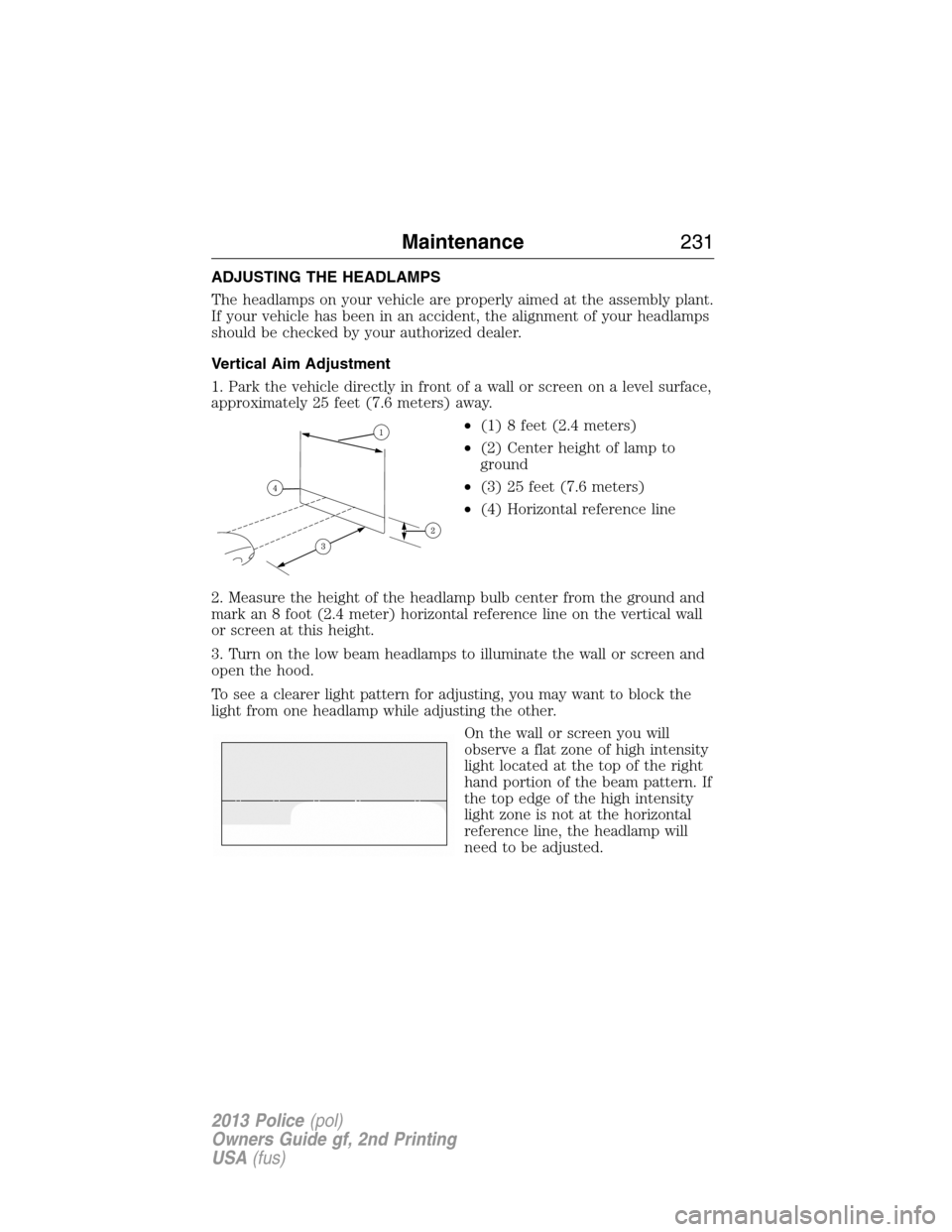
1. Park the vehicle directly in front of a wall or screen on a level surface,
approximately 25 feet (7.6 meters) away.
•(1) 8 feet (2.4 meters)
•(2) Center height of lamp to
ground
•(3) 25 feet (7.6 meters)
•(4) Horizontal reference line
2. Measure the height of the headlamp bulb center from the ground and
mark an 8 foot (2.4 meter) horizontal reference line on the vertical wall
or screen at this height.
3. Turn on the low beam headlamps to illuminate the wall or screen and
open the hood.
To see a clearer light pattern for adjusting, you may want to block the
light from one headlamp while adjusting the other.
On the wall or screen you will
observe a flat zone of high intensity
light located at the top of the right
hand portion of the beam pattern. If
the top edge of the high intensity
light zone is not at the horizontal
reference line, the headlamp will
need to be adjusted.
Maintenance231
2013 Police(pol)
Owners Guide gf, 2nd Printing
USA(fus)
Page 234 of 375
Replacing headlamp bulbs
WARNING:Handle a halogen headlamp bulb carefully and keep
out of children’s reach. Grasp the bulb only by its plastic base
and do not touch the glass. The oil from your hand could cause the
bulb to break the next time the headlamps are operated.
Note:If the bulb is accidentally touched, it should be cleaned with
rubbing alcohol before being used.
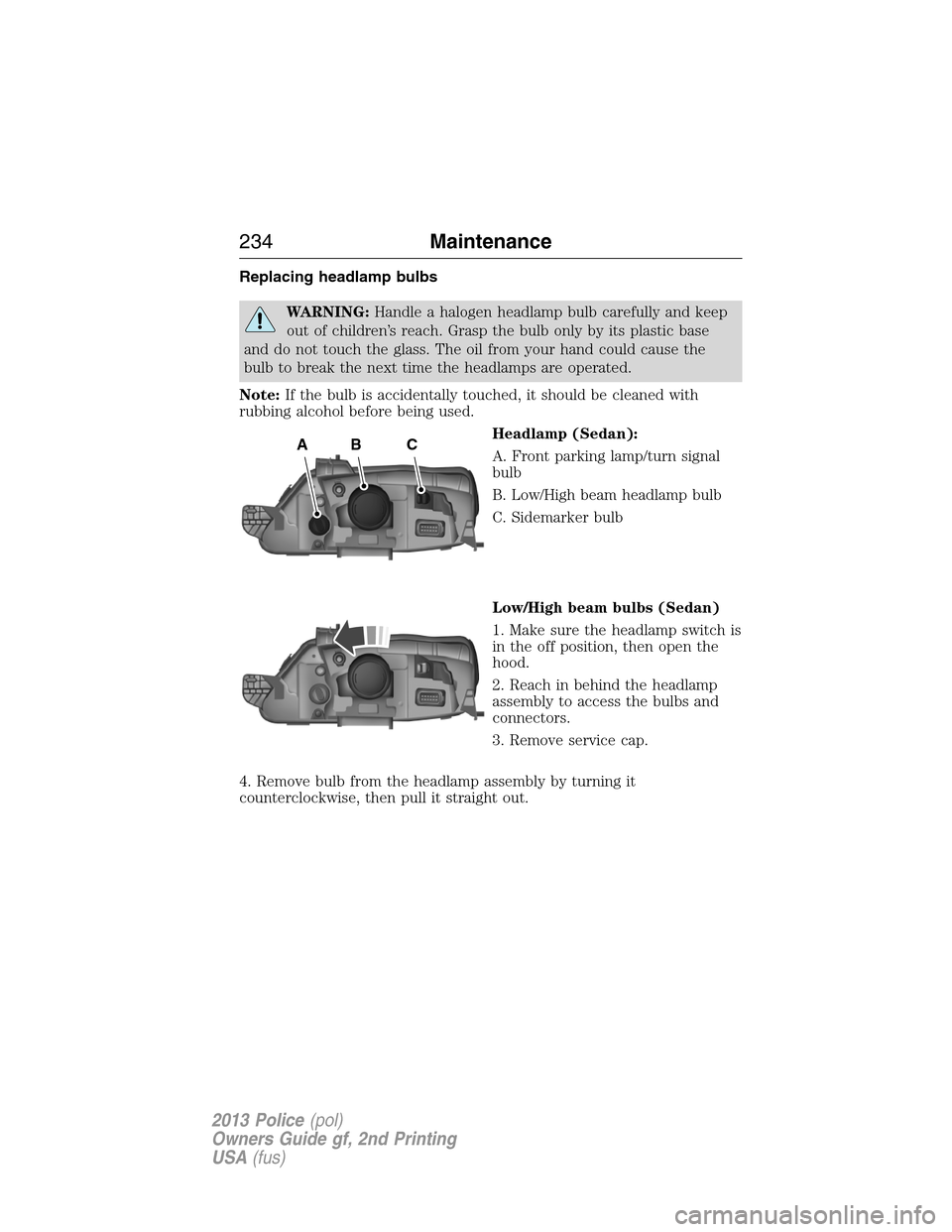
Headlamp (Sedan):
A. Front parking lamp/turn signal
bulb
B. Low/High beam headlamp bulb
C. Sidemarker bulb
Low/High beam bulbs (Sedan)
1. Make sure the headlamp switch is
in the off position, then open the
hood.
2. Reach in behind the headlamp
assembly to access the bulbs and
connectors.
3. Remove service cap.
4. Remove bulb from the headlamp assembly by turning it
counterclockwise, then pull it straight out.
ABC
234Maintenance
2013 Police(pol)
Owners Guide gf, 2nd Printing
USA(fus)
Page 235 of 375
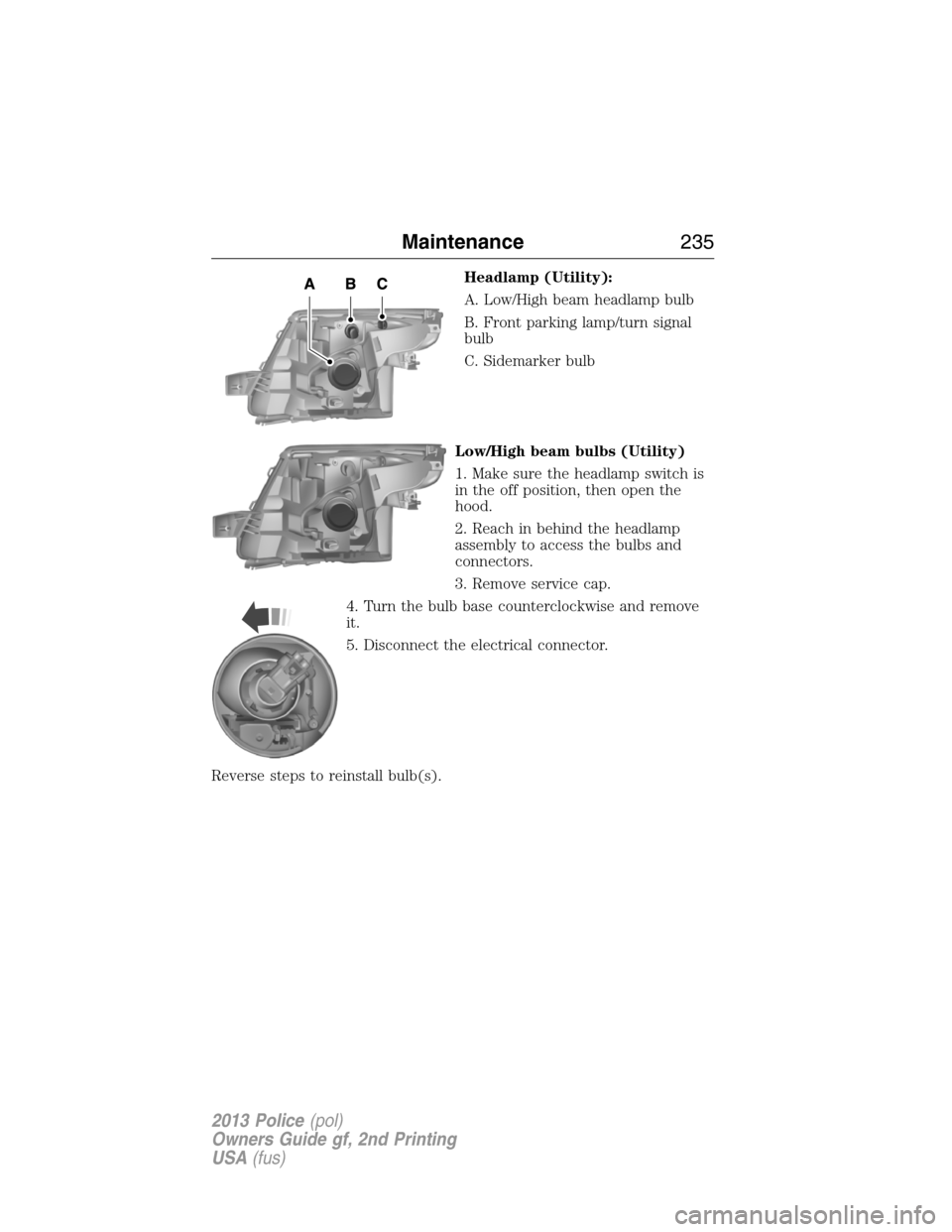
Headlamp (Utility):
A. Low/High beam headlamp bulb
B. Front parking lamp/turn signal
bulb
C. Sidemarker bulb
Low/High beam bulbs (Utility)
1. Make sure the headlamp switch is
in the off position, then open the
hood.
2. Reach in behind the headlamp
assembly to access the bulbs and
connectors.
3. Remove service cap.
4. Turn the bulb base counterclockwise and remove
it.
5. Disconnect the electrical connector.
Reverse steps to reinstall bulb(s).
Maintenance235
2013 Police(pol)
Owners Guide gf, 2nd Printing
USA(fus)
Page 236 of 375
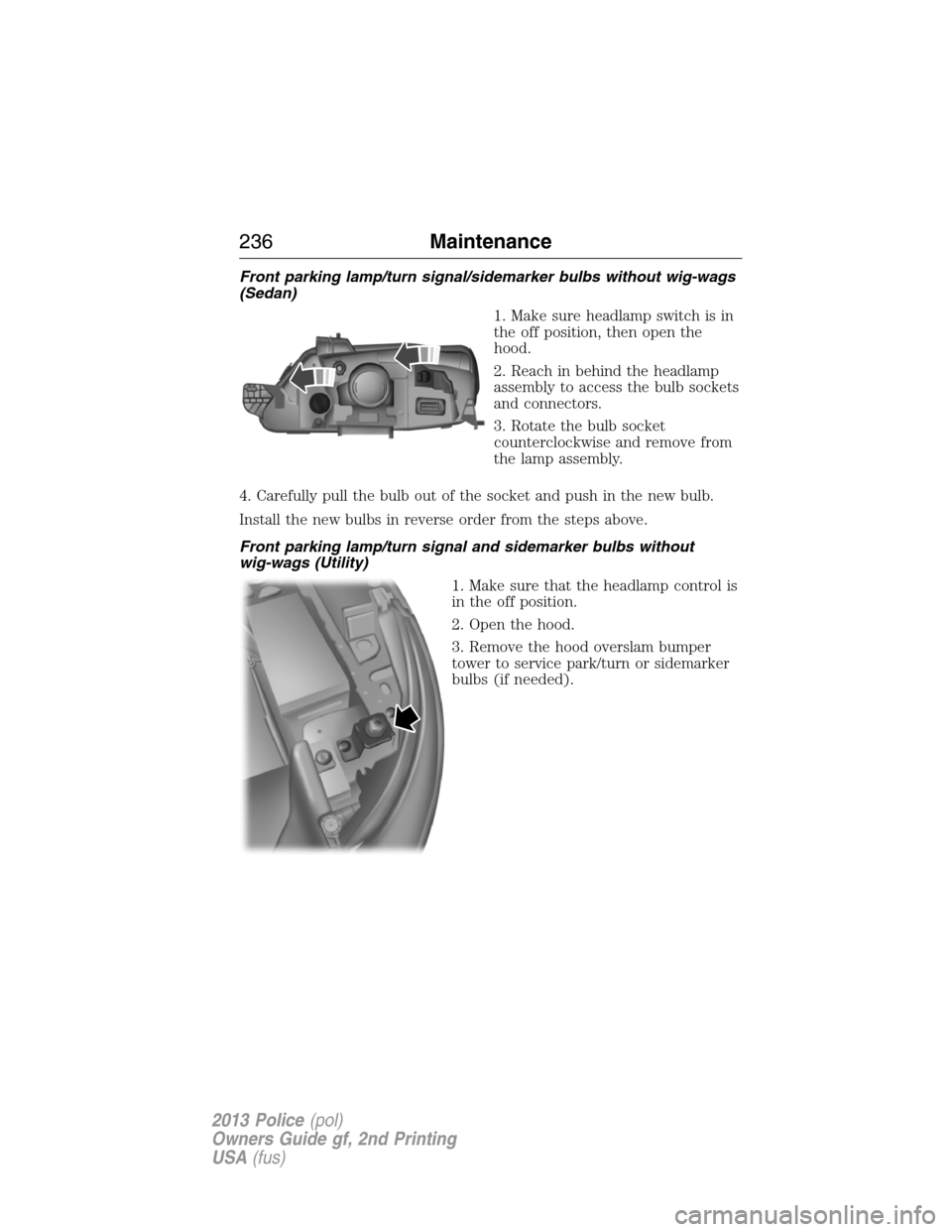
Front parking lamp/turn signal/sidemarker bulbs without wig-wags
(Sedan)
1. Make sure headlamp switch is in
the off position, then open the
hood.
2. Reach in behind the headlamp
assembly to access the bulb sockets
and connectors.
3. Rotate the bulb socket
counterclockwise and remove from
the lamp assembly.
4. Carefully pull the bulb out of the socket and push in the new bulb.
Install the new bulbs in reverse order from the steps above.
Front parking lamp/turn signal and sidemarker bulbs without
wig-wags (Utility)
1. Make sure that the headlamp control is
in the off position.
2. Open the hood.
3. Remove the hood overslam bumper
tower to service park/turn or sidemarker
bulbs (if needed).
236Maintenance
2013 Police(pol)
Owners Guide gf, 2nd Printing
USA(fus)
Page 237 of 375
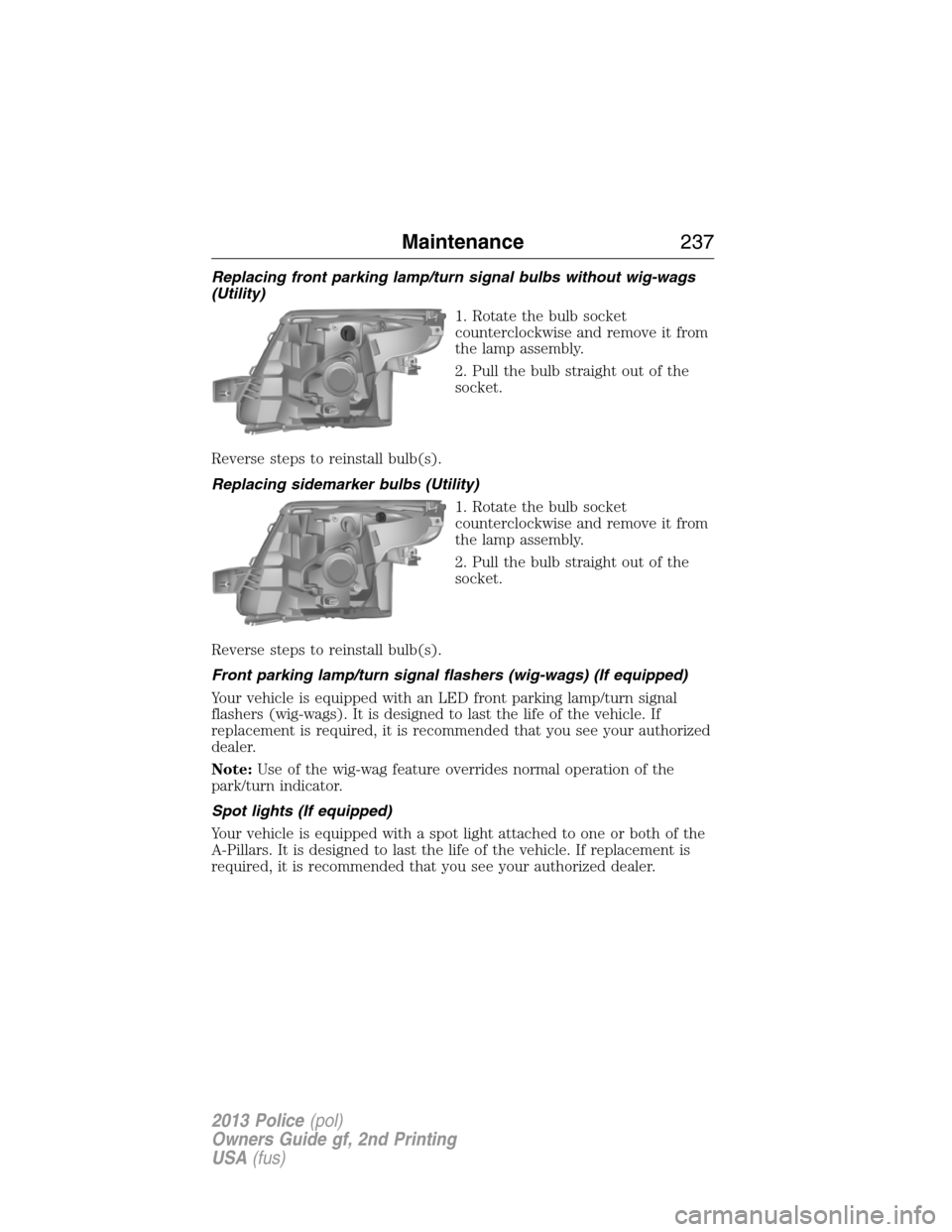
Replacing front parking lamp/turn signal bulbs without wig-wags
(Utility)
1. Rotate the bulb socket
counterclockwise and remove it from
the lamp assembly.
2. Pull the bulb straight out of the
socket.
Reverse steps to reinstall bulb(s).
Replacing sidemarker bulbs (Utility)
1. Rotate the bulb socket
counterclockwise and remove it from
the lamp assembly.
2. Pull the bulb straight out of the
socket.
Reverse steps to reinstall bulb(s).
Front parking lamp/turn signal flashers (wig-wags) (If equipped)
Your vehicle is equipped with an LED front parking lamp/turn signal
flashers (wig-wags). It is designed to last the life of the vehicle. If
replacement is required, it is recommended that you see your authorized
dealer.
Note:Use of the wig-wag feature overrides normal operation of the
park/turn indicator.
Spot lights (If equipped)
Your vehicle is equipped with a spot light attached to one or both of the
A-Pillars. It is designed to last the life of the vehicle. If replacement is
required, it is recommended that you see your authorized dealer.
Maintenance237
2013 Police(pol)
Owners Guide gf, 2nd Printing
USA(fus)
Page 242 of 375
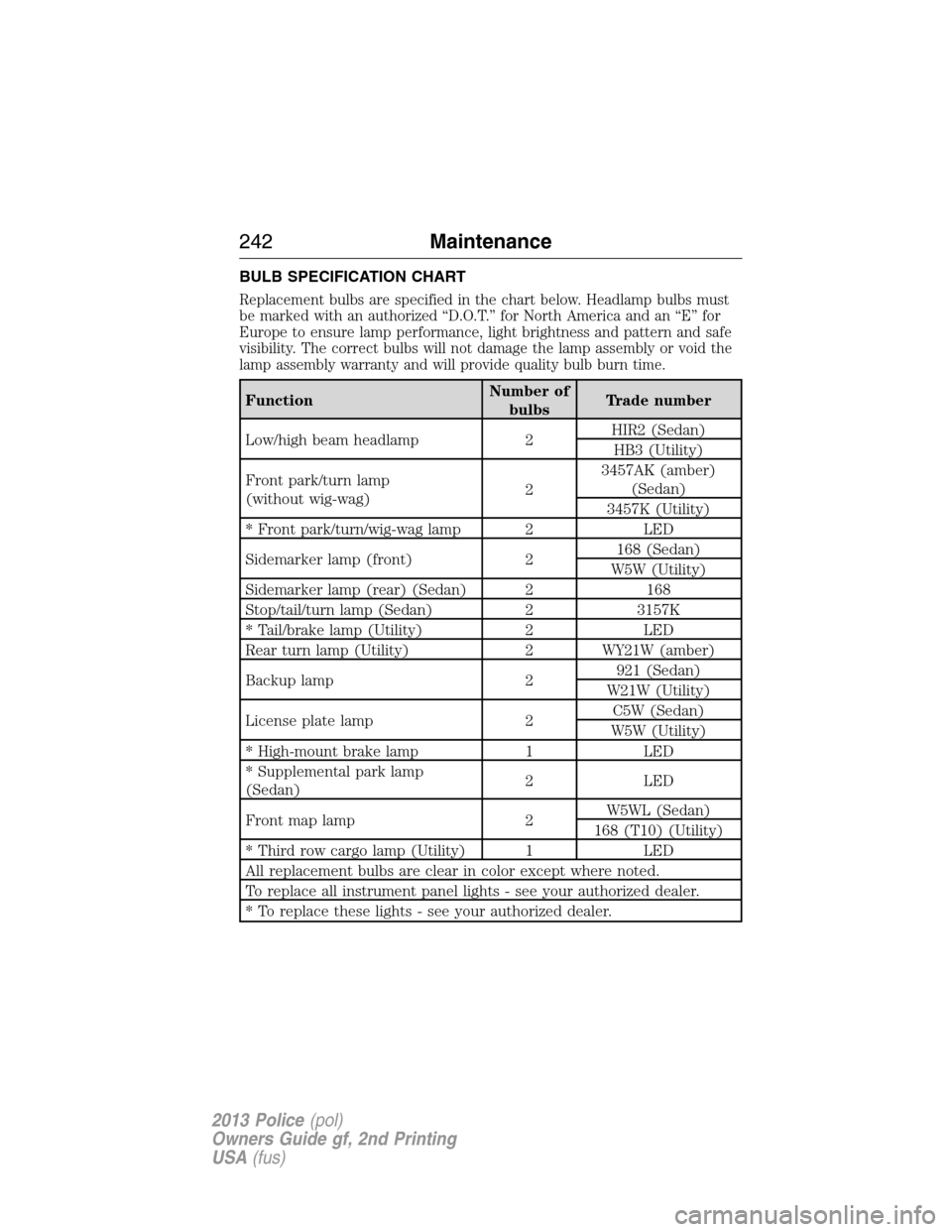
BULB SPECIFICATION CHART
Replacement bulbs are specified in the chart below. Headlamp bulbs must
be marked with an authorized “D.O.T.” for North America and an “E” for
Europe to ensure lamp performance, light brightness and pattern and safe
visibility. The correct bulbs will not damage the lamp assembly or void the
lamp assembly warranty and will provide quality bulb burn time.
FunctionNumber of
bulbsTrade number
Low/high beam headlamp 2HIR2 (Sedan)
HB3 (Utility)
Front park/turn lamp
(without wig-wag)23457AK (amber)
(Sedan)
3457K (Utility)
* Front park/turn/wig-wag lamp 2 LED
Sidemarker lamp (front) 2168 (Sedan)
W5W (Utility)
Sidemarker lamp (rear) (Sedan) 2 168
Stop/tail/turn lamp (Sedan) 2 3157K
* Tail/brake lamp (Utility) 2 LED
Rear turn lamp (Utility) 2 WY21W (amber)
Backup lamp 2921 (Sedan)
W21W (Utility)
License plate lamp 2C5W (Sedan)
W5W (Utility)
* High-mount brake lamp 1 LED
* Supplemental park lamp
(Sedan)2 LED
Front map lamp 2W5WL (Sedan)
168 (T10) (Utility)
* Third row cargo lamp (Utility) 1 LED
All replacement bulbs are clear in color except where noted.
To replace all instrument panel lights - see your authorized dealer.
* To replace these lights - see your authorized dealer.
242Maintenance
2013 Police(pol)
Owners Guide gf, 2nd Printing
USA(fus)
Page 249 of 375
VEHICLE STORAGE
If you plan on storing your vehicle for an extended period of time
(30 days or more), read the following maintenance recommendations to
make sure your vehicle stays in good operating condition.
All motor vehicles and their components were engineered and tested for
reliable, regular driving. Long term storage under various conditions may
lead to component degradation or failure unless specific precautions are
taken to preserve the components.
General
•Store all vehicles in a dry, ventilated place.
•Protect from sunlight, if possible.
•If vehicles are stored outside, they require regular maintenance to
protect against rust and damage.
Body
•Wash vehicle thoroughly to remove dirt, grease, oil, tar or mud from
exterior surfaces, rear-wheel housing and underside of front fenders.
•Periodically wash vehicles stored in exposed locations.
•Touch-up raw or primed metal to prevent rust.
•Cover chrome and stainless steel parts with a thick coat of auto wax
to prevent discoloration. Re-wax as necessary when the vehicle is
washed.
•Lubricate all hood, door and trunk lid hinges, and latches with a light
grade oil.
•Cover interior trim to prevent fading.
•Keep all rubber parts free from oil and solvents.
Engine
•The engine oil and filter should be changed prior to storage, as used
engine oil contain contaminates that may cause engine damage.
•Start the engine every 15 days. Run at fast idle until it reaches normal
operating temperature.
•With your foot on the brake, shift through all the gears while the
engine is running.
Vehicle Care249
2013 Police(pol)
Owners Guide gf, 2nd Printing
USA(fus)
Page 253 of 375
All-Wheel Drive (AWD) System (If Equipped)
WARNING:Do not become overconfident in the ability of AWD
vehicles. Although a AWD vehicle may accelerate better than
two-wheel drive vehicle in low traction situations, it won’t stop any
faster than two-wheel drive vehicles. Always drive at a safe speed.
Note:Your AWD vehicle is not intended for off-road use. This feature
gives your vehicle some limited off-road capabilities in which driving
surfaces are relatively level, obstruction-free and otherwise similar to
normal on-road driving conditions. Operating your vehicle under other
than those conditions could subject the vehicle to excessive stress which
might result in damage which is not covered under your warranty.
With the AWD option, power will be delivered to the front wheels and
distributed to the rear wheels as needed. This increases traction which
may enable you to safely drive over terrain and road conditions that a
conventional two-wheel drive vehicle cannot. The system is active all the
time and requires no input from the operator.
For AWD vehicles, a spare tire of a different size other than the tire
provided should never be used. A dissimilar spare tire size (other than
the spare tire provided) or major dissimilar tire sized between the front
and rear axles could cause the system to stop functioning and default to
front-wheel drive.
Wheels and Tires253
2013 Police(pol)
Owners Guide gf, 2nd Printing
USA(fus)
Page 257 of 375
Glossary of Tire Terminology
•Tire label:A label showing the OE (Original Equipment) tire sizes,
recommended inflation pressure and the maximum weight the vehicle
can carry.
•Tire Identification Number (TIN):A number on the sidewall of
each tire providing information about the tire brand and
manufacturing plant, tire size and date of manufacture. Also referred
to as DOT code.
•Inflation pressure:A measure of the amount of air in a tire.
•Standard load:A class of P-metric or Metric tires designed to carry a
maximum load at 35 psi [37 psi (2.5 bar) for Metric tires]. Increasing
the inflation pressure beyond this pressure will not increase the tire’s
load carrying capability.
•Extra load:A class of P-metric or Metric tires designed to carry a
heavier maximum load at 41 psi [43 psi (2.9 bar) for Metric tires].
Increasing the inflation pressure beyond this pressure will not increase
the tire’s load carrying capability.
•kPa:Kilopascal, a metric unit of air pressure.
•PSI:Pounds per square inch, a standard unit of air pressure.
•Cold inflation pressure:The tire pressure when the vehicle has
been stationary and out of direct sunlight for an hour or more and
prior to the vehicle being driven for 1 mile (1.6 kilometers).
•Recommended inflation pressure:The cold inflation pressure found
on the Safety Compliance Certification Label (affixed to either the
door hinge pillar, door-latch post, or the door edge that meets the
door-latch post, next to the driver’s seating position), or Tire Label
located on the B-Pillar or the edge of the driver’s door.
•B-pillar:The structural member at the side of the vehicle behind the
front door.
•Bead area of the tire:Area of the tire next to the rim.
•Sidewall of the tire:Area between the bead area and the tread.
•Tread area of the tire:Area of the perimeter of the tire that
contacts the road when mounted on the vehicle.
•Rim:The metal support (wheel) for a tire or a tire and tube assembly
upon which the tire beads are seated.
Wheels and Tires257
2013 Police(pol)
Owners Guide gf, 2nd Printing
USA(fus)