window FORD POLICE INTERCEPTOR UTILITY 2014 1.G Owners Manual
[x] Cancel search | Manufacturer: FORD, Model Year: 2014, Model line: POLICE INTERCEPTOR UTILITY, Model: FORD POLICE INTERCEPTOR UTILITY 2014 1.GPages: 406, PDF Size: 6.86 MB
Page 3 of 406
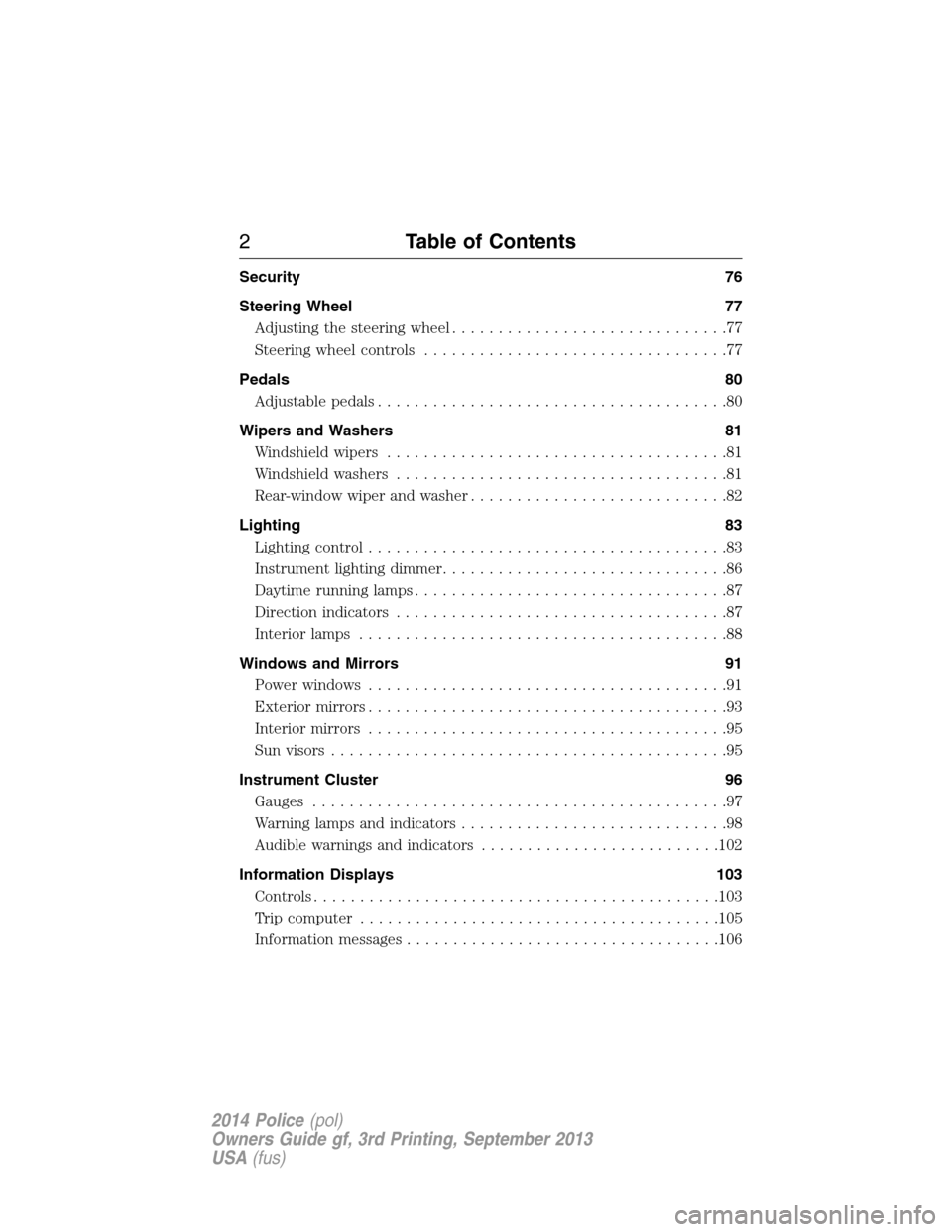
Security 76
Steering Wheel 77
Adjusting the steering wheel..............................77
Steering wheel controls.................................77
Pedals 80
Adjustable pedals......................................80
Wipers and Washers 81
Windshield wipers.....................................81
Windshield washers....................................81
Rear-window wiper and washer............................82
Lighting 83
Lighting control.......................................83
Instrument lighting dimmer...............................86
Daytime running lamps..................................87
Directionindicators ....................................87
Interior lamps........................................88
Windows and Mirrors 91
Power windows.......................................91
Exteriormirrors.......................................93
Interiormirrors .......................................95
Sunvisors ...........................................95
Instrument Cluster 96
Gauges.............................................97
Warning lamps and indicators.............................98
Audible warnings and indicators..........................102
Information Displays 103
Controls............................................103
Trip computer.......................................105
Information messages..................................106
2Table of Contents
2014 Police(pol)
Owners Guide gf, 3rd Printing, September 2013
USA(fus)
Page 4 of 406
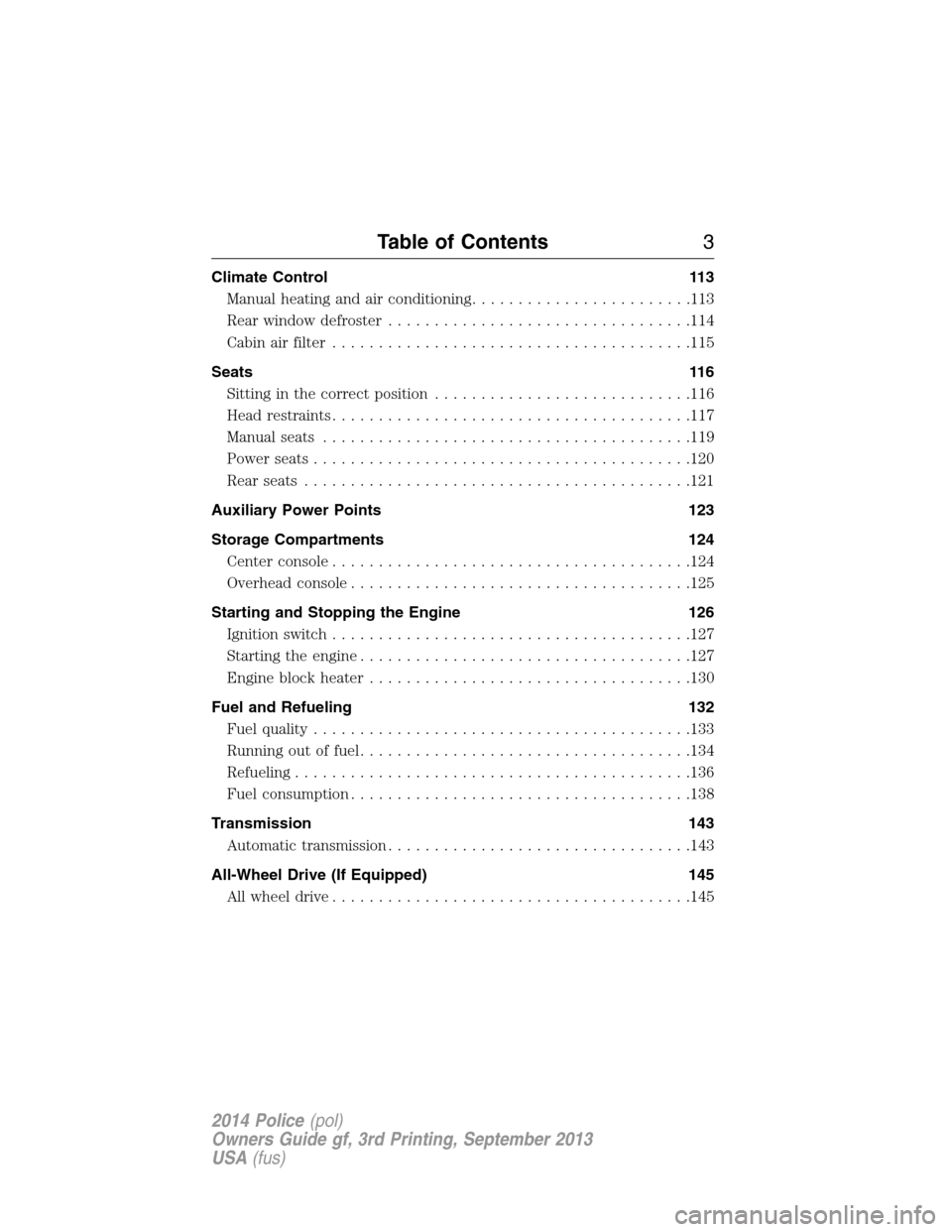
Climate Control 113
Manual heating and air conditioning........................113
Rear window defroster.................................114
Cabin air filter.......................................115
Seats 116
Sitting in the correct position............................116
Head restraints.......................................117
Manual seats........................................119
Power seats.........................................120
Rear seats..........................................121
Auxiliary Power Points 123
Storage Compartments 124
Center console.......................................124
Overhead console.....................................125
Starting and Stopping the Engine 126
Ignition switch.......................................127
Starting the engine....................................127
Engine block heater...................................130
Fuel and Refueling 132
Fuel quality.........................................133
Running out of fuel....................................134
Refueling...........................................136
Fuel consumption.....................................138
Transmission 143
Automatic transmission.................................143
All-Wheel Drive (If Equipped) 145
All wheel drive.......................................145
Table of Contents3
2014 Police(pol)
Owners Guide gf, 3rd Printing, September 2013
USA(fus)
Page 7 of 406
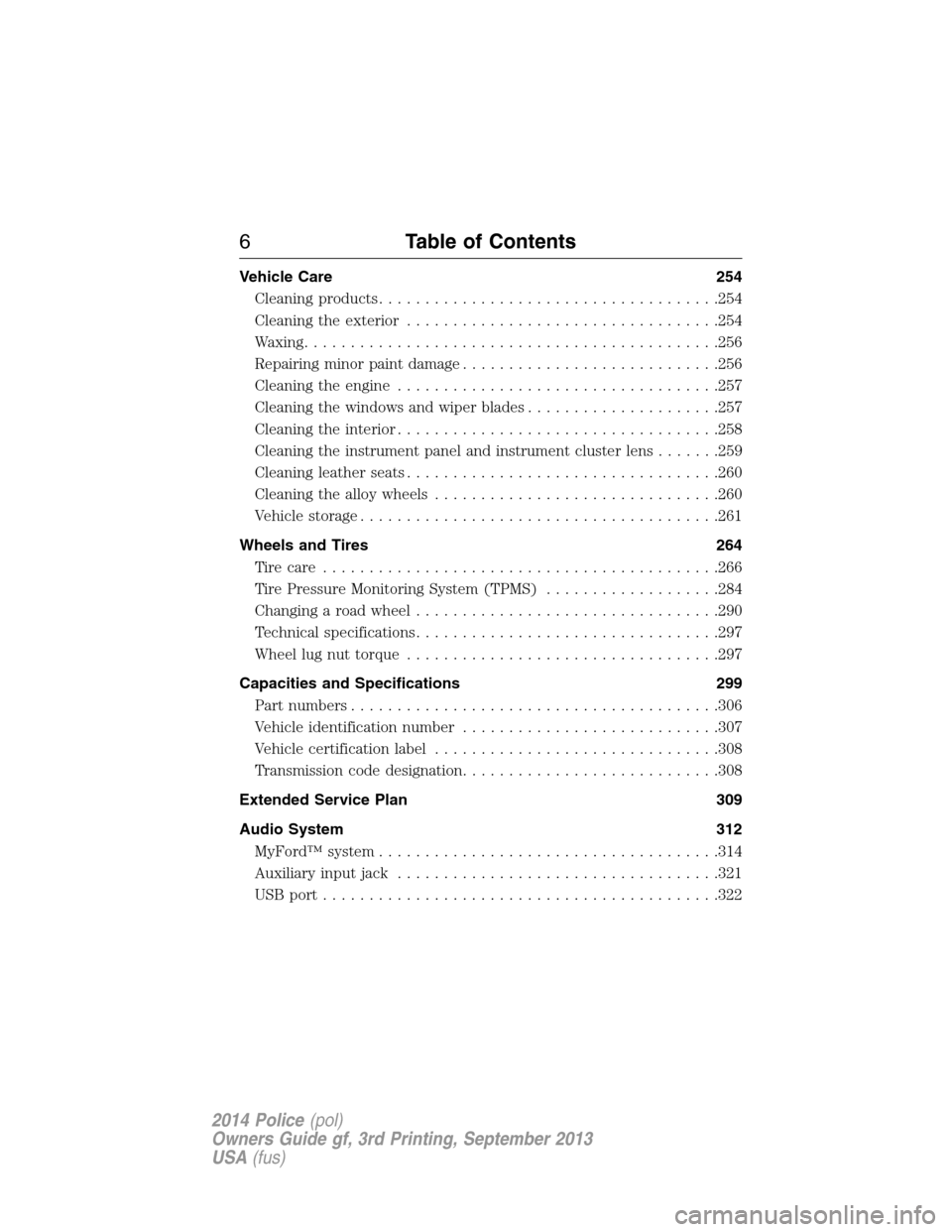
Vehicle Care 254
Cleaning products.....................................254
Cleaning the exterior..................................254
Waxing.............................................256
Repairing minor paint damage............................256
Cleaning the engine...................................257
Cleaning the windows and wiper blades.....................257
Cleaning the interior...................................258
Cleaning the instrument panel and instrument cluster lens.......259
Cleaning leather seats..................................260
Cleaning the alloy wheels...............................260
Vehicle storage.......................................261
Wheels and Tires 264
Tirecare ...........................................266
Tire Pressure Monitoring System (TPMS)...................284
Changing a road wheel.................................290
Technical specifications.................................297
Wheel lug nut torque..................................297
Capacities and Specifications 299
Part numbers........................................306
Vehicle identification number............................307
Vehicle certification label...............................308
Transmission code designation............................308
Extended Service Plan 309
Audio System 312
MyFord™ system.....................................314
Auxiliary input jack...................................321
USB port...........................................322
6Table of Contents
2014 Police(pol)
Owners Guide gf, 3rd Printing, September 2013
USA(fus)
Page 11 of 406
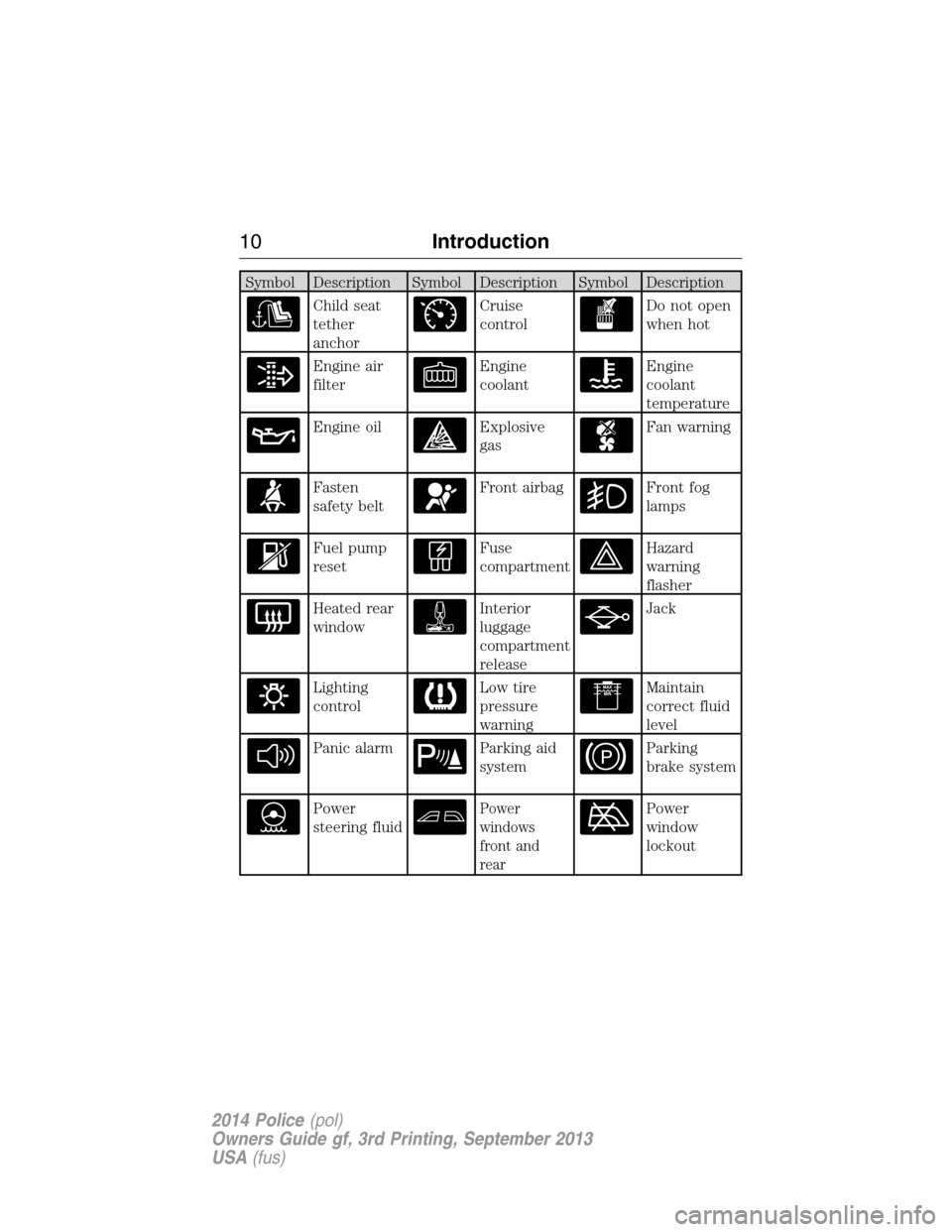
Symbol Description Symbol Description Symbol Description
Child seat
tether
anchorCruise
controlDo not open
when hot
Engine air
filterEngine
coolantEngine
coolant
temperature
Engine oilExplosive
gasFan warning
Fasten
safety beltFront airbagFront fog
lamps
Fuel pump
resetFuse
compartmentHazard
warning
flasher
Heated rear
windowInterior
luggage
compartment
releaseJack
Lighting
controlLow tire
pressure
warningMaintain
correct fluid
level
Panic alarmParking aid
systemParking
brake system
Power
steering fluidPower
windows
front and
rearPower
window
lockout
10Introduction
2014 Police(pol)
Owners Guide gf, 3rd Printing, September 2013
USA(fus)
Page 56 of 406
WARNING:All occupants of your vehicle including the driver
should always wear their safety belts even when an airbag
supplemental restraint system and curtain airbag is provided. Failure to
properly wear your safety belt could seriously increase the risk of injury
or death.
WARNING:To reduce risk of injury, do not obstruct or place
objects in the deployment path of the curtain airbag.
WARNING:If the curtain airbags have deployed, the curtain
airbags will not function again. The curtain airbags (including the
A, B and C pillar trim and headliner) must be inspected and serviced
by an authorized dealer. If the curtain airbag is not replaced, the
unrepaired area will increase the risk of injury in a crash.
The Safety Canopy will deploy during significant side crashes or when a
certain likelihood of a rollover event is detected by the rollover sensor.
The Safety Canopy is mounted to the roof side-rail sheet metal, behind
the headliner, above each row of seats. In certain sideways crashes or
rollover events, the Safety Canopy will be activated, regardless of which
seats are occupied. The Safety Canopy is designed to inflate between the
side window area and occupants to further enhance protection provided
in side impact crashes and rollover events.
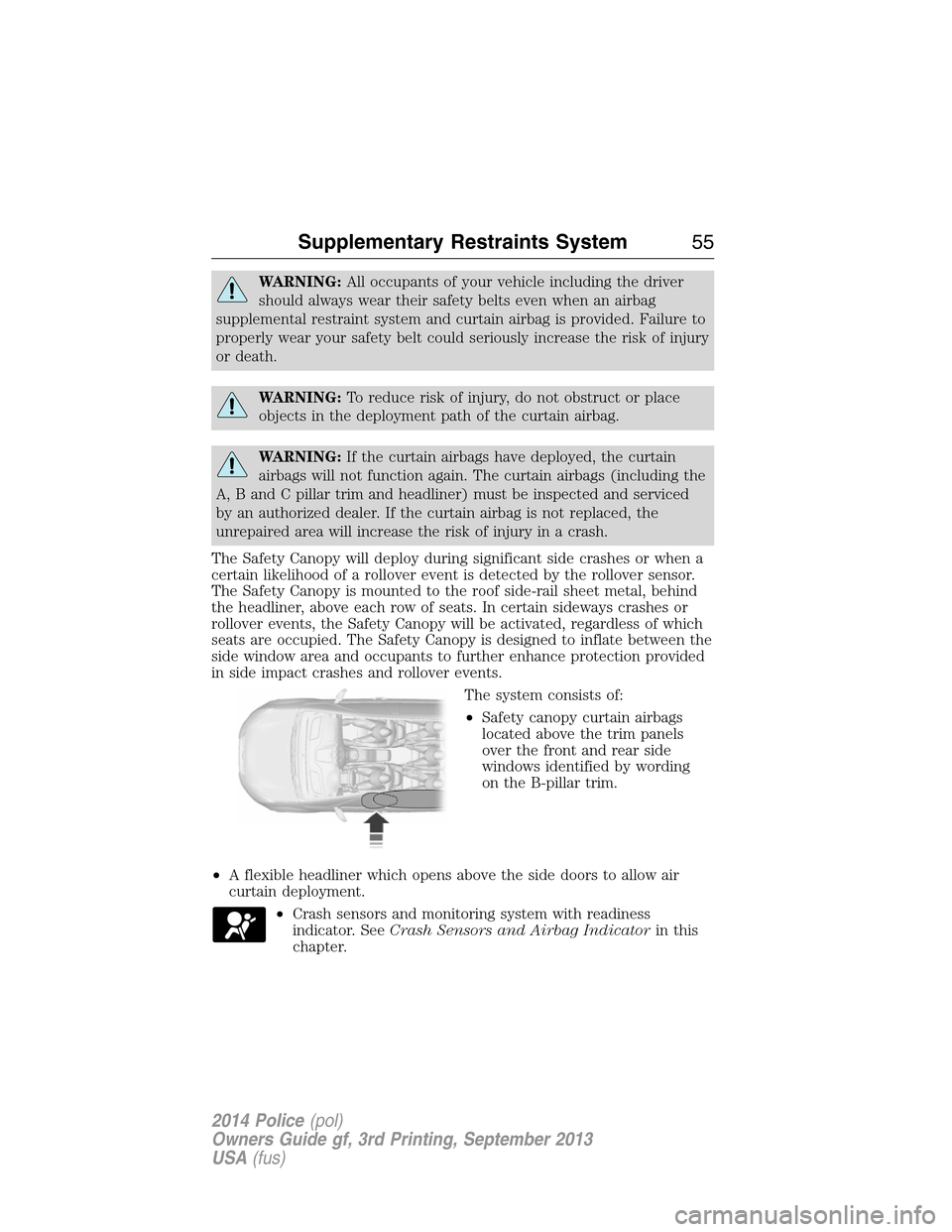
The system consists of:
•Safety canopy curtain airbags
located above the trim panels
over the front and rear side
windows identified by wording
on the B-pillar trim.
•A flexible headliner which opens above the side doors to allow air
curtain deployment.
•Crash sensors and monitoring system with readiness
indicator. SeeCrash Sensors and Airbag Indicatorin this
chapter.
Supplementary Restraints System55
2014 Police(pol)
Owners Guide gf, 3rd Printing, September 2013
USA(fus)
Page 57 of 406
Children 12 years old and under should always be properly restrained in
the rear seats. The Safety Canopy will not interfere with children
restrained using a properly installed child or booster seat because it is
designed to inflate downward from the headliner above the doors along
the side window opening.
The design and development of the Safety Canopy included
recommended testing procedures that were developed by a group of
automotive safety experts known as the Side Airbag Technical Working
Group. These recommended testing procedures help reduce the risk of
injuries related to the deployment of side airbags (including the Safety
Canopy).
CRASH SENSORS AND AIRBAG INDICATOR
WARNING:Modifying or adding equipment to the front end of
your vehicle (including frame, bumper, front end body structure
and tow hooks) may affect the performance of the airbag system,
increasing the risk of injury. Do not modify the front end of your
vehicle.
Your vehicle has a collection of crash and occupant sensors which
provide information to the restraints control module. The restraints
control module deploys (activates) the front safety belt pretensioners,
driver airbag, passenger airbag, seat mounted side airbags, and the
Safety Canopy. Based on the type of accident (frontal impact, side
impact or rollover) the restraints control module will deploy the
appropriate safety devices.
The restraints control module also monitors the readiness of the above
safety devices plus the crash and occupant sensors. The readiness of the
safety system is indicated by a warning indicator light in the instrument
cluster or by a backup tone if the warning light is not working. See the
Instrument Clusterchapter. Routine maintenance of the airbag is not
required.
A difficulty with the system is indicated by one or more of the following:
•The readiness light will either flash or stay lit.
•The readiness light will not illuminate immediately after the
ignition is turned on.
•A series of five beeps will be heard. The tone pattern will repeat
periodically until the problem or light are repaired.
56Supplementary Restraints System
2014 Police(pol)
Owners Guide gf, 3rd Printing, September 2013
USA(fus)
Page 74 of 406
LIFTGATE (UTILITY)
WARNING:Make sure to close and latch the liftgate to prevent
drawing exhaust fumes into your vehicle. This will also prevent
passengers and cargo from falling out. If you must drive with the
liftgate open, keep the vents or windows open so outside air comes into
your vehicle. Failure to follow this warning could result in serious
personal injury.
Note:Be careful when opening or closing the liftgate in a garage or
other enclosed area to avoid damaging the liftgate.
Note:Do not hang anything, for example a bike rack, from the spoiler,
glass or liftgate. This could damage the liftgate and its components.
Note:Do not leave the liftgate open while driving. This could damage
the liftgate and its components.
Note:Make sure the liftgate is closed and latched before driving your
vehicle. An unlatched liftgate may cause objects to fall out or block your
rear view.
The liftgate area is only intended for cargo, not passengers.
Open the liftgate using the outside button if your vehicle is unlocked or
use the key when your vehicle is locked.
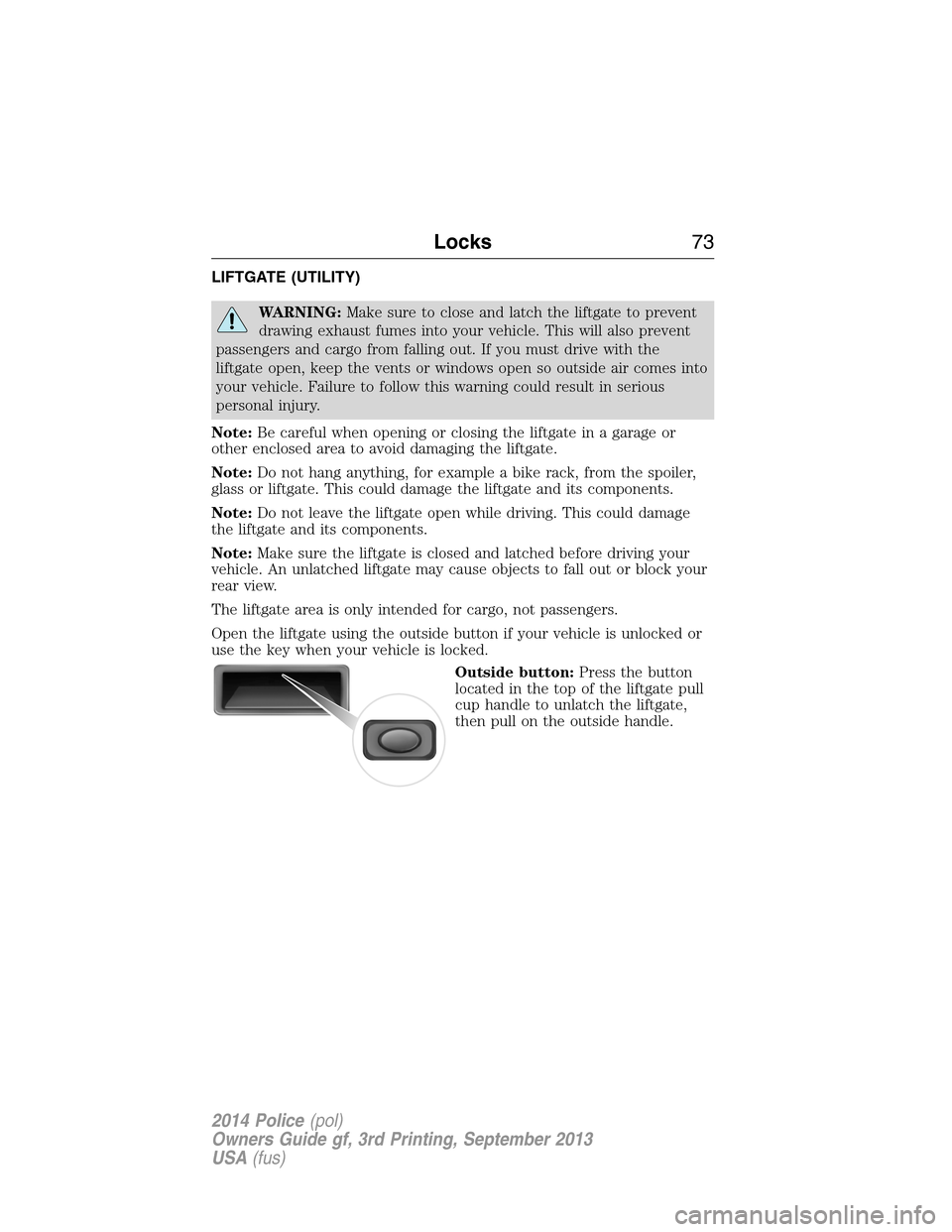
Outside button:Press the button
located in the top of the liftgate pull
cup handle to unlatch the liftgate,
then pull on the outside handle.
Locks73
2014 Police(pol)
Owners Guide gf, 3rd Printing, September 2013
USA(fus)
Page 83 of 406
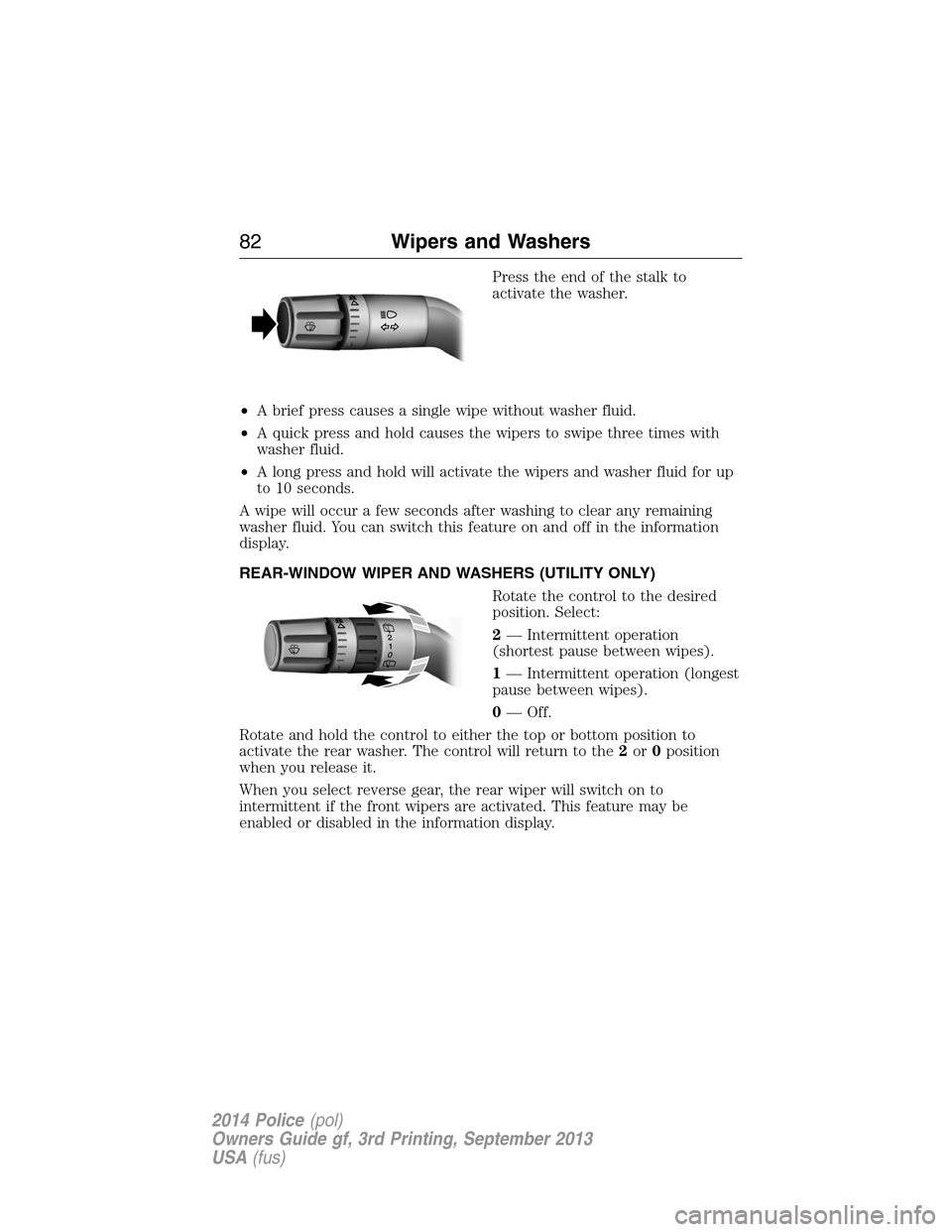
Press the end of the stalk to
activate the washer.
•A brief press causes a single wipe without washer fluid.
•A quick press and hold causes the wipers to swipe three times with
washer fluid.
•A long press and hold will activate the wipers and washer fluid for up
to 10 seconds.
A wipe will occur a few seconds after washing to clear any remaining
washer fluid. You can switch this feature on and off in the information
display.
REAR-WINDOW WIPER AND WASHERS (UTILITY ONLY)
Rotate the control to the desired
position. Select:
2— Intermittent operation
(shortest pause between wipes).
1— Intermittent operation (longest
pause between wipes).
0— Off.
Rotate and hold the control to either the top or bottom position to
activate the rear washer. The control will return to the2or0position
when you release it.
When you select reverse gear, the rear wiper will switch on to
intermittent if the front wipers are activated. This feature may be
enabled or disabled in the information display.
82Wipers and Washers
2014 Police(pol)
Owners Guide gf, 3rd Printing, September 2013
USA(fus)
Page 92 of 406
POWER WINDOWS
WARNING:Do not leave children unattended in your vehicle
and do not let children play with the power windows. They may
seriously injure themselves.
WARNING:When closing the power windows, you should verify
they are free of obstructions and make sure that children and
pets are not in the proximity of the window openings.
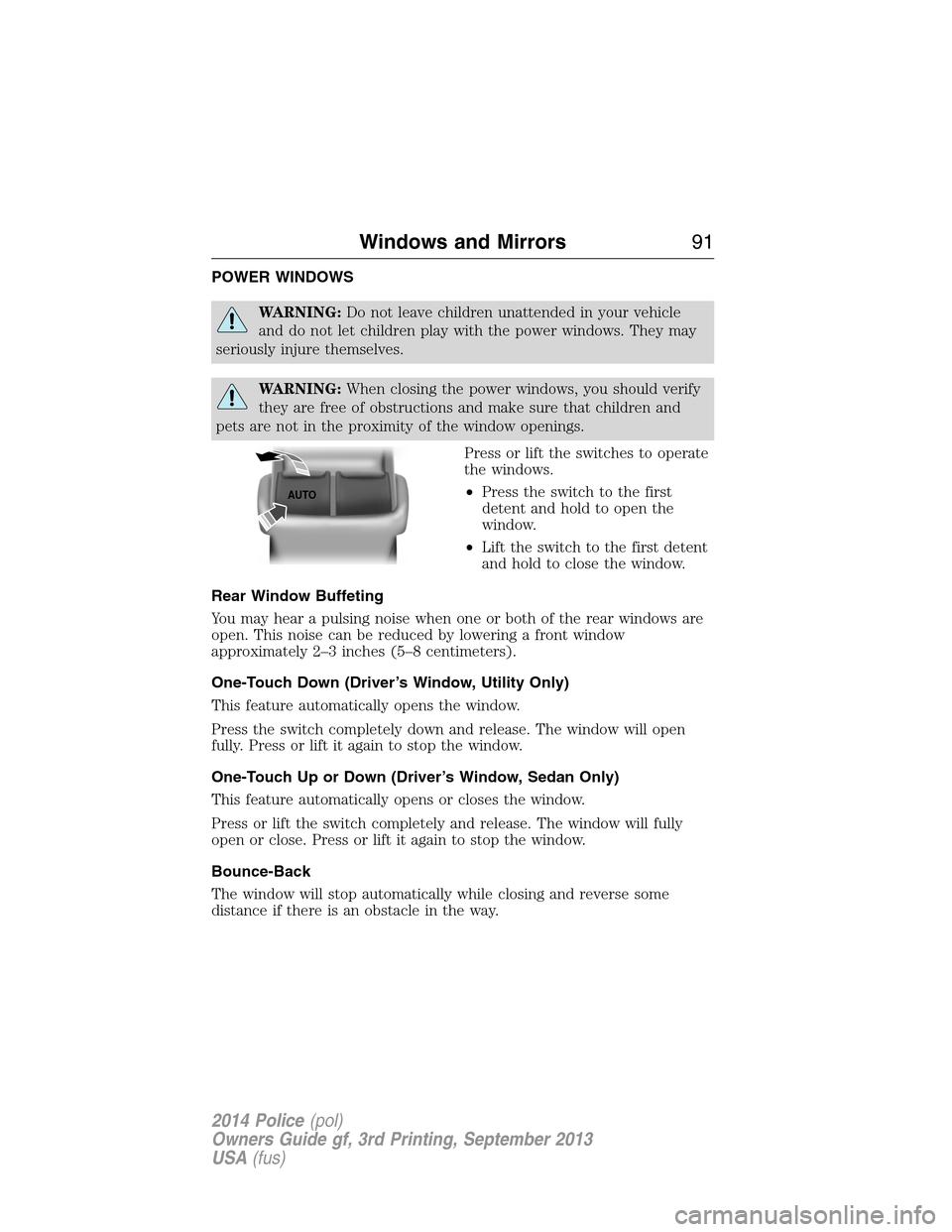
Press or lift the switches to operate
the windows.
•Press the switch to the first
detent and hold to open the
window.
•Lift the switch to the first detent
and hold to close the window.
Rear Window Buffeting
You may hear a pulsing noise when one or both of the rear windows are
open. This noise can be reduced by lowering a front window
approximately 2–3 inches (5–8 centimeters).
One-Touch Down (Driver’s Window, Utility Only)
This feature automatically opens the window.
Press the switch completely down and release. The window will open
fully. Press or lift it again to stop the window.
One-Touch Up or Down (Driver’s Window, Sedan Only)
This feature automatically opens or closes the window.
Press or lift the switch completely and release. The window will fully
open or close. Press or lift it again to stop the window.
Bounce-Back
The window will stop automatically while closing and reverse some
distance if there is an obstacle in the way.
AUTO
Windows and Mirrors91
2014 Police(pol)
Owners Guide gf, 3rd Printing, September 2013
USA(fus)
Page 93 of 406
Overriding the Bounce-Back Feature
WARNING:When you override the bounce-back feature the
window will not reverse if it detects an obstacle. Take care when
closing the windows to avoid personal injury or damage to your vehicle.
Pull up the window switch and hold within two seconds of the window
reaching the bounce-back position. The window will travel up with no
bounce-back protection. The window will stop if you release the switch
before the window is fully closed.
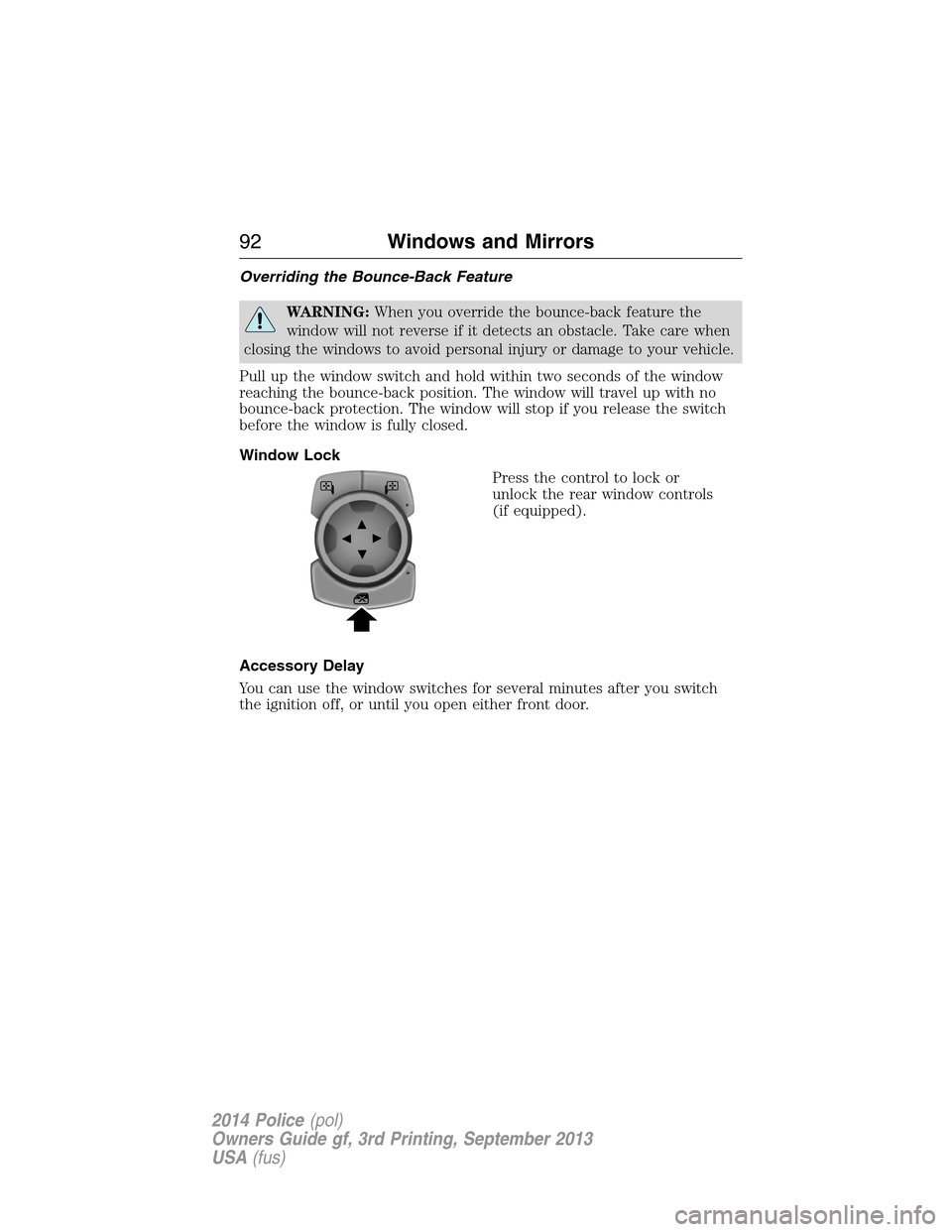
Window Lock
Press the control to lock or
unlock the rear window controls
(if equipped).
Accessory Delay
You can use the window switches for several minutes after you switch
the ignition off, or until you open either front door.
92Windows and Mirrors
2014 Police(pol)
Owners Guide gf, 3rd Printing, September 2013
USA(fus)