trailer FORD POLICE INTERCEPTOR UTILITY 2015 1.G Owner's Manual
[x] Cancel search | Manufacturer: FORD, Model Year: 2015, Model line: POLICE INTERCEPTOR UTILITY, Model: FORD POLICE INTERCEPTOR UTILITY 2015 1.GPages: 398, PDF Size: 6.24 MB
Page 188 of 398
ROADSIDE ASSISTANCE
Vehicles Sold in the United States: Getting Roadside Assistance
To fully assist you should you have a vehicle concern, Ford Motor
Company offers a complimentary Roadside Assistance program. This
program is separate from the New Vehicle Limited Warranty. The service
is available:
•24 hours a day, seven days a week.
•For the coverage period listed on the Roadside Assistance Card
included in your Owner’s Manual portfolio.
Roadside assistance will cover:
•A flat tire change with a good spare (except vehicles that have been
supplied with a tire inflation kit).
•Battery jump start.
•Lock-out assistance (key replacement cost is the customer’s
responsibility).
•Fuel delivery – Independent Service Contractors, if not prohibited by
state, local or municipal law, shall deliver up to 2.0 gallons (7.5 liters)
of gasoline or 5.0 gallons (18.9 liters) of diesel fuel to a disabled
vehicle. Fuel delivery service is limited to two no-charge occurrences
within a 12-month period.
•Winch out – available within 100 feet (30.5 meters) of a paved or
county maintained road, no recoveries.
•Towing – Ford eligible vehicles will be towed to an authorized dealer
within 35 miles (56.3 kilometers) of the disablement location or to the
nearest authorized dealer. If a member requests to be towed to an
authorized dealer more than 35 miles (56.3 kilometers) from the
disablement location, the member shall be responsible for any mileage
costs in excess of 35 miles (56.3 kilometers).
Roadside Assistance will include up to $200 coverage for a towed trailer
if the disabled eligible vehicle requires service at the nearest authorized
dealer. If the towing vehicle is operational but the trailer is not, then the
trailer does not qualify for any roadside services.
Vehicles Sold in the United States: Using Roadside Assistance
Complete the roadside assistance identification card and place it in your
wallet for quick reference. This card is found in the owner’s manual
portfolio in the glove compartment.
Roadside Emergencies187
2015 Police(pol)
Owners Guide gf, 1st Printing, April 2014
USA(fus)
Page 203 of 398

Fuse or relay
numberFuse amp
ratingProtected components
16 40A** Center console 6 way B+ feed 3
17 — Not used
18 40A** Front blower motor relay
19 30A** Starter relay
20 20A** Center console power point #2
21 — Not used
22 — Not used
23 30A** Driver power seat
24 40A** Police run/start relay
25 — Not used
26 40A** Rear window defrost relay
27 20A** Center console power point #1
28 — Not used
29 40A** Engine cooling fan #1 high speed
power, Engine cooling fan #1 and
#2 low speed primary fuse
30 40A** Engine cooling fan #2 high speed
fuse
31 25A** Engine cooling fan #1 and #2 low
speed secondary fuse
32 — Auxiliary blower motor relay
(Utility)
33 — Engine cooling fan #1 and #2 low
speed relay #2
34 — Blower motor relay
35 — Engine cooling fan #1 high speed
relay, Engine cooling fan #1 and
#2 low speed relay #1
36 — Not used
37 — Right-hand trailer tow stop/turn
lamps relay (Utility)
38 — Not used
202Fuses
2015 Police(pol)
Owners Guide gf, 1st Printing, April 2014
USA(fus)
Page 204 of 398

Fuse or relay
numberFuse amp
ratingProtected components
39 40A** Auxiliary blower motor (Utility)
40 40A** Center console 6-way B+ feed 1
41 — Not used
42 30A** Passenger seat (Sedan)
43 40A** Anti-lock brake system valves
(Utility)
20A** Anti-lock brake system valves
(Sedan)
44 — Rear washer relay (Utility)
45 — Not used
46 — Not used
47 — Not used
48 — Not used
49 — Not used
50 15A* Heated mirrors
51 — Not used
52 — Not used
53 — Left-hand trailer tow stop/turn
lamps relay (Utility)
54 — Not used
55 — Wiper relay
56 — Not used
57 — Not used
58 10A* Alternator A-line
59 10A* Brake on/off switch
60 — Not used
61 — Not used
62 10A* Air conditioner clutch relay
63 15A* Trailer tow stop/turn lamps
(Utility)
64 15A* Rear wipers (Utility)
65 30A* Fuel pump relay
Fuses203
2015 Police(pol)
Owners Guide gf, 1st Printing, April 2014
USA(fus)
Page 205 of 398
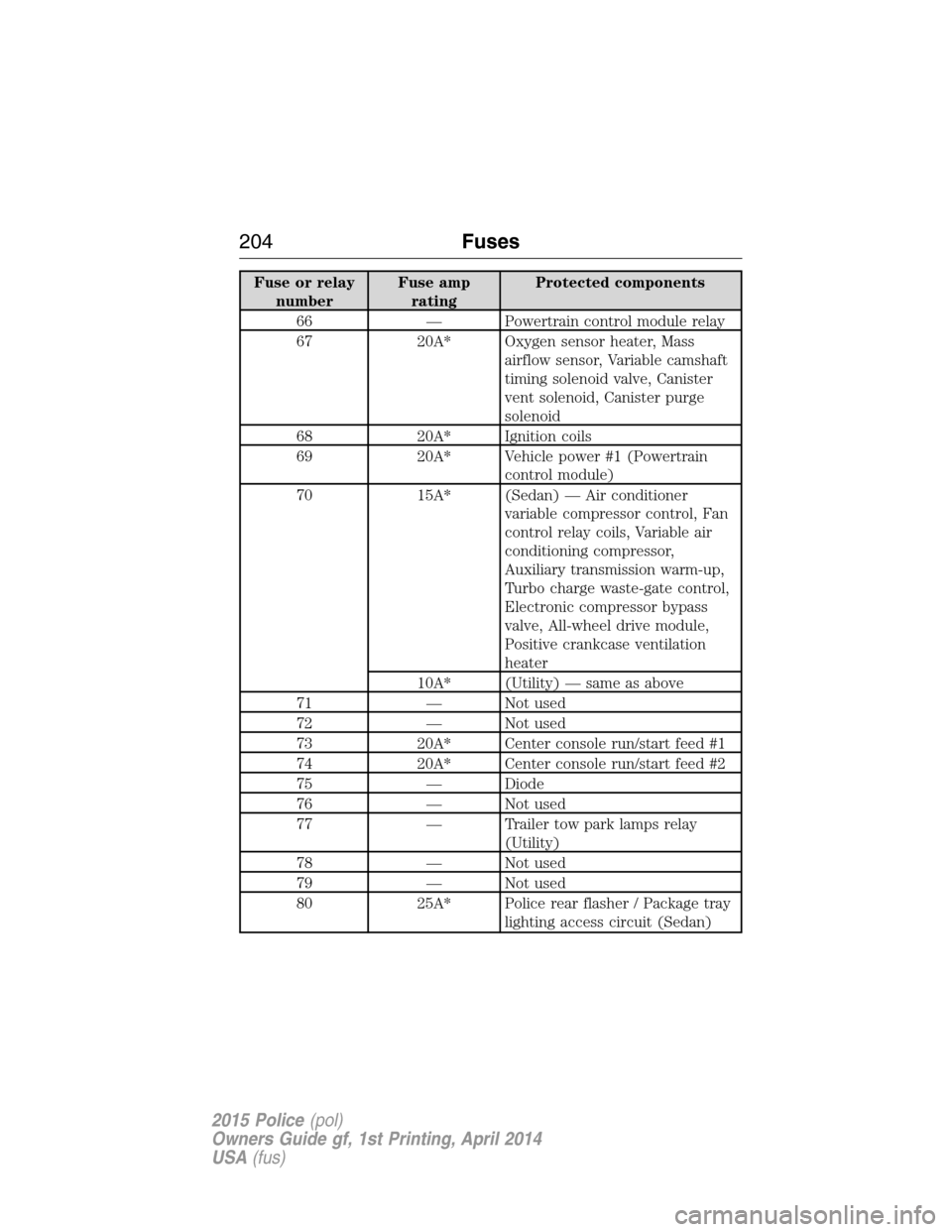
Fuse or relay
numberFuse amp
ratingProtected components
66 — Powertrain control module relay
67 20A* Oxygen sensor heater, Mass
airflow sensor, Variable camshaft
timing solenoid valve, Canister
vent solenoid, Canister purge
solenoid
68 20A* Ignition coils
69 20A* Vehicle power #1 (Powertrain
control module)
70 15A* (Sedan) — Air conditioner
variable compressor control, Fan
control relay coils, Variable air
conditioning compressor,
Auxiliary transmission warm-up,
Turbo charge waste-gate control,
Electronic compressor bypass
valve, All-wheel drive module,
Positive crankcase ventilation
heater
10A* (Utility) — same as above
71 — Not used
72 — Not used
73 20A* Center console run/start feed #1
74 20A* Center console run/start feed #2
75 — Diode
76 — Not used
77 — Trailer tow park lamps relay
(Utility)
78 — Not used
79 — Not used
80 25A* Police rear flasher / Package tray
lighting access circuit (Sedan)
204Fuses
2015 Police(pol)
Owners Guide gf, 1st Printing, April 2014
USA(fus)
Page 206 of 398
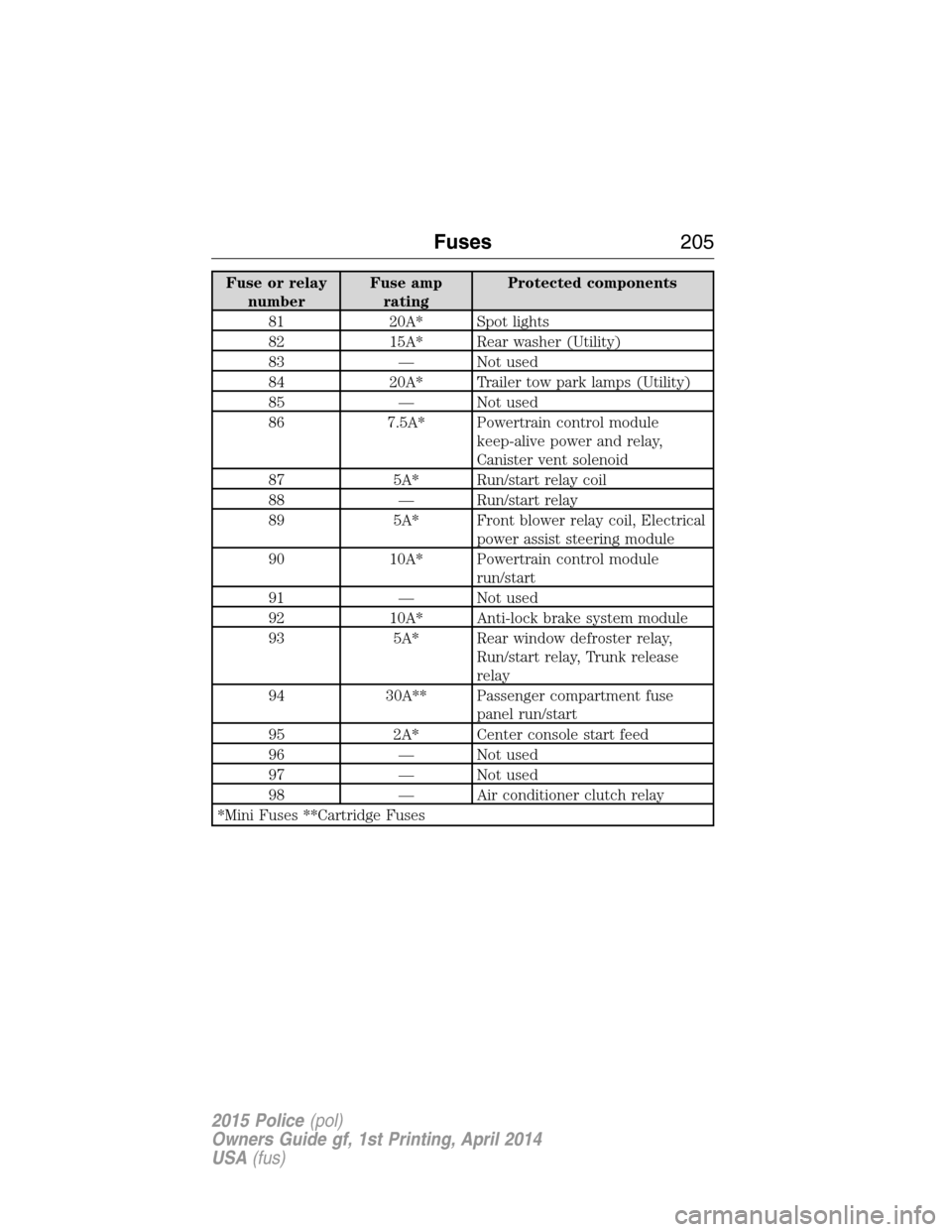
Fuse or relay
numberFuse amp
ratingProtected components
81 20A* Spot lights
82 15A* Rear washer (Utility)
83 — Not used
84 20A* Trailer tow park lamps (Utility)
85 — Not used
86 7.5A* Powertrain control module
keep-alive power and relay,
Canister vent solenoid
87 5A* Run/start relay coil
88 — Run/start relay
89 5A* Front blower relay coil, Electrical
power assist steering module
90 10A* Powertrain control module
run/start
91 — Not used
92 10A* Anti-lock brake system module
93 5A* Rear window defroster relay,
Run/start relay, Trunk release
relay
94 30A** Passenger compartment fuse
panel run/start
95 2A* Center console start feed
96 — Not used
97 — Not used
98 — Air conditioner clutch relay
*Mini Fuses **Cartridge Fuses
Fuses205
2015 Police(pol)
Owners Guide gf, 1st Printing, April 2014
USA(fus)
Page 222 of 398
Your vehicle has been designed to pull a trailer, but because of the added
load, the vehicle’s engine may temporarily reach higher temperatures
during severe operating conditions such as ascending a long or steep
grade while pulling a trailer in hot ambient temperatures.
At this time, you may notice your engine coolant temperature gauge
needle move toward the H (hot) and the POWER REDUCED TO LOWER
TEMP message may appear on the message center.
You may notice a reduction in the vehicle’s speed caused by reduced
engine power. Your vehicle has been designed to enter this mode if
certain high temperature/high load conditions take place in order to
manage the engine’s fluid temperatures. The amount of speed reduction
will depend on the vehicle loading, towing, grade, ambient temperature,
and other factors. If this occurs, there is no need to pull off the road.
The vehicle can continue to be driven while this message is active.
The air conditioning may also cycle on and off during severe operating
conditions to protect overheating of the engine. When the engine coolant
temperature decreases to a more normal operating temperature, the air
conditioning will turn on once again.
If you notice any of the following:
•
the engine coolant temperature gauge moves fully into the red (hot) area
•the coolant temperature warning light illuminates
•the service engine soon indicator illuminates
1. Pull off the road as soon as safely possible and place the vehicle in P
(Park).
2. Leave the engine running until the coolant temperature gauge needle
moves away from the H range. After several minutes, if this does not
happen, follow the remaining steps.
3. Turn the engine off and wait for it to cool before checking the coolant
level.
WARNING:Never remove the coolant reservoir cap while the
engine is running or hot.
4. If the coolant level is normal, you may restart your engine and
continue on.
5. If the coolant is low, add coolant, restart the engine and take your
vehicle to an authorized dealer. SeeAdding engine coolantin this
chapter for more information.
Refer to fail-safe cooling for additional information.
Maintenance221
2015 Police(pol)
Owners Guide gf, 1st Printing, April 2014
USA(fus)
Page 224 of 398
You have limited engine power when in the fail-safe mode, so drive the
vehicle with caution. The vehicle will not be able to maintain high-speed
operation and the engine will run rough. Remember that the engine is
capable of completely shutting down automatically to prevent engine
damage, therefore:
1. Pull off the road as soon as safely possible and turn off the engine.
2. Arrange for the vehicle to be taken to an authorized dealer.
3. If this is not possible, wait a short period for the engine to cool.
4. Check the coolant level and replenish if low.
WARNING:Never remove the coolant reservoir cap while the
engine is running or hot. The hot coolant is under pressure and
may cause serious burns.
5. Re-start the engine and take your vehicle to an authorized dealer.
Note:Driving the vehicle without repairing the engine problem increases
the chance of engine damage. Take your vehicle to an authorized dealer
as soon as possible.
AUTOMATIC TRANSMISSION FLUID CHECK
WARNING:The dipstick cap and surrounding components may
be hot; gloves are recommended.
Note:Automatic transmission fluid expands when warmed. To obtain an
accurate fluid check, drive the vehicle until it is warmed up
(approximately 20 miles [30 km]). If your vehicle has been operated for
an extended period at high speeds, in city traffic during hot weather or
pulling a trailer, the vehicle should be turned off until normal operating
temperatures are reached to allow the fluid to cool before checking.
Depending on vehicle use, cooling times could take up to 30 minutes or
longer.
Refer to yourscheduled maintenance informationfor scheduled
intervals for fluid checks and changes. Your transmission does not
consume fluid. However, the fluid level should be checked if the
transmission is not working properly, i.e., if the transmission slips or
shifts slowly or if you notice some sign of fluid leakage.
1. Drive the vehicle 20 miles (30 km) or until it reaches normal operating
temperature.
2. Park the vehicle on a level surface and engage the parking brake.
Maintenance223
2015 Police(pol)
Owners Guide gf, 1st Printing, April 2014
USA(fus)
Page 227 of 398

Correct fluid level
The transmission fluid should be checked at normal operating
temperature 180°F-200°F (82°C-93°C) on a level surface. The normal
operating temperature can be reached after approximately 20 miles
(30 km) of driving.
The transmission fluid level should be
targeted within the cross-hatch area
if at normal operating temperature
180°F-200°F (82°C-93°C) .
High fluid level
If the fluid level is above the MAX
range of the dipstick, remove fluid to
reach the hashmark level.Note:
Fluid level above the MAX level may
cause shift and/or engagement
concerns and/or possible damage.
High fluid levels can be caused by an overheating condition. If your
vehicle has been operated for an extended period at high speeds, in city
traffic during hot weather or pulling a trailer, the vehicle should be
turned off until normal operating temperatures are reached. Depending
on vehicle use, cooling times could take up to 30 minutes or longer.
Adjusting automatic transmission fluid levels
Before adding any fluid, make sure the correct type is used. The type of
fluid used is normally indicated on the dipstick and also in the
Capacities and Specificationschapter.
Note:Use of a non-approved automatic transmission fluid may cause
internal transmission component damage.
If necessary, add fluid in 1/2 pint
(250 ml) increments through the
filler tube until the level is correct.
If an overfill occurs, excess fluid
should be removed by an authorized
dealer.
Note:An overfill condition of transmission fluid may cause shift and/or
engagement concerns and/or possible damage.
MAX MIN
MAX MIN
226Maintenance
2015 Police(pol)
Owners Guide gf, 1st Printing, April 2014
USA(fus)
Page 384 of 398
SPECIAL OPERATING CONDITIONS
If you operate your vehicleprimarilyin any of the following conditions,
you need to perform additional maintenance as indicated. If you
occasionallyoperate your vehicle under any of these conditions, it is
not necessary to perform the additional maintenance. For specific
recommendations, see your dealership service advisor or technician.
Perform the services shown in the following tables when specified or
within 3000 miles (4800 kilometers) of the OIL CHANGE REQUIRED
message appearing in the information display.
Example #1:The OIL CHANGE REQUIRED message comes on at
28751 miles (46270 kilometers); perform the 30000 mile (48000
kilometer) automatic transmission fluid replacement.
Example #2:The OIL CHANGE REQUIRED message hasnotcome on,
but the odometer reads 30000 miles (48000 kilometers); perform the
engine air filter replacement. (for example, the Intelligent Oil-Life
Monitor was reset at 25000 miles [40000 kilometers].)
Towing a trailer or using a camper or car-top carrier
As required Change engine oil and filter as indicated by
the information display and perform services
listed in the Normal Scheduled Maintenance
chart.
Inspect frequently,
service as requiredInspect and lubricate U-joints.
See axle maintenance items under
Exceptions.
Every 30000 miles
(48000 km)Change automatic transmission fluid.
Scheduled Maintenance383
2015 Police(pol)
Owners Guide gf, 1st Printing, April 2014
USA(fus)
Page 392 of 398
911 Assist™ ..............................336
A
ABS (see Brakes) .....................149
Accessing call history/phone
book during active call .............325
Accessing your media menu
features ......................................347
Accessing your phone menu
features ......................................327
Accessory delay ..........................88
Active call menu options .........325
Advanced menu options ...334, 354
Advanced menu options
(prompts, languages, defaults,
master reset, installing
applications) ..............................334
Airbag supplemental restraint
system ..........................................47
and child safety seats ..............48
description ................................47
disposal ......................................62
driver airbag ..............................47
passenger airbag .......................47
side airbag ...........................47, 51
Air cleaner filter .......231, 233, 299
Air conditioning ........................107
manual heating and air
conditioning system ...............107
Air filter, cabin ..........................109
All Wheel Drive (AWD),
driving off road .........................139
Ambulance packages ..................15
Antifreeze
(see Engine coolant) ................218Anti-lock brake system
(see Brakes) ..............................149
Anti-theft system
arming the system ....................73
disarming a triggered system ..73
Audio system
Single CD ................................307
Audio system (see Radio) .......307
Automatic transmission ............137
fluid, adding ....................223, 227
fluid, checking ................223, 227
fluid, refill capacities ..............293
fluid, specification ..................293
Auxiliary input jack (Line in) ..314
Auxiliary powerpoint ................117
B
Battery .......................................228
acid, treating emergencies .....228
jumping a disabled battery ....189
maintenance-free ....................228
replacement, specifications ...299
servicing ..................................228
Blind Spot Information
System .......................................159
Booster seats ...............................22
Brakes ........................................148
anti-lock ...................................149
anti-lock brake system (ABS)
warning light ...........................149
brake warning light ................149
fluid, checking and adding ....227
fluid, refill capacities ..............293
fluid, specifications .................293
lubricant specifications ..........293
parking ....................................149
trailer .......................................178
Index391
2015 Police(pol)
Owners Guide gf, 1st Printing, April 2014
USA(fus)