maintenance reset FORD POLICE INTERCEPTOR UTILITY 2015 1.G Owners Manual
[x] Cancel search | Manufacturer: FORD, Model Year: 2015, Model line: POLICE INTERCEPTOR UTILITY, Model: FORD POLICE INTERCEPTOR UTILITY 2015 1.GPages: 398, PDF Size: 6.24 MB
Page 140 of 398
USING YOUR ALL-WHEEL-DRIVE (AWD) SYSTEM
AWD uses all four wheels to power the vehicle. This increases traction,
enabling you to drive over terrain and road conditions that a
conventional two-wheel drive vehicles cannot. The AWD system is active
all the time and requires no input from the operator.
Note:Your AWD vehicle is not intended for off-road use. The AWD
feature gives your vehicle some limited off-road capabilities in which
driving surfaces are relatively level, obstruction-free and otherwise
similar to normal on-road driving conditions. Operating your vehicle
under other than those conditions could subject the vehicle to excessive
stress which might result in damage which is not covered under your
warranty.
Note:When an AWD system fault is present, the warning Check AWD
will display in the message center. The AWD system is not functioning
correctly and defaulted to front-wheel drive. When this warning is
displayed, have your vehicle serviced at an authorized dealer.
Note:The AWD Off message may also be displayed in the message
center if the AWD system has overheated and defaulted to front-wheel
drive. This condition may occur if the vehicle was operated in extreme
conditions with excessive wheel slip, such as deep sand. To resume
normal AWD function as soon as possible, stop the vehicle in a safe
location and stop the engine for at least 10 minutes. After the engine has
been restarted and the AWD system has adequately cooled, the AWD Off
message will turn off and normal AWD function will return. In the event
the engine is not stopped, the AWD Off message will turn off when the
system cools and normal AWD function returns.
The Power Transfer Unit (PTU) in police vehicles does not require any
normal scheduled maintenance. The system is electronically monitored
and notifies the driver of required service by displaying the message
Change AWD Power Transfer Unit Lube in the information display. The
PTU lube will be more likely to require a fluid change if the vehicle has
experienced extended periods of extreme/severe duty cycle driving. Do
not check or change the PTU lubricant unless the unit has been
submerged in water, shows signs of leakage or a message indicating
required service is displayed. Contact your authorized dealer for service
and to reset the PTU lube life monitor.
All-Wheel Drive (If Equipped)139
2015 Police(pol)
Owners Guide gf, 1st Printing, April 2014
USA(fus)
Page 223 of 398
What you should know about fail-safe cooling
If the engine coolant supply is depleted, this feature allows the vehicle to
be driven temporarily before incremental component damage is incurred.
The “fail-safe” distance depends on ambient temperatures, vehicle load
and terrain.
How fail-safe cooling works
If the engine begins to overheat:
•The engine coolant temperature gauge will move to the red (hot)
area.
•The service engine soon indicator will illuminate.
If the engine reaches a preset over-temperature condition, the engine
will automatically switch to alternating cylinder operation. Each disabled
cylinder acts as an air pump and cools the engine.
When this occurs the vehicle will still operate. However:
•The engine power will be limited.
•The air conditioning system will be disabled.
Continued operation will increase the engine temperature and the engine
will completely shut down, causing steering and braking effort to
increase.
Once the engine temperature cools, the engine can be re-started. Take
your vehicle to an authorized dealer as soon as possible to minimize
engine damage.
When fail-safe mode is activated
WARNING:Fail-safe mode is for use during emergencies only.
Operate the vehicle in fail-safe mode only as long as necessary to
bring the vehicle to rest in a safe location and seek immediate repairs.
When in fail-safe mode, the vehicle will have limited power, will not be
able to maintain high-speed operation, and may completely shut down
without warning, potentially losing engine power, power steering assist,
and power brake assist, which may increase the possibility of a crash
resulting in serious injury.
222Maintenance
2015 Police(pol)
Owners Guide gf, 1st Printing, April 2014
USA(fus)
Page 231 of 398
4. Allow the engine to idle for at least one minute.
5. Turn the A/C on and allow the engine to idle for at least one minute.
6. Drive the vehicle to complete the relearning process.
•The vehicle may need to be driven 10 miles (16 km) or more to
relearn the idle and fuel trim strategy.
•Note:If you do not allow the engine to relearn its idle trim, the idle
quality of your vehicle may be adversely affected until the idle trim is
eventually relearned.
If the battery has been disconnected or a new battery has been installed,
the clock and radio settings must be reset once the battery is
reconnected.
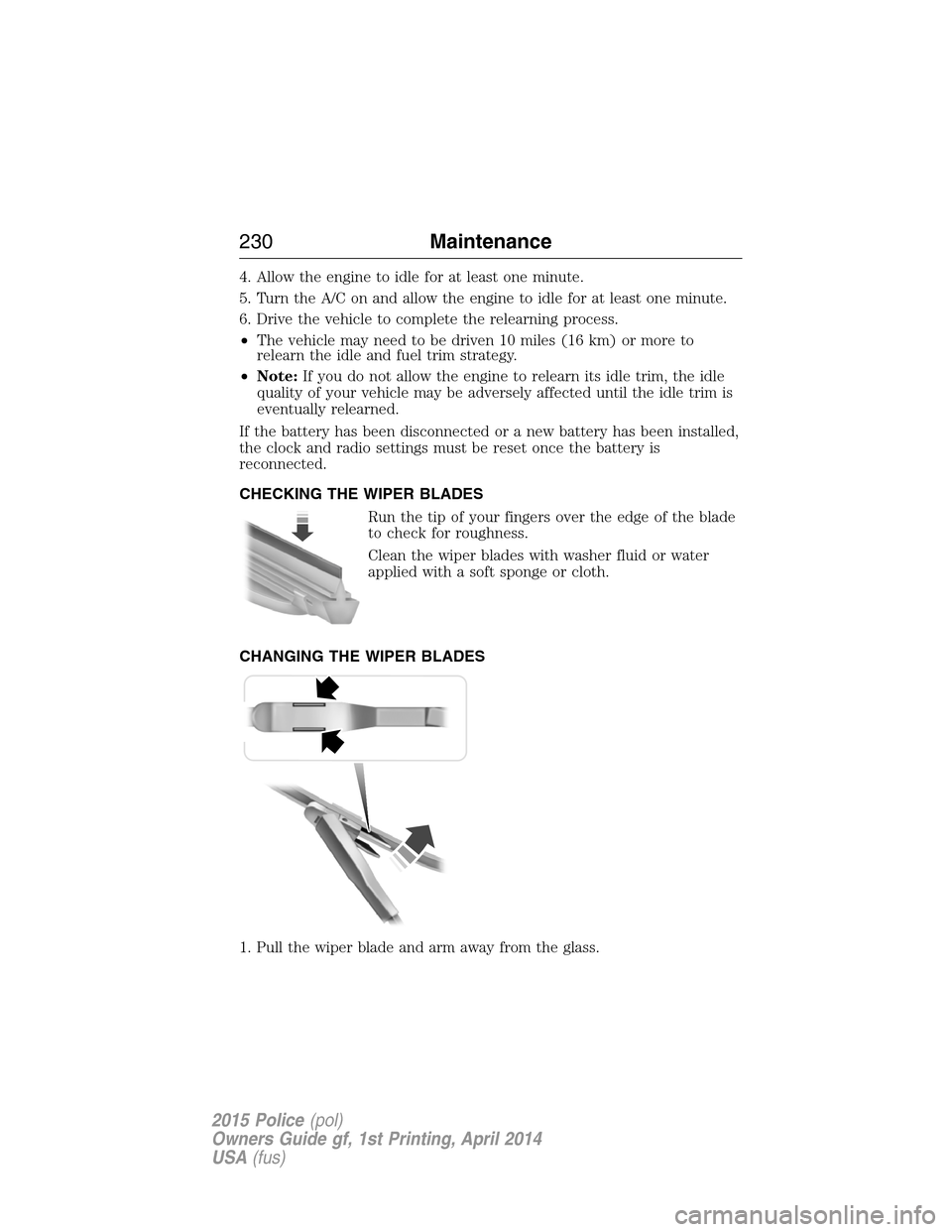
CHECKING THE WIPER BLADES
Run the tip of your fingers over the edge of the blade
to check for roughness.
Clean the wiper blades with washer fluid or water
applied with a soft sponge or cloth.
CHANGING THE WIPER BLADES
1. Pull the wiper blade and arm away from the glass.
230Maintenance
2015 Police(pol)
Owners Guide gf, 1st Printing, April 2014
USA(fus)
Page 374 of 398
Protecting Your Investment
Maintenance is an investment that will pay dividends in the form of
improved reliability, durability and resale value. To maintain the proper
performance of your vehicle and its emission control systems, it is
imperative that scheduled maintenance be completed at the designated
intervals.
Your vehicle is equipped with the Intelligent Oil-Life Monitor (IOLM)
system which displays a message in the information display at the proper
oil change service interval; this interval may be up to one year or
10000 miles (16000 kilometers). When ENGINE OIL CHANGE DUE or OIL
CHANGE REQUIRED appears in the information display, it is time for an
oil change; the oil change must be done within two weeks or 500 miles
(800 kilometers) of the ENGINE OIL CHANGE DUE or OIL CHANGE
REQUIRED message appearing. The Intelligent Oil-Life Monitor must be
reset after each oil change; see theInformation Displayschapter.
If your information display is prematurely reset or becomes inoperative,
you should perform the oil change interval at six months or 5000 miles
(8000 kilometers) from your last oil change. Never exceed one year or
10000 miles (16000 kilometers) between oil change intervals.
Your vehicle is very sophisticated and built with multiple, complex,
performance systems. Every manufacturer develops these systems using
different specifications and performance features. That is why it is
important to rely upon your dealership to properly diagnose and repair
your vehicle.
Ford Motor Company has recommended maintenance intervals for
various parts and component systems based upon engineering testing.
Ford Motor Company relies upon this testing to determine the most
appropriate mileage for replacement of oils and fluids to protect your
vehicle at the lowest overall cost to you and recommends against
maintenance schedules that deviate from the scheduled maintenance
information.
Ford strongly recommends the use of only genuine Ford, Motorcraft or
Ford-authorized remanufactured replacement parts because they are
engineered for your vehicle.
Additives and Chemicals
Ford Motor Company recommended additives and chemicals are listed in
the owner manual and in the Ford Workshop Manual. Additional chemicals
or additives not approved by Ford Motor Company are not recommended
as part of normal maintenance. Please consult your warranty information.
Scheduled Maintenance373
2015 Police(pol)
Owners Guide gf, 1st Printing, April 2014
USA(fus)
Page 379 of 398
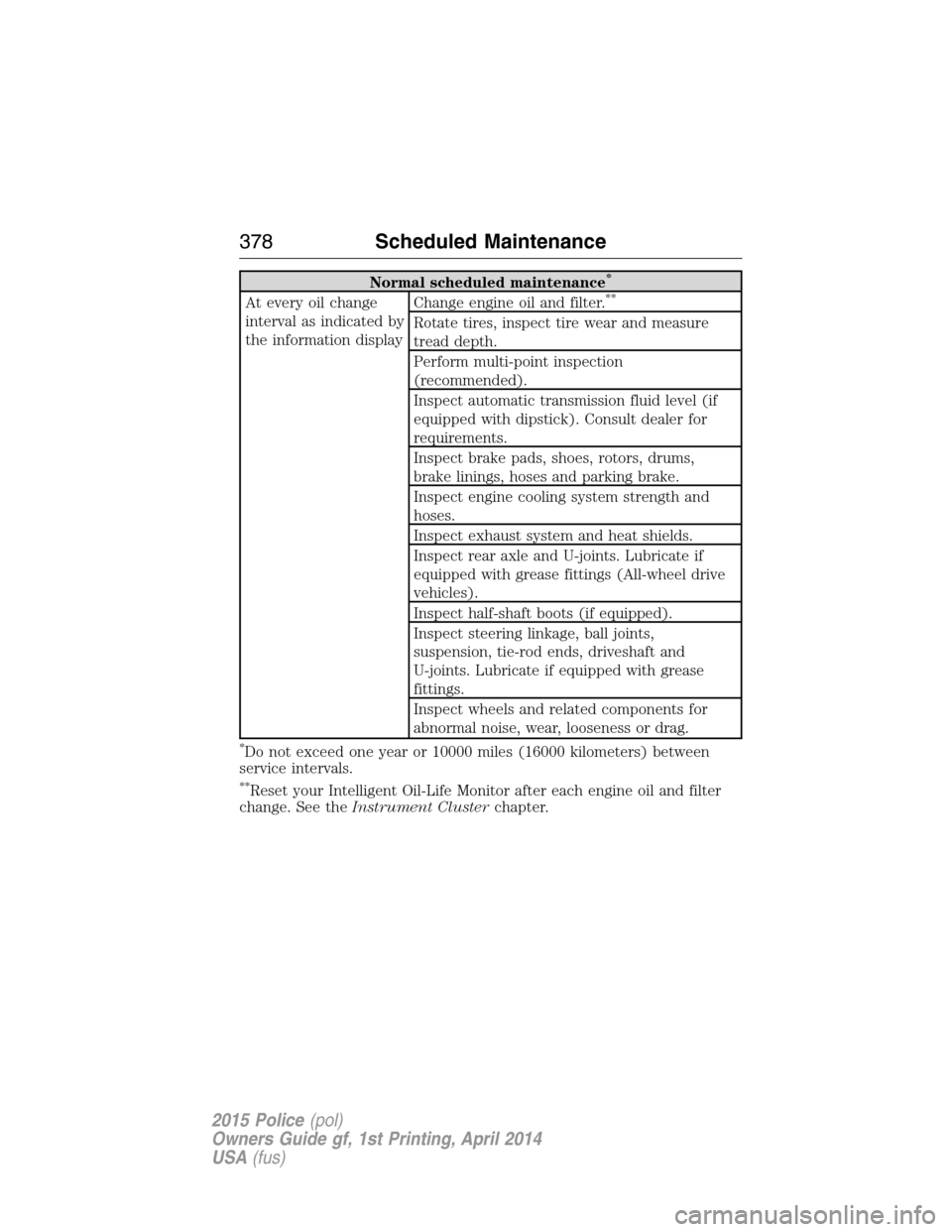
Normal scheduled maintenance*
At every oil change
interval as indicated by
the information displayChange engine oil and filter.**
Rotate tires, inspect tire wear and measure
tread depth.
Perform multi-point inspection
(recommended).
Inspect automatic transmission fluid level (if
equipped with dipstick). Consult dealer for
requirements.
Inspect brake pads, shoes, rotors, drums,
brake linings, hoses and parking brake.
Inspect engine cooling system strength and
hoses.
Inspect exhaust system and heat shields.
Inspect rear axle and U-joints. Lubricate if
equipped with grease fittings (All-wheel drive
vehicles).
Inspect half-shaft boots (if equipped).
Inspect steering linkage, ball joints,
suspension, tie-rod ends, driveshaft and
U-joints. Lubricate if equipped with grease
fittings.
Inspect wheels and related components for
abnormal noise, wear, looseness or drag.
*Do not exceed one year or 10000 miles (16000 kilometers) between
service intervals.
**Reset your Intelligent Oil-Life Monitor after each engine oil and filter
change. See theInstrument Clusterchapter.
378Scheduled Maintenance
2015 Police(pol)
Owners Guide gf, 1st Printing, April 2014
USA(fus)
Page 384 of 398
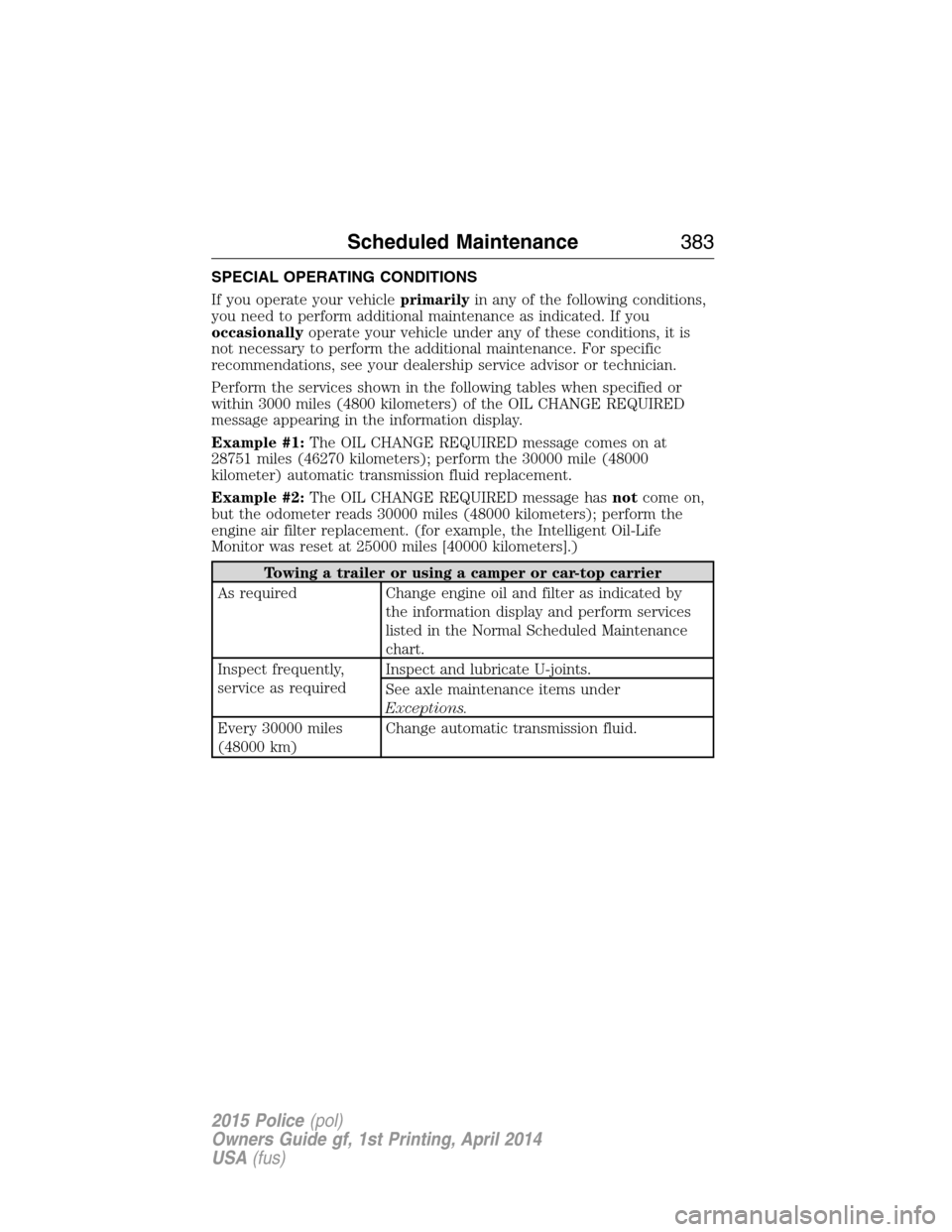
SPECIAL OPERATING CONDITIONS
If you operate your vehicleprimarilyin any of the following conditions,
you need to perform additional maintenance as indicated. If you
occasionallyoperate your vehicle under any of these conditions, it is
not necessary to perform the additional maintenance. For specific
recommendations, see your dealership service advisor or technician.
Perform the services shown in the following tables when specified or
within 3000 miles (4800 kilometers) of the OIL CHANGE REQUIRED
message appearing in the information display.
Example #1:The OIL CHANGE REQUIRED message comes on at
28751 miles (46270 kilometers); perform the 30000 mile (48000
kilometer) automatic transmission fluid replacement.
Example #2:The OIL CHANGE REQUIRED message hasnotcome on,
but the odometer reads 30000 miles (48000 kilometers); perform the
engine air filter replacement. (for example, the Intelligent Oil-Life
Monitor was reset at 25000 miles [40000 kilometers].)
Towing a trailer or using a camper or car-top carrier
As required Change engine oil and filter as indicated by
the information display and perform services
listed in the Normal Scheduled Maintenance
chart.
Inspect frequently,
service as requiredInspect and lubricate U-joints.
See axle maintenance items under
Exceptions.
Every 30000 miles
(48000 km)Change automatic transmission fluid.
Scheduled Maintenance383
2015 Police(pol)
Owners Guide gf, 1st Printing, April 2014
USA(fus)
Page 385 of 398
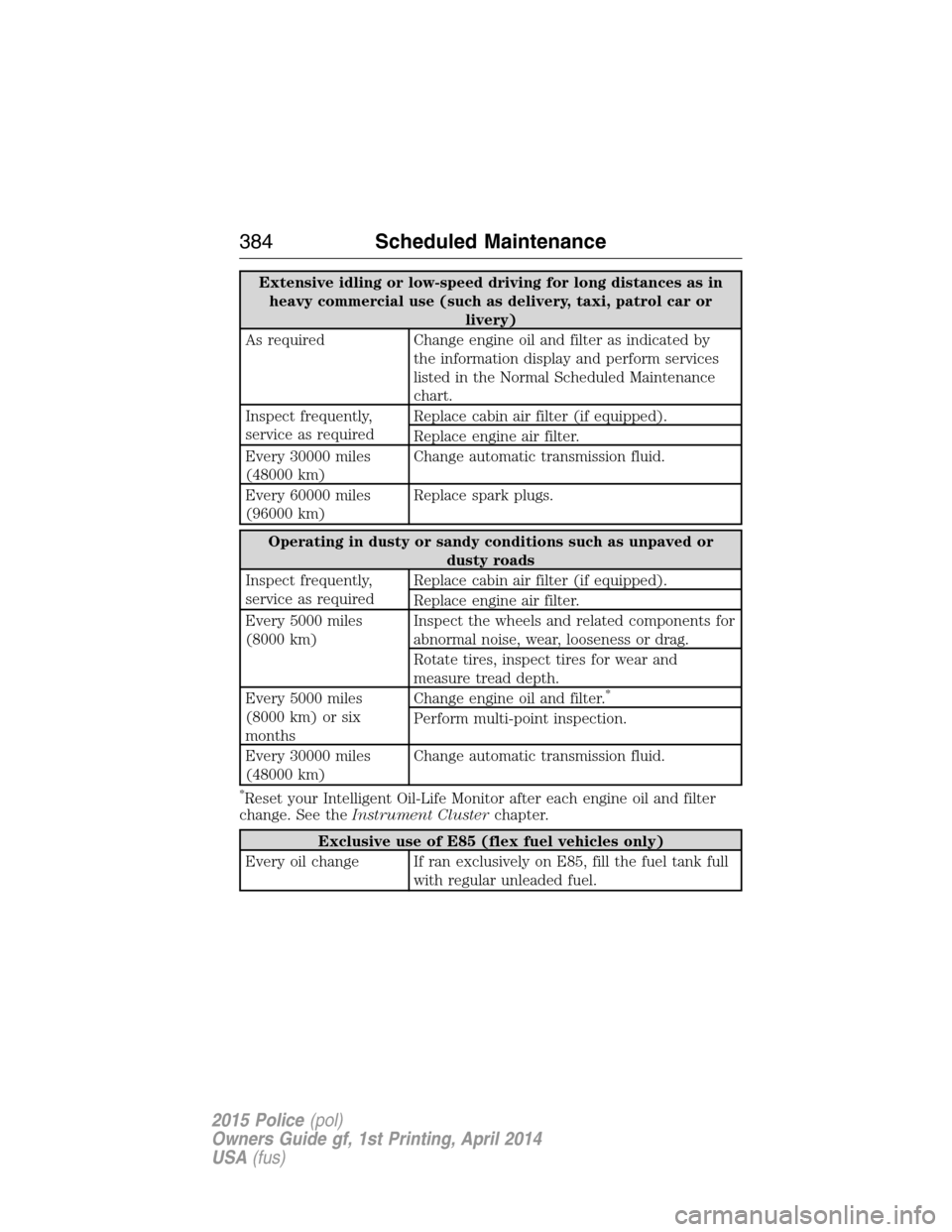
Extensive idling or low-speed driving for long distances as in
heavy commercial use (such as delivery, taxi, patrol car or
livery)
As required Change engine oil and filter as indicated by
the information display and perform services
listed in the Normal Scheduled Maintenance
chart.
Inspect frequently,
service as requiredReplace cabin air filter (if equipped).
Replace engine air filter.
Every 30000 miles
(48000 km)Change automatic transmission fluid.
Every 60000 miles
(96000 km)Replace spark plugs.
Operating in dusty or sandy conditions such as unpaved or
dusty roads
Inspect frequently,
service as requiredReplace cabin air filter (if equipped).
Replace engine air filter.
Every 5000 miles
(8000 km)Inspect the wheels and related components for
abnormal noise, wear, looseness or drag.
Rotate tires, inspect tires for wear and
measure tread depth.
Every 5000 miles
(8000 km) or six
monthsChange engine oil and filter.
*
Perform multi-point inspection.
Every 30000 miles
(48000 km)Change automatic transmission fluid.
*Reset your Intelligent Oil-Life Monitor after each engine oil and filter
change. See theInstrument Clusterchapter.
Exclusive use of E85 (flex fuel vehicles only)
Every oil change If ran exclusively on E85, fill the fuel tank full
with regular unleaded fuel.
384Scheduled Maintenance
2015 Police(pol)
Owners Guide gf, 1st Printing, April 2014
USA(fus)
Page 386 of 398
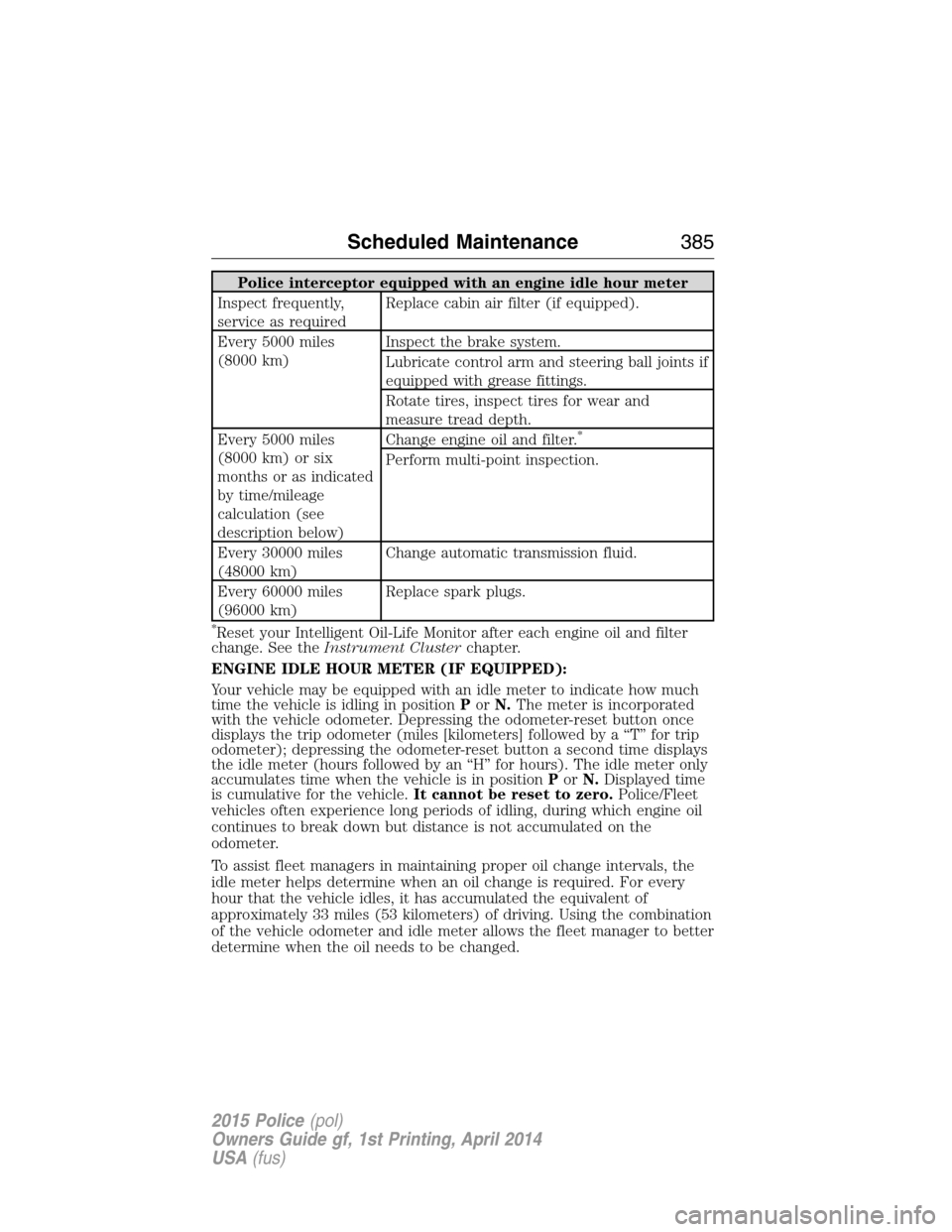
Police interceptor equipped with an engine idle hour meter
Inspect frequently,
service as requiredReplace cabin air filter (if equipped).
Every 5000 miles
(8000 km)Inspect the brake system.
Lubricate control arm and steering ball joints if
equipped with grease fittings.
Rotate tires, inspect tires for wear and
measure tread depth.
Every 5000 miles
(8000 km) or six
months or as indicated
by time/mileage
calculation (see
description below)Change engine oil and filter.
*
Perform multi-point inspection.
Every 30000 miles
(48000 km)Change automatic transmission fluid.
Every 60000 miles
(96000 km)Replace spark plugs.
*Reset your Intelligent Oil-Life Monitor after each engine oil and filter
change. See theInstrument Clusterchapter.
ENGINE IDLE HOUR METER (IF EQUIPPED):
Your vehicle may be equipped with an idle meter to indicate how much
time the vehicle is idling in positionPorN.The meter is incorporated
with the vehicle odometer. Depressing the odometer-reset button once
displays the trip odometer (miles [kilometers] followed by a “T” for trip
odometer); depressing the odometer-reset button a second time displays
the idle meter (hours followed by an “H” for hours). The idle meter only
accumulates time when the vehicle is in positionPorN.Displayed time
is cumulative for the vehicle.It cannot be reset to zero.Police/Fleet
vehicles often experience long periods of idling, during which engine oil
continues to break down but distance is not accumulated on the
odometer.
To assist fleet managers in maintaining proper oil change intervals, the
idle meter helps determine when an oil change is required. For every
hour that the vehicle idles, it has accumulated the equivalent of
approximately 33 miles (53 kilometers) of driving. Using the combination
of the vehicle odometer and idle meter allows the fleet manager to better
determine when the oil needs to be changed.
Scheduled Maintenance385
2015 Police(pol)
Owners Guide gf, 1st Printing, April 2014
USA(fus)
Page 392 of 398
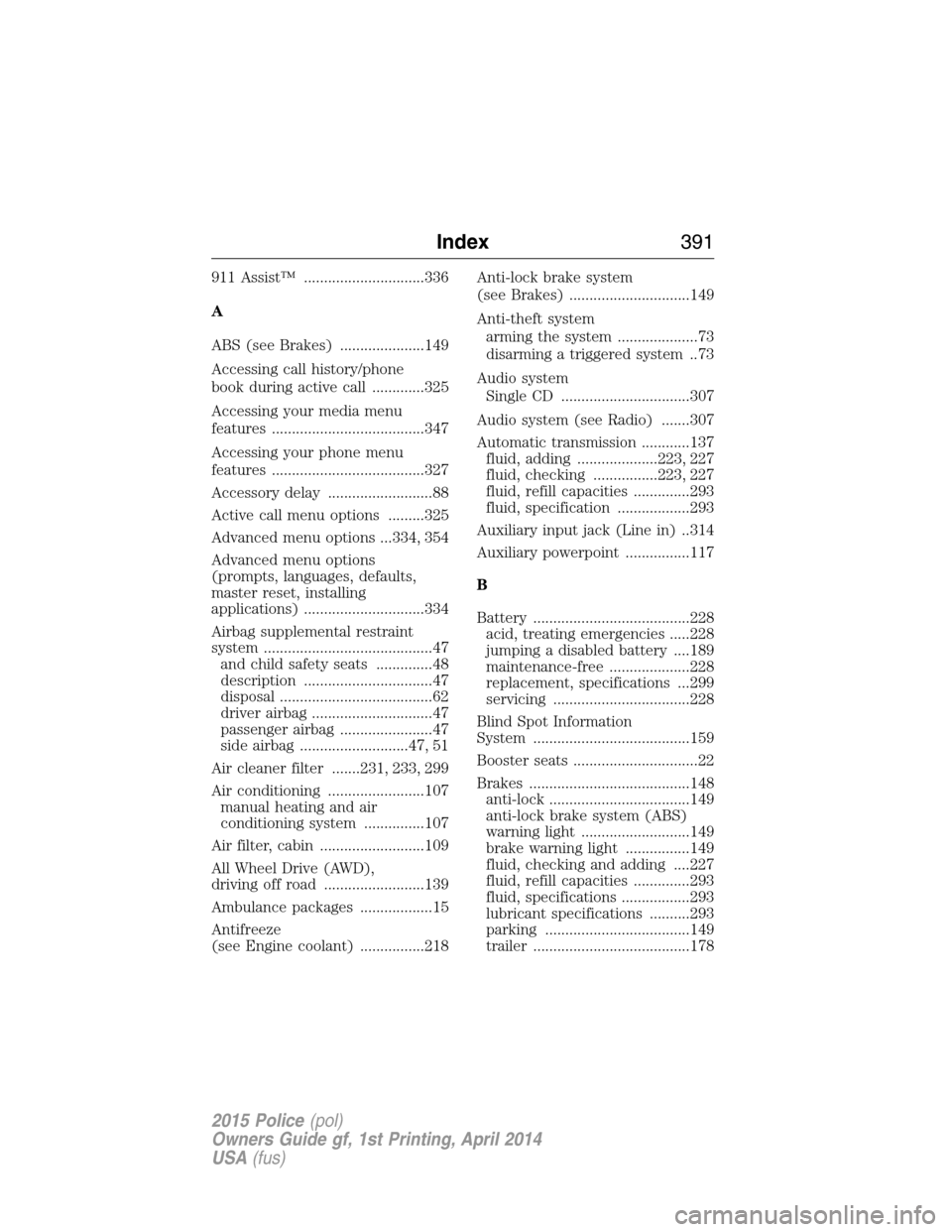
911 Assist™ ..............................336
A
ABS (see Brakes) .....................149
Accessing call history/phone
book during active call .............325
Accessing your media menu
features ......................................347
Accessing your phone menu
features ......................................327
Accessory delay ..........................88
Active call menu options .........325
Advanced menu options ...334, 354
Advanced menu options
(prompts, languages, defaults,
master reset, installing
applications) ..............................334
Airbag supplemental restraint
system ..........................................47
and child safety seats ..............48
description ................................47
disposal ......................................62
driver airbag ..............................47
passenger airbag .......................47
side airbag ...........................47, 51
Air cleaner filter .......231, 233, 299
Air conditioning ........................107
manual heating and air
conditioning system ...............107
Air filter, cabin ..........................109
All Wheel Drive (AWD),
driving off road .........................139
Ambulance packages ..................15
Antifreeze
(see Engine coolant) ................218Anti-lock brake system
(see Brakes) ..............................149
Anti-theft system
arming the system ....................73
disarming a triggered system ..73
Audio system
Single CD ................................307
Audio system (see Radio) .......307
Automatic transmission ............137
fluid, adding ....................223, 227
fluid, checking ................223, 227
fluid, refill capacities ..............293
fluid, specification ..................293
Auxiliary input jack (Line in) ..314
Auxiliary powerpoint ................117
B
Battery .......................................228
acid, treating emergencies .....228
jumping a disabled battery ....189
maintenance-free ....................228
replacement, specifications ...299
servicing ..................................228
Blind Spot Information
System .......................................159
Booster seats ...............................22
Brakes ........................................148
anti-lock ...................................149
anti-lock brake system (ABS)
warning light ...........................149
brake warning light ................149
fluid, checking and adding ....227
fluid, refill capacities ..............293
fluid, specifications .................293
lubricant specifications ..........293
parking ....................................149
trailer .......................................178
Index391
2015 Police(pol)
Owners Guide gf, 1st Printing, April 2014
USA(fus)
Page 394 of 398
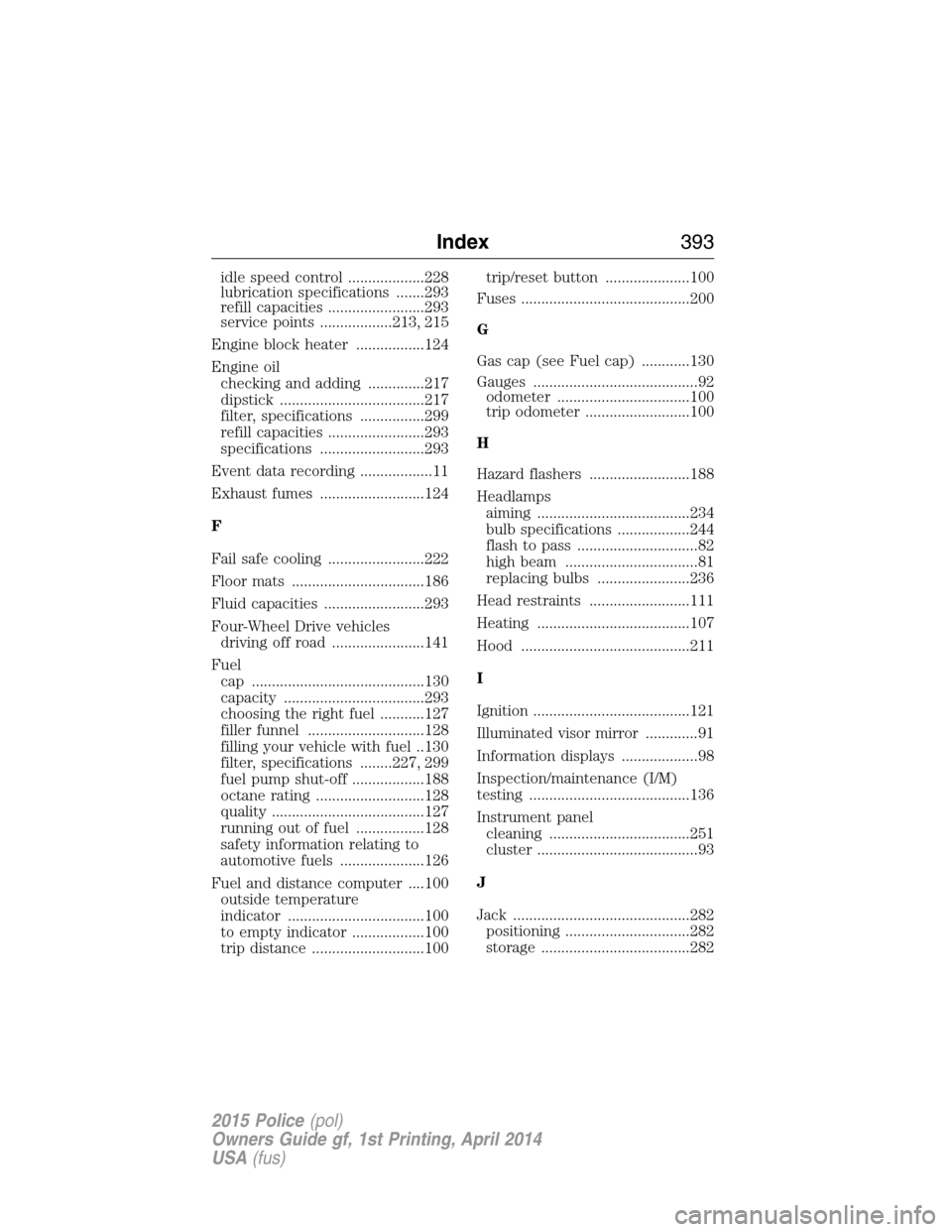
idle speed control ...................228
lubrication specifications .......293
refill capacities ........................293
service points ..................213, 215
Engine block heater .................124
Engine oil
checking and adding ..............217
dipstick ....................................217
filter, specifications ................299
refill capacities ........................293
specifications ..........................293
Event data recording ..................11
Exhaust fumes ..........................124
F
Fail safe cooling ........................222
Floor mats .................................186
Fluid capacities .........................293
Four-Wheel Drive vehicles
driving off road .......................141
Fuel
cap ...........................................130
capacity ...................................293
choosing the right fuel ...........127
filler funnel .............................128
filling your vehicle with fuel ..130
filter, specifications ........227, 299
fuel pump shut-off ..................188
octane rating ...........................128
quality ......................................127
running out of fuel .................128
safety information relating to
automotive fuels .....................126
Fuel and distance computer ....100
outside temperature
indicator ..................................100
to empty indicator ..................100
trip distance ............................100trip/reset button .....................100
Fuses ..........................................200
G
Gas cap (see Fuel cap) ............130
Gauges .........................................92
odometer .................................100
trip odometer ..........................100
H
Hazard flashers .........................188
Headlamps
aiming ......................................234
bulb specifications ..................244
flash to pass ..............................82
high beam .................................81
replacing bulbs .......................236
Head restraints .........................111
Heating ......................................107
Hood ..........................................211
I
Ignition .......................................121
Illuminated visor mirror .............91
Information displays ...................98
Inspection/maintenance (I/M)
testing ........................................136
Instrument panel
cleaning ...................................251
cluster ........................................93
J
Jack ............................................282
positioning ...............................282
storage .....................................282
Index393
2015 Police(pol)
Owners Guide gf, 1st Printing, April 2014
USA(fus)