100 FORD POLICE INTERCEPTOR UTILITY 2017 1.G Owner's Manual
[x] Cancel search | Manufacturer: FORD, Model Year: 2017, Model line: POLICE INTERCEPTOR UTILITY, Model: FORD POLICE INTERCEPTOR UTILITY 2017 1.GPages: 360, PDF Size: 4.06 MB
Page 218 of 360
U.S. Department of
Transportation Tire quality
grades: The U.S. Department of
Transportation requires Ford
Motor Company to give you the
following information about tire
grades exactly as the government
has written it.
Treadwear
The treadwear grade is a
comparative rating based on the
wear rate of the tire when tested
under controlled conditions on a
specified government test course.
For example, a tire graded 150
would wear 1½ times as well on
the government course as a tire
graded 100. The relative
performance of tires depends
upon the actual conditions of their
use, however, and may depart
significantly from the norm due to
variations in driving habits, service
practices, and differences in road
characteristics and climate.
Traction AA A B C WARNING
The traction grade assigned
to this tire is based on
straight-ahead braking traction
tests, and does not include
acceleration, cornering,
hydroplaning or peak traction
characteristics. The traction grades, from highest
to lowest are AA, A, B, and C. The
grades represent the tire
’s ability
to stop on wet pavement as
measured under controlled
conditions on specified
government test surfaces of
asphalt and concrete. A tire
marked C may have poor traction
performance.
Temperature A B C WARNING
The temperature grade for
this tire is established for a
tire that is properly inflated and
not overloaded. Excessive speed,
underinflation, or excessive
loading, either separately or in
combination, can cause heat
buildup and possible tire failure. The temperature grades are A
(the highest), B and C,
representing the tire
’s resistance
to the generation of heat and its
ability to dissipate heat when
tested under controlled conditions
on a specified indoor laboratory
test wheel. Sustained high
temperature can cause the
material of the tire to degenerate
and reduce tire life, and excessive
temperature can lead to sudden
tire failure. The grade C
corresponds to a level of
performance which all passenger
car tires must meet under the
215
Police Interceptor (TUB) Canada/United States of America, Police, enUSA, First Printing Wheels and Tires
Page 222 of 360
J.
Tire Ply Composition and
Material Used: Indicates the
number of plies or the number of
layers of rubber-coated fabric in
the tire tread and sidewall. Tire
manufacturers also must indicate
the ply materials in the tire and the
sidewall, which include steel,
nylon, polyester, and others.
K. Maximum Load: Indicates the
maximum load in kilograms and
pounds that can be carried by the
tire. See the Safety Compliance
Certification Label (affixed to
either the door hinge pillar,
door-latch post, or the door edge
that meets the door-latch post,
next to the driver's seating
position), for the correct tire
pressure for your vehicle.
L. Treadwear, Traction and
Temperature Grades:
*Treadwear The treadwear grade
is a comparative rating based on
the wear rate of the tire when
tested under controlled conditions
on a specified government test
course. For example, a tire graded
150 would wear one and one-half
times as well on the government
course as a tire graded 100. *Traction: The traction grades,
from highest to lowest are AA, A,
B, and C. The grades represent the
tire's ability to stop on wet
pavement as measured under
controlled conditions on specified
government test surfaces of
asphalt and concrete. A tire
marked C may have poor traction
performance.
*
Temperature: The temperature
grades are A (the highest), B and
C, representing the tire's
resistance to the generation of
heat and its ability to dissipate
heat when tested under controlled
conditions on a specified indoor
laboratory test wheel.
M. Maximum Inflation
Pressure:
Indicates the tire
manufacturers' maximum
permissible pressure or the
pressure at which the maximum
load can be carried by the tire. This
pressure is normally higher than
the vehicle manufacturer's
recommended cold inflation
pressure which can be found on
the Safety Compliance
Certification Label (affixed to
either the door hinge pillar,
door-latch post, or the door edge
that meets the door-latch post,
next to the driver's seating
position), or Tire Label which is
located on the B-Pillar or the edge
of the driver ’s door. The cold
inflation pressure should never be
set lower than the recommended
pressure on the vehicle label.
219
Police Interceptor (TUB) Canada/United States of America, Police, enUSA, First Printing Wheels and Tires
Page 241 of 360
TECHNICAL SPECIFICATIONS
Wheel Lug Nut Torque Specifications
WARNING
When a wheel is installed, always remove any corrosion, dirt or foreign materials
present on the mounting surfaces of the wheel or the surface of the wheel hub,
brake drum or brake disc that contacts the wheel. Make sure that any fasteners
that attach the rotor to the hub are secured so they do not interfere with the mounting
surfaces of the wheel. Installing wheels without correct metal-to-metal contact at the
wheel mounting surfaces can cause the wheel nuts to loosen and the wheel to come off
while your vehicle is in motion, resulting in loss of control. lb.ft (Nm)
*
Bolt size
110 lb.ft (149 Nm)
1/2-20 x 1.5
* Torque specifications are for nut and bolt threads free of dirt and rust. Use only Ford
recommended replacement fasteners.
Retighten the lug nuts to the specified torque within 100 miles (160 kilometers) after any
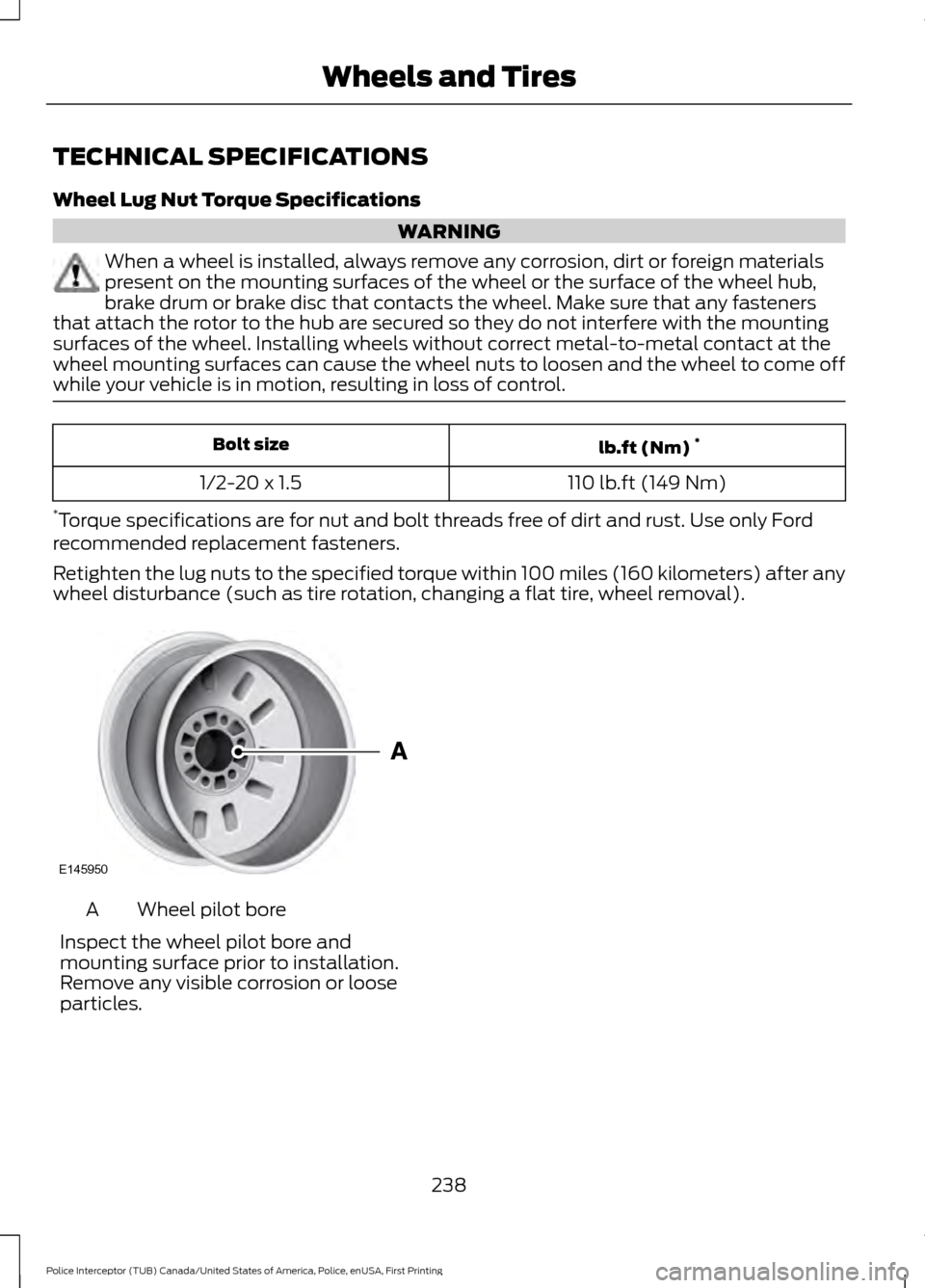
wheel disturbance (such as tire rotation, changing a flat tire, wheel removal). Wheel pilot bore
A
Inspect the wheel pilot bore and
mounting surface prior to installation.
Remove any visible corrosion or loose
particles.
238
Police Interceptor (TUB) Canada/United States of America, Police, enUSA, First Printing Wheels and TiresE145950
Page 305 of 360
GENERAL MAINTENANCE
INFORMATION
Why Maintain Your Vehicle?
Carefully following the maintenance
schedule helps protect against major repair
expenses resulting from neglect or
inadequate maintenance and may help to
increase the value of your vehicle when
you sell or trade it. Keep all receipts for
completed maintenance with your vehicle.
We have established regular maintenance
intervals for your vehicle based upon
rigorous testing. It is important that you
have your vehicle serviced at the proper
times. These intervals serve two purposes;
one is to maintain the reliability of your
vehicle and the second is to keep your cost
of owning your vehicle down.
It is your responsibility to have all
scheduled maintenance performed and to
make sure that the materials used meet
the specifications identified in this owner's
manual.
Failure to perform scheduled maintenance
invalidates warranty coverage on parts
affected by the lack of maintenance.
Why Maintain Your Vehicle at Your
Dealership?
Factory-Trained Technicians
Service technicians participate in extensive
factory-sponsored certification training to
help them become experts on the
operation of your vehicle. Ask your
dealership about the training and
certification their technicians have
received.
Genuine Ford and Motorcraft®
Replacement Parts
Dealerships stock Ford, Motorcraft and
Ford-authorized branded re-manufactured
replacement parts. These parts meet or
exceed our specifications. Parts installed
at your dealership carry a nationwide
24-month or unlimited mile (kilometer)
parts and labor limited warranty.
If you do not use Ford authorized parts they
may not meet our specifications and
depending on the part, it could affect
emissions compliance.
Convenience
Many dealerships have extended evening
and Saturday hours to make your service
visit more convenient and they offer one
stop shopping. They can perform any
services that are required on your vehicle,
from general maintenance to collision
repairs.
Note:
Not all dealers have extended hours
or body shops. Please contact your dealer
for details.
Protecting Your Investment
Maintenance is an investment that pays
dividends in the form of improved
reliability, durability and resale value. To
maintain the proper performance of your
vehicle and its emission control systems,
make sure you have scheduled
maintenance performed at the designated
intervals.
Your vehicle is equipped with the
Intelligent Oil-Life Monitor system, which
displays a message in the information
display at the proper oil change interval.
This interval may be up to one year or
10000 miles (16000 kilometers).
302
Police Interceptor (TUB) Canada/United States of America, Police, enUSA, First Printing Scheduled Maintenance
Page 306 of 360
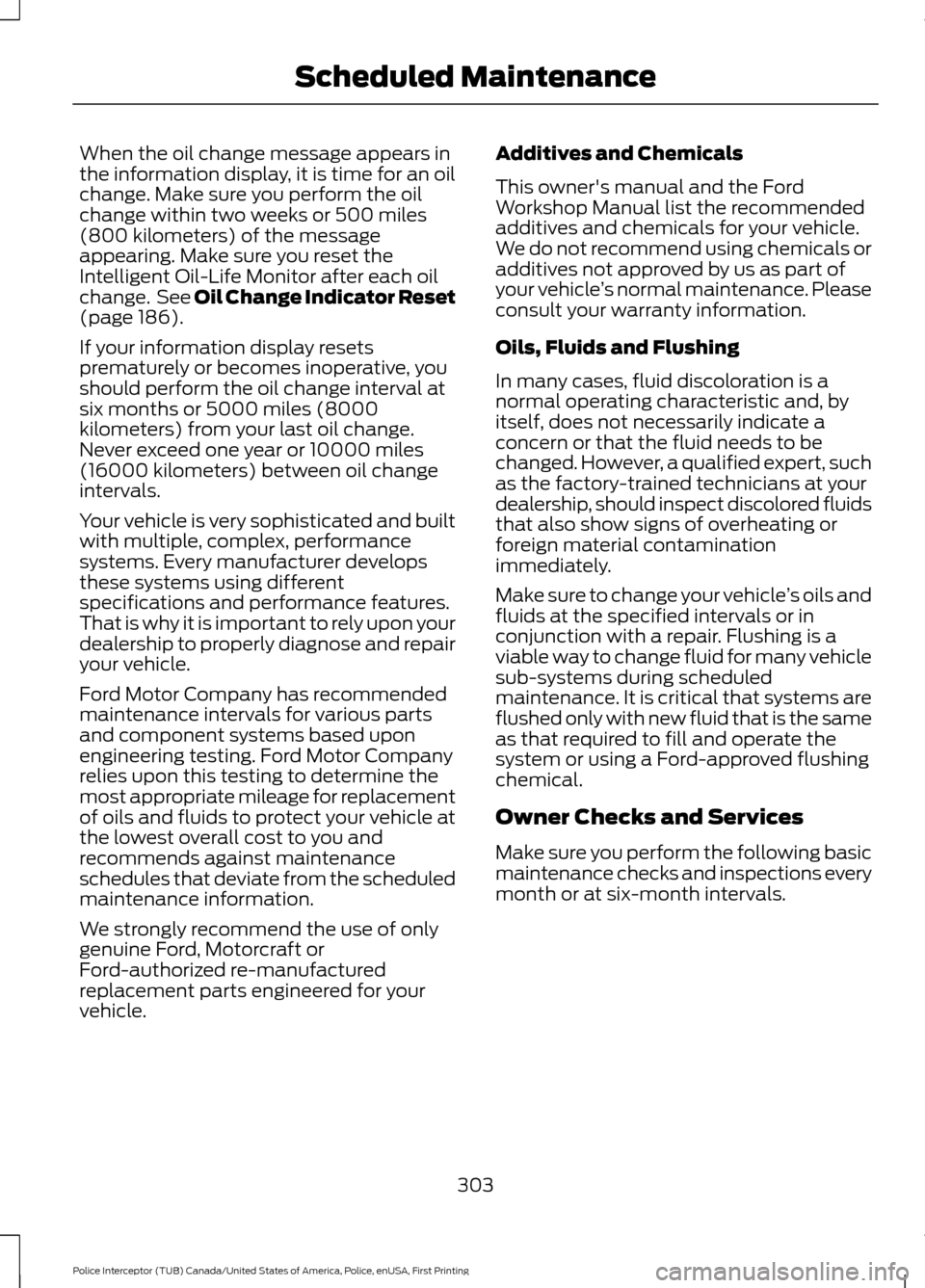
When the oil change message appears in
the information display, it is time for an oil
change. Make sure you perform the oil
change within two weeks or 500 miles
(800 kilometers) of the message
appearing. Make sure you reset the
Intelligent Oil-Life Monitor after each oil
change. See Oil Change Indicator Reset
(page 186).
If your information display resets
prematurely or becomes inoperative, you
should perform the oil change interval at
six months or 5000 miles (8000
kilometers) from your last oil change.
Never exceed one year or 10000 miles
(16000 kilometers) between oil change
intervals.
Your vehicle is very sophisticated and built
with multiple, complex, performance
systems. Every manufacturer develops
these systems using different
specifications and performance features.
That is why it is important to rely upon your
dealership to properly diagnose and repair
your vehicle.
Ford Motor Company has recommended
maintenance intervals for various parts
and component systems based upon
engineering testing. Ford Motor Company
relies upon this testing to determine the
most appropriate mileage for replacement
of oils and fluids to protect your vehicle at
the lowest overall cost to you and
recommends against maintenance
schedules that deviate from the scheduled
maintenance information.
We strongly recommend the use of only
genuine Ford, Motorcraft or
Ford-authorized re-manufactured
replacement parts engineered for your
vehicle. Additives and Chemicals
This owner's manual and the Ford
Workshop Manual list the recommended
additives and chemicals for your vehicle.
We do not recommend using chemicals or
additives not approved by us as part of
your vehicle
’s normal maintenance. Please
consult your warranty information.
Oils, Fluids and Flushing
In many cases, fluid discoloration is a
normal operating characteristic and, by
itself, does not necessarily indicate a
concern or that the fluid needs to be
changed. However, a qualified expert, such
as the factory-trained technicians at your
dealership, should inspect discolored fluids
that also show signs of overheating or
foreign material contamination
immediately.
Make sure to change your vehicle ’s oils and
fluids at the specified intervals or in
conjunction with a repair. Flushing is a
viable way to change fluid for many vehicle
sub-systems during scheduled
maintenance. It is critical that systems are
flushed only with new fluid that is the same
as that required to fill and operate the
system or using a Ford-approved flushing
chemical.
Owner Checks and Services
Make sure you perform the following basic
maintenance checks and inspections every
month or at six-month intervals.
303
Police Interceptor (TUB) Canada/United States of America, Police, enUSA, First Printing Scheduled Maintenance
Page 309 of 360
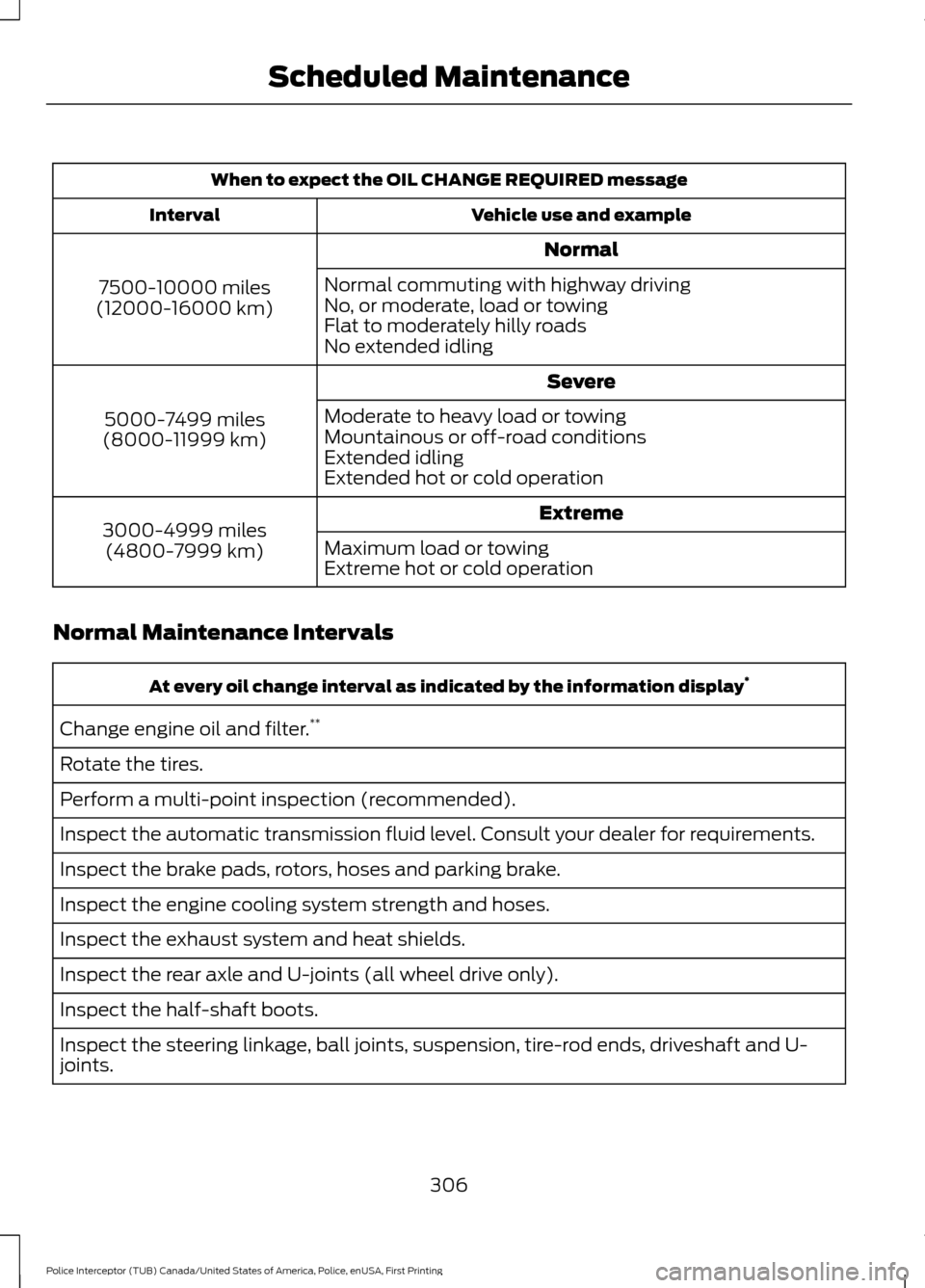
When to expect the OIL CHANGE REQUIRED message
Vehicle use and example
Interval
Normal
7500-10000 miles
(12000-16000 km) Normal commuting with highway driving
No, or moderate, load or towing
Flat to moderately hilly roads
No extended idling
Severe
5000-7499 miles
(8000-11999 km) Moderate to heavy load or towing
Mountainous or off-road conditions
Extended idling
Extended hot or cold operation
Extreme
3000-4999 miles
(4800-7999 km) Maximum load or towing
Extreme hot or cold operation
Normal Maintenance Intervals At every oil change interval as indicated by the information display
*
Change engine oil and filter. **
Rotate the tires.
Perform a multi-point inspection (recommended).
Inspect the automatic transmission fluid level. Consult your dealer for requirements.
Inspect the brake pads, rotors, hoses and parking brake.
Inspect the engine cooling system strength and hoses.
Inspect the exhaust system and heat shields.
Inspect the rear axle and U-joints (all wheel drive only).
Inspect the half-shaft boots.
Inspect the steering linkage, ball joints, suspension, tire-rod ends, driveshaft and U-
joints.
306
Police Interceptor (TUB) Canada/United States of America, Police, enUSA, First Printing Scheduled Maintenance
Page 310 of 360
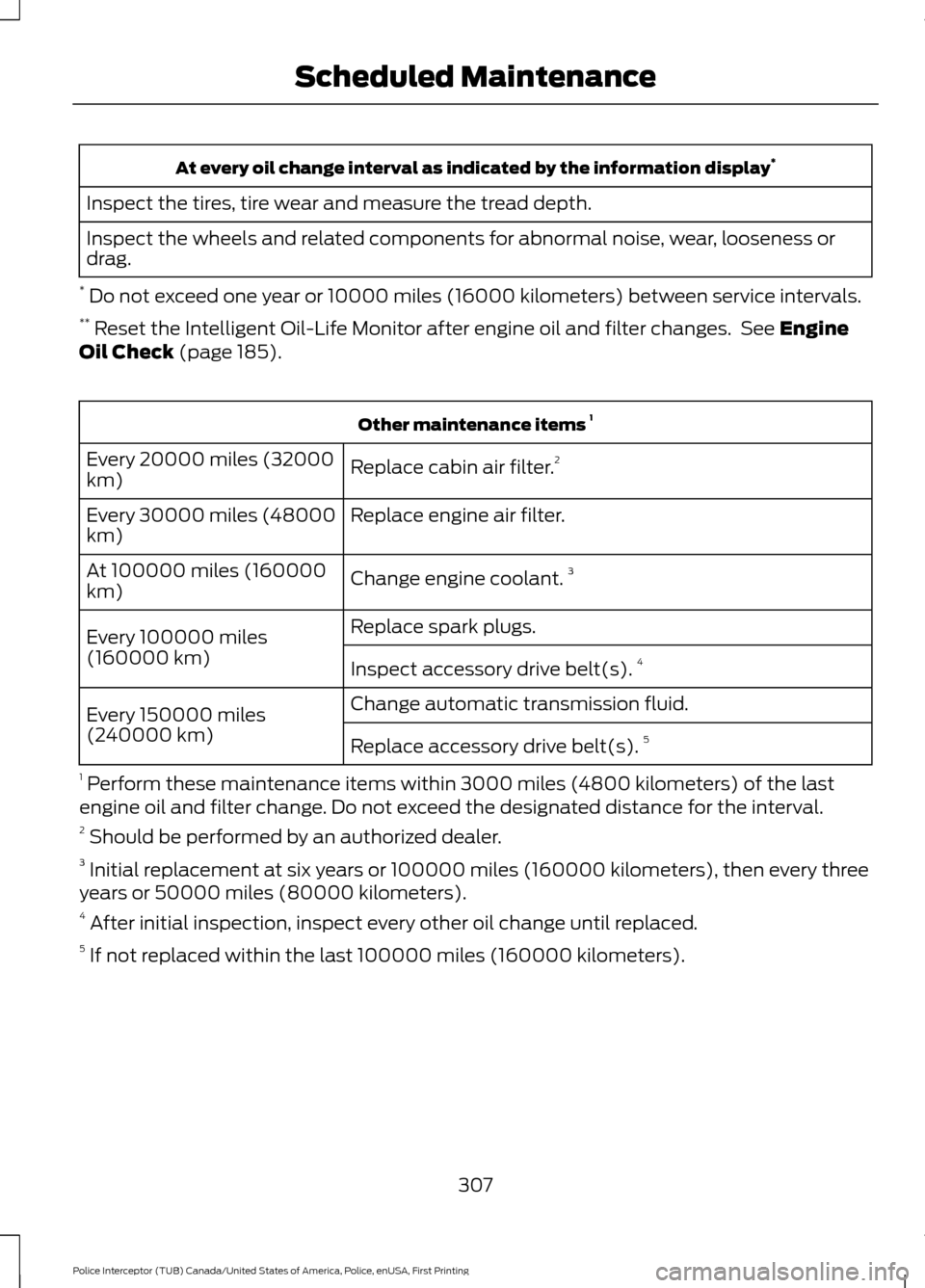
At every oil change interval as indicated by the information display
*
Inspect the tires, tire wear and measure the tread depth.
Inspect the wheels and related components for abnormal noise, wear, looseness or
drag.
* Do not exceed one year or 10000 miles (16000 kilometers) between service intervals.
** Reset the Intelligent Oil-Life Monitor after engine oil and filter changes. See Engine
Oil Check (page 185). Other maintenance items
1
Replace cabin air filter. 2
Every 20000 miles (32000
km)
Replace engine air filter.
Every 30000 miles (48000
km)
Change engine coolant.3
At 100000 miles (160000
km)
Replace spark plugs.
Every 100000 miles
(160000 km) Inspect accessory drive belt(s). 4
Change automatic transmission fluid.
Every 150000 miles
(240000 km)
Replace accessory drive belt(s). 5
1 Perform these maintenance items within 3000 miles (4800 kilometers) of the last
engine oil and filter change. Do not exceed the designated distance for the interval.
2 Should be performed by an authorized dealer.
3 Initial replacement at six years or 100000 miles (160000 kilometers), then every three
years or 50000 miles (80000 kilometers).
4 After initial inspection, inspect every other oil change until replaced.
5 If not replaced within the last 100000 miles (160000 kilometers).
307
Police Interceptor (TUB) Canada/United States of America, Police, enUSA, First Printing Scheduled Maintenance
Page 355 of 360
Getting Assistance Outside the U.S. and
Canada..........................................................167
Getting the Services You Need...............164 Away From Home.............................................. 164
H
Handbrake See: Parking Brake.............................................. 124
Hazard Warning Flashers..........................159
Headlamp Adjusting See: Adjusting the Headlamps..................... 196
Headlamp Removal See: Removing a Headlamp........................... 197
Head Restraints
..............................................93
Adjusting the Head Restraint.......................... 94
Tilting Head Restraints ..................................... 94
Heated Windows and Mirrors....................92 Heated Exterior Mirror........................................ 92
Heated Rear Window.......................................... 92
Heating See: Climate Control.......................................... 90
Hints on Controlling the Interior Climate.............................................................91
Cooling the Interior Quickly............................... 91
General Hints.......................................................... 91
Heating the Interior Quickly............................... 91
Maximum Cooling Performance in Instrument Panel or Instrument Panel
and Footwell Positions................................. 92
Recommended Settings for Cooling ............91
Recommended Settings for Heating.............91
Side Window Defogging in Cold Weather.............................................................. 92
Vehicle Stationary for Extended Periods During Extreme High Ambient
Temperatures.................................................... 91
Hints on Driving With Anti-Lock Brakes.............................................................123
Hood Lock See: Opening and Closing the Hood............181
I
Ignition Switch
..............................................100
In California (U.S. Only).............................165
Information Display Control......................58 Information Displays
......................................77
General Information............................................. 77
Information Messages.................................80 AdvanceTrac ™....................................................... 81
Alarm........................................................................\
. 81
AWD........................................................................\
... 81
Battery and Charging System......................... 82
Blind Spot Information and Cross Traffic Alert System...................................................... 82
Brake System......................................................... 83
Doors and Locks................................................... 83
Engine....................................................................... 84
Fuel........................................................................\
.... 84
Keys and Intelligent Access............................. 84
Lane Keeping System......................................... 85
Maintenance.......................................................... 86
Park Aid................................................................... 86
Park Brake............................................................... 87
Police Engine Idle feature.................................. 87
Power Steering...................................................... 87
Seats........................................................................\
. 87
Starting System.................................................... 88
Tire Pressure Monitoring System................... 88
Traction Control................................................... 88
Transmission......................................................... 89
Installing Child Restraints.............................17 Child Seats............................................................... 17
Using Lap and Shoulder Belts.......................... 18
Using Lower Anchors and Tethers for CHildren (LATCH)........................................... 20
Using Tether Straps............................................. 22
Instrument Cluster..........................................71
Instrument Lighting Dimmer.....................64
Interior Lamps.................................................65 Dome Lamp........................................................... 65
Dome Task Lamp................................................. 66
Front Map Lamps................................................. 65
Rear Interior Lamp............................................... 66
Interior Mirror
...................................................69
Auto-Dimming Mirror......................................... 69
Introduction.........................................................7
J
Jump Starting the Vehicle
.........................160
Connecting the Jumper Cables.................... 160
Jump Starting........................................................ 161
Preparing Your Vehicle..................................... 160
352
Police Interceptor (TUB) Canada/United States of America, Police, enUSA, First Printing Index
Page 358 of 360
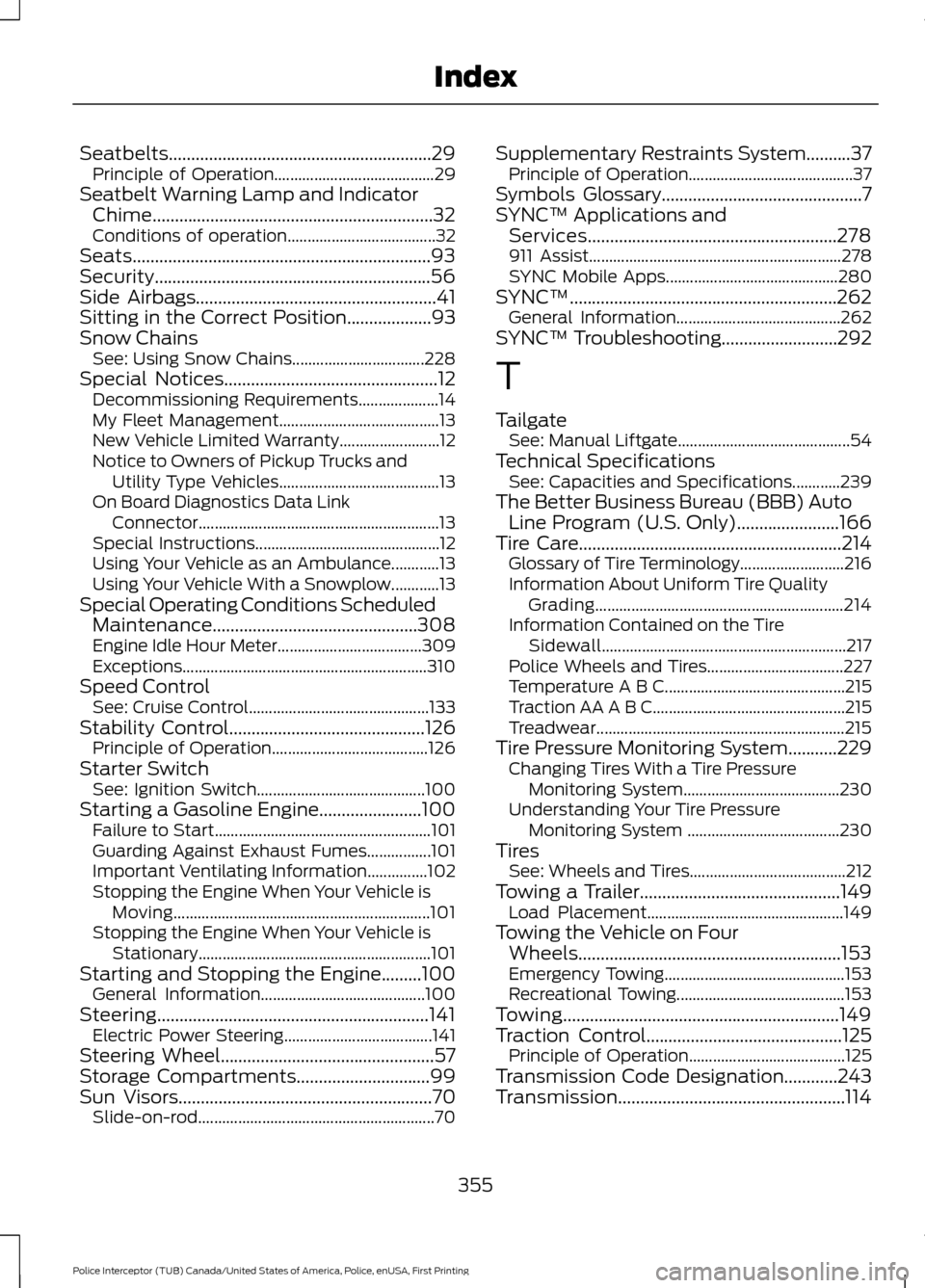
Seatbelts...........................................................29
Principle of Operation........................................ 29
Seatbelt Warning Lamp and Indicator Chime...............................................................32
Conditions of operation..................................... 32
Seats...................................................................93
Security..............................................................56
Side Airbags......................................................41
Sitting in the Correct Position...................93
Snow Chains See: Using Snow Chains................................. 228
Special Notices................................................12 Decommissioning Requirements.................... 14
My Fleet Management........................................ 13
New Vehicle Limited Warranty......................... 12
Notice to Owners of Pickup Trucks and Utility Type Vehicles........................................ 13
On Board Diagnostics Data Link Connector............................................................ 13
Special Instructions.............................................. 12
Using Your Vehicle as an Ambulance............13
Using Your Vehicle With a Snowplow............13
Special Operating Conditions Scheduled Maintenance..............................................308
Engine Idle Hour Meter.................................... 309
Exceptions............................................................. 310
Speed Control See: Cruise Control............................................. 133
Stability Control
............................................126
Principle of Operation....................................... 126
Starter Switch See: Ignition Switch.......................................... 100
Starting a Gasoline Engine.......................100 Failure to Start...................................................... 101
Guarding Against Exhaust Fumes................101
Important Ventilating Information...............102
Stopping the Engine When Your Vehicle is Moving................................................................ 101
Stopping the Engine When Your Vehicle is Stationary.......................................................... 101
Starting and Stopping the Engine.........100 General Information......................................... 100
Steering
.............................................................141
Electric Power Steering..................................... 141
Steering Wheel................................................57
Storage Compartments
..............................99
Sun Visors.........................................................70
Slide-on-rod........................................................... 70Supplementary Restraints System..........37
Principle of Operation......................................... 37
Symbols Glossary
.............................................7
SYNC™ Applications and Services........................................................278
911 Assist............................................................... 278
SYNC Mobile Apps........................................... 280
SYNC™
............................................................262
General Information......................................... 262
SYNC™ Troubleshooting
..........................292
T
Tailgate See: Manual Liftgate........................................... 54
Technical Specifications See: Capacities and Specifications............239
The Better Business Bureau (BBB) Auto Line Program (U.S. Only).......................166
Tire Care
...........................................................214
Glossary of Tire Terminology.......................... 216
Information About Uniform Tire Quality Grading.............................................................. 214
Information Contained on the Tire Sidewall............................................................. 217
Police Wheels and Tires.................................. 227
Temperature A B C............................................. 215
Traction AA A B C................................................ 215
Treadwear.............................................................. 215
Tire Pressure Monitoring System
...........229
Changing Tires With a Tire Pressure
Monitoring System....................................... 230
Understanding Your Tire Pressure Monitoring System ...................................... 230
Tires See: Wheels and Tires....................................... 212
Towing a Trailer.............................................149 Load Placement................................................. 149
Towing the Vehicle on Four Wheels...........................................................153
Emergency Towing............................................. 153
Recreational Towing.......................................... 153
Towing..............................................................149
Traction Control
............................................125
Principle of Operation....................................... 125
Transmission Code Designation............243
Transmission...................................................114
355
Police Interceptor (TUB) Canada/United States of America, Police, enUSA, First Printing Index