engine FORD POSTAL EXPLORER 2001 2.G Owner's Manual
[x] Cancel search | Manufacturer: FORD, Model Year: 2001, Model line: POSTAL EXPLORER, Model: FORD POSTAL EXPLORER 2001 2.GPages: 88, PDF Size: 0.7 MB
Page 34 of 88
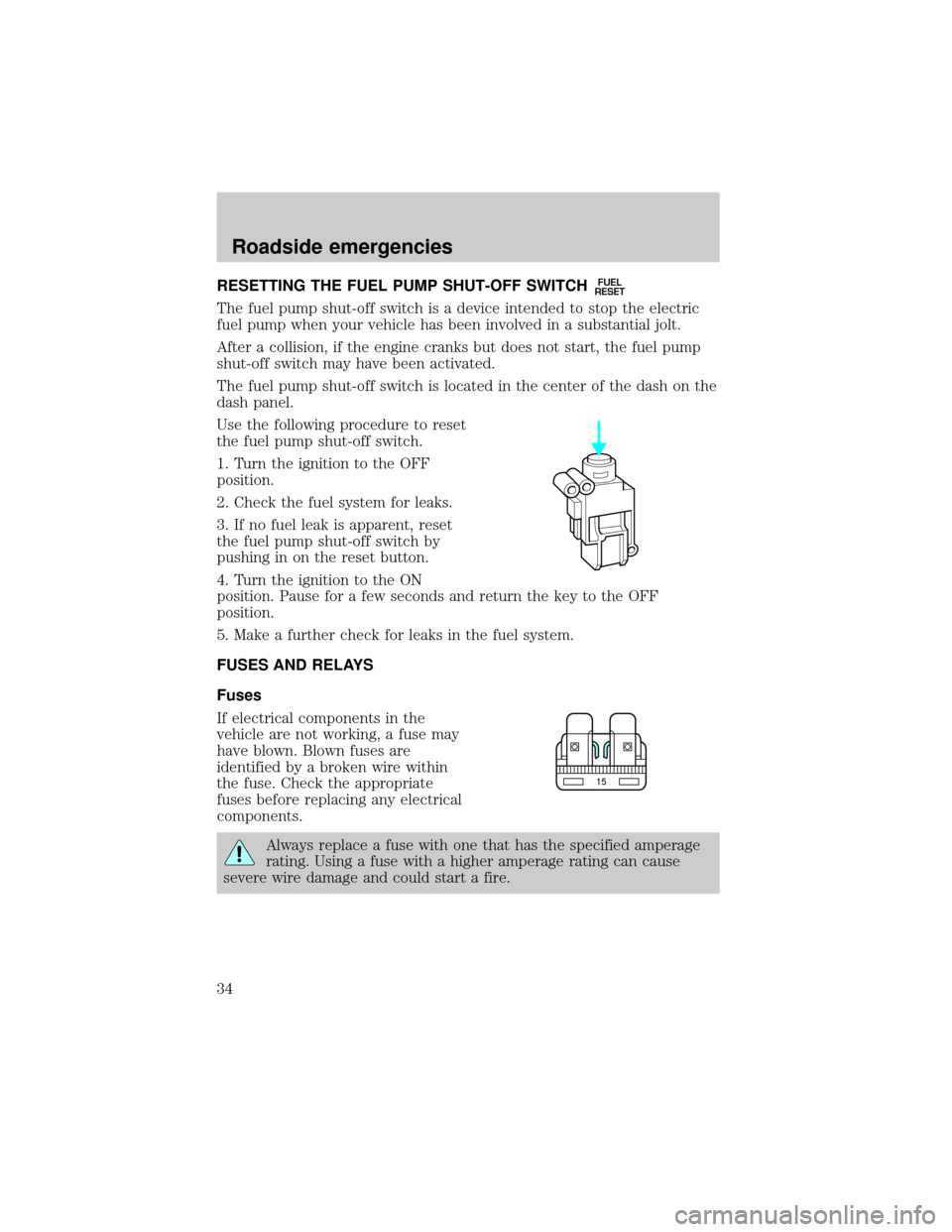
RESETTING THE FUEL PUMP SHUT-OFF SWITCHFUEL
RESET
The fuel pump shut-off switch is a device intended to stop the electric
fuel pump when your vehicle has been involved in a substantial jolt.
After a collision, if the engine cranks but does not start, the fuel pump
shut-off switch may have been activated.
The fuel pump shut-off switch is located in the center of the dash on the
dash panel.
Use the following procedure to reset
the fuel pump shut-off switch.
1. Turn the ignition to the OFF
position.
2. Check the fuel system for leaks.
3. If no fuel leak is apparent, reset
the fuel pump shut-off switch by
pushing in on the reset button.
4. Turn the ignition to the ON
position. Pause for a few seconds and return the key to the OFF
position.
5. Make a further check for leaks in the fuel system.
FUSES AND RELAYS
Fuses
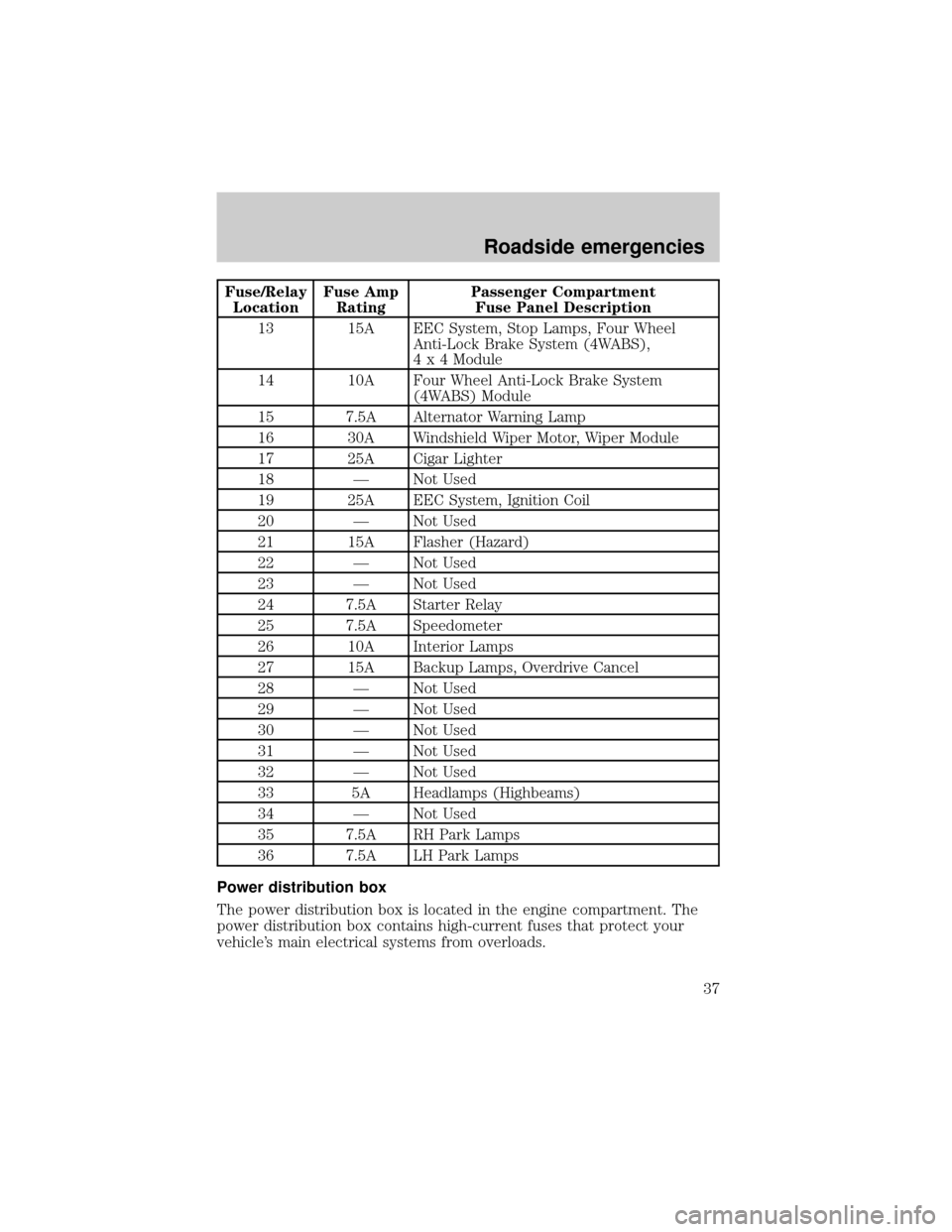
If electrical components in the
vehicle are not working, a fuse may
have blown. Blown fuses are
identified by a broken wire within
the fuse. Check the appropriate
fuses before replacing any electrical
components.
Always replace a fuse with one that has the specified amperage
rating. Using a fuse with a higher amperage rating can cause
severe wire damage and could start a fire.
15
Roadside emergencies
34
Page 37 of 88
Fuse/Relay
LocationFuse Amp
RatingPassenger Compartment
Fuse Panel Description
13 15A EEC System, Stop Lamps, Four Wheel
Anti-Lock Brake System (4WABS),
4 x 4 Module
14 10A Four Wheel Anti-Lock Brake System
(4WABS) Module
15 7.5A Alternator Warning Lamp
16 30A Windshield Wiper Motor, Wiper Module
17 25A Cigar Lighter
18 Ð Not Used
19 25A EEC System, Ignition Coil
20 Ð Not Used
21 15A Flasher (Hazard)
22 Ð Not Used
23 Ð Not Used
24 7.5A Starter Relay
25 7.5A Speedometer
26 10A Interior Lamps
27 15A Backup Lamps, Overdrive Cancel
28 Ð Not Used
29 Ð Not Used
30 Ð Not Used
31 Ð Not Used
32 Ð Not Used
33 5A Headlamps (Highbeams)
34 Ð Not Used
35 7.5A RH Park Lamps
36 7.5A LH Park Lamps
Power distribution box
The power distribution box is located in the engine compartment. The
power distribution box contains high-current fuses that protect your
vehicle's main electrical systems from overloads.
Roadside emergencies
37
Page 39 of 88
Fuse/Relay
LocationFuse Amp
RatingPower Distribution Box Description
2 Ð Not Used
3 Ð Not Used
4 Ð Not Used
5 10A* EEC Memory
6 Ð Not Used
7 15A* Horn
8 Ð Not Used
9 Ð Not Used
10 30A* Alternator System
11 15A* EEC Hego System
1 Ð LH Headlamp Relay
2 Ð Horn Relay
3 Ð RH Headlamp Relay
4 Ð Starter Relay
5 Ð EEC Power Relay
6 Ð Blower Relay
Diode 2 Ð EEC Diode
* Mini Fuses ** Maxi Fuses
Relay module
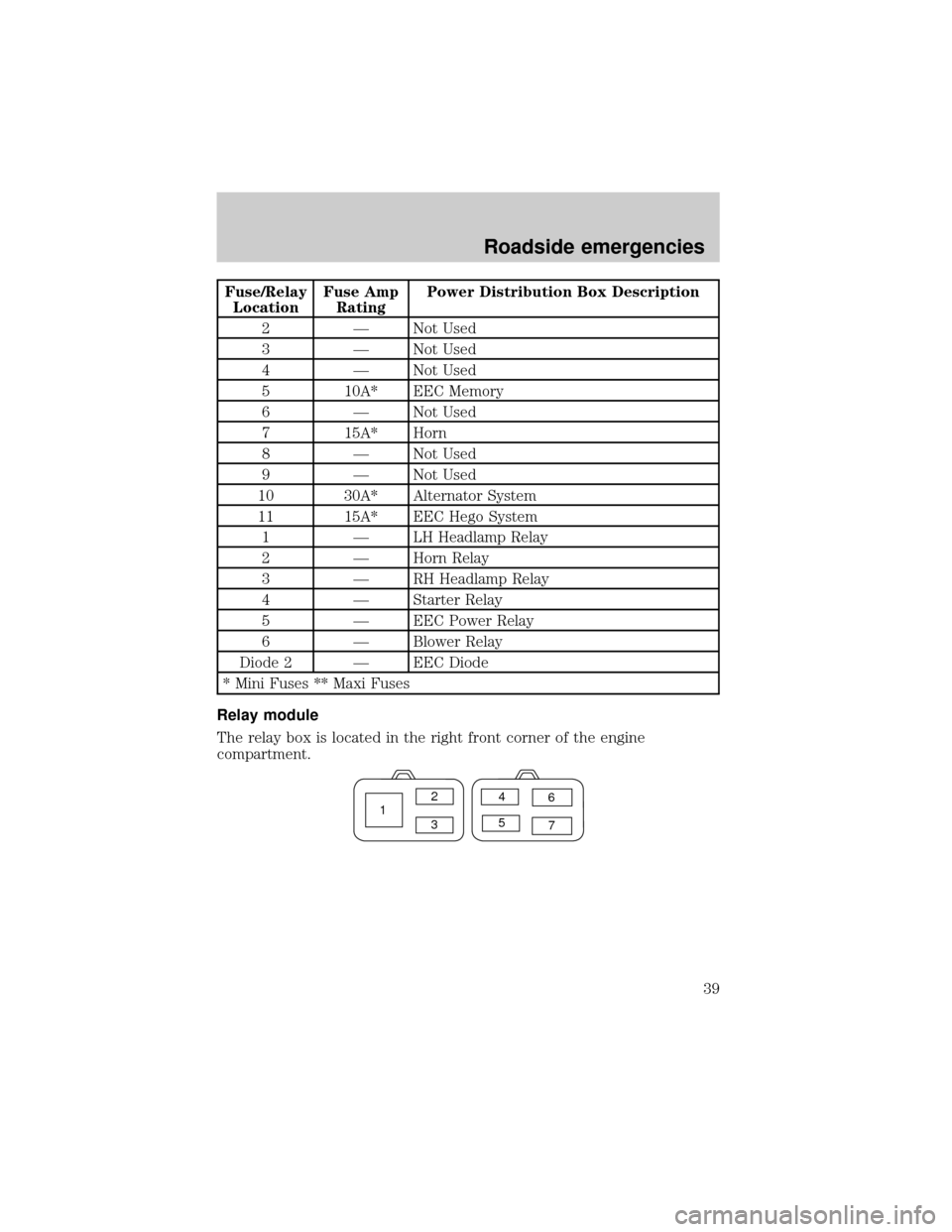
The relay box is located in the right front corner of the engine
compartment.
12
34
56
7
Roadside emergencies
39
Page 40 of 88
The relays are coded as follows:
Relay location Description
1 Side Marker Isolation Relay
2 Fuel Pump Relay
3 Rear Hazard Isolation Relay
4 LH Repeater/Marker Relay
5 RH Repeater/Marker Relay
6 LH Turn/Hazard Relay
7 RH Turn/Hazard Relay
CHANGING THE TIRES
If you get a flat tire while driving, do not apply the brake heavily.
Instead, gradually decrease your speed. Hold the steering wheel firmly
and slowly move to a safe place on the side of the road.
Tire change procedure
To prevent the vehicle from moving when you change a tire, be
sure the parking brake is set, then block (in both directions) the
wheel that is diagonally opposite (other side and end of the vehicle) to
the tire being changed.
If the vehicle slips off the jack, you or someone else could be
seriously injured.
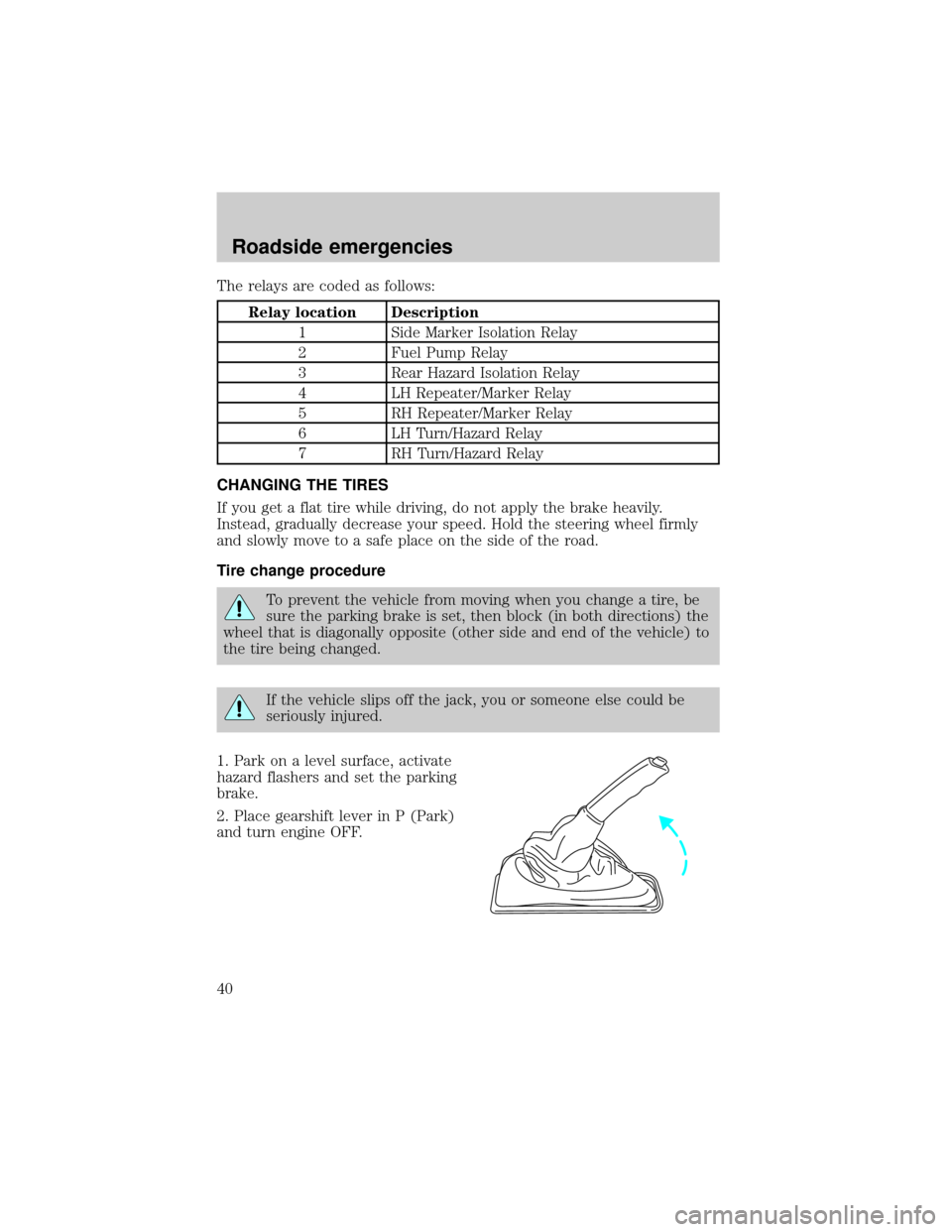
1. Park on a level surface, activate
hazard flashers and set the parking
brake.
2. Place gearshift lever in P (Park)
and turn engine OFF.
Roadside emergencies
40
Page 42 of 88
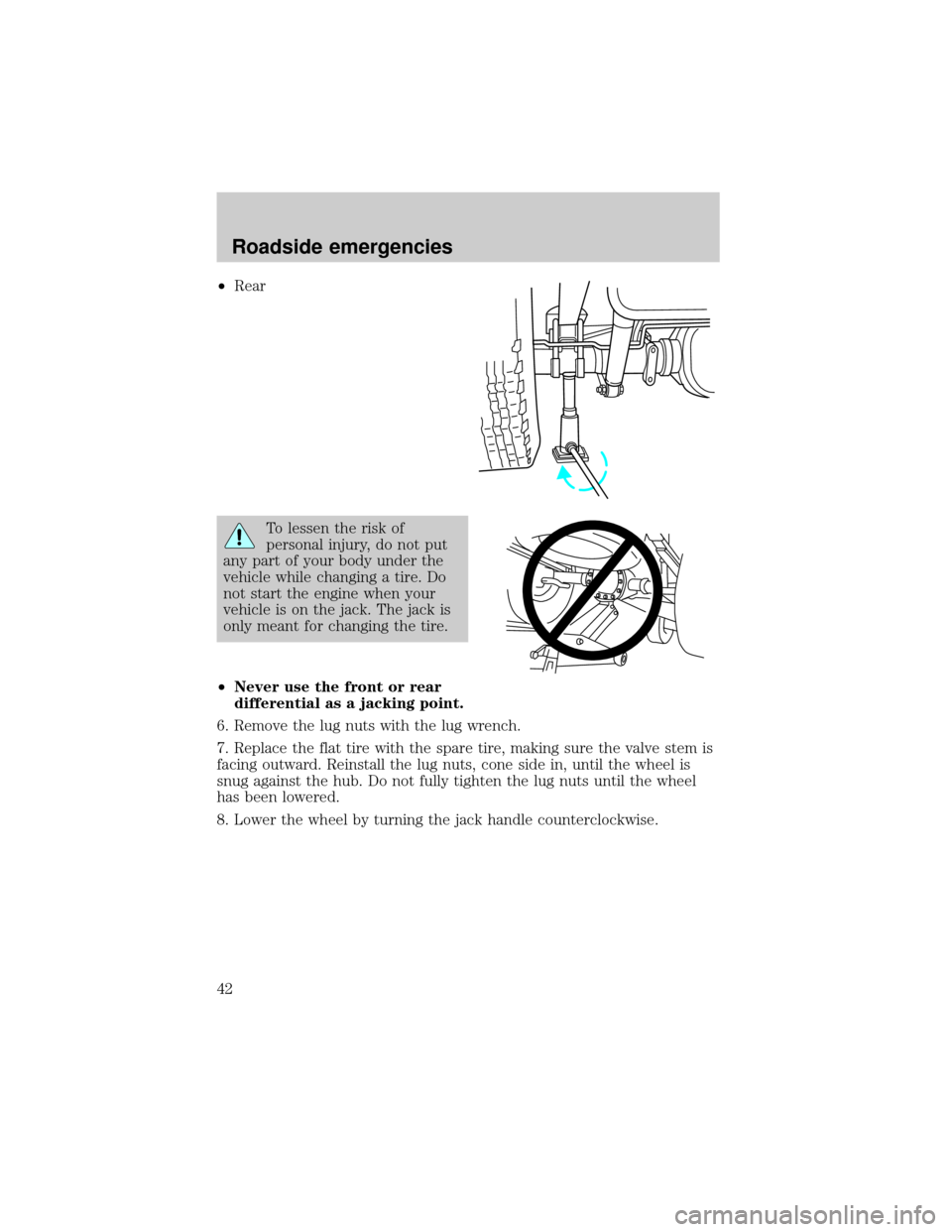
²Rear
To lessen the risk of
personal injury, do not put
any part of your body under the
vehicle while changing a tire. Do
not start the engine when your
vehicle is on the jack. The jack is
only meant for changing the tire.
²Never use the front or rear
differential as a jacking point.
6. Remove the lug nuts with the lug wrench.
7. Replace the flat tire with the spare tire, making sure the valve stem is
facing outward. Reinstall the lug nuts, cone side in, until the wheel is
snug against the hub. Do not fully tighten the lug nuts until the wheel
has been lowered.
8. Lower the wheel by turning the jack handle counterclockwise.
Roadside emergencies
42
Page 44 of 88
both vehicles and stay clear of the engine cooling fan and other moving
parts.
4. Check all battery terminals and remove any excessive corrosion before
you attach the battery cables. Ensure that vent caps are tight and level.
5. Turn the heater fan on in both vehicles to protect any electrical
surges. Turn all other accessories off.
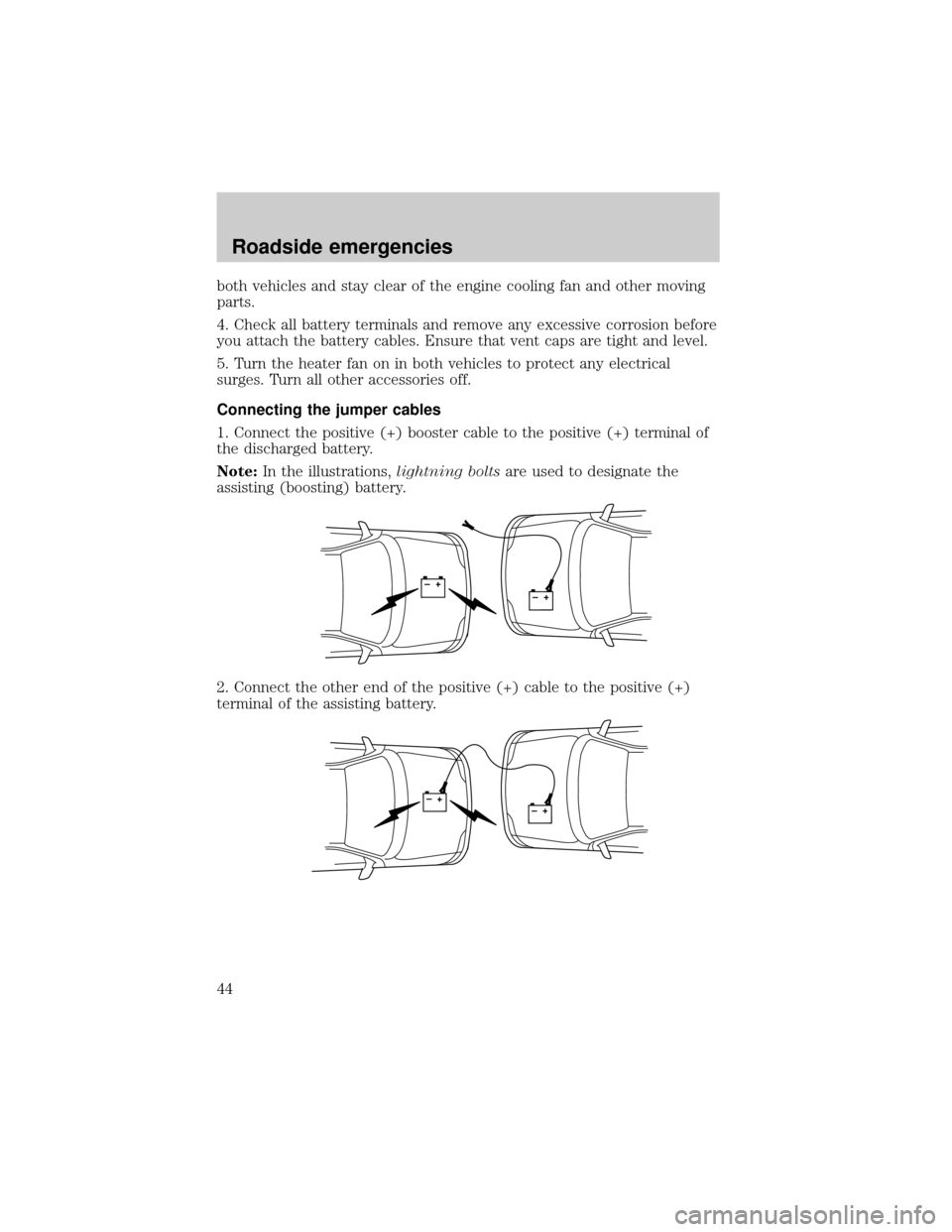
Connecting the jumper cables
1. Connect the positive (+) booster cable to the positive (+) terminal of
the discharged battery.
Note:In the illustrations,lightning boltsare used to designate the
assisting (boosting) battery.
2. Connect the other end of the positive (+) cable to the positive (+)
terminal of the assisting battery.
+–+–
+–+–
Roadside emergencies
44
Page 45 of 88
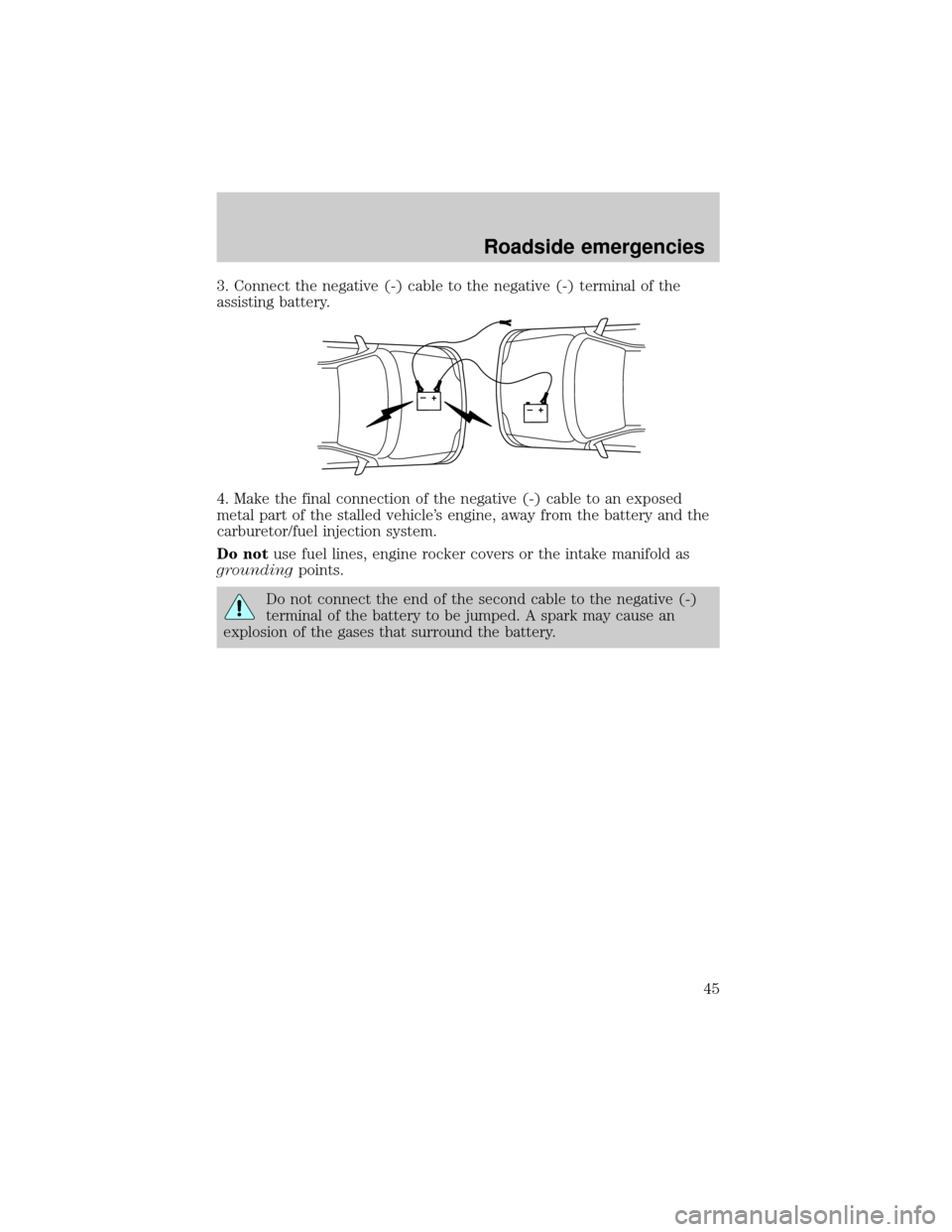
3. Connect the negative (-) cable to the negative (-) terminal of the
assisting battery.
4. Make the final connection of the negative (-) cable to an exposed
metal part of the stalled vehicle's engine, away from the battery and the
carburetor/fuel injection system.
Do notuse fuel lines, engine rocker covers or the intake manifold as
groundingpoints.
Do not connect the end of the second cable to the negative (-)
terminal of the battery to be jumped. A spark may cause an
explosion of the gases that surround the battery.
+–+–
Roadside emergencies
45
Page 46 of 88
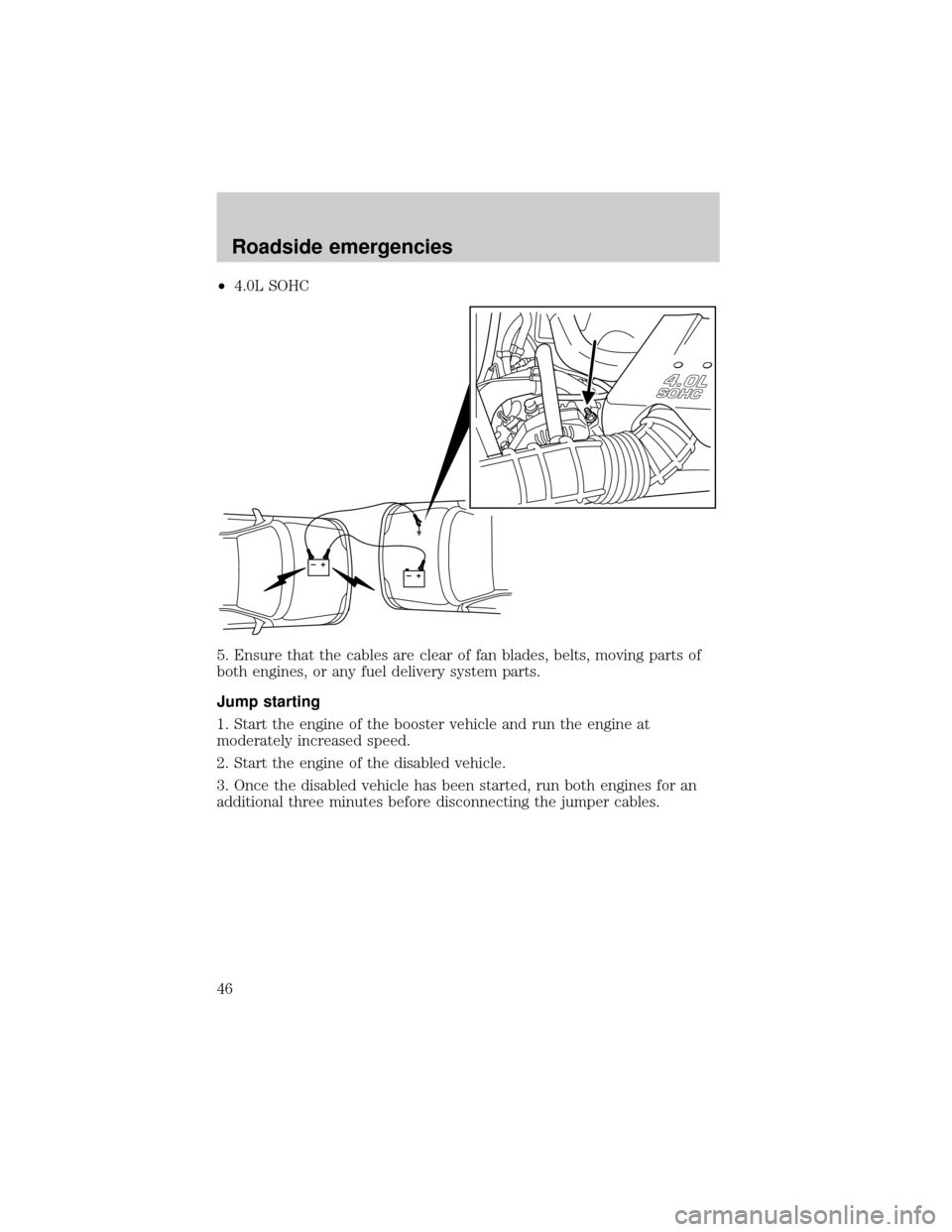
²4.0L SOHC
5. Ensure that the cables are clear of fan blades, belts, moving parts of
both engines, or any fuel delivery system parts.
Jump starting
1. Start the engine of the booster vehicle and run the engine at
moderately increased speed.
2. Start the engine of the disabled vehicle.
3. Once the disabled vehicle has been started, run both engines for an
additional three minutes before disconnecting the jumper cables.
+–+–
Roadside emergencies
46
Page 52 of 88

SERVICE RECOMMENDATIONS
To help you service your vehicle:
²We highlight do-it-yourself items in the engine compartment for easy
location.
²We provide a scheduled maintenance guide which makes tracking
routine service easy.
If your vehicle requires professional service, your dealership can provide
the necessary parts and service. Check your ªWarranty Guideº to find out
which parts and services are covered.
Use only recommended fuels, lubricants, fluids and service parts
conforming to specifications. Motorcraft parts are designed and built to
provide the best performance in your vehicle.
PRECAUTIONS WHEN SERVICING YOUR VEHICLE
Be especially careful when inspecting or servicing your vehicle.
²Do not work on a hot engine.
²When the engine is running, make sure that loose clothing, jewelry or
long hair does not get caught up in moving parts.
²Do not work on a vehicle with the engine running in an enclosed
space, unless you are sure you have enough ventilation.
²Keep all lit cigarettes, open flames and other lit material away from
the battery and all fuel related parts.
If you disconnect the battery, the engine must ªrelearnº its idle
conditions before your vehicle will drive properly, as explained inBattery
in this chapter.
Working with the engine off
1. Set the parking brake and ensure the gearshift is securely latched in P
(Park).
2. Turn off the engine and remove the key.
3. Block the wheels to prevent the vehicle from moving unexpectedly.
Working with the engine on
1. Set the parking brake and ensure the gearshift is securely latched in P
(Park).
2. Block the wheels to prevent the vehicle from moving unexpectedly.
Maintenance and care
52
Page 53 of 88
Do not start your engine with the air cleaner removed and do
not remove it while the engine is running.
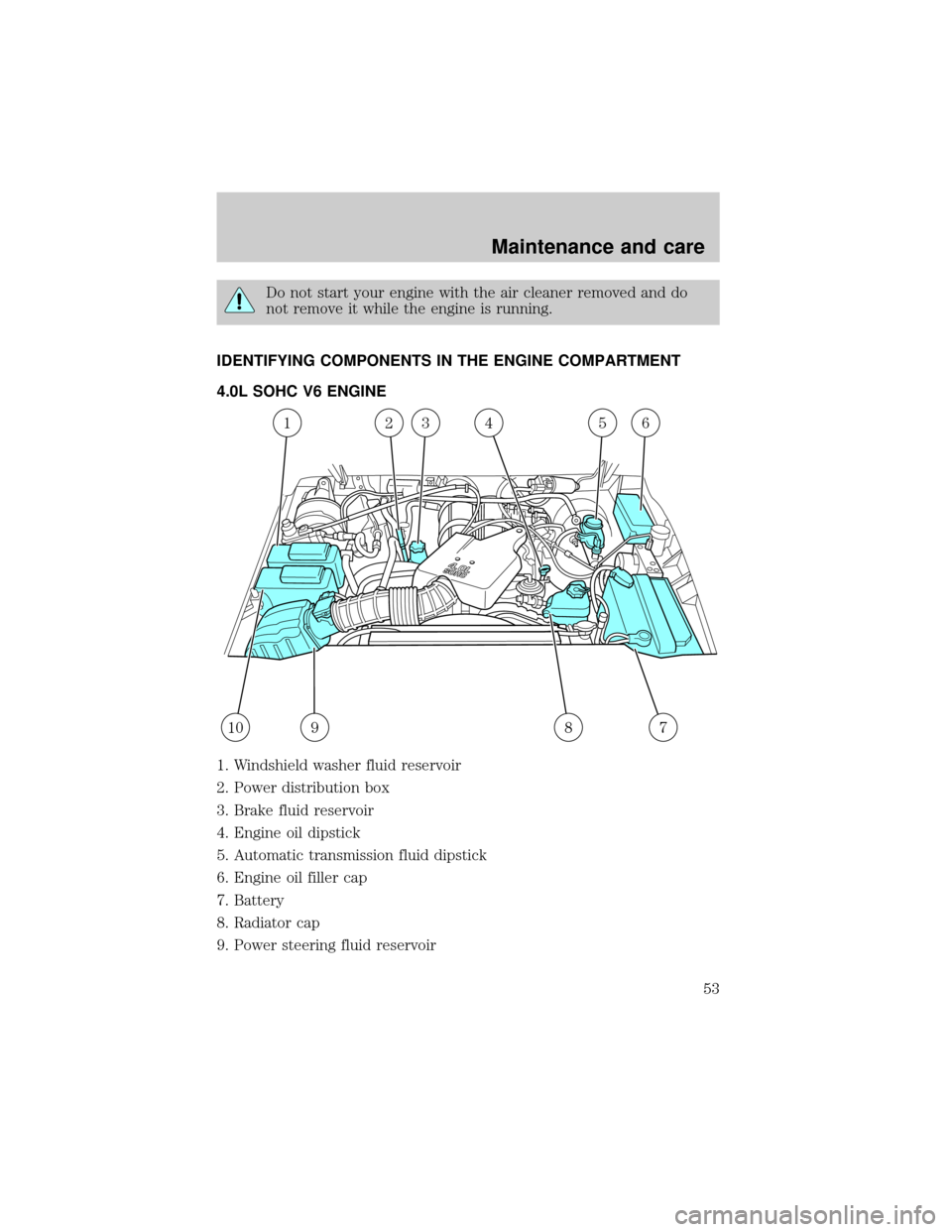
IDENTIFYING COMPONENTS IN THE ENGINE COMPARTMENT
4.0L SOHC V6 ENGINE
1. Windshield washer fluid reservoir
2. Power distribution box
3. Brake fluid reservoir
4. Engine oil dipstick
5. Automatic transmission fluid dipstick
6. Engine oil filler cap
7. Battery
8. Radiator cap
9. Power steering fluid reservoir
10
123456
978
Maintenance and care
53