lock FORD RANGER 1998 2.G Owner's Manual
[x] Cancel search | Manufacturer: FORD, Model Year: 1998, Model line: RANGER, Model: FORD RANGER 1998 2.GPages: 160, PDF Size: 1.38 MB
Page 65 of 160
RABS warning lamp
TheABSwarning lamp in the instrument cluster illuminates if a RABS
fault is detected. Have your vehicle serviced as soon as possible.
Normal braking is still effective
unless the BRAKE warning lamp is
also illuminated.
Using RABS
²In an emergency, applying full pressure may cause the front wheels to
lock.If the front brakes lock, the vehicle cannot be steered.Yo u
should apply the brakes with steadily increasing force, as if
ªsqueezingº the brakes. If you feel the front wheels begin to lock,
momentarily release the pedal and repeat the ªsqueezeº technique.
²We recommend that you familiarize yourself with how the RABS
performs. However, avoid unnecessary risks.
Four-wheel anti-lock brake system (ABS) (if equipped)
On vehicles equipped with an anti-lock braking system (ABS), a noise
from the hydraulic pump motor and pulsation in the pedal may be
observed during ABS braking events. Pedal pulsation coupled with noise
while braking under panic conditions or on loose gravel, bumps, wet or
snowy roads is normal and indicates proper functioning of the vehicle's
anti-lock brake system. If the vehicle has continuous vibration or shudder
while braking, felt mainly in the steering wheel, the vehicle most likely
needs service.
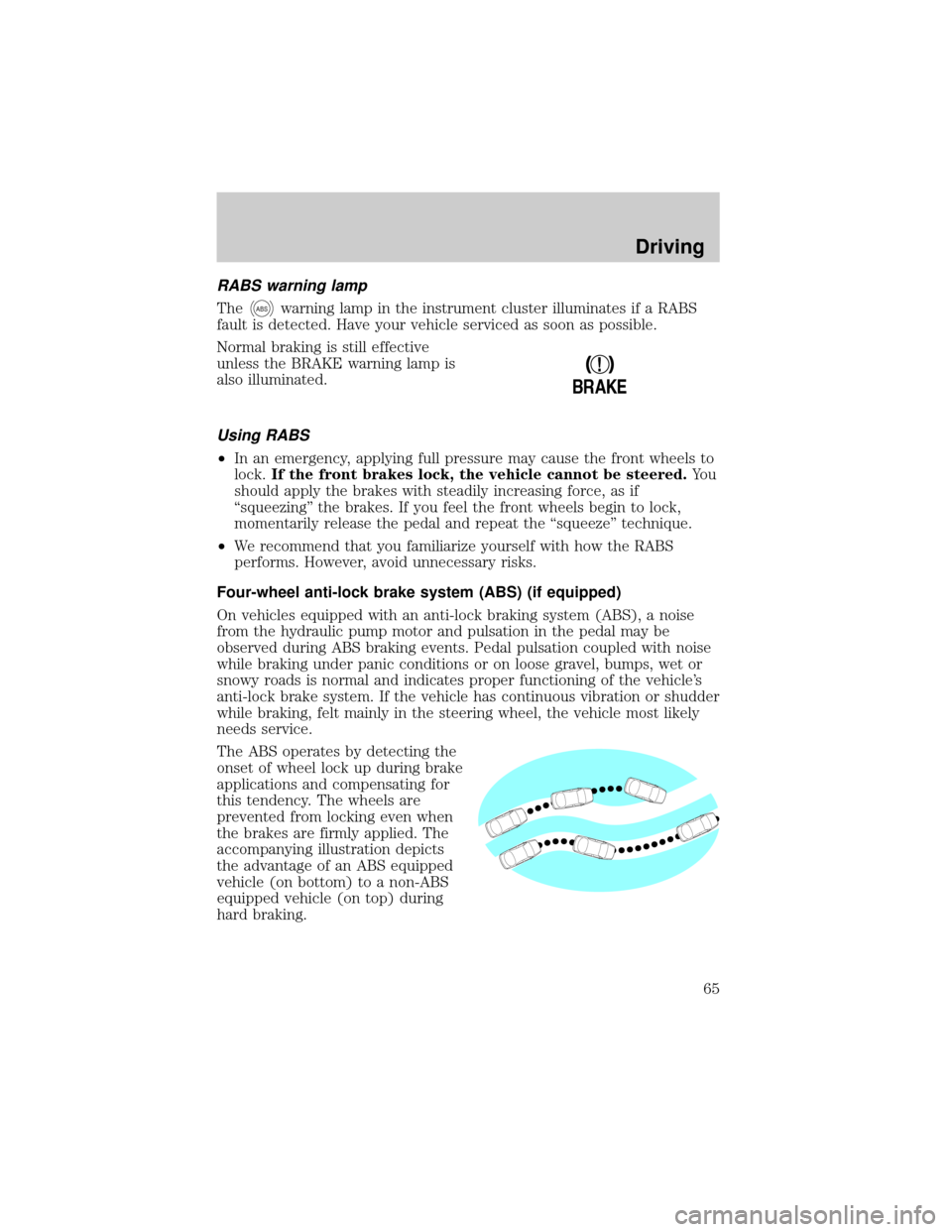
The ABS operates by detecting the
onset of wheel lock up during brake
applications and compensating for
this tendency. The wheels are
prevented from locking even when
the brakes are firmly applied. The
accompanying illustration depicts
the advantage of an ABS equipped
vehicle (on bottom) to a non-ABS
equipped vehicle (on top) during
hard braking.
!
BRAKE
Driving
65
Page 67 of 160
Always set the parking brake fully and make sure that the
gearshift is securely latched in P (Park) (automatic
transmission) or in 1 (First) (manual transmission).
The parking brake is not designed to stop a moving vehicle. However, if
the normal brakes fail, the parking brake can be used to stop your
vehicle in an emergency. Since the parking brake applies only the rear
brakes, the vehicle's stopping distance will be adversely affected.
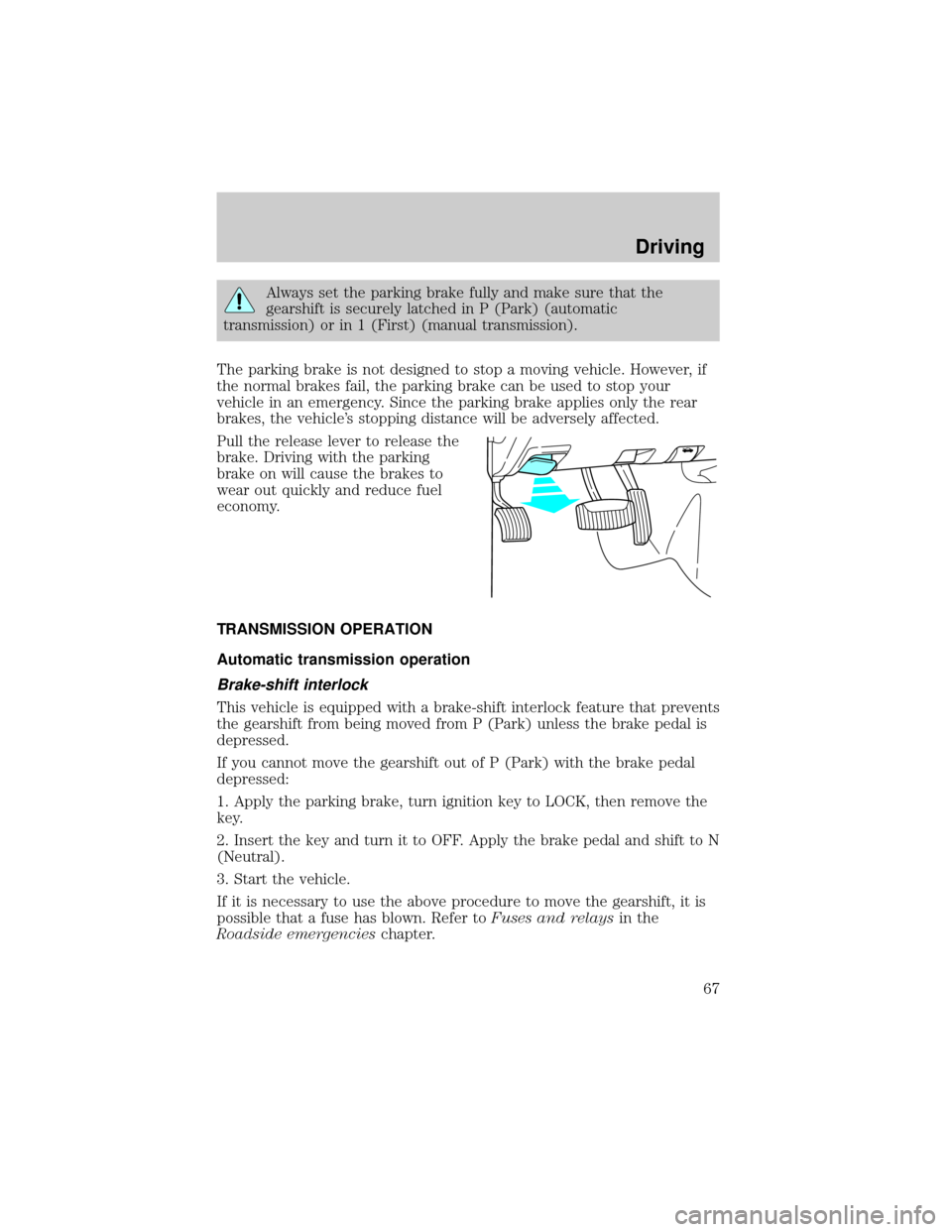
Pull the release lever to release the
brake. Driving with the parking
brake on will cause the brakes to
wear out quickly and reduce fuel
economy.
TRANSMISSION OPERATION
Automatic transmission operation
Brake-shift interlock
This vehicle is equipped with a brake-shift interlock feature that prevents
the gearshift from being moved from P (Park) unless the brake pedal is
depressed.
If you cannot move the gearshift out of P (Park) with the brake pedal
depressed:
1. Apply the parking brake, turn ignition key to LOCK, then remove the
key.
2. Insert the key and turn it to OFF. Apply the brake pedal and shift to N
(Neutral).
3. Start the vehicle.
If it is necessary to use the above procedure to move the gearshift, it is
possible that a fuse has blown. Refer toFuses and relaysin the
Roadside emergencieschapter.
Driving
67
Page 72 of 160
2 (Second)
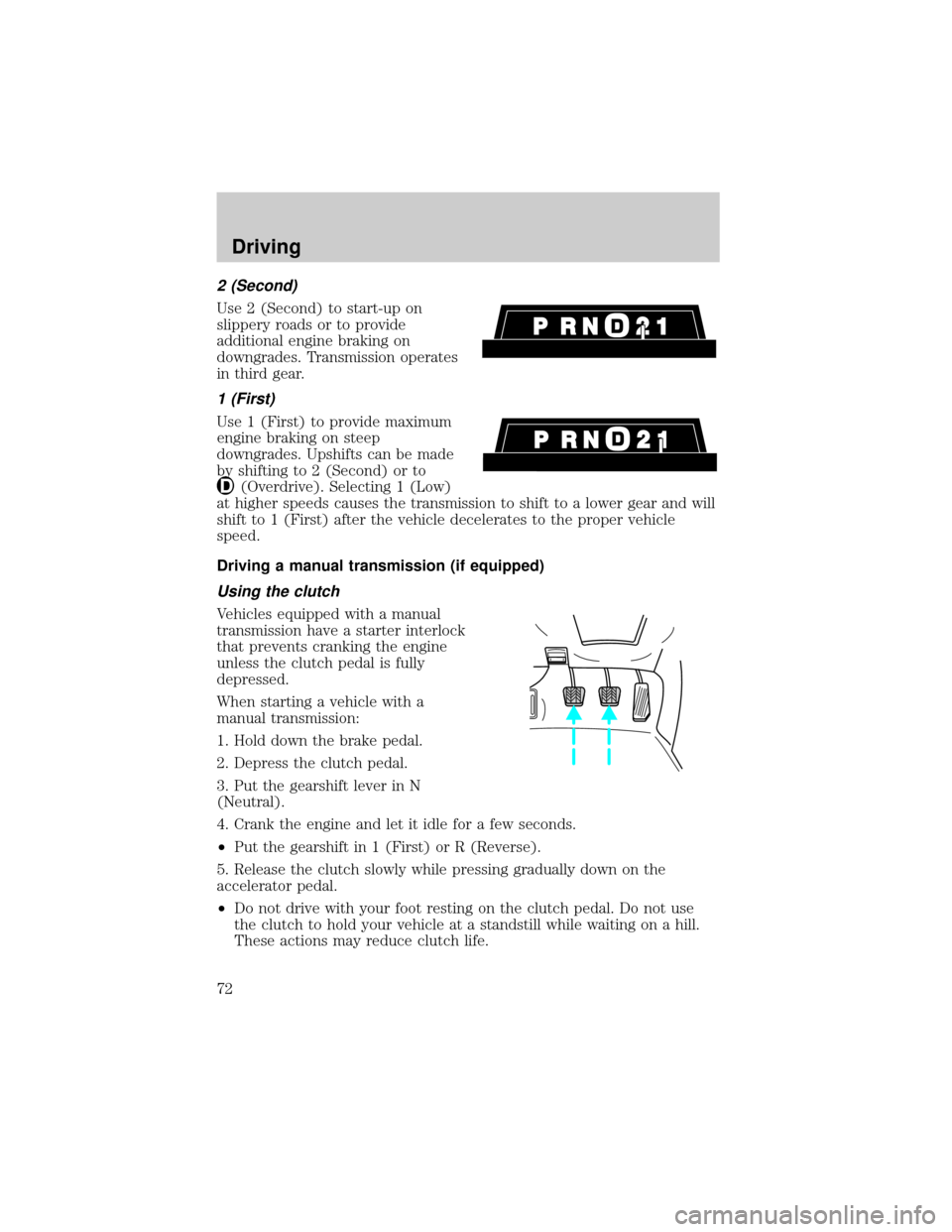
Use 2 (Second) to start-up on
slippery roads or to provide
additional engine braking on
downgrades. Transmission operates
in third gear.
1 (First)
Use 1 (First) to provide maximum
engine braking on steep
downgrades. Upshifts can be made
by shifting to 2 (Second) or to
(Overdrive). Selecting 1 (Low)
at higher speeds causes the transmission to shift to a lower gear and will
shift to 1 (First) after the vehicle decelerates to the proper vehicle
speed.
Driving a manual transmission (if equipped)
Using the clutch
Vehicles equipped with a manual
transmission have a starter interlock
that prevents cranking the engine
unless the clutch pedal is fully
depressed.
When starting a vehicle with a
manual transmission:
1. Hold down the brake pedal.
2. Depress the clutch pedal.
3. Put the gearshift lever in N
(Neutral).
4. Crank the engine and let it idle for a few seconds.
²Put the gearshift in 1 (First) or R (Reverse).
5. Release the clutch slowly while pressing gradually down on the
accelerator pedal.
²Do not drive with your foot resting on the clutch pedal. Do not use
the clutch to hold your vehicle at a standstill while waiting on a hill.
These actions may reduce clutch life.
Driving
72
Page 74 of 160
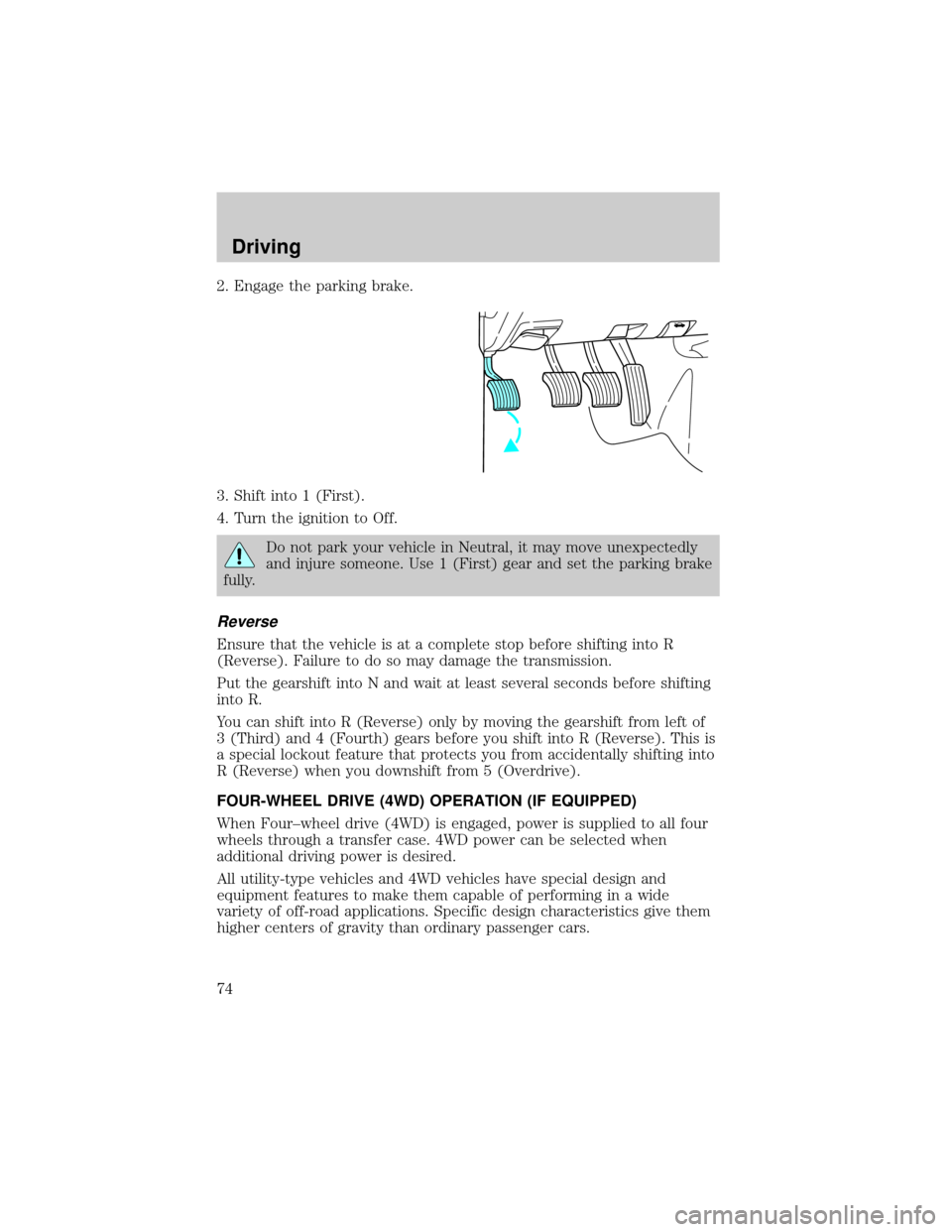
2. Engage the parking brake.
3. Shift into 1 (First).
4. Turn the ignition to Off.
Do not park your vehicle in Neutral, it may move unexpectedly
and injure someone. Use 1 (First) gear and set the parking brake
fully.
Reverse
Ensure that the vehicle is at a complete stop before shifting into R
(Reverse). Failure to do so may damage the transmission.
Put the gearshift into N and wait at least several seconds before shifting
into R.
You can shift into R (Reverse) only by moving the gearshift from left of
3 (Third) and 4 (Fourth) gears before you shift into R (Reverse). This is
a special lockout feature that protects you from accidentally shifting into
R (Reverse) when you downshift from 5 (Overdrive).
FOUR-WHEEL DRIVE (4WD) OPERATION (IF EQUIPPED)
When Four±wheel drive (4WD) is engaged, power is supplied to all four
wheels through a transfer case. 4WD power can be selected when
additional driving power is desired.
All utility-type vehicles and 4WD vehicles have special design and
equipment features to make them capable of performing in a wide
variety of off-road applications. Specific design characteristics give them
higher centers of gravity than ordinary passenger cars.
Driving
74
Page 79 of 160
If speed control cancels after climbing the hill, reset speed by pressing
and holding the SET ACCEL button to resume speeds over 50 km/h
(30 mph).
Automatic transmissions may shift frequently while driving up steep
grades. Eliminate frequent shifting by shifting out of
(Overdrive) into
D (Drive).
Driving on snow and ice
A 4WD vehicle has advantages over 2WD vehicles in snow and ice but
can skid like any other vehicle.
Avoid sudden applications of power and quick changes of direction on
snow and ice. Apply the accelerator slowly and steadily when starting
from a full stop.
When braking, apply the brakes as you normally would. In order to allow
the anti-lock brake system (ABS) to operate properly, keep steady
pressure on the brake pedal.
Allow more stopping distance and drive slower than usual. Consider
using one of the lower gears.
TRACTION-LOK AXLE (IF EQUIPPED)
This axle provides added traction on slippery surfaces, particularly when
one wheel is on a poor traction surface. Under normal conditions, the
Traction-Lok axle functions like a standard rear axle.
Extended use of other than the manufacturer's specified size tires on a
Traction-Lok rear axle could result in a permanent reduction in
effectiveness. This loss of effectiveness does not affect normal driving
and should not be noticeable to the driver.
To avoid injury, never run the engine with one wheel off the
ground, such as when changing a tire.
VEHICLE LOADING
Before loading a vehicle, familiarize yourself with the following terms:
²Base Curb Weight: Weight of the vehicle including any standard
equipment, fluids, lubricants, etc. It does not include passengers or
aftermarket equipment.
Driving
79
Page 90 of 160
2WD (automatic transmissions)
²Release the parking brake and place the transmission in N (Neutral).
²Maximum speed is 56 km/h (35 mph).
²Maximum distance is 80 km (50 miles).
If a distance of 80 km (50 miles) or a speed of 56 km/h (35 mph) must
be exceeded, you must disconnect the driveshaft. Mark the driveshaft
and axle flanges to ensure proper position when reconnecting the
driveshaft. Refer to the ªWorkshop Manualº for proper fastener torque
specifications.
When disconnecting/installing the driveshaft, the parking brake
must be set and the wheels blocked to ensure the vehicle does
not roll.
With the driveshaft disconnected, the maximum speed is 88 km/h
(55 mph) and there are no mileage restrictions.
See your dealer for help with disconnecting the driveshaft.
2WD (manual transmissions)
²Release the parking brake and place the transmission in the neutral
position.
²Maximum speed is 56 km/h (35 mph).
²Maximum distance is limited by towing equipment manufacturer's
recommendation, unlimited distance.
4WD ± Electronic shift transfer case
²Release the parking brake and place transmission in the neutral
position.
²Shift the transfer case to 2H (2WD high).
Both the 4WD HIGH and 4WD LOW indicator lights in the instrument
cluster will be off when the 4WD control is in 2WD.
For automatic transmissions,maximum speed is 56 km/h (35 mph)
and maximum distance is 80 km (50 miles).
²If you must exceed the distance or 80 km (50 miles) and/or speed of
56 km/h (35 mph), you must remove the rear driveshaft. Mark the
Driving
90
Page 91 of 160
driveshaft and axle flanges to ensure proper position when
reconnecting the driveshaft. Refer to the ªWorkshop Manualº for
proper fastener torque specifications.
When disconnecting/installing the driveshaft, the parking brake
must be set and the wheels blocked to ensure the vehicle does
not roll.
²When the driveshaft is disconnected, the maximum speed is 88 km/h
(55 mph) and the distance is unlimited.
²If you must exceed the distance or 80 km (50 miles) and/or speed of
56 km/h (35 mph), you must remove the rear driveshaft. Mark the
driveshaft and axle flanges to ensure proper position when
reconnecting the driveshaft. Refer to the ªWorkshop Manualº for
proper fastener torque specifications.
For manual transmissions,maximum speed is 88 km/h (55 mph) and
distance is unlimited.
Limited vehicle operation, such as driving the vehicle at a campsite, can
be accomplished with the rear driveshaft removed by using the front
drive to propel the vehicle. To operate the vehicle in this condition, you
mustfollow these guidelines:
²Place the transfer case in 4WD by rotating the 4WD control to 4WD
HIGH.
²Drive the vehicle only on good surface roads to avoid excessive loads
on the front-wheel drive system.
²Maximum speed is 56 km/h (35 mph).
²Maximum distance is 80 km (50 miles).
²Avoid quick acceleration and steep grades.
To return the vehicle to a towable condition, youmustplace the transfer
case in 2WD by rotating the 4WD control to 2WD. Both the 4WD HIGH
and 4WD LOW indicator lights in the instrument cluster will be off when
the 4WD control is in 2WD.
In addition, it is recommended that you follow the instruction provided
by the manufacturer of the towing apparatus.
Driving
91
Page 96 of 160

The fuses are coded as follows:
Fuse/
Relay
LocationFuse
Amp
RatingDescription
1 7.5A Power Mirror Switch
2 7.5A Blower Motor Relay, PAD Module, Air Bag
Diagnostic Monitor
3 7.5A Left Stop/Turn Trailer Tow Connector
4 10A Left Headlamp
5 10A Data Link Connector (DLC)
6 - NOT USED
7 7.5A Right Stop/Turn Trailer Tow Connector
8 10A Right Headlamp, Fog Lamp Relay
9 7.5A Brake Pedal Position Switch
10 7.5A Speed Control Servo/Amplifier Assembly, Generic
Electronic Module (GEM), Shift Lock Actuator,
Blend Door Actuator, A/C-Heater Assembly, Turn
Signals
1 234
5 678
9 101112
13 14 15 16
17 18 19 20
21 22 23 24
25 26
29 30
35 36
313233
34
27 28
Roadside emergencies
96
Page 97 of 160

Fuse/
Relay
LocationFuse
Amp
RatingDescription
11 7.5A Instrument Cluster, Daytime Running Lights
(DRL), RABS Resistor
12 - NOT USED
13 20A Brake Pedal Position Switch
14 20A or
10A20A: If equipped with Rear Anti-Lock Brake
System (RABS) Module. 10A: If equipped with
4 Wheel Anti-Lock Brake System (4WABS)
Module, 4WABS Main Relay
15 7.5A Instrument Cluster
16 30A Windshield Wiper Motor, Wiper Hi-Lo Relay,
Wiper Run/Park Relay
17 25A Cigar Lighter
18 15A Driver's Unlock Relay, All-Unlock Relay, All-Lock
Relay
19 25A PCM Power Diode
20 7.5A RAP Module, Generic Electronic Module (GEM),
Radio
21 15A Flasher (Hazard)
22 20A Auxiliary Power Socket
23 Ð Not Used
24 7.5A Clutch Pedal Position (CPP) switch, Starter
Interrupt Relay, Anti-Theft
25 7.5A Generic Electronic Module (GEM), Instrument
Cluster
26 10A Battery Saver Relay, Electronic Shift Relay,
Interior Lamp Relay, Power Window Relay,
Electronic Shift Control Module, Dome/Map
Lamp, GEM
27 15A Electric Shift, Backup Lamps, Daytime Running
Lamps (DRL), Transmission Control Switch
28 7.5A Generic Electronic Module (GEM), Radio
Roadside emergencies
97
Page 99 of 160
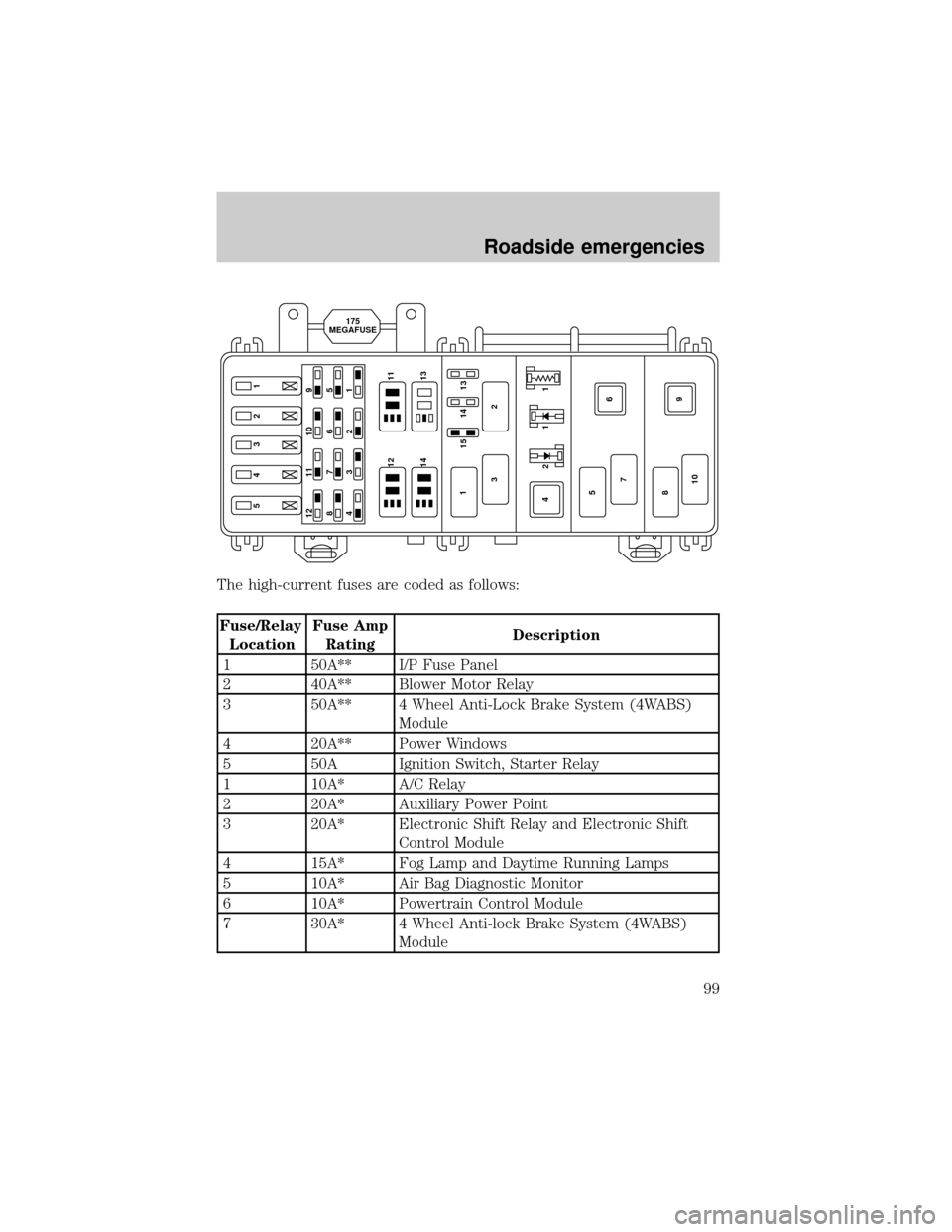
The high-current fuses are coded as follows:
Fuse/Relay
LocationFuse Amp
RatingDescription
1 50A** I/P Fuse Panel
2 40A** Blower Motor Relay
3 50A** 4 Wheel Anti-Lock Brake System (4WABS)
Module
4 20A** Power Windows
5 50A Ignition Switch, Starter Relay
1 10A* A/C Relay
2 20A* Auxiliary Power Point
3 20A* Electronic Shift Relay and Electronic Shift
Control Module
4 15A* Fog Lamp and Daytime Running Lamps
5 10A* Air Bag Diagnostic Monitor
6 10A* Powertrain Control Module
7 30A* 4 Wheel Anti-lock Brake System (4WABS)
Module
5432112 11 10 9
876 5
432 1
14 15 13
9 6
10 87 5 41
2 3
211
175
MEGAFUSE
11
13 12
14
Roadside emergencies
99