belt FORD RANGER 1999 2.G Owner's Manual
[x] Cancel search | Manufacturer: FORD, Model Year: 1999, Model line: RANGER, Model: FORD RANGER 1999 2.GPages: 216, PDF Size: 1.47 MB
Page 94 of 216
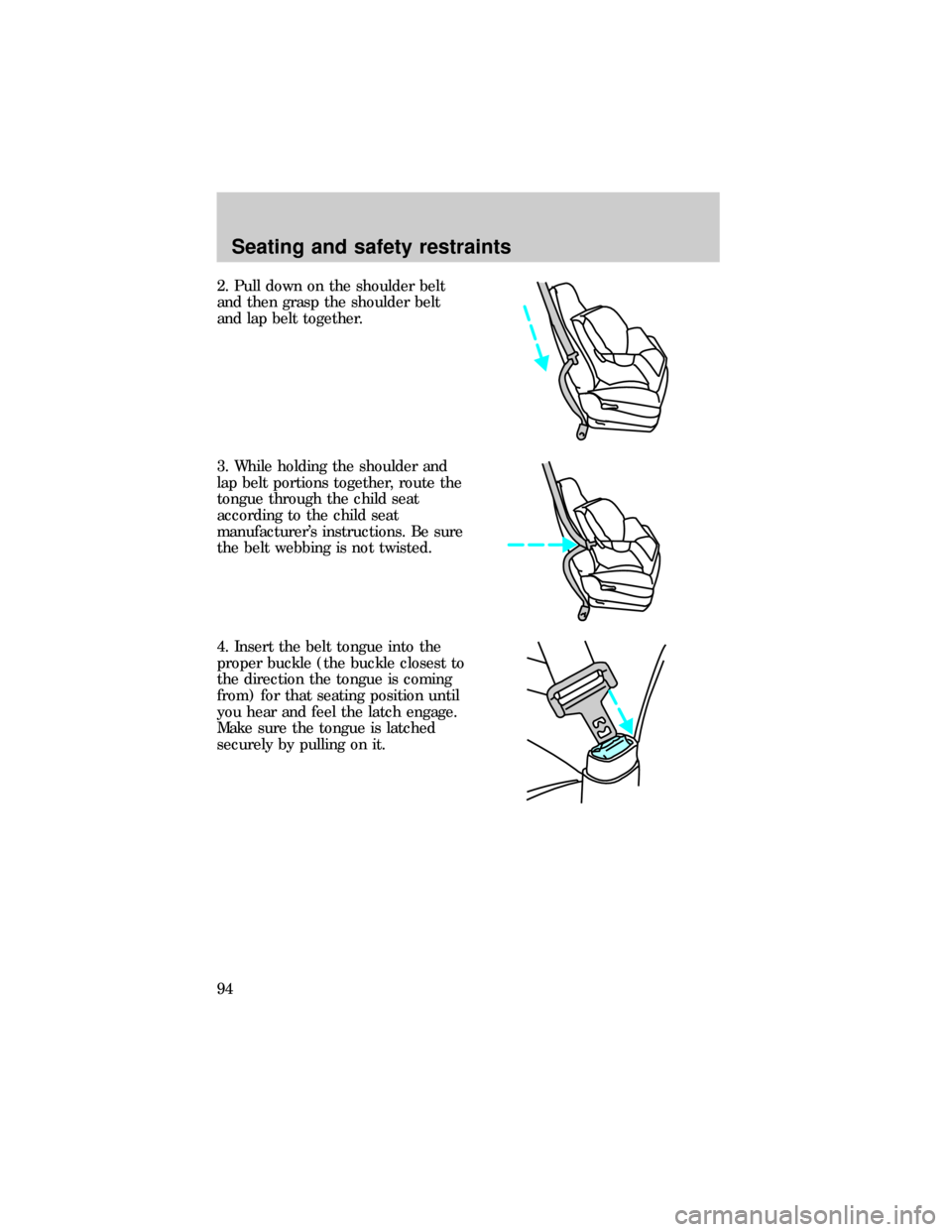
2. Pull down on the shoulder belt
and then grasp the shoulder belt
and lap belt together.
3. While holding the shoulder and
lap belt portions together, route the
tongue through the child seat
according to the child seat
manufacturer's instructions. Be sure
the belt webbing is not twisted.
4. Insert the belt tongue into the
proper buckle (the buckle closest to
the direction the tongue is coming
from) for that seating position until
you hear and feel the latch engage.
Make sure the tongue is latched
securely by pulling on it.
Seating and safety restraints
94
Page 95 of 216
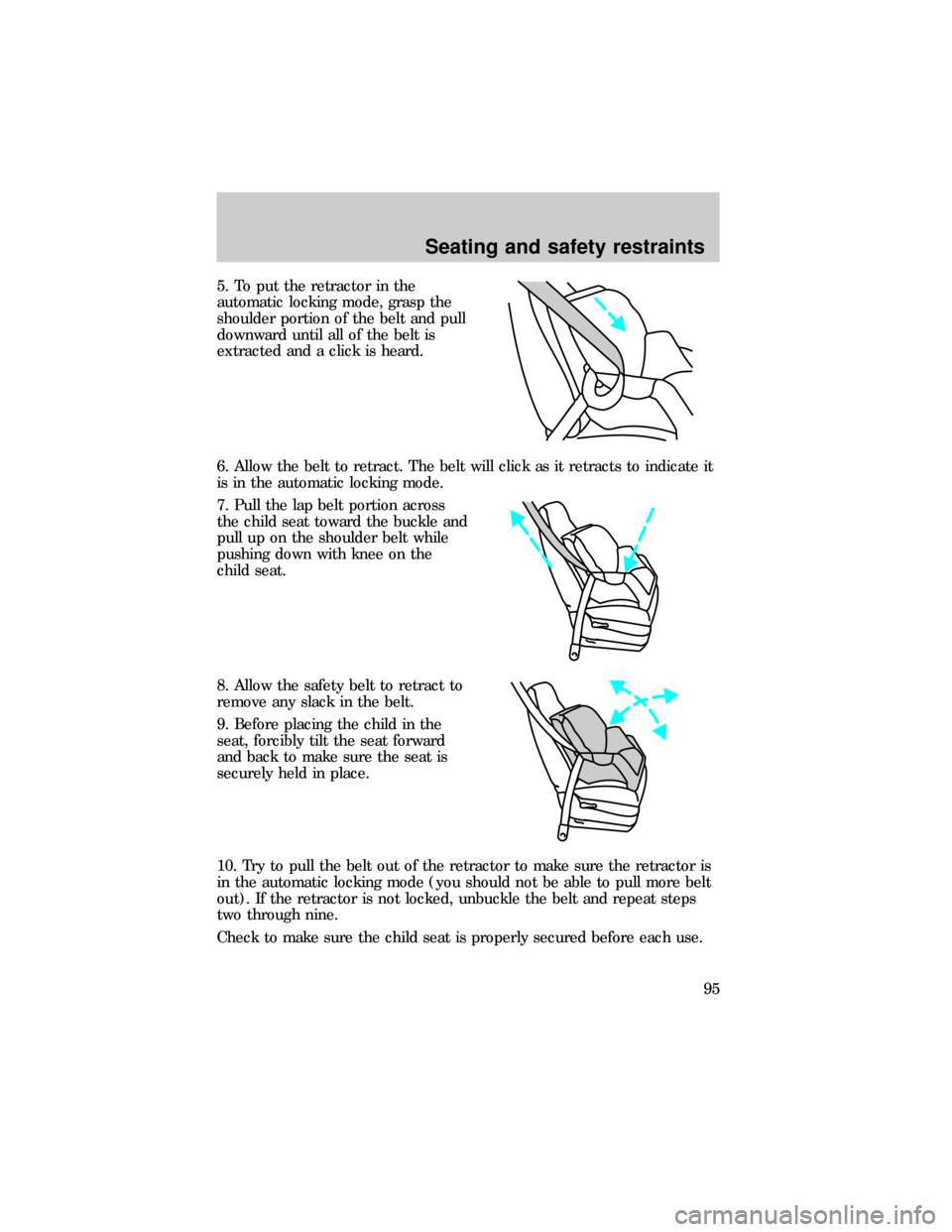
5. To put the retractor in the
automatic locking mode, grasp the
shoulder portion of the belt and pull
downward until all of the belt is
extracted and a click is heard.
6. Allow the belt to retract. The belt will click as it retracts to indicate it
is in the automatic locking mode.
7. Pull the lap belt portion across
the child seat toward the buckle and
pull up on the shoulder belt while
pushing down with knee on the
child seat.
8. Allow the safety belt to retract to
remove any slack in the belt.
9. Before placing the child in the
seat, forcibly tilt the seat forward
and back to make sure the seat is
securely held in place.
10. Try to pull the belt out of the retractor to make sure the retractor is
in the automatic locking mode (you should not be able to pull more belt
out). If the retractor is not locked, unbuckle the belt and repeat steps
two through nine.
Check to make sure the child seat is properly secured before each use.
Seating and safety restraints
95
Page 96 of 216
Attaching safety seats with tether straps
Some manufacturers make safety seats that include a tether strap that
goes over the back of the vehicle seat and attaches to an anchoring
point. Other manufacturers offer the tether strap as an accessory.
Contact the manufacturer of your child safety seat for information about
ordering a tether strap.
In SuperCabs equipped with Center Facing Jump Seats, the tether strap
anchor bracket should be installed only at the center of the cab's back
panel with the child seat in the front center seating position. Installing
an anchor bracket at the right rear of the cab may increase risk of injury
to an occupant of the right rear center facing jump seat in the event of a
collision or a sudden stop. If a tether child seat is installed in the right
front seating position, secure the tether strap to the webbing of the
buckled right rear lap belt.
You can attach a tether strap anchor bracket to the cab inner back panel
by using a tether anchor kit (613D20) available at no charge from any
Ford dealer.
Do not install a child seat in a center facing jump seat.
Tether anchorage hardware
Tether anchorage hardware kits (part number 613D20) including
instructions, may be obtained at no charge from any Ford or
Lincoln-Mercury dealer.
Tighten the anchor according to specifications. Otherwise, the
safety seat may not be properly secured and the child may be
injured in a sudden stop or collision.
Seating and safety restraints
96
Page 98 of 216
Important safety precautions
A computer system controls the engine's idle revolutions per minute
(RPM). When the engine starts, the idle RPM runs faster to warm the
engine. If the engine idle speed does not slow down automatically, have
the vehicle checked. Do not allow the vehicle to idle for more than ten
minutes at high engine RPM.
Before starting the vehicle:
1. Make sure all vehicle occupants have buckled their safety belts. For
more information on safety belts and their proper usage, refer to the
Seating and safety restraintschapter.
2. Make sure the headlamps and vehicle accessories are off.
If starting a vehicle with an automatic transmission:
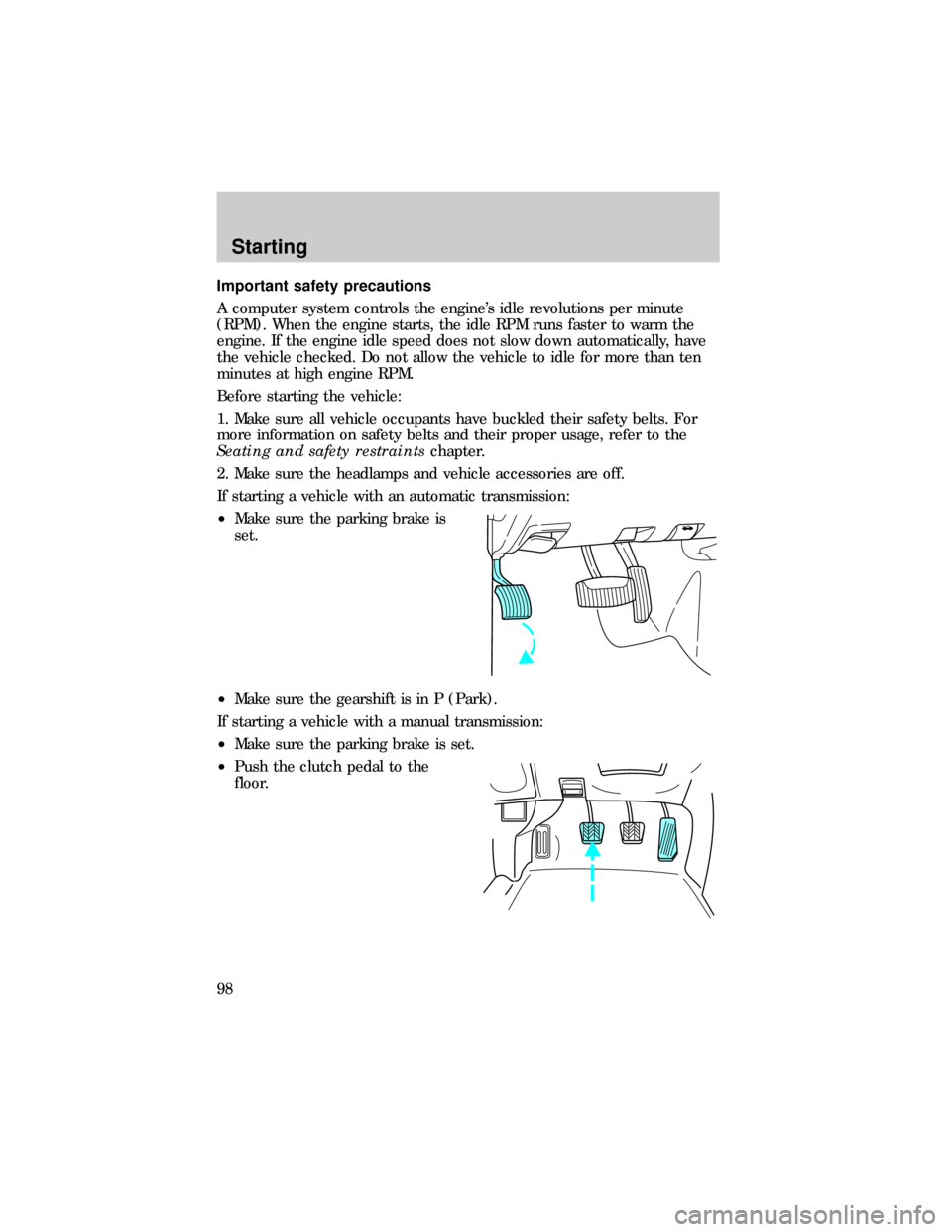
²Make sure the parking brake is
set.
²Make sure the gearshift is in P (Park).
If starting a vehicle with a manual transmission:
²Make sure the parking brake is set.
²Push the clutch pedal to the
floor.
Starting
98
Page 99 of 216
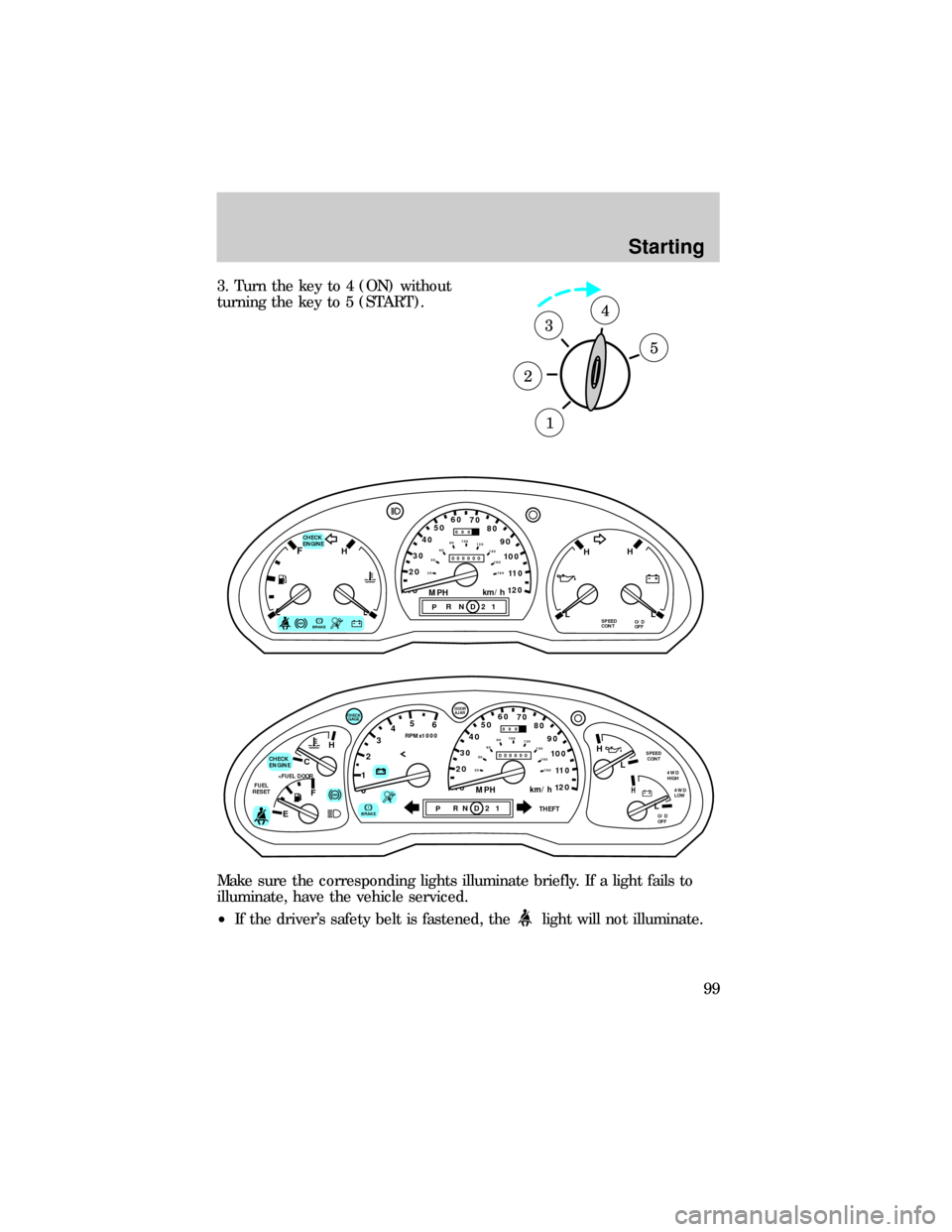
3. Turn the key to 4 (ON) without
turning the key to 5 (START).
Make sure the corresponding lights illuminate briefly. If a light fails to
illuminate, have the vehicle serviced.
²If the driver's safety belt is fastened, the
light will not illuminate.
1
2
34
5
ABS
CHECK
ENGINEFH
H H
PRND21ELSPEED
CONTO/D
OFFLL
10MPH 205060
70
304080
90
km/h
0 0 0
10 100
1
20
1
0 0 0 0 0 0406080100
120
140
160
180
20
!BRAKE
C
012345
6
RPMx1000
ABS
CHECK
ENGINE
FUEL
RESET
EFH
H
H
PRN D 2 1THEFT
SPEED
CONT
4WD
HIGH
4WD
LOW
O/D
OFFL
L
10MPH 205060
70
304080
90
km/h
0 0 0
10 100
1
20
1
0 0 0 0 0 0406080100
120
140
160
180
20
AJAR
CHECK
GAGE
!BRAKE
Starting
99
Page 149 of 216
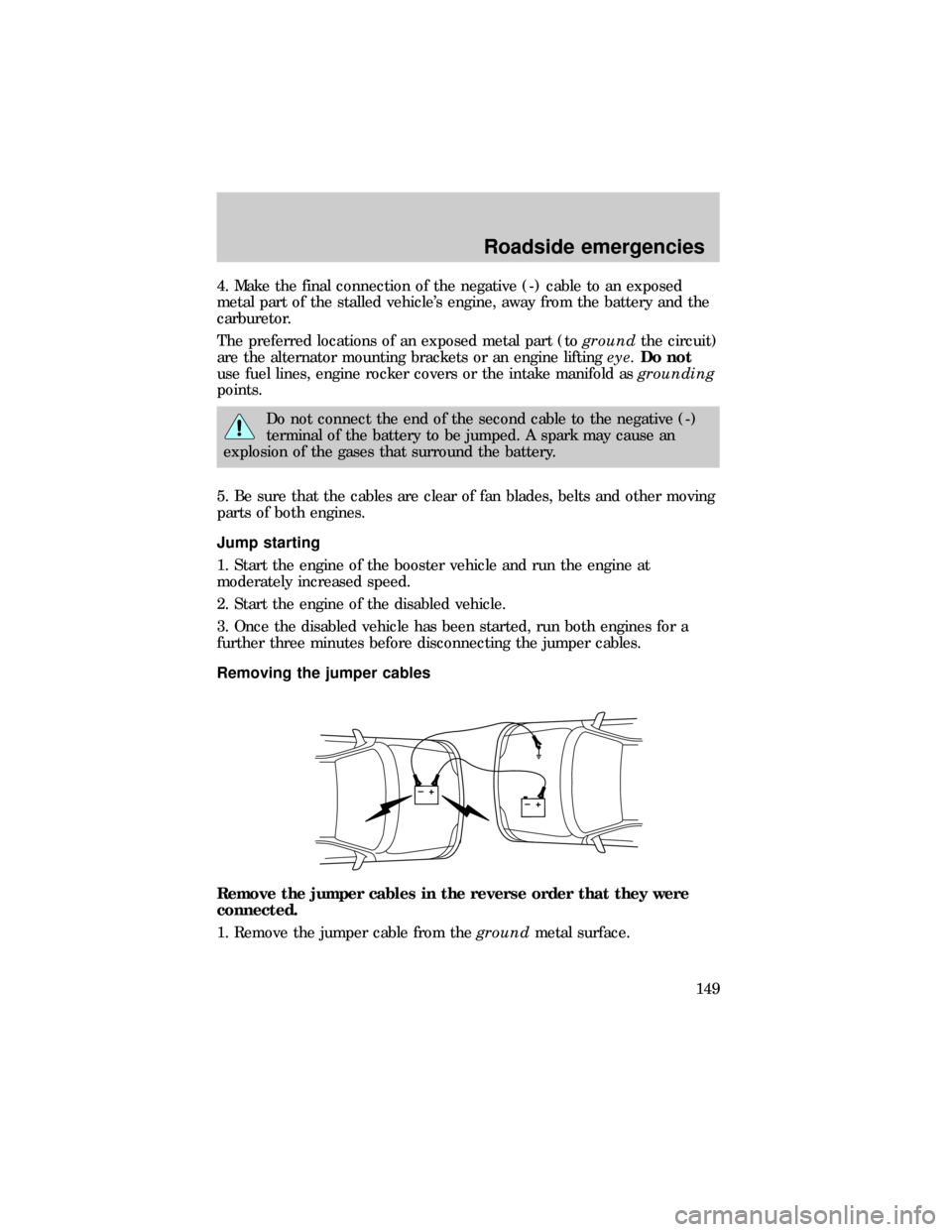
4. Make the final connection of the negative (-) cable to an exposed
metal part of the stalled vehicle's engine, away from the battery and the
carburetor.
The preferred locations of an exposed metal part (togroundthe circuit)
are the alternator mounting brackets or an engine liftingeye.Do not
use fuel lines, engine rocker covers or the intake manifold asgrounding
points.
Do not connect the end of the second cable to the negative (-)
terminal of the battery to be jumped. A spark may cause an
explosion of the gases that surround the battery.
5. Be sure that the cables are clear of fan blades, belts and other moving
parts of both engines.
Jump starting
1. Start the engine of the booster vehicle and run the engine at
moderately increased speed.
2. Start the engine of the disabled vehicle.
3. Once the disabled vehicle has been started, run both engines for a
further three minutes before disconnecting the jumper cables.
Removing the jumper cables
Remove the jumper cables in the reverse order that they were
connected.
1. Remove the jumper cable from thegroundmetal surface.
+–+–
Roadside emergencies
149
Page 151 of 216
4. Remove the jumper cable from the positive (+) terminal of the
disabled vehicle's battery.
After the disabled vehicle has been started and the jumper cables
removed, allow it to idle for several minutes so the engine computer can
relearnits idle conditions.
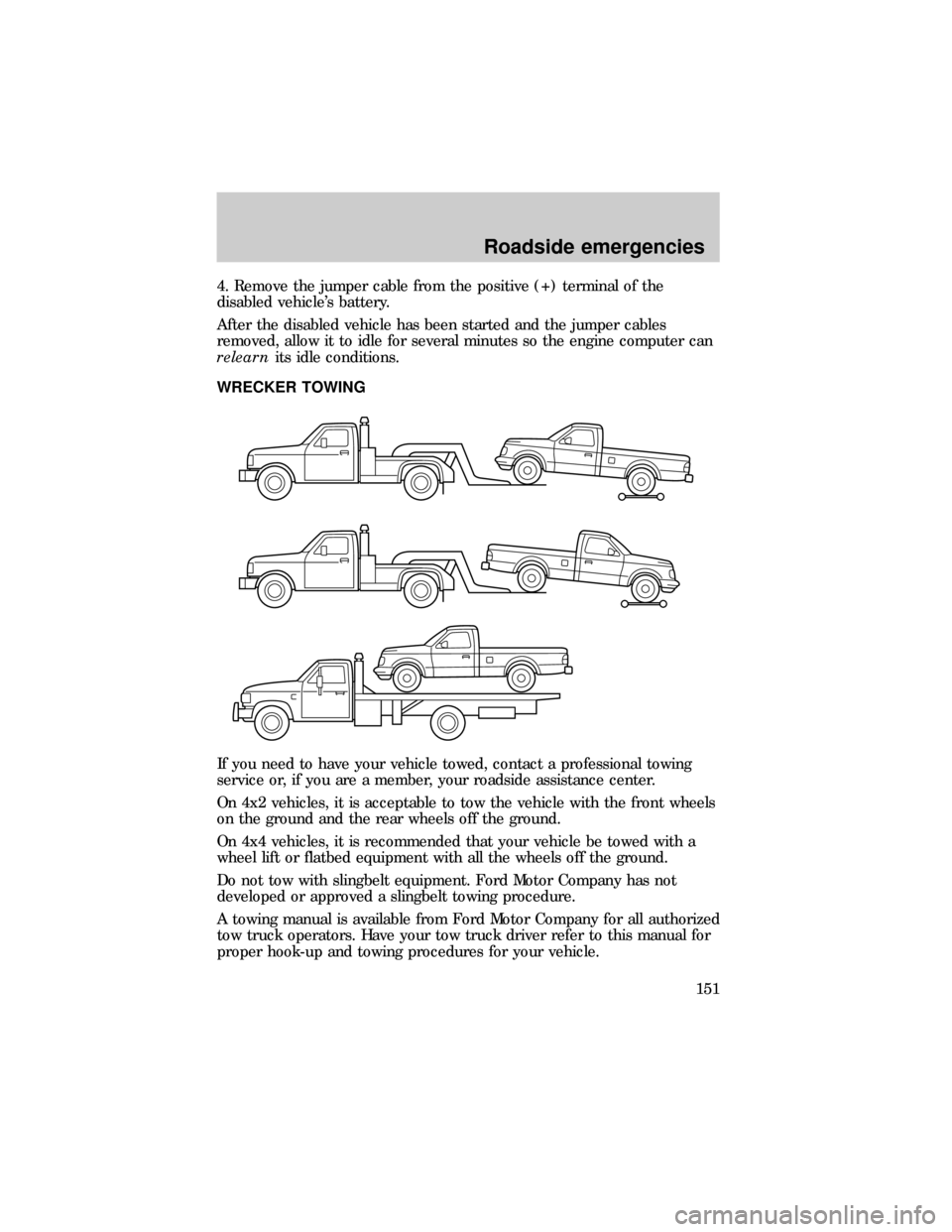
WRECKER TOWING
If you need to have your vehicle towed, contact a professional towing
service or, if you are a member, your roadside assistance center.
On 4x2 vehicles, it is acceptable to tow the vehicle with the front wheels
on the ground and the rear wheels off the ground.
On 4x4 vehicles, it is recommended that your vehicle be towed with a
wheel lift or flatbed equipment with all the wheels off the ground.
Do not tow with slingbelt equipment. Ford Motor Company has not
developed or approved a slingbelt towing procedure.
A towing manual is available from Ford Motor Company for all authorized
tow truck operators. Have your tow truck driver refer to this manual for
proper hook-up and towing procedures for your vehicle.
Roadside emergencies
151
Page 176 of 216
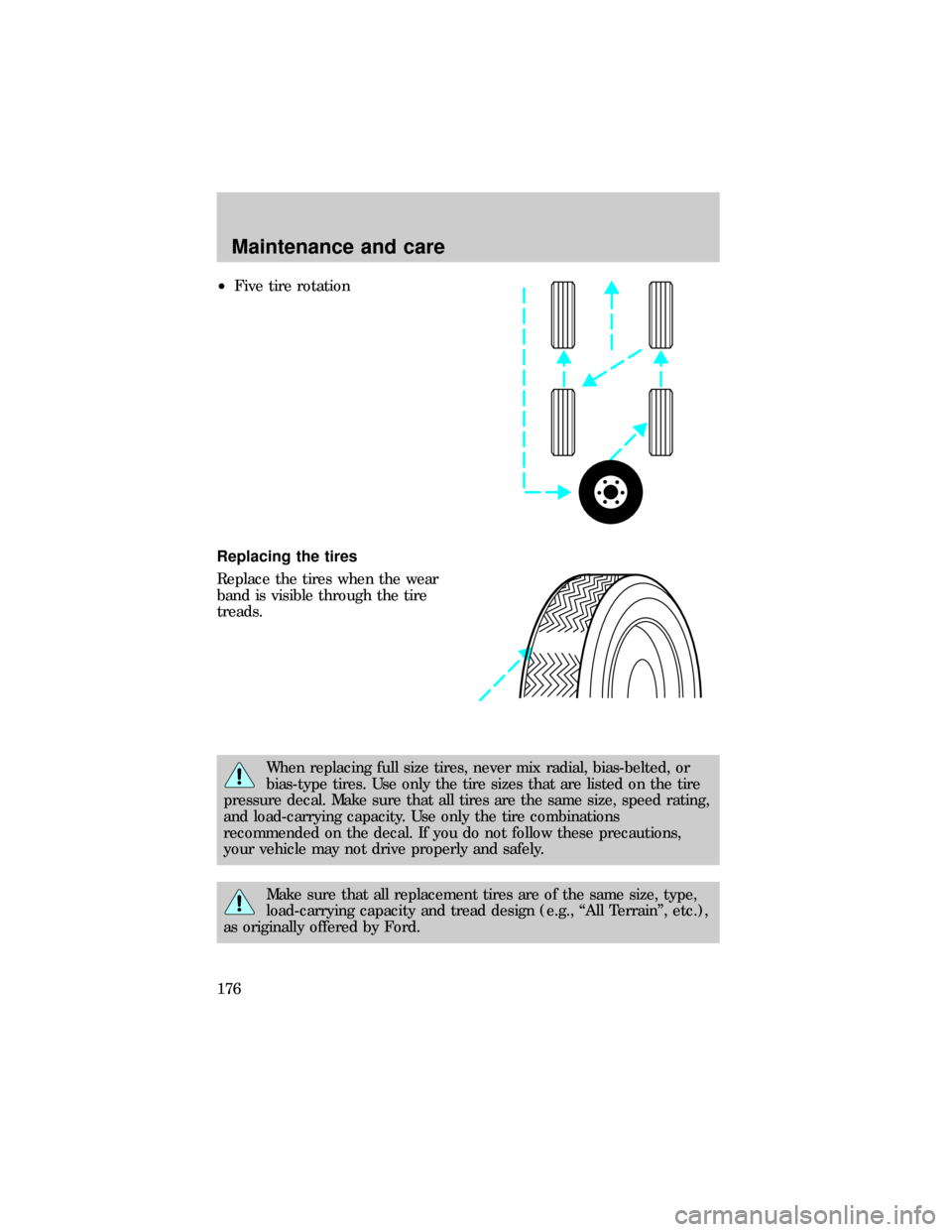
²Five tire rotation
Replacing the tires
Replace the tires when the wear
band is visible through the tire
treads.
When replacing full size tires, never mix radial, bias-belted, or
bias-type tires. Use only the tire sizes that are listed on the tire
pressure decal. Make sure that all tires are the same size, speed rating,
and load-carrying capacity. Use only the tire combinations
recommended on the decal. If you do not follow these precautions,
your vehicle may not drive properly and safely.
Make sure that all replacement tires are of the same size, type,
load-carrying capacity and tread design (e.g., ªAll Terrainº, etc.),
as originally offered by Ford.
Maintenance and care
176
Page 199 of 216

Cleaning the interior fabric
Remove dust and loose dirt with a whisk broom or a vacuum cleaner.
Remove fresh spots immediately. Do not use household or glass cleaners.
These agents can stain and discolor the fabric. Use a mild soap and
water solution if necessary.
Cleaning and maintaining the safety belts
Clean the safety belts with a mild soap solution recommended for
cleaning upholstery or carpets. Do not bleach or dye the belts, because
these actions may weaken the belt webbing.
Check the safety belt system periodically to make sure there are no
nicks, wear or cuts. If your vehicle has been involved in an accident,
refer to theSafety belt maintenancesection in theSeating and safety
restraintschapter.
Underbody
Flush the complete underside of vehicle frequently. Keep body drain
holes unplugged. Inspect for road damage.
Inside windows
Use glass cleaner for the inside windows if they become fogged.
Cleaning mirrors
Do not clean your mirrors with a dry cloth or abrasive materials. Use a
soft cloth and mild detergent and water. Be careful when removing ice
from outside mirrors because you may damage the reflective surface.
Maintenance and care
199
Page 211 of 216

filling your vehicle
with fuel ...........................178,180
gauge .........................................12
quality ......................................182
running out of fuel .................183
safety information relating to
automotive fuels .....................178
Fuses ...................................134,135
Gas mileage (see Fuel
economy) ..............183,184,185,186
Gauges ....................................11,12
engine coolant temperature
gauge .........................................13
engine oil pressure gauge ........15
GVWR
(Gross Vehicle Weight Rating)
calculating ..........123,128,129,130
Hazard flashers .........................133
Headlamps
aiming ......................................194
bulb specifications ..................194
high beam ..............................9,16
warning chime ..........................11
Heating ........................................17
heater only system ..............17,18
Hood ..........................................153
Ignition .......................................204
Inspection/maintenance
(I/M) testing ..............................188
Instrument panel ..........................6
cleaning ...................................198
Keys
key in ignition chime ...............11
positions of the ignition ...........55
Lamps
daytime running light ...............16
fog lamps ...................................16
headlamps .................................16
headlamps, flash to pass ..........17
instrument panel, dimming .....17
interior lamps .........................194replacing
bulbs .....188,189,190,191,192,193
Lane change indicator (see
Turn signal) .................................55
Lights, warning and indicator
air bag ..........................................8
anti-lock brakes (ABS) ..............9
anti-theft .....................................9
brake ............................................8
charging system ..........................9
check coolant ............................10
cruise indicator .........................11
door ajar ....................................10
fuel reset .....................................8
overdrive off ..............................10
safety belt ...................................8
speed control ............................60
turn signal indicator ...................9
Lumbar support, seats ..........72,73
Manual transmission
reverse .....................................114
Mirrors
cleaning ...................................199
side view mirrors (power) .......63
Motorcraft parts ........................183
Octane rating ............................181
Odometer .....................................14
Overdrive .....................................60
Panic alarm feature, remote
entry system ................................65
Parking brake ............................105
Power distribution box
(see Fuses) ...............................138
Power door locks ........................63
Power steering ..........................106
fluid, checking and adding ....165
Radio ...24,25,26,27,28,29,30,31,32,
33,34,35,36,37,38,39,41,
42,43,44,45,46,47,48,49,51
Relays ........................................134
Remote entry system ..64,68,69,70
illuminated entry ......................67
Index
211