ABS FORD RANGER 2000 2.G User Guide
[x] Cancel search | Manufacturer: FORD, Model Year: 2000, Model line: RANGER, Model: FORD RANGER 2000 2.GPages: 240, PDF Size: 2.07 MB
Page 124 of 240
Avoid sudden applications of power and quick changes of direction on
snow and ice. Apply the accelerator slowly and steadily when starting
from a full stop.
When braking, apply the brakes as you normally would. In order to allow
the anti-lock brake system (ABS) to operate properly, keep steady
pressure on the brake pedal.
Allow more stopping distance and drive slower than usual. Consider
using one of the lower gears.
TRACTION-LOK AXLE (IF EQUIPPED)
This axle provides added traction on slippery surfaces, particularly when
one wheel is on a poor traction surface. Under normal conditions, the
Traction-Lok axle functions like a standard rear axle.
Extended use of other than the manufacturer's specified size tires on a
Traction-Lok rear axle could result in a permanent reduction in
effectiveness. This loss of effectiveness does not affect normal driving
and should not be noticeable to the driver.
To avoid injury, never run the engine with one wheel off the
ground, such as when changing a tire.
DRIVING THROUGH WATER
Do not drive quickly through standing water, especially if the depth is
unknown. Traction or brake capability may be limited and if the ignition
system gets wet, your engine may stall. Water may also enter your
engine's air intake and severely damage your engine.
If driving through deep or standing water is unavoidable, proceed very
slowly. Never drive through water that is higher than the bottom of the
hubs (for trucks) or the bottom of the wheel rims (for cars).
Once through the water, always try the brakes. Wet brakes do not stop
the vehicle as effectively as dry brakes. Drying can be improved by
moving your vehicle slowly while applying light pressure on the brake
pedal.
Driving through deep water where the transmission vent tube is
submerged may allow water into the transmission and cause
internal transmission damage.
Driving
124
Page 142 of 240
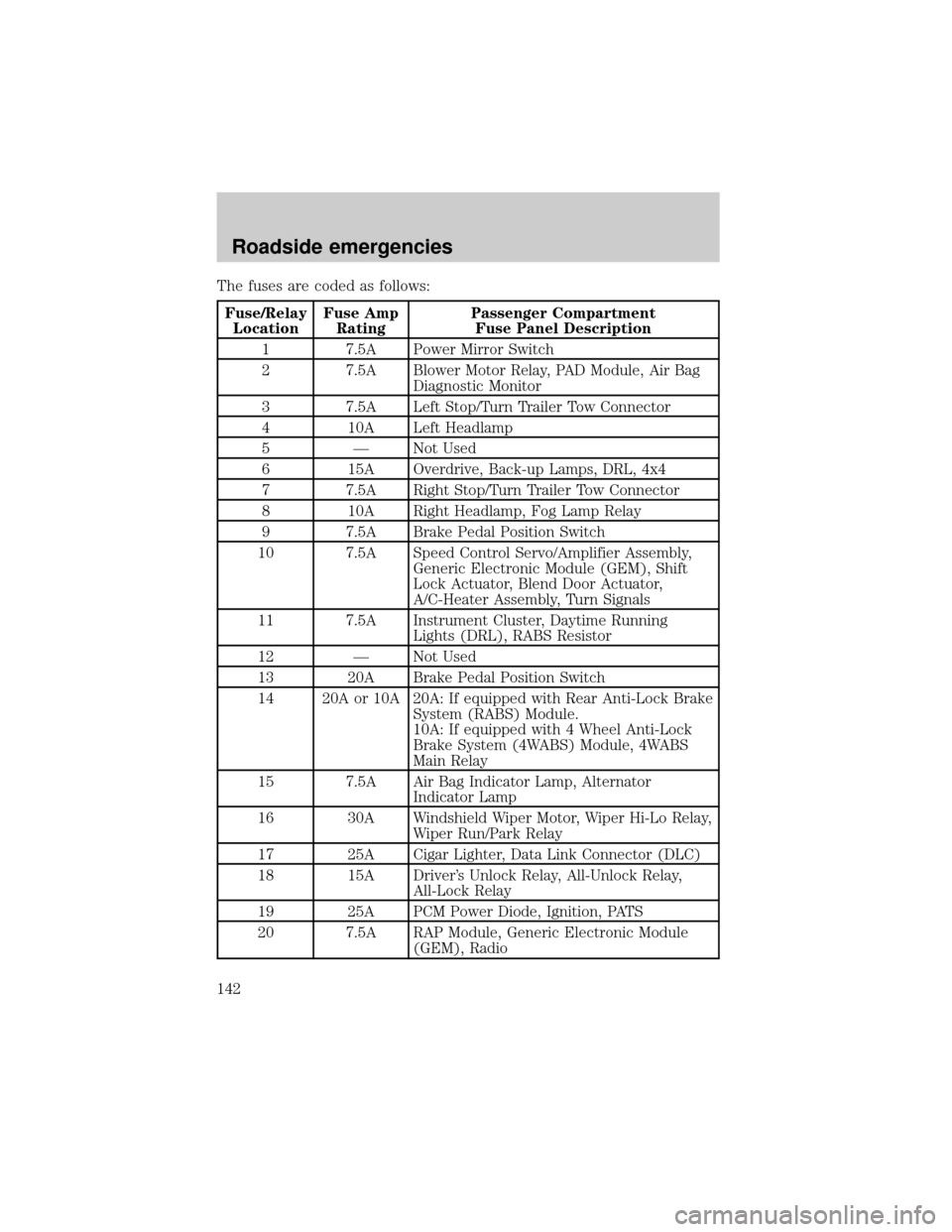
The fuses are coded as follows:
Fuse/Relay
LocationFuse Amp
RatingPassenger Compartment
Fuse Panel Description
1 7.5A Power Mirror Switch
2 7.5A Blower Motor Relay, PAD Module, Air Bag
Diagnostic Monitor
3 7.5A Left Stop/Turn Trailer Tow Connector
4 10A Left Headlamp
5 Ð Not Used
6 15A Overdrive, Back-up Lamps, DRL, 4x4
7 7.5A Right Stop/Turn Trailer Tow Connector
8 10A Right Headlamp, Fog Lamp Relay
9 7.5A Brake Pedal Position Switch
10 7.5A Speed Control Servo/Amplifier Assembly,
Generic Electronic Module (GEM), Shift
Lock Actuator, Blend Door Actuator,
A/C-Heater Assembly, Turn Signals
11 7.5A Instrument Cluster, Daytime Running
Lights (DRL), RABS Resistor
12 Ð Not Used
13 20A Brake Pedal Position Switch
14 20A or 10A 20A: If equipped with Rear Anti-Lock Brake
System (RABS) Module.
10A: If equipped with 4 Wheel Anti-Lock
Brake System (4WABS) Module, 4WABS
Main Relay
15 7.5A Air Bag Indicator Lamp, Alternator
Indicator Lamp
16 30A Windshield Wiper Motor, Wiper Hi-Lo Relay,
Wiper Run/Park Relay
17 25A Cigar Lighter, Data Link Connector (DLC)
18 15A Driver's Unlock Relay, All-Unlock Relay,
All-Lock Relay
19 25A PCM Power Diode, Ignition, PATS
20 7.5A RAP Module, Generic Electronic Module
(GEM), Radio
Roadside emergencies
142
Page 143 of 240
Fuse/Relay
LocationFuse Amp
RatingPassenger Compartment
Fuse Panel Description
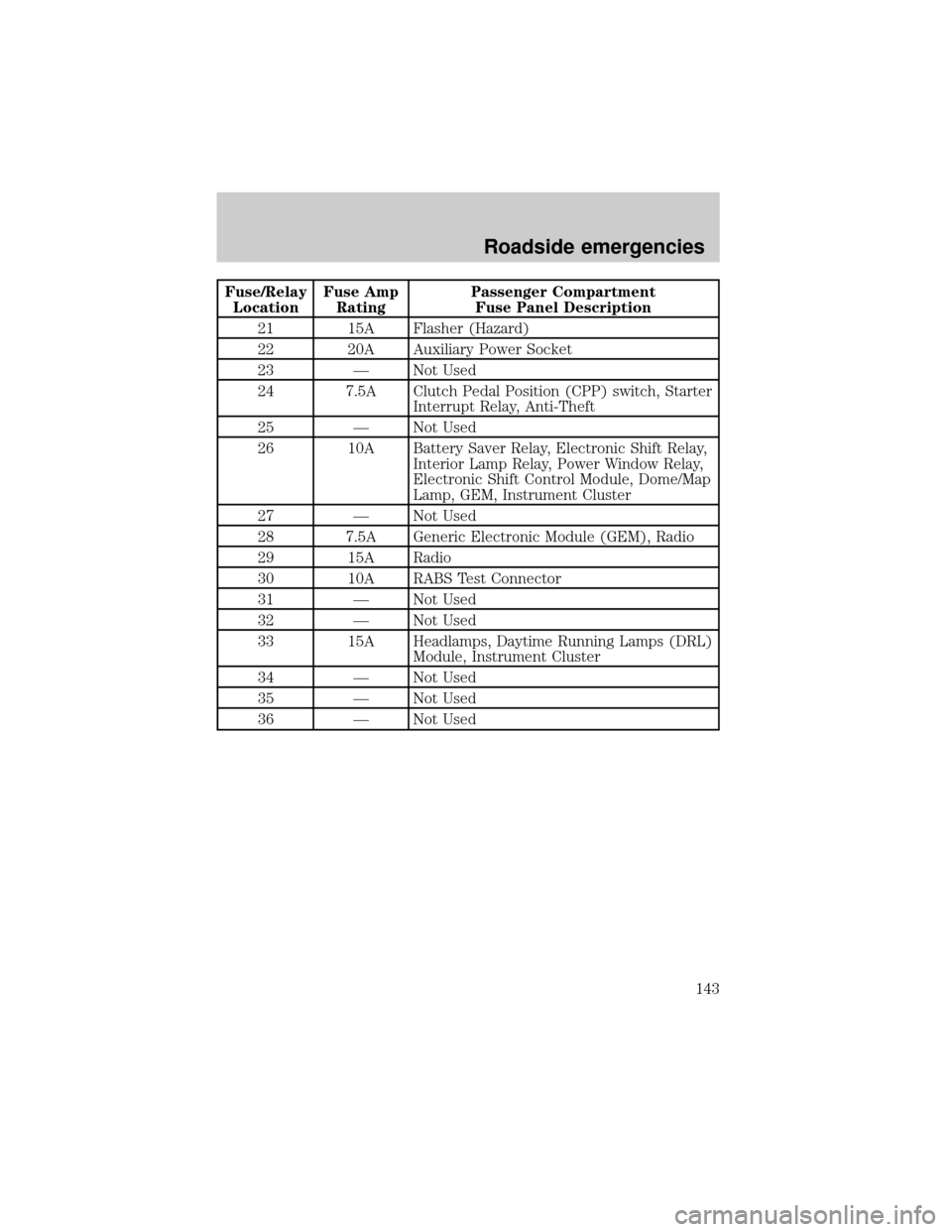
21 15A Flasher (Hazard)
22 20A Auxiliary Power Socket
23 Ð Not Used
24 7.5A Clutch Pedal Position (CPP) switch, Starter
Interrupt Relay, Anti-Theft
25 Ð Not Used
26 10A Battery Saver Relay, Electronic Shift Relay,
Interior Lamp Relay, Power Window Relay,
Electronic Shift Control Module, Dome/Map
Lamp, GEM, Instrument Cluster
27 Ð Not Used
28 7.5A Generic Electronic Module (GEM), Radio
29 15A Radio
30 10A RABS Test Connector
31 Ð Not Used
32 Ð Not Used
33 15A Headlamps, Daytime Running Lamps (DRL)
Module, Instrument Cluster
34 Ð Not Used
35 Ð Not Used
36 Ð Not Used
Roadside emergencies
143
Page 145 of 240
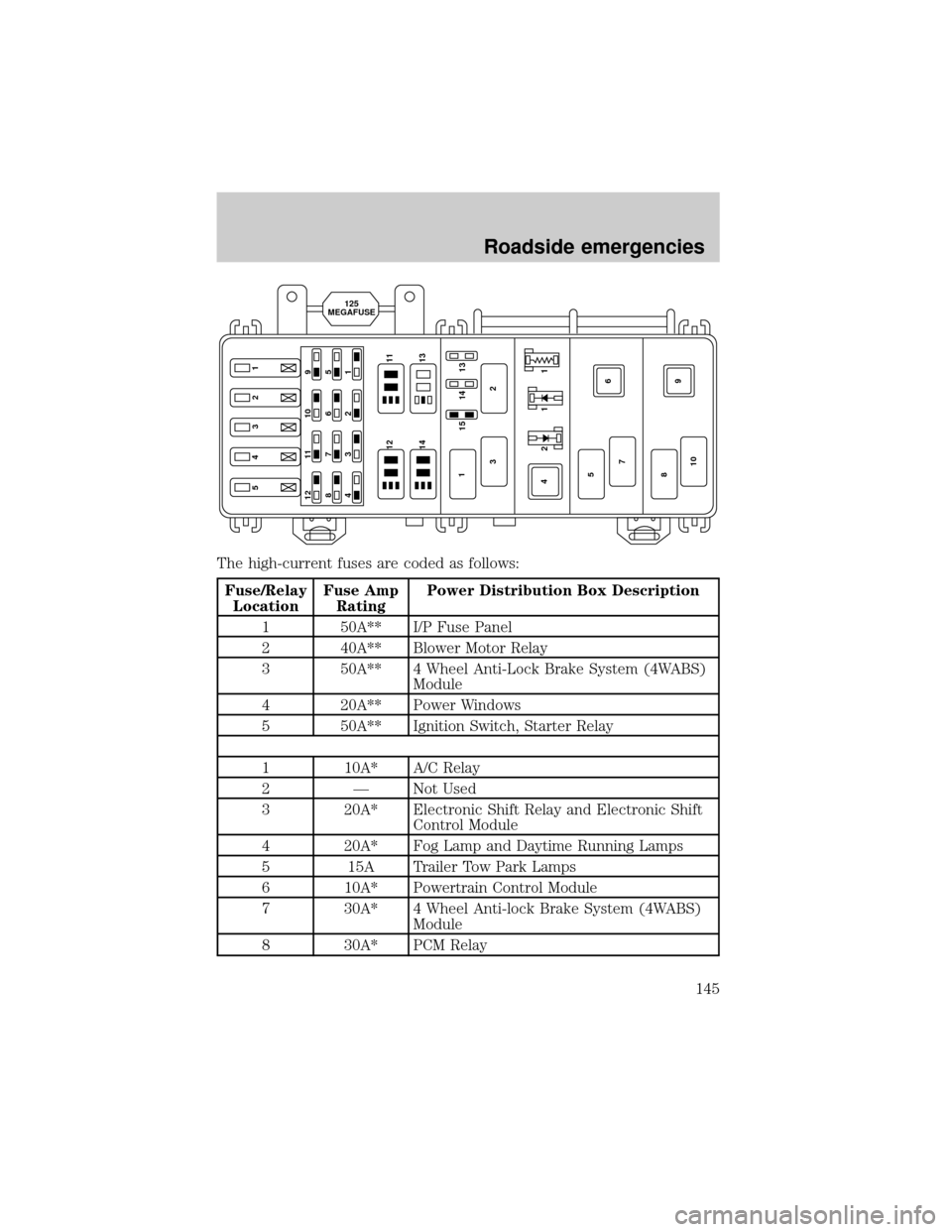
The high-current fuses are coded as follows:
Fuse/Relay
LocationFuse Amp
RatingPower Distribution Box Description
1 50A** I/P Fuse Panel
2 40A** Blower Motor Relay
3 50A** 4 Wheel Anti-Lock Brake System (4WABS)
Module
4 20A** Power Windows
5 50A** Ignition Switch, Starter Relay
1 10A* A/C Relay
2 Ð Not Used
3 20A* Electronic Shift Relay and Electronic Shift
Control Module
4 20A* Fog Lamp and Daytime Running Lamps
5 15A Trailer Tow Park Lamps
6 10A* Powertrain Control Module
7 30A* 4 Wheel Anti-lock Brake System (4WABS)
Module
8 30A* PCM Relay
5432112 11 10 9
876 5
432 1
14 15 13
9 6
10 87 5 41
2 3
211
125
MEGAFUSE
11
13 12
14
Roadside emergencies
145
Page 146 of 240
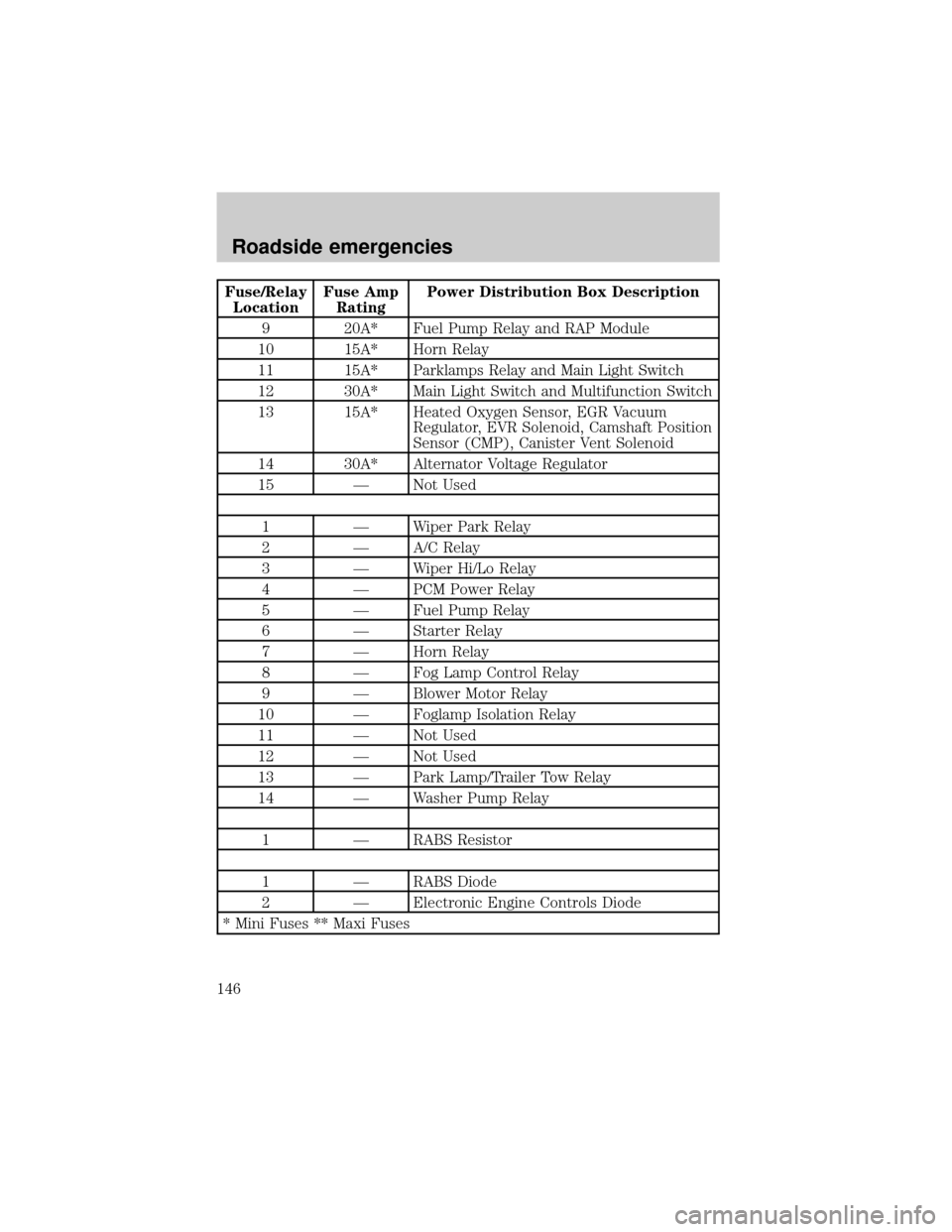
Fuse/Relay
LocationFuse Amp
RatingPower Distribution Box Description
9 20A* Fuel Pump Relay and RAP Module
10 15A* Horn Relay
11 15A* Parklamps Relay and Main Light Switch
12 30A* Main Light Switch and Multifunction Switch
13 15A* Heated Oxygen Sensor, EGR Vacuum
Regulator, EVR Solenoid, Camshaft Position
Sensor (CMP), Canister Vent Solenoid
14 30A* Alternator Voltage Regulator
15 Ð Not Used
1 Ð Wiper Park Relay
2 Ð A/C Relay
3 Ð Wiper Hi/Lo Relay
4 Ð PCM Power Relay
5 Ð Fuel Pump Relay
6 Ð Starter Relay
7 Ð Horn Relay
8 Ð Fog Lamp Control Relay
9 Ð Blower Motor Relay
10 Ð Foglamp Isolation Relay
11 Ð Not Used
12 Ð Not Used
13 Ð Park Lamp/Trailer Tow Relay
14 Ð Washer Pump Relay
1 Ð RABS Resistor
1 Ð RABS Diode
2 Ð Electronic Engine Controls Diode
* Mini Fuses ** Maxi Fuses
Roadside emergencies
146
Page 187 of 240

death or permanent injury. If fuel is swallowed, call a physician
immediately, even if no symptoms are immediately apparent. The toxic
effects of fuel may not be visible for hours.
²Avoid inhaling fuel vapors. Inhaling too much fuel vapor of any kind
can lead to eye and respiratory tract irritation. In severe cases,
excessive or prolonged breathing of fuel vapor can cause serious
illness and permanent injury.
²Avoid getting fuel liquid in your eyes. If fuel is splashed in the eyes,
remove contact lenses (if worn), flush with water for 15 minutes and
seek medical attention. Failure to seek proper medical attention could
lead to permanent injury.
²Fuels can also be harmful if absorbed through the skin. If fuel is
splashed on the skin and/or clothing, promptly remove contaminated
clothing and wash skin thoroughly with soap and water. Repeated or
prolonged skin contact with fuel liquid or vapor causes skin irritation.
²Be particularly careful if you are taking ªAntabuseº or other forms of
disulfiram for the treatment of alcoholism. Breathing gasoline and/or
ethanol vapors, or skin contact could cause an adverse reaction. In
sensitive individuals, serious personal injury or sickness may result. If
fuel is splashed on the skin, promptly wash skin thoroughly with soap
and water. Consult a physician immediately if you experience an
adverse reaction.
²FFV fuel tanks may contain zero to 85 percent or more of ethanol.
Any fuel blends containing gasoline and ethanol should be treated the
same as ªFuel Ethanol (E85)º.
Pure ethanol is the alcohol which is the intoxicating agent in liquor, beer
and wine. It is distilled from the fermentation of plants such as field corn
and sugar cane. When ethanol is used in the making of motor fuels, a
small amount of a bad tasting chemical is added to discourage beverage
use. The resulting fuel is called E
d100 meaning 100% pure ethanol
diluted by 2% to 5% gasoline as the ªdenaturant.º
Fuel ethanol (E
d85) is then made by adding 15% more unleaded
gasoline. The resulting fuel also has a higher octane rating than unleaded
regular gasoline and other properties which allow engine designs with
greater efficiency and power.
Winter blends may contain up to 30% unleaded gasoline (25% plus the
denaturant) to enhance cold engine starts. Severely cold weather may
require additional measures for reliable starting. Refer toCold Weather
Startingin theStartingchapter.
Maintenance and care
187
Page 189 of 240
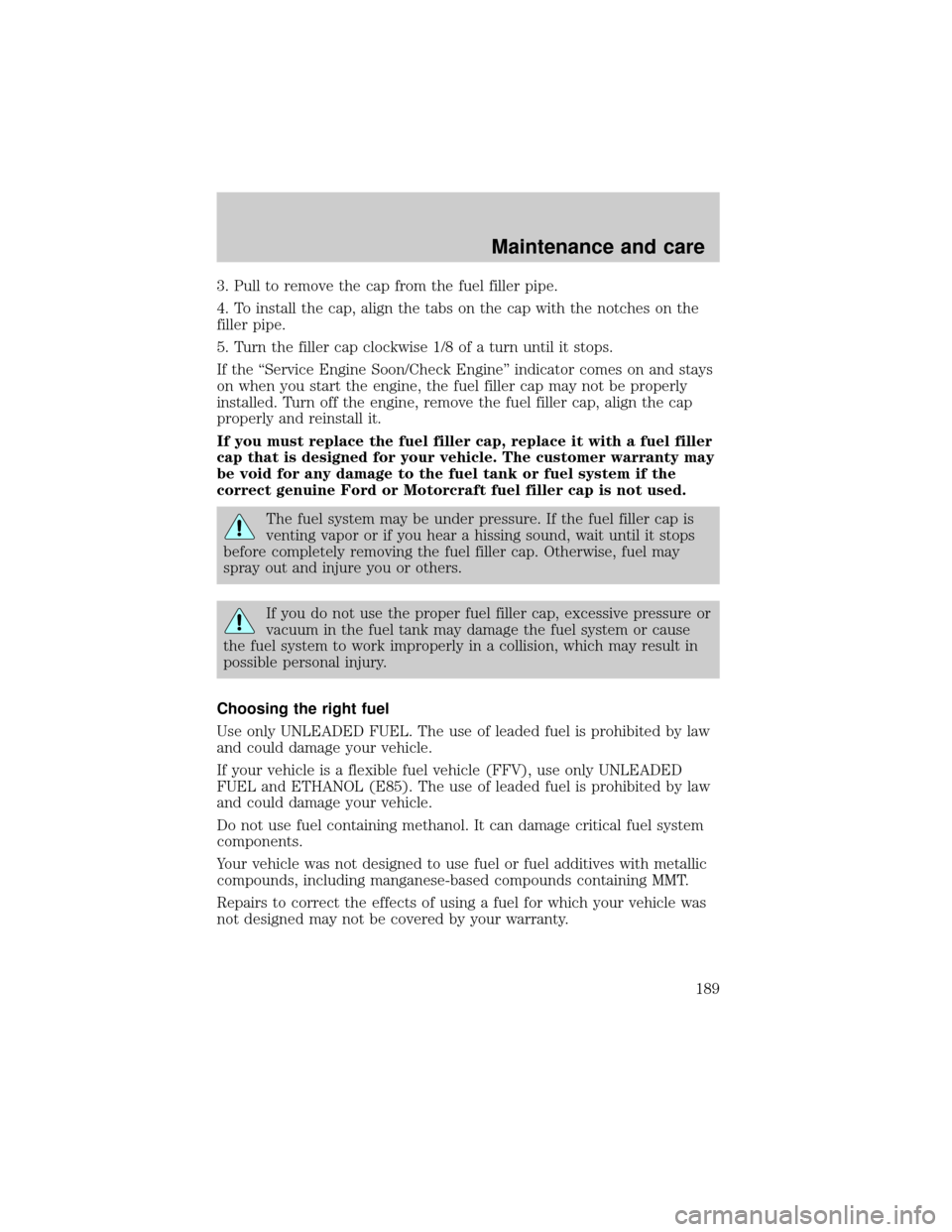
3. Pull to remove the cap from the fuel filler pipe.
4. To install the cap, align the tabs on the cap with the notches on the
filler pipe.
5. Turn the filler cap clockwise 1/8 of a turn until it stops.
If the ªService Engine Soon/Check Engineº indicator comes on and stays
on when you start the engine, the fuel filler cap may not be properly
installed. Turn off the engine, remove the fuel filler cap, align the cap
properly and reinstall it.
If you must replace the fuel filler cap, replace it with a fuel filler
cap that is designed for your vehicle. The customer warranty may
be void for any damage to the fuel tank or fuel system if the
correct genuine Ford or Motorcraft fuel filler cap is not used.
The fuel system may be under pressure. If the fuel filler cap is
venting vapor or if you hear a hissing sound, wait until it stops
before completely removing the fuel filler cap. Otherwise, fuel may
spray out and injure you or others.
If you do not use the proper fuel filler cap, excessive pressure or
vacuum in the fuel tank may damage the fuel system or cause
the fuel system to work improperly in a collision, which may result in
possible personal injury.
Choosing the right fuel
Use only UNLEADED FUEL. The use of leaded fuel is prohibited by law
and could damage your vehicle.
If your vehicle is a flexible fuel vehicle (FFV), use only UNLEADED
FUEL and ETHANOL (E85). The use of leaded fuel is prohibited by law
and could damage your vehicle.
Do not use fuel containing methanol. It can damage critical fuel system
components.
Your vehicle was not designed to use fuel or fuel additives with metallic
compounds, including manganese-based compounds containing MMT.
Repairs to correct the effects of using a fuel for which your vehicle was
not designed may not be covered by your warranty.
Maintenance and care
189
Page 198 of 240
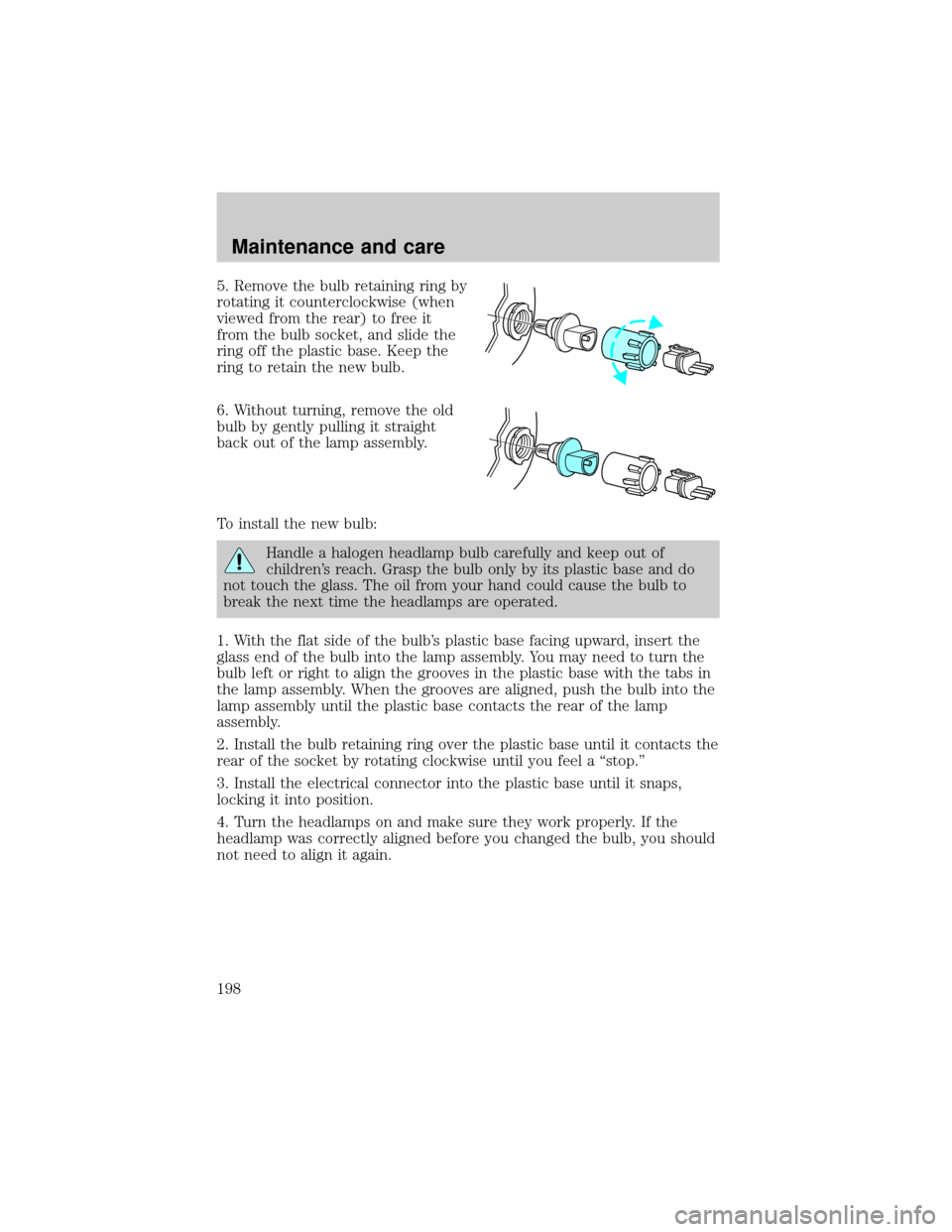
5. Remove the bulb retaining ring by
rotating it counterclockwise (when
viewed from the rear) to free it
from the bulb socket, and slide the
ring off the plastic base. Keep the
ring to retain the new bulb.
6. Without turning, remove the old
bulb by gently pulling it straight
back out of the lamp assembly.
To install the new bulb:
Handle a halogen headlamp bulb carefully and keep out of
children's reach. Grasp the bulb only by its plastic base and do
not touch the glass. The oil from your hand could cause the bulb to
break the next time the headlamps are operated.
1. With the flat side of the bulb's plastic base facing upward, insert the
glass end of the bulb into the lamp assembly. You may need to turn the
bulb left or right to align the grooves in the plastic base with the tabs in
the lamp assembly. When the grooves are aligned, push the bulb into the
lamp assembly until the plastic base contacts the rear of the lamp
assembly.
2. Install the bulb retaining ring over the plastic base until it contacts the
rear of the socket by rotating clockwise until you feel a ªstop.º
3. Install the electrical connector into the plastic base until it snaps,
locking it into position.
4. Turn the headlamps on and make sure they work properly. If the
headlamp was correctly aligned before you changed the bulb, you should
not need to align it again.
Maintenance and care
198
Page 231 of 240

Air bag supplemental
restraint system ..........................84
and child safety seats ..............85
description ................................84
disposal ......................................88
driver air bag ............................86
indicator light ......................10,87
operation ...................................86
passenger air bag .....................86
passenger
deactivation switch ..............25,88
Air cleaner filter .......................209
Air conditioning ..........................19
manual heating and air
conditioning system .................21
Ambulance packages ....................3
Antifreeze
(see Engine coolant) ................168
Anti-lock brake system
(see Brakes) .......................107,108
Anti-theft system
warning light .............................11
Audio system (see Radio) .........26
Automatic transmission ............111
driving an automatic
overdrive ..........................112,114
fluid, adding ............................173
fluid, checking ........................173
fluid, refill capacities ..............209
fluid, specification ..................214
Auxiliary power point .................25
Axle
lubricant specifications ...212,214
refill capacities ........................209
traction lok ..............................124
Battery .......................................178
acid, treating emergencies .....178
charging system
warning light .............................11
jumping a disabled battery ....152
maintenance-free ....................178
replacement, specifications ...209servicing ..................................178
voltage gauge ............................17
Belt minder .................................80
Brakes ........................................106
anti-lock .....................106,107,108
anti-lock brake system (ABS)
warning light ......................10,108
brake warning light ..................10
fluid, checking and adding ....166
fluid, refill capacities ..............209
fluid, specifications ..........212,214
lubricant specifications ...212,214
parking ....................................108
shift interlock ..........................111
Break-in period .............................2
Capacities for refilling fluids ....209
Cargo area shade ........................63
Cargo net .....................................63
Certification Label ....................217
Child safety restraints ................93
child safety belts ......................93
Child safety seats ........................94
attaching with tether straps ....99
in front seat ..............................96
in rear seat ................................96
tether anchorage hardware .....99
Cleaning your vehicle ...............203
engine compartment ..............204
exterior .............................204,207
exterior lamps .........................206
instrument panel ....................207
instrument panel lens ............207
interior .....................................207
mirrors .....................................208
plastic parts ............................206
safety belts ..............................207
washing ....................................203
waxing .....................................203
wheels ......................................204
windows ..................................208
wiper blades ............................206
Index
231
Page 234 of 240

air bag ........................................10
anti-lock brakes (ABS) .....10,108
anti-theft ...................................11
brake ..........................................10
charging system ........................11
check coolant ............................12
check engine ...............................8
cruise indicator .........................12
door ajar ....................................12
fuel reset ...................................10
high beam .................................11
overdrive off ..............................11
safety belt .................................10
speed control ............................59
turn signal indicator .................11
Load limits .................................125
GAWR ......................................125
GVWR ......................................125
trailer towing ..........................125
Loading instructions .................126
Lubricant specifications ....212,214
Lumbar support, seats ...............71
Manual transmission .................116
fluid capacities ........................209
lubricant specifications ..........214
reverse .....................................118
Mirrors
cleaning ...................................208
side view mirrors (power) .......62
Motorcraft parts .................192,209
Octane rating ............................190
Odometer .....................................16
Oil (see Engine oil) ..................163
Overdrive .....................................59
Panic alarm feature, remote
entry system ................................64
Parking brake ............................108
Parts (see Motorcraft parts) ....209
Power distribution box
(see Fuses) ...............................144
Power door locks ........................62
Power steering ..........................109fluid, checking and adding ....173
fluid, refill capacity ................209
fluid, specifications ..........212,214
Preparing to
drive your vehicle .....................110
Radio ............................................26
Relays ........................................140
Remote entry system ............63,64
illuminated entry ......................67
locking/unlocking doors ...........64
panic alarm ...............................64
replacement/additional
transmitters ...............................66
replacing the batteries .............65
Safety belts (see Safety
restraints) ...........13,72,73,74,75,76
Safety defects, reporting ..........230
Safety restraints ......72,73,74,75,76
belt minder ...............................80
cleaning the safety belts ...83,207
extension assembly ..................79
for adults ....................73,74,75,76
for children ...............................93
lap belt ......................................78
warning light
and chime ........................10,13,79
Safety seats for children ............94
Seat belts
(see Safety restraints) ...............72
Seats ............................................70
child safety seats ......................94
SecuriLock passive
anti-theft system ...............67,68,69
Servicing your vehicle ..............158
Snowplowing .................................3
Spark plugs,
specifications ...............209,214,215
Special notice ................................3
ambulance conversions ..............3
utility-type vehicles ....................3
Specification chart,
lubricants ............................212,214
Index
234