clutch FORD RANGER 2001 2.G User Guide
[x] Cancel search | Manufacturer: FORD, Model Year: 2001, Model line: RANGER, Model: FORD RANGER 2001 2.GPages: 272, PDF Size: 1.98 MB
Page 168 of 272
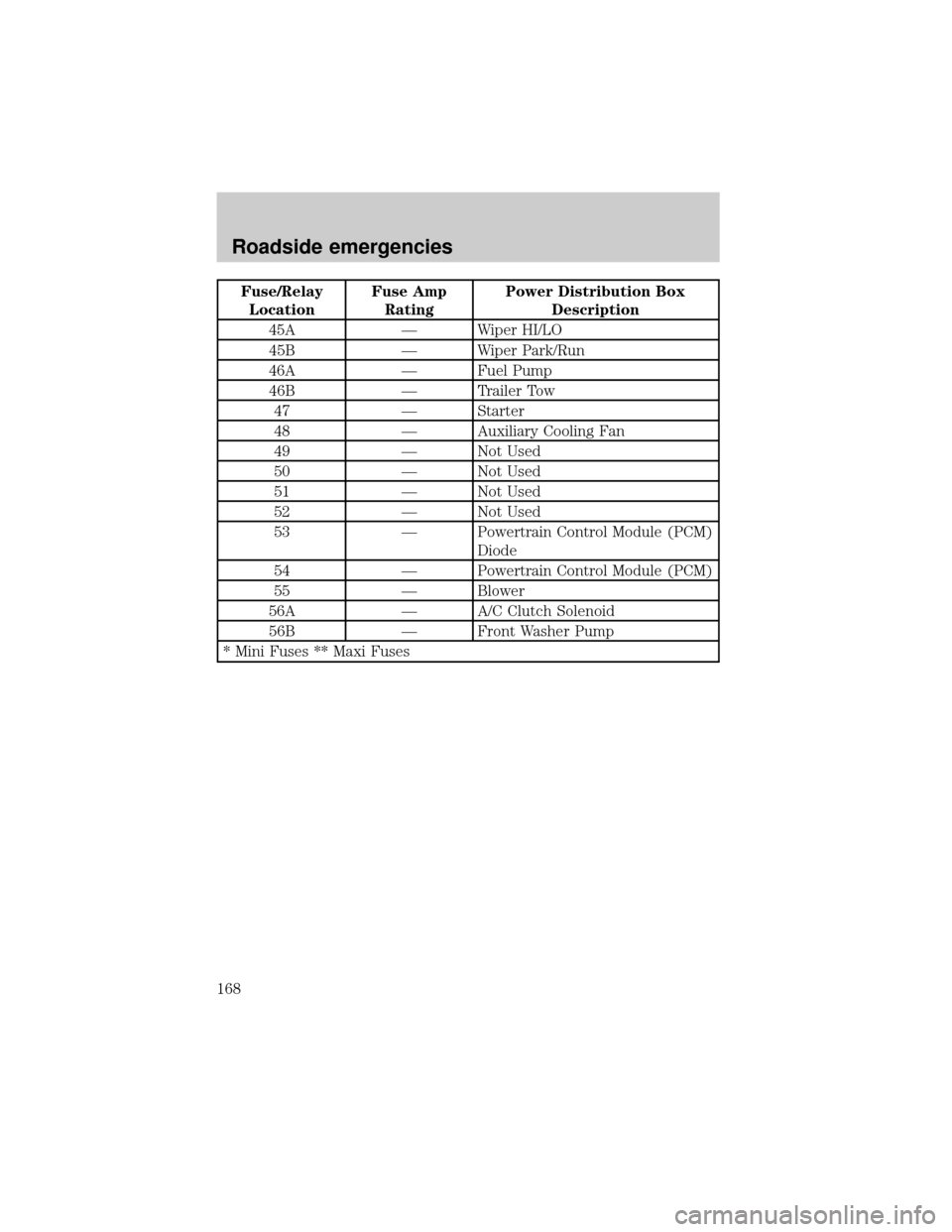
Fuse/Relay
LocationFuse Amp
RatingPower Distribution Box
Description
45A Ð Wiper HI/LO
45B Ð Wiper Park/Run
46A Ð Fuel Pump
46B Ð Trailer Tow
47 Ð Starter
48 Ð Auxiliary Cooling Fan
49 Ð Not Used
50 Ð Not Used
51 Ð Not Used
52 Ð Not Used
53 Ð Powertrain Control Module (PCM)
Diode
54 Ð Powertrain Control Module (PCM)
55 Ð Blower
56A Ð A/C Clutch Solenoid
56B Ð Front Washer Pump
* Mini Fuses ** Maxi Fuses
Roadside emergencies
168
Page 170 of 272
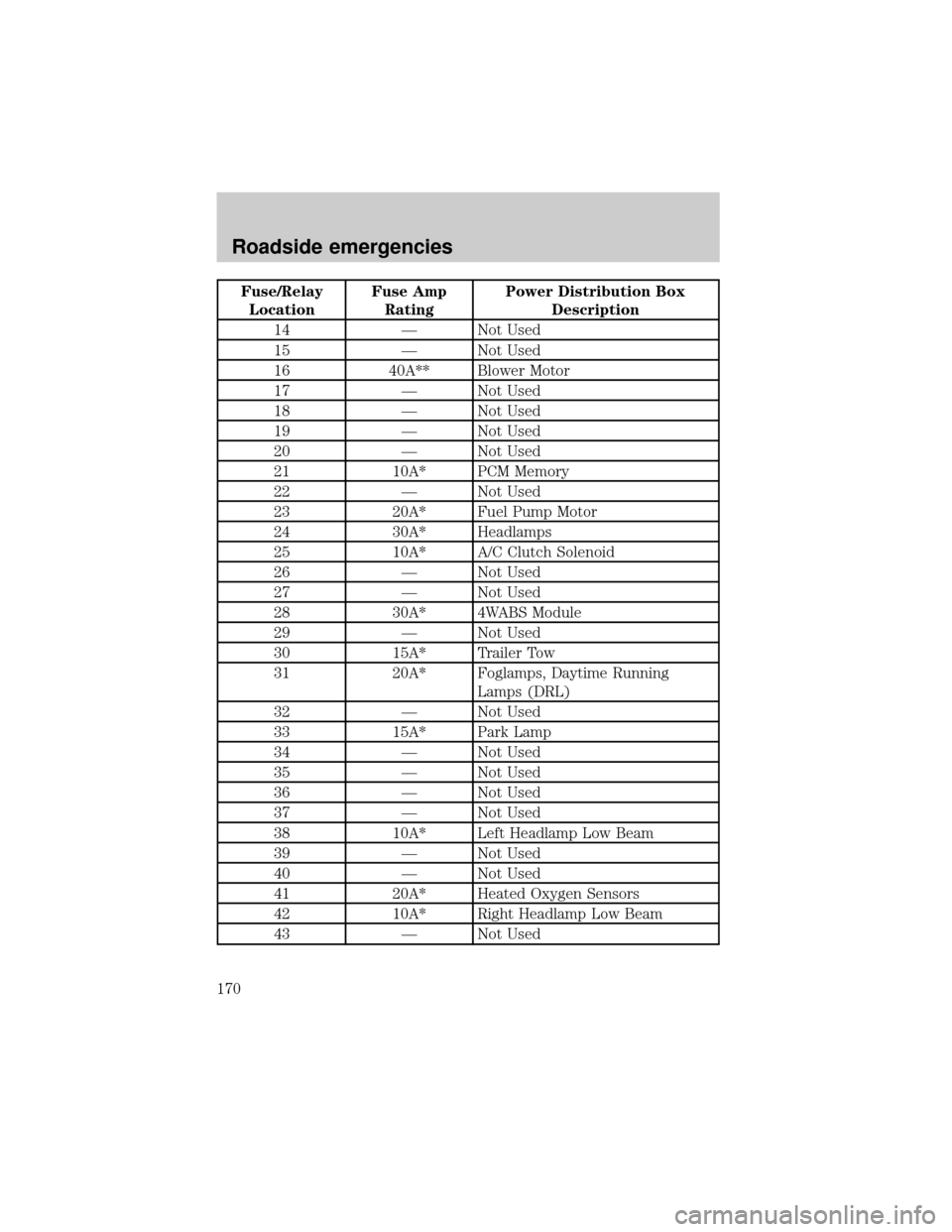
Fuse/Relay
LocationFuse Amp
RatingPower Distribution Box
Description
14 Ð Not Used
15 Ð Not Used
16 40A** Blower Motor
17 Ð Not Used
18 Ð Not Used
19 Ð Not Used
20 Ð Not Used
21 10A* PCM Memory
22 Ð Not Used
23 20A* Fuel Pump Motor
24 30A* Headlamps
25 10A* A/C Clutch Solenoid
26 Ð Not Used
27 Ð Not Used
28 30A* 4WABS Module
29 Ð Not Used
30 15A* Trailer Tow
31 20A* Foglamps, Daytime Running
Lamps (DRL)
32 Ð Not Used
33 15A* Park Lamp
34 Ð Not Used
35 Ð Not Used
36 Ð Not Used
37 Ð Not Used
38 10A* Left Headlamp Low Beam
39 Ð Not Used
40 Ð Not Used
41 20A* Heated Oxygen Sensors
42 10A* Right Headlamp Low Beam
43 Ð Not Used
Roadside emergencies
170
Page 171 of 272
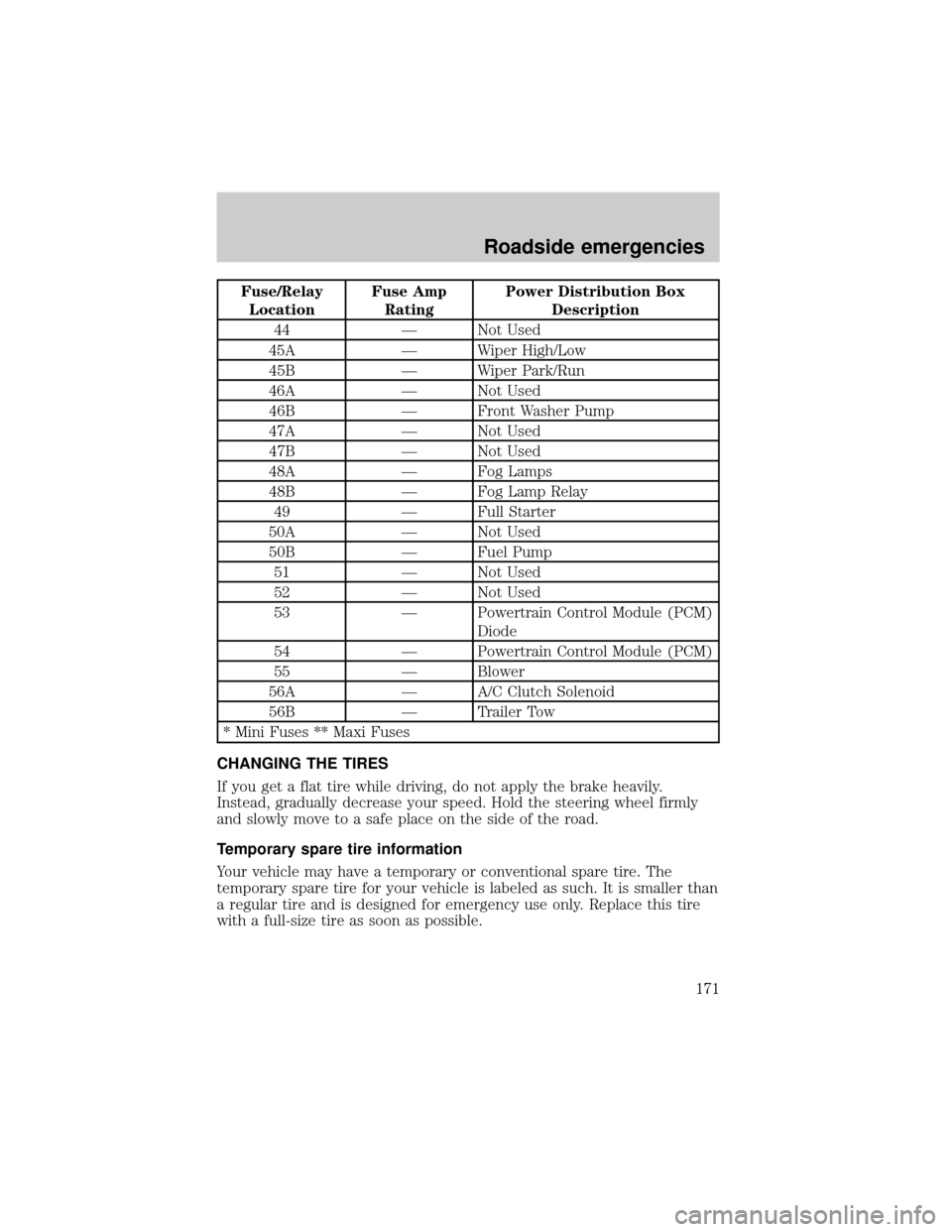
Fuse/Relay
LocationFuse Amp
RatingPower Distribution Box
Description
44 Ð Not Used
45A Ð Wiper High/Low
45B Ð Wiper Park/Run
46A Ð Not Used
46B Ð Front Washer Pump
47A Ð Not Used
47B Ð Not Used
48A Ð Fog Lamps
48B Ð Fog Lamp Relay
49 Ð Full Starter
50A Ð Not Used
50B Ð Fuel Pump
51 Ð Not Used
52 Ð Not Used
53 Ð Powertrain Control Module (PCM)
Diode
54 Ð Powertrain Control Module (PCM)
55 Ð Blower
56A Ð A/C Clutch Solenoid
56B Ð Trailer Tow
* Mini Fuses ** Maxi Fuses
CHANGING THE TIRES
If you get a flat tire while driving, do not apply the brake heavily.
Instead, gradually decrease your speed. Hold the steering wheel firmly
and slowly move to a safe place on the side of the road.
Temporary spare tire information
Your vehicle may have a temporary or conventional spare tire. The
temporary spare tire for your vehicle is labeled as such. It is smaller than
a regular tire and is designed for emergency use only. Replace this tire
with a full-size tire as soon as possible.
Roadside emergencies
171
Page 184 of 272

SERVICE RECOMMENDATIONS
To help you service your vehicle:
²We highlight do-it-yourself items in the engine compartment for easy
location.
²We provide a scheduled maintenance guide which makes tracking
routine service easy.
If your vehicle requires professional service, your dealership can provide
the necessary parts and service. Check yourWarranty Guideto find out
which parts and services are covered.
Use only recommended fuels, lubricants, fluids and service parts
conforming to specifications. Motorcraft parts are designed and built to
provide the best performance in your vehicle.
PRECAUTIONS WHEN SERVICING YOUR VEHICLE
Be especially careful when inspecting or servicing your vehicle.
²Do not work on a hot engine.
²When the engine is running, make sure that loose clothing, jewelry or
long hair does not get caught up in moving parts.
²Do not work on a vehicle with the engine running in an enclosed
space, unless you are sure you have enough ventilation.
²Keep all lit cigarettes, open flames and other lit material away from
the battery and all fuel related parts.
If you disconnect the battery, the engine must ªrelearnº its idle
conditions before your vehicle will drive properly, as explained inBattery
in this chapter.
Working with the engine off
²Automatic transmission:
1. Set the parking brake and ensure the gearshift is securely latched in P
(Park).
2. Turn off the engine and remove the key.
3. Block the wheels to prevent the vehicle from moving unexpectedly.
²Manual transmission:
1. Set the parking brake.
2. Depress the clutch and place the gearshift in 1 (First).
Maintenance and care
184
Page 185 of 272
3. Turn off the engine and remove the key.
4. Block the wheels to prevent the vehicle from moving unexpectedly.
Working with the engine on
²Automatic transmission:
1. Set the parking brake and ensure the gearshift is securely latched in P
(Park).
2. Block the wheels to prevent the vehicle from moving unexpectedly.
Note:Do not start your engine with the air cleaner removed and do not
remove it while the engine is running.
²Manual transmission:
1. Set the parking brake, depress the clutch and place the gearshift in
neutral.
2. Block the wheels to prevent the vehicle from moving unexpectedly.
Note:Do not start your engine with the air cleaner removed and do not
remove it while the engine is running.
The cooling fan is automatic and may come on at any time.
Always disconnect the negative terminal of the battery before
working near the fan.
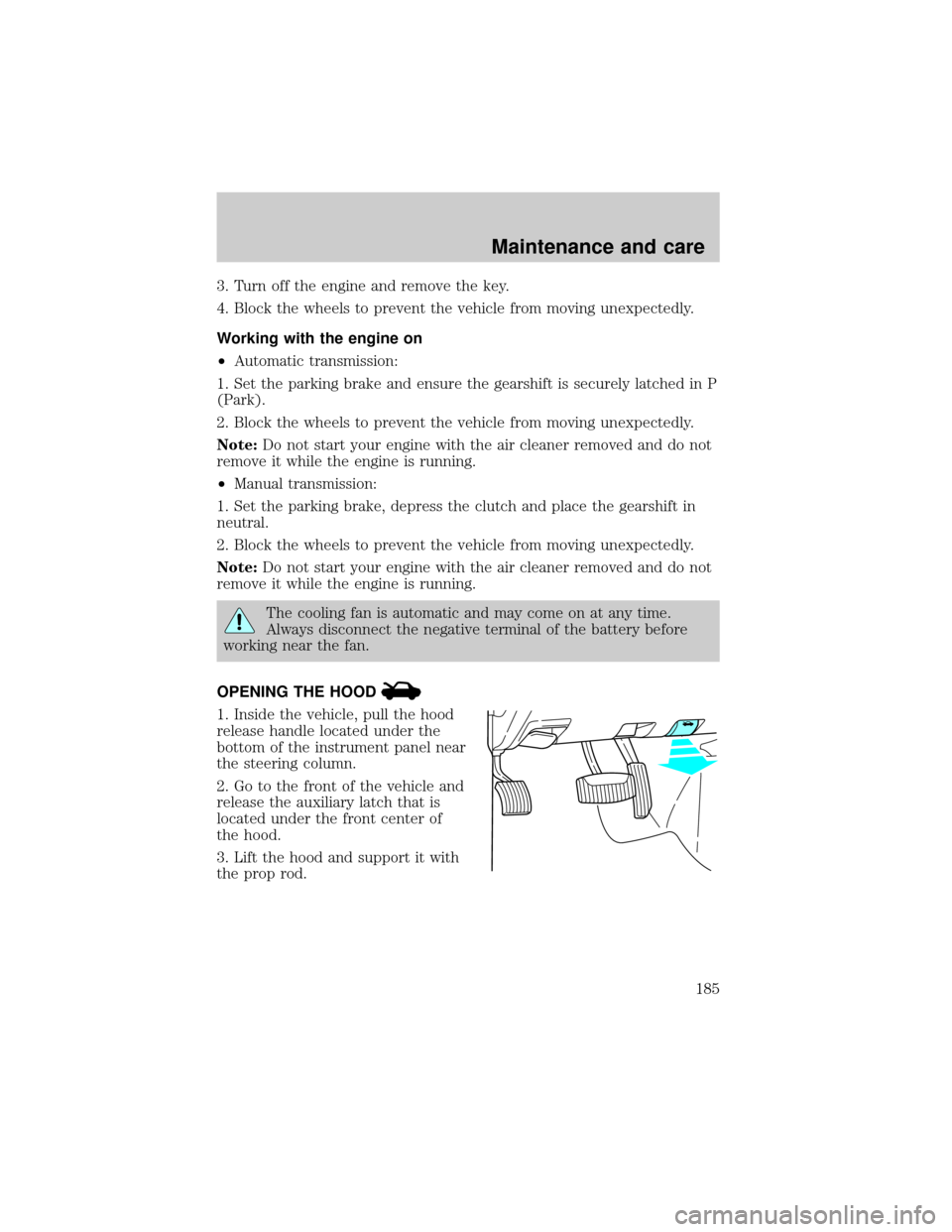
OPENING THE HOOD
1. Inside the vehicle, pull the hood
release handle located under the
bottom of the instrument panel near
the steering column.
2. Go to the front of the vehicle and
release the auxiliary latch that is
located under the front center of
the hood.
3. Lift the hood and support it with
the prop rod.
Maintenance and care
185
Page 186 of 272
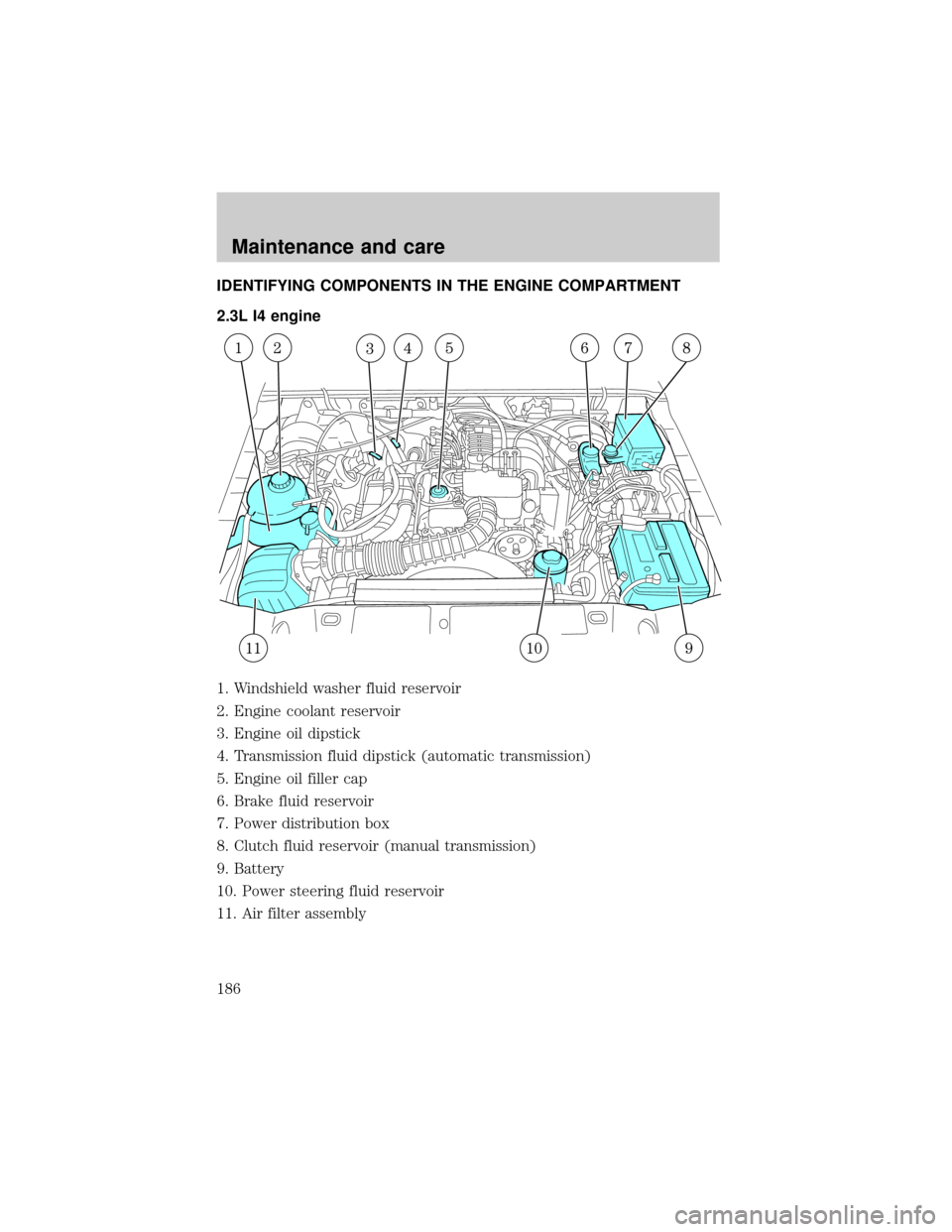
IDENTIFYING COMPONENTS IN THE ENGINE COMPARTMENT
2.3L I4 engine
1. Windshield washer fluid reservoir
2. Engine coolant reservoir
3. Engine oil dipstick
4. Transmission fluid dipstick (automatic transmission)
5. Engine oil filler cap
6. Brake fluid reservoir
7. Power distribution box
8. Clutch fluid reservoir (manual transmission)
9. Battery
10. Power steering fluid reservoir
11. Air filter assembly
Maintenance and care
186
Page 187 of 272
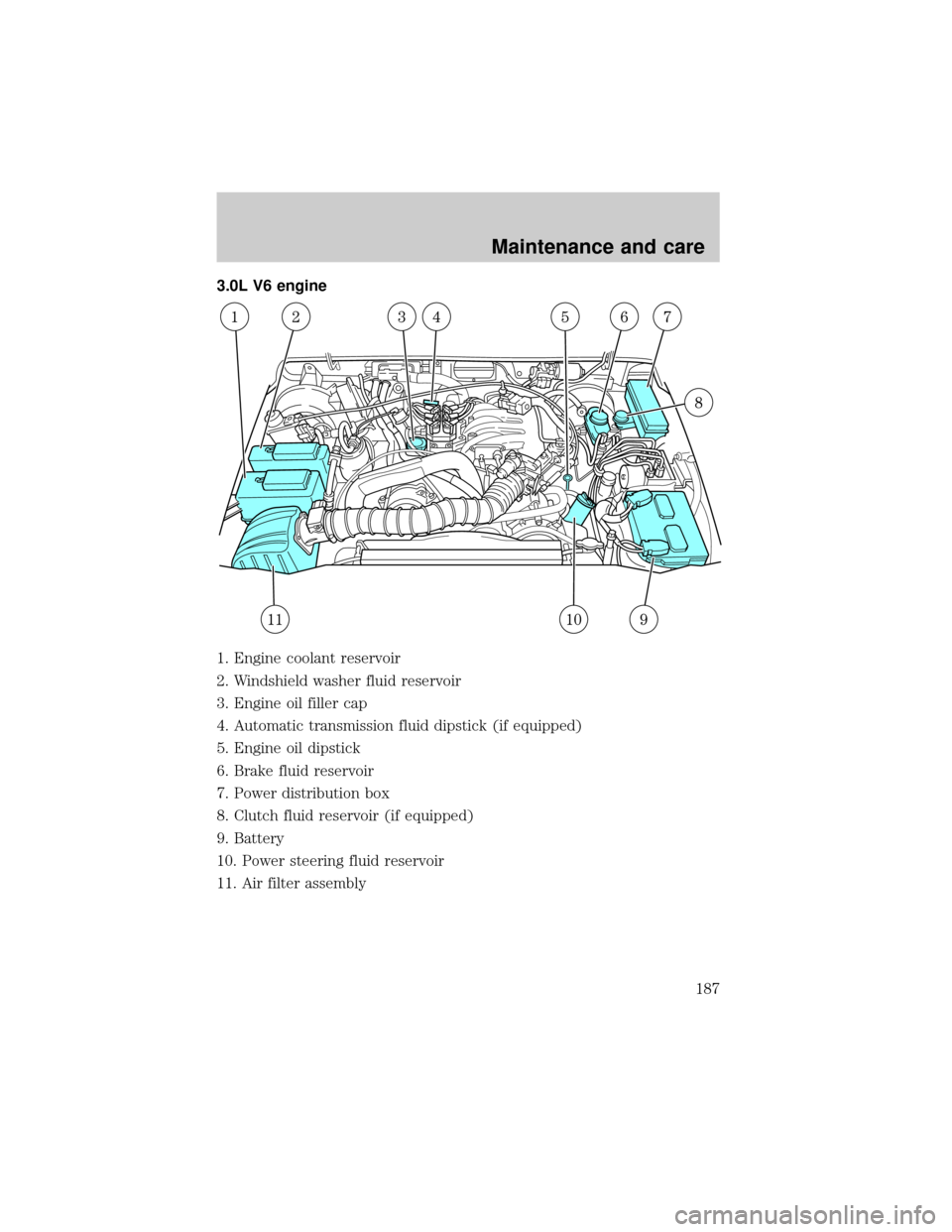
3.0L V6 engine
1. Engine coolant reservoir
2. Windshield washer fluid reservoir
3. Engine oil filler cap
4. Automatic transmission fluid dipstick (if equipped)
5. Engine oil dipstick
6. Brake fluid reservoir
7. Power distribution box
8. Clutch fluid reservoir (if equipped)
9. Battery
10. Power steering fluid reservoir
11. Air filter assembly
Maintenance and care
187
Page 188 of 272
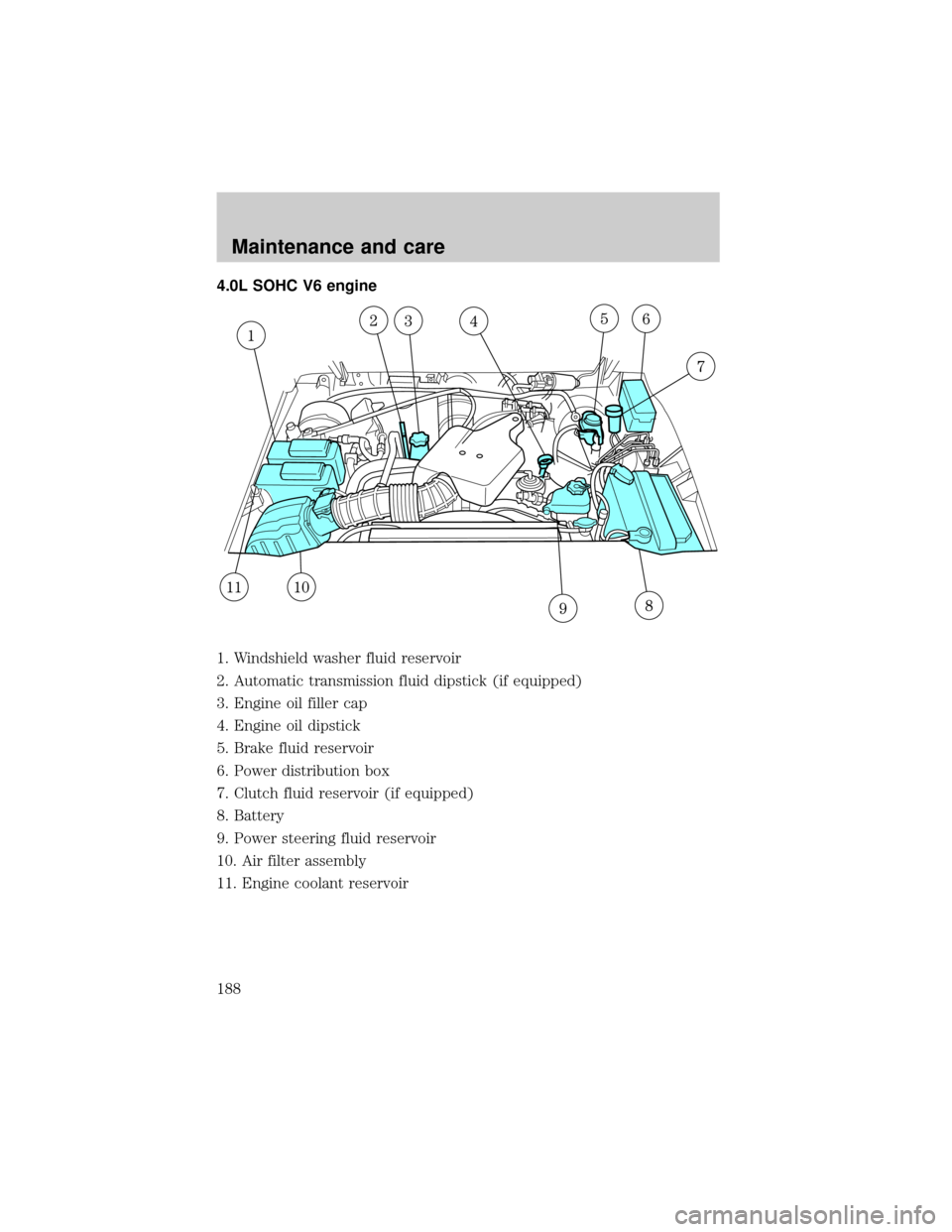
4.0L SOHC V6 engine
1. Windshield washer fluid reservoir
2. Automatic transmission fluid dipstick (if equipped)
3. Engine oil filler cap
4. Engine oil dipstick
5. Brake fluid reservoir
6. Power distribution box
7. Clutch fluid reservoir (if equipped)
8. Battery
9. Power steering fluid reservoir
10. Air filter assembly
11. Engine coolant reservoir
Maintenance and care
188
Page 195 of 272
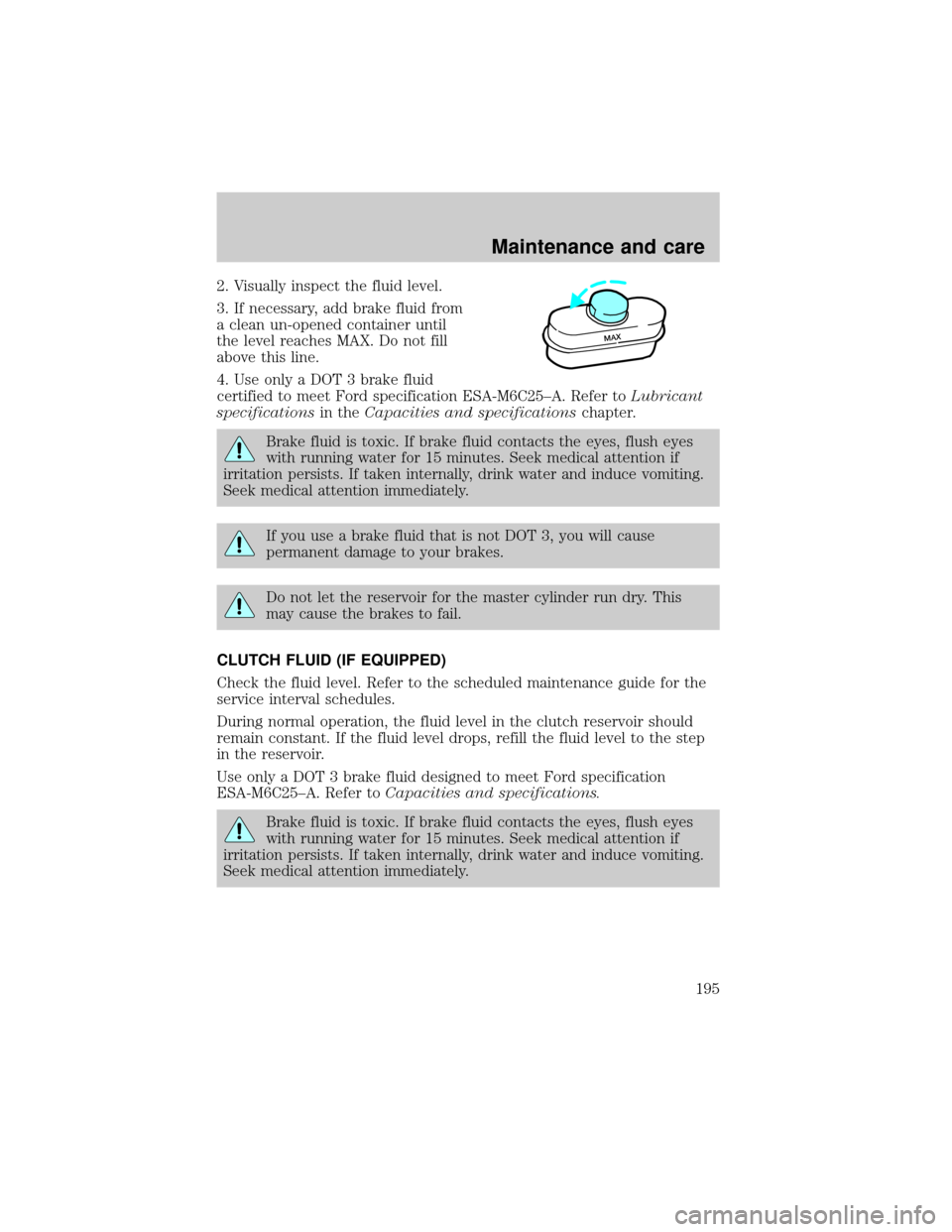
2. Visually inspect the fluid level.
3. If necessary, add brake fluid from
a clean un-opened container until
the level reaches MAX. Do not fill
above this line.
4. Use only a DOT 3 brake fluid
certified to meet Ford specification ESA-M6C25±A. Refer toLubricant
specificationsin theCapacities and specificationschapter.
Brake fluid is toxic. If brake fluid contacts the eyes, flush eyes
with running water for 15 minutes. Seek medical attention if
irritation persists. If taken internally, drink water and induce vomiting.
Seek medical attention immediately.
If you use a brake fluid that is not DOT 3, you will cause
permanent damage to your brakes.
Do not let the reservoir for the master cylinder run dry. This
may cause the brakes to fail.
CLUTCH FLUID (IF EQUIPPED)
Check the fluid level. Refer to the scheduled maintenance guide for the
service interval schedules.
During normal operation, the fluid level in the clutch reservoir should
remain constant. If the fluid level drops, refill the fluid level to the step
in the reservoir.
Use only a DOT 3 brake fluid designed to meet Ford specification
ESA-M6C25±A. Refer toCapacities and specifications.
Brake fluid is toxic. If brake fluid contacts the eyes, flush eyes
with running water for 15 minutes. Seek medical attention if
irritation persists. If taken internally, drink water and induce vomiting.
Seek medical attention immediately.
MAX
Maintenance and care
195
Page 240 of 272
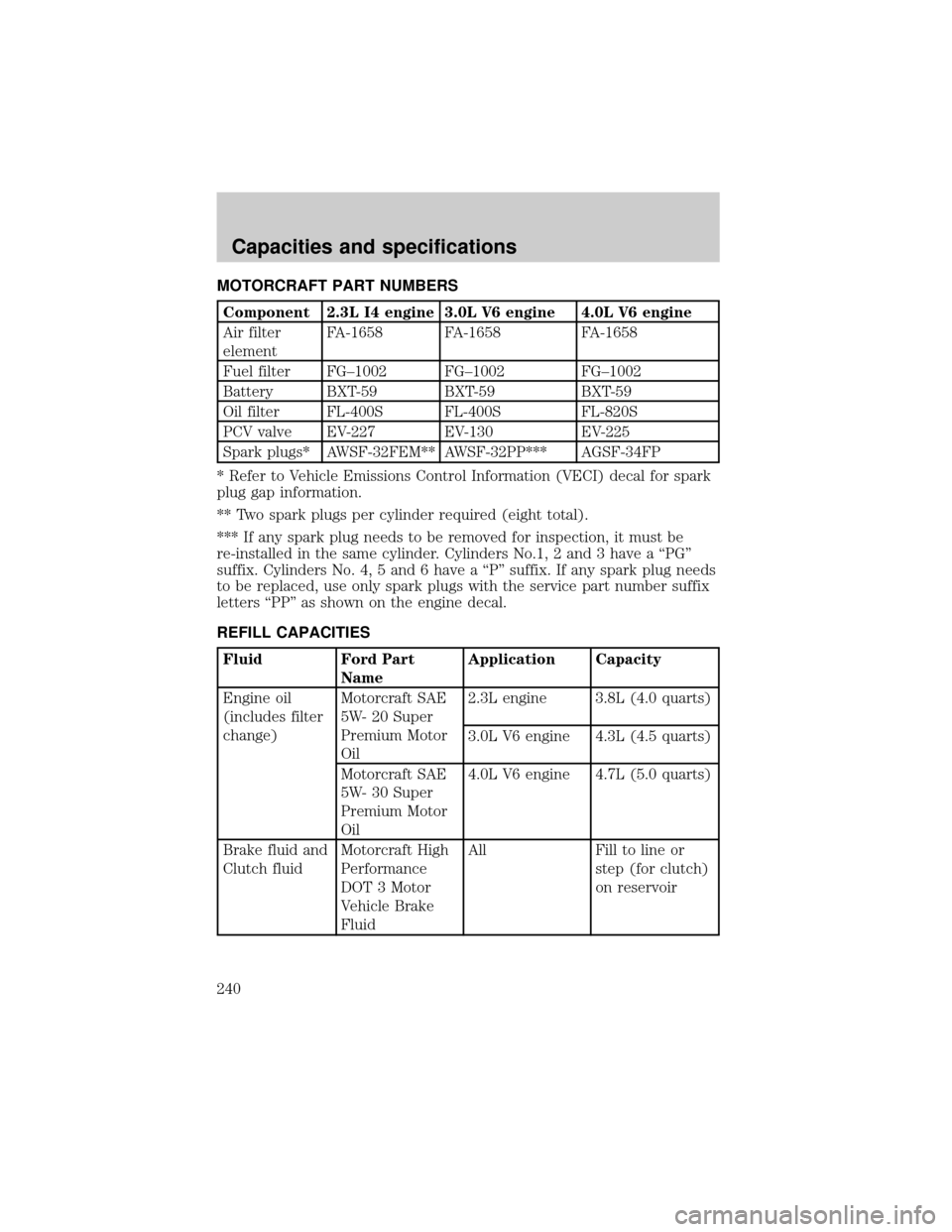
MOTORCRAFT PART NUMBERS
Component 2.3L I4 engine 3.0L V6 engine 4.0L V6 engine
Air filter
elementFA-1658 FA-1658 FA-1658
Fuel filter FG±1002 FG±1002 FG±1002
Battery BXT-59 BXT-59 BXT-59
Oil filter FL-400S FL-400S FL-820S
PCV valve EV-227 EV-130 EV-225
Spark plugs* AWSF-32FEM** AWSF-32PP*** AGSF-34FP
* Refer to Vehicle Emissions Control Information (VECI) decal for spark
plug gap information.
** Two spark plugs per cylinder required (eight total).
*** If any spark plug needs to be removed for inspection, it must be
re-installed in the same cylinder. Cylinders No.1, 2 and 3 have a ªPGº
suffix. Cylinders No. 4, 5 and 6 have a ªPº suffix. If any spark plug needs
to be replaced, use only spark plugs with the service part number suffix
letters ªPPº as shown on the engine decal.
REFILL CAPACITIES
Fluid Ford Part
NameApplication Capacity
Engine oil
(includes filter
change)Motorcraft SAE
5W- 20 Super
Premium Motor
Oil2.3L engine 3.8L (4.0 quarts)
3.0L V6 engine 4.3L (4.5 quarts)
Motorcraft SAE
5W- 30 Super
Premium Motor
Oil4.0L V6 engine 4.7L (5.0 quarts)
Brake fluid and
Clutch fluidMotorcraft High
Performance
DOT 3 Motor
Vehicle Brake
FluidAll Fill to line or
step (for clutch)
on reservoir
Capacities and specifications
240