trailer FORD RANGER 2003 2.G Owner's Manual
[x] Cancel search | Manufacturer: FORD, Model Year: 2003, Model line: RANGER, Model: FORD RANGER 2003 2.GPages: 248, PDF Size: 2.53 MB
Page 159 of 248
If you use the temporary spare tire continuously or do not follow
these precautions, the tire could fail, causing you to lose control
of the vehicle, possibly injuring yourself or others.
When driving with the temporary spare tiredo not:
•exceed 80 km/h (50 mph) or drive further than 3,200 km (2,000
miles) total under any circumstances
•load the vehicle beyond maximum vehicle load rating listed on the
Safety Compliance Label
•tow a trailer
•use more than one temporary spare tire at a time
Use of a temporary spare tire at any one wheel location can lead to
impairment of the following:
•Handling, stability and braking performance
•Comfort and noise
•Ground clearance and parking at curbs
•Winter driving capability
Conventional spare tire information
If you have the conventional spare tire that is the same size as your
other road tires, you can use the spare as you would any of the other
tires. The spare tire will be equivalent to your road tires, although it may
not have the same appearance (black-side wall instead of outlined-white
letters).
Roadside Emergencies
159
Page 214 of 248
•Combine errands and minimize stop-and-go driving.
Maintenance
•Keep tires properly inflated and use only recommended size.
•Operating a vehicle with the wheels out of alignment will reduce fuel
economy.
•Use recommended engine oil. Refer toLubricant specificationsin
this chapter.
•Perform all regularly scheduled maintenance items. Follow the
recommended maintenance schedule and owner maintenance checks
found in your vehicle scheduled maintenance guide.
Conditions
•Heavily loading a vehicle or towing a trailer may reduce fuel economy
at any speed.
•Carrying unnecessary weight may reduce fuel economy (approximately
0.4 km/L [1 mpg] is lost for every 180 kg [400 lb] of weight carried).
•Adding certain accessories to your vehicle (for example bug
deflectors, rollbars/light bars, running boards, ski/luggage racks) may
reduce fuel economy.
•Using fuel blended with alcohol may lower fuel economy.
•Fuel economy may decrease with lower temperatures during the first
12–16 km (8–10 miles) of driving.
•Driving on flat terrain offers improved fuel economy as compared to
driving on hilly terrain.
•Transmissions give their best fuel economy when operated in the top
cruise gear and with steady pressure on the gas pedal.
•Four-wheel-drive operation (if equipped) is less fuel efficient than
two-wheel-drive operation.
•Close windows for high speed driving.
EPA window sticker
Every new vehicle should have the EPA window sticker. Contact your
dealer if the window sticker is not supplied with your vehicle. The EPA
window sticker should be your guide for the fuel economy comparisons
with other vehicles.
It is important to note the box in the lower left corner of the window
sticker. These numbers represent the Range of L/100 km (MPG)
Maintenance and Specifications
214
Page 219 of 248
Brake fluid is toxic. If brake fluid contacts the eyes, flush eyes
with running water for 15 minutes. Seek medical attention if
irritation persists. If taken internally, drink water and induce vomiting.
Seek medical attention immediately.
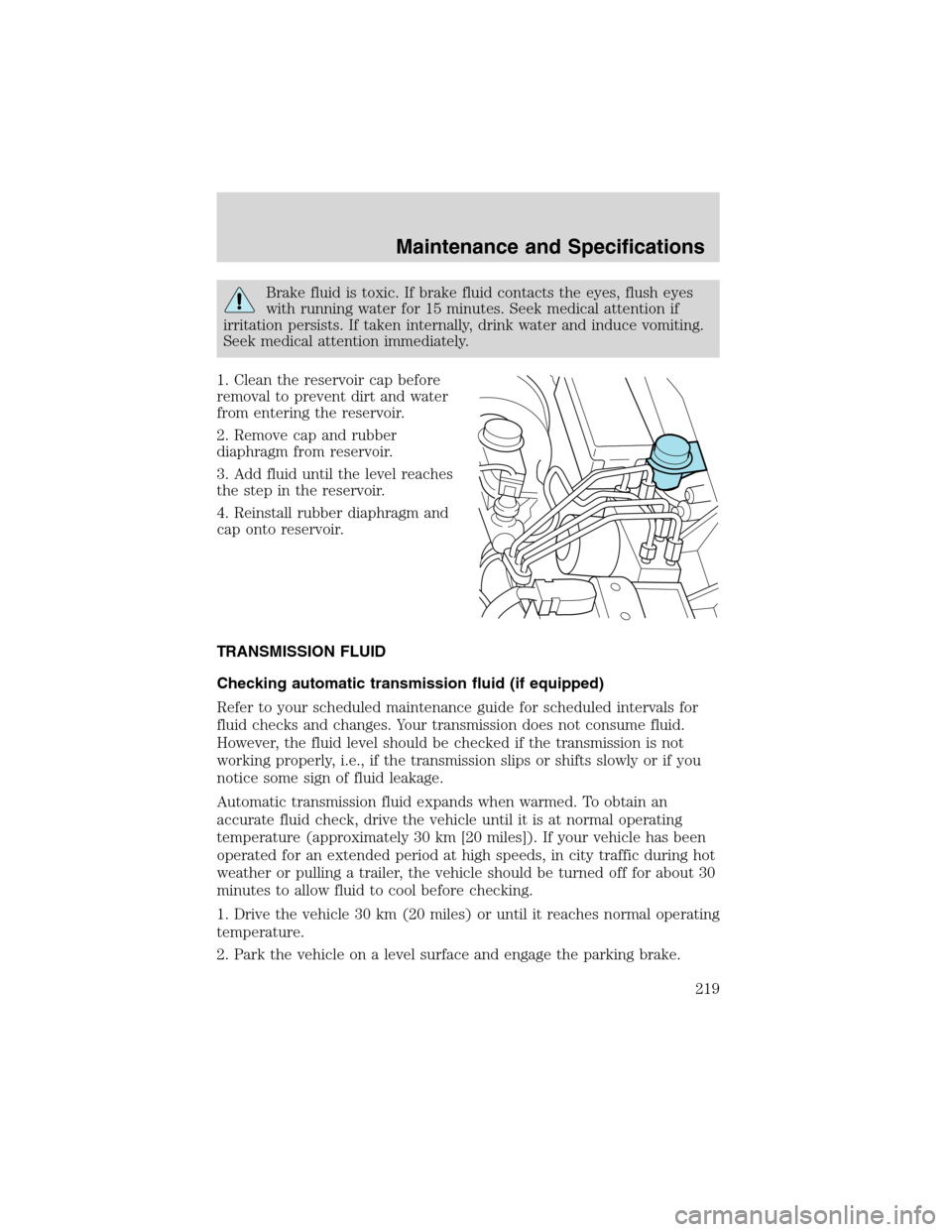
1. Clean the reservoir cap before
removal to prevent dirt and water
from entering the reservoir.
2. Remove cap and rubber
diaphragm from reservoir.
3. Add fluid until the level reaches
the step in the reservoir.
4. Reinstall rubber diaphragm and
cap onto reservoir.
TRANSMISSION FLUID
Checking automatic transmission fluid (if equipped)
Refer to your scheduled maintenance guide for scheduled intervals for
fluid checks and changes. Your transmission does not consume fluid.
However, the fluid level should be checked if the transmission is not
working properly, i.e., if the transmission slips or shifts slowly or if you
notice some sign of fluid leakage.
Automatic transmission fluid expands when warmed. To obtain an
accurate fluid check, drive the vehicle until it is at normal operating
temperature (approximately 30 km [20 miles]). If your vehicle has been
operated for an extended period at high speeds, in city traffic during hot
weather or pulling a trailer, the vehicle should be turned off for about 30
minutes to allow fluid to cool before checking.
1. Drive the vehicle 30 km (20 miles) or until it reaches normal operating
temperature.
2. Park the vehicle on a level surface and engage the parking brake.
Maintenance and Specifications
219
Page 241 of 248
Bed tent (Short bed, Styleside only)
Cellular phone holder
Compass mirror
Compass mirror with outside temperature reading
Daytime running lights
First aid kit
Fog lights
Peace of mind kit
Pickup box rails (tubular)
Removable bike carrier (bed mount/hitch mount)
Running boards/bars
Speed control
Trailer hitch (Class III)
Trailer hitch bars and balls
Trailer hitch wiring adaptor
Trailgate table
Protection and appearance equipment
Air bag anti-theft locks
Bed mats
Bedliners
Bull bars (chrome & black)
Carpeted floor mats with logo
Door edge guards
Front end covers (full and sport)
Bug deflectors
Cap (hard—color keyed—Leer supplier branded)
Locking gas cap
Rear window deflector
Removable tailgate lock
Retractable bed hooks
Running boards and bars
Accessories
241
Page 246 of 248
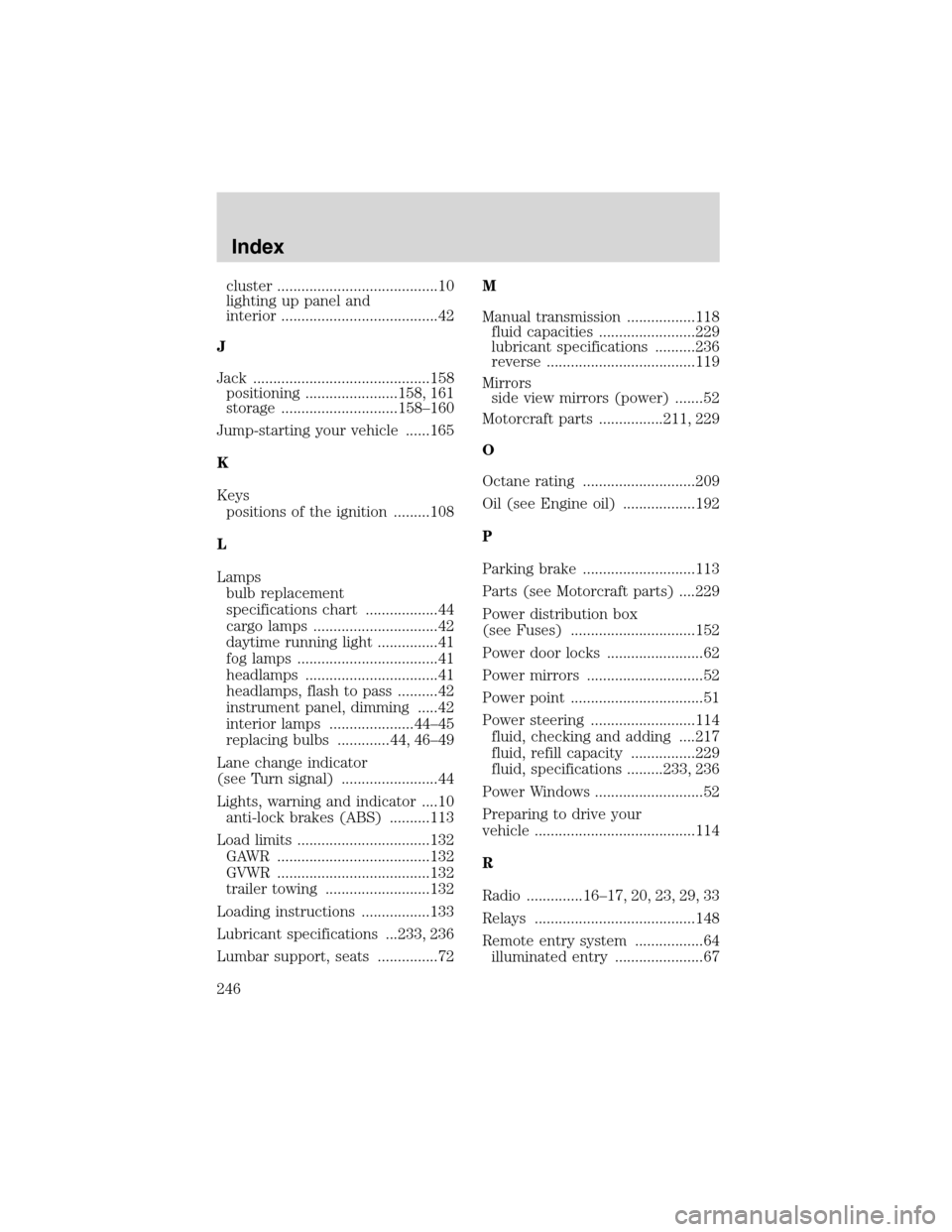
cluster ........................................10
lighting up panel and
interior .......................................42
J
Jack ............................................158
positioning .......................158, 161
storage .............................158–160
Jump-starting your vehicle ......165
K
Keys
positions of the ignition .........108
L
Lamps
bulb replacement
specifications chart ..................44
cargo lamps ...............................42
daytime running light ...............41
fog lamps ...................................41
headlamps .................................41
headlamps, flash to pass ..........42
instrument panel, dimming .....42
interior lamps .....................44–45
replacing bulbs .............44, 46–49
Lane change indicator
(see Turn signal) ........................44
Lights, warning and indicator ....10
anti-lock brakes (ABS) ..........113
Load limits .................................132
GAWR ......................................132
GVWR ......................................132
trailer towing ..........................132
Loading instructions .................133
Lubricant specifications ...233, 236
Lumbar support, seats ...............72M
Manual transmission .................118
fluid capacities ........................229
lubricant specifications ..........236
reverse .....................................119
Mirrors
side view mirrors (power) .......52
Motorcraft parts ................211, 229
O
Octane rating ............................209
Oil (see Engine oil) ..................192
P
Parking brake ............................113
Parts (see Motorcraft parts) ....229
Power distribution box
(see Fuses) ...............................152
Power door locks ........................62
Power mirrors .............................52
Power point .................................51
Power steering ..........................114
fluid, checking and adding ....217
fluid, refill capacity ................229
fluid, specifications .........233, 236
Power Windows ...........................52
Preparing to drive your
vehicle ........................................114
R
Radio ..............16–17, 20, 23, 29, 33
Relays ........................................148
Remote entry system .................64
illuminated entry ......................67
Index
246
Page 247 of 248
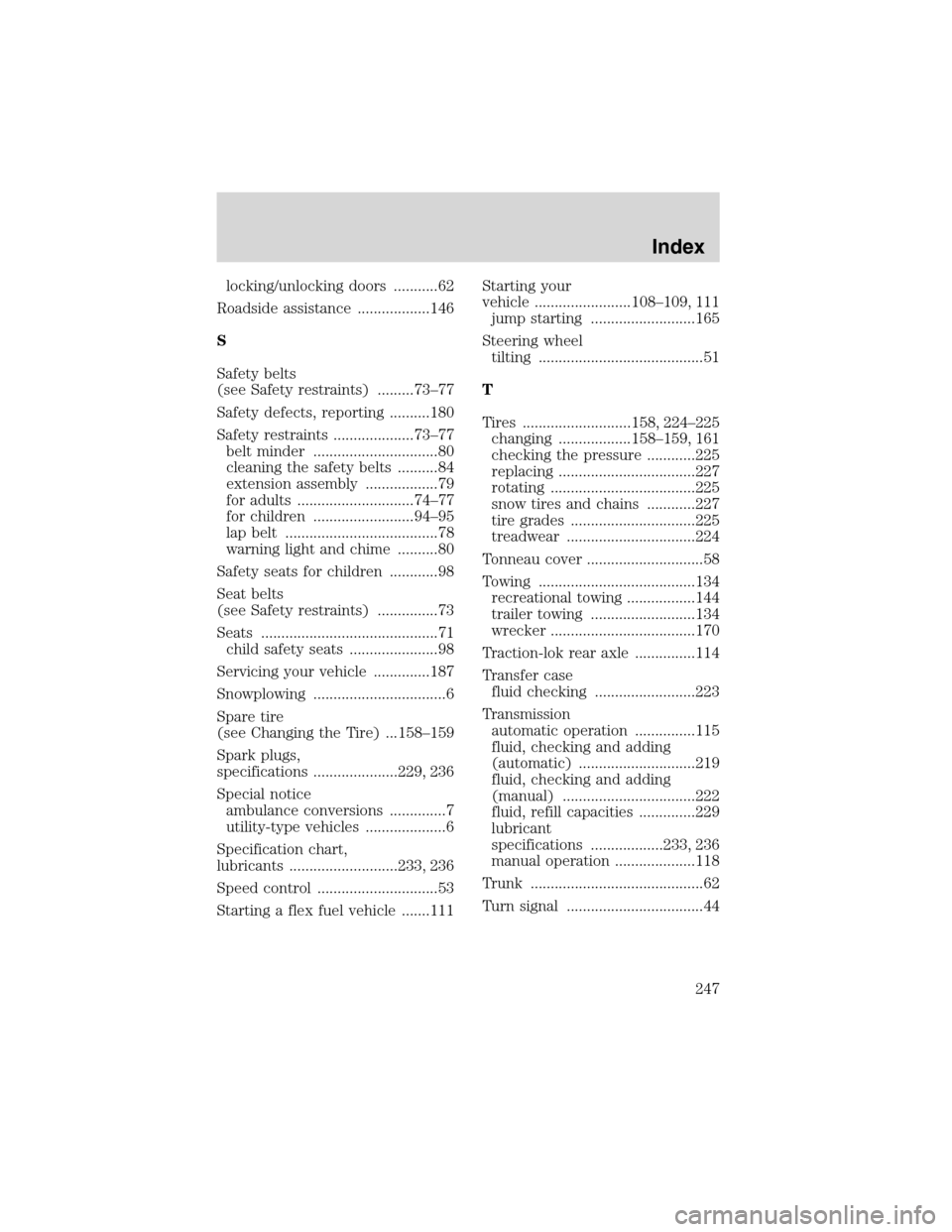
locking/unlocking doors ...........62
Roadside assistance ..................146
S
Safety belts
(see Safety restraints) .........73–77
Safety defects, reporting ..........180
Safety restraints ....................73–77
belt minder ...............................80
cleaning the safety belts ..........84
extension assembly ..................79
for adults .............................74–77
for children .........................94–95
lap belt ......................................78
warning light and chime ..........80
Safety seats for children ............98
Seat belts
(see Safety restraints) ...............73
Seats ............................................71
child safety seats ......................98
Servicing your vehicle ..............187
Snowplowing .................................6
Spare tire
(see Changing the Tire) ...158–159
Spark plugs,
specifications .....................229, 236
Special notice
ambulance conversions ..............7
utility-type vehicles ....................6
Specification chart,
lubricants ...........................233, 236
Speed control ..............................53
Starting a flex fuel vehicle .......111Starting your
vehicle ........................108–109, 111
jump starting ..........................165
Steering wheel
tilting .........................................51
T
Tires ...........................158, 224–225
changing ..................158–159, 161
checking the pressure ............225
replacing ..................................227
rotating ....................................225
snow tires and chains ............227
tire grades ...............................225
treadwear ................................224
Tonneau cover .............................58
Towing .......................................134
recreational towing .................144
trailer towing ..........................134
wrecker ....................................170
Traction-lok rear axle ...............114
Transfer case
fluid checking .........................223
Transmission
automatic operation ...............115
fluid, checking and adding
(automatic) .............................219
fluid, checking and adding
(manual) .................................222
fluid, refill capacities ..............229
lubricant
specifications ..................233, 236
manual operation ....................118
Trunk ...........................................62
Turn signal ..................................44
Index
247