seats FORD RANGER 2004 2.G User Guide
[x] Cancel search | Manufacturer: FORD, Model Year: 2004, Model line: RANGER, Model: FORD RANGER 2004 2.GPages: 248, PDF Size: 6.16 MB
Page 85 of 248
Booster seats position a child so that safety belts fit better. They lift the
child up so that the lap belt rests low across the hips and the knees
bend comfortably. Booster seats also make the shoulder belt fit better
and more comfortably for growing children.
When children should use booster seats
Children need to use booster seats from the time they outgrow the
toddler seat until they are big enough for the vehicle seat and
lap/shoulder belt to fit properly. Generally this is when they weigh about
80 lbs (about 8 to 12 years old).
Booster seats should be used until you can answer YES to ALL of these
questions:
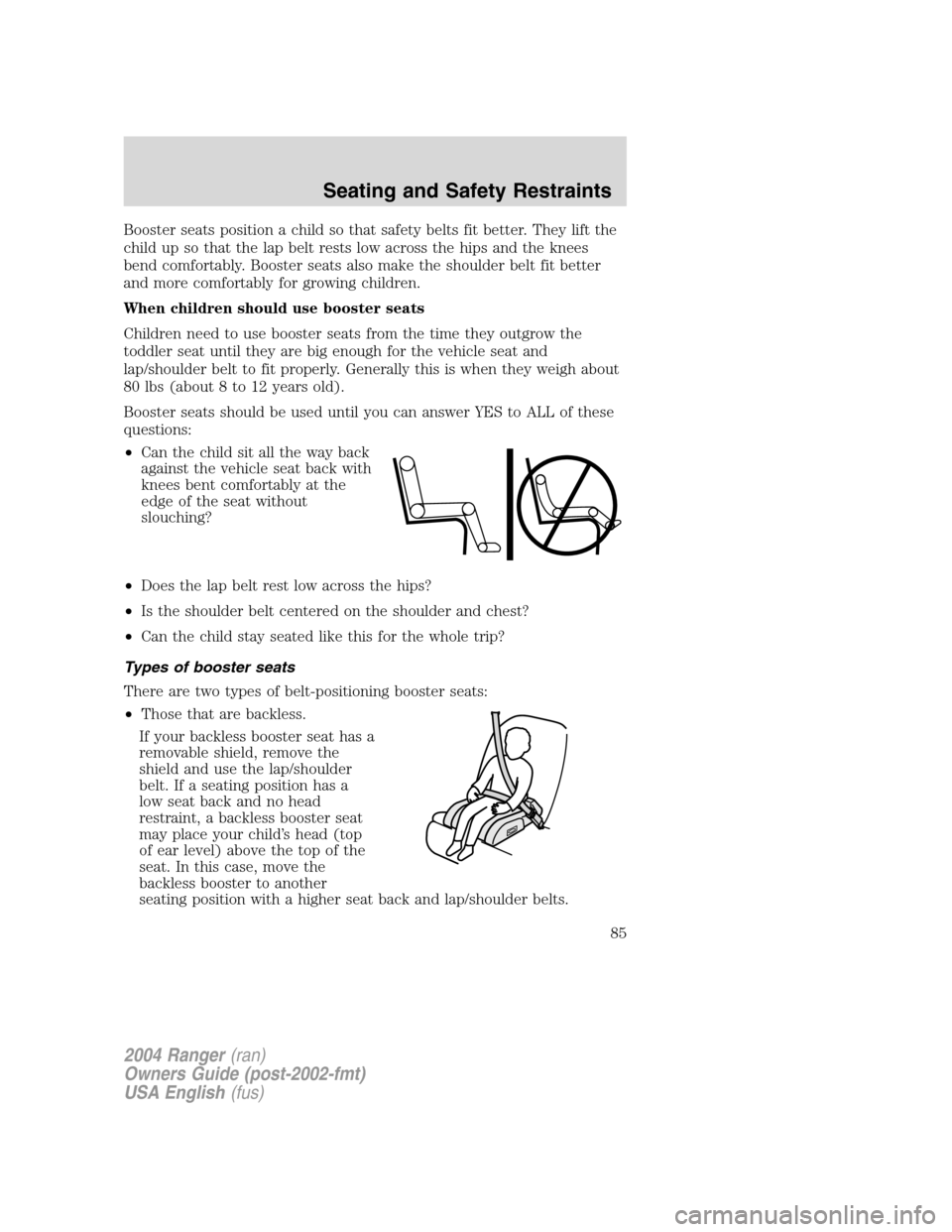
•Can the child sit all the way back
against the vehicle seat back with
knees bent comfortably at the
edge of the seat without
slouching?
• Does the lap belt rest low across the hips?
• Is the shoulder belt centered on the shoulder and chest?
• Can the child stay seated like this for the whole trip?
Types of booster seats
There are two types of belt-positioning booster seats:
• Those that are backless.
If your backless booster seat has a
removable shield, remove the
shield and use the lap/shoulder
belt. If a seating position has a
low seat back and no head
restraint, a backless booster seat
may place your child ’s head (top
of ear level) above the top of the
seat. In this case, move the
backless booster to another
seating position with a higher seat back and lap/shoulder belts.
2004 Ranger (ran)
Owners Guide (post-2002-fmt)
USA English (fus)
Seating and Safety Restraints
85
Page 87 of 248
SAFETY SEATS FOR CHILDREN
Child and infant or child safety seats
Use a safety seat that is recommended for the size and weight of the
child. Carefully follow all of the manufacturer’s instructions with the
safety seat you put in your vehicle. If you do not install and use the
safety seat properly, the child may be injured in a sudden stop or
collision.
When installing a child safety seat:
• Review and follow the information
presented in the Air bag
supplemental restraint system
(SRS) section in this chapter.
• Use the correct safety belt buckle
for that seating position (the
buckle closest to the direction the
tongue is coming from).
• Insert the belt tongue into the
proper buckle until you hear a
snap and feel it latch. Make sure the tongue is securely fastened in the
buckle.
• Keep the buckle release button pointing up and away from the safety
seat, with the tongue between the child seat and the release button,
to prevent accidental unbuckling.
• Place seat back in upright position.
• Put the safety belt in the automatic locking mode. Refer to Automatic
locking mode (passenger side front and outboard rear seating
positions) (if equipped) section in this chapter.
2004 Ranger (ran)
Owners Guide (post-2002-fmt)
USA English (fus)
Seating and Safety Restraints
87
Page 88 of 248
•LATCH lower anchors are recommended for use by children up to 22
kg (48 pounds) in a child restraint. Top tether anchors can be used
for children up to 27 kg (60 pounds) in a child restraint, and to
provide upper torso restraint for children up to 36 kg (80 pounds)
using an upper torso harness and a belt-positioning booster.
Ford recommends the use of a child safety seat having a top tether
strap. Install the child safety seat in a seating position with LATCH and
tether anchors. For more information on top tether straps and anchors,
refer to Attaching safety seats with tether straps in this chapter. For
more information of LATCH anchors refer to Attaching safety seats with
LATCH (Lower Anchors and Tethers for Children) attachments in this
chapter.
Carefully follow all of the manufacturer ’s instructions included
with the safety seat you put in your vehicle. If you do not install
and use the safety seat properly, the child may be injured in a sudden
stop or collision.
Installing child safety seats with combination lap and shoulder
belts
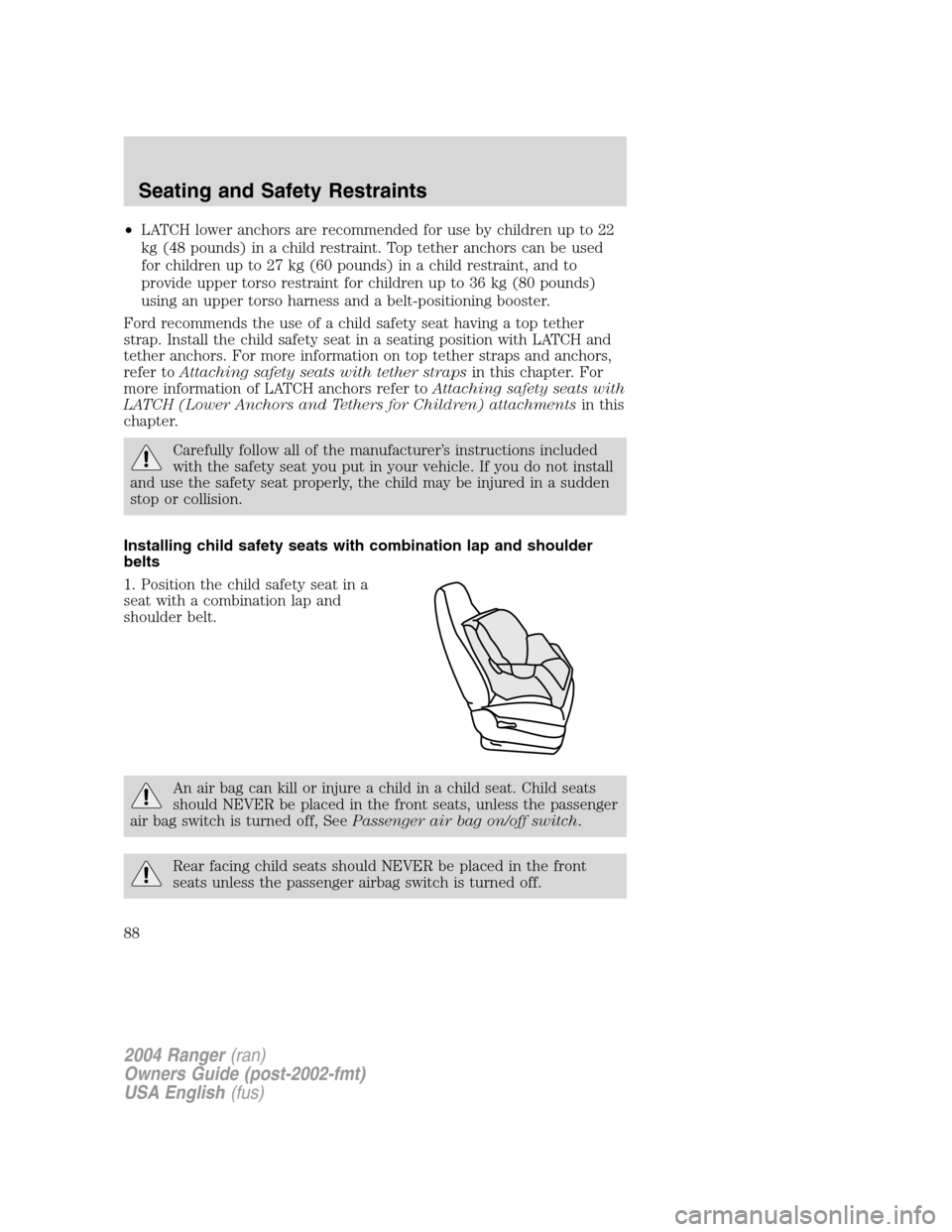
1. Position the child safety seat in a
seat with a combination lap and
shoulder belt.
An air bag can kill or injure a child in a child seat. Child seats
should NEVER be placed in the front seats, unless the passenger
air bag switch is turned off, See Passenger air bag on/off switch .
Rear facing child seats should NEVER be placed in the front
seats unless the passenger airbag switch is turned off.
2004 Ranger(ran)
Owners Guide (post-2002-fmt)
USA English (fus)
Seating and Safety Restraints
88
Page 91 of 248
Attaching child safety seats with tether straps
Most new forward-facing child safety seats include a tether strap which
goes over the back of the seat and hooks to an anchoring point. Tether
straps are available as an accessory for many older safety seats. Contact
the manufacturer of your child seat for information about ordering a
tether strap.
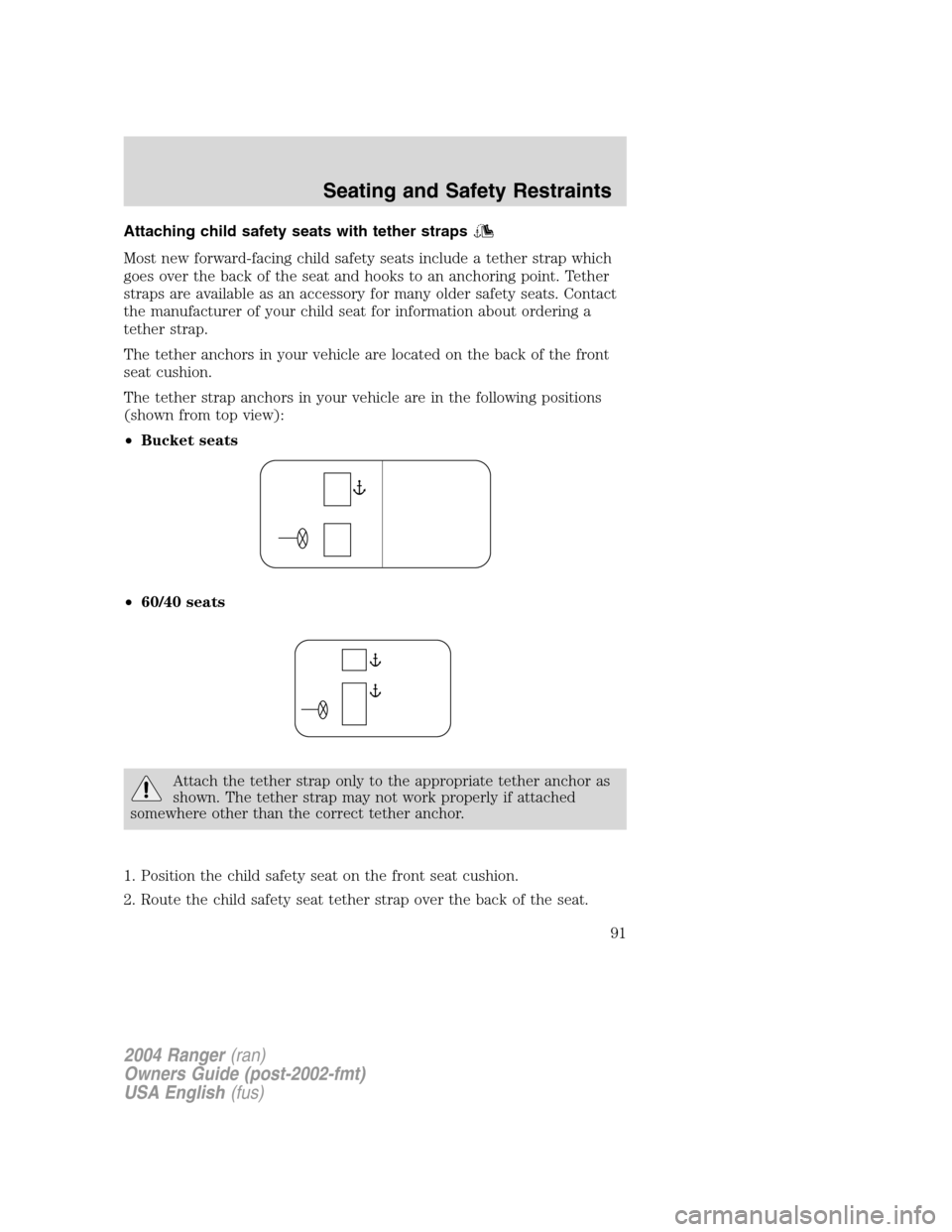
The tether anchors in your vehicle are located on the back of the front
seat cushion.
The tether strap anchors in your vehicle are in the following positions
(shown from top view):
•Bucket seats
• 60/40 seats
Attach the tether strap only to the appropriate tether anchor as
shown. The tether strap may not work properly if attached
somewhere other than the correct tether anchor.
1. Position the child safety seat on the front seat cushion.
2. Route the child safety seat tether strap over the back of the seat.
2004 Ranger (ran)
Owners Guide (post-2002-fmt)
USA English (fus)
Seating and Safety Restraints
91
Page 93 of 248
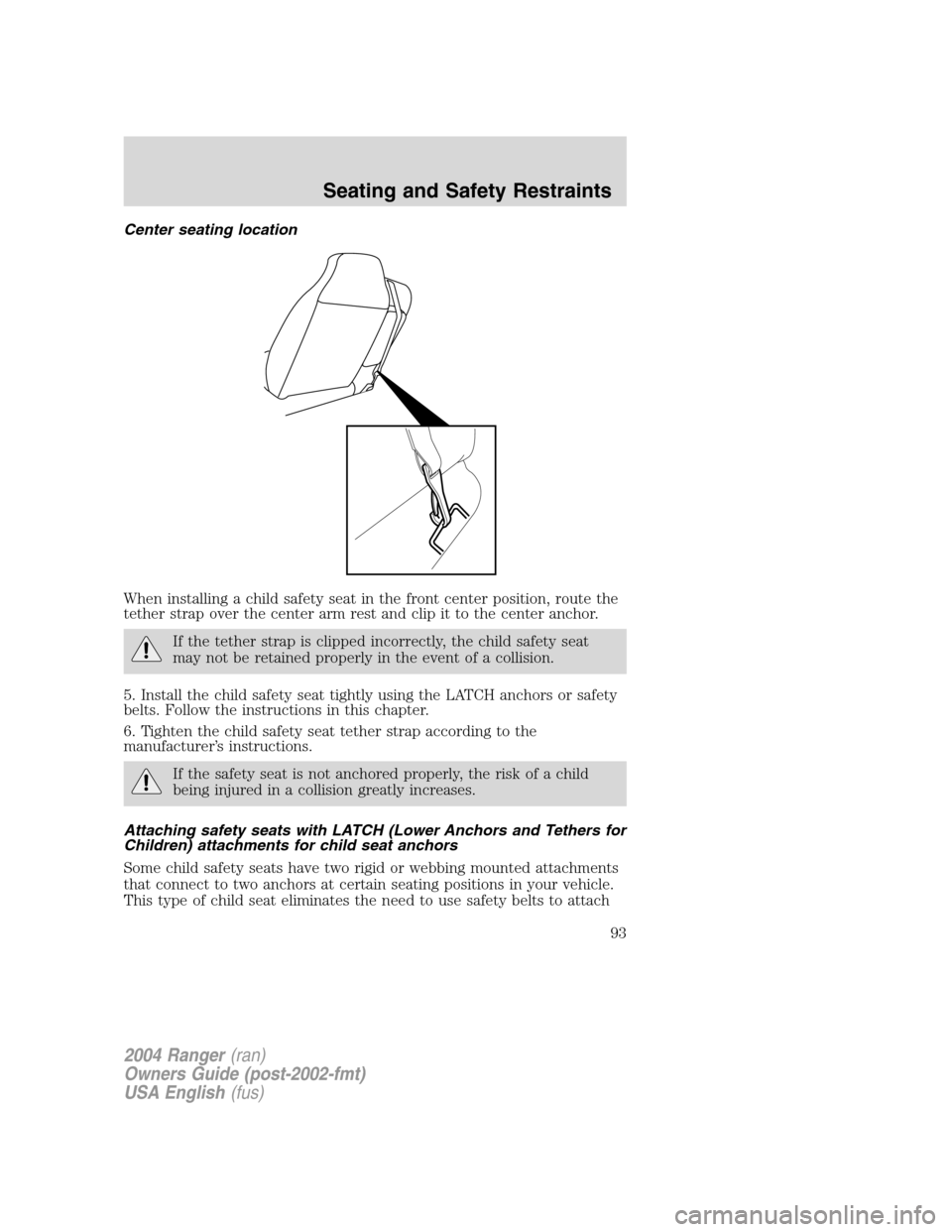
Center seating location
When installing a child safety seat in the front center position, route the
tether strap over the center arm rest and clip it to the center anchor.
If the tether strap is clipped incorrectly, the child safety seat
may not be retained properly in the event of a collision.
5. Install the child safety seat tightly using the LATCH anchors or safety
belts. Follow the instructions in this chapter.
6. Tighten the child safety seat tether strap according to the
manufacturer ’s instructions.
If the safety seat is not anchored properly, the risk of a child
being injured in a collision greatly increases.
Attaching safety seats with LATCH (Lower Anchors and Tethers for
Children) attachments for child seat anchors
Some child safety seats have two rigid or webbing mounted attachments
that connect to two anchors at certain seating positions in your vehicle.
This type of child seat eliminates the need to use safety belts to attach
2004 Ranger (ran)
Owners Guide (post-2002-fmt)
USA English (fus)
Seating and Safety Restraints
93
Page 94 of 248
the child seat. For forward-facing child seats, the tether strap must also
be attached to the proper tether anchor. SeeAttaching safety seats with
tether straps in this chapter.
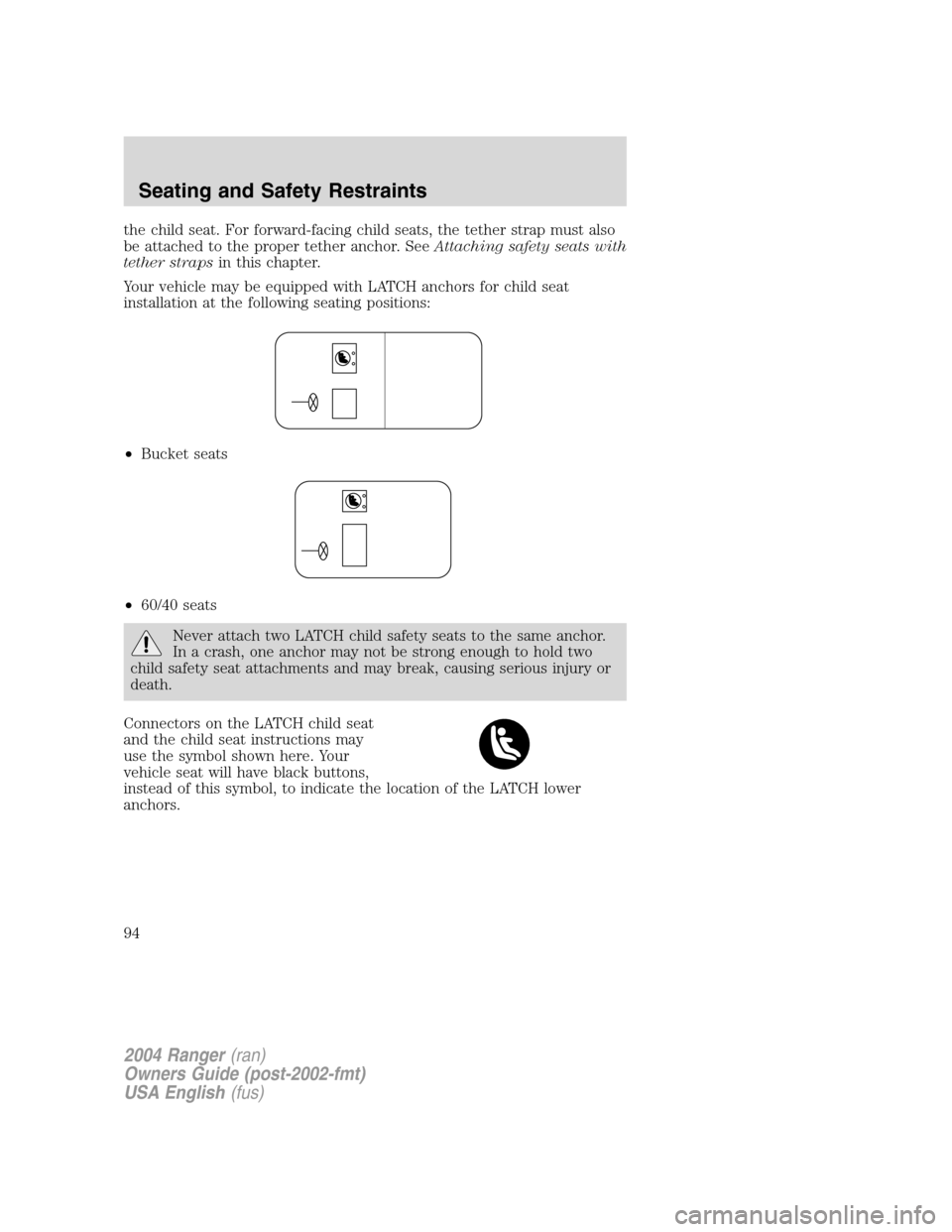
Your vehicle may be equipped with LATCH anchors for child seat
installation at the following seating positions:
• Bucket seats
• 60/40 seats
Never attach two LATCH child safety seats to the same anchor.
In a crash, one anchor may not be strong enough to hold two
child safety seat attachments and may break, causing serious injury or
death.
Connectors on the LATCH child seat
and the child seat instructions may
use the symbol shown here. Your
vehicle seat will have black buttons,
instead of this symbol, to indicate the location of the LATCH lower
anchors.
2004 Ranger (ran)
Owners Guide (post-2002-fmt)
USA English (fus)
Seating and Safety Restraints
94
Page 146 of 248
Location of the spare tire and tools
The spare tire and tools for your vehicle are stowed in the following
locations:
Tool Location
Spare tire Under the vehicle, just forward of the rear bumper
Jack, jack handle, wheel nut wrench Regular Cab: behind the passenger
seat, underneath the jack and tools
cover on the floor
SuperCab: stowed in the passenger
side rear cab compartment or
behind the jump seat in a separate
tool bag
Four-door models: stowed behind
the front seats, between jump
seats and underneath jack and
tools cover.
Key, spare tire lock (if equipped) In the glove box
Removing the spare tire
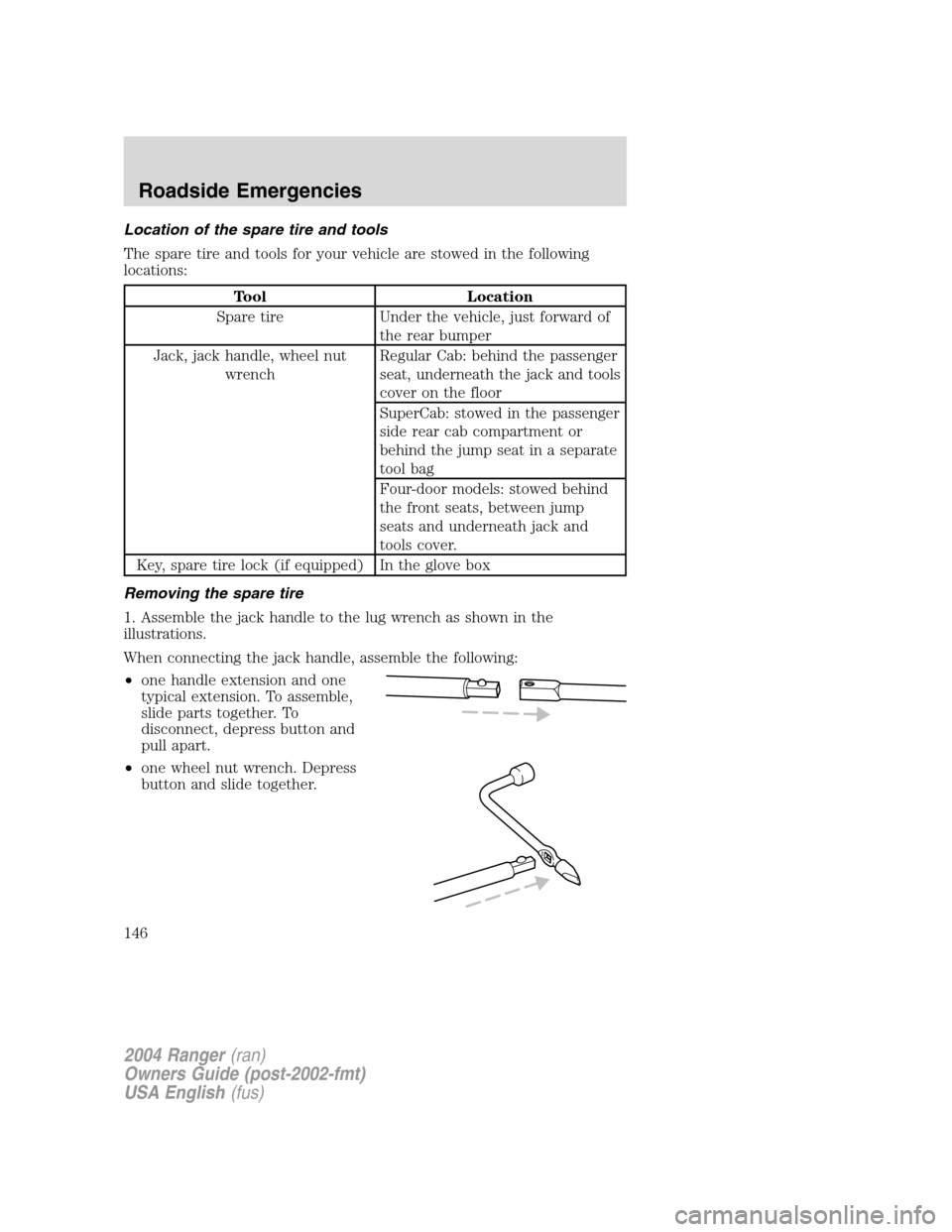
1. Assemble the jack handle to the lug wrench as shown in the
illustrations.
When connecting the jack handle, assemble the following:
• one handle extension and one
typical extension. To assemble,
slide parts together. To
disconnect, depress button and
pull apart.
• one wheel nut wrench. Depress
button and slide together.
2004 Ranger (ran)
Owners Guide (post-2002-fmt)
USA English (fus)
Roadside Emergencies
146
Page 171 of 248
INSTRUMENT PANEL AND CLUSTER LENS
Clean the instrument panel with a damp cloth, then dry with a dry cloth.
•Avoid cleaners or polish that increase the gloss of the upper portion of
the instrument panel. The dull finish in this area helps protect the
driver from undesirable windshield reflection.
Do not use chemical solvents or strong detergents when cleaning
the steering wheel or instrument panel to avoid contamination of
the air bag system.
• Be certain to wash or wipe your hands clean if you have been in
contact with certain products such as insect repellent and suntan
lotion in order to avoid possible damage to the interior painted
surfaces.
INTERIOR
For fabric, carpets, cloth seats and safety belts:
• Remove dust and loose dirt with a vacuum cleaner.
• Remove light stains and soil with Motorcraft Extra Strength
Upholstery Cleaner (ZC-41).
• If grease or tar is present on the material, spot-clean the area first
with Motorcraft Spot and Stain Remover (ZC-14).
• Never saturate the seat covers with cleaning solution.
• Do not use household cleaning products or glass cleaners, which can
stain and discolor the fabric and affect the flame retardant abilities of
the seat materials.
Do not use cleaning solvents, bleach or dye on the vehicle ’s
seatbelts, as these actions may weaken the belt webbing.
LEATHER SEATS (IF EQUIPPED)
Your leather seating surfaces have a clear, protective coating over the
leather.
• To clean, use a soft cloth with Motorcraft Deluxe Leather and Vinyl
Cleaner (ZC-11 –A). Dry the area with a soft cloth.
• To help maintain its resiliency and color, use the Motorcraft Deluxe
Leather Care Kit (ZC-11 –D), available from your authorized dealer.
2004 Ranger (ran)
Owners Guide (post-2002-fmt)
USA English (fus)
Cleaning
171
Page 239 of 248
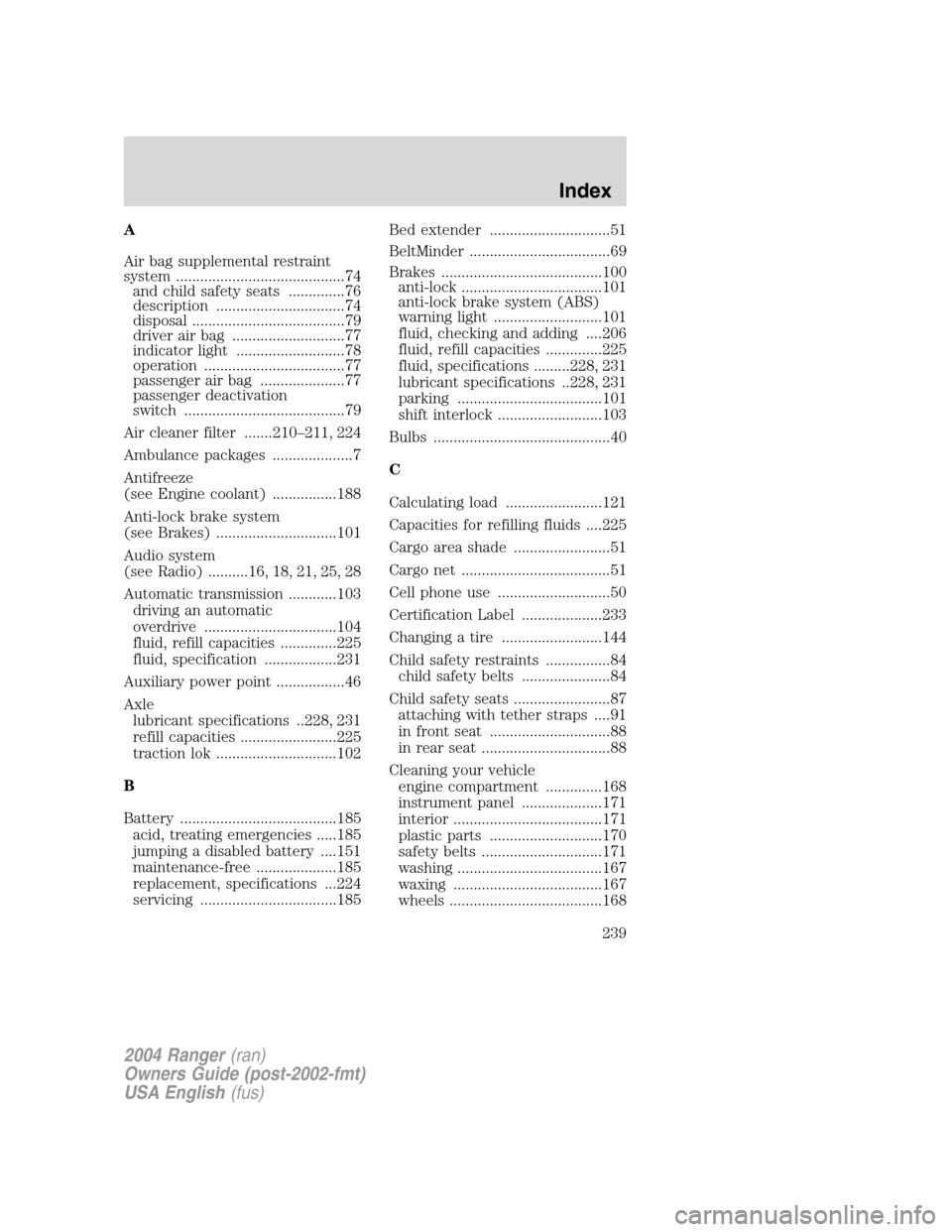
A
Air bag supplemental restraint
system ..........................................74and child safety seats ..............76
description ................................74
disposal ......................................79
driver air bag ............................77
indicator light ...........................78
operation ...................................77
passenger air bag .....................77
passenger deactivation
switch ........................................79
Air cleaner filter .......210 –211, 224
Ambulance packages ....................7
Antifreeze
(see Engine coolant) ................188
Anti-lock brake system
(see Brakes) ..............................101
Audio system
(see Radio) ..........16, 18, 21, 25, 28
Automatic transmission ............103 driving an automatic
overdrive .................................104
fluid, refill capacities ..............225
fluid, specification ..................231
Auxiliary power point .................46
Axle lubricant specifications ..228, 231
refill capacities ........................225
traction lok ..............................102
B
Battery .......................................185 acid, treating emergencies .....185
jumping a disabled battery ....151
maintenance-free ....................185
replacement, specifications ...224
servicing ..................................185 Bed extender ..............................51
BeltMinder ...................................69
Brakes ........................................100
anti-lock ...................................101
anti-lock brake system (ABS)
warning light ...........................101
fluid, checking and adding ....206
fluid, refill capacities ..............225
fluid, specifications .........228, 231
lubricant specifications ..228, 231
parking ....................................101
shift interlock ..........................103
Bulbs ............................................40
C
Calculating load ........................121
Capacities for refilling fluids ....225
Cargo area shade ........................51
Cargo net .....................................51
Cell phone use ............................50
Certification Label ....................233
Changing a tire .........................144
Child safety restraints ................84 child safety belts ......................84
Child safety seats ........................87 attaching with tether straps ....91
in front seat ..............................88
in rear seat ................................88
Cleaning your vehicle engine compartment ..............168
instrument panel ....................171
interior .....................................171
plastic parts ............................170
safety belts ..............................171
washing ....................................167
waxing .....................................167
wheels ......................................168
2004 Ranger (ran)
Owners Guide (post-2002-fmt)
USA English (fus)
Index
Index
239
Page 241 of 248
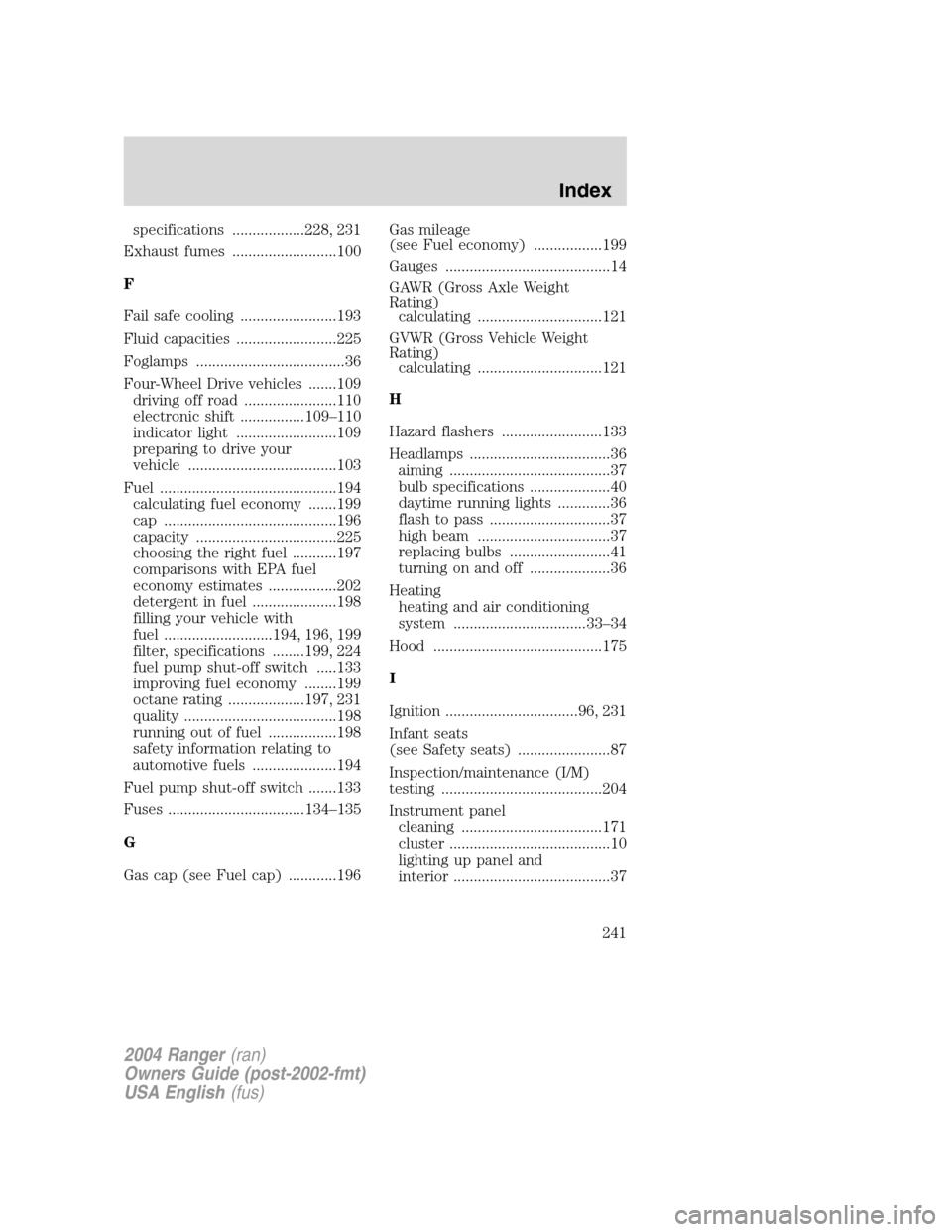
specifications ..................228, 231
Exhaust fumes ..........................100
F
Fail safe cooling ........................193
Fluid capacities .........................225
Foglamps .....................................36
Four-Wheel Drive vehicles .......109 driving off road .......................110
electronic shift ................109 –110
indicator light .........................109
preparing to drive your
vehicle .....................................103
Fuel ............................................194 calculating fuel economy .......199
cap ...........................................196
capacity ...................................225
choosing the right fuel ...........197
comparisons with EPA fuel
economy estimates .................202
detergent in fuel .....................198
filling your vehicle with
fuel ...........................194, 196, 199
filter, specifications ........199, 224
fuel pump shut-off switch .....133
improving fuel economy ........199
octane rating ...................197, 231
quality ......................................198
running out of fuel .................198
safety information relating to
automotive fuels .....................194
Fuel pump shut-off switch .......133
Fuses ..................................134 –135
G
Gas cap (see Fuel cap) ............196 Gas mileage
(see Fuel economy) .................199
Gauges .........................................14
GAWR (Gross Axle Weight
Rating)
calculating ...............................121
GVWR (Gross Vehicle Weight
Rating) calculating ...............................121
H
Hazard flashers .........................133
Headlamps ...................................36 aiming ........................................37
bulb specifications ....................40
daytime running lights .............36
flash to pass ..............................37
high beam .................................37
replacing bulbs .........................41
turning on and off ....................36
Heating heating and air conditioning
system .................................33 –34
Hood ..........................................175
I
Ignition .................................96, 231
Infant seats
(see Safety seats) .......................87
Inspection/maintenance (I/M)
testing ........................................204
Instrument panel cleaning ...................................171
cluster ........................................10
lighting up panel and
interior .......................................37
2004 Ranger (ran)
Owners Guide (post-2002-fmt)
USA English (fus)
Index
241