lock FORD RANGER 2004 2.G Service Manual
[x] Cancel search | Manufacturer: FORD, Model Year: 2004, Model line: RANGER, Model: FORD RANGER 2004 2.GPages: 248, PDF Size: 6.16 MB
Page 106 of 248
•Use when driving conditions cause excessive shifting from O/D to
other gears. Examples: city traffic, hilly terrain, heavy loads, trailer
towing and when engine braking is required.
• To return to O/D (overdrive mode), press the transmission control
switch. The O/D OFF lamp will not be illuminated.
•
O/D (Overdrive) is automatically returned each time the key is turned off.
2 (Second)
Use 2 (Second) to start-up on slippery roads or to provide additional
engine braking on downgrades.
1 (First)
• Provides maximum engine braking.
• Allows upshifts by moving gearshift lever.
• Will not downshift into 1 (First) at high speeds; allows for 1 (First)
when vehicle reaches slower speeds.
Forced downshifts
• Allowed in
(Overdrive) or Drive.
• Depress the accelerator to the floor.
• Allows transmission to select an appropriate gear.
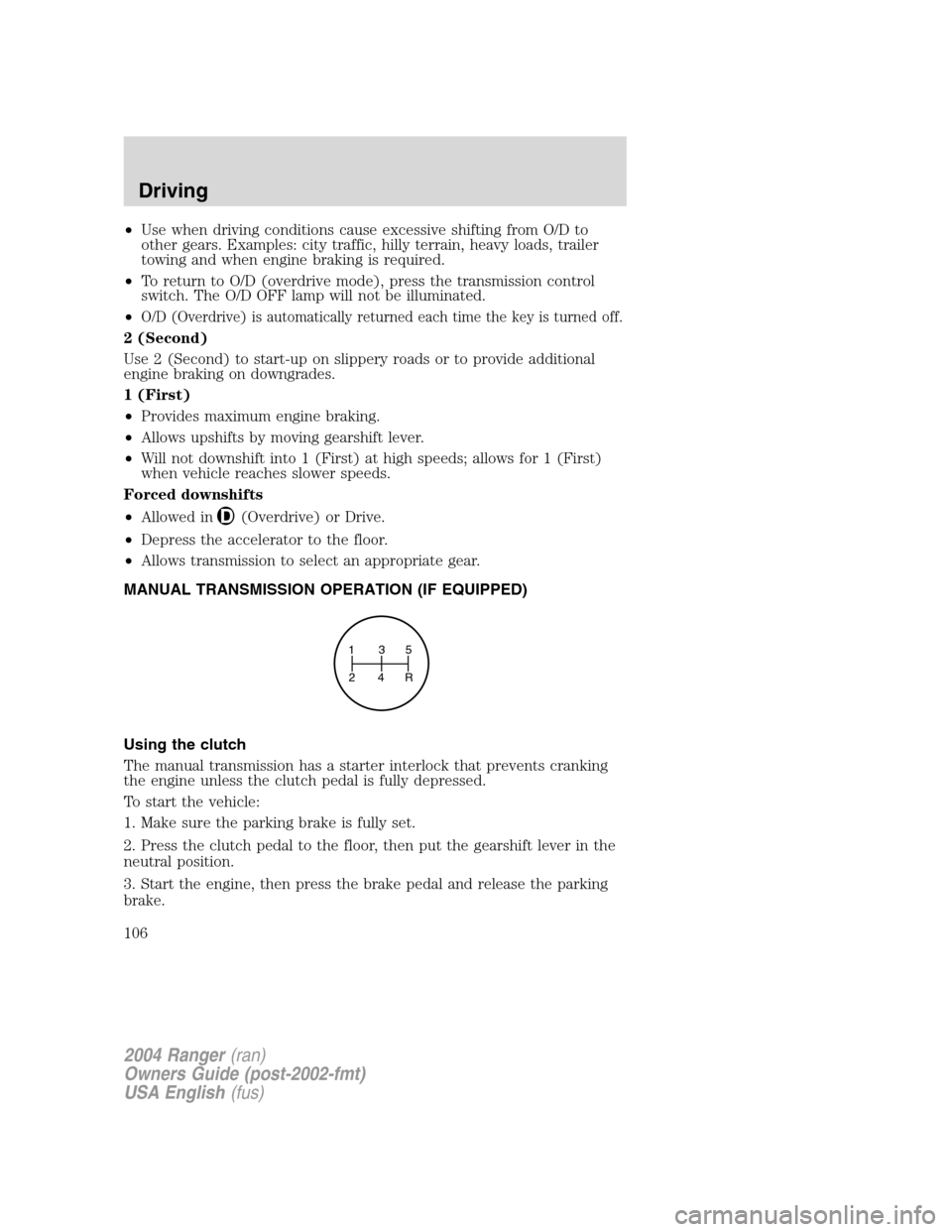
MANUAL TRANSMISSION OPERATION (IF EQUIPPED)
Using the clutch
The manual transmission has a starter interlock that prevents cranking
the engine unless the clutch pedal is fully depressed.
To start the vehicle:
1. Make sure the parking brake is fully set.
2. Press the clutch pedal to the floor, then put the gearshift lever in the
neutral position.
3. Start the engine, then press the brake pedal and release the parking
brake.
1 35
24 R
2004 Ranger (ran)
Owners Guide (post-2002-fmt)
USA English (fus)
Driving
106
Page 108 of 248
Reverse
1. Make sure that your vehicle is at a complete stop before you shift into
R (Reverse). Failure to do so may damage the transmission.
2. Move the gearshift lever into the neutral position and wait at least
three seconds before shifting into R (Reverse).
•The gearshift lever can only be moved into R (Reverse) by moving it
from left of 3 (Third) and 4 (Fourth) before shifting into R (Reverse).
This is a lockout feature that protects the transmission from
accidentally being shifted into R (Reverse) from 5 (Overdrive).
Parking your vehicle
1. Apply the brake and shift into the neutral position.
2. Fully apply the parking brake, then shift into 1 (First).
3. Turn the ignition off.
Do not park your vehicle in Neutral, it may move unexpectedly
and injure someone. Use 1 (First) gear and set the parking brake
fully.
Removing the key
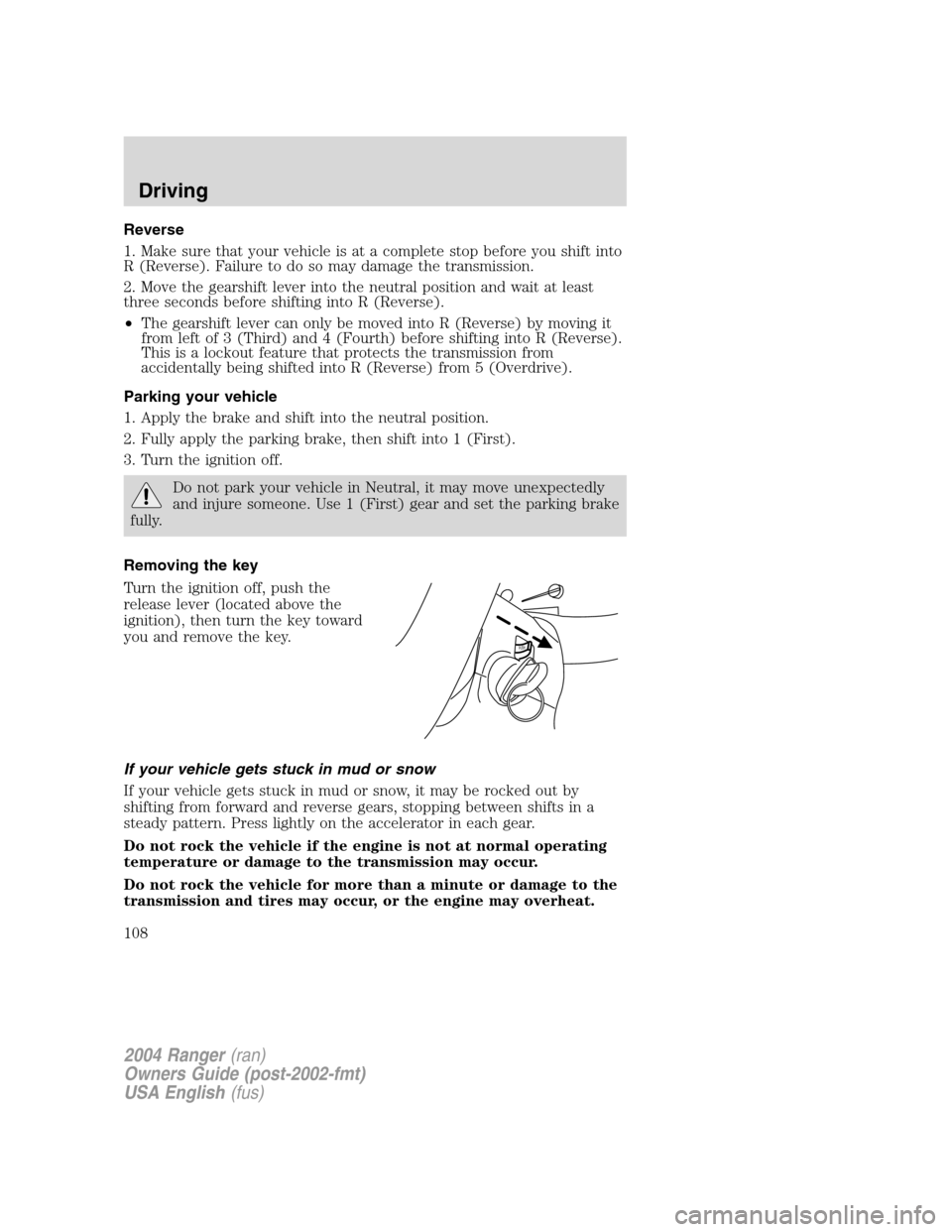
Turn the ignition off, push the
release lever (located above the
ignition), then turn the key toward
you and remove the key.
If your vehicle gets stuck in mud or snow
If your vehicle gets stuck in mud or snow, it may be rocked out by
shifting from forward and reverse gears, stopping between shifts in a
steady pattern. Press lightly on the accelerator in each gear.
Do not rock the vehicle if the engine is not at normal operating
temperature or damage to the transmission may occur.
Do not rock the vehicle for more than a minute or damage to the
transmission and tires may occur, or the engine may overheat.
PUSH
2004 Ranger (ran)
Owners Guide (post-2002-fmt)
USA English (fus)
Driving
108
Page 113 of 248
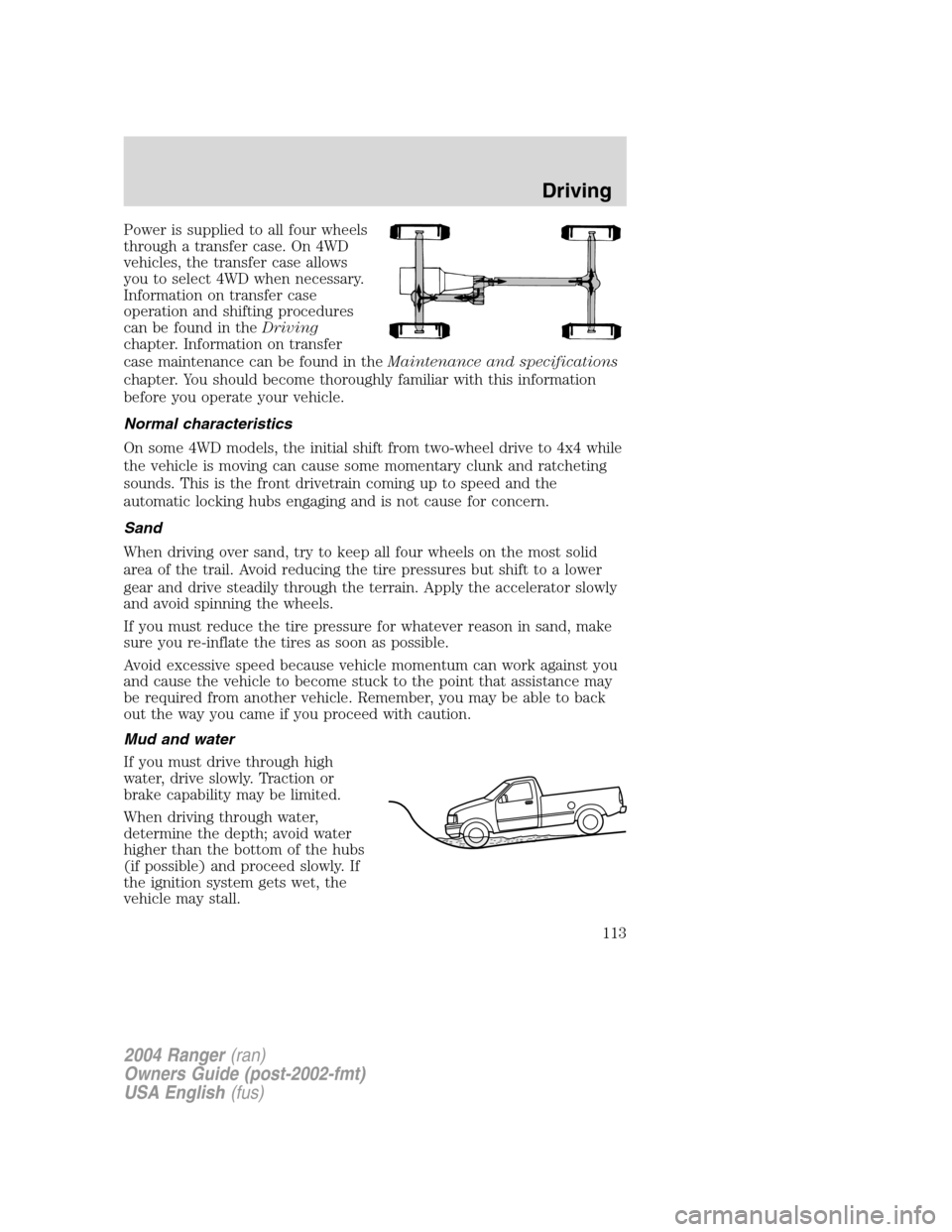
Power is supplied to all four wheels
through a transfer case. On 4WD
vehicles, the transfer case allows
you to select 4WD when necessary.
Information on transfer case
operation and shifting procedures
can be found in theDriving
chapter. Information on transfer
case maintenance can be found in the Maintenance and specifications
chapter. You should become thoroughly familiar with this information
before you operate your vehicle.
Normal characteristics
On some 4WD models, the initial shift from two-wheel drive to 4x4 while
the vehicle is moving can cause some momentary clunk and ratcheting
sounds. This is the front drivetrain coming up to speed and the
automatic locking hubs engaging and is not cause for concern.
Sand
When driving over sand, try to keep all four wheels on the most solid
area of the trail. Avoid reducing the tire pressures but shift to a lower
gear and drive steadily through the terrain. Apply the accelerator slowly
and avoid spinning the wheels.
If you must reduce the tire pressure for whatever reason in sand, make
sure you re-inflate the tires as soon as possible.
Avoid excessive speed because vehicle momentum can work against you
and cause the vehicle to become stuck to the point that assistance may
be required from another vehicle. Remember, you may be able to back
out the way you came if you proceed with caution.
Mud and water
If you must drive through high
water, drive slowly. Traction or
brake capability may be limited.
When driving through water,
determine the depth; avoid water
higher than the bottom of the hubs
(if possible) and proceed slowly. If
the ignition system gets wet, the
vehicle may stall.
2004 Ranger (ran)
Owners Guide (post-2002-fmt)
USA English (fus)
Driving
113
Page 115 of 248
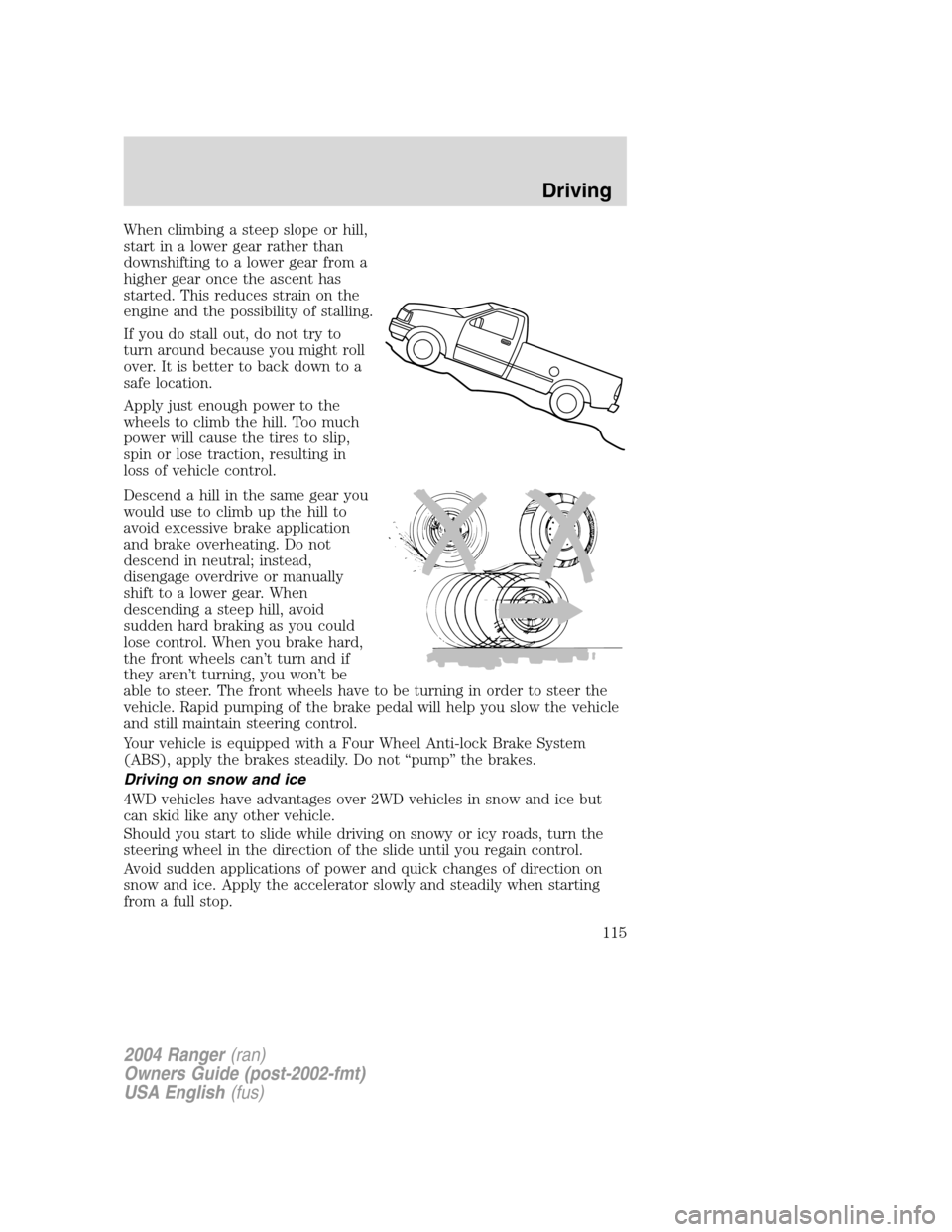
When climbing a steep slope or hill,
start in a lower gear rather than
downshifting to a lower gear from a
higher gear once the ascent has
started. This reduces strain on the
engine and the possibility of stalling.
If you do stall out, do not try to
turn around because you might roll
over. It is better to back down to a
safe location.
Apply just enough power to the
wheels to climb the hill. Too much
power will cause the tires to slip,
spin or lose traction, resulting in
loss of vehicle control.
Descend a hill in the same gear you
would use to climb up the hill to
avoid excessive brake application
and brake overheating. Do not
descend in neutral; instead,
disengage overdrive or manually
shift to a lower gear. When
descending a steep hill, avoid
sudden hard braking as you could
lose control. When you brake hard,
the front wheels can’t turn and if
they aren ’t turning, you won ’tbe
able to steer. The front wheels have to be turning in order to steer the
vehicle. Rapid pumping of the brake pedal will help you slow the vehicle
and still maintain steering control.
Your vehicle is equipped with a Four Wheel Anti-lock Brake System
(ABS), apply the brakes steadily. Do not “pump ”the brakes.
Driving on snow and ice
4WD vehicles have advantages over 2WD vehicles in snow and ice but
can skid like any other vehicle.
Should you start to slide while driving on snowy or icy roads, turn the
steering wheel in the direction of the slide until you regain control.
Avoid sudden applications of power and quick changes of direction on
snow and ice. Apply the accelerator slowly and steadily when starting
from a full stop.
2004 Ranger (ran)
Owners Guide (post-2002-fmt)
USA English (fus)
Driving
115
Page 116 of 248
Avoid sudden braking as well. Although a 4WD vehicle may accelerate
better than a two-wheel drive vehicle in snow and ice, it won’t stop any
faster, because as in other vehicles, braking occurs at all four wheels. Do
not become overconfident as to road conditions.
Make sure you allow sufficient distance between you and other vehicles
for stopping. Drive slower than usual and consider using one of the lower
gears. Your vehicle is equipped with a Four Wheel Anti-Lock Brake
System (ABS); apply the brake steadily. Do not “pump ”the brakes. Refer
to the Brakes section of this chapter for additional information on the
operation of the anti-lock brake system.
Never drive with chains on the front tires of 4WD vehicles without also
putting them on the rear tires. This could cause the rear to slide and
swing around during braking.
Tires, Replacement Requirements
Do not use a size and type of tire and wheel other than that
originally provided by Ford Motor Company because it can affect
the safety and performance of your vehicle, which could result in an
increased risk of loss of vehicle control, vehicle rollover, and/or serious
personal injury or death.
Make sure all tires and wheels on the vehicle are of the same size, type,
tread design and load-carrying capacity. If you have questions regarding
tire replacement, see an authorized Ford or Lincoln/Mercury dealer.
If you nevertheless decide to equip your 4WD for off-road use with tires
larger than what Ford Motor Company recommends, you should not use
these tires for highway driving.
If you use any tire/wheel combination not recommended by Ford Motor
Company, it may adversely affect vehicle handling and could cause
steering, suspension, axle or transfer case failure as well as the increased
risk of loss of vehicle control.
Do not use “aftermarket lift kits ”or other suspension modifications,
whether or not they are used with larger tires and wheels.
These “aftermarket lift kits ”could adversely affect the vehicle ’s handling
characteristics, which could lead to loss of vehicle control or rollover and
serious injury.
Tires can be damaged during off-road use. For your safety, tires that are
damaged should not be used for highway driving because they are more
likely to blow out or fail.
2004 Ranger (ran)
Owners Guide (post-2002-fmt)
USA English (fus)
Driving
116
Page 117 of 248
You should carefully observe the recommended tire inflation pressure
found on the safety compliance certification label attached to the left
front door lock facing or door latch post pillar. Failure to follow tire
pressure recommendations can adversely affect the way your vehicle
handles. Do not exceed the Ford Motor Company recommended pressure
even if it is less than the maximum pressure allowed for the tire.
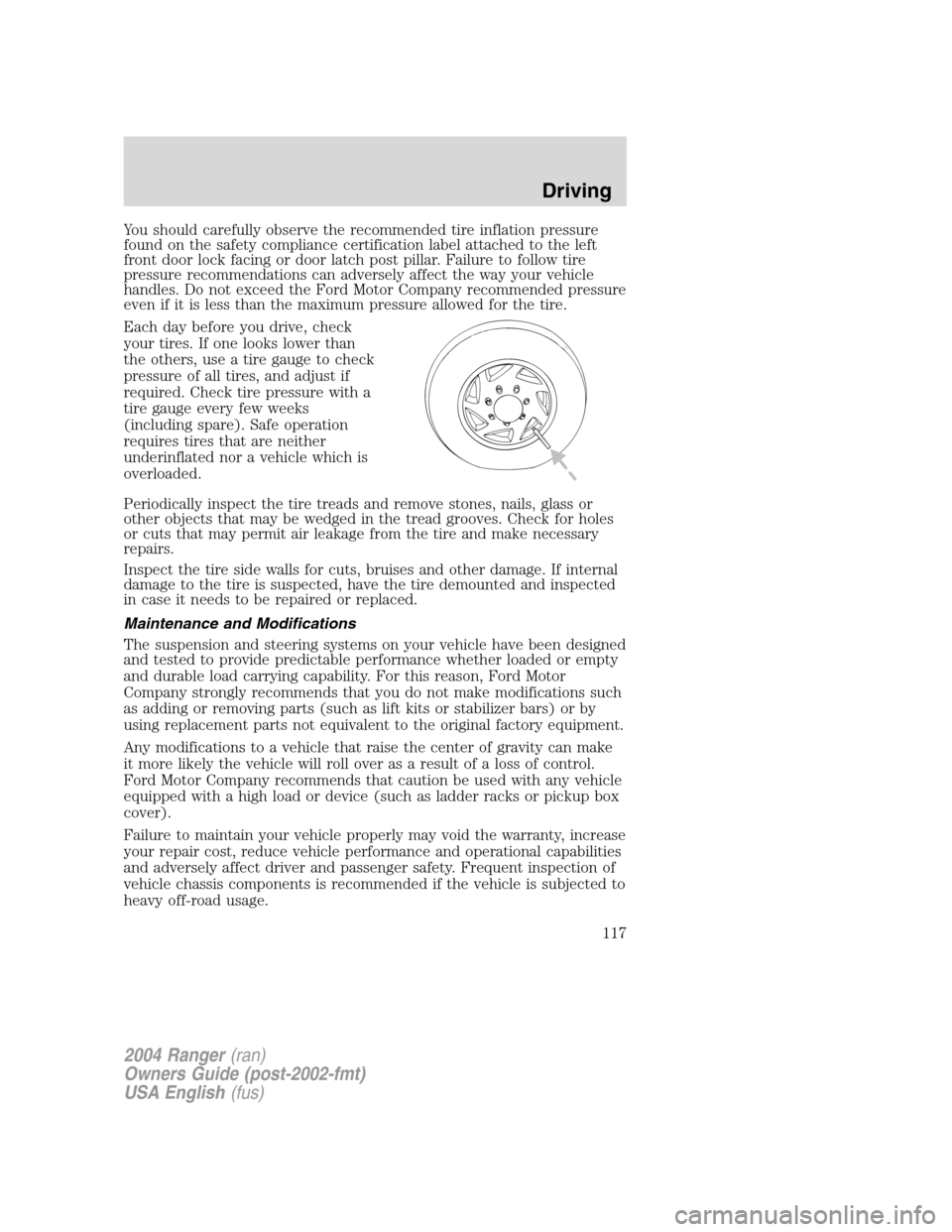
Each day before you drive, check
your tires. If one looks lower than
the others, use a tire gauge to check
pressure of all tires, and adjust if
required. Check tire pressure with a
tire gauge every few weeks
(including spare). Safe operation
requires tires that are neither
underinflated nor a vehicle which is
overloaded.
Periodically inspect the tire treads and remove stones, nails, glass or
other objects that may be wedged in the tread grooves. Check for holes
or cuts that may permit air leakage from the tire and make necessary
repairs.
Inspect the tire side walls for cuts, bruises and other damage. If internal
damage to the tire is suspected, have the tire demounted and inspected
in case it needs to be repaired or replaced.
Maintenance and Modifications
The suspension and steering systems on your vehicle have been designed
and tested to provide predictable performance whether loaded or empty
and durable load carrying capability. For this reason, Ford Motor
Company strongly recommends that you do not make modifications such
as adding or removing parts (such as lift kits or stabilizer bars) or by
using replacement parts not equivalent to the original factory equipment.
Any modifications to a vehicle that raise the center of gravity can make
it more likely the vehicle will roll over as a result of a loss of control.
Ford Motor Company recommends that caution be used with any vehicle
equipped with a high load or device (such as ladder racks or pickup box
cover).
Failure to maintain your vehicle properly may void the warranty, increase
your repair cost, reduce vehicle performance and operational capabilities
and adversely affect driver and passenger safety. Frequent inspection of
vehicle chassis components is recommended if the vehicle is subjected to
heavy off-road usage.
2004 Ranger(ran)
Owners Guide (post-2002-fmt)
USA English (fus)
Driving
117
Page 130 of 248
RECREATIONAL TOWING
Follow these guidelines if you have a need for recreational towing. An
example of recreational towing would be towing your vehicle behind a
motorhome. These guidelines are designed to ensure that your
transmission is not damaged.
4x2 vehicles equipped with a manual transmission:
Note:4x2 vehicles with a manual transmission follow these guidelines
for recreational towing:
Before you have your vehicle towed:
• Release the parking brake.
• Move the gearshift to the neutral position.
• Turn the key in the ignition to the OFF/UNLOCKED position.
• The maximum recommended speed is 88 km/h (55 mph).
• The maximum recommended distance is unlimited.
• The vehicle must be towed in the forward position to ensure no
damage is done to the internal transmission components.
In addition, it is recommended that you follow the instructions
provided by the aftermarket manufacturer of the towing
apparatus if one has been installed.
Vehicles equipped with automatic transmission and 4x4 vehicles
equipped with an electronic-shift transfer case and a manual
transmission:
4x2 vehicles with automatic transmissions, 4x4 vehicles with an
electronic-shift transfer case and automatic transmission and 4x4
vehicles equipped with an electronic-shift transfer case and manual
transmission follow these guidelines for recreational towing:
• Release the parking brake.
• Turn the key in the ignition to the OFF/UNLOCKED position.
• Place the transmission in N (Neutral).
• Do not exceed a distance of 80 km (50 miles).
• Do not exceed 56 km/h (35 mph) vehicle speed.
• The vehicle must be towed in the forward position to ensure no
damage is done to the internal transfer case components.
2004 Ranger (ran)
Owners Guide (post-2002-fmt)
USA English (fus)
Driving
130
Page 132 of 248
GETTING ROADSIDE ASSISTANCE
To fully assist you should you have a vehicle concern, Ford Motor
Company offers a complimentary roadside assistance program. This
program is separate from the New Vehicle Limited Warranty. The service
is available:
•24–hours, seven days a week
• for the New Vehicle Limited Warranty period of three years or 60,000
km (36,000 miles), whichever occurs first on Ford and Mercury
vehicles, and four years or 80,000 km (50,000 miles) on Lincoln
vehicles.
Roadside assistance will cover:
• changing a flat tire
• jump-starts
• lock-out assistance
• limited fuel delivery
• towing of your disabled vehicle to the nearest Ford Motor Company
dealership, or your selling dealer if within 56.3 km (35 miles) of the
nearest Ford Motor Company dealership (one tow per disablement).
Even non-warranty related tows, like accidents or getting stuck in the
mud or snow, are covered (some exclusions apply, such as impound
towing or repossession).
Canadian customers refer to your Owner Information Guide for
information on:
• coverage period
• exact fuel amounts
• towing of your disabled vehicle
• emergency travel expense reimbursement
• travel planning benefits
USING ROADSIDE ASSISTANCE
Complete the roadside assistance identification card and place it in your
wallet for quick reference. In the United States, this card is found in the
Owner Guide portfolio in the glove compartment in Ford vehicles and is
mailed to you if you own a Mercury or Lincoln. In Canada, the card is
found in the Owner Information Guide in the glove compartment.
U.S. Ford or Mercury vehicle customers who require roadside assistance,
call 1 –800 –241 –3673; Lincoln vehicle customers call 1 –800 –521 –4140.
2004 Ranger (ran)
Owners Guide (post-2002-fmt)
USA English (fus)
Roadside Emergencies
Roadside Emergencies
132
Page 137 of 248
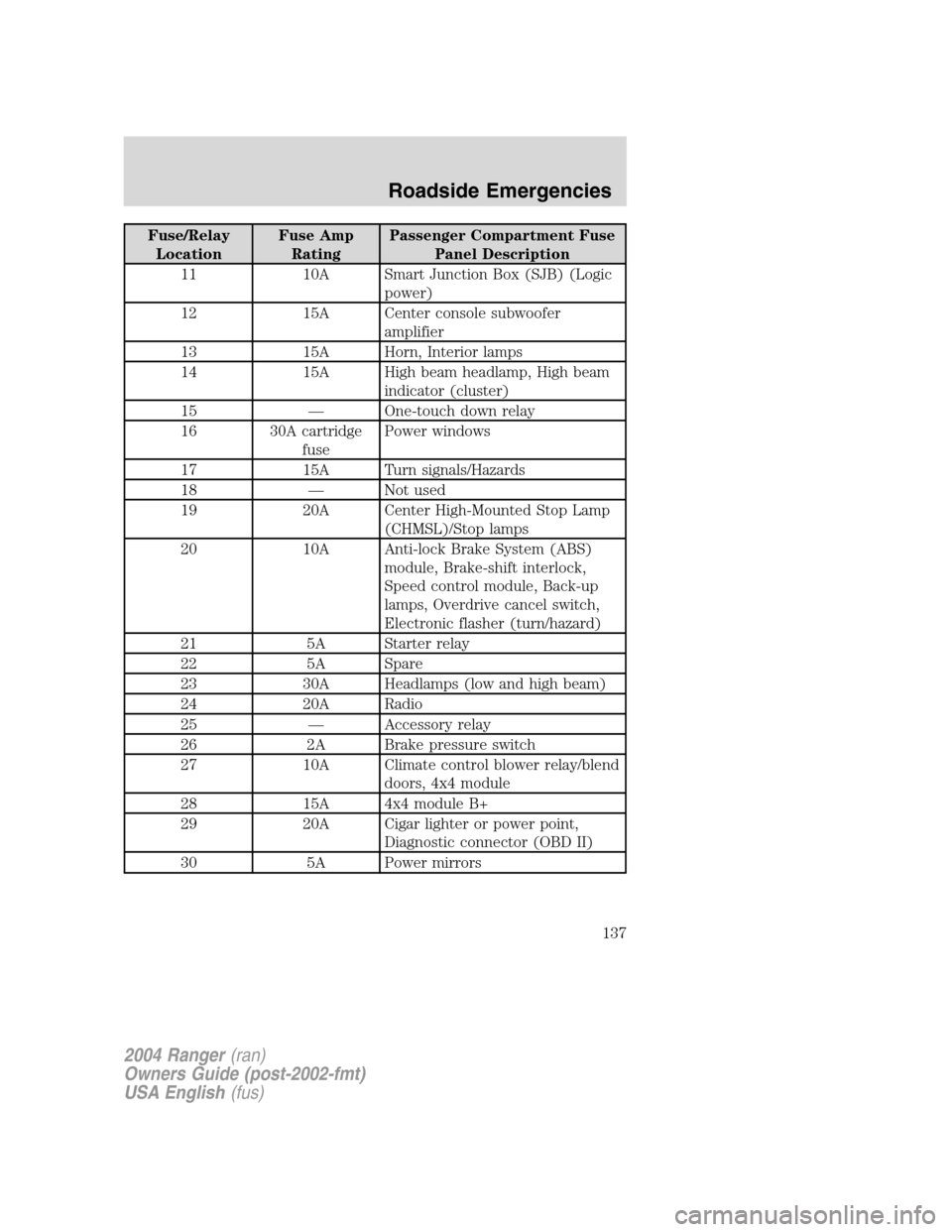
Fuse/RelayLocation Fuse Amp
Rating Passenger Compartment Fuse
Panel Description
11 10A Smart Junction Box (SJB) (Logic power)
12 15A Center console subwoofer amplifier
13 15A Horn, Interior lamps
14 15A High beam headlamp, High beam indicator (cluster)
15 —One-touch down relay
16 30A cartridge fusePower windows
17 15A Turn signals/Hazards
18 —Not used
19 20A Center High-Mounted Stop Lamp (CHMSL)/Stop lamps
20 10A Anti-lock Brake System (ABS) module, Brake-shift interlock,
Speed control module, Back-up
lamps, Overdrive cancel switch,
Electronic flasher (turn/hazard)
21 5A Starter relay
22 5A Spare
23 30A Headlamps (low and high beam)
24 20A Radio
25 —Accessory relay
26 2A Brake pressure switch
27 10A Climate control blower relay/blend doors, 4x4 module
28 15A 4x4 module B+
29 20A Cigar lighter or power point, Diagnostic connector (OBD II)
30 5A Power mirrors
2004 Ranger (ran)
Owners Guide (post-2002-fmt)
USA English (fus)
Roadside Emergencies
137
Page 138 of 248
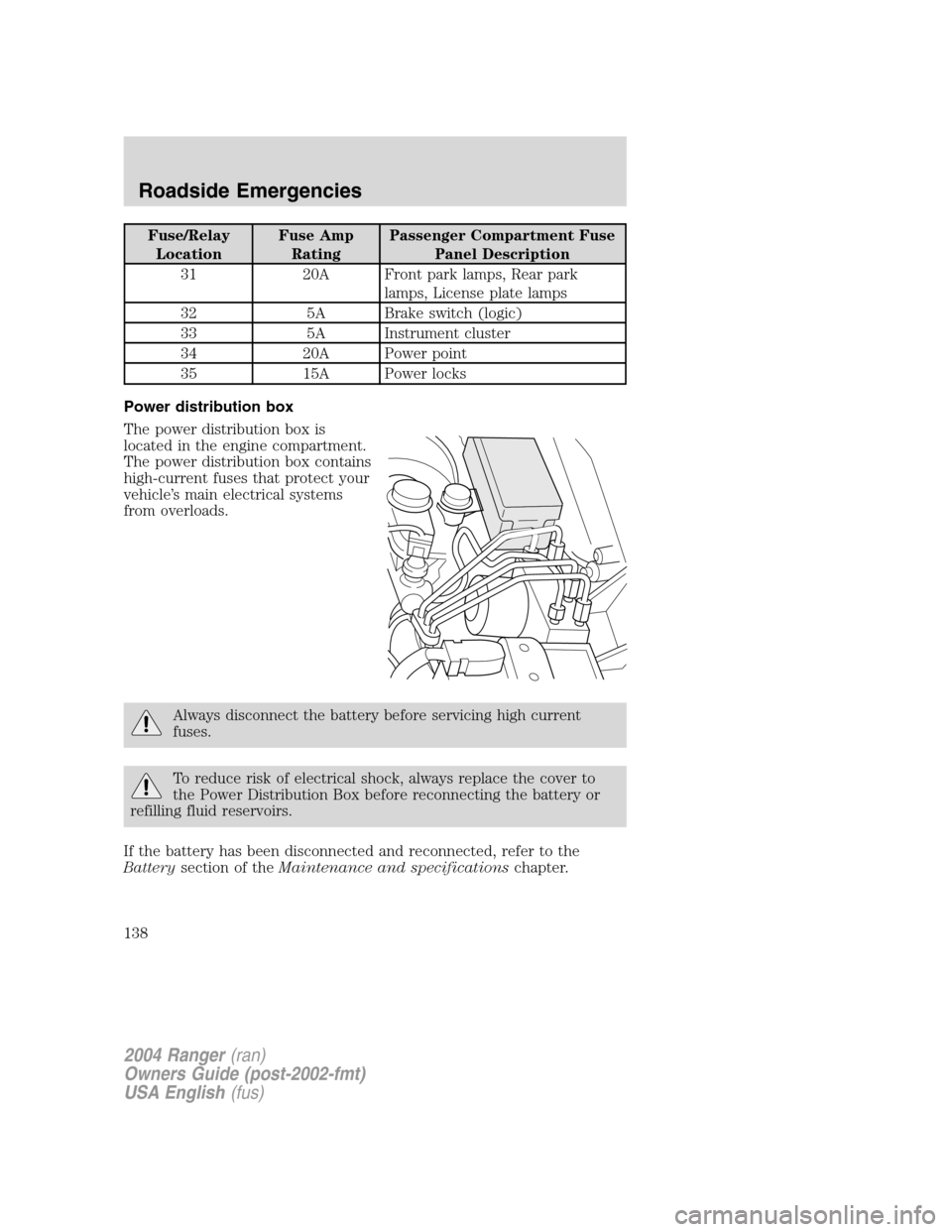
Fuse/RelayLocation Fuse Amp
Rating Passenger Compartment Fuse
Panel Description
31 20A Front park lamps, Rear park lamps, License plate lamps
32 5A Brake switch (logic)
33 5A Instrument cluster
34 20A Power point
35 15A Power locks
Power distribution box
The power distribution box is
located in the engine compartment.
The power distribution box contains
high-current fuses that protect your
vehicle ’s main electrical systems
from overloads.
Always disconnect the battery before servicing high current
fuses.
To reduce risk of electrical shock, always replace the cover to
the Power Distribution Box before reconnecting the battery or
refilling fluid reservoirs.
If the battery has been disconnected and reconnected, refer to the
Battery section of the Maintenance and specifications chapter.
2004 Ranger(ran)
Owners Guide (post-2002-fmt)
USA English (fus)
Roadside Emergencies
138