clutch FORD RANGER 2008 2.G Owners Manual
[x] Cancel search | Manufacturer: FORD, Model Year: 2008, Model line: RANGER, Model: FORD RANGER 2008 2.GPages: 272, PDF Size: 2.73 MB
Page 58 of 272
Disengaging speed control
To disengage the speed control:
•Depress the brake pedal or
•Depress the clutch pedal (if equipped).
Disengaging the speed control will not erase previous set speed.
Note:When you use the clutch pedal to disengage the speed control,
the engine speed may briefly increase, this is normal.
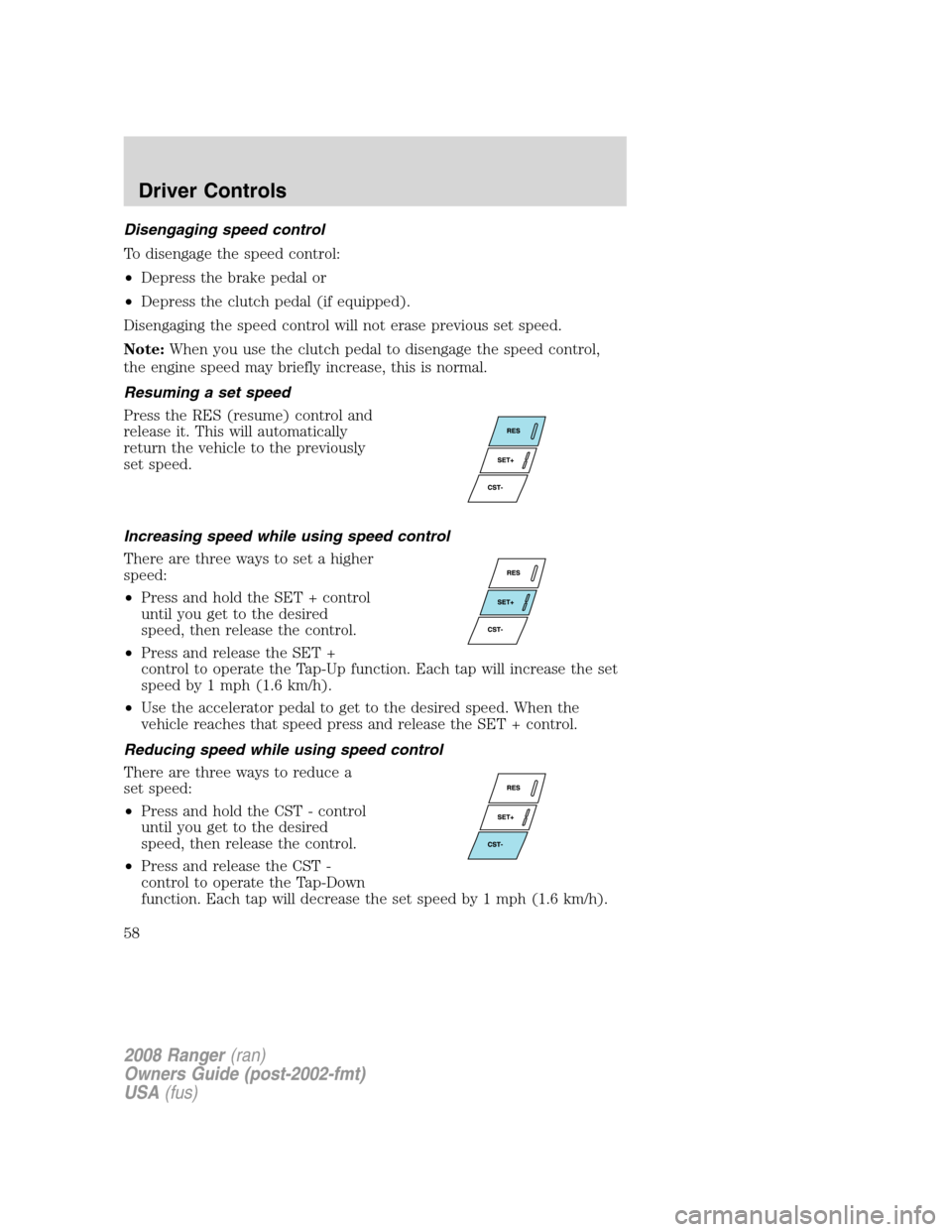
Resuming a set speed
Press the RES (resume) control and
release it. This will automatically
return the vehicle to the previously
set speed.
Increasing speed while using speed control
There are three ways to set a higher
speed:
•Press and hold the SET + control
until you get to the desired
speed, then release the control.
•Press and release the SET +
control to operate the Tap-Up function. Each tap will increase the set
speed by 1 mph (1.6 km/h).
•Use the accelerator pedal to get to the desired speed. When the
vehicle reaches that speed press and release the SET + control.
Reducing speed while using speed control
There are three ways to reduce a
set speed:
•Press and hold the CST - control
until you get to the desired
speed, then release the control.
•Press and release the CST -
control to operate the Tap-Down
function. Each tap will decrease the set speed by 1 mph (1.6 km/h).
2008 Ranger(ran)
Owners Guide (post-2002-fmt)
USA(fus)
Driver Controls
58
Page 59 of 272
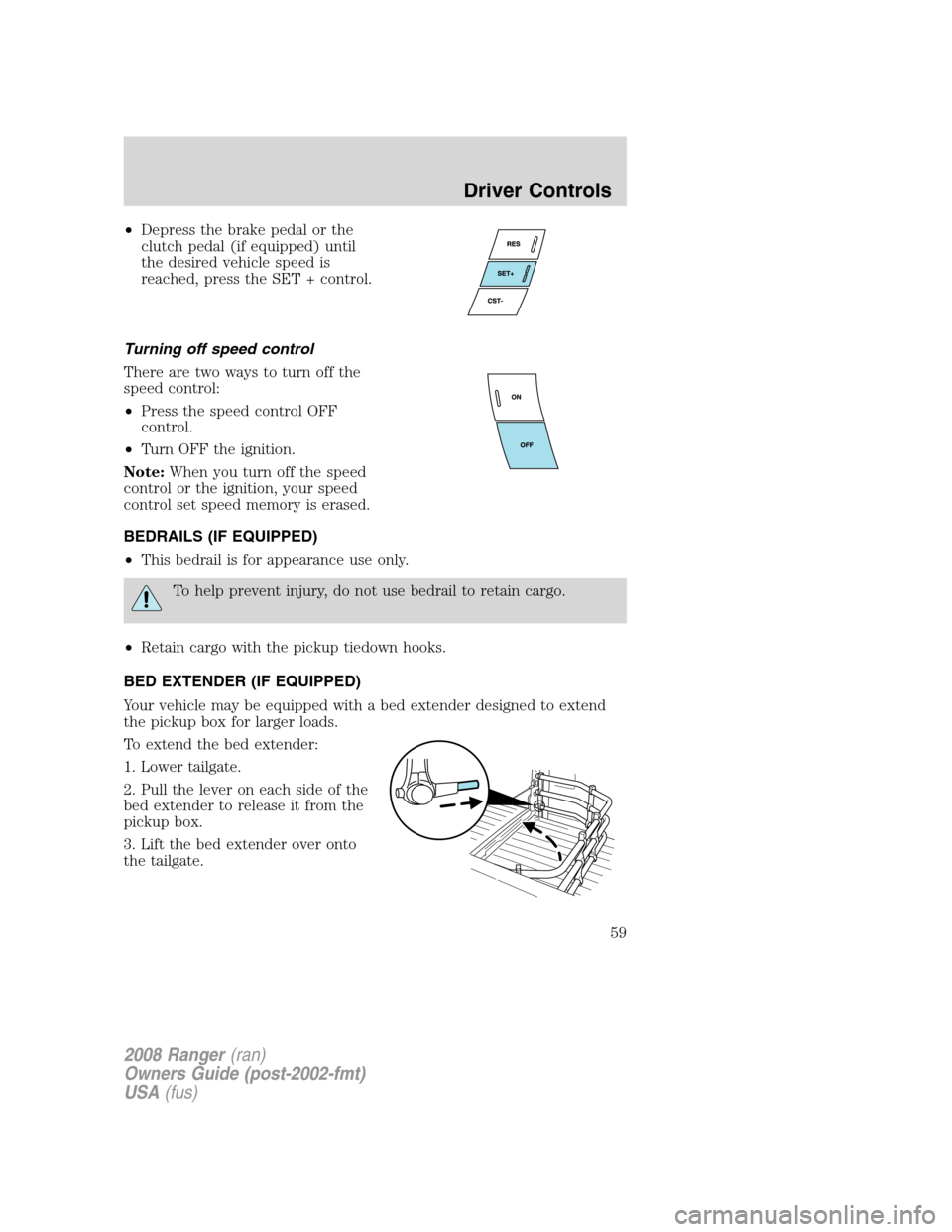
•Depress the brake pedal or the
clutch pedal (if equipped) until
the desired vehicle speed is
reached, press the SET + control.
Turning off speed control
There are two ways to turn off the
speed control:
•Press the speed control OFF
control.
•Turn OFF the ignition.
Note:When you turn off the speed
control or the ignition, your speed
control set speed memory is erased.
BEDRAILS (IF EQUIPPED)
•This bedrail is for appearance use only.
To help prevent injury, do not use bedrail to retain cargo.
•Retain cargo with the pickup tiedown hooks.
BED EXTENDER (IF EQUIPPED)
Your vehicle may be equipped with a bed extender designed to extend
the pickup box for larger loads.
To extend the bed extender:
1. Lower tailgate.
2. Pull the lever on each side of the
bed extender to release it from the
pickup box.
3. Lift the bed extender over onto
the tailgate.
2008 Ranger(ran)
Owners Guide (post-2002-fmt)
USA(fus)
Driver Controls
59
Page 148 of 272
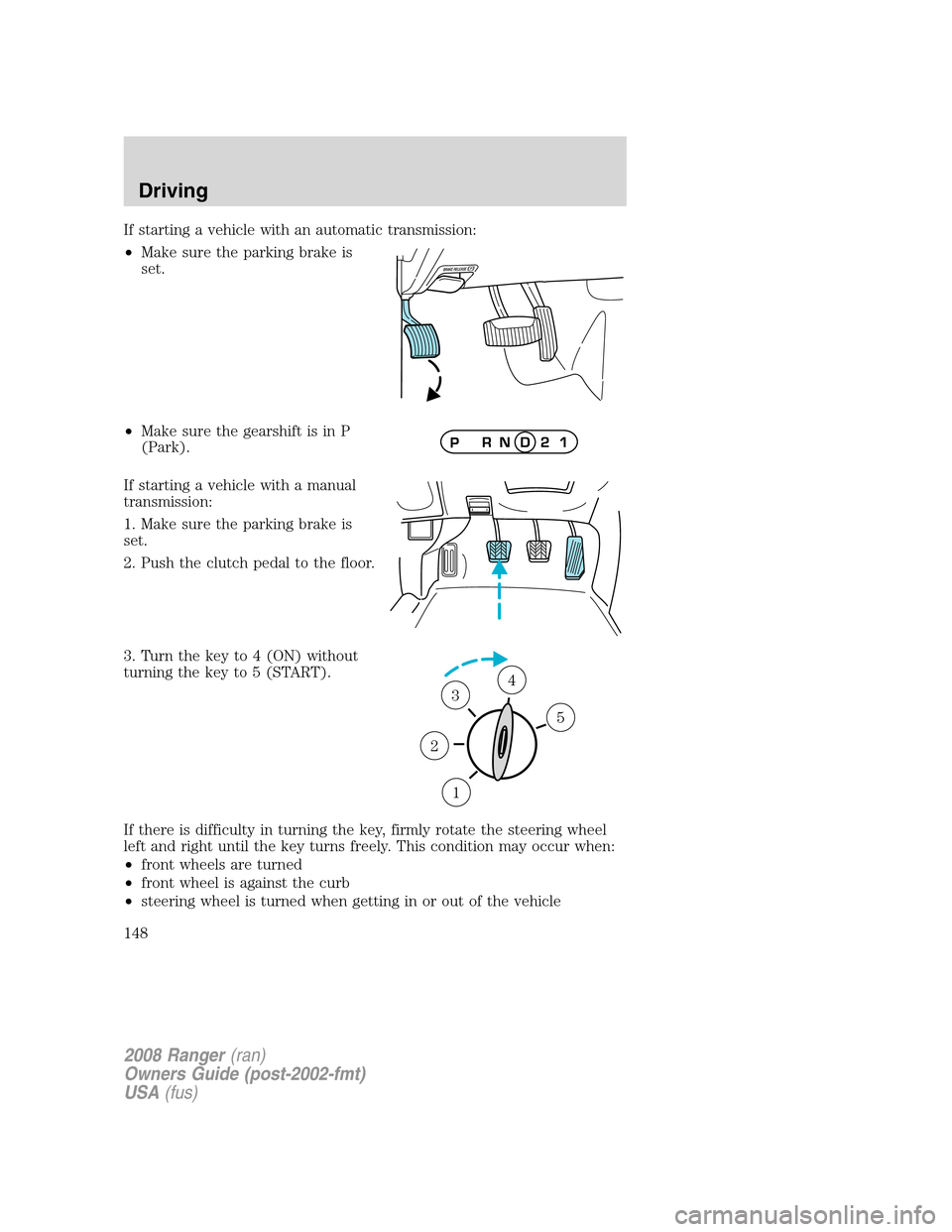
If starting a vehicle with an automatic transmission:
•Make sure the parking brake is
set.
•Make sure the gearshift is in P
(Park).
If starting a vehicle with a manual
transmission:
1. Make sure the parking brake is
set.
2. Push the clutch pedal to the floor.
3. Turn the key to 4 (ON) without
turning the key to 5 (START).
If there is difficulty in turning the key, firmly rotate the steering wheel
left and right until the key turns freely. This condition may occur when:
•front wheels are turned
•front wheel is against the curb
•steering wheel is turned when getting in or out of the vehicle
1
2
34
5
2008 Ranger(ran)
Owners Guide (post-2002-fmt)
USA(fus)
Driving
148
Page 159 of 272
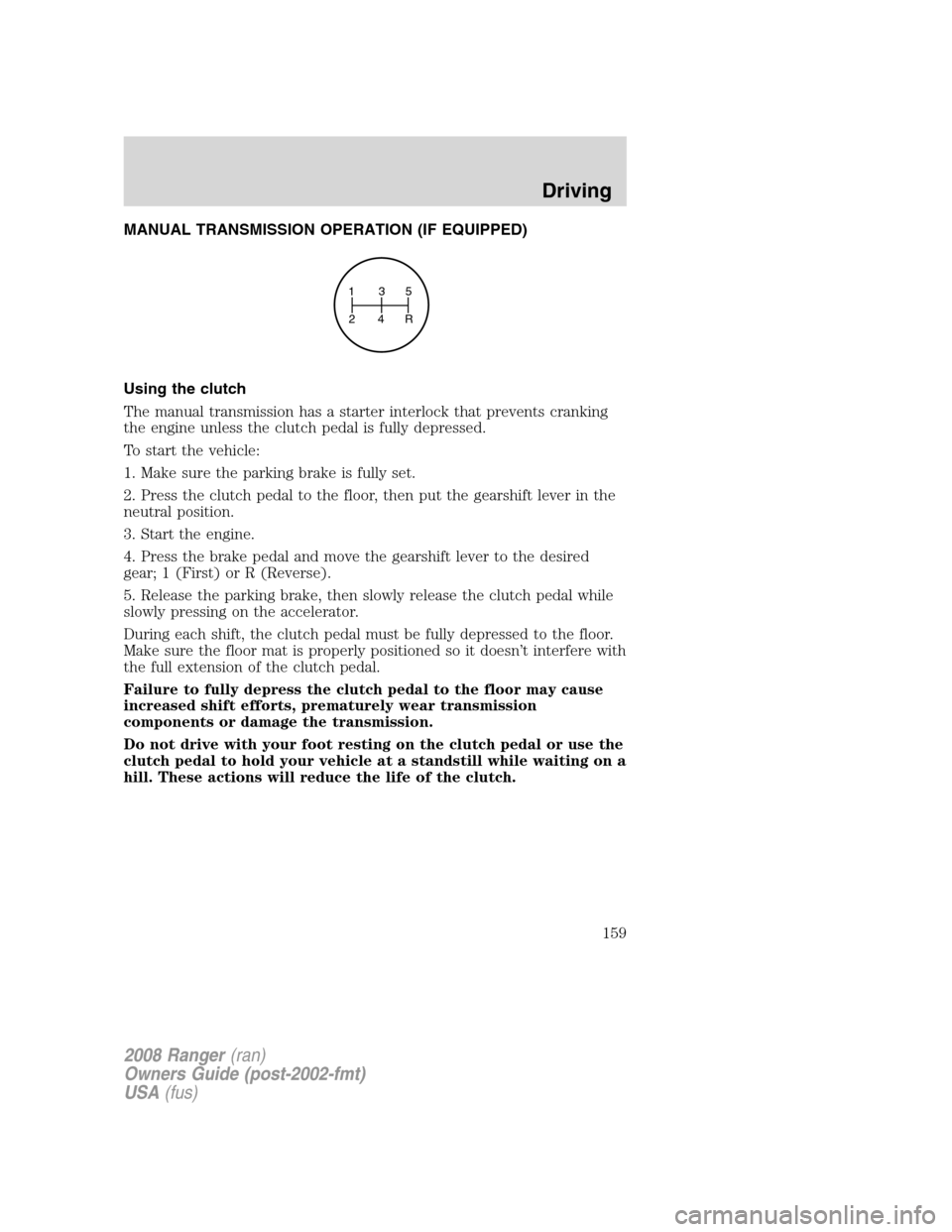
MANUAL TRANSMISSION OPERATION (IF EQUIPPED)
Using the clutch
The manual transmission has a starter interlock that prevents cranking
the engine unless the clutch pedal is fully depressed.
To start the vehicle:
1. Make sure the parking brake is fully set.
2. Press the clutch pedal to the floor, then put the gearshift lever in the
neutral position.
3. Start the engine.
4. Press the brake pedal and move the gearshift lever to the desired
gear; 1 (First) or R (Reverse).
5. Release the parking brake, then slowly release the clutch pedal while
slowly pressing on the accelerator.
During each shift, the clutch pedal must be fully depressed to the floor.
Make sure the floor mat is properly positioned so it doesn’t interfere with
the full extension of the clutch pedal.
Failure to fully depress the clutch pedal to the floor may cause
increased shift efforts, prematurely wear transmission
components or damage the transmission.
Do not drive with your foot resting on the clutch pedal or use the
clutch pedal to hold your vehicle at a standstill while waiting on a
hill. These actions will reduce the life of the clutch.
135
24
R
2008 Ranger(ran)
Owners Guide (post-2002-fmt)
USA(fus)
Driving
159
Page 163 of 272
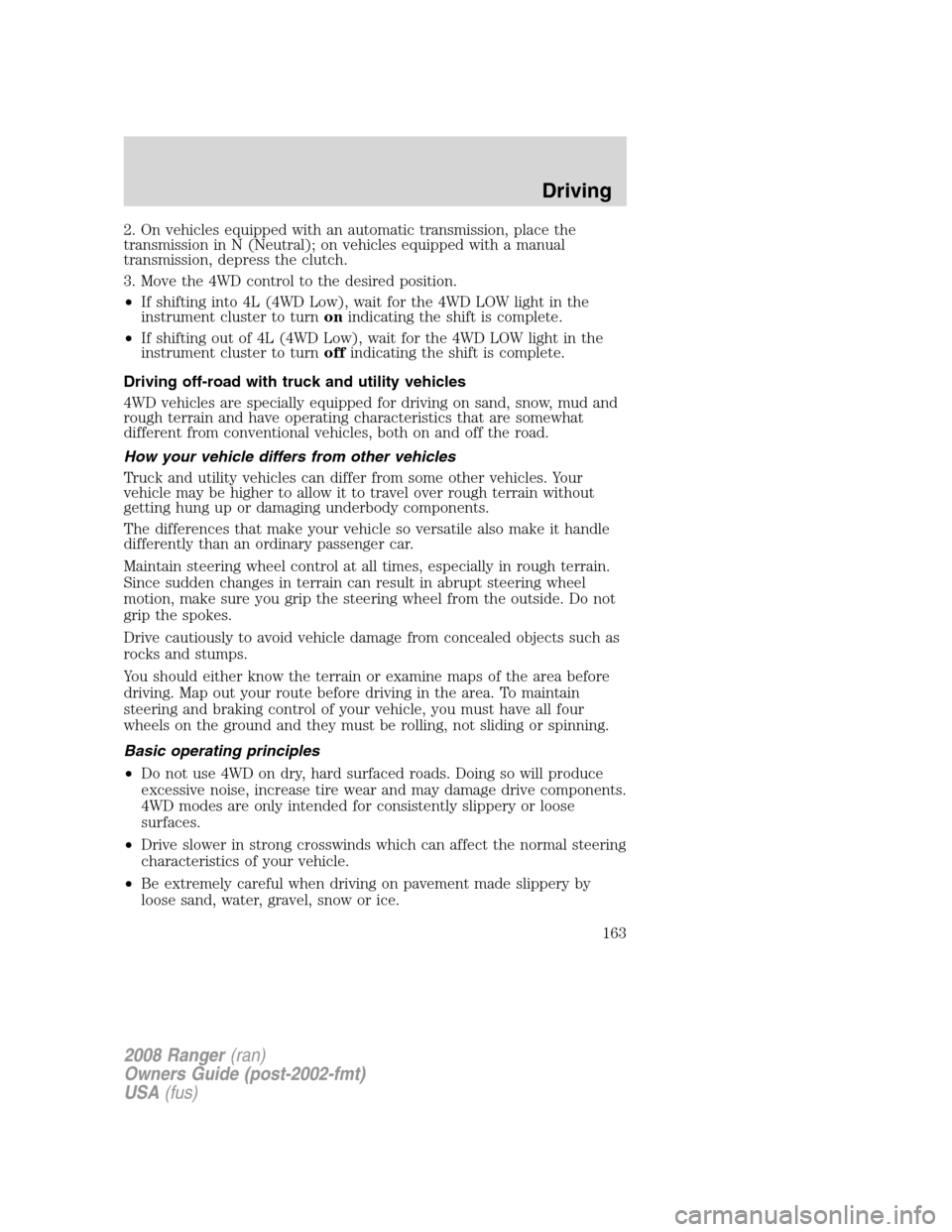
2. On vehicles equipped with an automatic transmission, place the
transmission in N (Neutral); on vehicles equipped with a manual
transmission, depress the clutch.
3. Move the 4WD control to the desired position.
•If shifting into 4L (4WD Low), wait for the 4WD LOW light in the
instrument cluster to turnonindicating the shift is complete.
•If shifting out of 4L (4WD Low), wait for the 4WD LOW light in the
instrument cluster to turnoffindicating the shift is complete.
Driving off-road with truck and utility vehicles
4WD vehicles are specially equipped for driving on sand, snow, mud and
rough terrain and have operating characteristics that are somewhat
different from conventional vehicles, both on and off the road.
How your vehicle differs from other vehicles
Truck and utility vehicles can differ from some other vehicles. Your
vehicle may be higher to allow it to travel over rough terrain without
getting hung up or damaging underbody components.
The differences that make your vehicle so versatile also make it handle
differently than an ordinary passenger car.
Maintain steering wheel control at all times, especially in rough terrain.
Since sudden changes in terrain can result in abrupt steering wheel
motion, make sure you grip the steering wheel from the outside. Do not
grip the spokes.
Drive cautiously to avoid vehicle damage from concealed objects such as
rocks and stumps.
You should either know the terrain or examine maps of the area before
driving. Map out your route before driving in the area. To maintain
steering and braking control of your vehicle, you must have all four
wheels on the ground and they must be rolling, not sliding or spinning.
Basic operating principles
•Do not use 4WD on dry, hard surfaced roads. Doing so will produce
excessive noise, increase tire wear and may damage drive components.
4WD modes are only intended for consistently slippery or loose
surfaces.
•Drive slower in strong crosswinds which can affect the normal steering
characteristics of your vehicle.
•Be extremely careful when driving on pavement made slippery by
loose sand, water, gravel, snow or ice.
2008 Ranger(ran)
Owners Guide (post-2002-fmt)
USA(fus)
Driving
163
Page 179 of 272
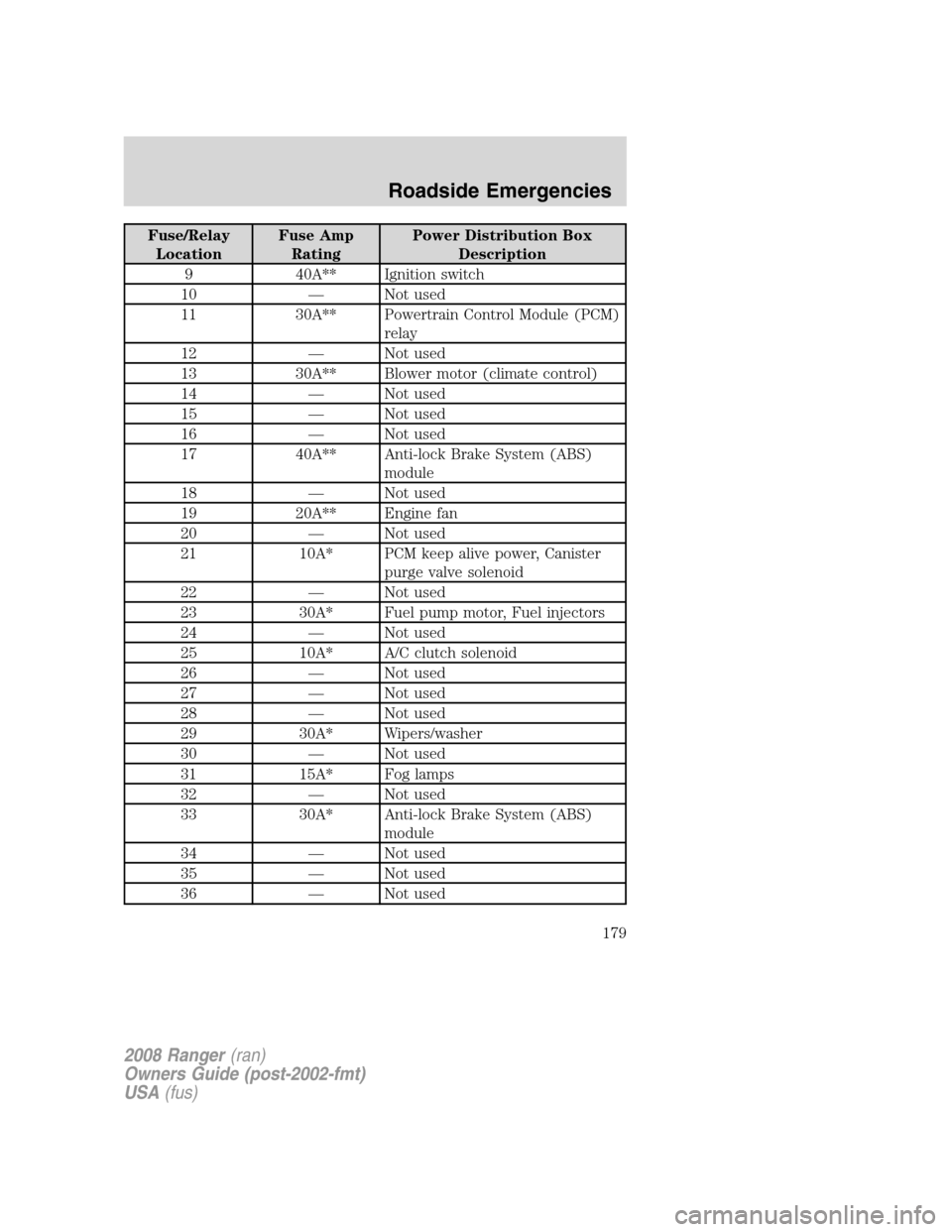
Fuse/Relay
LocationFuse Amp
RatingPower Distribution Box
Description
9 40A** Ignition switch
10 — Not used
11 30A** Powertrain Control Module (PCM)
relay
12 — Not used
13 30A** Blower motor (climate control)
14 — Not used
15 — Not used
16 — Not used
17 40A** Anti-lock Brake System (ABS)
module
18 — Not used
19 20A** Engine fan
20 — Not used
21 10A* PCM keep alive power, Canister
purge valve solenoid
22 — Not used
23 30A* Fuel pump motor, Fuel injectors
24 — Not used
25 10A* A/C clutch solenoid
26 — Not used
27 — Not used
28 — Not used
29 30A* Wipers/washer
30 — Not used
31 15A* Fog lamps
32 — Not used
33 30A* Anti-lock Brake System (ABS)
module
34 — Not used
35 — Not used
36 — Not used
2008 Ranger(ran)
Owners Guide (post-2002-fmt)
USA(fus)
Roadside Emergencies
179
Page 180 of 272
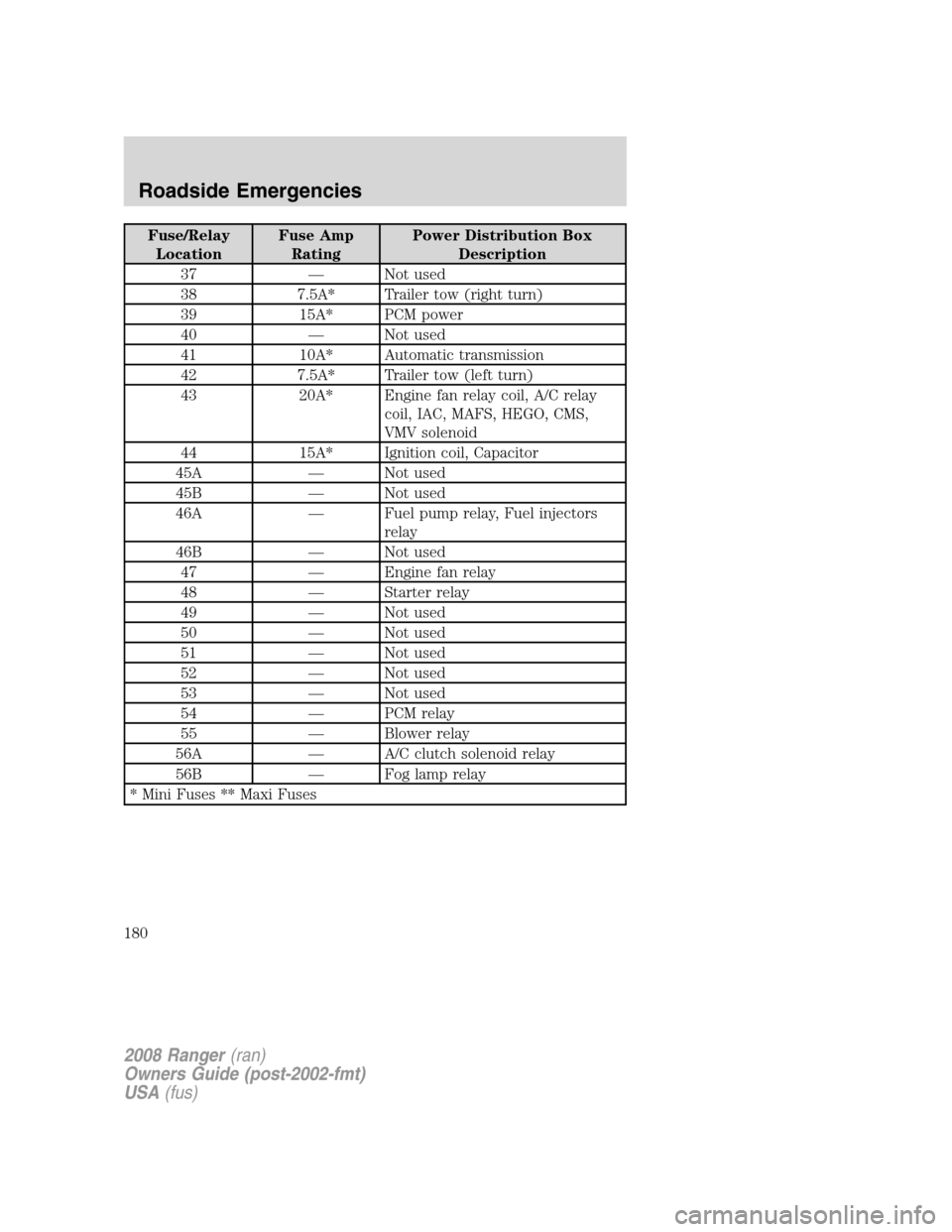
Fuse/Relay
LocationFuse Amp
RatingPower Distribution Box
Description
37 — Not used
38 7.5A* Trailer tow (right turn)
39 15A* PCM power
40 — Not used
41 10A* Automatic transmission
42 7.5A* Trailer tow (left turn)
43 20A* Engine fan relay coil, A/C relay
coil, IAC, MAFS, HEGO, CMS,
VMV solenoid
44 15A* Ignition coil, Capacitor
45A — Not used
45B — Not used
46A — Fuel pump relay, Fuel injectors
relay
46B — Not used
47 — Engine fan relay
48 — Starter relay
49 — Not used
50 — Not used
51 — Not used
52 — Not used
53 — Not used
54 — PCM relay
55 — Blower relay
56A — A/C clutch solenoid relay
56B — Fog lamp relay
* Mini Fuses ** Maxi Fuses
2008 Ranger(ran)
Owners Guide (post-2002-fmt)
USA(fus)
Roadside Emergencies
180
Page 182 of 272
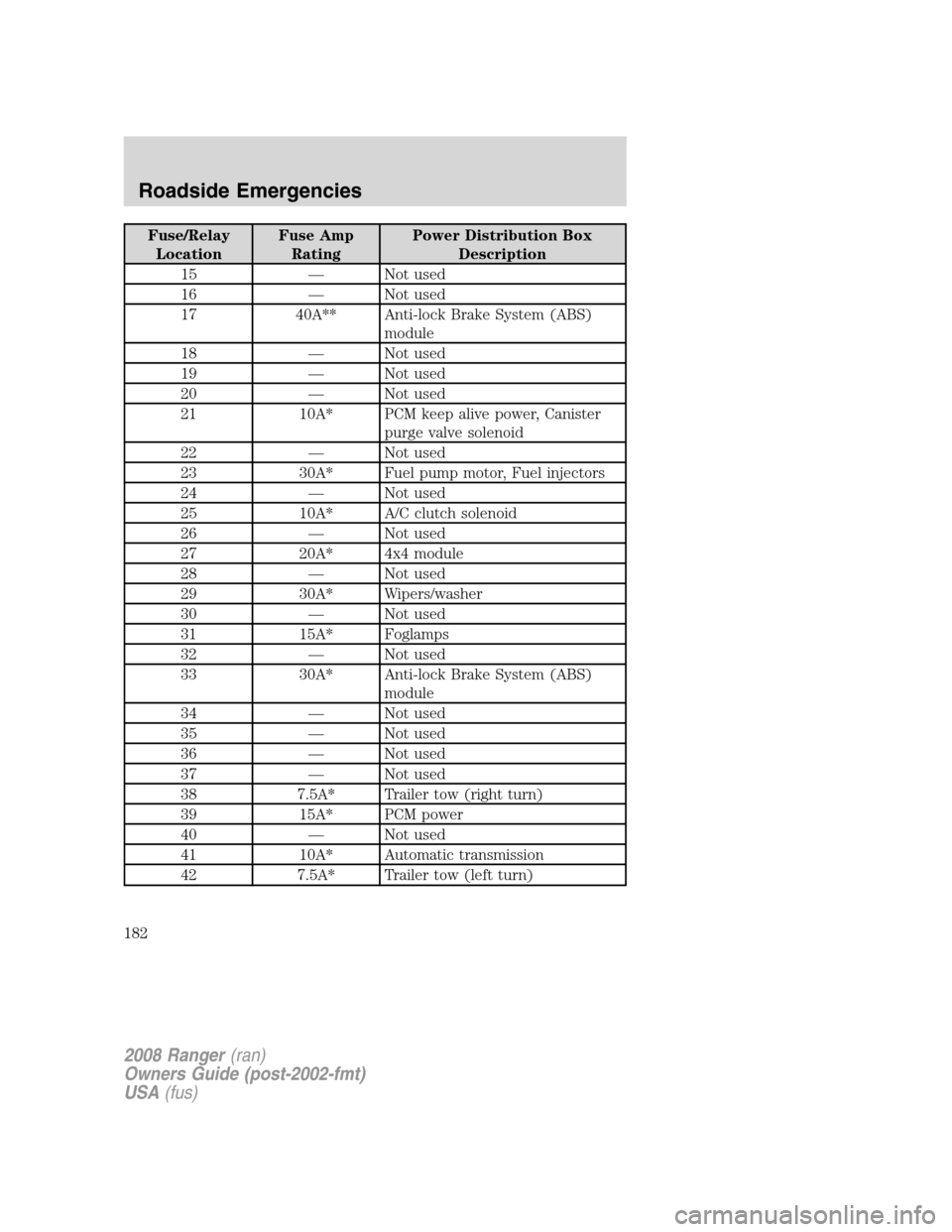
Fuse/Relay
LocationFuse Amp
RatingPower Distribution Box
Description
15 — Not used
16 — Not used
17 40A** Anti-lock Brake System (ABS)
module
18 — Not used
19 — Not used
20 — Not used
21 10A* PCM keep alive power, Canister
purge valve solenoid
22 — Not used
23 30A* Fuel pump motor, Fuel injectors
24 — Not used
25 10A* A/C clutch solenoid
26 — Not used
27 20A* 4x4 module
28 — Not used
29 30A* Wipers/washer
30 — Not used
31 15A* Foglamps
32 — Not used
33 30A* Anti-lock Brake System (ABS)
module
34 — Not used
35 — Not used
36 — Not used
37 — Not used
38 7.5A* Trailer tow (right turn)
39 15A* PCM power
40 — Not used
41 10A* Automatic transmission
42 7.5A* Trailer tow (left turn)
2008 Ranger(ran)
Owners Guide (post-2002-fmt)
USA(fus)
Roadside Emergencies
182
Page 183 of 272
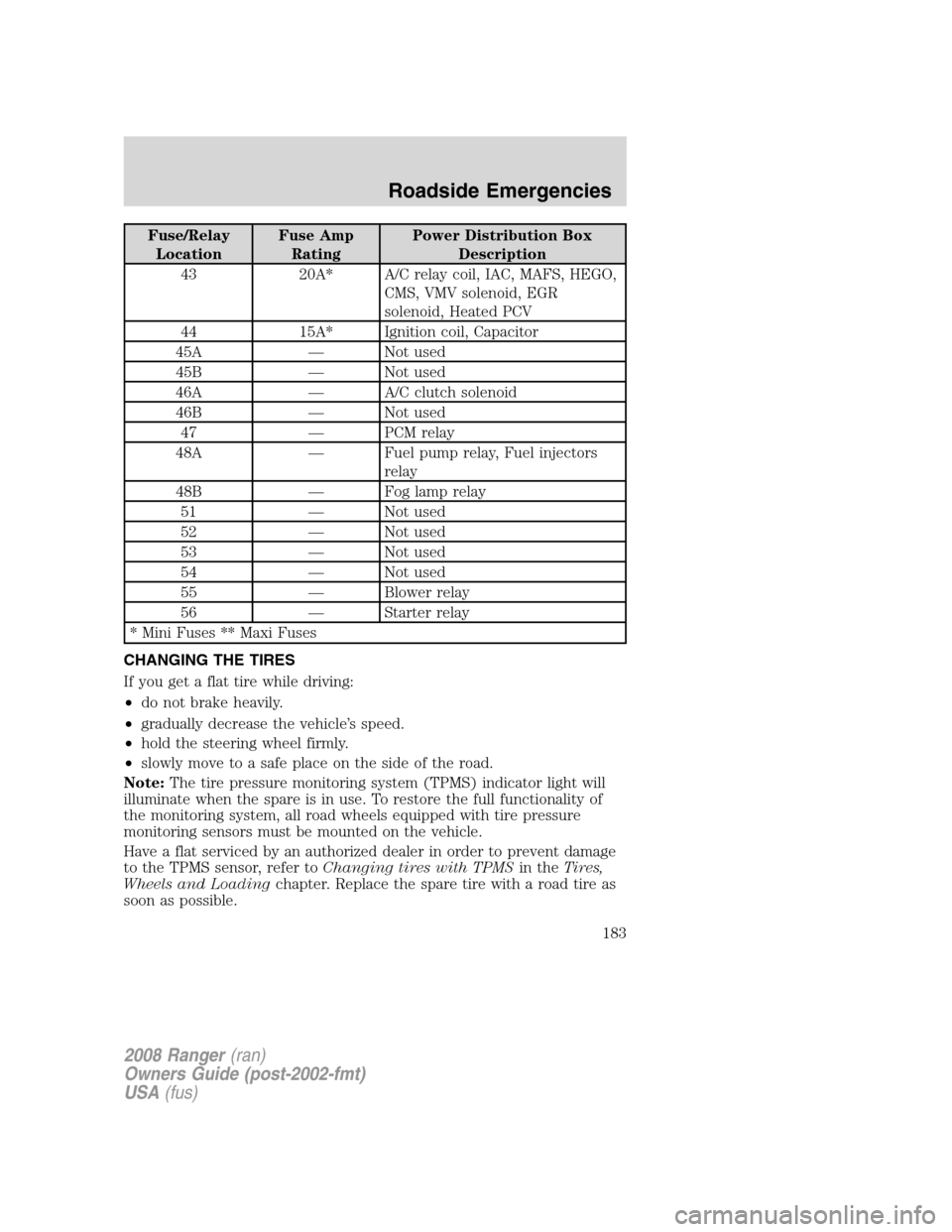
Fuse/Relay
LocationFuse Amp
RatingPower Distribution Box
Description
43 20A* A/C relay coil, IAC, MAFS, HEGO,
CMS, VMV solenoid, EGR
solenoid, Heated PCV
44 15A* Ignition coil, Capacitor
45A — Not used
45B — Not used
46A — A/C clutch solenoid
46B — Not used
47 — PCM relay
48A — Fuel pump relay, Fuel injectors
relay
48B — Fog lamp relay
51 — Not used
52 — Not used
53 — Not used
54 — Not used
55 — Blower relay
56 — Starter relay
* Mini Fuses ** Maxi Fuses
CHANGING THE TIRES
If you get a flat tire while driving:
•do not brake heavily.
•gradually decrease the vehicle’s speed.
•hold the steering wheel firmly.
•slowly move to a safe place on the side of the road.
Note:The tire pressure monitoring system (TPMS) indicator light will
illuminate when the spare is in use. To restore the full functionality of
the monitoring system, all road wheels equipped with tire pressure
monitoring sensors must be mounted on the vehicle.
Have a flat serviced by an authorized dealer in order to prevent damage
to the TPMS sensor, refer toChanging tires with TPMSin theTires,
Wheels and Loadingchapter. Replace the spare tire with a road tire as
soon as possible.
2008 Ranger(ran)
Owners Guide (post-2002-fmt)
USA(fus)
Roadside Emergencies
183
Page 215 of 272
SERVICE RECOMMENDATIONS
To help you service your vehicle, we providescheduled maintenance
informationwhich makes tracking routine service easy.
If your vehicle requires professional service, your authorized dealer can
provide the necessary parts and service. Check yourWarranty Guideto
find out which parts and services are covered.
Use only recommended fuels, lubricants, fluids and service parts
conforming to specifications. Motorcraft parts are designed and built to
provide the best performance in your vehicle.
PRECAUTIONS WHEN SERVICING YOUR VEHICLE
•Do not work on a hot engine.
•Make sure that nothing gets caught in moving parts.
•Do not work on a vehicle with the engine running in an enclosed
space, unless you are sure you have enough ventilation.
•Keep all open flames and other burning (cigarettes) material away
from the battery and all fuel related parts.
Working with the engine off
•Automatic transmission/transaxle:
1. Set the parking brake and shift to P (Park).
2. Turn off the engine and remove the key.
3. Block the wheels.
•Manual transmission/transaxle:
1. Set the parking brake, depress the clutch and place the gearshift in 1
(First).
2. Turn off the engine and remove the key.
3. Block the wheels.
Working with the engine on
•Automatic transmission:
1. Set the parking brake and shift to P (Park).
2. Block the wheels.
•Manual transmission:
1. Set the parking brake, depress the clutch and place the gearshift in N
(Neutral).
2008 Ranger(ran)
Owners Guide (post-2002-fmt)
USA(fus)
Maintenance and Specifications
215