4x4 FORD RANGER 2009 2.G Owners Manual
[x] Cancel search | Manufacturer: FORD, Model Year: 2009, Model line: RANGER, Model: FORD RANGER 2009 2.GPages: 280, PDF Size: 2.45 MB
Page 15 of 280
WARNING:Never remove the coolant reservoir cap while the
engine is running or hot.
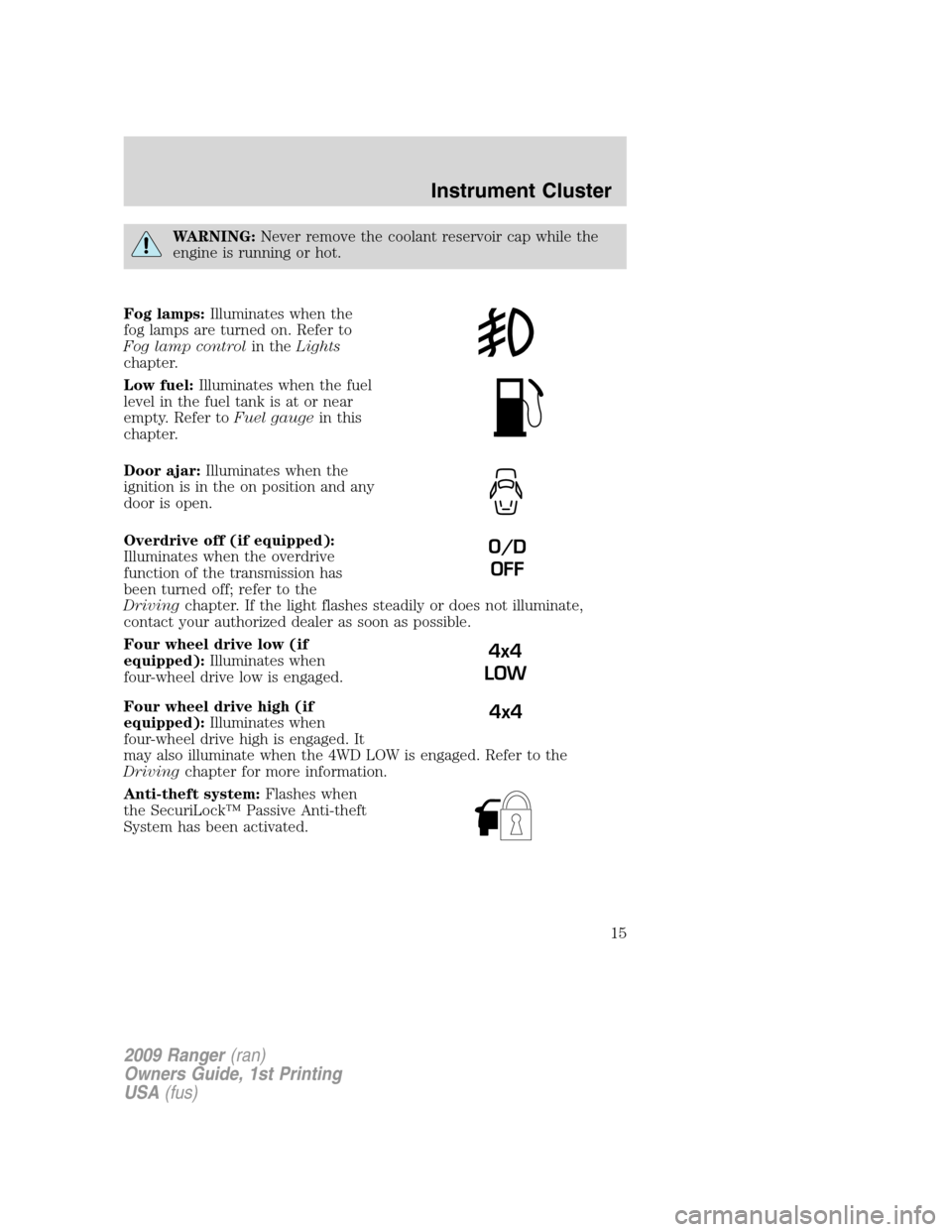
Fog lamps:Illuminates when the
fog lamps are turned on. Refer to
Fog lamp controlin theLights
chapter.
Low fuel:Illuminates when the fuel
level in the fuel tank is at or near
empty. Refer toFuel gaugein this
chapter.
Door ajar:Illuminates when the
ignition is in the on position and any
door is open.
Overdrive off (if equipped):
Illuminates when the overdrive
function of the transmission has
been turned off; refer to the
Drivingchapter. If the light flashes steadily or does not illuminate,
contact your authorized dealer as soon as possible.
Four wheel drive low (if
equipped):Illuminates when
four-wheel drive low is engaged.
Four wheel drive high (if
equipped):Illuminates when
four-wheel drive high is engaged. It
may also illuminate when the 4WD LOW is engaged. Refer to the
Drivingchapter for more information.
Anti-theft system:Flashes when
the SecuriLock™ Passive Anti-theft
System has been activated.
O/D
OFF
4x4
LOW
4x4
2009 Ranger(ran)
Owners Guide, 1st Printing
USA(fus)
Instrument Cluster
15
Page 145 of 280
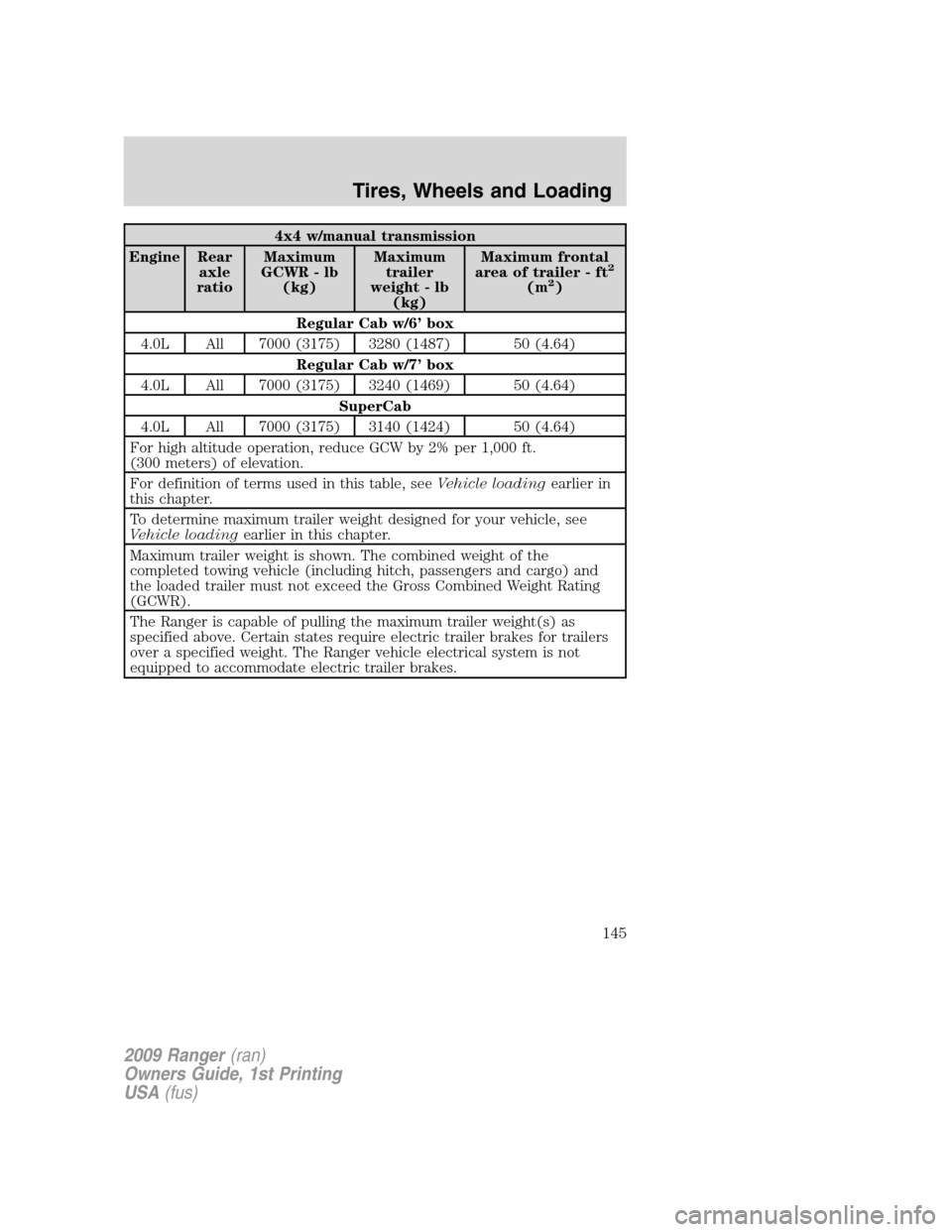
4x4 w/manual transmission
Engine Rear
axle
ratioMaximum
GCWR - lb
(kg)Maximum
trailer
weight - lb
(kg)Maximum frontal
area of trailer - ft
2
(m2)
Regular Cab w/6’ box
4.0L All 7000 (3175) 3280 (1487) 50 (4.64)
Regular Cab w/7’ box
4.0L All 7000 (3175) 3240 (1469) 50 (4.64)
SuperCab
4.0L All 7000 (3175) 3140 (1424) 50 (4.64)
For high altitude operation, reduce GCW by 2% per 1,000 ft.
(300 meters) of elevation.
For definition of terms used in this table, seeVehicle loadingearlier in
this chapter.
To determine maximum trailer weight designed for your vehicle, see
Vehicle loadingearlier in this chapter.
Maximum trailer weight is shown. The combined weight of the
completed towing vehicle (including hitch, passengers and cargo) and
the loaded trailer must not exceed the Gross Combined Weight Rating
(GCWR).
The Ranger is capable of pulling the maximum trailer weight(s) as
specified above. Certain states require electric trailer brakes for trailers
over a specified weight. The Ranger vehicle electrical system is not
equipped to accommodate electric trailer brakes.
2009 Ranger(ran)
Owners Guide, 1st Printing
USA(fus)
Tires, Wheels and Loading
145
Page 147 of 280
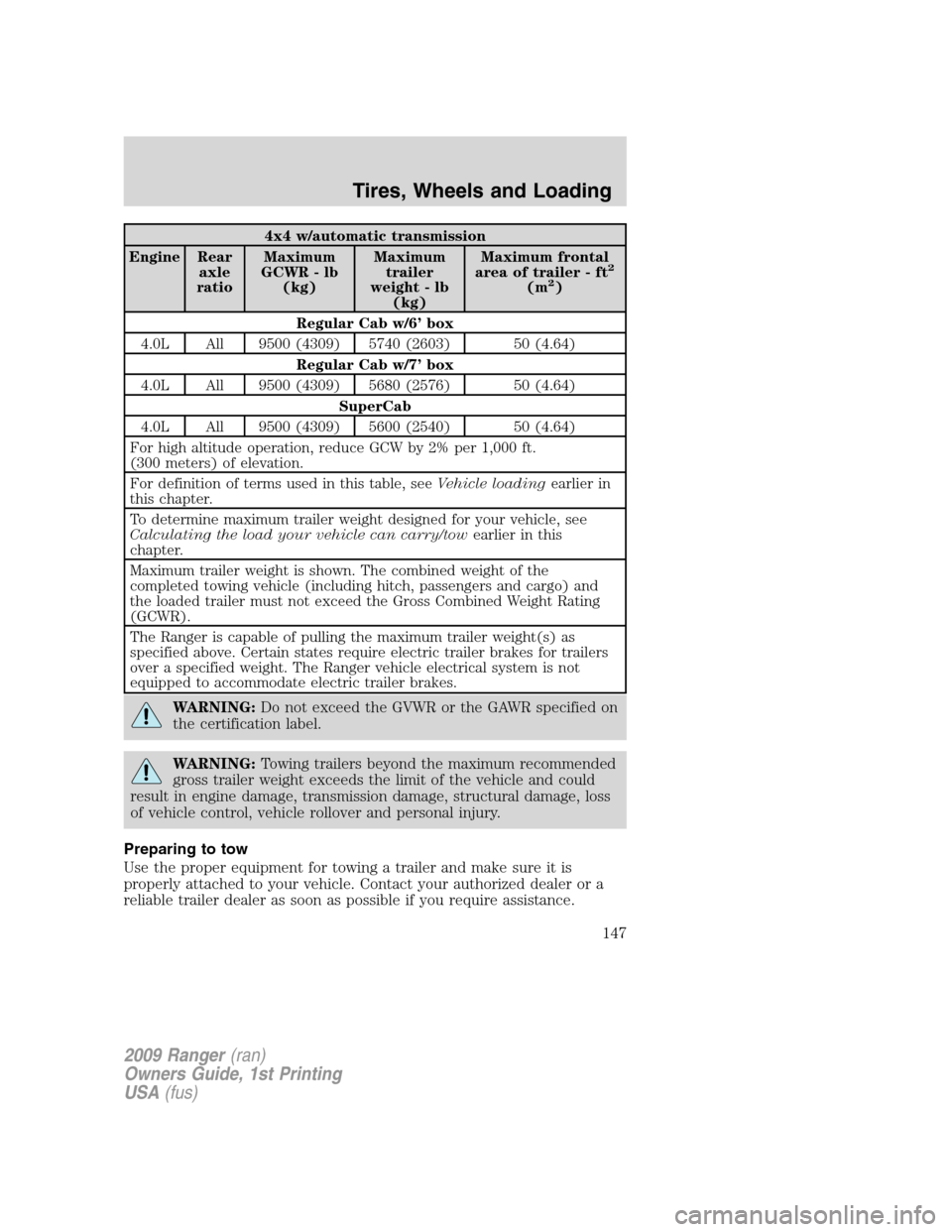
4x4 w/automatic transmission
Engine Rear
axle
ratioMaximum
GCWR - lb
(kg)Maximum
trailer
weight - lb
(kg)Maximum frontal
area of trailer - ft
2
(m2)
Regular Cab w/6’ box
4.0L All 9500 (4309) 5740 (2603) 50 (4.64)
Regular Cab w/7’ box
4.0L All 9500 (4309) 5680 (2576) 50 (4.64)
SuperCab
4.0L All 9500 (4309) 5600 (2540) 50 (4.64)
For high altitude operation, reduce GCW by 2% per 1,000 ft.
(300 meters) of elevation.
For definition of terms used in this table, seeVehicle loadingearlier in
this chapter.
To determine maximum trailer weight designed for your vehicle, see
Calculating the load your vehicle can carry/towearlier in this
chapter.
Maximum trailer weight is shown. The combined weight of the
completed towing vehicle (including hitch, passengers and cargo) and
the loaded trailer must not exceed the Gross Combined Weight Rating
(GCWR).
The Ranger is capable of pulling the maximum trailer weight(s) as
specified above. Certain states require electric trailer brakes for trailers
over a specified weight. The Ranger vehicle electrical system is not
equipped to accommodate electric trailer brakes.
WARNING:Do not exceed the GVWR or the GAWR specified on
the certification label.
WARNING:Towing trailers beyond the maximum recommended
gross trailer weight exceeds the limit of the vehicle and could
result in engine damage, transmission damage, structural damage, loss
of vehicle control, vehicle rollover and personal injury.
Preparing to tow
Use the proper equipment for towing a trailer and make sure it is
properly attached to your vehicle. Contact your authorized dealer or a
reliable trailer dealer as soon as possible if you require assistance.
2009 Ranger(ran)
Owners Guide, 1st Printing
USA(fus)
Tires, Wheels and Loading
147
Page 152 of 280
Exceeding these limits may allow water to enter vehicle components:
•causing internal damage to the components.
•affecting driveability, emissions and reliability.
Replace the rear axle lubricant any time the axle has been submerged in
water. Rear axle lubricant quantities are not to be checked or changed
unless a leak is suspected or repair required.
RECREATIONAL TOWING
Follow these guidelines if you have a need for recreational (RV) towing.
An example of recreational towing would be towing your vehicle behind
a motorhome. These guidelines are designed to ensure that your
transmission is not damaged.
2WD and 4WD vehicles with manual transmissions:
Before you tow your vehicle:
•Release the parking brake.
•Move the gearshift to the neutral position.
•Turn the key in the ignition to the off/unlocked position.
•The maximum recommended speed is 55 mph (88 km/h).
•The maximum recommended distance is unlimited.
•Put 4x4 switch in 2WD mode (4x4 only)
•The vehicle must be towed in the forward position to ensure no
damage is done to the internal transmission components.
For 4x4 vehicles with a manual transmission, it is recommended that a
Neutral Tow Kit be purchased and installed by an authorized dealer if
the vehicle is towed frequently.
In addition, it is recommended that you follow the instructions provided
by the aftermarket manufacturer of the towing equipment, if provided.
In case of a roadside emergency with a disabled vehicle, seeWrecker
towingin theRoadside Emergencieschapter.
2WD vehicles with automatic transmissions:Do not tow your vehicle
with any wheels on the ground, as vehicle or transmission damage may
occur. It is recommended to tow your vehicle with all four (4) wheels off
the ground such as when using a car-hauling trailer. Otherwise, no
recreational towing is permitted.
In case of a roadside emergency with a disabled vehicle, seeWrecker
towingin theRoadside Emergencieschapter.
2009 Ranger(ran)
Owners Guide, 1st Printing
USA(fus)
Tires, Wheels and Loading
152
Page 170 of 280
If your vehicle gets stuck in mud or snow
If your vehicle gets stuck in mud or snow, it may be rocked out by
shifting between forward and reverse gears, stopping between shifts in a
steady pattern. Press lightly on the accelerator in each gear.
Do not rock the vehicle if the engine is not at normal operating
temperature or damage to the transmission may occur.
Do not rock the vehicle for more than a minute or damage to the
transmission and tires may occur, or the engine may overheat.
FOUR-WHEEL DRIVE (4WD) OPERATION (IF EQUIPPED)
WARNING:For important information regarding safe operation
of this type of vehicle, seePreparing to drive your vehiclein
this chapter.
Four–wheel drive (4WD) supplies power to all four wheels. 4WD should
not be operated on dry pavement; driveline damage may occur.
If equipped with the Electronic Shift 4WD System, and 4WD Low
is selected while the vehicle is moving above 3 mph (5 km/h), the
4WD system will not engage. This is normal and should be no
reason for concern.Refer toShifting to/from 4WD Lowfor proper
operation.
4WD system indicator lights
•4x4- Momentarily illuminates
when the vehicle is started.
Illuminates when 4H (4WD High)
is engaged.
•4x4 LOW– Momentarily
illuminates when the vehicle is
started. Illuminates when 4L
(4WD Low) is engaged.
4x4
4x4
LOW
2009 Ranger(ran)
Owners Guide, 1st Printing
USA(fus)
Driving
170
Page 174 of 280
•In the event of an emergency stop, avoid skidding the tires and do not
attempt any sharp steering wheel movements.
WARNING:Vehicles with a higher center of gravity such as
utility and four-wheel drive vehicles handle differently than
vehicles with a lower center of gravity. Utility and four-wheel drive
vehicles arenotdesigned for cornering at speeds as high as passenger
cars any more than low-slung sports cars are designed to perform
satisfactorily under off-road conditions. Avoid sharp turns, excessive
speed and abrupt maneuvers in these vehicles. Failure to drive
cautiously could result in an increased risk of loss of vehicle control,
vehicle rollover, personal injury and death.
•If the vehicle goes from one type of surface to another (i.e., from
concrete to gravel) there will be a change in the way the vehicle
responds to a maneuver (steering, acceleration or braking). Again,
avoid these abrupt inputs.
4WD Systems
4WD (when you select a 4WD mode) uses all four wheels to power the
vehicle. This increases traction, enabling you to drive over terrain and
road conditions that a conventional two-wheel drive vehicle cannot.
Power is supplied to all four wheels through a transfer case. On 4WD
vehicles, the transfer case allows you to select 4WD when necessary.
Information on transfer case operation and shifting procedures can be
found in theDrivingchapter. Information on transfer case maintenance
can be found in theMaintenance and Specificationschapter. You
should become thoroughly familiar with this information before you
operate your vehicle.
Normal characteristics
On some 4WD models, the initial shift from two-wheel drive to 4x4 while
the vehicle is moving can cause some momentary clunk and ratcheting
sounds.
Sand
When driving over sand, try to keep all four wheels on the most solid
area of the trail. Avoid reducing the tire pressures but shift to a lower
gear and drive steadily through the terrain. Apply the accelerator slowly
and avoid spinning the wheels.
2009 Ranger(ran)
Owners Guide, 1st Printing
USA(fus)
Driving
174
Page 183 of 280
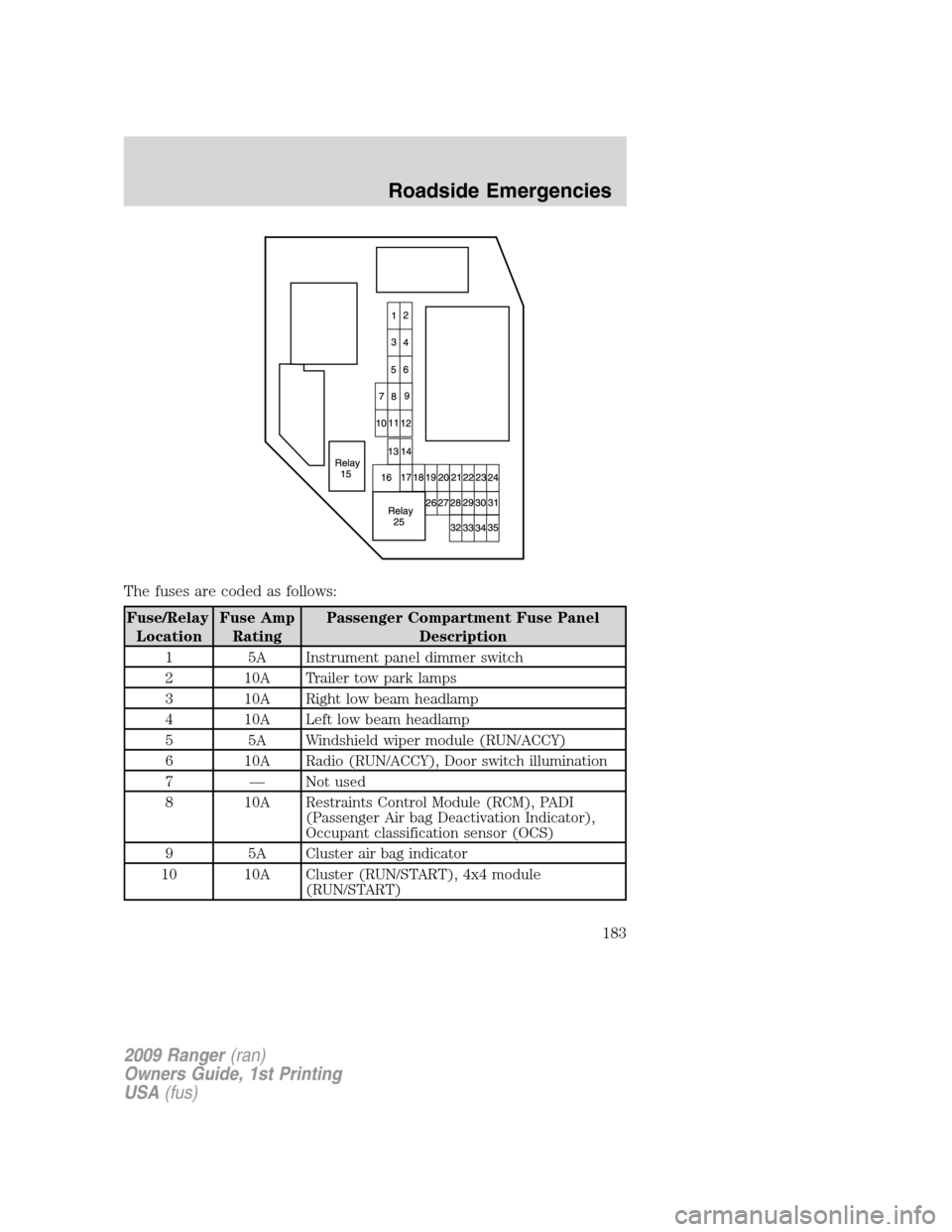
The fuses are coded as follows:
Fuse/Relay
LocationFuse Amp
RatingPassenger Compartment Fuse Panel
Description
1 5A Instrument panel dimmer switch
2 10A Trailer tow park lamps
3 10A Right low beam headlamp
4 10A Left low beam headlamp
5 5A Windshield wiper module (RUN/ACCY)
6 10A Radio (RUN/ACCY), Door switch illumination
7 — Not used
8 10A Restraints Control Module (RCM), PADI
(Passenger Air bag Deactivation Indicator),
Occupant classification sensor (OCS)
9 5A Cluster air bag indicator
10 10A Cluster (RUN/START), 4x4 module
(RUN/START)
2009 Ranger(ran)
Owners Guide, 1st Printing
USA(fus)
Roadside Emergencies
183
Page 184 of 280
Fuse/Relay
LocationFuse Amp
RatingPassenger Compartment Fuse Panel
Description
11 10A Smart Junction Box (SJB) (Logic power)
12 15A Audiophile subwoofer amplifier, Satellite radio
13 15A Horn, Interior lamps
14 15A High beam headlamp, High beam indicator
(cluster)
15 — Not used
16 30A
cartridge
fusePower windows
17 15A Turn signals/Hazards
18 — Not used
19 20A Center High-Mounted Stop Lamp
(CHMSL)/Stop lamps
20 10A
Anti-lock Brake System (ABS) module, Speed
control module, Back-up lamps, Overdrive cancel
switch, Electronic flasher (turn/hazard)
21 5A Starter relay coil
22 5A Radio (START)
23 30A Headlamps (low and high beam)
24 20A Radio battery feed (B+)
25 — Accessory relay (power windows)
26 2A Redundant cruise switch
27 10A Climate control blower relay/blend doors
28 15A 4x4 module battery feed (B+)
29 20A Cigar lighter, Diagnostic connector (OBD II)
30 5A Power mirrors
31 20A Front park lamps, Rear park lamps, License
plate lamps, Dimmer switch, Trailer tow park
lamps
32 5A Brake switch (logic), Brake-shift interlock
33 5A Instrument cluster battery feed (B+)
34 20A Power point
35 15A Power locks
2009 Ranger(ran)
Owners Guide, 1st Printing
USA(fus)
Roadside Emergencies
184
Page 190 of 280
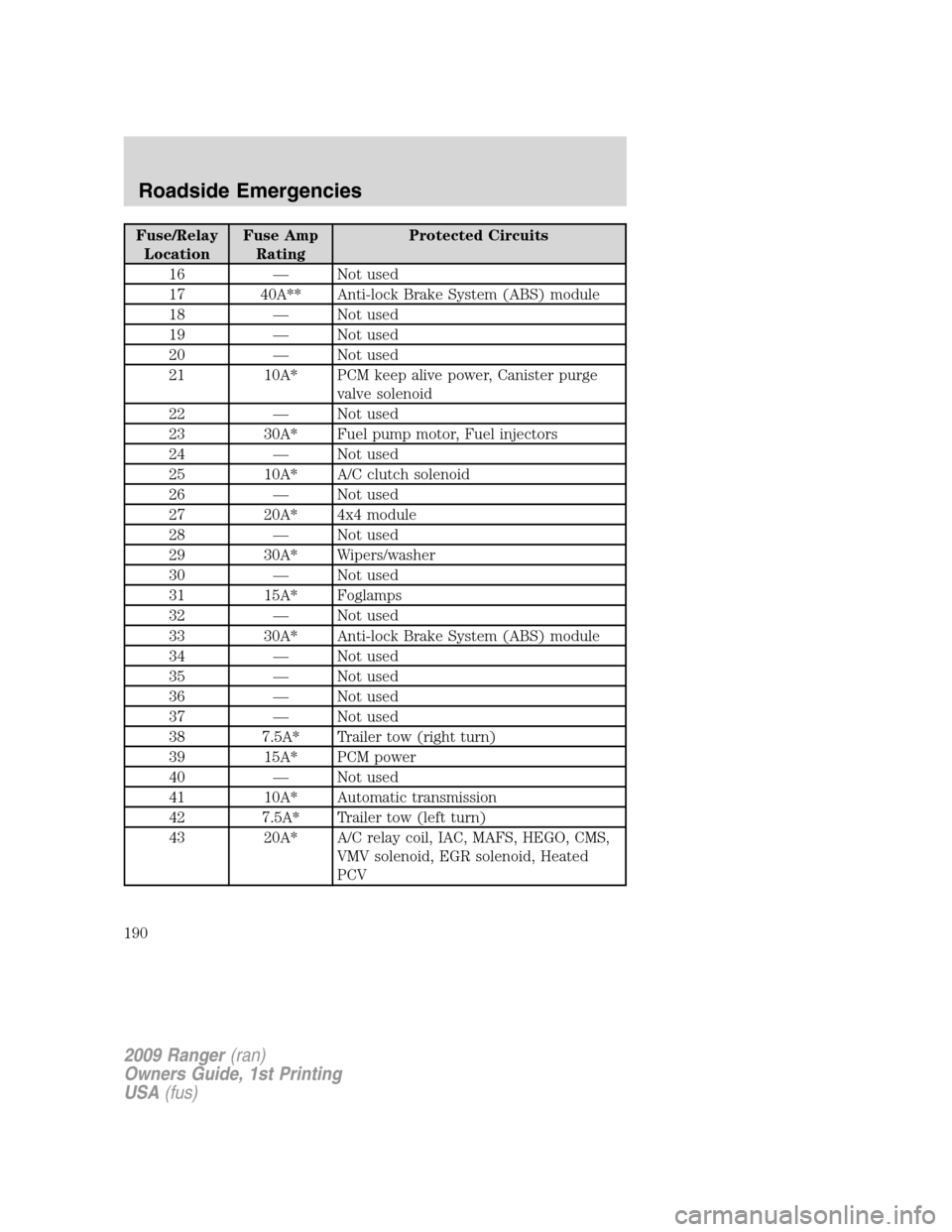
Fuse/Relay
LocationFuse Amp
RatingProtected Circuits
16 — Not used
17 40A** Anti-lock Brake System (ABS) module
18 — Not used
19 — Not used
20 — Not used
21 10A* PCM keep alive power, Canister purge
valve solenoid
22 — Not used
23 30A* Fuel pump motor, Fuel injectors
24 — Not used
25 10A* A/C clutch solenoid
26 — Not used
27 20A* 4x4 module
28 — Not used
29 30A* Wipers/washer
30 — Not used
31 15A* Foglamps
32 — Not used
33 30A* Anti-lock Brake System (ABS) module
34 — Not used
35 — Not used
36 — Not used
37 — Not used
38 7.5A* Trailer tow (right turn)
39 15A* PCM power
40 — Not used
41 10A* Automatic transmission
42 7.5A* Trailer tow (left turn)
43 20A* A/C relay coil, IAC, MAFS, HEGO, CMS,
VMV solenoid, EGR solenoid, Heated
PCV
2009 Ranger(ran)
Owners Guide, 1st Printing
USA(fus)
Roadside Emergencies
190
Page 206 of 280
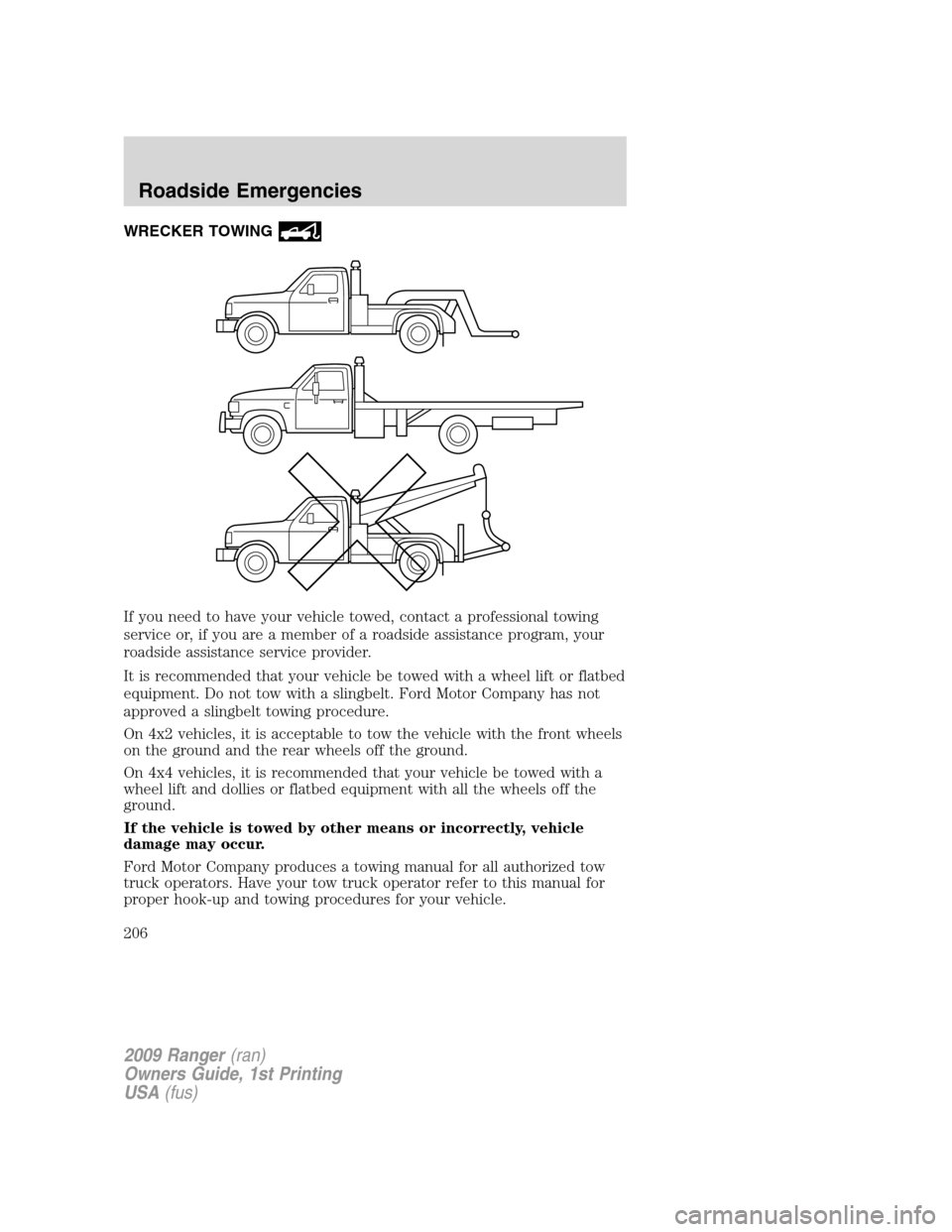
WRECKER TOWING
If you need to have your vehicle towed, contact a professional towing
service or, if you are a member of a roadside assistance program, your
roadside assistance service provider.
It is recommended that your vehicle be towed with a wheel lift or flatbed
equipment. Do not tow with a slingbelt. Ford Motor Company has not
approved a slingbelt towing procedure.
On 4x2 vehicles, it is acceptable to tow the vehicle with the front wheels
on the ground and the rear wheels off the ground.
On 4x4 vehicles, it is recommended that your vehicle be towed with a
wheel lift and dollies or flatbed equipment with all the wheels off the
ground.
If the vehicle is towed by other means or incorrectly, vehicle
damage may occur.
Ford Motor Company produces a towing manual for all authorized tow
truck operators. Have your tow truck operator refer to this manual for
proper hook-up and towing procedures for your vehicle.
2009 Ranger(ran)
Owners Guide, 1st Printing
USA(fus)
Roadside Emergencies
206