brakes FORD RANGER 2009 2.G Owners Manual
[x] Cancel search | Manufacturer: FORD, Model Year: 2009, Model line: RANGER, Model: FORD RANGER 2009 2.GPages: 280, PDF Size: 2.45 MB
Page 2 of 280
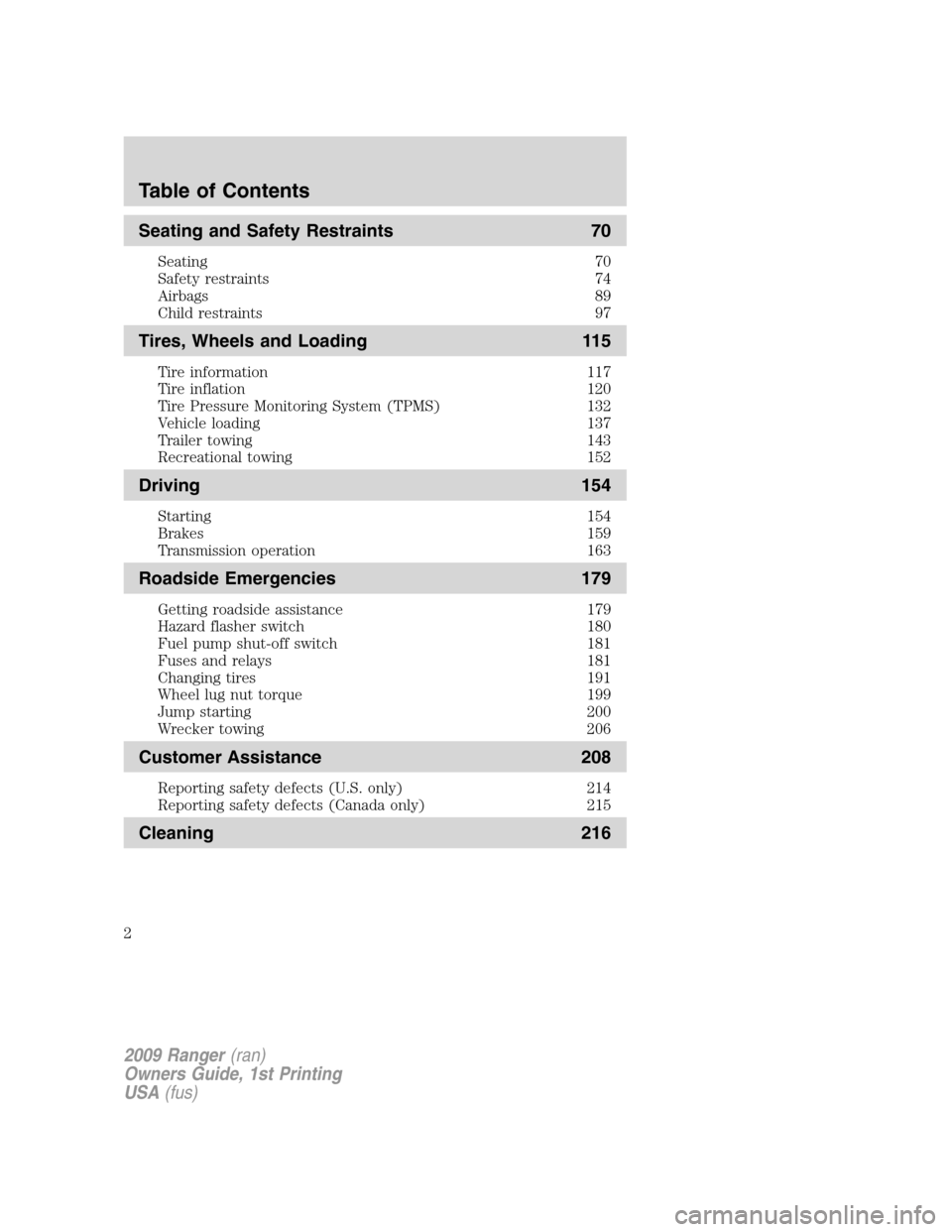
Seating and Safety Restraints 70
Seating 70
Safety restraints 74
Airbags 89
Child restraints 97
Tires, Wheels and Loading 115
Tire information 117
Tire inflation 120
Tire Pressure Monitoring System (TPMS) 132
Vehicle loading 137
Trailer towing 143
Recreational towing 152
Driving 154
Starting 154
Brakes 159
Transmission operation 163
Roadside Emergencies 179
Getting roadside assistance 179
Hazard flasher switch 180
Fuel pump shut-off switch 181
Fuses and relays 181
Changing tires 191
Wheel lug nut torque 199
Jump starting 200
Wrecker towing 206
Customer Assistance 208
Reporting safety defects (U.S. only) 214
Reporting safety defects (Canada only) 215
Cleaning 216
Table of Contents
2
2009 Ranger(ran)
Owners Guide, 1st Printing
USA(fus)
Page 59 of 280
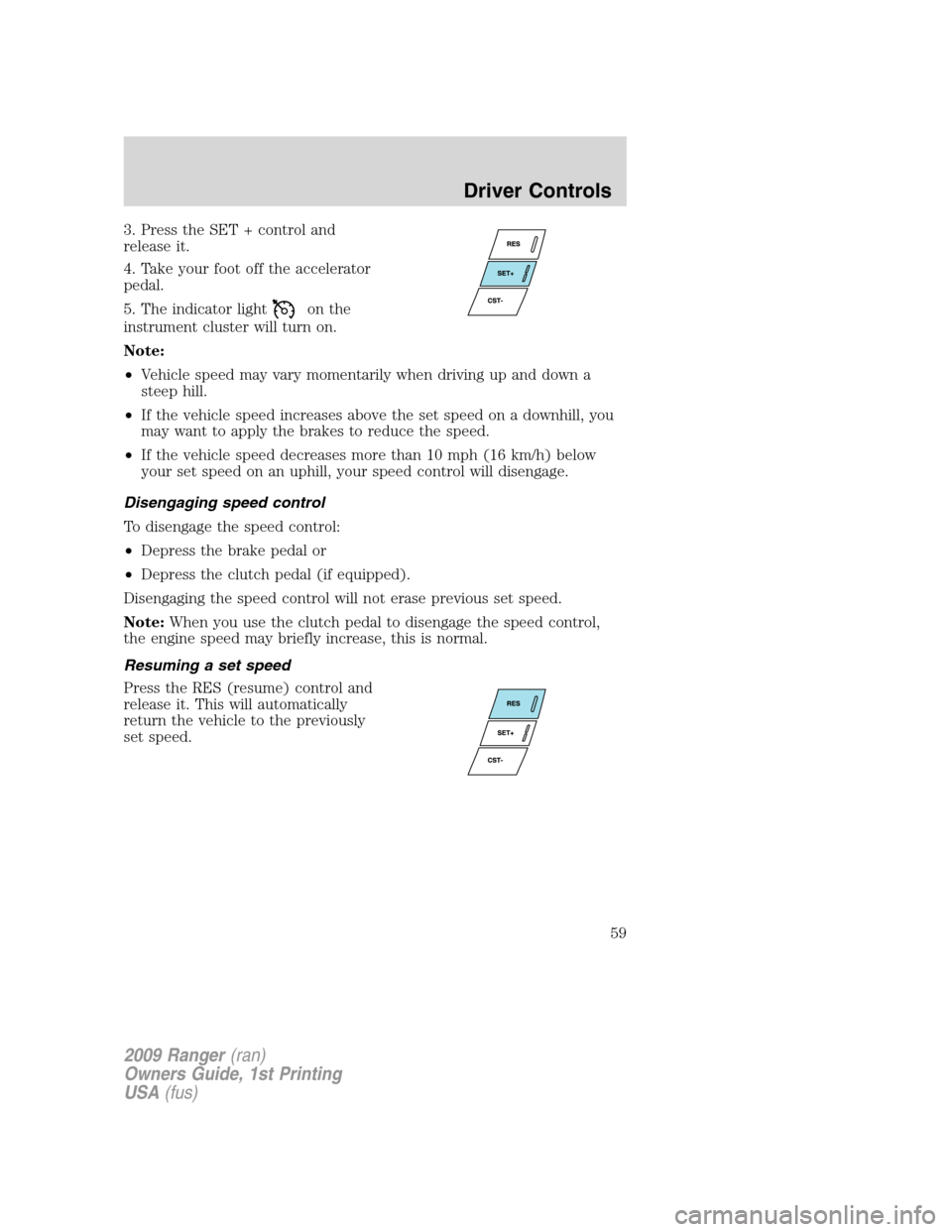
3. Press the SET + control and
release it.
4. Take your foot off the accelerator
pedal.
5. The indicator light
on the
instrument cluster will turn on.
Note:
•Vehicle speed may vary momentarily when driving up and down a
steep hill.
•If the vehicle speed increases above the set speed on a downhill, you
may want to apply the brakes to reduce the speed.
•If the vehicle speed decreases more than 10 mph (16 km/h) below
your set speed on an uphill, your speed control will disengage.
Disengaging speed control
To disengage the speed control:
•Depress the brake pedal or
•Depress the clutch pedal (if equipped).
Disengaging the speed control will not erase previous set speed.
Note:When you use the clutch pedal to disengage the speed control,
the engine speed may briefly increase, this is normal.
Resuming a set speed
Press the RES (resume) control and
release it. This will automatically
return the vehicle to the previously
set speed.
2009 Ranger(ran)
Owners Guide, 1st Printing
USA(fus)
Driver Controls
59
Page 80 of 280
Energy management feature
•This vehicle has a safety belt system with an energy management
feature at the front outboard seating positions to help further reduce
the risk of injury in the event of a head-on collision.
•This energy management system has a retractor assembly that is
designed to pay out webbing in a controlled manner. This feature is
designed to help reduce the belt force acting on the occupant’s chest.
The front outboard safety restraints in the vehicle are combination lap
and shoulder belts. The driver safety belt has the first two types of
locking modes and the front passenger outboard safety belt has all three
types of locking modes described below:
Vehicle sensitive mode
This is the normal retractor mode, which allows free shoulder belt length
adjustment to your movements and locking in response to vehicle
movement. For example, if the driver brakes suddenly or turns a corner
sharply, or the vehicle receives an impact of approximately 5 mph
(8 km/h) or more, the combination safety belts will lock to help reduce
forward movement of the driver and passengers.
Webbing extraction sensitive mode
The webbing sensitive locking mode locks the webbing and prevents
more belt from being pulled out if the belt is pulled out too quickly. The
belt will unlock when you stop pulling on it.
Automatic locking mode
The automatic locking mode is not available on the driver safety belt.
When to use the automatic locking mode
In this mode, the shoulder belt is automatically pre-locked. The belt will
still retract to remove any slack in the shoulder belt. The automatic
locking mode is not available on the driver safety belt.
This mode should be usedany timea child safety seat is installed in a
passenger front seat. Refer toSafety restraints for childrenorSafety
seats for childrenlater in this chapter.
2009 Ranger(ran)
Owners Guide, 1st Printing
USA(fus)
Seating and Safety Restraints
80
Page 141 of 280
WARNING:Exceeding the Safety Compliance Certification Label
vehicle weight rating limits could result in substandard vehicle
handling or performance, engine, transmission and/or structural
damage, serious damage to the vehicle, loss of control and personal
injury.
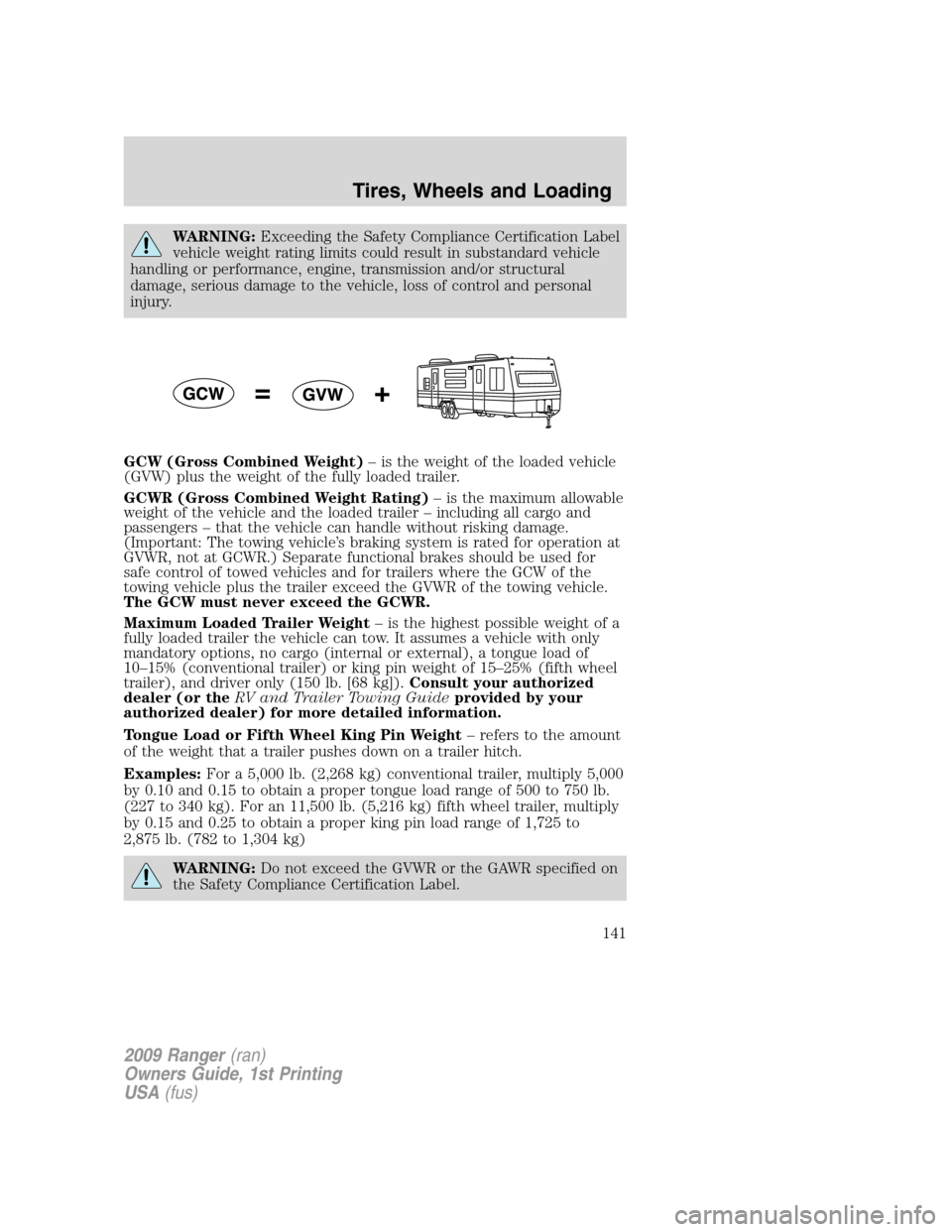
GCW (Gross Combined Weight)– is the weight of the loaded vehicle
(GVW) plus the weight of the fully loaded trailer.
GCWR (Gross Combined Weight Rating)– is the maximum allowable
weight of the vehicle and the loaded trailer – including all cargo and
passengers – that the vehicle can handle without risking damage.
(Important: The towing vehicle’s braking system is rated for operation at
GVWR, not at GCWR.) Separate functional brakes should be used for
safe control of towed vehicles and for trailers where the GCW of the
towing vehicle plus the trailer exceed the GVWR of the towing vehicle.
The GCW must never exceed the GCWR.
Maximum Loaded Trailer Weight– is the highest possible weight of a
fully loaded trailer the vehicle can tow. It assumes a vehicle with only
mandatory options, no cargo (internal or external), a tongue load of
10–15% (conventional trailer) or king pin weight of 15–25% (fifth wheel
trailer), and driver only (150 lb. [68 kg]).Consult your authorized
dealer (or theRV and Trailer Towing Guideprovided by your
authorized dealer) for more detailed information.
Tongue Load or Fifth Wheel King Pin Weight– refers to the amount
of the weight that a trailer pushes down on a trailer hitch.
Examples:For a 5,000 lb. (2,268 kg) conventional trailer, multiply 5,000
by 0.10 and 0.15 to obtain a proper tongue load range of 500 to 750 lb.
(227 to 340 kg). For an 11,500 lb. (5,216 kg) fifth wheel trailer, multiply
by 0.15 and 0.25 to obtain a proper king pin load range of 1,725 to
2,875 lb. (782 to 1,304 kg)
WARNING:Do not exceed the GVWR or the GAWR specified on
the Safety Compliance Certification Label.
2009 Ranger(ran)
Owners Guide, 1st Printing
USA(fus)
Tires, Wheels and Loading
141
Page 144 of 280
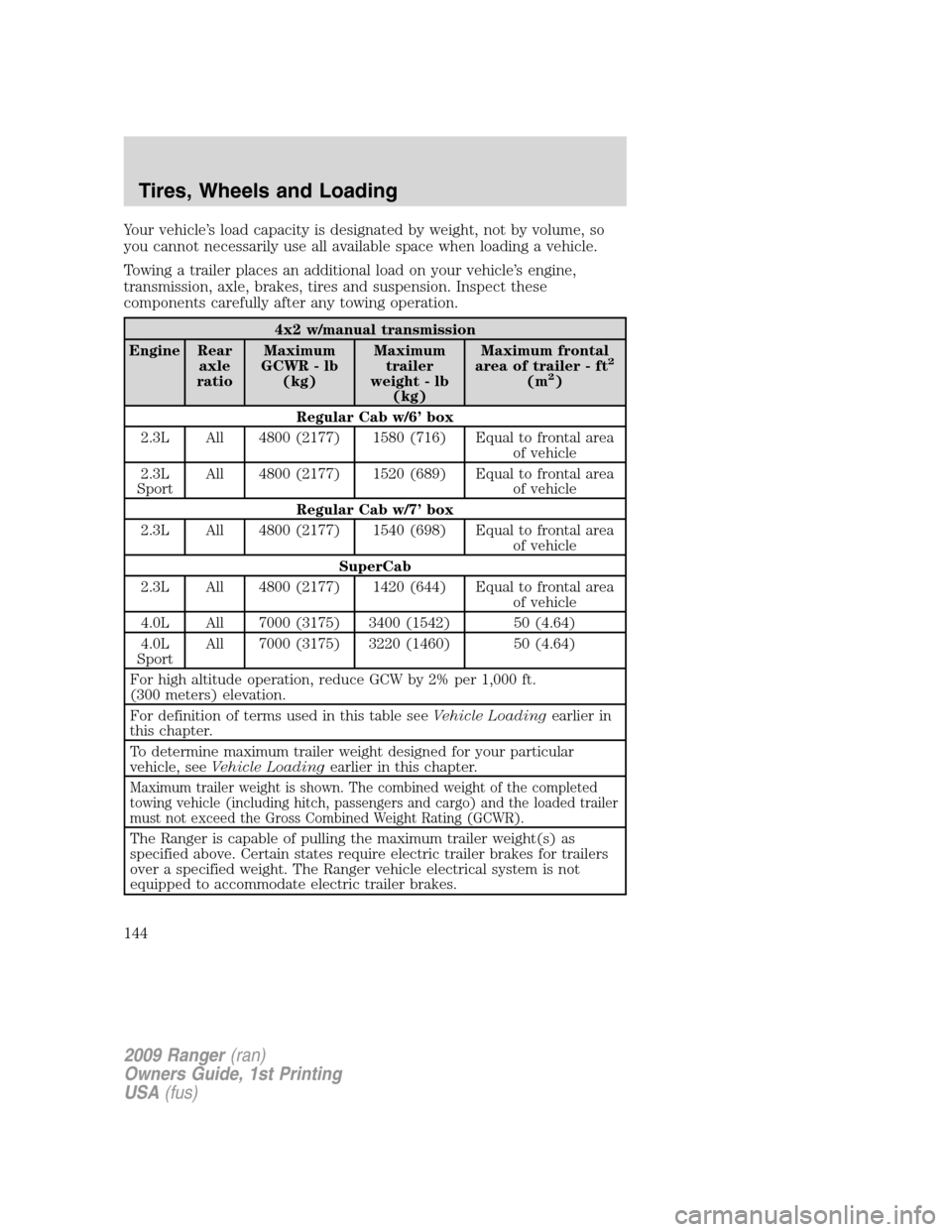
Your vehicle’s load capacity is designated by weight, not by volume, so
you cannot necessarily use all available space when loading a vehicle.
Towing a trailer places an additional load on your vehicle’s engine,
transmission, axle, brakes, tires and suspension. Inspect these
components carefully after any towing operation.
4x2 w/manual transmission
Engine Rear
axle
ratioMaximum
GCWR - lb
(kg)Maximum
trailer
weight - lb
(kg)Maximum frontal
area of trailer - ft
2
(m2)
Regular Cab w/6’ box
2.3L All 4800 (2177) 1580 (716) Equal to frontal area
of vehicle
2.3L
SportAll 4800 (2177) 1520 (689) Equal to frontal area
of vehicle
Regular Cab w/7’ box
2.3L All 4800 (2177) 1540 (698) Equal to frontal area
of vehicle
SuperCab
2.3L All 4800 (2177) 1420 (644) Equal to frontal area
of vehicle
4.0L All 7000 (3175) 3400 (1542) 50 (4.64)
4.0L
SportAll 7000 (3175) 3220 (1460) 50 (4.64)
For high altitude operation, reduce GCW by 2% per 1,000 ft.
(300 meters) elevation.
For definition of terms used in this table seeVehicle Loadingearlier in
this chapter.
To determine maximum trailer weight designed for your particular
vehicle, seeVehicle Loadingearlier in this chapter.
Maximum trailer weight is shown. The combined weight of the completed
towing vehicle (including hitch, passengers and cargo) and the loaded trailer
must not exceed the Gross Combined Weight Rating (GCWR).
The Ranger is capable of pulling the maximum trailer weight(s) as
specified above. Certain states require electric trailer brakes for trailers
over a specified weight. The Ranger vehicle electrical system is not
equipped to accommodate electric trailer brakes.
2009 Ranger(ran)
Owners Guide, 1st Printing
USA(fus)
Tires, Wheels and Loading
144
Page 145 of 280
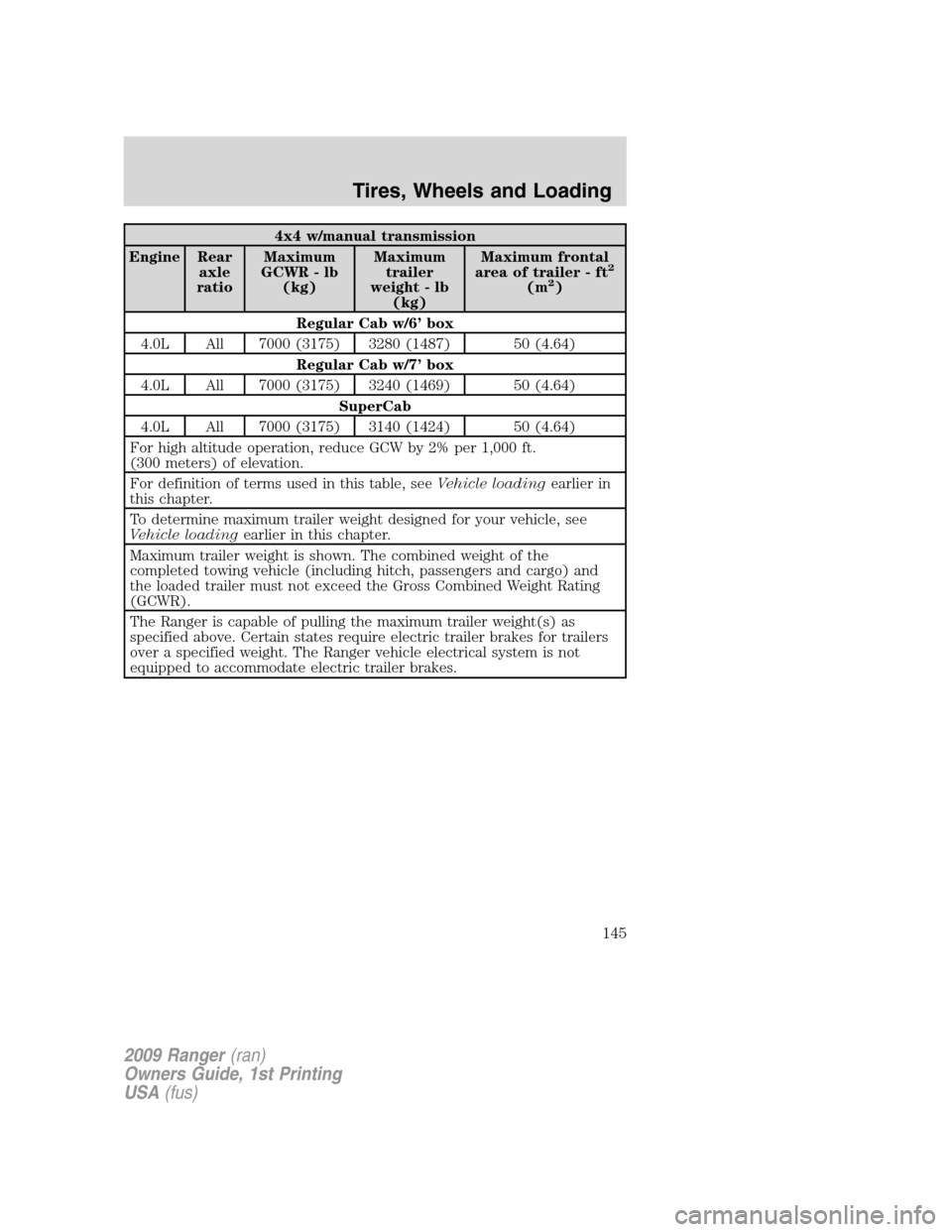
4x4 w/manual transmission
Engine Rear
axle
ratioMaximum
GCWR - lb
(kg)Maximum
trailer
weight - lb
(kg)Maximum frontal
area of trailer - ft
2
(m2)
Regular Cab w/6’ box
4.0L All 7000 (3175) 3280 (1487) 50 (4.64)
Regular Cab w/7’ box
4.0L All 7000 (3175) 3240 (1469) 50 (4.64)
SuperCab
4.0L All 7000 (3175) 3140 (1424) 50 (4.64)
For high altitude operation, reduce GCW by 2% per 1,000 ft.
(300 meters) of elevation.
For definition of terms used in this table, seeVehicle loadingearlier in
this chapter.
To determine maximum trailer weight designed for your vehicle, see
Vehicle loadingearlier in this chapter.
Maximum trailer weight is shown. The combined weight of the
completed towing vehicle (including hitch, passengers and cargo) and
the loaded trailer must not exceed the Gross Combined Weight Rating
(GCWR).
The Ranger is capable of pulling the maximum trailer weight(s) as
specified above. Certain states require electric trailer brakes for trailers
over a specified weight. The Ranger vehicle electrical system is not
equipped to accommodate electric trailer brakes.
2009 Ranger(ran)
Owners Guide, 1st Printing
USA(fus)
Tires, Wheels and Loading
145
Page 146 of 280
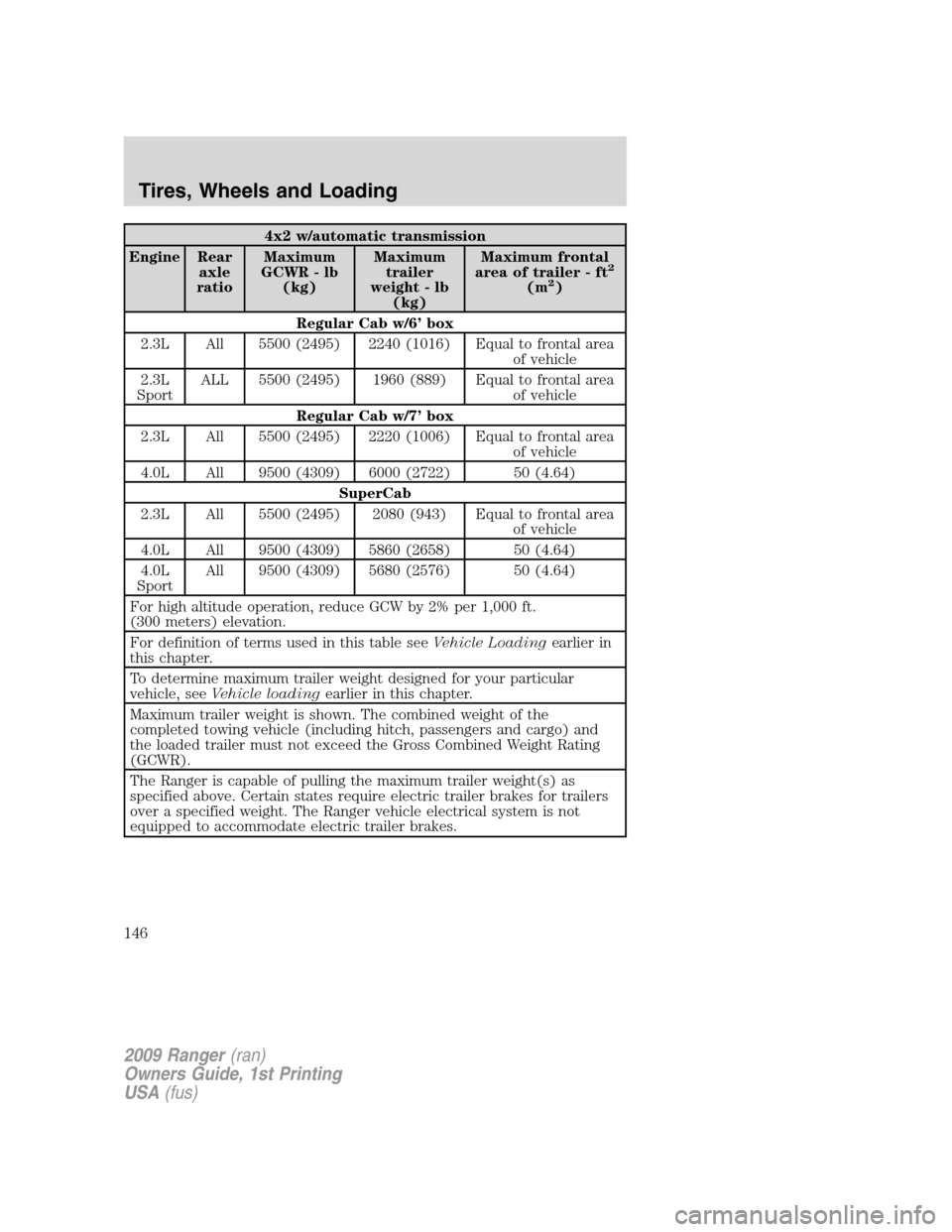
4x2 w/automatic transmission
Engine Rear
axle
ratioMaximum
GCWR - lb
(kg)Maximum
trailer
weight - lb
(kg)Maximum frontal
area of trailer - ft
2
(m2)
Regular Cab w/6’ box
2.3L All 5500 (2495) 2240 (1016) Equal to frontal area
of vehicle
2.3L
SportALL 5500 (2495) 1960 (889) Equal to frontal area
of vehicle
Regular Cab w/7’ box
2.3L All 5500 (2495) 2220 (1006) Equal to frontal area
of vehicle
4.0L All 9500 (4309) 6000 (2722) 50 (4.64)
SuperCab
2.3L All 5500 (2495) 2080 (943) Equal to frontal area
of vehicle
4.0L All 9500 (4309) 5860 (2658) 50 (4.64)
4.0L
SportAll 9500 (4309) 5680 (2576) 50 (4.64)
For high altitude operation, reduce GCW by 2% per 1,000 ft.
(300 meters) elevation.
For definition of terms used in this table seeVehicle Loadingearlier in
this chapter.
To determine maximum trailer weight designed for your particular
vehicle, seeVehicle loadingearlier in this chapter.
Maximum trailer weight is shown. The combined weight of the
completed towing vehicle (including hitch, passengers and cargo) and
the loaded trailer must not exceed the Gross Combined Weight Rating
(GCWR).
The Ranger is capable of pulling the maximum trailer weight(s) as
specified above. Certain states require electric trailer brakes for trailers
over a specified weight. The Ranger vehicle electrical system is not
equipped to accommodate electric trailer brakes.
2009 Ranger(ran)
Owners Guide, 1st Printing
USA(fus)
Tires, Wheels and Loading
146
Page 147 of 280
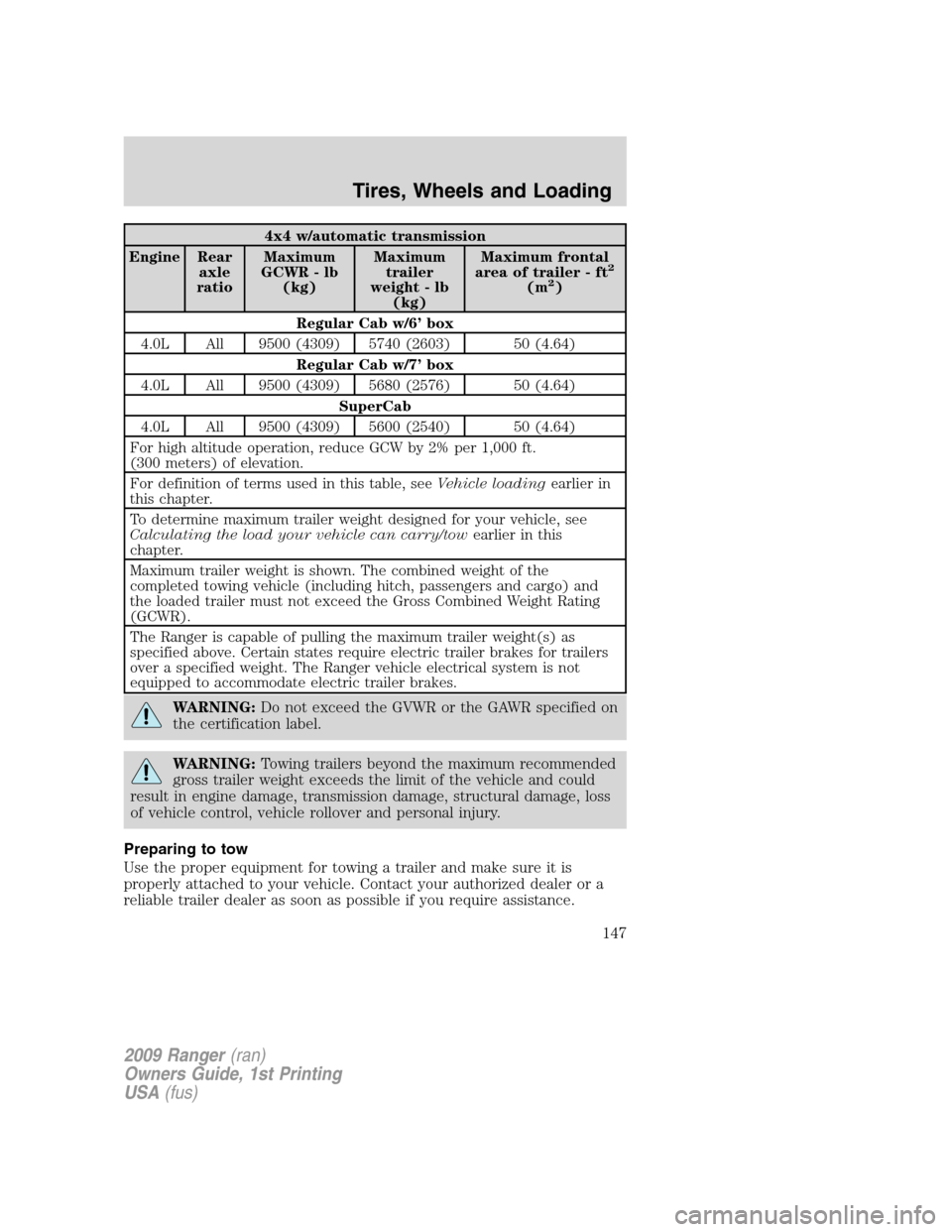
4x4 w/automatic transmission
Engine Rear
axle
ratioMaximum
GCWR - lb
(kg)Maximum
trailer
weight - lb
(kg)Maximum frontal
area of trailer - ft
2
(m2)
Regular Cab w/6’ box
4.0L All 9500 (4309) 5740 (2603) 50 (4.64)
Regular Cab w/7’ box
4.0L All 9500 (4309) 5680 (2576) 50 (4.64)
SuperCab
4.0L All 9500 (4309) 5600 (2540) 50 (4.64)
For high altitude operation, reduce GCW by 2% per 1,000 ft.
(300 meters) of elevation.
For definition of terms used in this table, seeVehicle loadingearlier in
this chapter.
To determine maximum trailer weight designed for your vehicle, see
Calculating the load your vehicle can carry/towearlier in this
chapter.
Maximum trailer weight is shown. The combined weight of the
completed towing vehicle (including hitch, passengers and cargo) and
the loaded trailer must not exceed the Gross Combined Weight Rating
(GCWR).
The Ranger is capable of pulling the maximum trailer weight(s) as
specified above. Certain states require electric trailer brakes for trailers
over a specified weight. The Ranger vehicle electrical system is not
equipped to accommodate electric trailer brakes.
WARNING:Do not exceed the GVWR or the GAWR specified on
the certification label.
WARNING:Towing trailers beyond the maximum recommended
gross trailer weight exceeds the limit of the vehicle and could
result in engine damage, transmission damage, structural damage, loss
of vehicle control, vehicle rollover and personal injury.
Preparing to tow
Use the proper equipment for towing a trailer and make sure it is
properly attached to your vehicle. Contact your authorized dealer or a
reliable trailer dealer as soon as possible if you require assistance.
2009 Ranger(ran)
Owners Guide, 1st Printing
USA(fus)
Tires, Wheels and Loading
147
Page 148 of 280
Hitches
For towing trailers up to 2,000 lb (907 kg), use a weight carrying hitch
and ball which uniformly distributes the trailer tongue loads through the
underbody structure. Use a frame-mounted weight distributing hitch for
trailers over 2,000 lb (907 kg).
Do not install a single or multi-clamp type bumper hitch, or a hitch
which attaches to the axle. Underbody mounted hitches are acceptable if
they are installed properly. Follow the towing instructions of a reputable
rental agency.
Whenever a trailer hitch and hardware are removed, make sure all
mounting holes in the underbody are properly sealed to prevent noxious
gases or water from entering.
Safety chains
Always connect the trailer’s safety chains to the frame or hook retainers
of the vehicle hitch. To connect the trailer’s safety chains, cross the
chains under the trailer tongue and allow slack for turning corners.
If you use a rental trailer, follow the instructions that the rental agency
gives to you.
Do not attach safety chains to the bumper.
Trailer brakes
Electric brakes and manual, automatic or surge-type trailer brakes are
safe if installed properly and adjusted to the manufacturer’s
specifications. The trailer brakes must meet local and Federal
regulations.
WARNING:Do not connect a trailer’s hydraulic brake system
directly to your vehicle’s brake system. Your vehicle may not
have enough braking power and your chances of having a collision
greatly increase.
The braking system of the tow vehicle is rated for operation at the
GVWR not GCWR.
2009 Ranger(ran)
Owners Guide, 1st Printing
USA(fus)
Tires, Wheels and Loading
148
Page 159 of 280
•Finally, have the engine block heater system checked during your fall
tune-up to be sure it’s in good working order.
How to use the engine block heater
Ensure the receptacle terminals are clean and dry prior to use. To clean
them, use a dry cloth.
Depending on the type of factory installed equipment, your engine block
heater system may consume anywhere between 400 watts or 1000 watts
of energy per hour. Your factory installed block heater system does not
have a thermostat; however, maximum temperature is attained after
approximately three hours of operation. Block heater operation longer
than three hours will not improve system performance and will
unnecessarily use additional electricity.
Make sure system is unplugged and properly stowed before driving the
vehicle. While not in use, make sure the protective cover seals the
prongs of the engine block heater cord plug.
BRAKES
Occasional brake noise is normal. If a metal-to-metal, continuous grinding
or continuous squeal sound is present, the brake linings may be worn-out
and should be inspected by an authorized dealer. If the vehicle has
continuous vibration or shudder in the steering wheel while braking, the
vehicle should be inspected by an authorized dealer.
Refer toBrake system warning
lightin theInstrument Cluster
chapter for information on the brake
system warning light.
Four-wheel anti-lock brake system (ABS)
This vehicle is equipped with an anti-lock braking system (ABS). A noise
from the hydraulic pump motor and pulsation in the pedal may be
observed during ABS braking events and the brake pedal may suddenly
travel a little farther as soon as ABS braking is done and normal brake
operation resumes. Pedal pulsation coupled with noise while braking
under panic conditions or on loose gravel, bumps, wet or snowy roads is
normal and indicates proper functioning of the vehicle’s anti-lock brake
system.
Note:The ABS performs a self-check after you start the engine and
begin to drive away.
A brief mechanical noise may be heard during this test. This is normal. If
a malfunction is found, the ABS warning light will come on. If the vehicle
P!
BRAKE
2009 Ranger(ran)
Owners Guide, 1st Printing
USA(fus)
Driving
159