automatic transmission FORD RANGER 2020 Owners Manual
[x] Cancel search | Manufacturer: FORD, Model Year: 2020, Model line: RANGER, Model: FORD RANGER 2020Pages: 478, PDF Size: 7.44 MB
Page 6 of 478
Engine Block Heater
...................................143
Unique Driving Characteristics
Auto-Start-Stop ..........................................
145
Fuel and Refueling
Safety Precautions ......................................
147
Fuel Quality ....................................................
147
Fuel Filler Funnel Location .......................
148
Running Out of Fuel ...................................
148
Refueling ........................................................
150
Fuel Consumption .......................................
152
Engine Emission Control
Emission Law ................................................
154
Catalytic Converter .....................................
155
Transmission
Automatic Transmission ..........................
158
Four-Wheel Drive
Principle of Operation ................................
162
Using Four-Wheel Drive ............................
162
Rear Axle
Electronic Locking Differential ...............
169
Brakes
General Information .....................................
171
Hints on Driving With Anti-Lock Brakes ........................................................................\
..
171
Parking Brake .................................................
172
Hill Start Assist ..............................................
172
Traction Control
Principle of Operation ................................
174
Using Traction Control ...............................
174Stability Control
Principle of Operation
................................
175
Using Stability Control ...............................
176
Terrain Control
Principle of Operation ................................
178
Trail Control
What Is Trail Control ..................................
180
Switching Trail Control On and Off ......
180
Setting the Trail Control Speed .............
180
Canceling the Set Speed .........................
180
Trail Control Indicators ...............................
181
Trail Control – Troubleshooting ..............
181
Parking Aids
Principle of Operation ................................
182
Rear Parking Aid ...........................................
182
Front Parking Aid .........................................
183
Rear View Camera ......................................
184
Cruise Control
Principle of Operation ...............................
188
Using Cruise Control ..................................
188
Using Adaptive Cruise Control ...............
189
Driving Aids
Driver Alert .....................................................
196
Lane Keeping System ................................
197
Blind Spot Information System ............
202
Cross Traffic Alert .......................................
205
Steering ..........................................................
209
Pre-Collision Assist ...................................
209
Load Carrying
Load Limit .......................................................
214
Roof Racks and Load Carriers ................
218
Load Retaining Fixtures .............................
218
3
Ranger (TFG) Canada/United States of America, Vehicles Built From: 18-11-2019, LB3J 19A321 AB enUSA, Edition date: 202002, Second-Printing Table of Contents
Page 7 of 478
Towing
Towing a Trailer
...........................................220
Trailer Sway Control ....................................
221
Recommended Towing Weights ............
221
Essential Towing Checks ..........................
223
Towing the Vehicle on Four Wheels .....
226
Driving Hints
Breaking-In ....................................................
229
Economical Driving ....................................
229
Cold Weather Precautions ......................
230
Off-Road Driving .........................................
230
Driving Through Water ...............................
231
Floor Mats ......................................................
232
Roadside Emergencies
Roadside Assistance .................................
233
Hazard Flashers ...........................................
234
Fuel Shutoff ..................................................
234
Jump Starting the Vehicle .......................
235
Transporting the Vehicle ..........................
237
Towing Points ...............................................
238
Customer Assistance
Getting the Services You Need ..............
239
In California (U.S. Only) ...........................
240
The Better Business Bureau (BBB) Auto Line Program (U.S. Only) ......................
241
Utilizing the Mediation/Arbitration Program (Canada Only) ......................
242
Getting Assistance Outside the U.S. and Canada .......................................................
242
Ordering Additional Owner's Literature ........................................................................\
244
Reporting Safety Defects (U.S. Only) ........................................................................\
244
Reporting Safety Defects (Canada Only) ........................................................................\
244
Fuses
Fuse Box Locations ....................................
246Fuse Specification Chart
..........................
247
Changing a Fuse .........................................
259
Maintenance
General Information ...................................
261
Opening and Closing the Hood .............
262
Under Hood Overview ..............................
263
Engine Oil Dipstick .....................................
264
Engine Oil Check .........................................
264
Oil Change Indicator Reset .....................
265
Engine Coolant Check ..............................
266
Automatic Transmission Fluid Check ........................................................................\
270
Brake Fluid Check .......................................
270
Power Steering Fluid Check .....................
271
Washer Fluid Check .....................................
271
Fuel Filter .........................................................
271
Charging the 12V Battery ..........................
272
Changing the 12V Battery .........................
272
Checking the Wiper Blades .....................
274
Changing the Wiper Blades ....................
274
Adjusting the Headlamps ........................
275
Removing a Headlamp .............................
276
Changing a Bulb ..........................................
276
Changing the Engine Air Filter ...............
280
Vehicle Care
General Information ..................................
282
Cleaning Products ......................................
282
Cleaning the Exterior .................................
282
Waxing ............................................................
284
Cleaning the Engine ..................................
284
Cleaning the Windows and Wiper Blades ........................................................................\
284
Cleaning the Interior ..................................
285
Cleaning the Instrument Panel and Instrument Cluster Lens ......................
285
Cleaning Leather Seats ............................
286
Repairing Minor Paint Damage ..............
287
Cleaning the Wheels .................................
287
4
Ranger (TFG) Canada/United States of America, Vehicles Built From: 18-11-2019, LB3J 19A321 AB enUSA, Edition date: 202002, Second-Printing Table of Contents
Page 59 of 478
Remote Start (If Equipped)
WARNING:
To avoid exhaust
fumes, do not use remote start if your
vehicle is parked indoors or in areas that
are not well ventilated.
Note: Do not use remote start if your fuel
level is low. The remote start button is on the
remote control.
This feature allows you to start your
vehicle from the outside. The remote
control has an extended operating range.
If your vehicle has automatic climate
control, you can configure it to operate
when you remote start your vehicle.
See
Climate Control (page 117). A manual
climate control system will run at the
setting it was set to when you switched
your vehicle off.
Many states and provinces have
restrictions for the use of remote start.
Check your local and state or provincial
laws for specific requirements regarding
remote start systems.
The remote start system does not work if:
• The ignition is on.
• The alarm system triggers.
• You disable the feature.
• The hood is open.
• The transmission is not in park (P).
• The vehicle battery voltage is too low.
• The service engine soon light is on.
Remote Control Feedback (If
Equipped)
An LED on the remote control provides
status feedback of remote start or stop
commands. Status
LED
Remote startsuccessful
Solid green
Remote stopsuccessful
Solid red
Request failed or
status not received
Blinking red
Status incomplete
Blinking green
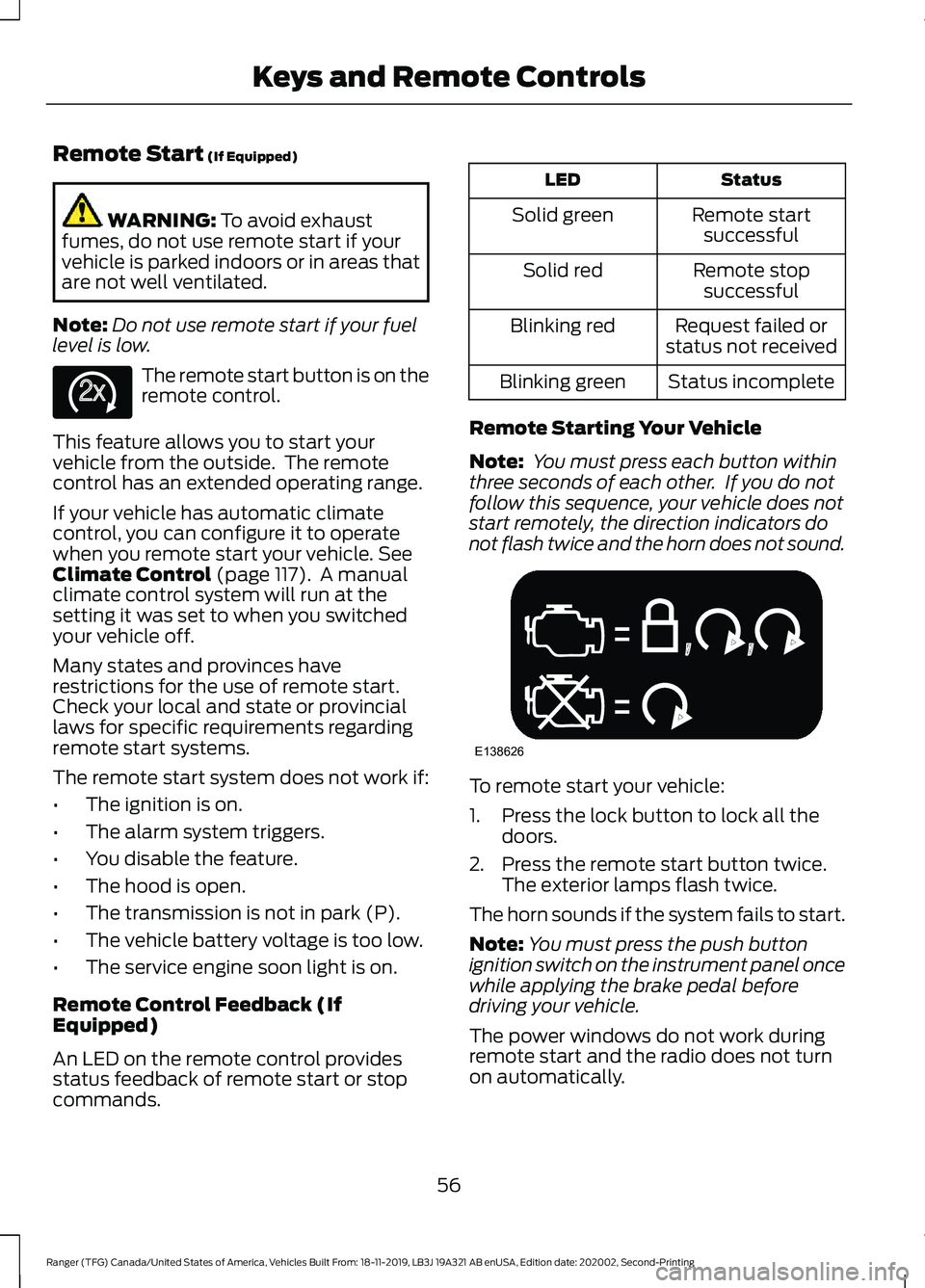
Remote Starting Your Vehicle
Note: You must press each button within
three seconds of each other. If you do not
follow this sequence, your vehicle does not
start remotely, the direction indicators do
not flash twice and the horn does not sound. To remote start your vehicle:
1. Press the lock button to lock all the
doors.
2. Press the remote start button twice. The exterior lamps flash twice.
The horn sounds if the system fails to start.
Note: You must press the push button
ignition switch on the instrument panel once
while applying the brake pedal before
driving your vehicle.
The power windows do not work during
remote start and the radio does not turn
on automatically.
56
Ranger (TFG) Canada/United States of America, Vehicles Built From: 18-11-2019, LB3J 19A321 AB enUSA, Edition date: 202002, Second-Printing Keys and Remote ControlsE138625 E138626
Page 82 of 478
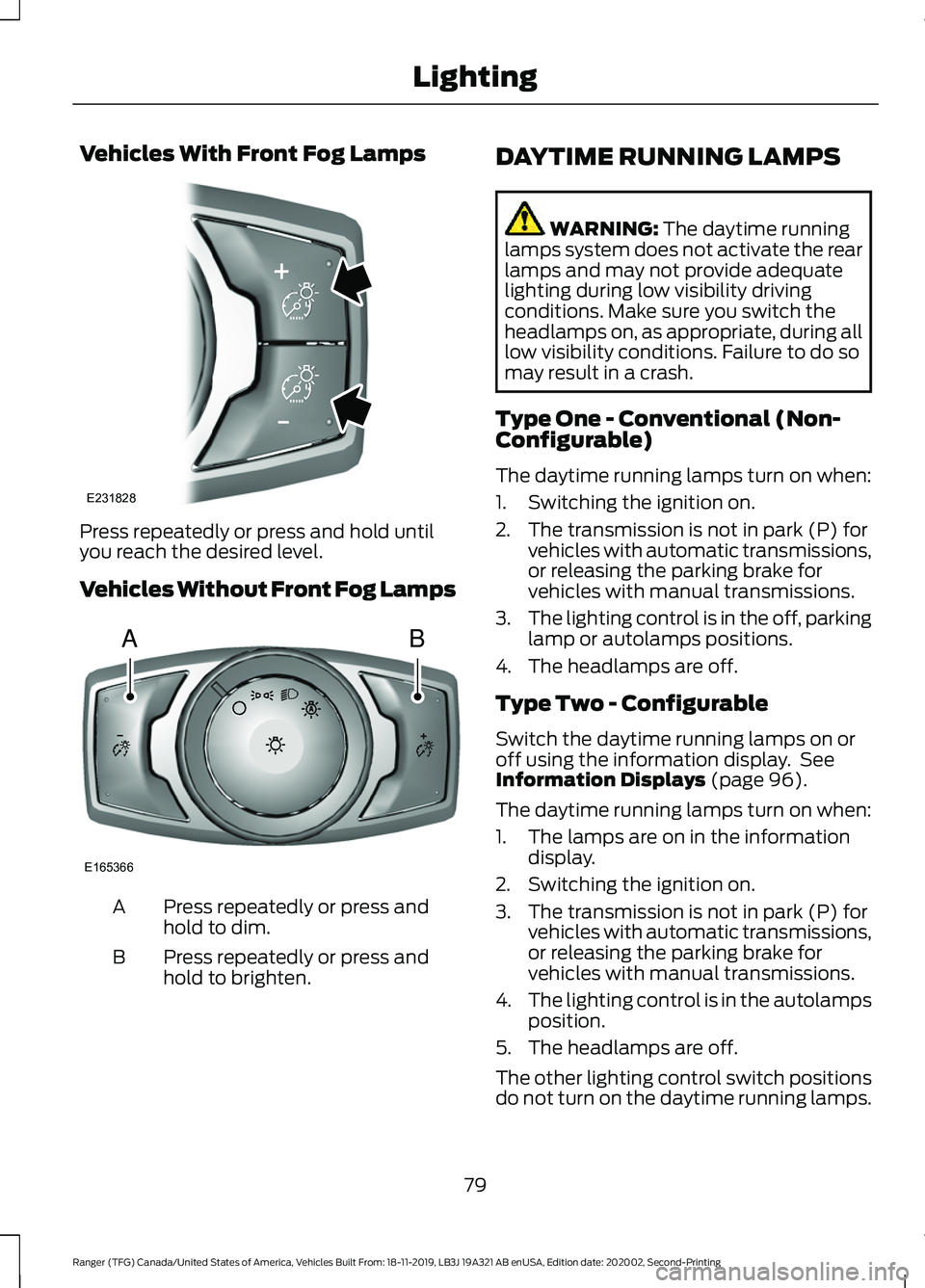
Vehicles With Front Fog Lamps
Press repeatedly or press and hold until
you reach the desired level.
Vehicles Without Front Fog Lamps
Press repeatedly or press and
hold to dim.
A
Press repeatedly or press and
hold to brighten.
B DAYTIME RUNNING LAMPS WARNING: The daytime running
lamps system does not activate the rear
lamps and may not provide adequate
lighting during low visibility driving
conditions. Make sure you switch the
headlamps on, as appropriate, during all
low visibility conditions. Failure to do so
may result in a crash.
Type One - Conventional (Non-
Configurable)
The daytime running lamps turn on when:
1. Switching the ignition on.
2. The transmission is not in park (P) for vehicles with automatic transmissions,
or releasing the parking brake for
vehicles with manual transmissions.
3. The lighting control is in the off, parking
lamp or autolamps positions.
4. The headlamps are off.
Type Two - Configurable
Switch the daytime running lamps on or
off using the information display. See
Information Displays
(page 96).
The daytime running lamps turn on when:
1. The lamps are on in the information display.
2. Switching the ignition on.
3. The transmission is not in park (P) for vehicles with automatic transmissions,
or releasing the parking brake for
vehicles with manual transmissions.
4. The lighting control is in the autolamps
position.
5. The headlamps are off.
The other lighting control switch positions
do not turn on the daytime running lamps.
79
Ranger (TFG) Canada/United States of America, Vehicles Built From: 18-11-2019, LB3J 19A321 AB enUSA, Edition date: 202002, Second-Printing LightingE231828 AB
E165366
Page 108 of 478
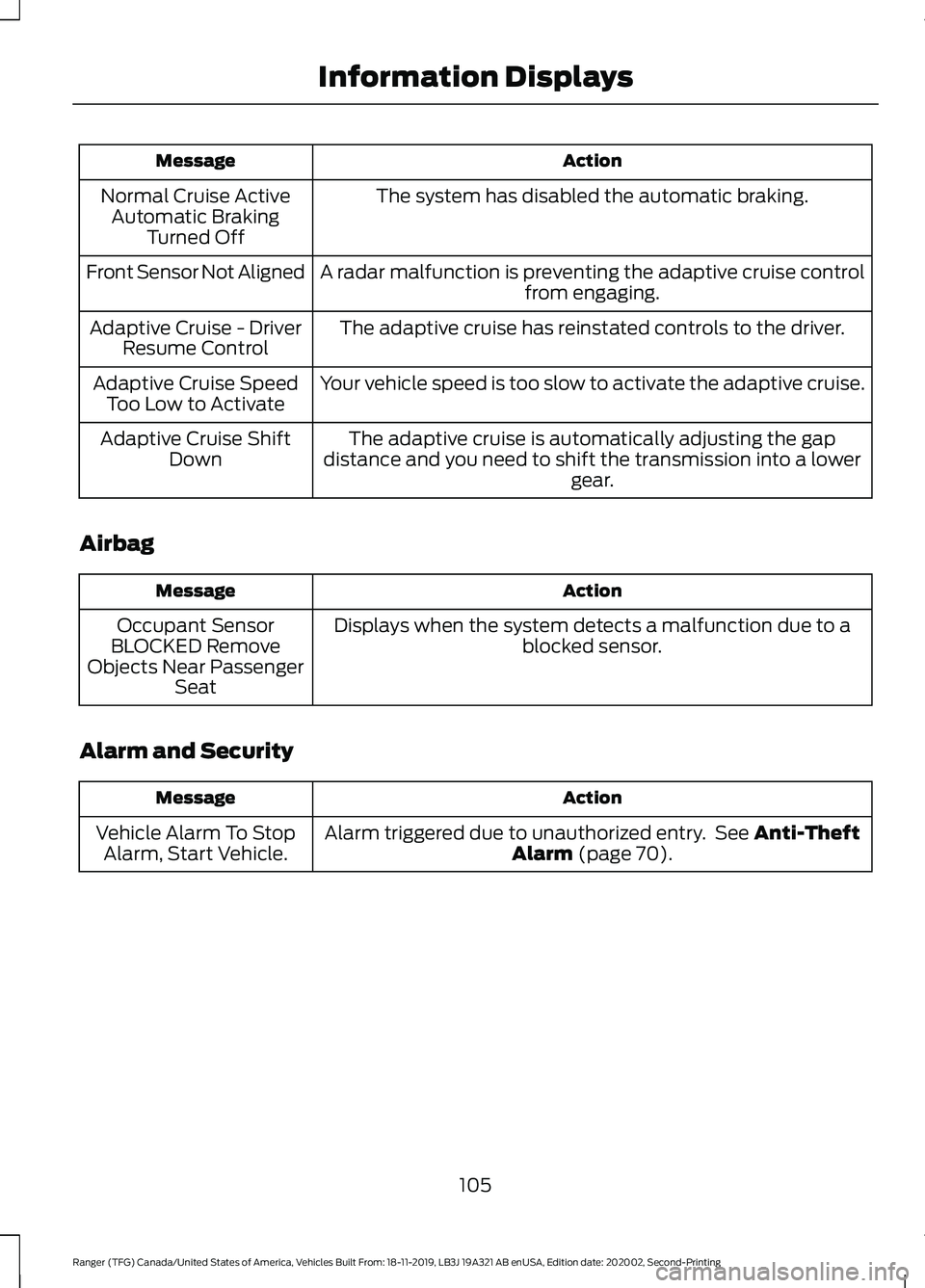
Action
Message
The system has disabled the automatic braking.
Normal Cruise Active
Automatic Braking Turned Off
A radar malfunction is preventing the adaptive cruise control from engaging.
Front Sensor Not Aligned
The adaptive cruise has reinstated controls to the driver.
Adaptive Cruise - Driver
Resume Control
Your vehicle speed is too slow to activate the adaptive cruise.
Adaptive Cruise Speed
Too Low to Activate
The adaptive cruise is automatically adjusting the gap
distance and you need to shift the transmission into a lower gear.
Adaptive Cruise Shift
Down
Airbag Action
Message
Displays when the system detects a malfunction due to a blocked sensor.
Occupant Sensor
BLOCKED Remove
Objects Near Passenger Seat
Alarm and Security Action
Message
Alarm triggered due to unauthorized entry. See Anti-Theft
Alarm (page 70).
Vehicle Alarm To Stop
Alarm, Start Vehicle.
105
Ranger (TFG) Canada/United States of America, Vehicles Built From: 18-11-2019, LB3J 19A321 AB enUSA, Edition date: 202002, Second-Printing Information Displays
Page 148 of 478
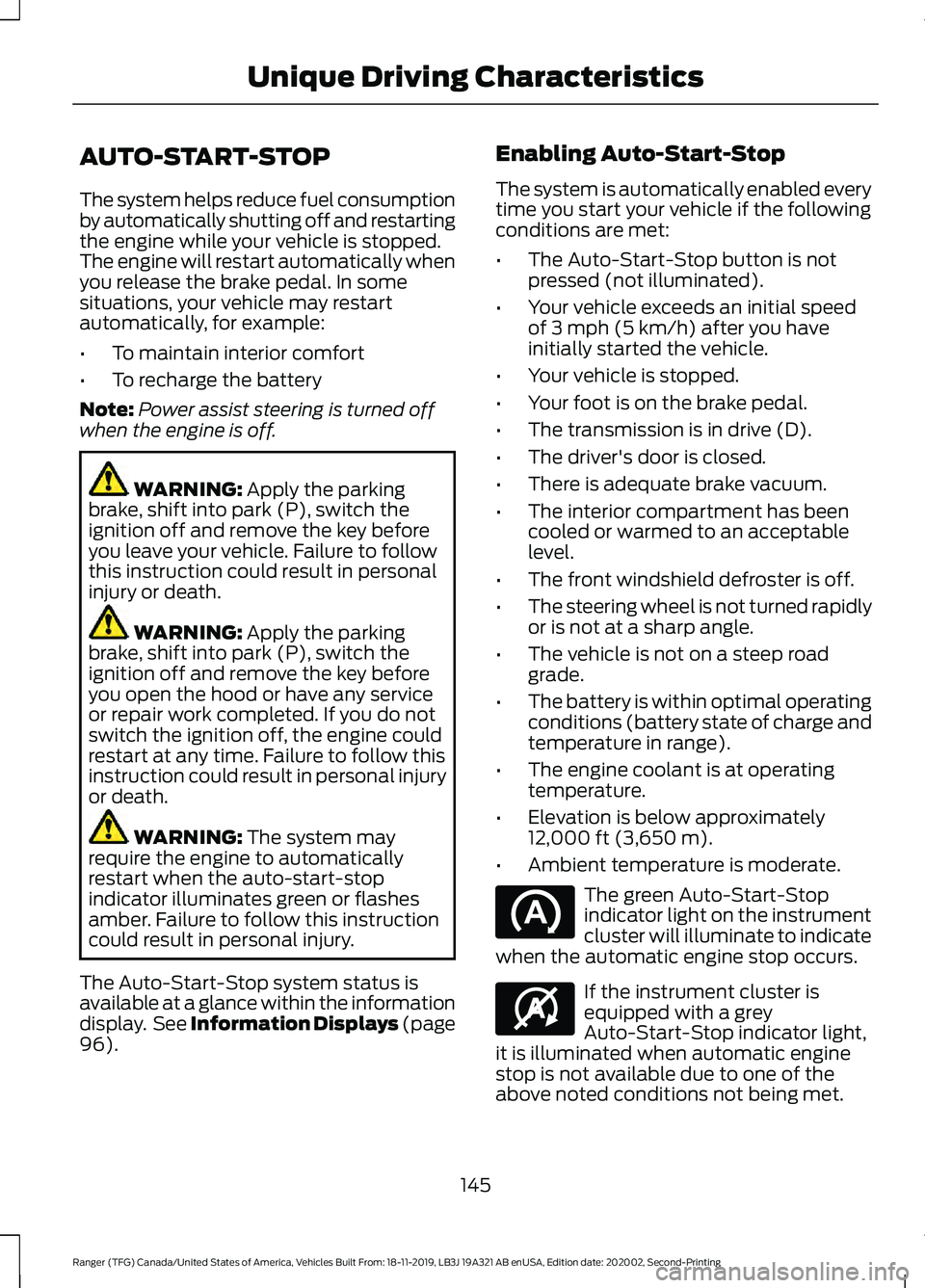
AUTO-START-STOP
The system helps reduce fuel consumption
by automatically shutting off and restarting
the engine while your vehicle is stopped.
The engine will restart automatically when
you release the brake pedal. In some
situations, your vehicle may restart
automatically, for example:
•
To maintain interior comfort
• To recharge the battery
Note: Power assist steering is turned off
when the engine is off. WARNING: Apply the parking
brake, shift into park (P), switch the
ignition off and remove the key before
you leave your vehicle. Failure to follow
this instruction could result in personal
injury or death. WARNING:
Apply the parking
brake, shift into park (P), switch the
ignition off and remove the key before
you open the hood or have any service
or repair work completed. If you do not
switch the ignition off, the engine could
restart at any time. Failure to follow this
instruction could result in personal injury
or death. WARNING:
The system may
require the engine to automatically
restart when the auto-start-stop
indicator illuminates green or flashes
amber. Failure to follow this instruction
could result in personal injury.
The Auto-Start-Stop system status is
available at a glance within the information
display. See Information Displays (page
96
). Enabling Auto-Start-Stop
The system is automatically enabled every
time you start your vehicle if the following
conditions are met:
•
The Auto-Start-Stop button is not
pressed (not illuminated).
• Your vehicle exceeds an initial speed
of
3 mph (5 km/h) after you have
initially started the vehicle.
• Your vehicle is stopped.
• Your foot is on the brake pedal.
• The transmission is in drive (D).
• The driver's door is closed.
• There is adequate brake vacuum.
• The interior compartment has been
cooled or warmed to an acceptable
level.
• The front windshield defroster is off.
• The steering wheel is not turned rapidly
or is not at a sharp angle.
• The vehicle is not on a steep road
grade.
• The battery is within optimal operating
conditions (battery state of charge and
temperature in range).
• The engine coolant is at operating
temperature.
• Elevation is below approximately
12,000 ft (3,650 m)
.
• Ambient temperature is moderate. The green Auto-Start-Stop
indicator light on the instrument
cluster will illuminate to indicate
when the automatic engine stop occurs. If the instrument cluster is
equipped with a grey
Auto-Start-Stop indicator light,
it is illuminated when automatic engine
stop is not available due to one of the
above noted conditions not being met.
145
Ranger (TFG) Canada/United States of America, Vehicles Built From: 18-11-2019, LB3J 19A321 AB enUSA, Edition date: 202002, Second-Printing Unique Driving Characteristics E146361
Page 149 of 478
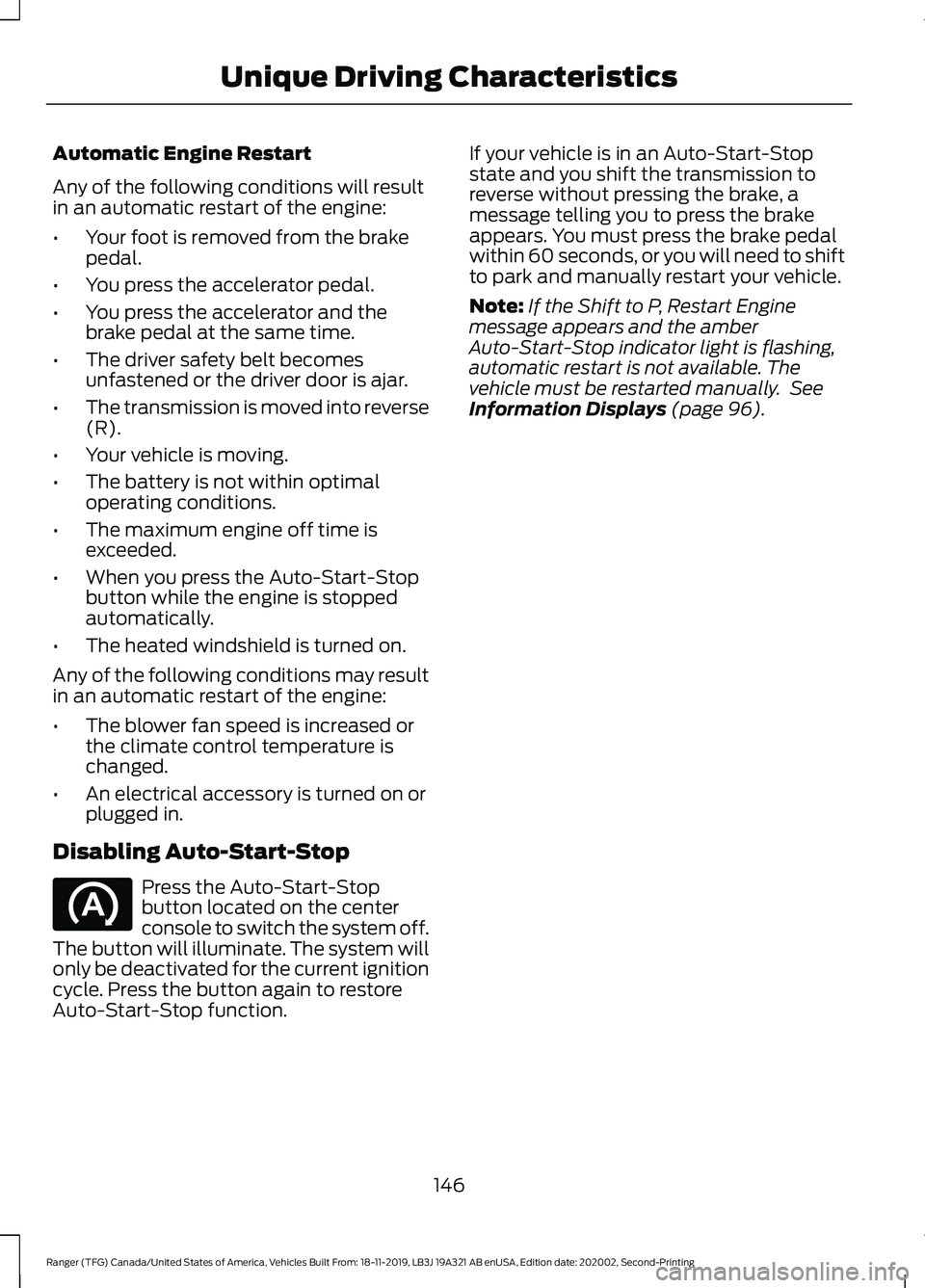
Automatic Engine Restart
Any of the following conditions will result
in an automatic restart of the engine:
•
Your foot is removed from the brake
pedal.
• You press the accelerator pedal.
• You press the accelerator and the
brake pedal at the same time.
• The driver safety belt becomes
unfastened or the driver door is ajar.
• The transmission is moved into reverse
(R).
• Your vehicle is moving.
• The battery is not within optimal
operating conditions.
• The maximum engine off time is
exceeded.
• When you press the Auto-Start-Stop
button while the engine is stopped
automatically.
• The heated windshield is turned on.
Any of the following conditions may result
in an automatic restart of the engine:
• The blower fan speed is increased or
the climate control temperature is
changed.
• An electrical accessory is turned on or
plugged in.
Disabling Auto-Start-Stop Press the Auto-Start-Stop
button located on the center
console to switch the system off.
The button will illuminate. The system will
only be deactivated for the current ignition
cycle. Press the button again to restore
Auto-Start-Stop function. If your vehicle is in an Auto-Start-Stop
state and you shift the transmission to
reverse without pressing the brake, a
message telling you to press the brake
appears. You must press the brake pedal
within 60 seconds, or you will need to shift
to park and manually restart your vehicle.
Note:
If the Shift to P, Restart Engine
message appears and the amber
Auto-Start-Stop indicator light is flashing,
automatic restart is not available. The
vehicle must be restarted manually. See
Information Displays (page 96).
146
Ranger (TFG) Canada/United States of America, Vehicles Built From: 18-11-2019, LB3J 19A321 AB enUSA, Edition date: 202002, Second-Printing Unique Driving Characteristics
Page 161 of 478
AUTOMATIC TRANSMISSION
WARNING: Always fully apply the
parking brake and make sure you shift
into park (P). Failure to follow this
instruction could result in personal injury
or death. WARNING:
Do not apply the brake
pedal and accelerator pedal
simultaneously. Applying both pedals
simultaneously for more than a few
seconds will limit engine performance,
which may result in difficulty maintaining
speed in traffic and could lead to serious
injury.
Note: A cold engine has a higher idle
speed. This increases the tendency for your
vehicle to creep when you have selected a
drive gear.
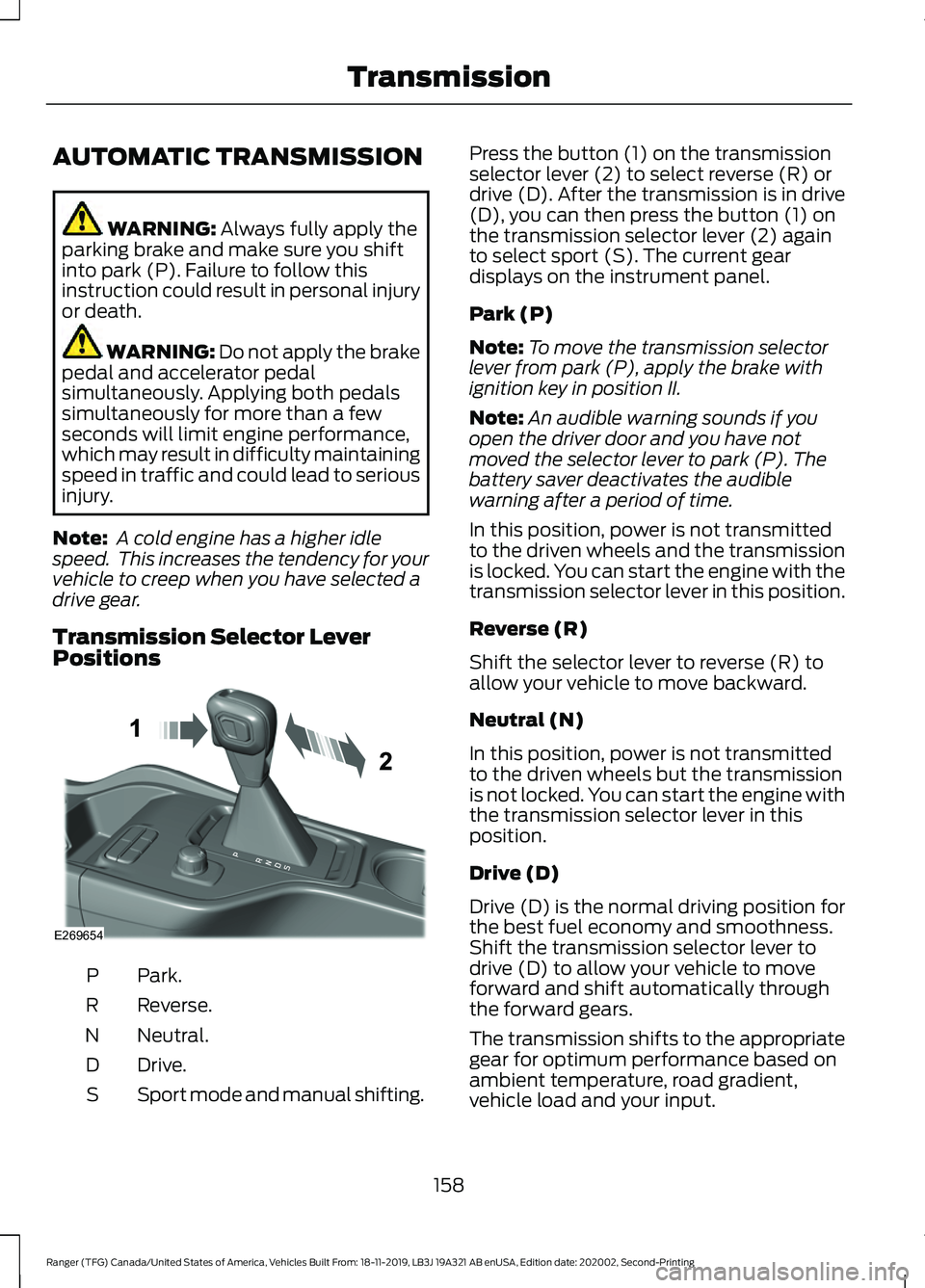
Transmission Selector Lever
Positions Park.
P
Reverse.
R
Neutral.
N
Drive.
D
Sport mode and manual shifting.
S Press the button (1) on the transmission
selector lever (2) to select reverse (R) or
drive (D). After the transmission is in drive
(D), you can then press the button (1) on
the transmission selector lever (2) again
to select sport (S). The current gear
displays on the instrument panel.
Park (P)
Note:
To move the transmission selector
lever from park (P), apply the brake with
ignition key in position II.
Note: An audible warning sounds if you
open the driver door and you have not
moved the selector lever to park (P). The
battery saver deactivates the audible
warning after a period of time.
In this position, power is not transmitted
to the driven wheels and the transmission
is locked. You can start the engine with the
transmission selector lever in this position.
Reverse (R)
Shift the selector lever to reverse (R) to
allow your vehicle to move backward.
Neutral (N)
In this position, power is not transmitted
to the driven wheels but the transmission
is not locked. You can start the engine with
the transmission selector lever in this
position.
Drive (D)
Drive (D) is the normal driving position for
the best fuel economy and smoothness.
Shift the transmission selector lever to
drive (D) to allow your vehicle to move
forward and shift automatically through
the forward gears.
The transmission shifts to the appropriate
gear for optimum performance based on
ambient temperature, road gradient,
vehicle load and your input.
158
Ranger (TFG) Canada/United States of America, Vehicles Built From: 18-11-2019, LB3J 19A321 AB enUSA, Edition date: 202002, Second-Printing TransmissionE269654
Page 162 of 478
Sport Mode (S)
Switch on sport mode by shifting the
transmission selector lever to sport (S). In
sport mode the transmission selects the
optimum gear for best performance. This
gear selection is typically lower than that
of drive (D) and the shifts are faster.
Tow Mode
To switch on tow mode, press
the button on the center console
until tow mode is active. The
indicator light illuminates in the instrument
cluster when the system becomes active.
The tow mode feature:
• Moves upshifts to higher engine speeds
to reduce the frequency of
transmission shifting.
• Provides engine braking in all forward
gears, which slows your vehicle and
assists you in controlling your vehicle
when descending a slope.
• Depending on driving conditions and
load conditions, may downshift the
transmission, slow your vehicle and
control your vehicle speed when
descending a hill, without pressing the
accelerator pedal. The amount of
downshift braking provided varies
based upon the amount you press the
brake pedal.
The tow mode feature improves
transmission operation when towing a
trailer or a heavy load. All transmission
gear ranges are available when using tow
mode.
To switch off the tow mode feature and
return to normal driving mode, press the
button on the center console twice. The
indicator light turns off when the system
turns off. Tow mode also turns off when
you power down your vehicle. SelectShift™ Automatic
Transmission
This feature gives you the ability to change
gears up or down as desired.
As long as the engine speed does not
exceed the maximum allowable limit,
downshifts are allowed. SelectShift
automatically downshifts at low engine
speeds in order to prevent engine stalls.
Note:
Engine damage may occur if you
maintain excessive engine revving without
shifting.
SelectShift does not automatically upshift,
even if the engine is approaching the RPM
limit.
For 10 speed transmissions - with the
transmission selector lever in sport (S)
position:
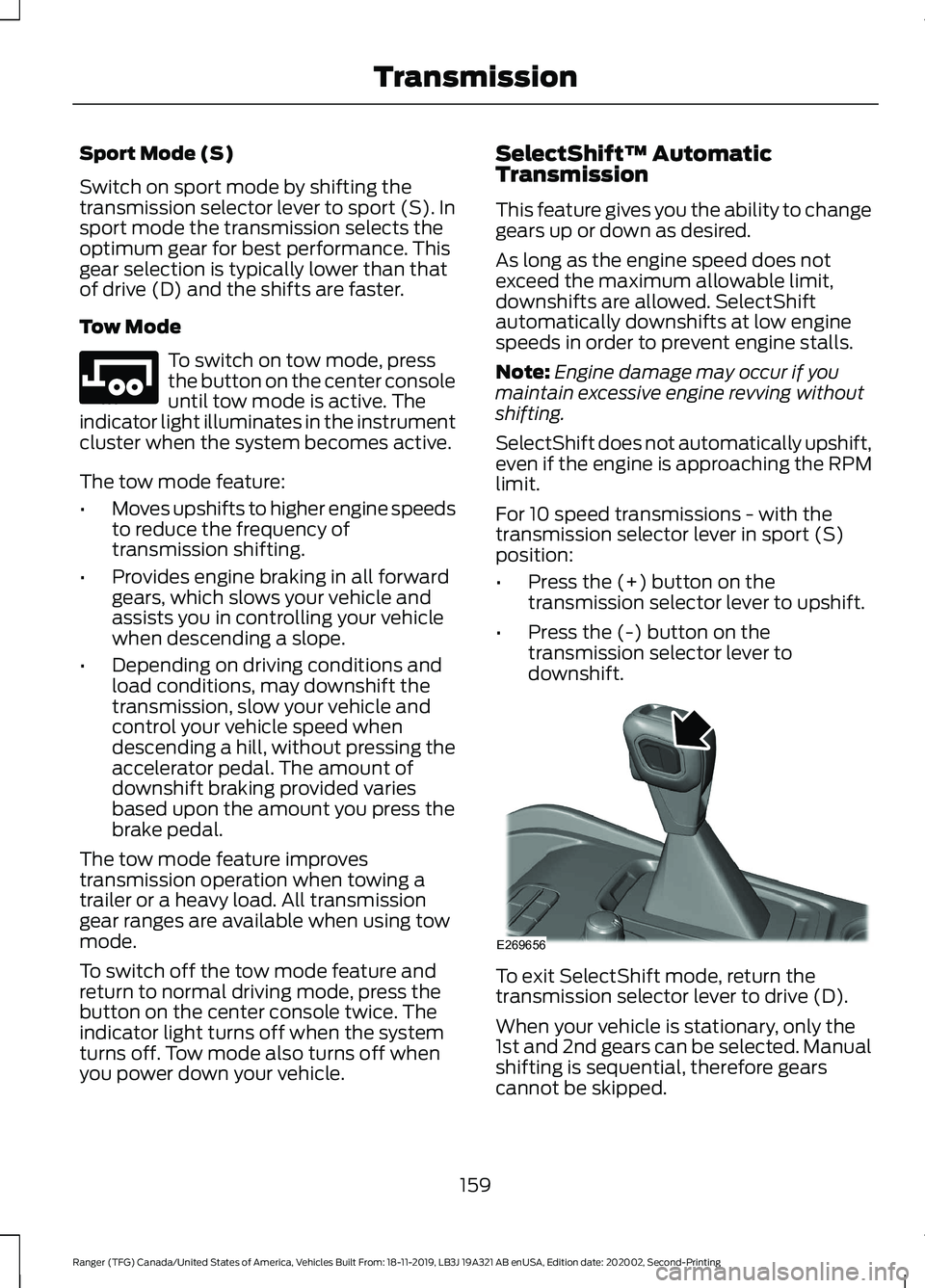
• Press the (+) button on the
transmission selector lever to upshift.
• Press the (-) button on the
transmission selector lever to
downshift. To exit SelectShift mode, return the
transmission selector lever to drive (D).
When your vehicle is stationary, only the
1st and 2nd gears can be selected. Manual
shifting is sequential, therefore gears
cannot be skipped.
159
Ranger (TFG) Canada/United States of America, Vehicles Built From: 18-11-2019, LB3J 19A321 AB enUSA, Edition date: 202002, Second-Printing TransmissionE246592 E269656
Page 163 of 478
Progressive Range Selection
Progressive Range Selection gives you the
ability to lockout gears from the automatic
shifting range. This may provide you with
an improved driving experience for
example, in slippery conditions or when
experiencing a steep slope.
With the transmission in drive (D), press
the – button to active PRS. The available
and selected gears appear on the
instrument cluster.
All available gears display with the current
gear indicated. Press the – button again to
lock out gears beginning with the highest
gear. For example, press the – button or
twice to lock out 10th and 9th gears. Only
the available gears display and the
transmission shifts between the available
gears. Press the + button to unlock gears
to allow the transmission to shift to higher
gears. The transmission shifts within the
gear range you select.
Brake-Shift Interlock
WARNING: When doing this
procedure, you need to take the
transmission out of park (P) which
means your vehicle can roll freely. To
avoid unwanted vehicle movement,
always fully apply the parking brake prior
to doing this procedure. Use wheels
chocks if appropriate. WARNING:
If the parking brake is
fully released, but the brake warning
lamp remains illuminated, the brakes
may not be working properly. Have your
vehicle checked as soon as possible.
Note: For some markets this feature is
disabled. Your vehicle has a brake-shift interlock
feature that prevents moving the gearshift
lever from park (P) when the ignition is on
and you do not press the brake pedal.
The system requires service if you cannot
move the gearshift lever out of park (P)
with the ignition on and the brake pedal
pressed. It is possible that a fuse has blown
or your vehicle
’s brake lamps are not
operating properly. See Fuses (page 246).
If the fuse is not blown and the brake
lamps are properly working, the following
procedure allows you to move the selector
lever from park (P):
Note: See an authorized dealer as soon as
possible if this procedure is used.
10 Speed Transmission
Apply the parking brake and switch the
ignition off before performing this
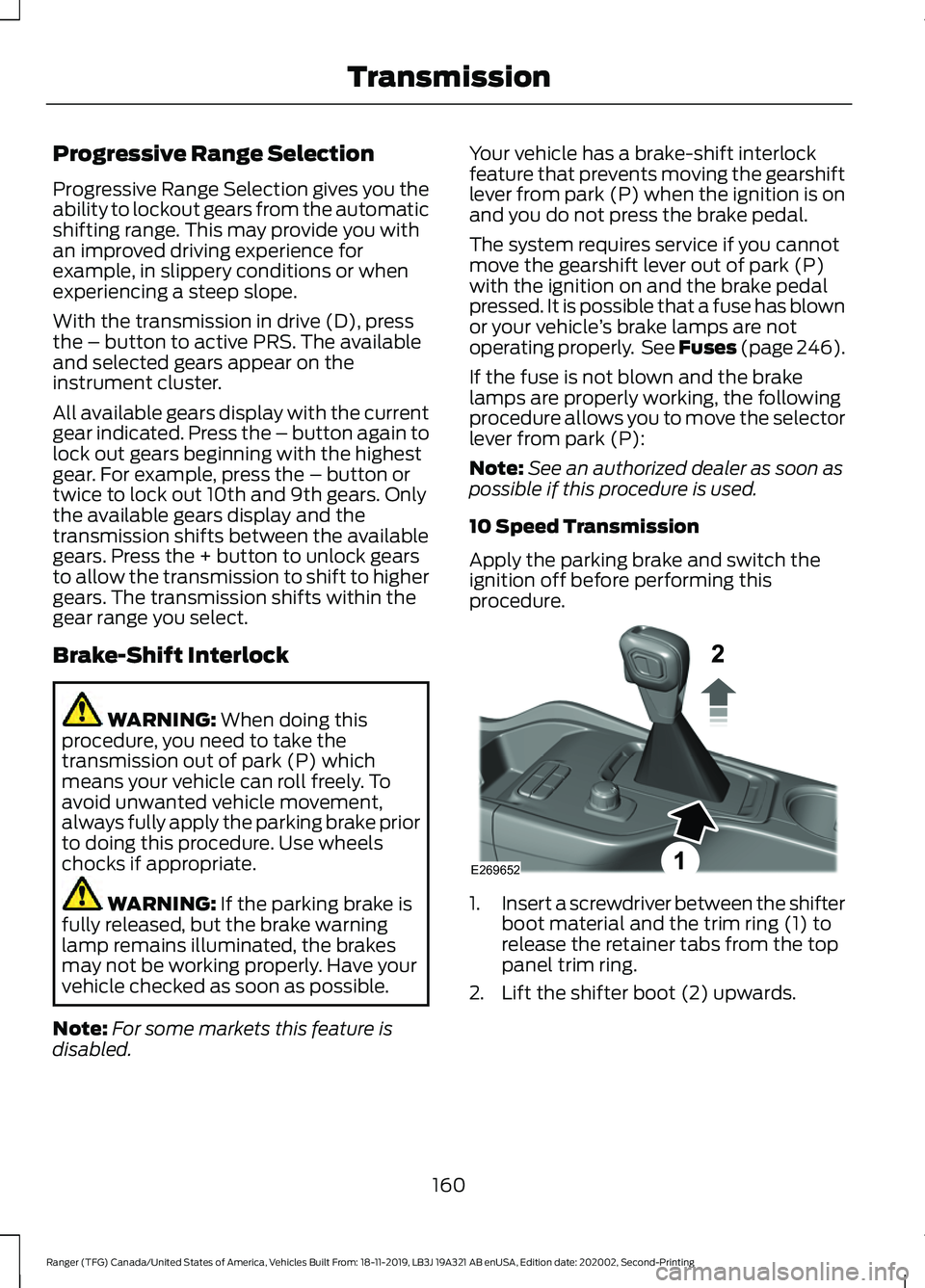
procedure. 1.
Insert a screwdriver between the shifter
boot material and the trim ring (1) to
release the retainer tabs from the top
panel trim ring.
2. Lift the shifter boot (2) upwards.
160
Ranger (TFG) Canada/United States of America, Vehicles Built From: 18-11-2019, LB3J 19A321 AB enUSA, Edition date: 202002, Second-Printing TransmissionE269652