check FORD RANGER 2023 Owners Manual
[x] Cancel search | Manufacturer: FORD, Model Year: 2023, Model line: RANGER, Model: FORD RANGER 2023Pages: 470, PDF Size: 13.06 MB
Page 5 of 470
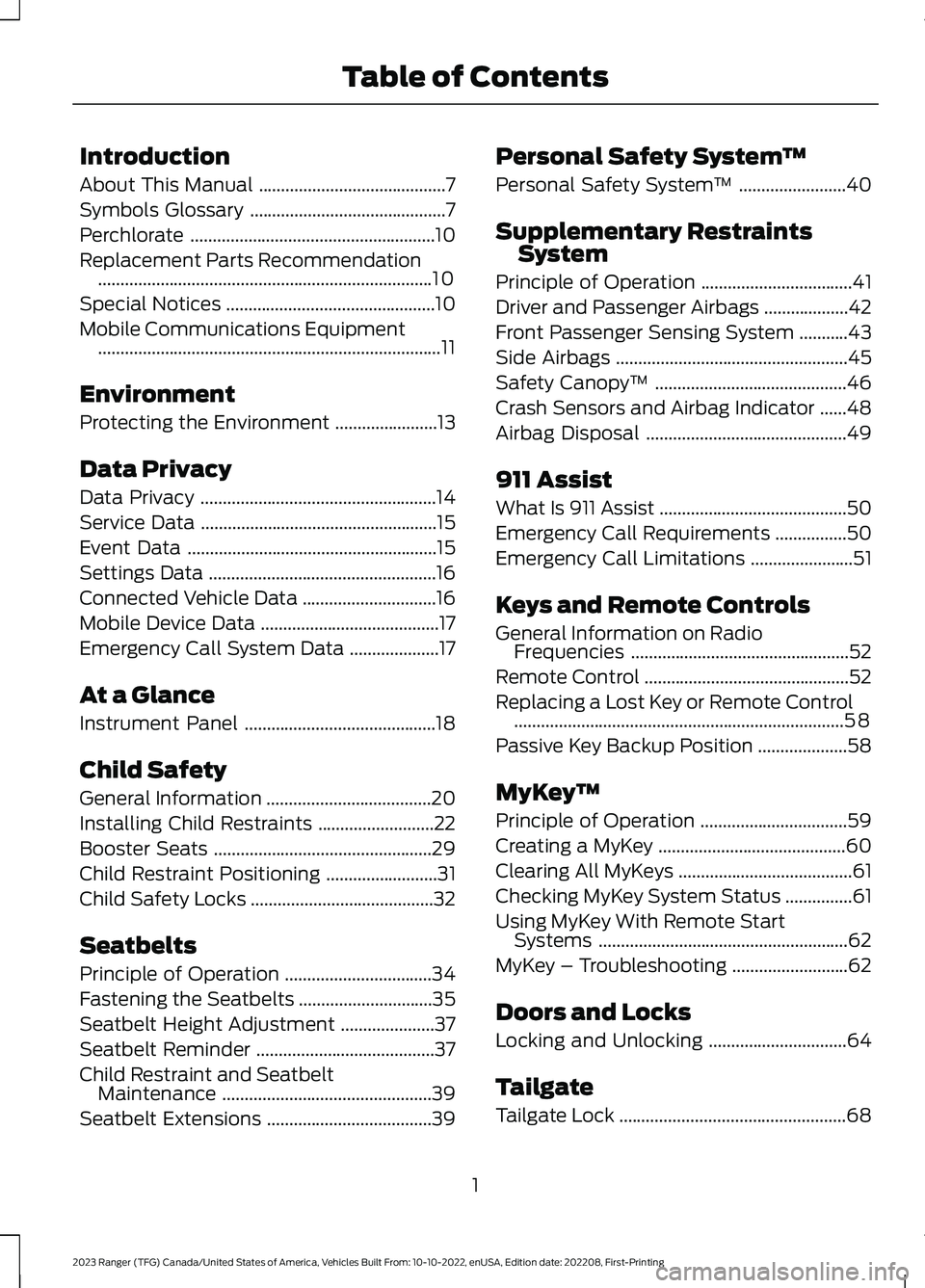
Introduction
About This Manual..........................................7
Symbols Glossary............................................7
Perchlorate.......................................................10
Replacement Parts Recommendation...........................................................................10
Special Notices...............................................10
Mobile Communications Equipment.............................................................................11
Environment
Protecting the Environment.......................13
Data Privacy
Data Privacy.....................................................14
Service Data.....................................................15
Event Data........................................................15
Settings Data...................................................16
Connected Vehicle Data..............................16
Mobile Device Data........................................17
Emergency Call System Data....................17
At a Glance
Instrument Panel...........................................18
Child Safety
General Information.....................................20
Installing Child Restraints..........................22
Booster Seats.................................................29
Child Restraint Positioning.........................31
Child Safety Locks.........................................32
Seatbelts
Principle of Operation.................................34
Fastening the Seatbelts..............................35
Seatbelt Height Adjustment.....................37
Seatbelt Reminder........................................37
Child Restraint and SeatbeltMaintenance...............................................39
Seatbelt Extensions.....................................39
Personal Safety System™
Personal Safety System™........................40
Supplementary RestraintsSystem
Principle of Operation..................................41
Driver and Passenger Airbags...................42
Front Passenger Sensing System...........43
Side Airbags....................................................45
Safety Canopy™...........................................46
Crash Sensors and Airbag Indicator......48
Airbag Disposal.............................................49
911 Assist
What Is 911 Assist..........................................50
Emergency Call Requirements................50
Emergency Call Limitations.......................51
Keys and Remote Controls
General Information on RadioFrequencies.................................................52
Remote Control..............................................52
Replacing a Lost Key or Remote Control..........................................................................58
Passive Key Backup Position....................58
MyKey™
Principle of Operation.................................59
Creating a MyKey..........................................60
Clearing All MyKeys.......................................61
Checking MyKey System Status...............61
Using MyKey With Remote StartSystems........................................................62
MyKey – Troubleshooting..........................62
Doors and Locks
Locking and Unlocking...............................64
Tailgate
Tailgate Lock...................................................68
1
2023 Ranger (TFG) Canada/United States of America, Vehicles Built From: 10-10-2022, enUSA, Edition date: 202208, First-PrintingTable of Contents
Page 8 of 470
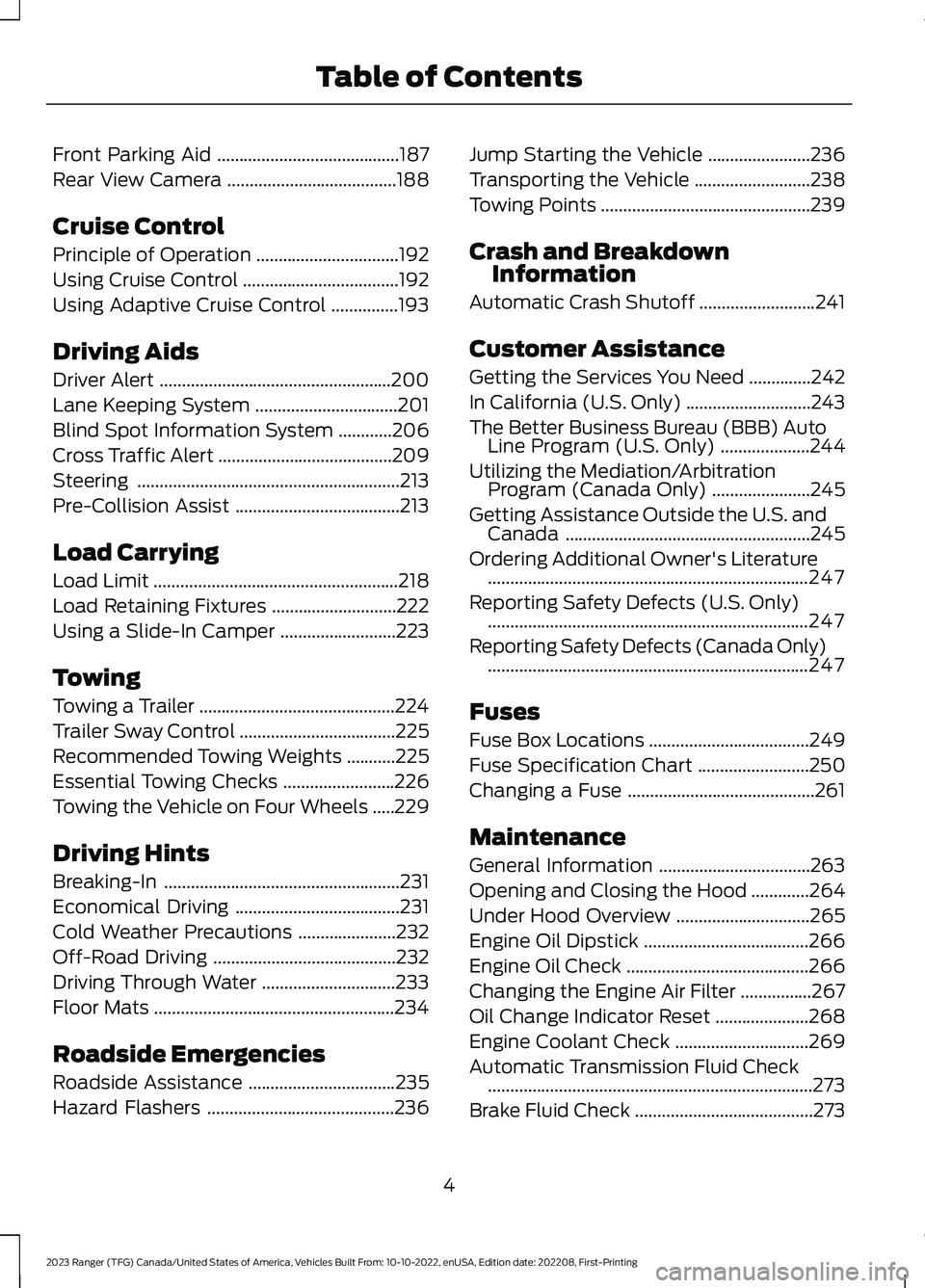
Front Parking Aid.........................................187
Rear View Camera......................................188
Cruise Control
Principle of Operation................................192
Using Cruise Control...................................192
Using Adaptive Cruise Control...............193
Driving Aids
Driver Alert....................................................200
Lane Keeping System................................201
Blind Spot Information System............206
Cross Traffic Alert.......................................209
Steering...........................................................213
Pre-Collision Assist.....................................213
Load Carrying
Load Limit.......................................................218
Load Retaining Fixtures............................222
Using a Slide-In Camper..........................223
Towing
Towing a Trailer............................................224
Trailer Sway Control...................................225
Recommended Towing Weights...........225
Essential Towing Checks.........................226
Towing the Vehicle on Four Wheels.....229
Driving Hints
Breaking-In.....................................................231
Economical Driving.....................................231
Cold Weather Precautions......................232
Off-Road Driving.........................................232
Driving Through Water..............................233
Floor Mats......................................................234
Roadside Emergencies
Roadside Assistance.................................235
Hazard Flashers..........................................236
Jump Starting the Vehicle.......................236
Transporting the Vehicle..........................238
Towing Points...............................................239
Crash and BreakdownInformation
Automatic Crash Shutoff..........................241
Customer Assistance
Getting the Services You Need..............242
In California (U.S. Only)............................243
The Better Business Bureau (BBB) AutoLine Program (U.S. Only)....................244
Utilizing the Mediation/ArbitrationProgram (Canada Only)......................245
Getting Assistance Outside the U.S. andCanada.......................................................245
Ordering Additional Owner's Literature........................................................................247
Reporting Safety Defects (U.S. Only)........................................................................247
Reporting Safety Defects (Canada Only)........................................................................247
Fuses
Fuse Box Locations....................................249
Fuse Specification Chart.........................250
Changing a Fuse..........................................261
Maintenance
General Information..................................263
Opening and Closing the Hood.............264
Under Hood Overview..............................265
Engine Oil Dipstick.....................................266
Engine Oil Check.........................................266
Changing the Engine Air Filter................267
Oil Change Indicator Reset.....................268
Engine Coolant Check..............................269
Automatic Transmission Fluid Check.........................................................................273
Brake Fluid Check........................................273
4
2023 Ranger (TFG) Canada/United States of America, Vehicles Built From: 10-10-2022, enUSA, Edition date: 202208, First-PrintingTable of Contents
Page 9 of 470
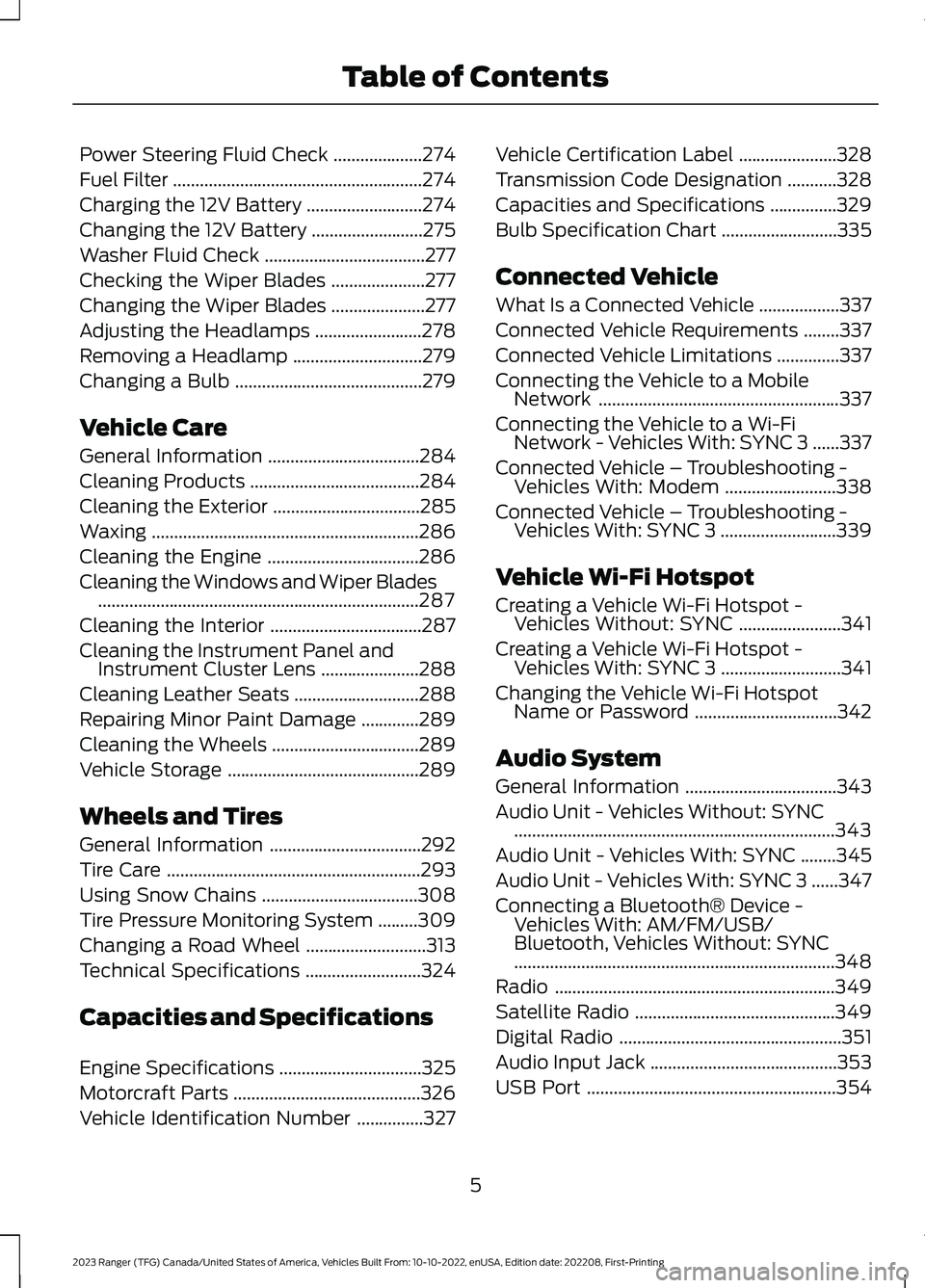
Power Steering Fluid Check....................274
Fuel Filter........................................................274
Charging the 12V Battery..........................274
Changing the 12V Battery.........................275
Washer Fluid Check....................................277
Checking the Wiper Blades.....................277
Changing the Wiper Blades.....................277
Adjusting the Headlamps........................278
Removing a Headlamp.............................279
Changing a Bulb..........................................279
Vehicle Care
General Information..................................284
Cleaning Products......................................284
Cleaning the Exterior.................................285
Waxing............................................................286
Cleaning the Engine..................................286
Cleaning the Windows and Wiper Blades........................................................................287
Cleaning the Interior..................................287
Cleaning the Instrument Panel andInstrument Cluster Lens......................288
Cleaning Leather Seats............................288
Repairing Minor Paint Damage.............289
Cleaning the Wheels.................................289
Vehicle Storage...........................................289
Wheels and Tires
General Information..................................292
Tire Care.........................................................293
Using Snow Chains...................................308
Tire Pressure Monitoring System.........309
Changing a Road Wheel...........................313
Technical Specifications..........................324
Capacities and Specifications
Engine Specifications................................325
Motorcraft Parts..........................................326
Vehicle Identification Number...............327
Vehicle Certification Label......................328
Transmission Code Designation...........328
Capacities and Specifications...............329
Bulb Specification Chart..........................335
Connected Vehicle
What Is a Connected Vehicle..................337
Connected Vehicle Requirements........337
Connected Vehicle Limitations..............337
Connecting the Vehicle to a MobileNetwork......................................................337
Connecting the Vehicle to a Wi-FiNetwork - Vehicles With: SYNC 3......337
Connected Vehicle – Troubleshooting -Vehicles With: Modem.........................338
Connected Vehicle – Troubleshooting -Vehicles With: SYNC 3..........................339
Vehicle Wi-Fi Hotspot
Creating a Vehicle Wi-Fi Hotspot -Vehicles Without: SYNC.......................341
Creating a Vehicle Wi-Fi Hotspot -Vehicles With: SYNC 3...........................341
Changing the Vehicle Wi-Fi HotspotName or Password................................342
Audio System
General Information..................................343
Audio Unit - Vehicles Without: SYNC........................................................................343
Audio Unit - Vehicles With: SYNC........345
Audio Unit - Vehicles With: SYNC 3......347
Connecting a Bluetooth® Device -Vehicles With: AM/FM/USB/Bluetooth, Vehicles Without: SYNC........................................................................348
Radio...............................................................349
Satellite Radio.............................................349
Digital Radio..................................................351
Audio Input Jack..........................................353
USB Port........................................................354
5
2023 Ranger (TFG) Canada/United States of America, Vehicles Built From: 10-10-2022, enUSA, Edition date: 202208, First-PrintingTable of Contents
Page 12 of 470

Brake fluid - non petroleumbased
Brake system
Brake system
Cabin air filter
Check fuel cap
Child safety door lock or unlock
Child seat lower anchor
Child seat tether anchor
Cruise control
Do not open when hot
Electric Parking brake
Engine air filter
Engine coolant
Engine coolant temperature
Engine oil
Explosive gas
Fan warning
Fasten seatbelt
Flammable
Front fog lamps
Fuel pump reset
Fuse compartment
Hazard flashers
Headlamp high beams
Headlamps on
Heated rear window
Hill descent control
Horn control
Interior luggage compartmentrelease
Jack
8
2023 Ranger (TFG) Canada/United States of America, Vehicles Built From: 10-10-2022, enUSA, Edition date: 202208, First-PrintingIntroductionE139209 E67024 E270480 E139223 E139211 E141128 E332905 E139219 E139212 E103308 E67022 E139221 E139228 E71880 E231160 E139214 E75790 E67019 E270968 E163171 E270945 E139231
Page 24 of 470
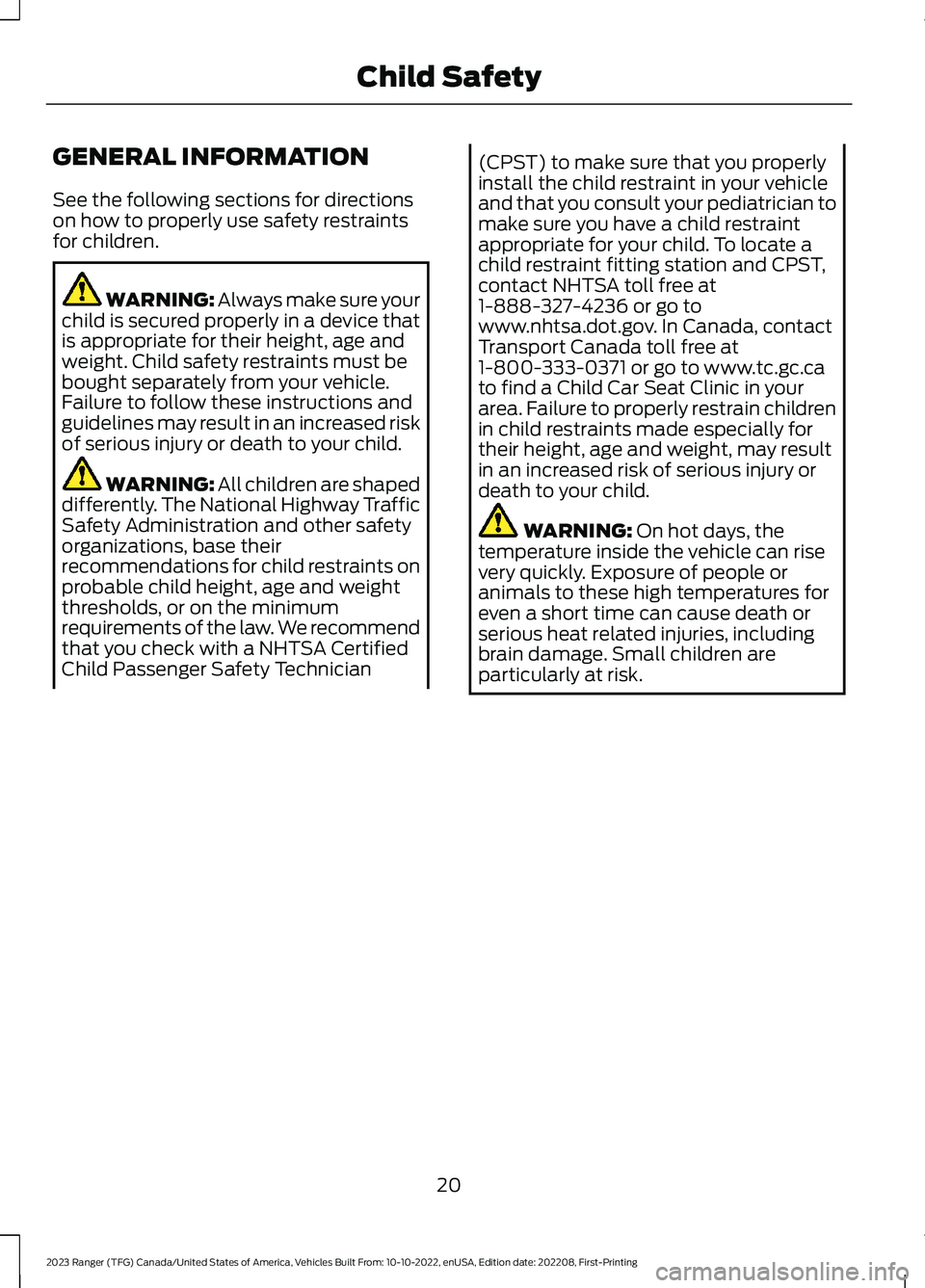
GENERAL INFORMATION
See the following sections for directionson how to properly use safety restraintsfor children.
WARNING: Always make sure yourchild is secured properly in a device thatis appropriate for their height, age andweight. Child safety restraints must bebought separately from your vehicle.Failure to follow these instructions andguidelines may result in an increased riskof serious injury or death to your child.
WARNING: All children are shapeddifferently. The National Highway TrafficSafety Administration and other safetyorganizations, base theirrecommendations for child restraints onprobable child height, age and weightthresholds, or on the minimumrequirements of the law. We recommendthat you check with a NHTSA CertifiedChild Passenger Safety Technician
(CPST) to make sure that you properlyinstall the child restraint in your vehicleand that you consult your pediatrician tomake sure you have a child restraintappropriate for your child. To locate achild restraint fitting station and CPST,contact NHTSA toll free at1-888-327-4236 or go towww.nhtsa.dot.gov. In Canada, contactTransport Canada toll free at1-800-333-0371 or go to www.tc.gc.cato find a Child Car Seat Clinic in yourarea. Failure to properly restrain childrenin child restraints made especially fortheir height, age and weight, may resultin an increased risk of serious injury ordeath to your child.
WARNING: On hot days, thetemperature inside the vehicle can risevery quickly. Exposure of people oranimals to these high temperatures foreven a short time can cause death orserious heat related injuries, includingbrain damage. Small children areparticularly at risk.
20
2023 Ranger (TFG) Canada/United States of America, Vehicles Built From: 10-10-2022, enUSA, Edition date: 202208, First-PrintingChild Safety
Page 25 of 470
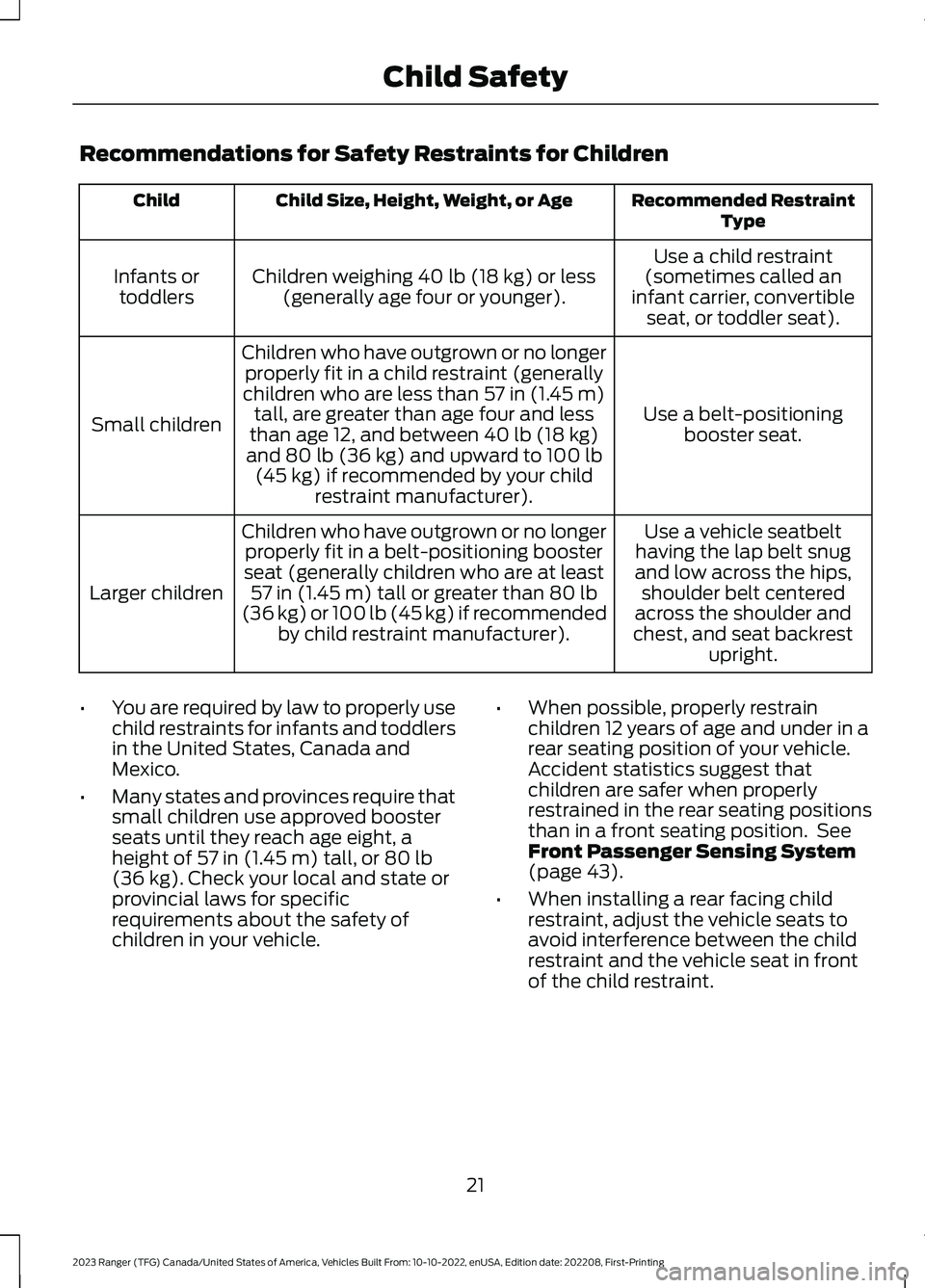
Recommendations for Safety Restraints for Children
Recommended RestraintTypeChild Size, Height, Weight, or AgeChild
Use a child restraint(sometimes called aninfant carrier, convertibleseat, or toddler seat).
Children weighing 40 lb (18 kg) or less(generally age four or younger).Infants ortoddlers
Use a belt-positioningbooster seat.
Children who have outgrown or no longerproperly fit in a child restraint (generallychildren who are less than 57 in (1.45 m)tall, are greater than age four and lessthan age 12, and between 40 lb (18 kg)and 80 lb (36 kg) and upward to 100 lb(45 kg) if recommended by your childrestraint manufacturer).
Small children
Use a vehicle seatbelthaving the lap belt snugand low across the hips,shoulder belt centeredacross the shoulder andchest, and seat backrestupright.
Children who have outgrown or no longerproperly fit in a belt-positioning boosterseat (generally children who are at least57 in (1.45 m) tall or greater than 80 lb(36 kg) or 100 lb (45 kg) if recommendedby child restraint manufacturer).
Larger children
•You are required by law to properly usechild restraints for infants and toddlersin the United States, Canada andMexico.
•Many states and provinces require thatsmall children use approved boosterseats until they reach age eight, aheight of 57 in (1.45 m) tall, or 80 lb(36 kg). Check your local and state orprovincial laws for specificrequirements about the safety ofchildren in your vehicle.
•When possible, properly restrainchildren 12 years of age and under in arear seating position of your vehicle.Accident statistics suggest thatchildren are safer when properlyrestrained in the rear seating positionsthan in a front seating position. SeeFront Passenger Sensing System(page 43).
•When installing a rear facing childrestraint, adjust the vehicle seats toavoid interference between the childrestraint and the vehicle seat in frontof the child restraint.
21
2023 Ranger (TFG) Canada/United States of America, Vehicles Built From: 10-10-2022, enUSA, Edition date: 202208, First-PrintingChild Safety
Page 28 of 470
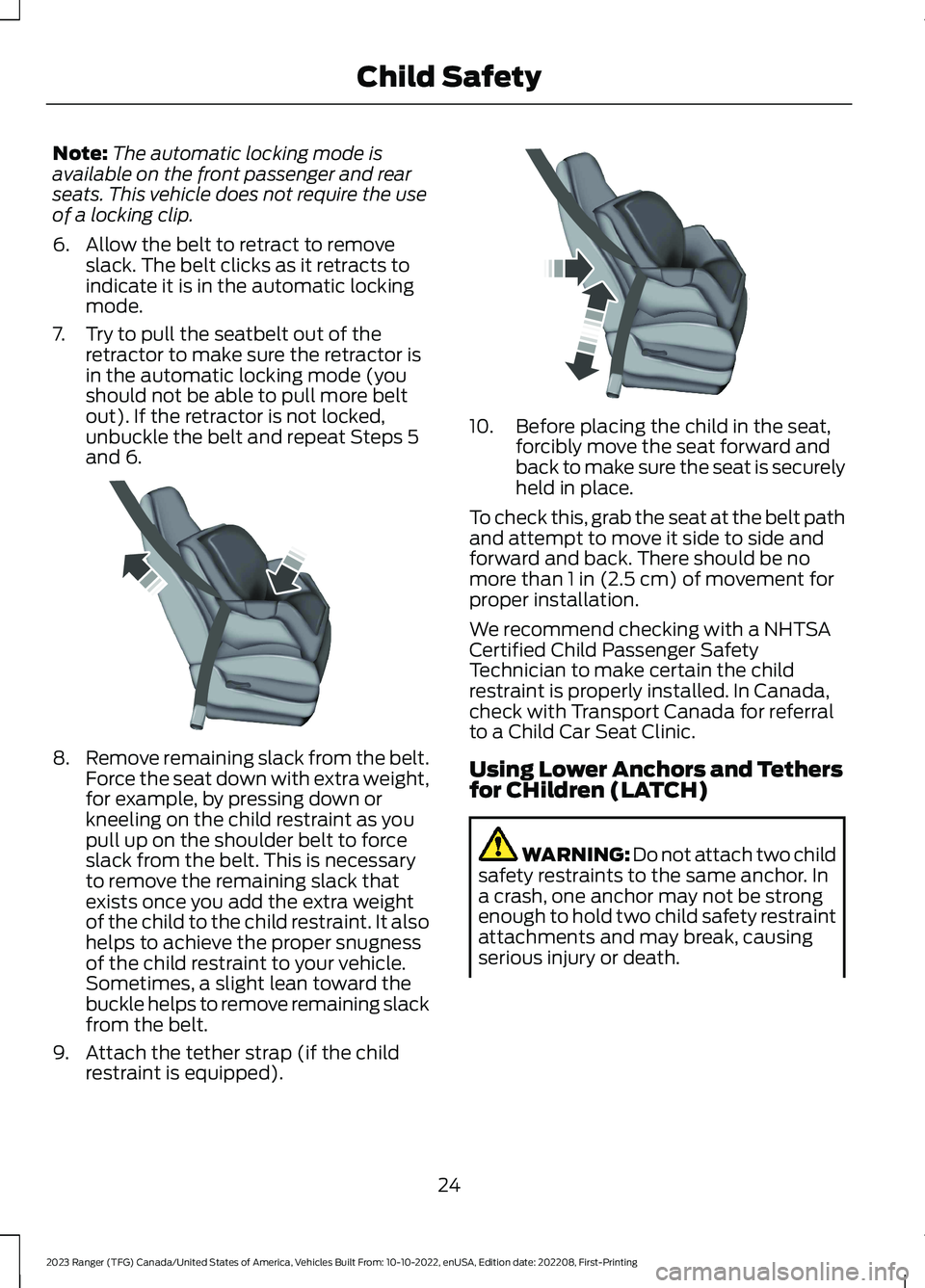
Note:The automatic locking mode isavailable on the front passenger and rearseats. This vehicle does not require the useof a locking clip.
6.Allow the belt to retract to removeslack. The belt clicks as it retracts toindicate it is in the automatic lockingmode.
7.Try to pull the seatbelt out of theretractor to make sure the retractor isin the automatic locking mode (youshould not be able to pull more beltout). If the retractor is not locked,unbuckle the belt and repeat Steps 5and 6.
8.Remove remaining slack from the belt.Force the seat down with extra weight,for example, by pressing down orkneeling on the child restraint as youpull up on the shoulder belt to forceslack from the belt. This is necessaryto remove the remaining slack thatexists once you add the extra weightof the child to the child restraint. It alsohelps to achieve the proper snugnessof the child restraint to your vehicle.Sometimes, a slight lean toward thebuckle helps to remove remaining slackfrom the belt.
9.Attach the tether strap (if the childrestraint is equipped).
10.Before placing the child in the seat,forcibly move the seat forward andback to make sure the seat is securelyheld in place.
To check this, grab the seat at the belt pathand attempt to move it side to side andforward and back. There should be nomore than 1 in (2.5 cm) of movement forproper installation.
We recommend checking with a NHTSACertified Child Passenger SafetyTechnician to make certain the childrestraint is properly installed. In Canada,check with Transport Canada for referralto a Child Car Seat Clinic.
Using Lower Anchors and Tethersfor CHildren (LATCH)
WARNING: Do not attach two childsafety restraints to the same anchor. Ina crash, one anchor may not be strongenough to hold two child safety restraintattachments and may break, causingserious injury or death.
24
2023 Ranger (TFG) Canada/United States of America, Vehicles Built From: 10-10-2022, enUSA, Edition date: 202208, First-PrintingChild SafetyE142533 E142534
Page 30 of 470
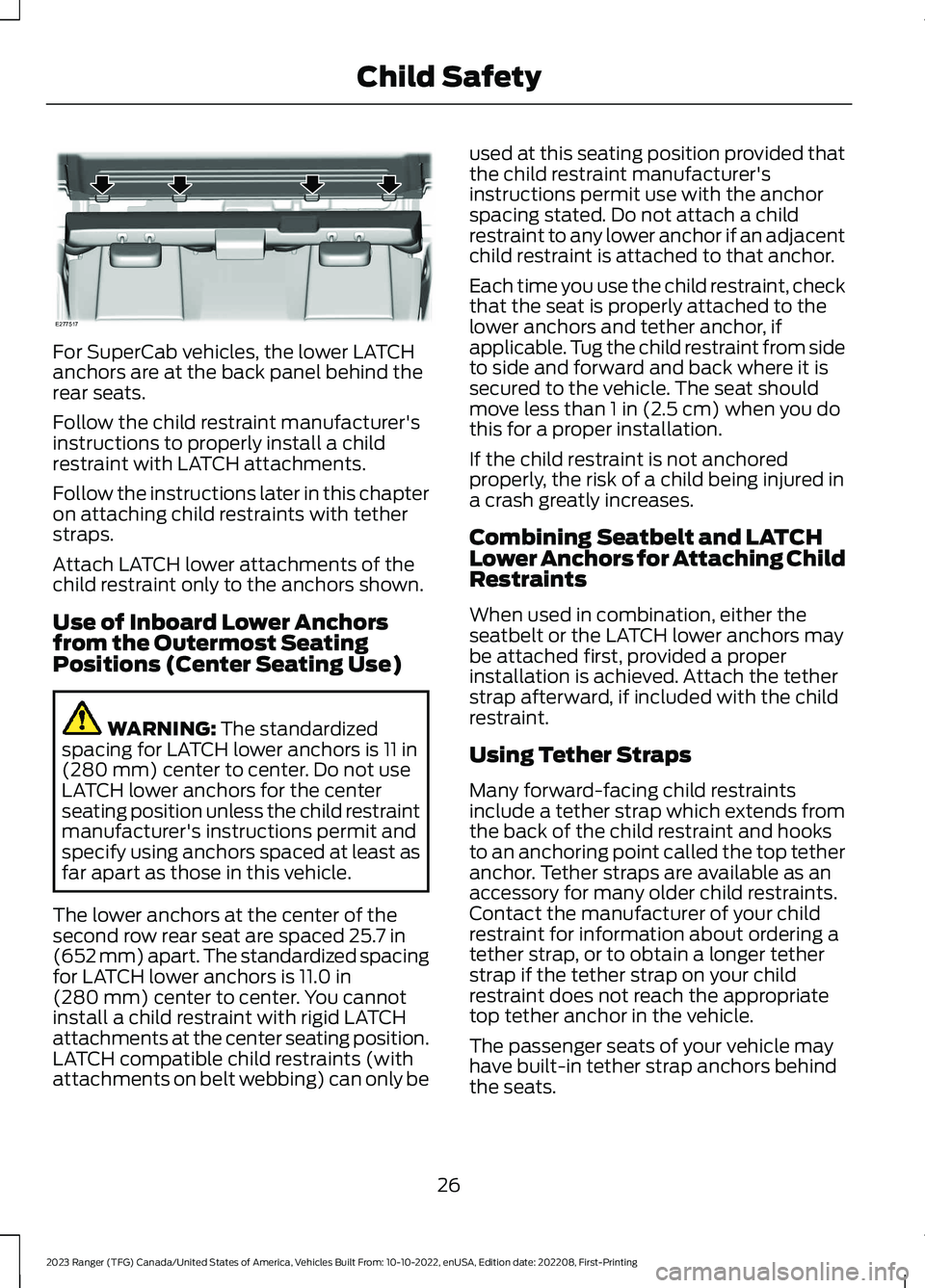
For SuperCab vehicles, the lower LATCHanchors are at the back panel behind therear seats.
Follow the child restraint manufacturer'sinstructions to properly install a childrestraint with LATCH attachments.
Follow the instructions later in this chapteron attaching child restraints with tetherstraps.
Attach LATCH lower attachments of thechild restraint only to the anchors shown.
Use of Inboard Lower Anchorsfrom the Outermost SeatingPositions (Center Seating Use)
WARNING: The standardizedspacing for LATCH lower anchors is 11 in(280 mm) center to center. Do not useLATCH lower anchors for the centerseating position unless the child restraintmanufacturer's instructions permit andspecify using anchors spaced at least asfar apart as those in this vehicle.
The lower anchors at the center of thesecond row rear seat are spaced 25.7 in(652 mm) apart. The standardized spacingfor LATCH lower anchors is 11.0 in(280 mm) center to center. You cannotinstall a child restraint with rigid LATCHattachments at the center seating position.LATCH compatible child restraints (withattachments on belt webbing) can only be
used at this seating position provided thatthe child restraint manufacturer'sinstructions permit use with the anchorspacing stated. Do not attach a childrestraint to any lower anchor if an adjacentchild restraint is attached to that anchor.
Each time you use the child restraint, checkthat the seat is properly attached to thelower anchors and tether anchor, ifapplicable. Tug the child restraint from sideto side and forward and back where it issecured to the vehicle. The seat shouldmove less than 1 in (2.5 cm) when you dothis for a proper installation.
If the child restraint is not anchoredproperly, the risk of a child being injured ina crash greatly increases.
Combining Seatbelt and LATCHLower Anchors for Attaching ChildRestraints
When used in combination, either theseatbelt or the LATCH lower anchors maybe attached first, provided a properinstallation is achieved. Attach the tetherstrap afterward, if included with the childrestraint.
Using Tether Straps
Many forward-facing child restraintsinclude a tether strap which extends fromthe back of the child restraint and hooksto an anchoring point called the top tetheranchor. Tether straps are available as anaccessory for many older child restraints.Contact the manufacturer of your childrestraint for information about ordering atether strap, or to obtain a longer tetherstrap if the tether strap on your childrestraint does not reach the appropriatetop tether anchor in the vehicle.
The passenger seats of your vehicle mayhave built-in tether strap anchors behindthe seats.
26
2023 Ranger (TFG) Canada/United States of America, Vehicles Built From: 10-10-2022, enUSA, Edition date: 202208, First-PrintingChild SafetyE277517
Page 35 of 470
If the booster seat slides on the vehicleseat upon which it is being used, placing arubberized mesh sold as shelf or carpetliner under the booster seat may improvethis condition. Do not introduce any itemthicker than this under the booster seat.Check with the booster seatmanufacturer's instructions.
CHILD RESTRAINT
POSITIONING
WARNING: Do not place arearward facing child restraint in front ofan active airbag. Failure to follow thisinstruction could result in personal injuryor death.
WARNING: Properly securechildren 12 years old and under in a rearseating position whenever possible. Ifyou are unable to properly secure allchildren in a rear seating position,properly secure the largest child on thefront seat. If you must use a forwardfacing child restraint on the front seat,move the seat as far back as possible.Failure to follow these instructions couldresult in personal injury or death.
WARNING: Always carefully followthe instructions and warnings providedby the manufacturer of any childrestraint to determine if the restraintdevice is appropriate for your child's size,height, weight, or age. Follow the childrestraint manufacturer's instructions andwarnings provided for installation anduse in conjunction with the instructions
and warnings provided by your vehiclemanufacturer. A safety seat that isimproperly installed or utilized, isinappropriate for your child's height, age,or weight or does not properly fit thechild may increase the risk of seriousinjury or death.
WARNING: Do not allow apassenger to hold a child on their lapwhen your vehicle is moving. Failure tofollow this instruction could result inpersonal injury or death in the event of asudden stop or crash.
WARNING: Do not use pillows,books or towels to boost your child'sheight. Failure to follow this instructioncould result in personal injury or death.
WARNING: Properly secure childrestraints or booster seats when they arenot in use. They could become projectilesin a sudden stop or crash. Failure tofollow this instruction could result inpersonal injury or death.
WARNING: Do not put the shouldersection of the seatbelt or allow the childto put the shoulder section of theseatbelt under their arm or behind theirback. Failure to follow this instructioncould reduce the effectiveness of theseatbelt and increase the risk of injury ordeath in a crash.
WARNING: Do not leave childrenor pets unattended in your vehicle.Failure to follow this instruction couldresult in personal injury or death.
31
2023 Ranger (TFG) Canada/United States of America, Vehicles Built From: 10-10-2022, enUSA, Edition date: 202208, First-PrintingChild Safety
Page 38 of 470
PRINCIPLE OF OPERATION
WARNING: Always drive and ridewith your seatback upright and the lapbelt snug and low across the hips.
WARNING: Children must alwaysbe properly restrained.
WARNING: Do not allow apassenger to hold a child on their lapwhen your vehicle is moving. Failure tofollow this instruction could result inpersonal injury or death in the event of asudden stop or crash.
WARNING: All occupants of yourvehicle, including the driver, shouldalways properly wear their seatbelts,even when an airbag supplementalrestraint system is provided. Failure toproperly wear your seatbelt couldseriously increase the risk of injury ordeath.
WARNING: It is extremelydangerous to ride in a cargo area, insideor outside of a vehicle. In a crash, peopleriding in these areas are more likely to beseriously injured or killed. Do not allowpeople to ride in any area of your vehiclethat is not equipped with seats andseatbelts. Make sure everyone in yourvehicle is in a seat and properly using aseatbelt. Failure to follow this warningcould result in serious personal injury ordeath.
WARNING: In a rollover crash, anunbelted person is significantly morelikely to die than a person wearing aseatbelt.
WARNING: Each seating positionin your vehicle has a specific seatbeltassembly made up of one buckle andone tongue designed to be used as a pair.Use the shoulder belt on the outsideshoulder only. Never wear the shoulderbelt under the arm. Never use a singleseatbelt for more than one person.
WARNING: Properly securechildren 12 years old and under in a rearseating position whenever possible. Ifyou are unable to properly secure allchildren in a rear seating position,properly secure the largest child on thefront seat. If you must use a forwardfacing child restraint on the front seat,move the seat as far back as possible.Failure to follow these instructions couldresult in personal injury or death.
WARNING: Seatbelts and seatsmay be hot in a vehicle that is in thesunshine. The hot seatbelts or seats mayburn a small child. Check seat covers andbuckles before you place a childanywhere near them.
All seating positions in this vehicle havelap and shoulder seatbelts. All occupantsof the vehicle should always properly weartheir seatbelts, even when an airbagsupplemental restraint system is provided.
The seatbelt system consists of:
•Lap and shoulder seatbelts.
•Shoulder seatbelt with automaticlocking mode - except driver seatbelt.
•Height adjuster at the front outermostseating positions - if equipped.
•Seatbelt pretensioner at the frontoutermost and rear outermost seatingpositions.
34
2023 Ranger (TFG) Canada/United States of America, Vehicles Built From: 10-10-2022, enUSA, Edition date: 202208, First-PrintingSeatbelts