belt FORD SUPER DUTY 2003 1.G Owner's Guide
[x] Cancel search | Manufacturer: FORD, Model Year: 2003, Model line: SUPER DUTY, Model: FORD SUPER DUTY 2003 1.GPages: 256, PDF Size: 2.3 MB
Page 101 of 256
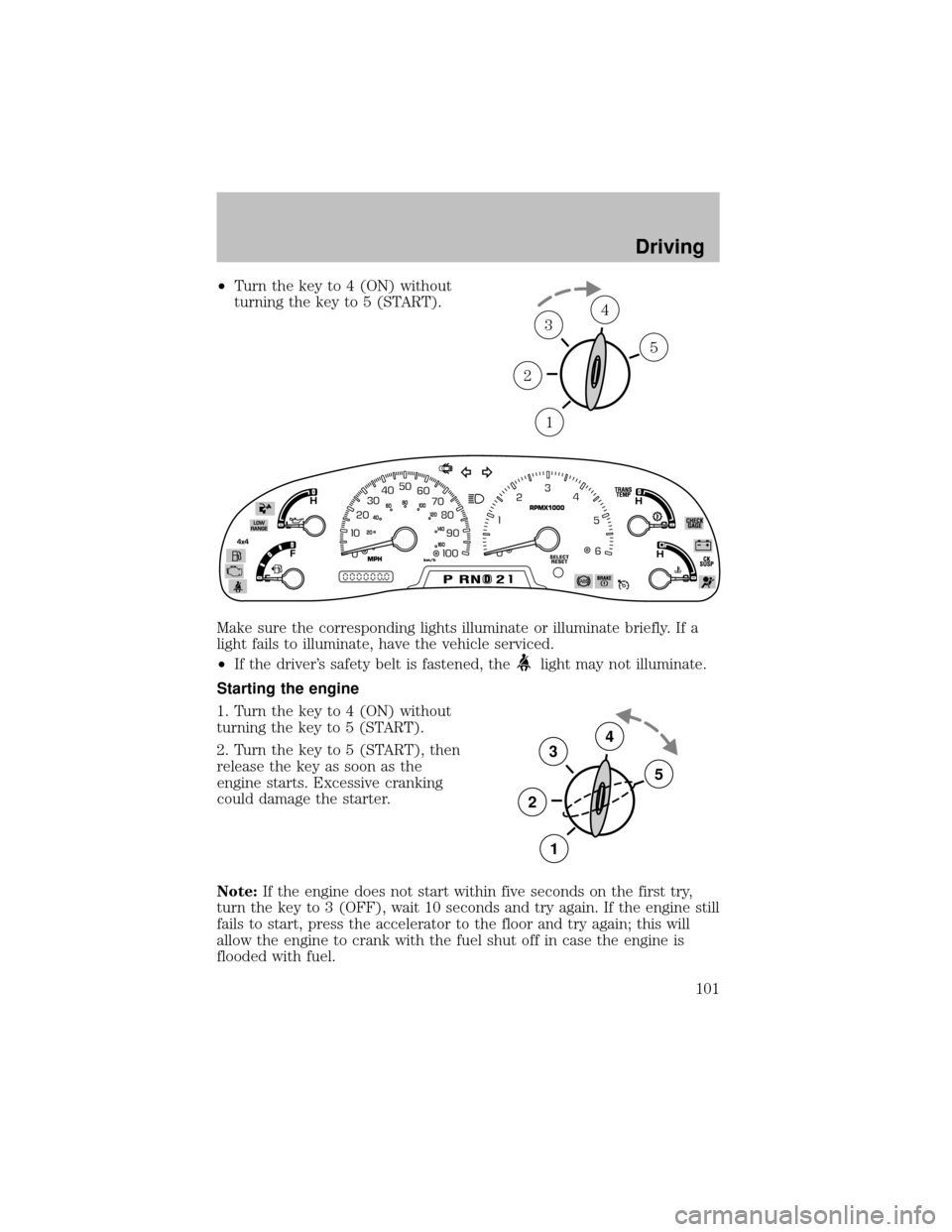
•Turn the keyto 4 (ON) without
turning the keyto 5 (START).
Make sure the corresponding lights illuminate or illuminate briefly. If a
light fails to illuminate, have the vehicle serviced.
•If the driver’s safetybelt is fastened, the
light maynot illuminate.
Starting the engine
1. Turn the keyto 4 (ON) without
turning the keyto 5 (START).
2. Turn the keyto 5 (START), then
release the keyas soon as the
engine starts. Excessive cranking
could damage the starter.
Note:If the engine does not start within five seconds on the first try,
turn the keyto 3 (OFF), wait 10 seconds and tryagain. If the engine still
fails to start, press the accelerator to the floor and tryagain; this will
allow the engine to crank with the fuel shut off in case the engine is
flooded with fuel.
1
2
34
5
3
2
1
5
4
Driving
101
Page 105 of 256
hold the brake pedal down, release the parking brake, then trypushing
the parking brake pedal further down. Chock the wheels if required. If
the parking brake cannot hold the weight of the vehicle, the parking
brake mayneed to be serviced.
STEERING
To prevent damage to the power steering system:
•Never hold the steering wheel at its furthest turning points (until it
stops) for more than a few seconds when the engine is running.
•Do not operate the vehicle with a low power steering pump fluid level
(below the MIN mark on the reservoir).
If the power steering system breaks down (or if the engine is turned
off), you can steer the vehicle manually, but it takes more effort.
If the steering wanders or pulls, check for:
•an underinflated tire
•uneven tire wear
•loose or worn suspension components
•loose or worn steering components
•improper steering alignment
TRACTION-LOK AXLE (IF EQUIPPED)
This axle provides added traction on slipperysurfaces, particularlywhen
one wheel is on a poor traction surface. Under normal conditions, the
Traction-Lok axle functions like a standard rear axle.
To reduce the risk of injury, never run the engine with one wheel
off the ground, such as when changing a tire.
PREPARING TO DRIVE YOUR VEHICLE
Utilityvehicles have a significantlyhigher rollover rate than
other types of vehicles.
In a rollover crash, an unbelted person is significantlymore likely
to die than a person wearing a safetybelt.
Your vehicle has larger tires and increased ground clearance, giving the
vehicle a higher center of gravitythan a passenger car.
Driving
105
Page 150 of 256
•Tires have their maximum inflation pressure and associated load rating
imprinted on the tire sidewall. This pressure mayor maynot be the
same as that shown as recommended on the vehicle. The vehicle
operator mayhave to adjust the tire inflation pressure to
accommodate the snowplow and payload. Consult your dealer or
equipment installer for help with proper inflation pressures.
•Federal and some local regulations require additional exterior lamps
for snowplow-equipped vehicles. Consult your dealer for additional
information.
•After installing a snowplow to the vehicle, ensure the vehicle’s front
toe alignment and front ride height are within specification (reset if
required). These specifications are located in the vehicle’s Workshop
Manual.
Note:Do not exceed the GVWR or the GAWR specified on the
certification label.
Removing snowplow
After removing a snowplow from the vehicle, ensure the vehicle’s front toe
alignment and front ride height are within specification (reset if required).
Snowplowing with your air bag-equipped vehicle
Your vehicle is equipped with a driver and passenger air bag
Supplemental Restraint System (SRS) The SRS is designed to activate in
certain frontal and offset frontal collisions when the vehicle sustains
sufficient longitudinal deceleration.
Careless or high speed driving while plowing snow which results in
sufficient vehicle decelerations can deploythe air bag. Such driving also
increases the risk of accidents.
All occupants of the vehicle, including the driver, should always
properlywear their safetybelts, even when an air bag (SRS) is
provided.
Never remove or defeat the “tripping mechanisms” designed into the
snow removal equipment byits manufacturer. Doing so maycause
damage to the vehicle and the snow removal equipment as well as
possible air bag deployment.
Do not attempt to service, repair, or modifythe Air Bag
Supplemental Restraint System or its fuses. See your Ford or
Lincoln Mercurydealer.
Driving
150
Page 170 of 256
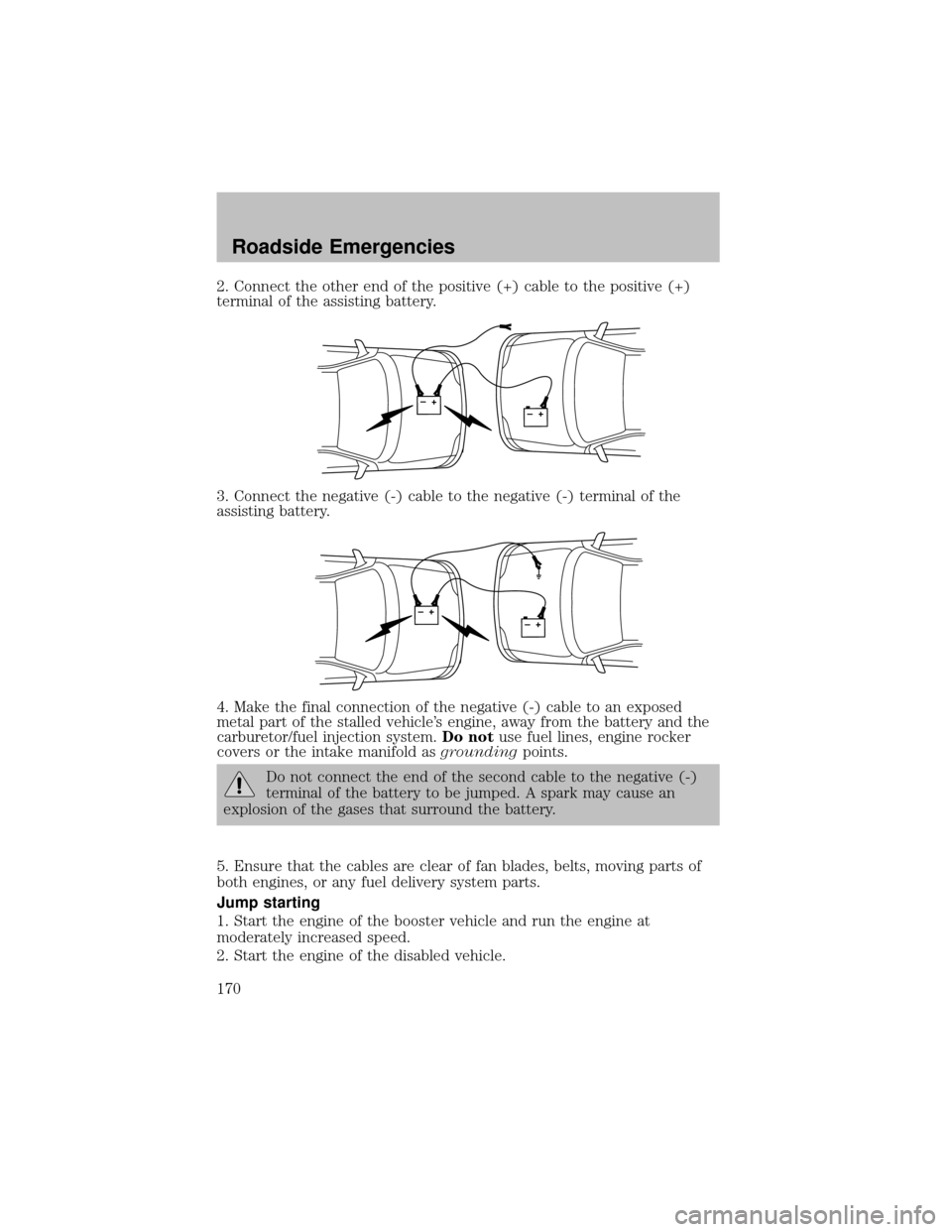
2. Connect the other end of the positive (+) cable to the positive (+)
terminal of the assisting battery.
3. Connect the negative (-) cable to the negative (-) terminal of the
assisting battery.
4. Make the final connection of the negative (-) cable to an exposed
metal part of the stalled vehicle’s engine, awayfrom the batteryand the
carburetor/fuel injection system.Do notuse fuel lines, engine rocker
covers or the intake manifold asgroundingpoints.
Do not connect the end of the second cable to the negative (-)
terminal of the batteryto be jumped. A spark maycause an
explosion of the gases that surround the battery.
5. Ensure that the cables are clear of fan blades, belts, moving parts of
both engines, or anyfuel deliverysystem parts.
Jump starting
1. Start the engine of the booster vehicle and run the engine at
moderatelyincreased speed.
2. Start the engine of the disabled vehicle.
+–+–
+–+–
Roadside Emergencies
170
Page 173 of 256
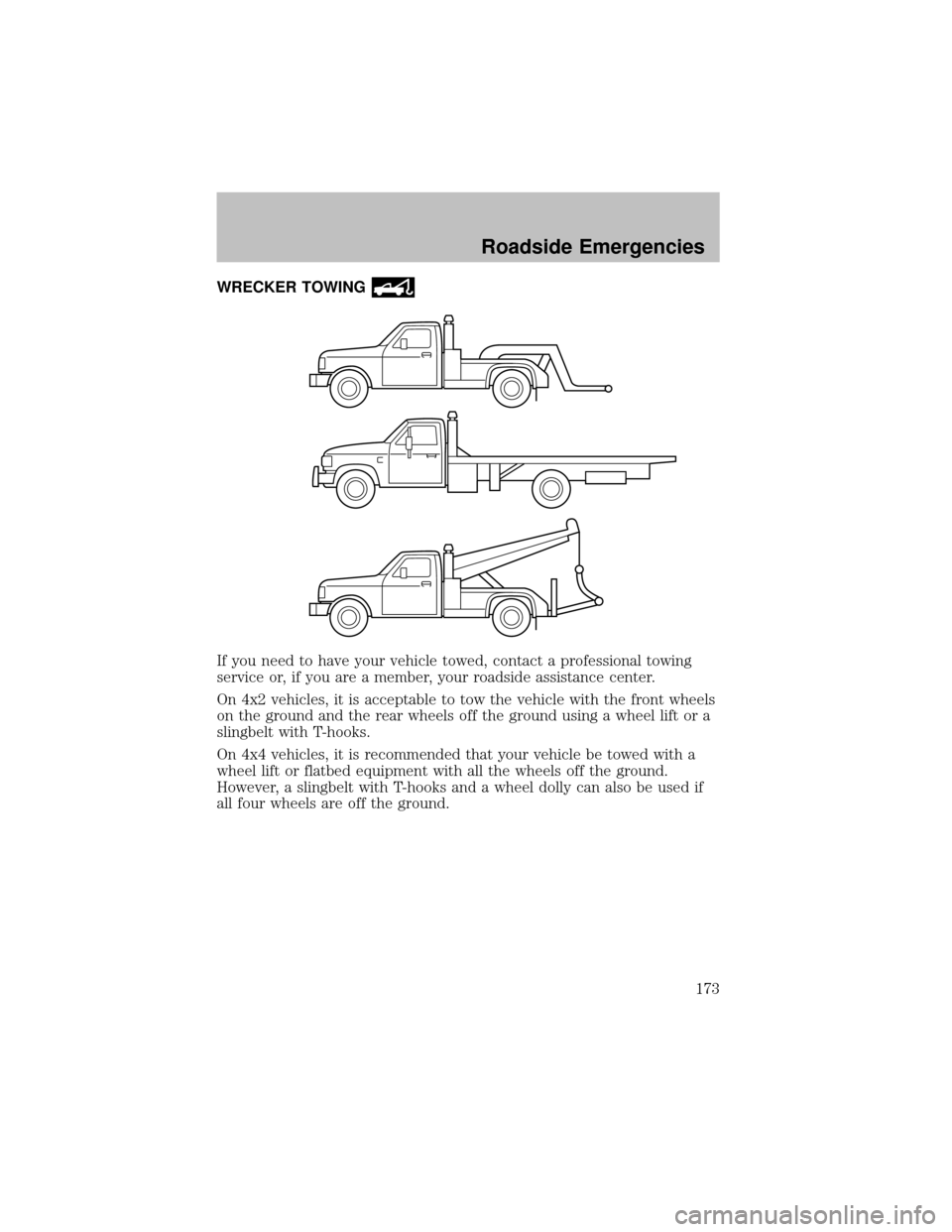
WRECKER TOWING
If you need to have your vehicle towed, contact a professional towing
service or, if you are a member, your roadside assistance center.
On 4x2 vehicles, it is acceptable to tow the vehicle with the front wheels
on the ground and the rear wheels off the ground using a wheel lift or a
slingbelt with T-hooks.
On 4x4 vehicles, it is recommended that your vehicle be towed with a
wheel lift or flatbed equipment with all the wheels off the ground.
However, a slingbelt with T-hooks and a wheel dollycan also be used if
all four wheels are off the ground.
Roadside Emergencies
173
Page 174 of 256

An alternative for towing a 4x4 vehicle is to:
•put the transfer case in neutral. On manual 4WD systems, put the
4WD shift lever in N (Neutral); on electronic shift on the fly4WD
systems, press the 2WD portion of the 4WD control.
•unlock the front hub locks (refer toFour wheel drive [4WD]
Operation [if equipped]in theDrivingchapter).
•lift the rear wheels of the vehicle using a wheel lift or a sling belt with
T-hooks.
If the vehicle is towed by other means or incorrectly, vehicle
damage may occur.
Ford Motor Companyproduces a towing manual for all authorized tow
truck operators. Have your tow truck operator refer to this manual for
proper hook-up and towing procedures for your vehicle.
Roadside Emergencies
174
Page 187 of 256
INSTRUMENT PANEL AND CLUSTER LENS
Clean the instrument panel with a damp cloth, then drywith a drycloth.
•Avoid cleaners or polish that increase the gloss of the upper portion of
the instrument panel. The dull finish in this area helps protect the
driver from undesirable windshield reflection.
Do not use chemical solvents or strong detergents when cleaning
the steering wheel or instrument panel to avoid contamination of
the air bag system.
•Be certain to wash or wipe your hands clean if you have been in
contact with certain products such as insect repellent and suntan
lotion in order to avoid possible damage to the painted surfaces.
INTERIOR TRIM
•Clean the interior trim areas with a damp cloth, then drybywiping
with a dry, soft, clean cloth.
•Do not use household or glass cleaners as these maydamage the
finish.
INTERIOR
For fabric, carpets, cloth seats and safetybelts:
•Remove dust and loose dirt with a vacuum cleaner.
•Remove light stains and soil with Ford Extra Strength Upholstery
Cleaner (E8AZ-19523–AA).
•If grease or tar is present on the material, spot-clean the area first
with Motorcraft Spot and Stain Remover (ZC-14).
•Never saturate the seat covers with cleaning solution.
•Do not use household cleaning products or glass cleaners, which can
stain and discolor the fabric and affect the flame retardant abilities of
the seat materials.
Do not use cleaning solvents, bleach or dye on the vehicle’s
seatbelts, as these actions mayweaken the belt webbing.
Cleaning
187
Page 226 of 256
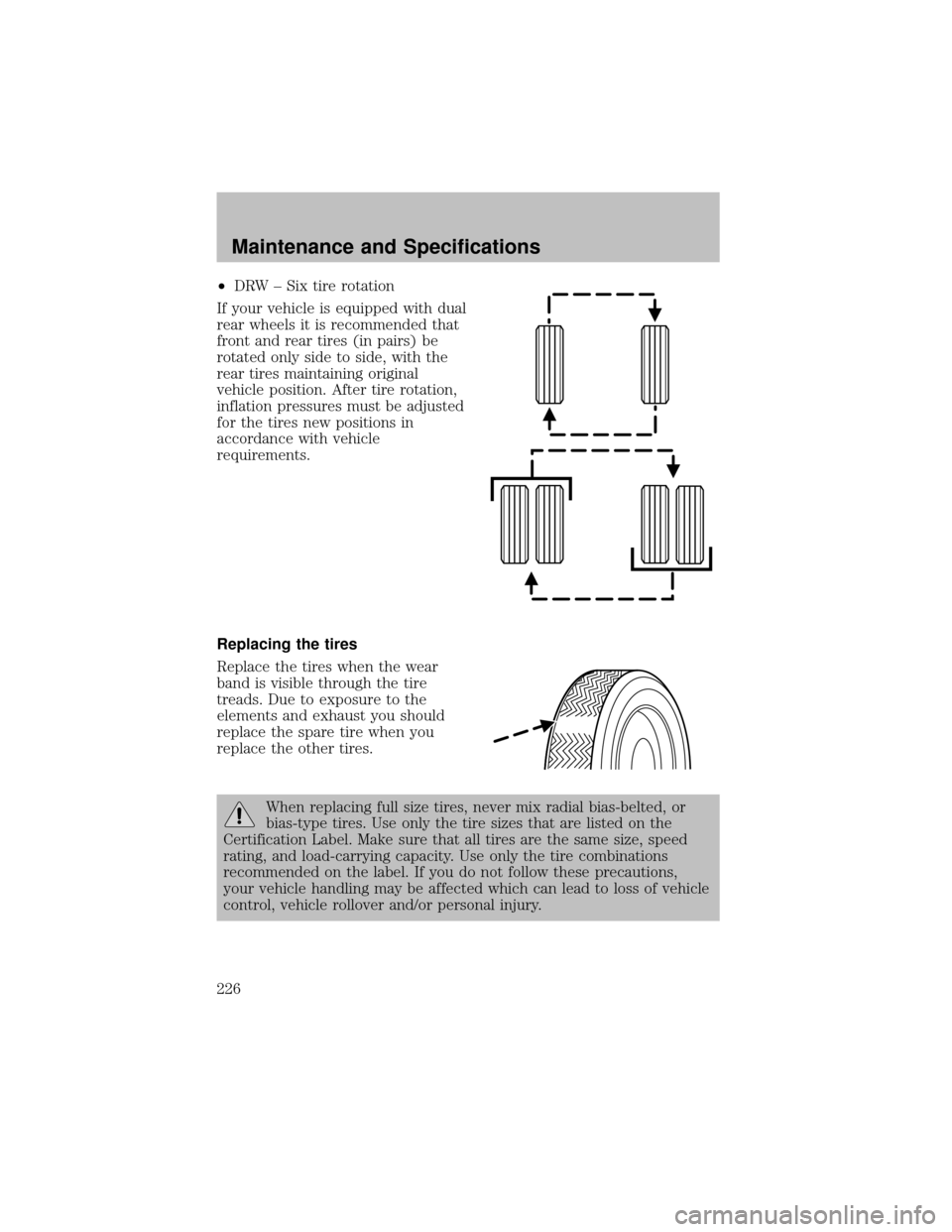
•DRW – Six tire rotation
If your vehicle is equipped with dual
rear wheels it is recommended that
front and rear tires (in pairs) be
rotated onlyside to side, with the
rear tires maintaining original
vehicle position. After tire rotation,
inflation pressures must be adjusted
for the tires new positions in
accordance with vehicle
requirements.
Replacing the tires
Replace the tires when the wear
band is visible through the tire
treads. Due to exposure to the
elements and exhaust you should
replace the spare tire when you
replace the other tires.
When replacing full size tires, never mix radial bias-belted, or
bias-type tires. Use only the tire sizes that are listed on the
Certification Label. Make sure that all tires are the same size, speed
rating, and load-carrying capacity. Use only the tire combinations
recommended on the label. If you do not follow these precautions,
your vehicle handling may be affected which can lead to loss of vehicle
control, vehicle rollover and/or personal injury.
Maintenance and Specifications
226
Page 249 of 256

A
Accessorydelay ..........................47
Air bag supplemental restraint
system ..........................................79
and child safetyseats ..............80
description ................................79
disposal ......................................83
driver air bag ............................81
indicator light ...........................82
operation ...................................81
passenger air bag .....................81
passenger deactivation
switch ........................................83
Air cleaner filter .......220–221, 228
Ambulance packages ....................6
Antifreeze
(see Engine coolant) ................199
Anti-lock brake system
(see Brakes) ......................103–104
Audio system
(see Radio) ................17–18, 21, 25
Automatic transmission ............106
driving an automatic
overdrive .................................107
fluid, adding ............................216
fluid, checking ........................216
fluid, refill capacities ..............228
fluid, specification ..................235
Auxiliarypower point .................46
Axle
lubricant specifications ..232, 235
refill capacities ........................228
traction lok ..............................105
B
Battery.......................................197
acid, treating emergencies .....197jumping a disabled battery....168
maintenance-free ....................197
replacement, specifications ...228
servicing ..................................197
BeltMinder ...................................74
Brakes ........................................102
anti-lock ...........................102–104
anti-lock brake system (ABS)
warning light ...........................103
fluid, checking and adding ....215
fluid, refill capacities ..............228
fluid, specifications .........232, 235
lubricant specifications ..232, 235
parking ....................................104
shift interlock ..........................106
Break-in period .............................5
Bulbs ............................................38
C
Calculating load ........................127
Capacities for refilling fluids ....228
Cassette tape player ...................25
CD changer .................................28
CD-single premium .........17–18, 21
Certification Label ....................243
Child safetyrestraints ................88
child safetybelts ......................88
Child safetyseats ........................90
attaching with tether straps ....94
in front seat ..............................92
in rear seat ................................92
Cleaning your vehicle
engine compartment ..............185
instrument panel ....................187
interior .....................................187
interior trim ............................187
plastic parts ............................186
Index
249
Page 253 of 256

fluid, refill capacity................228
fluid, specifications .........232, 235
Power Windows ...........................47
Preparing to drive your
vehicle ........................................105
R
Radio ..........................17–18, 21, 25
Relays ........................................154
Remote entrysystem .................58
illuminated entry......................60
locking/unlocking doors ...........56
Reverse sensing system ...........111
Roadside assistance ..................152
S
Safetybelts (see Safety
restraints) ........................68–71, 73
Safetydefects, reporting ..........183
Safetyrestraints ....................68–73
belt minder ...............................74
cleaning the safetybelts ..........78
extension assembly..................78
for adults .............................69–71
for children .........................87–88
warning light and chime ..........74
Safetyseats for children ............90
Seat belts (see Safety
restraints) ....................................68
Seats ............................................63
child safetyseats ......................90
cleaning ...................................188
Servicing your vehicle ..............191
Snowplowing .................6, 148–150Spare tire
(see Changing the Tire) ...........159
Spark plugs,
specifications .....................228, 235
Special notice ................................7
ambulance conversions ..............6
diesel-powered vehicles .............6
four-wheel drive vehicles .......151
utility-type vehicles ....................6
Specification chart,
lubricants ...........................232, 235
Speed control ..............................48
Starting your vehicle ....98–99, 101
jump starting ..........................168
Steering wheel
tilting .........................................45
T
Tailgate ........................................55
Tires ...................................221–223
changing ..........................159, 161
checking the pressure ............223
replacing ..................................226
rotating ....................................224
snow tires and chains ............227
tire grades ...............................222
treadwear ................................222
Towing .......................................127
trailer towing ..........................127
wrecker ....................................173
Traction-lok rear axle ...............105
Transfer case
fluid checking .........................220
Transmission
automatic operation ...............106
fluid, checking and adding
(automatic) .............................216
Index
253