engine FORD SUPER DUTY 2005 1.G Diesel Supplement Manual
[x] Cancel search | Manufacturer: FORD, Model Year: 2005, Model line: SUPER DUTY, Model: FORD SUPER DUTY 2005 1.GPages: 72, PDF Size: 0.52 MB
Page 28 of 72
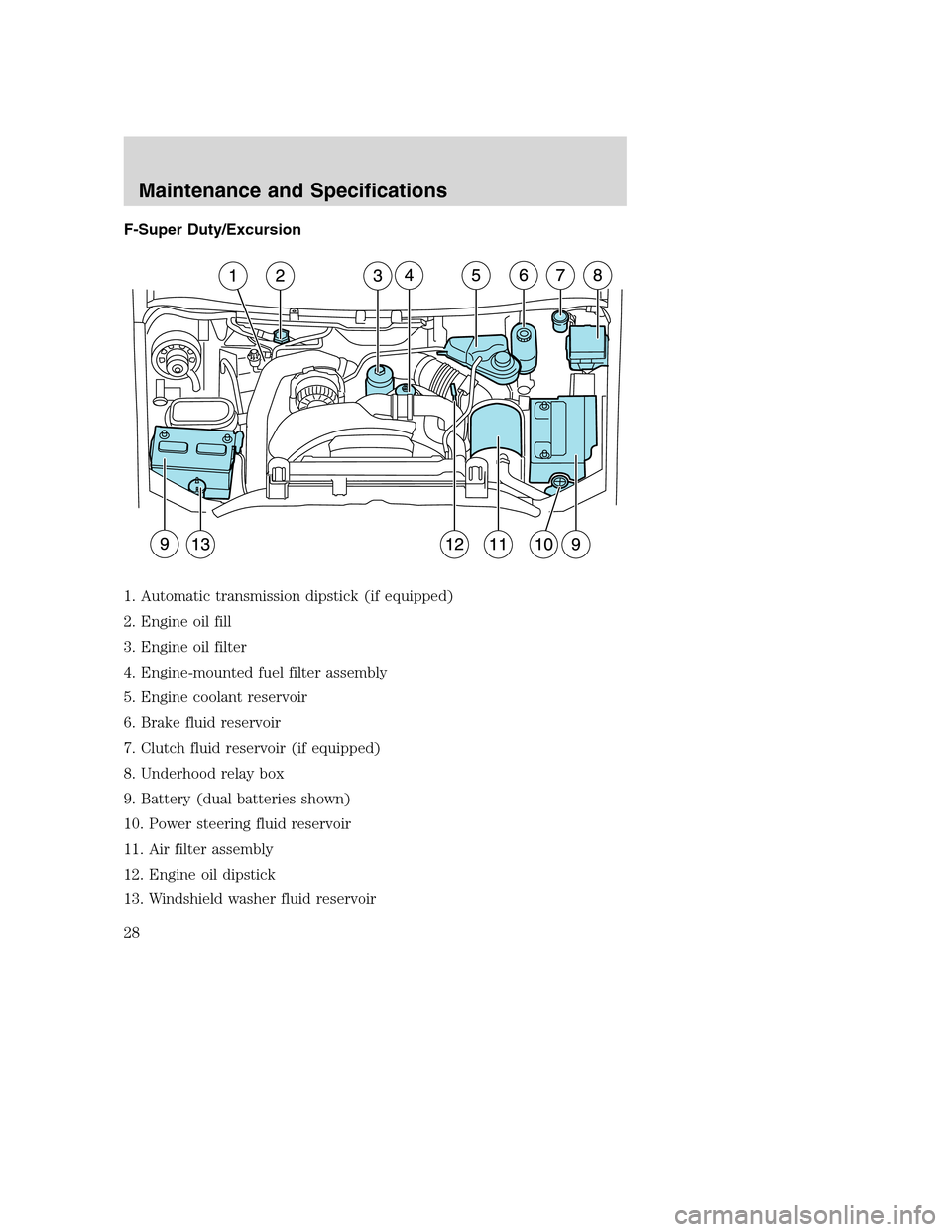
F-Super Duty/Excursion
1. Automatic transmission dipstick (if equipped)
2. Engine oil fill
3. Engine oil filter
4. Engine-mounted fuel filter assembly
5. Engine coolant reservoir
6. Brake fluid reservoir
7. Clutch fluid reservoir (if equipped)
8. Underhood relay box
9. Battery (dual batteries shown)
10. Power steering fluid reservoir
11. Air filter assembly
12. Engine oil dipstick
13. Windshield washer fluid reservoir
Maintenance and Specifications
28
Page 29 of 72
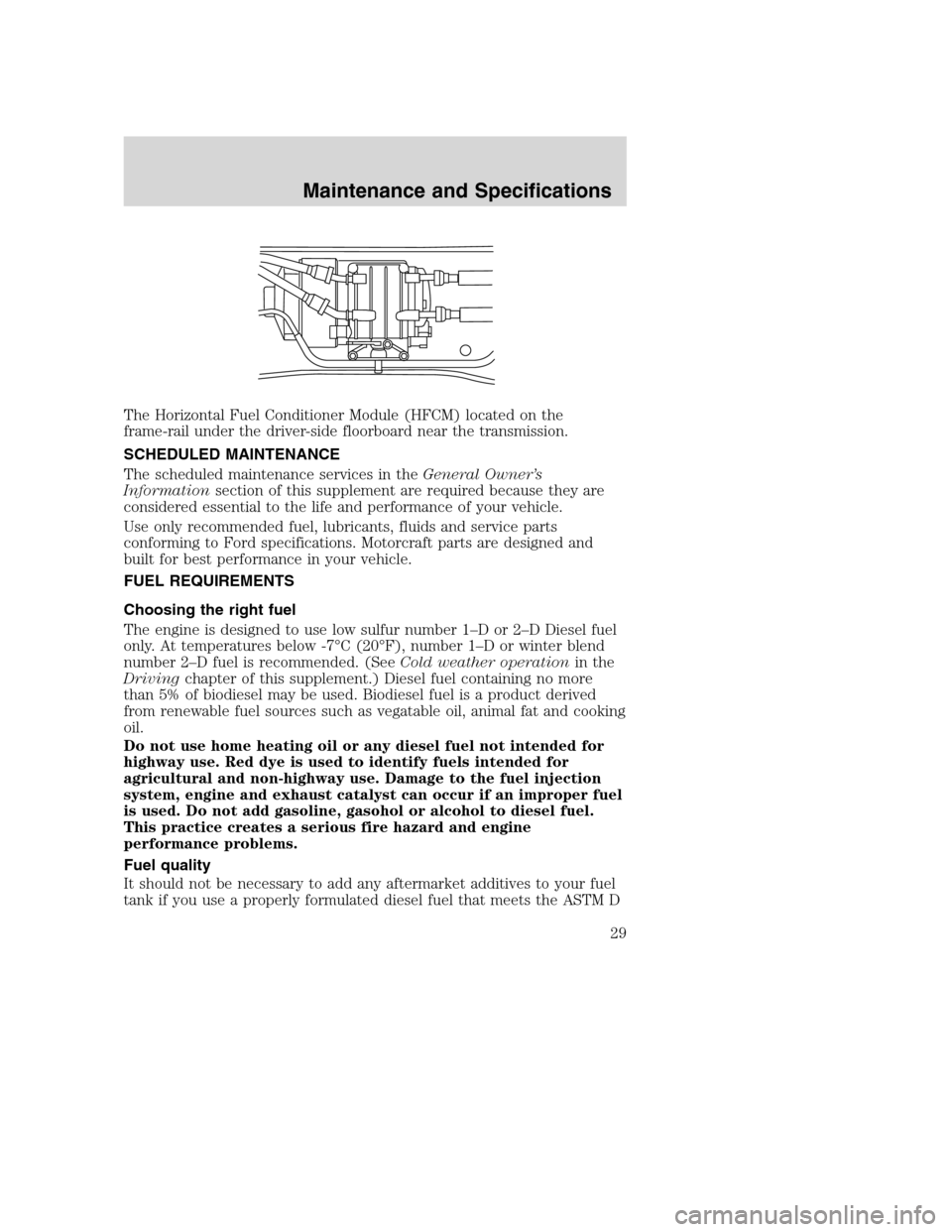
The Horizontal Fuel Conditioner Module (HFCM) located on the
frame-rail under the driver-side floorboard near the transmission.
SCHEDULED MAINTENANCE
The scheduled maintenance services in theGeneral Owner’s
Informationsection of this supplement are required because they are
considered essential to the life and performance of your vehicle.
Use only recommended fuel, lubricants, fluids and service parts
conforming to Ford specifications. Motorcraft parts are designed and
built for best performance in your vehicle.
FUEL REQUIREMENTS
Choosing the right fuel
The engine is designed to use low sulfur number 1–Dor2–D Diesel fuel
only. At temperatures below -7°C (20°F), number 1–D or winter blend
number 2–D fuel is recommended. (SeeCold weather operationin the
Drivingchapter of this supplement.) Diesel fuel containing no more
than 5% of biodiesel may be used. Biodiesel fuel is a product derived
from renewable fuel sources such as vegatable oil, animal fat and cooking
oil.
Do not use home heating oil or any diesel fuel not intended for
highway use. Red dye is used to identify fuels intended for
agricultural and non-highway use. Damage to the fuel injection
system, engine and exhaust catalyst can occur if an improper fuel
is used. Do not add gasoline, gasohol or alcohol to diesel fuel.
This practice creates a serious fire hazard and engine
performance problems.
Fuel quality
It should not be necessary to add any aftermarket additives to your fuel
tank if you use a properly formulated diesel fuel that meets the ASTM D
Maintenance and Specifications
29
Page 30 of 72
975 industry specification. Aftermarket additives can damage the injector
system or engine. Repairs to correct the effects of using an aftermarket
product in your fuel may not be covered by your warranty.
Do not blend used engine oil with diesel fuel under any
circumstances.Blending used oil with the fuel will significantly increase
your vehicle’s exhaust emissions and reduce engine life due to increased
internal wear.
Many of the world’s automakers approved the World-wide Fuel Charter
that recommends diesel fuel specifications to provide improved
performance and emission control system protection for your vehicle.
Diesel fuel that meets the World-wide Fuel Charter should be used when
available. Ask your fuel supplier about fuel that meets the World-wide
Fuel Charter.
Fueling tips
If the engine fails to start in 30 seconds, turn the key to the OFF
position and wait 30 seconds before trying again.
Truck stops have pumps and nozzles designed for larger, heavy-duty
trucks. When refueling at truck stops: if the nozzle shuts off repeatedly
when refueling, wait 5–10 seconds; then use a slower rate of flow (don’t
depress the nozzle trigger as far).
If air is allowed to enter the fuel system (during fuel filter change or if
you run out of fuel) the engine will purge the trapped air as it runs. The
engine may run rough and produce white smoke while air is in the
system. This is normal and should correct itself in a short time.
An engine that suddenly becomes noisy or operates poorly after a fuel fill
could be using substandard fuel (i.e., high water content, low cetane
rating or gasoline in the fuel). Diesel fuel should be purchased from a
reputable station which sells a large amount of diesel fuel.
Care should be taken whenever diesel fuel is stored. Use only clean,
approved containers which will prevent the entry of dirt or water.
Diesel fuel must not be stored in a galvanized container. The fuel will
dissolve the zinc in a galvanized container. The zinc will then remain in
solution until it is run through the engine where it will be deposited in
the fuel injectors causing expensive-to-repair damage.
Diesel fuel dispensing nozzle fill rate
This truck is equipped with a fuel fill pipe which is able to accept fuel up
to 20 gallons per minute from an 1 1/8 inch fuel dispensing nozzle.
Pumping fuel at greater flow rates may result in premature nozzle
shut-off or spitback.
Maintenance and Specifications
30
Page 31 of 72
FUEL CONDITIONER MODULE (FCM - E-SERIES)/HORIZONTAL
FUEL CONDITIONING MODULE (HFCM - F-SUPER
DUTY/EXCURSION) - FUEL FILTER/WATER SEPARATOR
HFCM - F-Super Duty/Excursion
The vehicle is equipped with a Horizontal Fuel Conditioning Module
(HFCM) located on the frame-rail under the driver-side floorboard near
the transmission.
Water should be drained from the
module assembly whenever the
warning light comes on. The WATER
IN FUEL light will come on when
approximately 100 cc (0.2 pints) of water accumulates in the module.
Replace the fuel filters with Ford Part No. FD–4604. This part number
includes filters and seals for both the engine-mounted and
frame-mounted filters.
FCM - E-Series
The vehicle is equipped with a Fuel Conditioning Module (FCM) located
on the driver-side of the vehicle next to the transmission case.
Water should be drained from the
module assembly whenever the
warning light comes on. The WATER
IN FUEL light will come on when
approximately 100 cc (0.2 pints) of water accumulates in the module.
Replace the fuel filters with Ford Part No. FD–4604. This part number
includes filters and seals for both the engine-mounted filter and the FCM
filter.
DRAINING THE FCM/HFCM AND CHANGING THE FUEL FILTERS
Your vehicle is equipped with two fuel filters; one is mounted on top of
the engine.On F-Super Duty and Excursion vehicles,the second
filter, inside the HFCM, is mounted inside the frame rail under the
driver-side floorboard near the transmission.On E-Series vehicles,the
second filter, inside the FCM, is mounted on the driver-side of the
vehicle next to the transmission case.On all vehicles,both filters
should be replaced at the same time. The Motorcraft part number for the
replacement filters is FD-4604.
Maintenance and Specifications
31
Page 32 of 72
FCM/HFCM drain procedure
1. Stop the vehicle andshut offthe engine.
The vehicle must be stopped with the engine off when draining
the HFCM/FCM. Fuel may ignite if the separator is drained while
the engine is running or vehicle is moving.
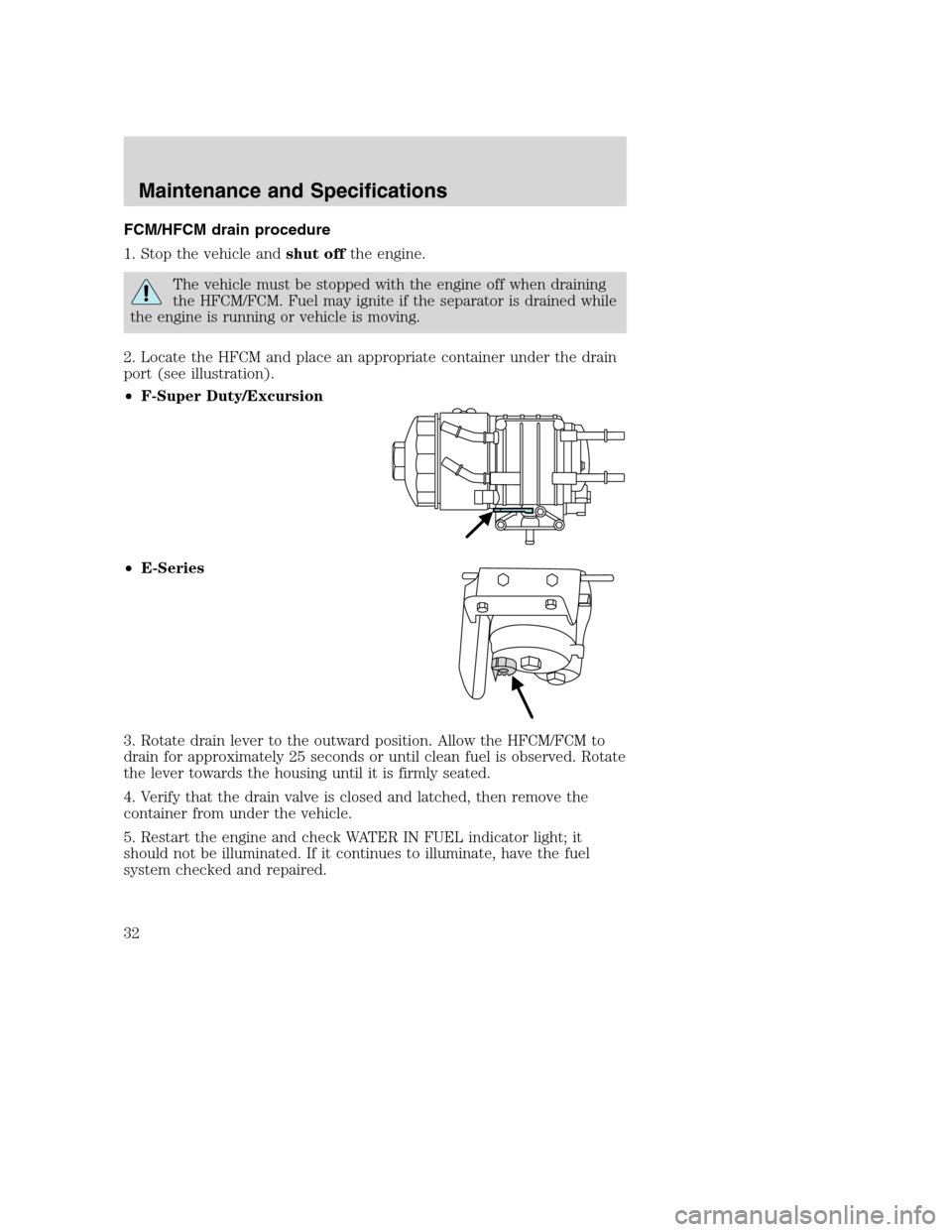
2. Locate the HFCM and place an appropriate container under the drain
port (see illustration).
•F-Super Duty/Excursion
•E-Series
3. Rotate drain lever to the outward position. Allow the HFCM/FCM to
drain for approximately 25 seconds or until clean fuel is observed. Rotate
the lever towards the housing until it is firmly seated.
4. Verify that the drain valve is closed and latched, then remove the
container from under the vehicle.
5. Restart the engine and check WATER IN FUEL indicator light; it
should not be illuminated. If it continues to illuminate, have the fuel
system checked and repaired.
Maintenance and Specifications
32
Page 34 of 72
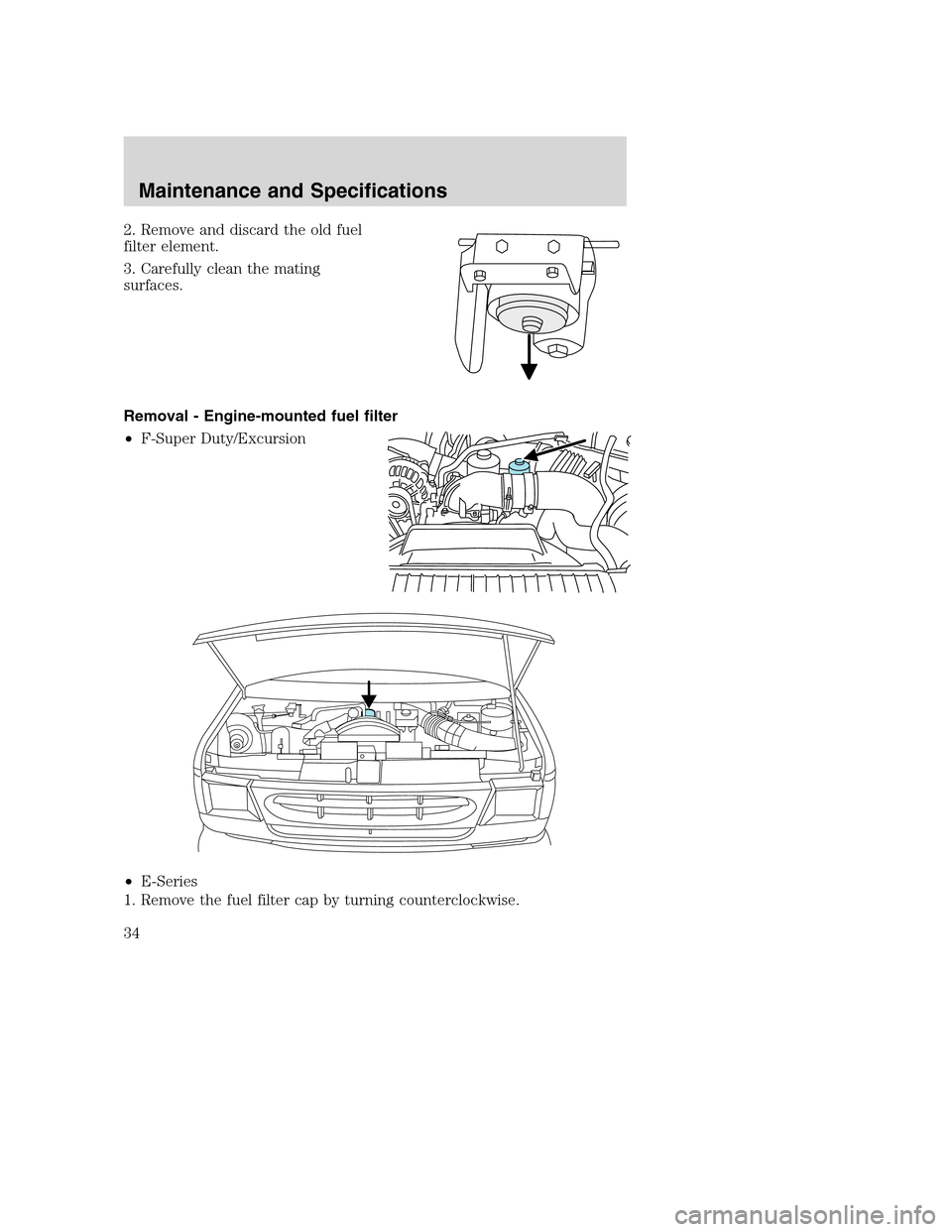
2. Remove and discard the old fuel
filter element.
3. Carefully clean the mating
surfaces.
Removal - Engine-mounted fuel filter
•F-Super Duty/Excursion
•E-Series
1. Remove the fuel filter cap by turning counterclockwise.
Maintenance and Specifications
34
Page 35 of 72
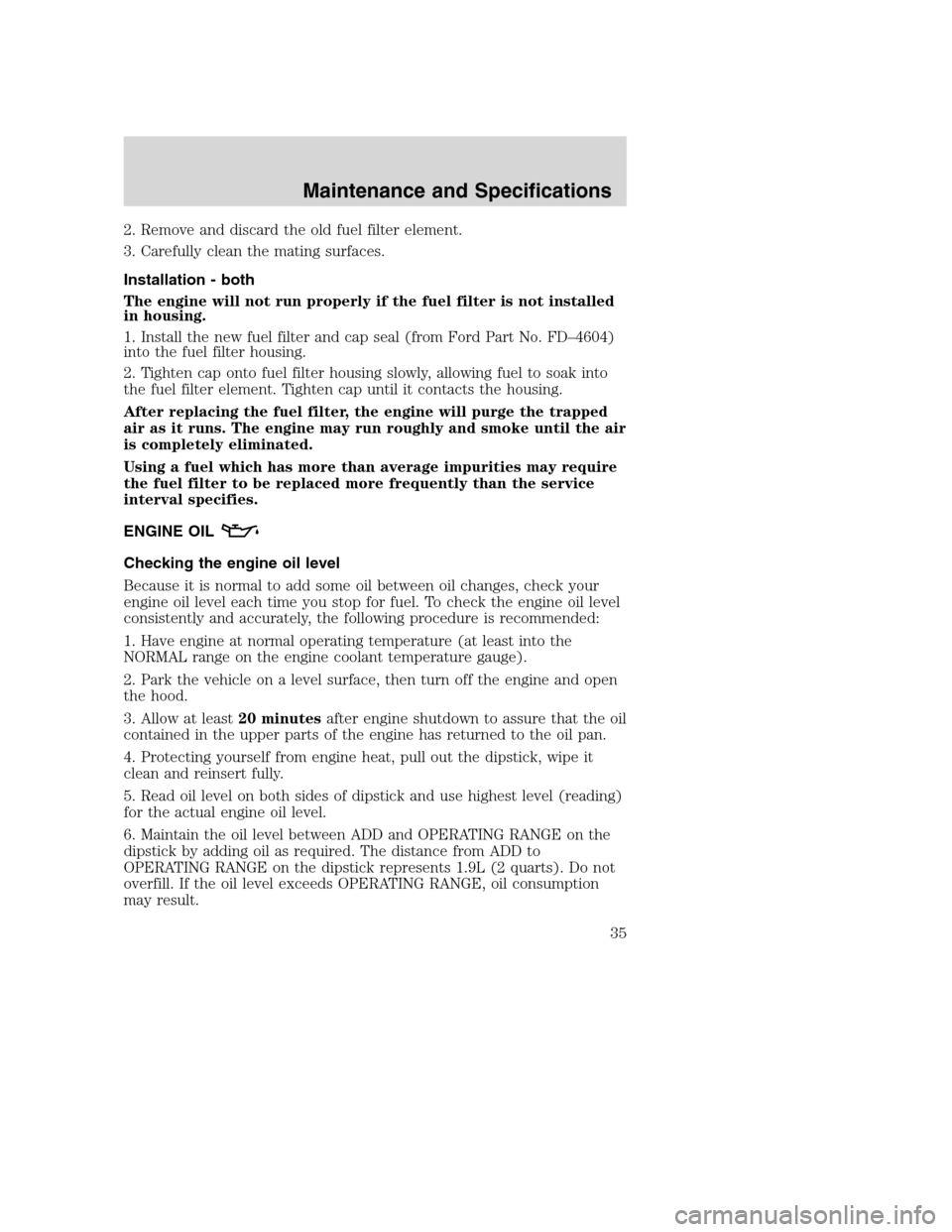
2. Remove and discard the old fuel filter element.
3. Carefully clean the mating surfaces.
Installation - both
The engine will not run properly if the fuel filter is not installed
in housing.
1. Install the new fuel filter and cap seal (from Ford Part No. FD–4604)
into the fuel filter housing.
2. Tighten cap onto fuel filter housing slowly, allowing fuel to soak into
the fuel filter element. Tighten cap until it contacts the housing.
After replacing the fuel filter, the engine will purge the trapped
air as it runs. The engine may run roughly and smoke until the air
is completely eliminated.
Using a fuel which has more than average impurities may require
the fuel filter to be replaced more frequently than the service
interval specifies.
ENGINE OIL
Checking the engine oil level
Because it is normal to add some oil between oil changes, check your
engine oil level each time you stop for fuel. To check the engine oil level
consistently and accurately, the following procedure is recommended:
1. Have engine at normal operating temperature (at least into the
NORMAL range on the engine coolant temperature gauge).
2. Park the vehicle on a level surface, then turn off the engine and open
the hood.
3. Allow at least20 minutesafter engine shutdown to assure that the oil
contained in the upper parts of the engine has returned to the oil pan.
4. Protecting yourself from engine heat, pull out the dipstick, wipe it
clean and reinsert fully.
5. Read oil level on both sides of dipstick and use highest level (reading)
for the actual engine oil level.
6. Maintain the oil level between ADD and OPERATING RANGE on the
dipstick by adding oil as required. The distance from ADD to
OPERATING RANGE on the dipstick represents 1.9L (2 quarts). Do not
overfill. If the oil level exceeds OPERATING RANGE, oil consumption
may result.
Maintenance and Specifications
35
Page 36 of 72
Engine oil specifications
To help achieve proper engine performance and durability, it is important
that only engine lubricating oils of the proper quality are used in your
diesel engine and that the engine oil is changedno laterthan the
recommended interval. Diesel engines require specially formulated oil to
resist contamination. Proper quality oils also provide maximum efficiency
of the crankcase ventilating system which reduces air pollution.
For normal or severe service, use Motorcraft oil or an equivalent oil
conforming to Ford Specification WSS-M2C171–D or API Service
categories CI-4, CI-4/SL or DHD-1. If CI-4 oil is not available, CH-4 is
acceptable..
Engine oils with improved fuel economy properties (energy conserving)
are currently available. If you use an energy conserving oil, be sure it
meets the recommended Ford Specification,APIservice categories and
SAE viscosity grades listed in the Lubricant and Maintenance Materials
Specifications chart. Some energy conserving oilsdo notmeet the
requirements necessary for your diesel engine.
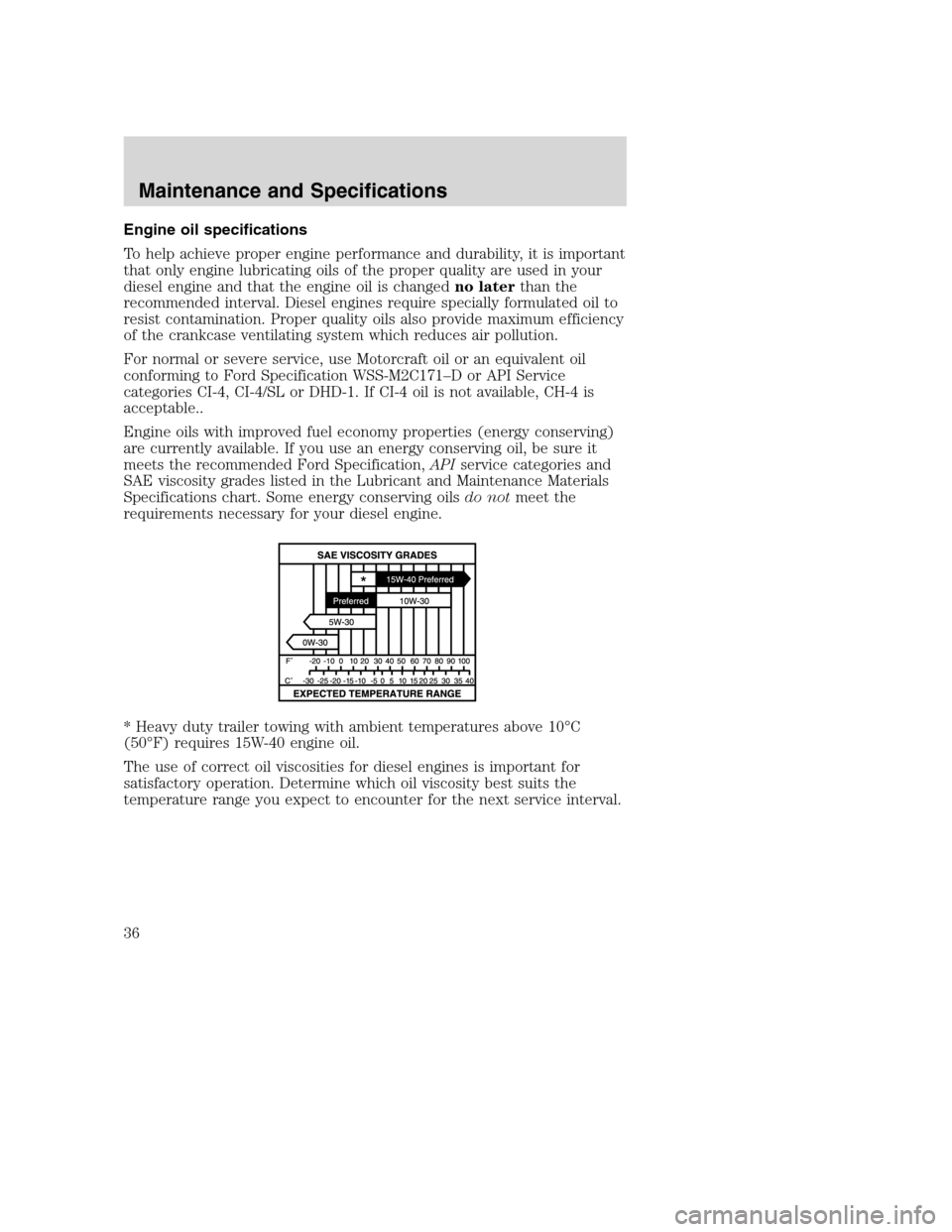
* Heavy duty trailer towing with ambient temperatures above 10°C
(50°F) requires 15W-40 engine oil.
The use of correct oil viscosities for diesel engines is important for
satisfactory operation. Determine which oil viscosity best suits the
temperature range you expect to encounter for the next service interval.
Maintenance and Specifications
36
Page 37 of 72
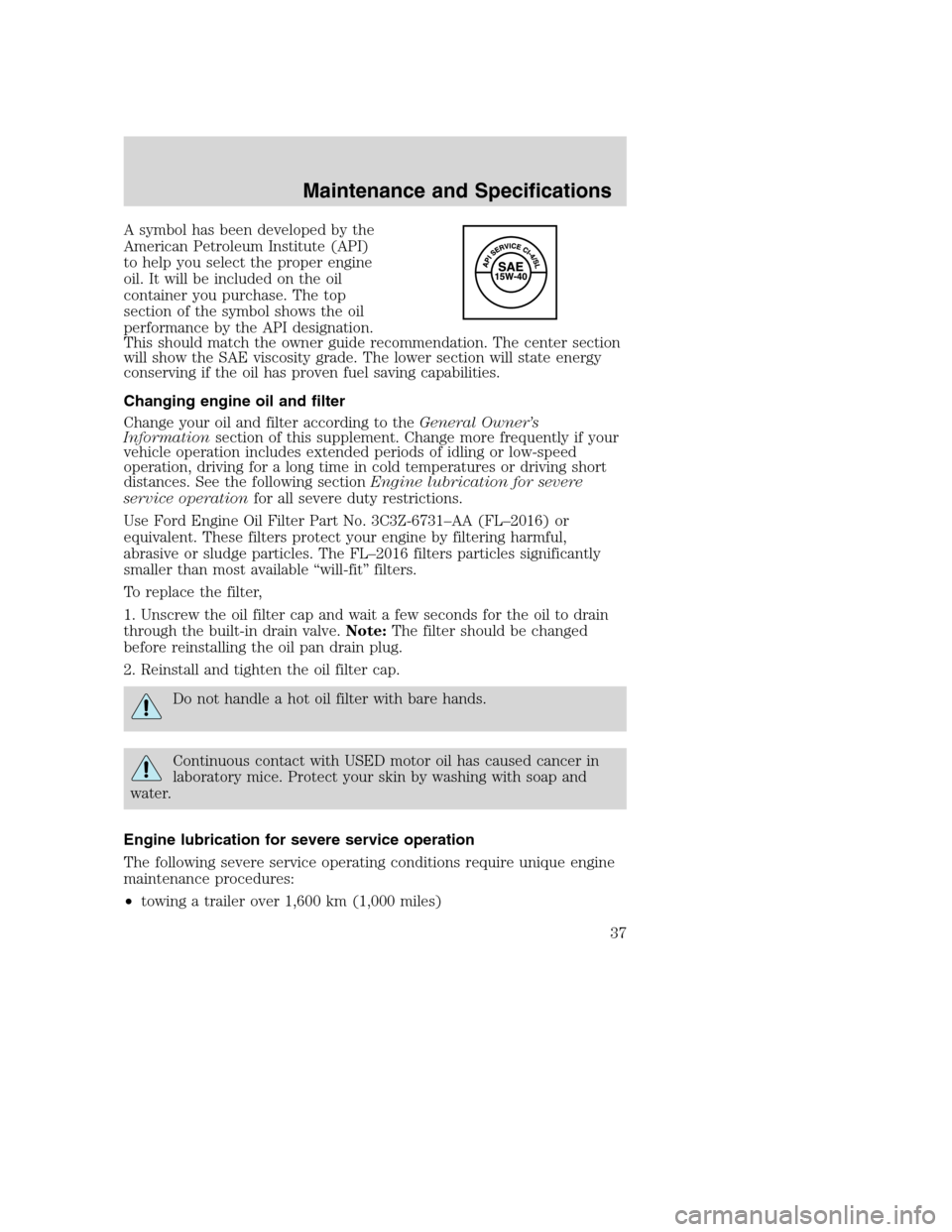
A symbol has been developed by the
American Petroleum Institute (API)
to help you select the proper engine
oil. It will be included on the oil
container you purchase. The top
section of the symbol shows the oil
performance by the API designation.
This should match the owner guide recommendation. The center section
will show the SAE viscosity grade. The lower section will state energy
conserving if the oil has proven fuel saving capabilities.
Changing engine oil and filter
Change your oil and filter according to theGeneral Owner’s
Informationsection of this supplement. Change more frequently if your
vehicle operation includes extended periods of idling or low-speed
operation, driving for a long time in cold temperatures or driving short
distances. See the following sectionEngine lubrication for severe
service operationfor all severe duty restrictions.
Use Ford Engine Oil Filter Part No. 3C3Z-6731–AA (FL–2016) or
equivalent. These filters protect your engine by filtering harmful,
abrasive or sludge particles. The FL–2016 filters particles significantly
smaller than most available“will-fit”filters.
To replace the filter,
1. Unscrew the oil filter cap and wait a few seconds for the oil to drain
through the built-in drain valve.Note:The filter should be changed
before reinstalling the oil pan drain plug.
2. Reinstall and tighten the oil filter cap.
Do not handle a hot oil filter with bare hands.
Continuous contact with USED motor oil has caused cancer in
laboratory mice. Protect your skin by washing with soap and
water.
Engine lubrication for severe service operation
The following severe service operating conditions require unique engine
maintenance procedures:
•towing a trailer over 1,600 km (1,000 miles)
Maintenance and Specifications
37
Page 38 of 72
![FORD SUPER DUTY 2005 1.G Diesel Supplement Manual •sustained, high speed driving at Gross Vehicle Weight Rating
(maximum loaded weight for vehicle operation during hot
weather-above 32°C [90°F]).
•frequent or extended idling (over 10 minutes pe](/img/11/5263/w960_5263-37.png "FORD SUPER DUTY 2005 1.G Diesel Supplement Manual •sustained, high speed driving at Gross Vehicle Weight Rating
(maximum loaded weight for vehicle operation during hot
weather-above 32°C [90°F]).
•frequent or extended idling (over 10 minutes pe")
•sustained, high speed driving at Gross Vehicle Weight Rating
(maximum loaded weight for vehicle operation during hot
weather-above 32°C [90°F]).
•frequent or extended idling (over 10 minutes per hour of normal
driving).
•operating in severe dust conditions.
•frequent, short trips of 16 km (10 miles) or less during freezing
weather
If you are operating your vehicle under any of these conditions, observe
the following service procedures:
•Change engine oil and filter every 8,000 km (5,000 miles).
•Use Motorcraft oil or an equivalent oil conforming to Ford
Specification WSS-M2C171–D or API categories CI-4, CI–4/SL or
DHD-1. If CI-4 oil is not available, CH-4 is acceptable.
For more information refer theGeneral Owner’s Informationsection of
this supplement.
REPLACING THE AIR FILTER ELEMENT
When replacing the air filter element, use the Motorcraft air filter element
listed. Refer to theMotorcraft part numberschart in this section.
Note: Do not start your engine with the air cleaner removed and do not
remove it while the engine is running.
Failure to use the correct air filter element may result in severe
engine damage.
•E-series air filter element:
1. Disconnect the hoses from the air cleaner outlet tube.
2. Loosen the clamp and disconnect
the air cleaner outlet tube.
Maintenance and Specifications
38